
the Creative Commons Attribution 4.0 License.
the Creative Commons Attribution 4.0 License.
 | 13 Apr 2026
Post-Disturbance Soil Monitoring in Forests using Remote Sensing: An Evidence Map
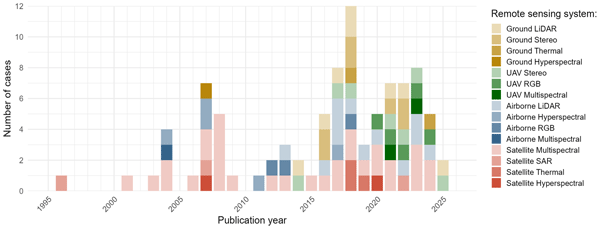
Abstract. Forest soils underpin ecosystem resilience and productivity but are increasingly threatened by natural and anthropogenic disturbances. Monitoring post‑disturbance soil degradation at operational scales remains challenging in forests, where ground‑signal obstruction and reliance on proxy indicators constrain remote sensing (RS) applications. To identify where RS can benefit soil monitoring and support emerging reporting needs, we developed a structured evidence map of studies assessing post‑disturbance forest soil degradation using RS methods. From 4,338 records, 72 primary studies were synthesized across disturbance types, biomes, platforms, scales, and indicators. The evidence base is dominated by wildfire and harvesting, reflecting disturbance pathways that produce observable surface impacts. Multispectral satellite data remain the primary tool for mapping post‑fire severity and erosion‑related indicators, while LiDAR and stereo‑photogrammetry are most often used to quantify surface deformation after harvest operations. Indicators tied to subsurface physical, chemical, or biological change remain sparsely represented due to observability limits. Overall, RS is most effective for mapping disturbance footprints, detecting surface‑expressed indicators, and stratifying landscapes for targeted field assessment, rather than directly measuring soil properties. This evidence map clarifies the benefits and limits of RS, identifies persistent gaps, and highlights priorities for developing disturbance‑aware soil‑monitoring frameworks. It also specifies which soil indicators are defensibly observable with RS and which require complementary approaches. By linking disturbance processes to observable indicators, this synthesis helps define realistic RS‑supported objectives for reporting frameworks within national forest monitoring and assessment programs.
-
Notice on discussion status
The requested preprint has a corresponding peer-reviewed final revised paper. You are encouraged to refer to the final revised version.
-
Preprint
(2021 KB)
-
The requested preprint has a corresponding peer-reviewed final revised paper. You are encouraged to refer to the final revised version.
- Preprint
(2021 KB) - Metadata XML
- BibTeX
- EndNote
- Final revised paper


Journal article(s) based on this preprint
Interactive discussion
Status: closed
-
RC1: 'Comment on egusphere-2026-1722', Mark Kimsey, 09 Jun 2026
-
AC1: 'Reply on RC1', Maisy Roach-Krajewski, 25 Jun 2026
We thank the reviewer for the very positive assessment of our manuscript and for highlighting the value of synthesizing the challenges and opportunities surrounding post-disturbance forest soil monitoring using remote sensing into a single evidence map. We also appreciate the reviewer’s encouraging remarks regarding the concluding discussion on disturbance prevention and the future roles of AI and emerging sensing technologies.
We have corrected the minor editorial issue identified by the reviewer (the extra space before the period in the original submission).Citation: https://doi.org/10.5194/egusphere-2026-1722-AC1 -
AC2: 'Reply on RC2', Maisy Roach-Krajewski, 25 Jun 2026
Clarify overlap with Latterini et al. (2025) and distinction from prior reviews.
We thank the reviewer for highlighting Latterini et al. (2025). This review was published after our original literature search and screening period (25–26 February 2025) and therefore could not have been included in the formal evidence-map dataset defined in our Methods. We have nevertheless incorporated it as a narrative citation in the revised manuscript to clarify the distinction between that harvesting/operations-focused synthesis and our broader cross-disturbance evidence map of post-disturbance forest soil monitoring. Specifically, we now cite Latterini et al. (2025) in the Introduction when situating our study relative to prior syntheses, and in selected Discussion sections where overlap is most direct (harvesting-related structural sensing, scale trade-offs, and future AI/data-fusion directions) (additions highlighted in yellow; pages 5, 23, 37, 44).
We also revised the Discussion to reduce direct overlap with the operational forestry scope of Latterini et al. (2025) by removing the former discussion subsection that overlapped most directly with forest-operations planning and decision-support applications. As revised, our manuscript is now framed more explicitly around a cross-disturbance evidence map of post-disturbance forest soil degradation, organized using a disturbance–threat–indicator framework, rather than as a review of remote sensing for harvesting operations per se.
Distinguish disturbance indicators, surface proxies, and direct soil degradation metrics.
We thank the reviewer for emphasizing the need to distinguish disturbance indicators, surface-condition proxies, and direct soil degradation metrics. This distinction was already embedded in our manuscript’s disturbance–threat–indicator framing, including the classification of observability as direct, proxy-based, or limited, the observability matrix in Table 1, and the discussion of threat–indicator mismatch for wildfire and harvesting in Section 4.2. These sections already distinguish between (for example) directly observable surface deformation, proxy-observable indicators such as rut geometry or roughness, and field-dependent subsurface metrics such as bulk density, porosity, and hydraulic conductivity.
However, we agree that this logic needed to be reflected more consistently throughout the manuscript. We therefore revised the Abstract, Introduction, and Conclusion to moderate stronger wording and better align with the observability framework already developed in the Discussion (changes/additions highlighted in pink; pages 2, 5-6, 24, 45-46). We also added an explicit methodological limitation at the end of Methods 2.4 (highlighted in green; p. 9), clarifying that this structured evidence map characterizes evidence availability and observability patterns, but does not include a formal critical appraisal of study quality, validation strength, uncertainty, or transferability across regions and forest types.
Claims regarding operational readiness / reporting robustness are too strong for an evidence map.
We agree that some wording in the previous version could be interpreted as stronger than warranted for an evidence map. In response, we added a methodological limitation statement to Section 2.4 (highlighted in green; p. 9), explicitly stating that the synthesis was designed to characterize the scope, distribution, and methodological patterns of the literature, and that it should not be interpreted as a ranked assessment of operational readiness or reporting robustness. We also moderated language in the Abstract, Introduction, and Conclusion so that the manuscript now refers more cautiously to indicators that show the clearest observability pathways and strongest evidence base, rather than implying a formal determination of what is most “defensible” or “reporting-ready” (changes/additions highlighted in pink; pages 2, 5-6, 24, 45-46).
These revisions preserve the manuscript’s relevance to emerging reporting needs while making clearer that the contribution of this evidence map is to identify where remote sensing is most consistently informative, where it remains proxy-based, and where field validation remains essential.
Review suggested studies that were missed from the evidence base.
We thank the reviewer for identifying additional studies that they considered potentially relevant to the evidence base. In response, we screened the reviewer-suggested papers against the eligibility criteria used in the original evidence-map workflow. This screening showed that the suggested studies fell into several distinct categories. One study (Affek et al., 2017) was already included in the formal evidence base. To improve transparency and help avoid confusion between studies cited in the main manuscript text and those included in the mapped evidence base, we added an explicit statement in Section 3.1.1 (highlighted in blue; p. 10) indicating that a complete list of studies included in the final evidence base is provided in the Appendix (Table A3; pages 53-61). Three studies (Abdi et al., 2022; Wedeux et al., 2020; Mikita et al., 2022) did not meet the eligibility criteria because, although they used remote sensing in forest-related contexts, they did not establish the required direct or indirect link between RS products and soil degradation indicators, or were focused on road/trail/biomass-related outcomes rather than post-disturbance soil degradation itself. Two studies (Osei Forkuo et al., 2025; Latterini et al., 2025b) appeared relevant but fell outside the practical capture of the original formal search workflow, which was conducted on the 25th and 26th February, 2025. Finally, three studies (Starke et al., 2020; Forkuo and Borz, 2023; Lovrinčević et al., 2024) appeared potentially eligible but were not retrieved by the original documented search process.
Because this manuscript reports a structured evidence map, we chose not to retroactively insert studies through an undocumented post hoc pathway. The evidence base is defined by the documented search strategy, screening workflow, and snowball-search process described in the Methods, and reproducibility depends on maintaining a transparent and traceable chain of study inclusion. If the same documented workflow were repeated, it should yield the same evidence map; therefore, adding newly identified studies outside that workflow would not constitute a simple correction to the existing map, but rather a deviation from the original reproducible process. “These suggested studies, although some appeared potentially eligible, were identified outside that documented workflow, and as such we considered it more rigorous to report them transparently in the response rather than to incorporate them ad hoc into the formal evidence base for this revision.
Citation: https://doi.org/10.5194/egusphere-2026-1722-AC2
-
AC1: 'Reply on RC1', Maisy Roach-Krajewski, 25 Jun 2026
-
RC2: 'Comment on egusphere-2026-1722', Anonymous Referee #2, 09 Jun 2026
The manuscript deals with an interesting topic and it is in line with the scope of the Journal. A strong point is the disturbance–threat–indicator framing, especially the distinction between indicators that are directly observable, proxy-observable, or essentially dependent on field validation. This is a valuable message, and it is well aligned with the practical reality that remote sensing can map disturbance footprints and surface expressions much better than it can directly quantify subsurface soil change.
A point which needs to be addressed is a partial but substantial overlapping with another recent review: Latterini F., Camarretta N., Watt M.S. Remote sensing for planning harvesting operations and monitoring their effects on the forest ecosystem: State of the art and future perspectives. Forest Ecology and Management 2025, 597, 123175. https://doi.org/10.1016/j.foreco.2025.123175. The submitted manuscript has a broader disturbance scope, including wildfire, harvesting, insect outbreak, windthrow, mining, and off-road vehicles, but the harvesting subsection overlaps strongly. Here the major overlapping areas:
- Both papers identify LiDAR and UAV/SfM photogrammetry as key tools for detecting skid trails, rutting, soil displacement, and surface deformation. The submitted manuscript states that harvesting studies rely mainly on LiDAR and photogrammetry for rut geometry and surface disturbance reconstruction. This is very close to Latterini et al. discussion of LiDAR-based monitoring of canopy and soil disruption after forest operations
- Both works converge on the same broad conclusion: satellite data are better suited to broad-scale disturbance screening and canopy disturbance, while LiDAR is more suitable for fine-scale structural impacts, including soil disturbance. The two manuscripts have pretty similar conclusions that broad-scale satellite observations support screening, while site-scale diagnostics require high-resolution acquisitions.
- Both papers emphasize that RS is powerful for mapping visible disturbance but limited for direct measurement of subsurface soil change. The submitted manuscript is very explicit that bulk density, porosity, and hydraulic conductivity cannot be retrieved remotely and require in situ testing. This overlaps with the attached review’s broader framing that monitoring forest-operation impacts requires integrating RS with field validation and operational knowledge
- Both papers discuss AI and data fusion as future directions.
- The submitted manuscript frames RS-supported soil monitoring in relation to reporting frameworks and operational monitoring. The work by Latterini et al. goes further on practical adoption, emphasizing user-friendly software, training, and practitioner-oriented tools. This is an area where the submitted manuscript could be improved by citing recent operational forestry RS literature and by expanding the discussion of barriers to implementation.
- sub-section 4.5.2 is strongly overlapping with the review by Latterini et al., which morevoer went much deeper under this point. Not being this the main focus of the review, I even suggest to remove the entire sub-section
- Also looking at the database of Latterini et al., several papers seem to be missing (list could not be complete - please verify):
Abdi, O., Uusitalo, J., Kivinen, V.P., 2022. Logging trail segmentation via a novel U-Net convolutional neural network and High-Density laser scanning data. Remote Sens. 14. https://doi.org/10.3390/rs14020349
Affek, A.N., Zachwatowicz, M., Sosnowska, A., Gerl´ee, A., Kiszka, K., 2017. Impacts of modern mechanised skidding on the natural and cultural heritage of the polish carpathian mountains. Ecol. Manag. 405, 391–403. https://doi.org/10.1016/j. foreco.2017.09.047.
Osei Forkuo, G., Borz, S.A., Proto, A.R., 2025. Detecting severity and extent of soil disturbance in forest operations using mobile LiDAR technology. Croat. J. For. Eng. 46, 329–345. https://doi.org/10.5552/crojfe.2025.3246
Latterini, F., Dyderski, M.K., Picchio, R., Venanzi, R., Spinelli, R., Magagnotti, N., Schweier, J., Kushwaha, S.K.P., Camarretta, N., Watt, M.S., 2025b. Mapping skid trails and evaluating soil disturbance from UAV-Based LiDAR surveys in Mediterranean forests. Land Degrad. Dev. https://doi.org/10.1002/ldr.70162.
Wedeux, B., Dalponte, M., Schlund, M., Hagen, S., Cochrane, M., Graham, L., Usup, A., Thomas, A., Coomes, D., 2020. Dynamics of a human-modified tropical peat swamp forest revealed by repeat lidar surveys. Glob. Chang Biol. 26, 3947–3964. https:// doi.org/10.1111/gcb.15108.
Starke, M., Derron, C., Heubaum, F., Ziesak, M., 2020. Rut depth evaluation of a triple- bogie system for forwarders—field trials with TLS data support. Sustainability 12, 6412. https://doi.org/10.3390/su12166412
Mikita, T., Krauskov´a, D., Hrůza, P., Cibulka, M., Patoˇcka, Z., 2022. Forest road wearing course damage assessment possibilities with different types of laser scanning methods including new iphone LiDAR scanning apps. Forests 13. https://doi.org/ 10.3390/f13111763.
Forkuo, G.O., Borz, S.A., 2023. Accuracy and inter-cloud precision of low-cost mobile LiDAR technology in estimating soil disturbance in forest operations. Front. For. Glob. Change 6. https://doi.org/10.3389/ffgc.2023.1224575.
Lovrinˇcevi´c, M., Papa, I., Popovi´c, M., Janeˇs, D., Porˇsinsky, T., Pentek, T., Đuka, A., 2024. Methods of rut depth measurements on forwarder trails in lowland forest. Forests 15. https://doi.org/10.3390/f15061021.
Authors should therefore better clarify the differences with Latterini et al. in the Introduction section.
A further importanc concern is that the manuscript sometimes moves beyond evidence mapping and makes relatively strong claims about operational defensibility and national reporting without a sufficiently explicit assessment of study quality, validation strength, uncertainty, or transferability. The authors should clarify the difference between evidence availability and evidence robustness. If no formal quality appraisal was conducted, conclusions about operational reporting should be moderated.
The paper would benefit from a stricter distinction between disturbance indicators, surface-condition proxies, and actual soil degradation. This is particularly important for wildfire studies, where spectral indices such as NBR, dNBR, NDVI, char/ash cover, or vegetation loss may indicate burn severity or surface change but do not necessarily represent soil degradation directly. Similarly, for harvesting, the manuscript should more clearly separate machine-traffic detection, rut/deformation mapping, inferred compaction, and measured soil physical degradation. A visible skid trail or rut is not equivalent to bulk density, porosity, hydraulic conductivity, or biological degradation.
Citation: https://doi.org/10.5194/egusphere-2026-1722-RC2 -
AC2: 'Reply on RC2', Maisy Roach-Krajewski, 25 Jun 2026
Clarify overlap with Latterini et al. (2025) and distinction from prior reviews.
We thank the reviewer for highlighting Latterini et al. (2025). This review was published after our original literature search and screening period (25–26 February 2025) and therefore could not have been included in the formal evidence-map dataset defined in our Methods. We have nevertheless incorporated it as a narrative citation in the revised manuscript to clarify the distinction between that harvesting/operations-focused synthesis and our broader cross-disturbance evidence map of post-disturbance forest soil monitoring. Specifically, we now cite Latterini et al. (2025) in the Introduction when situating our study relative to prior syntheses, and in selected Discussion sections where overlap is most direct (harvesting-related structural sensing, scale trade-offs, and future AI/data-fusion directions) (additions highlighted in yellow; pages 5, 23, 37, 44).
We also revised the Discussion to reduce direct overlap with the operational forestry scope of Latterini et al. (2025) by removing the former discussion subsection that overlapped most directly with forest-operations planning and decision-support applications. As revised, our manuscript is now framed more explicitly around a cross-disturbance evidence map of post-disturbance forest soil degradation, organized using a disturbance–threat–indicator framework, rather than as a review of remote sensing for harvesting operations per se.
Distinguish disturbance indicators, surface proxies, and direct soil degradation metrics.
We thank the reviewer for emphasizing the need to distinguish disturbance indicators, surface-condition proxies, and direct soil degradation metrics. This distinction was already embedded in our manuscript’s disturbance–threat–indicator framing, including the classification of observability as direct, proxy-based, or limited, the observability matrix in Table 1, and the discussion of threat–indicator mismatch for wildfire and harvesting in Section 4.2. These sections already distinguish between (for example) directly observable surface deformation, proxy-observable indicators such as rut geometry or roughness, and field-dependent subsurface metrics such as bulk density, porosity, and hydraulic conductivity.
However, we agree that this logic needed to be reflected more consistently throughout the manuscript. We therefore revised the Abstract, Introduction, and Conclusion to moderate stronger wording and better align with the observability framework already developed in the Discussion (changes/additions highlighted in pink; pages 2, 5-6, 24, 45-46). We also added an explicit methodological limitation at the end of Methods 2.4 (highlighted in green; p. 9), clarifying that this structured evidence map characterizes evidence availability and observability patterns, but does not include a formal critical appraisal of study quality, validation strength, uncertainty, or transferability across regions and forest types.
Claims regarding operational readiness / reporting robustness are too strong for an evidence map.
We agree that some wording in the previous version could be interpreted as stronger than warranted for an evidence map. In response, we added a methodological limitation statement to Section 2.4 (highlighted in green; p. 9), explicitly stating that the synthesis was designed to characterize the scope, distribution, and methodological patterns of the literature, and that it should not be interpreted as a ranked assessment of operational readiness or reporting robustness. We also moderated language in the Abstract, Introduction, and Conclusion so that the manuscript now refers more cautiously to indicators that show the clearest observability pathways and strongest evidence base, rather than implying a formal determination of what is most “defensible” or “reporting-ready” (changes/additions highlighted in pink; pages 2, 5-6, 24, 45-46).
These revisions preserve the manuscript’s relevance to emerging reporting needs while making clearer that the contribution of this evidence map is to identify where remote sensing is most consistently informative, where it remains proxy-based, and where field validation remains essential.
Review suggested studies that were missed from the evidence base.
We thank the reviewer for identifying additional studies that they considered potentially relevant to the evidence base. In response, we screened the reviewer-suggested papers against the eligibility criteria used in the original evidence-map workflow. This screening showed that the suggested studies fell into several distinct categories. One study (Affek et al., 2017) was already included in the formal evidence base. To improve transparency and help avoid confusion between studies cited in the main manuscript text and those included in the mapped evidence base, we added an explicit statement in Section 3.1.1 (highlighted in blue; p. 10) indicating that a complete list of studies included in the final evidence base is provided in the Appendix (Table A3; pages 53-61). Three studies (Abdi et al., 2022; Wedeux et al., 2020; Mikita et al., 2022) did not meet the eligibility criteria because, although they used remote sensing in forest-related contexts, they did not establish the required direct or indirect link between RS products and soil degradation indicators, or were focused on road/trail/biomass-related outcomes rather than post-disturbance soil degradation itself. Two studies (Osei Forkuo et al., 2025; Latterini et al., 2025b) appeared relevant but fell outside the practical capture of the original formal search workflow, which was conducted on the 25th and 26th February, 2025. Finally, three studies (Starke et al., 2020; Forkuo and Borz, 2023; Lovrinčević et al., 2024) appeared potentially eligible but were not retrieved by the original documented search process.
Because this manuscript reports a structured evidence map, we chose not to retroactively insert studies through an undocumented post hoc pathway. The evidence base is defined by the documented search strategy, screening workflow, and snowball-search process described in the Methods, and reproducibility depends on maintaining a transparent and traceable chain of study inclusion. If the same documented workflow were repeated, it should yield the same evidence map; therefore, adding newly identified studies outside that workflow would not constitute a simple correction to the existing map, but rather a deviation from the original reproducible process. “These suggested studies, although some appeared potentially eligible, were identified outside that documented workflow, and as such we considered it more rigorous to report them transparently in the response rather than to incorporate them ad hoc into the formal evidence base for this revision.
Citation: https://doi.org/10.5194/egusphere-2026-1722-AC2 -
RC3: 'Reply on AC2', Anonymous Referee #2, 26 Jun 2026
Dear Authors,
I am satisfied of the answers you gave and I am pretty sure that the manuscript could be accepted after integrating the revisions mentioned in your answer.
Best
Citation: https://doi.org/10.5194/egusphere-2026-1722-RC3 -
AC3: 'Reply on RC3', Maisy Roach-Krajewski, 13 Jul 2026
We thank the reviewer for their positive evaluation. We have incorporated the revisions described in our previous responses into the revised manuscript.
Citation: https://doi.org/10.5194/egusphere-2026-1722-AC3
-
AC3: 'Reply on RC3', Maisy Roach-Krajewski, 13 Jul 2026
-
RC3: 'Reply on AC2', Anonymous Referee #2, 26 Jun 2026
-
AC2: 'Reply on RC2', Maisy Roach-Krajewski, 25 Jun 2026
Peer review completion


Interactive discussion
Status: closed
-
RC1: 'Comment on egusphere-2026-1722', Mark Kimsey, 09 Jun 2026
The authors present a comprehensive review of post-disturbance forest soil monitoring and the use of remote sensing. The manuscript highlighted the extensive challenges and opportunities surrounding the use of disturbance detection and RS. The value of this manuscript is synthesizing these well known limitations/opportunities into a singular manuscript. I particularly appreciated the concluding statements on the use of RS for disturbance prevention and the future of quantum sensing/AI. The latter will indeed transform how we monitor and manage our forest systems.
Overall, I find this manuscript ready for publication. The only nit picky editorial item I could find was an extra space in front of a period on Line 54, otherwise the document was very well written.
Citation: https://doi.org/10.5194/egusphere-2026-1722-RC1 -
AC1: 'Reply on RC1', Maisy Roach-Krajewski, 25 Jun 2026
We thank the reviewer for the very positive assessment of our manuscript and for highlighting the value of synthesizing the challenges and opportunities surrounding post-disturbance forest soil monitoring using remote sensing into a single evidence map. We also appreciate the reviewer’s encouraging remarks regarding the concluding discussion on disturbance prevention and the future roles of AI and emerging sensing technologies.
We have corrected the minor editorial issue identified by the reviewer (the extra space before the period in the original submission).Citation: https://doi.org/10.5194/egusphere-2026-1722-AC1 -
AC2: 'Reply on RC2', Maisy Roach-Krajewski, 25 Jun 2026
Clarify overlap with Latterini et al. (2025) and distinction from prior reviews.
We thank the reviewer for highlighting Latterini et al. (2025). This review was published after our original literature search and screening period (25–26 February 2025) and therefore could not have been included in the formal evidence-map dataset defined in our Methods. We have nevertheless incorporated it as a narrative citation in the revised manuscript to clarify the distinction between that harvesting/operations-focused synthesis and our broader cross-disturbance evidence map of post-disturbance forest soil monitoring. Specifically, we now cite Latterini et al. (2025) in the Introduction when situating our study relative to prior syntheses, and in selected Discussion sections where overlap is most direct (harvesting-related structural sensing, scale trade-offs, and future AI/data-fusion directions) (additions highlighted in yellow; pages 5, 23, 37, 44).
We also revised the Discussion to reduce direct overlap with the operational forestry scope of Latterini et al. (2025) by removing the former discussion subsection that overlapped most directly with forest-operations planning and decision-support applications. As revised, our manuscript is now framed more explicitly around a cross-disturbance evidence map of post-disturbance forest soil degradation, organized using a disturbance–threat–indicator framework, rather than as a review of remote sensing for harvesting operations per se.
Distinguish disturbance indicators, surface proxies, and direct soil degradation metrics.
We thank the reviewer for emphasizing the need to distinguish disturbance indicators, surface-condition proxies, and direct soil degradation metrics. This distinction was already embedded in our manuscript’s disturbance–threat–indicator framing, including the classification of observability as direct, proxy-based, or limited, the observability matrix in Table 1, and the discussion of threat–indicator mismatch for wildfire and harvesting in Section 4.2. These sections already distinguish between (for example) directly observable surface deformation, proxy-observable indicators such as rut geometry or roughness, and field-dependent subsurface metrics such as bulk density, porosity, and hydraulic conductivity.
However, we agree that this logic needed to be reflected more consistently throughout the manuscript. We therefore revised the Abstract, Introduction, and Conclusion to moderate stronger wording and better align with the observability framework already developed in the Discussion (changes/additions highlighted in pink; pages 2, 5-6, 24, 45-46). We also added an explicit methodological limitation at the end of Methods 2.4 (highlighted in green; p. 9), clarifying that this structured evidence map characterizes evidence availability and observability patterns, but does not include a formal critical appraisal of study quality, validation strength, uncertainty, or transferability across regions and forest types.
Claims regarding operational readiness / reporting robustness are too strong for an evidence map.
We agree that some wording in the previous version could be interpreted as stronger than warranted for an evidence map. In response, we added a methodological limitation statement to Section 2.4 (highlighted in green; p. 9), explicitly stating that the synthesis was designed to characterize the scope, distribution, and methodological patterns of the literature, and that it should not be interpreted as a ranked assessment of operational readiness or reporting robustness. We also moderated language in the Abstract, Introduction, and Conclusion so that the manuscript now refers more cautiously to indicators that show the clearest observability pathways and strongest evidence base, rather than implying a formal determination of what is most “defensible” or “reporting-ready” (changes/additions highlighted in pink; pages 2, 5-6, 24, 45-46).
These revisions preserve the manuscript’s relevance to emerging reporting needs while making clearer that the contribution of this evidence map is to identify where remote sensing is most consistently informative, where it remains proxy-based, and where field validation remains essential.
Review suggested studies that were missed from the evidence base.
We thank the reviewer for identifying additional studies that they considered potentially relevant to the evidence base. In response, we screened the reviewer-suggested papers against the eligibility criteria used in the original evidence-map workflow. This screening showed that the suggested studies fell into several distinct categories. One study (Affek et al., 2017) was already included in the formal evidence base. To improve transparency and help avoid confusion between studies cited in the main manuscript text and those included in the mapped evidence base, we added an explicit statement in Section 3.1.1 (highlighted in blue; p. 10) indicating that a complete list of studies included in the final evidence base is provided in the Appendix (Table A3; pages 53-61). Three studies (Abdi et al., 2022; Wedeux et al., 2020; Mikita et al., 2022) did not meet the eligibility criteria because, although they used remote sensing in forest-related contexts, they did not establish the required direct or indirect link between RS products and soil degradation indicators, or were focused on road/trail/biomass-related outcomes rather than post-disturbance soil degradation itself. Two studies (Osei Forkuo et al., 2025; Latterini et al., 2025b) appeared relevant but fell outside the practical capture of the original formal search workflow, which was conducted on the 25th and 26th February, 2025. Finally, three studies (Starke et al., 2020; Forkuo and Borz, 2023; Lovrinčević et al., 2024) appeared potentially eligible but were not retrieved by the original documented search process.
Because this manuscript reports a structured evidence map, we chose not to retroactively insert studies through an undocumented post hoc pathway. The evidence base is defined by the documented search strategy, screening workflow, and snowball-search process described in the Methods, and reproducibility depends on maintaining a transparent and traceable chain of study inclusion. If the same documented workflow were repeated, it should yield the same evidence map; therefore, adding newly identified studies outside that workflow would not constitute a simple correction to the existing map, but rather a deviation from the original reproducible process. “These suggested studies, although some appeared potentially eligible, were identified outside that documented workflow, and as such we considered it more rigorous to report them transparently in the response rather than to incorporate them ad hoc into the formal evidence base for this revision.
Citation: https://doi.org/10.5194/egusphere-2026-1722-AC2
-
AC1: 'Reply on RC1', Maisy Roach-Krajewski, 25 Jun 2026
-
RC2: 'Comment on egusphere-2026-1722', Anonymous Referee #2, 09 Jun 2026
The manuscript deals with an interesting topic and it is in line with the scope of the Journal. A strong point is the disturbance–threat–indicator framing, especially the distinction between indicators that are directly observable, proxy-observable, or essentially dependent on field validation. This is a valuable message, and it is well aligned with the practical reality that remote sensing can map disturbance footprints and surface expressions much better than it can directly quantify subsurface soil change.
A point which needs to be addressed is a partial but substantial overlapping with another recent review: Latterini F., Camarretta N., Watt M.S. Remote sensing for planning harvesting operations and monitoring their effects on the forest ecosystem: State of the art and future perspectives. Forest Ecology and Management 2025, 597, 123175. https://doi.org/10.1016/j.foreco.2025.123175. The submitted manuscript has a broader disturbance scope, including wildfire, harvesting, insect outbreak, windthrow, mining, and off-road vehicles, but the harvesting subsection overlaps strongly. Here the major overlapping areas:
- Both papers identify LiDAR and UAV/SfM photogrammetry as key tools for detecting skid trails, rutting, soil displacement, and surface deformation. The submitted manuscript states that harvesting studies rely mainly on LiDAR and photogrammetry for rut geometry and surface disturbance reconstruction. This is very close to Latterini et al. discussion of LiDAR-based monitoring of canopy and soil disruption after forest operations
- Both works converge on the same broad conclusion: satellite data are better suited to broad-scale disturbance screening and canopy disturbance, while LiDAR is more suitable for fine-scale structural impacts, including soil disturbance. The two manuscripts have pretty similar conclusions that broad-scale satellite observations support screening, while site-scale diagnostics require high-resolution acquisitions.
- Both papers emphasize that RS is powerful for mapping visible disturbance but limited for direct measurement of subsurface soil change. The submitted manuscript is very explicit that bulk density, porosity, and hydraulic conductivity cannot be retrieved remotely and require in situ testing. This overlaps with the attached review’s broader framing that monitoring forest-operation impacts requires integrating RS with field validation and operational knowledge
- Both papers discuss AI and data fusion as future directions.
- The submitted manuscript frames RS-supported soil monitoring in relation to reporting frameworks and operational monitoring. The work by Latterini et al. goes further on practical adoption, emphasizing user-friendly software, training, and practitioner-oriented tools. This is an area where the submitted manuscript could be improved by citing recent operational forestry RS literature and by expanding the discussion of barriers to implementation.
- sub-section 4.5.2 is strongly overlapping with the review by Latterini et al., which morevoer went much deeper under this point. Not being this the main focus of the review, I even suggest to remove the entire sub-section
- Also looking at the database of Latterini et al., several papers seem to be missing (list could not be complete - please verify):
Abdi, O., Uusitalo, J., Kivinen, V.P., 2022. Logging trail segmentation via a novel U-Net convolutional neural network and High-Density laser scanning data. Remote Sens. 14. https://doi.org/10.3390/rs14020349
Affek, A.N., Zachwatowicz, M., Sosnowska, A., Gerl´ee, A., Kiszka, K., 2017. Impacts of modern mechanised skidding on the natural and cultural heritage of the polish carpathian mountains. Ecol. Manag. 405, 391–403. https://doi.org/10.1016/j. foreco.2017.09.047.
Osei Forkuo, G., Borz, S.A., Proto, A.R., 2025. Detecting severity and extent of soil disturbance in forest operations using mobile LiDAR technology. Croat. J. For. Eng. 46, 329–345. https://doi.org/10.5552/crojfe.2025.3246
Latterini, F., Dyderski, M.K., Picchio, R., Venanzi, R., Spinelli, R., Magagnotti, N., Schweier, J., Kushwaha, S.K.P., Camarretta, N., Watt, M.S., 2025b. Mapping skid trails and evaluating soil disturbance from UAV-Based LiDAR surveys in Mediterranean forests. Land Degrad. Dev. https://doi.org/10.1002/ldr.70162.
Wedeux, B., Dalponte, M., Schlund, M., Hagen, S., Cochrane, M., Graham, L., Usup, A., Thomas, A., Coomes, D., 2020. Dynamics of a human-modified tropical peat swamp forest revealed by repeat lidar surveys. Glob. Chang Biol. 26, 3947–3964. https:// doi.org/10.1111/gcb.15108.
Starke, M., Derron, C., Heubaum, F., Ziesak, M., 2020. Rut depth evaluation of a triple- bogie system for forwarders—field trials with TLS data support. Sustainability 12, 6412. https://doi.org/10.3390/su12166412
Mikita, T., Krauskov´a, D., Hrůza, P., Cibulka, M., Patoˇcka, Z., 2022. Forest road wearing course damage assessment possibilities with different types of laser scanning methods including new iphone LiDAR scanning apps. Forests 13. https://doi.org/ 10.3390/f13111763.
Forkuo, G.O., Borz, S.A., 2023. Accuracy and inter-cloud precision of low-cost mobile LiDAR technology in estimating soil disturbance in forest operations. Front. For. Glob. Change 6. https://doi.org/10.3389/ffgc.2023.1224575.
Lovrinˇcevi´c, M., Papa, I., Popovi´c, M., Janeˇs, D., Porˇsinsky, T., Pentek, T., Đuka, A., 2024. Methods of rut depth measurements on forwarder trails in lowland forest. Forests 15. https://doi.org/10.3390/f15061021.
Authors should therefore better clarify the differences with Latterini et al. in the Introduction section.
A further importanc concern is that the manuscript sometimes moves beyond evidence mapping and makes relatively strong claims about operational defensibility and national reporting without a sufficiently explicit assessment of study quality, validation strength, uncertainty, or transferability. The authors should clarify the difference between evidence availability and evidence robustness. If no formal quality appraisal was conducted, conclusions about operational reporting should be moderated.
The paper would benefit from a stricter distinction between disturbance indicators, surface-condition proxies, and actual soil degradation. This is particularly important for wildfire studies, where spectral indices such as NBR, dNBR, NDVI, char/ash cover, or vegetation loss may indicate burn severity or surface change but do not necessarily represent soil degradation directly. Similarly, for harvesting, the manuscript should more clearly separate machine-traffic detection, rut/deformation mapping, inferred compaction, and measured soil physical degradation. A visible skid trail or rut is not equivalent to bulk density, porosity, hydraulic conductivity, or biological degradation.
Citation: https://doi.org/10.5194/egusphere-2026-1722-RC2 -
AC2: 'Reply on RC2', Maisy Roach-Krajewski, 25 Jun 2026
Clarify overlap with Latterini et al. (2025) and distinction from prior reviews.
We thank the reviewer for highlighting Latterini et al. (2025). This review was published after our original literature search and screening period (25–26 February 2025) and therefore could not have been included in the formal evidence-map dataset defined in our Methods. We have nevertheless incorporated it as a narrative citation in the revised manuscript to clarify the distinction between that harvesting/operations-focused synthesis and our broader cross-disturbance evidence map of post-disturbance forest soil monitoring. Specifically, we now cite Latterini et al. (2025) in the Introduction when situating our study relative to prior syntheses, and in selected Discussion sections where overlap is most direct (harvesting-related structural sensing, scale trade-offs, and future AI/data-fusion directions) (additions highlighted in yellow; pages 5, 23, 37, 44).
We also revised the Discussion to reduce direct overlap with the operational forestry scope of Latterini et al. (2025) by removing the former discussion subsection that overlapped most directly with forest-operations planning and decision-support applications. As revised, our manuscript is now framed more explicitly around a cross-disturbance evidence map of post-disturbance forest soil degradation, organized using a disturbance–threat–indicator framework, rather than as a review of remote sensing for harvesting operations per se.
Distinguish disturbance indicators, surface proxies, and direct soil degradation metrics.
We thank the reviewer for emphasizing the need to distinguish disturbance indicators, surface-condition proxies, and direct soil degradation metrics. This distinction was already embedded in our manuscript’s disturbance–threat–indicator framing, including the classification of observability as direct, proxy-based, or limited, the observability matrix in Table 1, and the discussion of threat–indicator mismatch for wildfire and harvesting in Section 4.2. These sections already distinguish between (for example) directly observable surface deformation, proxy-observable indicators such as rut geometry or roughness, and field-dependent subsurface metrics such as bulk density, porosity, and hydraulic conductivity.
However, we agree that this logic needed to be reflected more consistently throughout the manuscript. We therefore revised the Abstract, Introduction, and Conclusion to moderate stronger wording and better align with the observability framework already developed in the Discussion (changes/additions highlighted in pink; pages 2, 5-6, 24, 45-46). We also added an explicit methodological limitation at the end of Methods 2.4 (highlighted in green; p. 9), clarifying that this structured evidence map characterizes evidence availability and observability patterns, but does not include a formal critical appraisal of study quality, validation strength, uncertainty, or transferability across regions and forest types.
Claims regarding operational readiness / reporting robustness are too strong for an evidence map.
We agree that some wording in the previous version could be interpreted as stronger than warranted for an evidence map. In response, we added a methodological limitation statement to Section 2.4 (highlighted in green; p. 9), explicitly stating that the synthesis was designed to characterize the scope, distribution, and methodological patterns of the literature, and that it should not be interpreted as a ranked assessment of operational readiness or reporting robustness. We also moderated language in the Abstract, Introduction, and Conclusion so that the manuscript now refers more cautiously to indicators that show the clearest observability pathways and strongest evidence base, rather than implying a formal determination of what is most “defensible” or “reporting-ready” (changes/additions highlighted in pink; pages 2, 5-6, 24, 45-46).
These revisions preserve the manuscript’s relevance to emerging reporting needs while making clearer that the contribution of this evidence map is to identify where remote sensing is most consistently informative, where it remains proxy-based, and where field validation remains essential.
Review suggested studies that were missed from the evidence base.
We thank the reviewer for identifying additional studies that they considered potentially relevant to the evidence base. In response, we screened the reviewer-suggested papers against the eligibility criteria used in the original evidence-map workflow. This screening showed that the suggested studies fell into several distinct categories. One study (Affek et al., 2017) was already included in the formal evidence base. To improve transparency and help avoid confusion between studies cited in the main manuscript text and those included in the mapped evidence base, we added an explicit statement in Section 3.1.1 (highlighted in blue; p. 10) indicating that a complete list of studies included in the final evidence base is provided in the Appendix (Table A3; pages 53-61). Three studies (Abdi et al., 2022; Wedeux et al., 2020; Mikita et al., 2022) did not meet the eligibility criteria because, although they used remote sensing in forest-related contexts, they did not establish the required direct or indirect link between RS products and soil degradation indicators, or were focused on road/trail/biomass-related outcomes rather than post-disturbance soil degradation itself. Two studies (Osei Forkuo et al., 2025; Latterini et al., 2025b) appeared relevant but fell outside the practical capture of the original formal search workflow, which was conducted on the 25th and 26th February, 2025. Finally, three studies (Starke et al., 2020; Forkuo and Borz, 2023; Lovrinčević et al., 2024) appeared potentially eligible but were not retrieved by the original documented search process.
Because this manuscript reports a structured evidence map, we chose not to retroactively insert studies through an undocumented post hoc pathway. The evidence base is defined by the documented search strategy, screening workflow, and snowball-search process described in the Methods, and reproducibility depends on maintaining a transparent and traceable chain of study inclusion. If the same documented workflow were repeated, it should yield the same evidence map; therefore, adding newly identified studies outside that workflow would not constitute a simple correction to the existing map, but rather a deviation from the original reproducible process. “These suggested studies, although some appeared potentially eligible, were identified outside that documented workflow, and as such we considered it more rigorous to report them transparently in the response rather than to incorporate them ad hoc into the formal evidence base for this revision.
Citation: https://doi.org/10.5194/egusphere-2026-1722-AC2 -
RC3: 'Reply on AC2', Anonymous Referee #2, 26 Jun 2026
Dear Authors,
I am satisfied of the answers you gave and I am pretty sure that the manuscript could be accepted after integrating the revisions mentioned in your answer.
Best
Citation: https://doi.org/10.5194/egusphere-2026-1722-RC3 -
AC3: 'Reply on RC3', Maisy Roach-Krajewski, 13 Jul 2026
We thank the reviewer for their positive evaluation. We have incorporated the revisions described in our previous responses into the revised manuscript.
Citation: https://doi.org/10.5194/egusphere-2026-1722-AC3
-
AC3: 'Reply on RC3', Maisy Roach-Krajewski, 13 Jul 2026
-
RC3: 'Reply on AC2', Anonymous Referee #2, 26 Jun 2026
-
AC2: 'Reply on RC2', Maisy Roach-Krajewski, 25 Jun 2026
Peer review completion
Journal article(s) based on this preprint
Data sets
Post-Disturbance Soil Monitoring in Forests using Remote Sensing: An Evidence Map M. Roach-Krajewski et al. https://doi.org/10.5281/zenodo.19225706
Viewed
| HTML | XML | Total | BibTeX | EndNote | |
|---|---|---|---|---|---|
| 352 | 122 | 42 | 516 | 42 | 36 |
- HTML: 352
- PDF: 122
- XML: 42
- Total: 516
- BibTeX: 42
- EndNote: 36
Viewed (geographical distribution)
| Country | # | Views | % |
|---|
| Total: | 0 |
| HTML: | 0 |
| PDF: | 0 |
| XML: | 0 |
- 1
Maisy Roach-Krajewski
Xavier Giroux-Bougard
David Paré
Catlan Dallaire
Luc Guindon
Florian Jordan
Charlotte Norris
Kara Webster
Jérôme Laganière

The requested preprint has a corresponding peer-reviewed final revised paper. You are encouraged to refer to the final revised version.
- Preprint
(2021 KB) - Metadata XML
The authors present a comprehensive review of post-disturbance forest soil monitoring and the use of remote sensing. The manuscript highlighted the extensive challenges and opportunities surrounding the use of disturbance detection and RS. The value of this manuscript is synthesizing these well known limitations/opportunities into a singular manuscript. I particularly appreciated the concluding statements on the use of RS for disturbance prevention and the future of quantum sensing/AI. The latter will indeed transform how we monitor and manage our forest systems.
Overall, I find this manuscript ready for publication. The only nit picky editorial item I could find was an extra space in front of a period on Line 54, otherwise the document was very well written.