
the Creative Commons Attribution 4.0 License.
the Creative Commons Attribution 4.0 License.
 | 21 Apr 2026
Annual firn pack variations in the context of the climate settings: Example from the Grosser Aletschgletscher using multi-year radar observations
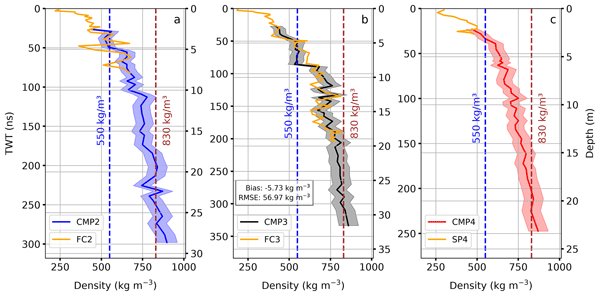
Abstract. The glacier mass balance is driven by primary processes such as snowfall and surface melt; secondary processes, like firn pack warming, percolation, and refreezing, are becoming more important even in high-elevation basins, which are triggered by warming Alpine regions. All these processes are functionally related to temporal changes in the firn pack, predominantly its density structure. Here, we provide a detailed assessment of temporal changes in firn density, stratigraphy, and compaction rate at different locations of the glacier accumulation area, representing the first such analysis for a glacier in the European Alps. To achieve this, we combined multi-year geophysical observations, predominantly ground-penetrating radar (GPR)‑based common‑midpoint (CMP) surveys, with direct firn‑core investigations from the accumulation area of the Aletsch Glacier, Switzerland. We estimated temporal changes in firn density and compaction rates within the identified 8–9 annual layers using internal reflection horizons (IRHs) from repeat CMP measurements and analysis of firn core-derived chemical impurity and stable isotope relationship. Our results suggest that the changes in firn density over a year decrease with depth and age, with the largest change (∼130 kg m-3 a-1) occurring at the near-surface annual layers at a low-lying accumulation area where the summer surface melt is more significant than at the higher elevations. Similarly, the estimated compaction rate (maximum ∼0.3 m a-1 near the surface) decreases with depth and age. The CMP‑derived density–depth profile agrees with the firn‑core results, illustrating that CMP measurements are a valuable alternative for increasing the spatial distribution of observations and complementing invasive and laborious glaciological measurements. We also estimated spatial changes in firn density and accumulation along a GPR transect and traced the spatial extent of the firn body. The comparison of GPR observations from winter 2024 and 2025 reveals a potential effect of glacier dynamics on firn stratigraphy. Our results demonstrate that the combination of multi-year GPR profiles, CMP analyses, and firn-core observations can be used to quantify temporal changes in firn density, stratigraphy, and compaction rate, an essential step toward improving firn-densification models and glacier mass-balance estimates.
-
Notice on discussion status
The requested preprint has a corresponding peer-reviewed final revised paper. You are encouraged to refer to the final revised version.
-
Preprint
(24076 KB)
-
The requested preprint has a corresponding peer-reviewed final revised paper. You are encouraged to refer to the final revised version.
- Preprint
(24076 KB) - Metadata XML
- BibTeX
- EndNote
- Final revised paper


Journal article(s) based on this preprint
Interactive discussion
Status: closed
-
RC1: 'Comment on egusphere-2026-1721', Anonymous Referee #1, 24 May 2026
The comment was uploaded in the form of a supplement: https://egusphere.copernicus.org/preprints/2026/egusphere-2026-1721/egusphere-2026-1721-RC1-supplement.pdfCitation: https://doi.org/
10.5194/egusphere-2026-1721-RC1 - AC1: 'Reply on RC1', Akash Patil, 24 Jun 2026
-
RC2: 'Comment on egusphere-2026-1721', Anonymous Referee #2, 08 Jun 2026
- AC2: 'Reply on RC2', Akash Patil, 24 Jun 2026
Peer review completion


Interactive discussion
Status: closed
-
RC1: 'Comment on egusphere-2026-1721', Anonymous Referee #1, 24 May 2026
The comment was uploaded in the form of a supplement: https://egusphere.copernicus.org/preprints/2026/egusphere-2026-1721/egusphere-2026-1721-RC1-supplement.pdf
- AC1: 'Reply on RC1', Akash Patil, 24 Jun 2026
-
RC2: 'Comment on egusphere-2026-1721', Anonymous Referee #2, 08 Jun 2026
- AC2: 'Reply on RC2', Akash Patil, 24 Jun 2026
Peer review completion
Journal article(s) based on this preprint
Viewed
| HTML | XML | Total | BibTeX | EndNote | |
|---|---|---|---|---|---|
| 394 | 227 | 43 | 664 | 44 | 43 |
- HTML: 394
- PDF: 227
- XML: 43
- Total: 664
- BibTeX: 44
- EndNote: 43
Viewed (geographical distribution)
| Country | # | Views | % |
|---|
| Total: | 0 |
| HTML: | 0 |
| PDF: | 0 |
| XML: | 0 |
- 1

Christoph Mayer
Theo M. Jenk
Astrid Lambrecht
Thorsten Seehaus
Alexander R. Groos
Michelle Worek
The requested preprint has a corresponding peer-reviewed final revised paper. You are encouraged to refer to the final revised version.
- Preprint
(24076 KB) - Metadata XML