
the Creative Commons Attribution 4.0 License.
the Creative Commons Attribution 4.0 License.
 | 14 Apr 2026
Spatiotemporal Linkage and Transmission of Urban Heat Islands in the Yangtze River Delta Urban Agglomeration: The Role of Urban Heat Advection
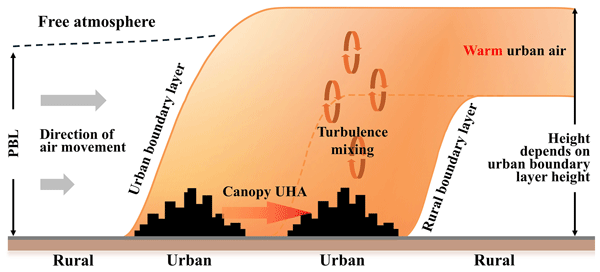
Abstract. Urban heat islands (UHIs) substantially modify the urban thermal environment, yet the contribution of non‑local processes such as urban heat advection (UHA) in dense urban agglomerations remains poorly quantified. Using five years of high‑density automatic weather station data and Weather Research and Forecasting (WRF) simulations, we investigate how UHA links canopy‑layer UHI (CUHI) and boundary‑layer UHI (BUHI) across the Suzhou-Wuxi-Changzhou metropolitan area in the Yangtze River Delta, China. UHA exhibits pronounced spatiotemporal variability, systematically transporting heat from upwind to downwind cities along the prevailing winds. Under northwesterly flow, daily‑mean UHA intensities increase from negative values in upwind regions to about 0.3 °C downstream, with nocturnal UHA during peak hours reaching roughly 0.6 °C. Observations show that nighttime UHA is nonlinearly modulated by wind speed and planetary boundary-layer height (PBLH), with maximum downstream warming under moderate winds and intermediate PBLH, whereas deep daytime convective boundary layers (PBLH ≥ 800 m) dilute urban heat plumes and can reverse UHA to a net cooling effect. WRF experiments further indicate that urbanization in the upstream city of Changzhou enhances CUHII in the adjacent downstream Wuxi by up to about 0.6 °C (9–42 %) and BUHII by up to about 0.35 °C (19–141 %), with detectable canopy‑level warming extending beyond 100 km downwind. These results demonstrate that cross‑city UHA superposition, strongly regulated by boundary‑layer dynamics, is a key physical process coupling UHIs within urban agglomerations, requiring explicit consideration in regional climate assessments.
-
Notice on discussion status
The requested preprint has a corresponding peer-reviewed final revised paper. You are encouraged to refer to the final revised version.
-
Preprint
(2231 KB)
-
Supplement
(810 KB)
-
The requested preprint has a corresponding peer-reviewed final revised paper. You are encouraged to refer to the final revised version.
- Preprint
(2231 KB) - Metadata XML
-
Supplement
(810 KB) - BibTeX
- EndNote
- Final revised paper


Journal article(s) based on this preprint
Interactive discussion
Status: closed
-
RC1: 'Comment on egusphere-2026-1707', jiachuan yang, 21 Apr 2026
-
AC2: 'Reply on RC1', Yuanjian Yang, 11 Jun 2026
Dear Reviewer and Editors:
We are sincerely grateful to the editor and reviewer for their valuable time for reviewing our manuscript. The comments are very helpful and valuable, and we have addressed the issues raised by the reviewer in the revised manuscript. Please find our point-by-point response to the comments raised by the reviewer.
Sincerely yours,
Dr. Yuanjian Yang, representing all co-authors
-
AC2: 'Reply on RC1', Yuanjian Yang, 11 Jun 2026
-
RC2: 'Comment on egusphere-2026-1707', Anonymous Referee #1, 21 Apr 2026
-
AC1: 'Reply on RC2', Yuanjian Yang, 11 Jun 2026
Dear Reviewer and Editors:
We are sincerely grateful to the editor and reviewer for their valuable time for reviewing our manuscript. The comments are very helpful and valuable, and we have addressed the issues raised by the reviewer in the revised manuscript. Please find our point-by-point response to the comments raised by the reviewer.
Sincerely yours,
Dr. Yuanjian Yang, representing all co-authors
-
AC1: 'Reply on RC2', Yuanjian Yang, 11 Jun 2026
-
RC3: 'Comment on egusphere-2026-1707', Anonymous Referee #3, 23 Apr 2026
This paper investigates whether urban heat islands in a dense metropolitan corridor should be treated as separate local phenomena, or as a connected thermal system linked by urban heat advection. Using five years of station observations and WRF-SLUCM experiments over the Suzhou–Wuxi–Changzhou region, the authors show that heat is transported from upwind to downwind cities, that this effect is much stronger at night than during the day, and that wind speed and boundary-layer depth jointly regulate both the magnitude and even the sign of the advection signal. The paper is interesting because it moves the discussion from single-city UHI toward inter-city thermal coupling, and the combined use of long-term observations and targeted sensitivity tests gives the study a solid basis. At the same time, several aspects of the analysis need to be treated more carefully.
Specific comments:
1. The paper at times attributes the downstream warming too directly to UHA. In the sensitivity experiment, changing urban land to cropland also changes surface roughness, moisture flux, and local circulation. I suggest the authors use slightly more careful language and clarify that the downstream response cannot be treated as pure advection alone.2. The discussion of PBLH may need a more cautious interpretation. The observational PBLH product is relatively coarse, and the model also has known uncertainty in wind speed and PBLH. Since PBLH is central to the main argument, the related uncertainty should be acknowledged more clearly.
3. The observational UHA index is useful, but it is still a statistical proxy rather than a direct physical estimate of heat advection. It would strengthen the paper if the authors explain this point more clearly, and, if possible, compare it briefly with the advection term from the WRF results. A simple validation of the model wind field would also help.
4. The BUHI calculation needs a little more methodological clarification. The current method appears to use a arithmetic mean, while the WRF vertical levels are unevenly spaced. This may give too much weight to the near-surface layers. The authors may clarify whether a thickness-weighted or mass-weighted average would be more appropriate, or note the possible sensitivity.
5. Some parts of the physical interpretation may be presented more clearly. The discussion of CUHI, BUHI, and UHA is sometimes mixed together, so the mechanism is not always easy to follow. It would also help to briefly clarify the station classification and rural reference choice, and to note the possible influence of other regional factors such as surface effects, southeast marine air, aerosols, and anthropogenic heat assumptions in the model.
Citation: https://doi.org/10.5194/egusphere-2026-1707-RC3 -
AC3: 'Reply on RC3', Yuanjian Yang, 11 Jun 2026
Dear Reviewer and Editors:
We are sincerely grateful to the editor and reviewer for their valuable time for reviewing our manuscript. The comments are very helpful and valuable, and we have addressed the issues raised by the reviewer in the revised manuscript. Please find our point-by-point response to the comments raised by the reviewer.
Sincerely yours,
Dr. Yuanjian Yang, representing all co-authors
-
AC3: 'Reply on RC3', Yuanjian Yang, 11 Jun 2026
Peer review completion


Interactive discussion
Status: closed
-
RC1: 'Comment on egusphere-2026-1707', jiachuan yang, 21 Apr 2026
This manuscript investigates the regional transmission of Urban Heat Islands via Urban Heat Advection (UHA) in the Yangtze River Delta, presenting a valuable framework of cross-city thermal plume superposition. The observational analysis and experimental design are robust. However, there are space for improvement regarding the quantitative metrics calculation and physically based discussion of these findings. I recommended a revision. The underlying hypothesis and conceptual framework are excellent, making this paper a potentially highly impactful contribution to the field of urban climate.
1. Introduction: There are several key points that need to be emphasized and refined. The cities reviewed in the fourth paragraph are located in maritime (Netherlands, UK) and semi-arid (Texas) climates, whereas the YRD is a humid subtropical region. The author is encouraged to state whether there are existing studies conducted in similar climates. In line 80, the term "urban chain" is mentioned but is not explicitly defined or explained. The same applies to the "different wind regime." Since the YRD is significantly influenced by land-sea breeze circulation, the interaction between the sea breeze and UHA is crucial; the authors should provide a review and introduction regarding this specific phenomenon.
2. Section 2.1: Strength: The authors filtered the wind direction for rural stations to effectively avoid bias in the UHI calculation. However, while "high AHF intensity" is used to define urban stations, the actual numerical threshold used is missing. Furthermore, while matching rural stations to the same latitudinal zone is an excellent way to control for incoming solar radiation, the longitude is equally important in the YRD region because it determines the distance to the ocean. The authors need to justify that their selection of rural stations does not introduce bias into the UHI calculation regarding coastal proximity.
3. Section 2.2.2, the definition of UHA intensity is effective because it isolates the background UHI by calculating a seasonal average across all wind directions. However, this remains a statistical definition rather than a thermodynamic one. Since the authors utilized the WRF model, which explicitly solves the thermodynamic equations, they are encouraged to compare this statistical proxy against the physical advection derived from the WRF simulations.
4. Section 2.2.4, In Equations (6) and (7), the authors calculated the mean boundary layer potential temperature as an arithmetic mean. However, the WRF simulation adopts non-uniform sigma levels, where vertical levels are more densely packed near the surface. For example, there may be 10 levels within the bottom 200 m and only 4 levels in the upper 800 m. In this case, an arithmetic mean will be skewed toward the surface. The authors should instead utilize a thickness-weighted or mass-weighted average to ensure an accurate representation of the boundary layer.
5. Line 220: The main distinction between SE and NW winds in the YRD region is that the SE flow originates from the East China Sea. As a marine boundary layer air mass, it naturally exerts a substantial upwind cooling effect; nonetheless, the SE wind still results in a positive downwind effect of up to 0.09°C. Furthermore, the urban thermal plumes in summer and winter are driven by different factors. In the summer, the plume is primarily driven by solar heating and the sensible heat flux from engineering materials. In contrast, during the winter, it is largely driven by anthropogenic heat flux (e.g., building heating, vehicle waste heat). I expect more detailed elaboration and discussion on these seasonal drivers in this section. The day–night asymmetry is also a highlight of the study. Is this phenomenon related to the lake breeze from Taihu Lake, or is it dominated by the solar diurnal cycle?
6. Line 240: The relationship between WS (wind speed) and PBLH (planetary boundary layer height) during the nighttime is one of causality rather than simple correlation. At night, in the absence of solar radiation, the boundary layer is primarily driven by mechanical shear, which is fundamentally determined by wind speed. Therefore, applying a Pearson correlation in this context is inappropriate. However, the conclusion regarding the nonlinear modulation of UHA intensity by WS and PBLH remains sound. The authors should reframe this paragraph to reflect the underlying physical mechanisms rather than relying solely on statistical metrics.
7. Line 280: The experimental design is excellent and effectively isolates the impact of removing upwind heat sources. However, converting urban areas into croplands involves more than just "turning off" anthropogenic and sensible heat; it also significantly alters the surface morphology, as cities have a high aerodynamic roughness length (z_0). Consequently, the authors should interpret these results with caution. It remains unclear whether the observed temperature drop is primarily due to the reduction in urban heat or the increased ventilation resulting from higher wind speeds over a smoother surface.
8. Figure 10: This result is intriguing; however, it confirms my concerns regarding the unweighted average potential temperature mentioned in Section 2.2.4. Since the wind vectors are more densely sampled near the ground, the arithmetic mean effectively oversamples the surface compared to the upper boundary layer. This bias may render the reported ΔBUHII unreliable.
9. Figure 8, since the heat advection is also a dynamic process (-v⋅∇T), there should also have a validation for wind.
Citation: https://doi.org/10.5194/egusphere-2026-1707-RC1 -
AC2: 'Reply on RC1', Yuanjian Yang, 11 Jun 2026
Dear Reviewer and Editors:
We are sincerely grateful to the editor and reviewer for their valuable time for reviewing our manuscript. The comments are very helpful and valuable, and we have addressed the issues raised by the reviewer in the revised manuscript. Please find our point-by-point response to the comments raised by the reviewer.
Sincerely yours,
Dr. Yuanjian Yang, representing all co-authors
-
AC2: 'Reply on RC1', Yuanjian Yang, 11 Jun 2026
-
RC2: 'Comment on egusphere-2026-1707', Anonymous Referee #1, 21 Apr 2026
-
AC1: 'Reply on RC2', Yuanjian Yang, 11 Jun 2026
Dear Reviewer and Editors:
We are sincerely grateful to the editor and reviewer for their valuable time for reviewing our manuscript. The comments are very helpful and valuable, and we have addressed the issues raised by the reviewer in the revised manuscript. Please find our point-by-point response to the comments raised by the reviewer.
Sincerely yours,
Dr. Yuanjian Yang, representing all co-authors
-
AC1: 'Reply on RC2', Yuanjian Yang, 11 Jun 2026
-
RC3: 'Comment on egusphere-2026-1707', Anonymous Referee #3, 23 Apr 2026
This paper investigates whether urban heat islands in a dense metropolitan corridor should be treated as separate local phenomena, or as a connected thermal system linked by urban heat advection. Using five years of station observations and WRF-SLUCM experiments over the Suzhou–Wuxi–Changzhou region, the authors show that heat is transported from upwind to downwind cities, that this effect is much stronger at night than during the day, and that wind speed and boundary-layer depth jointly regulate both the magnitude and even the sign of the advection signal. The paper is interesting because it moves the discussion from single-city UHI toward inter-city thermal coupling, and the combined use of long-term observations and targeted sensitivity tests gives the study a solid basis. At the same time, several aspects of the analysis need to be treated more carefully.
Specific comments:
1. The paper at times attributes the downstream warming too directly to UHA. In the sensitivity experiment, changing urban land to cropland also changes surface roughness, moisture flux, and local circulation. I suggest the authors use slightly more careful language and clarify that the downstream response cannot be treated as pure advection alone.2. The discussion of PBLH may need a more cautious interpretation. The observational PBLH product is relatively coarse, and the model also has known uncertainty in wind speed and PBLH. Since PBLH is central to the main argument, the related uncertainty should be acknowledged more clearly.
3. The observational UHA index is useful, but it is still a statistical proxy rather than a direct physical estimate of heat advection. It would strengthen the paper if the authors explain this point more clearly, and, if possible, compare it briefly with the advection term from the WRF results. A simple validation of the model wind field would also help.
4. The BUHI calculation needs a little more methodological clarification. The current method appears to use a arithmetic mean, while the WRF vertical levels are unevenly spaced. This may give too much weight to the near-surface layers. The authors may clarify whether a thickness-weighted or mass-weighted average would be more appropriate, or note the possible sensitivity.
5. Some parts of the physical interpretation may be presented more clearly. The discussion of CUHI, BUHI, and UHA is sometimes mixed together, so the mechanism is not always easy to follow. It would also help to briefly clarify the station classification and rural reference choice, and to note the possible influence of other regional factors such as surface effects, southeast marine air, aerosols, and anthropogenic heat assumptions in the model.
Citation: https://doi.org/10.5194/egusphere-2026-1707-RC3 -
AC3: 'Reply on RC3', Yuanjian Yang, 11 Jun 2026
Dear Reviewer and Editors:
We are sincerely grateful to the editor and reviewer for their valuable time for reviewing our manuscript. The comments are very helpful and valuable, and we have addressed the issues raised by the reviewer in the revised manuscript. Please find our point-by-point response to the comments raised by the reviewer.
Sincerely yours,
Dr. Yuanjian Yang, representing all co-authors
-
AC3: 'Reply on RC3', Yuanjian Yang, 11 Jun 2026
Peer review completion
Journal article(s) based on this preprint
Viewed
| HTML | XML | Total | Supplement | BibTeX | EndNote | |
|---|---|---|---|---|---|---|
| 360 | 181 | 57 | 598 | 58 | 36 | 34 |
- HTML: 360
- PDF: 181
- XML: 57
- Total: 598
- Supplement: 58
- BibTeX: 36
- EndNote: 34
Viewed (geographical distribution)
| Country | # | Views | % |
|---|
| Total: | 0 |
| HTML: | 0 |
| PDF: | 0 |
| XML: | 0 |
- 1
Jiesheng Xue
Yuanjian Yang

Guoyu Ren
Simone Lolli
The requested preprint has a corresponding peer-reviewed final revised paper. You are encouraged to refer to the final revised version.
- Preprint
(2231 KB) - Metadata XML
-
Supplement
(810 KB) - BibTeX
- EndNote
- Final revised paper
This manuscript investigates the regional transmission of Urban Heat Islands via Urban Heat Advection (UHA) in the Yangtze River Delta, presenting a valuable framework of cross-city thermal plume superposition. The observational analysis and experimental design are robust. However, there are space for improvement regarding the quantitative metrics calculation and physically based discussion of these findings. I recommended a revision. The underlying hypothesis and conceptual framework are excellent, making this paper a potentially highly impactful contribution to the field of urban climate.
1. Introduction: There are several key points that need to be emphasized and refined. The cities reviewed in the fourth paragraph are located in maritime (Netherlands, UK) and semi-arid (Texas) climates, whereas the YRD is a humid subtropical region. The author is encouraged to state whether there are existing studies conducted in similar climates. In line 80, the term "urban chain" is mentioned but is not explicitly defined or explained. The same applies to the "different wind regime." Since the YRD is significantly influenced by land-sea breeze circulation, the interaction between the sea breeze and UHA is crucial; the authors should provide a review and introduction regarding this specific phenomenon.
2. Section 2.1: Strength: The authors filtered the wind direction for rural stations to effectively avoid bias in the UHI calculation. However, while "high AHF intensity" is used to define urban stations, the actual numerical threshold used is missing. Furthermore, while matching rural stations to the same latitudinal zone is an excellent way to control for incoming solar radiation, the longitude is equally important in the YRD region because it determines the distance to the ocean. The authors need to justify that their selection of rural stations does not introduce bias into the UHI calculation regarding coastal proximity.
3. Section 2.2.2, the definition of UHA intensity is effective because it isolates the background UHI by calculating a seasonal average across all wind directions. However, this remains a statistical definition rather than a thermodynamic one. Since the authors utilized the WRF model, which explicitly solves the thermodynamic equations, they are encouraged to compare this statistical proxy against the physical advection derived from the WRF simulations.
4. Section 2.2.4, In Equations (6) and (7), the authors calculated the mean boundary layer potential temperature as an arithmetic mean. However, the WRF simulation adopts non-uniform sigma levels, where vertical levels are more densely packed near the surface. For example, there may be 10 levels within the bottom 200 m and only 4 levels in the upper 800 m. In this case, an arithmetic mean will be skewed toward the surface. The authors should instead utilize a thickness-weighted or mass-weighted average to ensure an accurate representation of the boundary layer.
5. Line 220: The main distinction between SE and NW winds in the YRD region is that the SE flow originates from the East China Sea. As a marine boundary layer air mass, it naturally exerts a substantial upwind cooling effect; nonetheless, the SE wind still results in a positive downwind effect of up to 0.09°C. Furthermore, the urban thermal plumes in summer and winter are driven by different factors. In the summer, the plume is primarily driven by solar heating and the sensible heat flux from engineering materials. In contrast, during the winter, it is largely driven by anthropogenic heat flux (e.g., building heating, vehicle waste heat). I expect more detailed elaboration and discussion on these seasonal drivers in this section. The day–night asymmetry is also a highlight of the study. Is this phenomenon related to the lake breeze from Taihu Lake, or is it dominated by the solar diurnal cycle?
6. Line 240: The relationship between WS (wind speed) and PBLH (planetary boundary layer height) during the nighttime is one of causality rather than simple correlation. At night, in the absence of solar radiation, the boundary layer is primarily driven by mechanical shear, which is fundamentally determined by wind speed. Therefore, applying a Pearson correlation in this context is inappropriate. However, the conclusion regarding the nonlinear modulation of UHA intensity by WS and PBLH remains sound. The authors should reframe this paragraph to reflect the underlying physical mechanisms rather than relying solely on statistical metrics.
7. Line 280: The experimental design is excellent and effectively isolates the impact of removing upwind heat sources. However, converting urban areas into croplands involves more than just "turning off" anthropogenic and sensible heat; it also significantly alters the surface morphology, as cities have a high aerodynamic roughness length (z_0). Consequently, the authors should interpret these results with caution. It remains unclear whether the observed temperature drop is primarily due to the reduction in urban heat or the increased ventilation resulting from higher wind speeds over a smoother surface.
8. Figure 10: This result is intriguing; however, it confirms my concerns regarding the unweighted average potential temperature mentioned in Section 2.2.4. Since the wind vectors are more densely sampled near the ground, the arithmetic mean effectively oversamples the surface compared to the upper boundary layer. This bias may render the reported ΔBUHII unreliable.
9. Figure 8, since the heat advection is also a dynamic process (-v⋅∇T), there should also have a validation for wind.