
the Creative Commons Attribution 4.0 License.
the Creative Commons Attribution 4.0 License.
 | 27 Mar 2026
GEE-DisALEXI: Cloud-Based Implementation of the DisALEXI Model for Evapotranspiration Monitoring Using Google Earth Engine
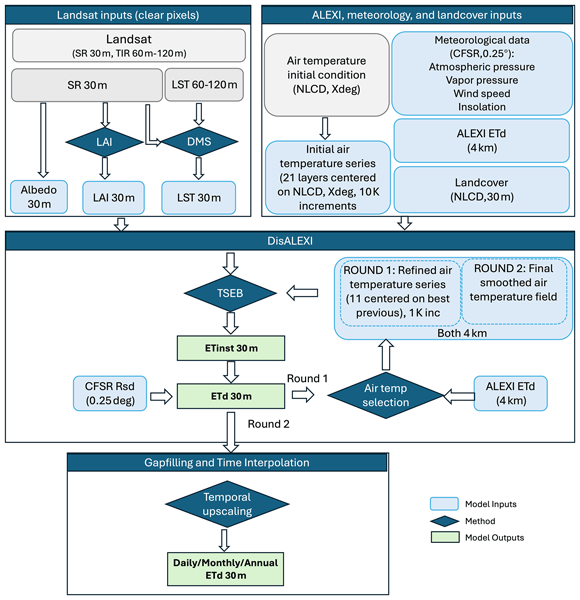
Abstract. Evapotranspiration (ET), a key component of the terrestrial water and energy cycles, is essential for understanding ecosystem productivity, agricultural water use, and vegetation health. While traditional ground-based methods offer direct ET measurements, they are limited in spatial coverage and scalability. Two Source Energy Balance (TSEB) based satellite remote sensing ET retrieval algorithms have emerged as a powerful tool for estimating ET across diverse landscapes, providing robust field-to-regional ET estimates. With increasing needs for field-scale ET data for applications in agriculture, forest and water resources management, traditional ET computing relying on local servers is challenged for data storage and computing capability. The integration of ET models into the cloud-based platform via Google Earth Engine (GEE) enables scalable, high-resolution ET data production and delivery to stakeholders. This paper presents the cloud implementation of Disaggregation of the Atmosphere Land Exchange Inverse model (DisALEXI) on GEE, detailing technical enhancements, model evaluation across biomes and climate zones, and comparison with water balance estimated ET at basin-scale. Among all the land cover types assessed, GEE-DisALEXI consistently exhibited the best performance in croplands across all time scales, particularly during the growing season, where the model achieves a MAE of 16.8 % at monthly timesteps. The annual bias of DisALEXI ET comparing with water balance estimated ET at Hydrologic Unit Code (HUC) 08 basins is -0.36 %. An anomaly of the ratio between ET and reference ET is calculated at regional scale and is compared with US. Drought Monitor data to explore the capability of using ET metrics for drought monitoring over different climate zones. The ET metric shows good correlation with U.S. Drought Monitor drought signal and is the strongest over humid areas. We also discuss current limitations and future directions for improving GEE-DisALEXI, including opportunities for enhanced forcing data and parameterization, to advance cloud-based ET modeling for water and agriculture management.
-
Notice on discussion status
The requested preprint has a corresponding peer-reviewed final revised paper. You are encouraged to refer to the final revised version.
-
Preprint
(8670 KB)
-
The requested preprint has a corresponding peer-reviewed final revised paper. You are encouraged to refer to the final revised version.
- Preprint
(8670 KB) - Metadata XML
- BibTeX
- EndNote
- Final revised paper


Journal article(s) based on this preprint
Interactive discussion
Status: closed
-
RC1: 'Comment on egusphere-2026-1691', Anonymous Referee #1, 23 Apr 2026
- AC1: 'Reply on RC1', Yun Yang, 20 May 2026
-
RC2: 'Comment on egusphere-2026-1691', Anonymous Referee #2, 02 May 2026
This study presents a modeling tool based on Google Earth Engine that allows the well-published remote sensing-based evapotranspiration model, DisALEXI, to be efficiently applied at the continental US and beyond. The study examined the uncertainty of the tool by comparing eddyflux ET data measured at selected sites and ET derived from the watershed water balance method at the HUC8 scale. The authors claim that the modeling tool works well the study region and performs better the OpenET ensembled ET at multiple scales. The authors also suggest stress index derived for this study is comparable to U.S. Drought Monitor drought signal (especially in humid region) and thus can be used for monitoring drought impacts.
I think the modeling tool developed by this study has a huge potential to provide high resolution ET (e.g., 30 m that is most useful for a few applications) products although currently the resolution is 4-5 km.
I have offered detailed comments (see attached) throughout the main text that needs authors to carefully address. Here are some highlights that I hope the authors can address before the work can be published.
1. Model descriptions are needed to give readers a high level overview about how the model works and how it differs from other RS based models.
2. Alternative model validation at the watershed scale might be useful. Please note that not all HUC8 watersheds are gaged (no references are given about the source of streamflow and ET data) and therefore comparing ET at the watershed level is still model to model comparison. It would make a strong case if the authors compare modeled ET to derived ET from smaller gaging referenced watersheds like what the following papers did for general hydrological model validations that use commonly used datasets published by USGS. The gaged watersheds offer more convincing ET values than the HUC8 (that are rather large and heterogenous). The lathe HUC8 can have issues of ET such as P
Li, C., et al, 2020. Impacts of urbanization on watershed water balances across the conterminous United States. Water Resources Research, 56(7), p.e2019WR026574.
Caldwell, P.V., et al. 2012. Impacts of impervious cover, water withdrawals, and climate change on river flows in the conterminous US. Hydrology and Earth System Sciences, 16(8), pp.2839-2857.
- AC2: 'Reply on RC2', Yun Yang, 20 May 2026
Peer review completion


Interactive discussion
Status: closed
-
RC1: 'Comment on egusphere-2026-1691', Anonymous Referee #1, 23 Apr 2026
It proposed a framework of estimating field scale ET using the GEE and DisALEXI model. Then produced 30 m ET were evaluated with flux tower observations over different land cover types. They were also compared with the existing dataset of OpenET and water balance ET. These datasets mostly performed similarly. So, it should show the advantage of this method.
- Why were 11 different air temperature maps used? It is confused for selecting different air temperature maps. Who is the benchmark at 4-km, DisALEXI or ALEXI, why? They are close, does not mean they are reliable.
- How to fill Landsat daily ET when it is partly cloudy covered?
- The comparison between the Landsat and flux tower daily ET showed that the relative error of Landsat daily ET could be more than 40 to 50%. This model needs to be refined at forest and shrub areas.
- What about the terrains of over these flux tower areas? The comparisons are at point rather than regional.
- It cannot find these reductions in Table A1.
- There is no OpenET in Figure 6
- Actually, the modeled monthly ET, both GEE-DisALEXI and ensemble, have significant differences with ground measurements at the forest sites. It need more details for these disagreement.
- The DisALEXI ET overestimated the low values but underestimated the high values. But the ensemble ET does not have this issue. So what is the advantage of DisALEXI ET?
- Why did the comparison between ET metrics and Drought ? They are different things, especially over the dryland area, lower ET doesn't mean drought.
Citation: https://doi.org/10.5194/egusphere-2026-1691-RC1 - AC1: 'Reply on RC1', Yun Yang, 20 May 2026
-
RC2: 'Comment on egusphere-2026-1691', Anonymous Referee #2, 02 May 2026
This study presents a modeling tool based on Google Earth Engine that allows the well-published remote sensing-based evapotranspiration model, DisALEXI, to be efficiently applied at the continental US and beyond. The study examined the uncertainty of the tool by comparing eddyflux ET data measured at selected sites and ET derived from the watershed water balance method at the HUC8 scale. The authors claim that the modeling tool works well the study region and performs better the OpenET ensembled ET at multiple scales. The authors also suggest stress index derived for this study is comparable to U.S. Drought Monitor drought signal (especially in humid region) and thus can be used for monitoring drought impacts.
I think the modeling tool developed by this study has a huge potential to provide high resolution ET (e.g., 30 m that is most useful for a few applications) products although currently the resolution is 4-5 km.
I have offered detailed comments (see attached) throughout the main text that needs authors to carefully address. Here are some highlights that I hope the authors can address before the work can be published.
1. Model descriptions are needed to give readers a high level overview about how the model works and how it differs from other RS based models.
2. Alternative model validation at the watershed scale might be useful. Please note that not all HUC8 watersheds are gaged (no references are given about the source of streamflow and ET data) and therefore comparing ET at the watershed level is still model to model comparison. It would make a strong case if the authors compare modeled ET to derived ET from smaller gaging referenced watersheds like what the following papers did for general hydrological model validations that use commonly used datasets published by USGS. The gaged watersheds offer more convincing ET values than the HUC8 (that are rather large and heterogenous). The lathe HUC8 can have issues of ET such as P
Li, C., et al, 2020. Impacts of urbanization on watershed water balances across the conterminous United States. Water Resources Research, 56(7), p.e2019WR026574.
Caldwell, P.V., et al. 2012. Impacts of impervious cover, water withdrawals, and climate change on river flows in the conterminous US. Hydrology and Earth System Sciences, 16(8), pp.2839-2857.
- AC2: 'Reply on RC2', Yun Yang, 20 May 2026
Peer review completion
Journal article(s) based on this preprint
Viewed
| HTML | XML | Total | BibTeX | EndNote | |
|---|---|---|---|---|---|
| 544 | 284 | 45 | 873 | 39 | 44 |
- HTML: 544
- PDF: 284
- XML: 45
- Total: 873
- BibTeX: 39
- EndNote: 44
Viewed (geographical distribution)
| Country | # | Views | % |
|---|
| Total: | 0 |
| HTML: | 0 |
| PDF: | 0 |
| XML: | 0 |
- 1
Yun Yang
Martha Anderson
Charles Morton
Yanghui Kang
Feng Gao
Weina Duan
Hui Liu
John Volk
Christopher Hain
The requested preprint has a corresponding peer-reviewed final revised paper. You are encouraged to refer to the final revised version.
- Preprint
(8670 KB) - Metadata XML
It proposed a framework of estimating field scale ET using the GEE and DisALEXI model. Then produced 30 m ET were evaluated with flux tower observations over different land cover types. They were also compared with the existing dataset of OpenET and water balance ET. These datasets mostly performed similarly. So, it should show the advantage of this method.