
the Creative Commons Attribution 4.0 License.
the Creative Commons Attribution 4.0 License.
 | 04 May 2026
Chemical characteristics and environmental drivers of nitrogen-containing organic aerosol formation in coastal and inland urban atmospheres in Myanmar
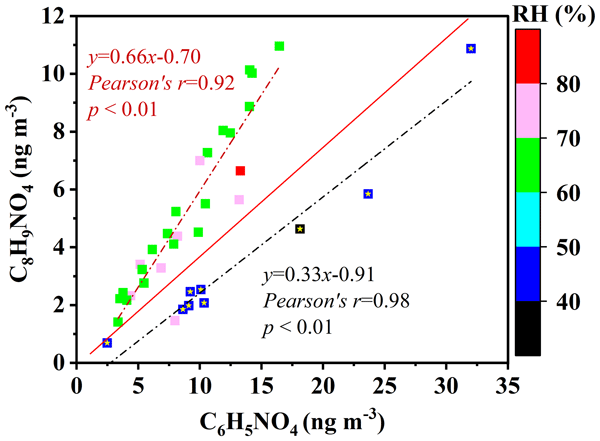
Abstract. Nitrogen-containing organic compounds (NOCs) are important light-absorbing constituents of atmospheric PM2.5 and can substantially influence aerosol radiative forcing, air quality, and climate. Previous studies have mainly focused on the source apportionment and concentrations levels of NOCs, while the mechanisms governing their formation and particle-phase partitioning remain insufficiently constrained, particularly in tropical regions. Here, we aim to elucidate regional differences in NOCs characteristics in Myanmar, with emphasis on how relative humidity (RH) and precursor species influence their formation pathways. We report the first molecular-level spatio-temporal characterization of NOCs in Myanmar, identifying 1064 organic compounds in ESI- mode, with NOCs contributing 14–21 % of molecular formulas and 13–35 % of total mass. Organic nitrates (ONs) dominated CHON species across all sites, with higher abundances in Mandalay than in Yangon. Two ubiquitous nitrophenols, nitrocatechol (C6H5NO4) and dimethyl nitrocatechol (C8H9NO4), showed strong covariance but a distinct dependence of their particle-phase C8H9NO4/C6H5NO4 ratio on RH. CHemistry with Aerosol Microphysics in Python (PyCHAM) box model simulations reveal that increasing RH enhances aerosol water content, strengthening Raoult effect and preferentially suppressing condensation of the less soluble C8H9NO4. Seasonal increases in summertime OH further promote C6H5NO4 formation. These two processes explain the observed RH dependence and demonstrate that the C8H9NO4/C6H5NO4 ratio reflects both aerosol liquid water content and oxidative aging, while remaining sensitive to precursor supply. These findings provide new constraints on nitrophenol evolution in humid tropical environments and improve interpretation of NOC sources and aging processes, thereby supporting more accurate assessments of their regional and global radiative impacts.
-
Notice on discussion status
The requested preprint has a corresponding peer-reviewed final revised paper. You are encouraged to refer to the final revised version.
-
Preprint
(2075 KB)
-
Supplement
(658 KB)
-
The requested preprint has a corresponding peer-reviewed final revised paper. You are encouraged to refer to the final revised version.
- Preprint
(2075 KB) - Metadata XML
-
Supplement
(658 KB) - BibTeX
- EndNote
- Final revised paper


Journal article(s) based on this preprint
Interactive discussion
Status: closed
-
RC1: 'Comment on egusphere-2026-1677', Anonymous Referee #1, 21 May 2026
- AC1: 'Reply on RC1', Ning Zhang, 19 Jun 2026
-
RC2: 'Comment on egusphere-2026-1677', Anonymous Referee #2, 28 May 2026
This manuscript using ultra-high-performance liquid chromatography coupled with Orbitrap mass spectrometry to characterize the spatial variability of NOCs in ambient PM2.5 samples collected from typical tropical regions. In addition, combined with Box-model to investigate the formation-related processes of high-abundance nitrophenolic compounds were investigated. This study enhances our understanding of atmospheric NOCs drivers. Before to publication, the manuscript would benefit from addressing the comments below.
- Line 544-547, “This box model finding is supported...”, the attribution to biomass burning is not sufficiently supported.
- Could the RH dependence be influenced by precursor variability rather than partitioning?
- The model does not include transport processes.
- The explanation based on solubility of C6H5NO4 and C8H9NO4 lacks support.
- How generalizable are your findings?
- “demonstrate that varying precursor concentrations can substantially disrupt the relationship between C8H9NO4/C6H5NO4 and aerosol aging.” in line 515-517, based on the analysis in Figure S7, I guess that RH is more likely to influence the relationship between C8H9NO4/C6H5NO4 and aerosol aging, and that the comparison of precursor concentrations does not have a significant effect.
- “variations in the formation of nitrophenolic compounds is influenced” in Line 539-540, “is” should be changed to “are”; “mass concentration of these two compounds were higher in the Mandalay samples than in Yangon” in line 405, “were” should be changed to “was”.
- The section on implications in the “Conclusions and Implications” chapter needs to be strengthened.
Citation: https://doi.org/10.5194/egusphere-2026-1677-RC2 - AC2: 'Reply on RC2', Ning Zhang, 19 Jun 2026
Peer review completion


Interactive discussion
Status: closed
-
RC1: 'Comment on egusphere-2026-1677', Anonymous Referee #1, 21 May 2026
This study presents the molecular-level characterization of nitrogen-containing organic compounds (NOCs) in Myanmar aerosols, identifying 1064 organic compounds with NOCs contributing 14-21% of molecular formulas and 13-35% of total mass. The authors demonstrate that organic nitrates dominate CHON species, and that the C8H9NO4/C6H5NO4 ratio reflects combined effects of relative humidity, photochemistry, and precursor availability, which is a valuable finding for understanding NOC evolution in tropical environments. However, several methodological concerns should be addressed before publication. Overall, this is a solid contribution to the field of atmospheric chemistry, particularly for underrepresented tropical regions. Minor revisions are recommended to strengthen the methodology and contextualize the findings within broader knowledge frameworks.
- Introduction: Actually, there have been quite a few studies using similar high-resolution mass spectrometry to investigate the molecular characteristics and formation mechanisms of NOCs. These should be clearly stated in the background section so as to more accurately highlight the novelty of this study.
- Methods section: The uncertainties of the measurement methods should be specified, particularly for the water-soluble organic nitrogen that is directly relevant to the analysis in this study.
- The justification for the model setup should be more sufficient. For example, "Testing showed the model required around 9 hours of spin-up (starting from midday local time) before concentrations settled." How was the threshold for determining when concentrations "settled" defined?
- "These results are consistent with the findings of Sun et al. (2025), who reported that..."The comparison of the results should utilize atmospheric observation data from similar regions to reflect the differences between coastal and urban areas. Currently, selecting only one paper for comparison is not representative.
- How large is the uncertainty of the semi-quantitative analysis based on high-resolution mass spectrometry? Is there any corresponding methodological paper as a basis? These details should be clearly described in the main text. Furthermore, after the semi-quantification, does the total mass variation of these organic molecules align with the variation of the total organics? Has any further validation been conducted?
- Why is the identification criterion for nitrophenols O/N ≥ 3 instead of O/N ≥ 2?
- The interpretation of the box model results requires more substantial data analysis. For example, "The box modelling results have shown that the Raoult effect driven by changes in aerosol water content, which are driven by changes in RH, exerts a physical influence over C8H9NO4/C6H5NO4, since C8H9NO4 is more sensitive to the effect." However, no specific data analysis is presented to support this.
Citation: https://doi.org/10.5194/egusphere-2026-1677-RC1 - AC1: 'Reply on RC1', Ning Zhang, 19 Jun 2026
-
RC2: 'Comment on egusphere-2026-1677', Anonymous Referee #2, 28 May 2026
This manuscript using ultra-high-performance liquid chromatography coupled with Orbitrap mass spectrometry to characterize the spatial variability of NOCs in ambient PM2.5 samples collected from typical tropical regions. In addition, combined with Box-model to investigate the formation-related processes of high-abundance nitrophenolic compounds were investigated. This study enhances our understanding of atmospheric NOCs drivers. Before to publication, the manuscript would benefit from addressing the comments below.
- Line 544-547, “This box model finding is supported...”, the attribution to biomass burning is not sufficiently supported.
- Could the RH dependence be influenced by precursor variability rather than partitioning?
- The model does not include transport processes.
- The explanation based on solubility of C6H5NO4 and C8H9NO4 lacks support.
- How generalizable are your findings?
- “demonstrate that varying precursor concentrations can substantially disrupt the relationship between C8H9NO4/C6H5NO4 and aerosol aging.” in line 515-517, based on the analysis in Figure S7, I guess that RH is more likely to influence the relationship between C8H9NO4/C6H5NO4 and aerosol aging, and that the comparison of precursor concentrations does not have a significant effect.
- “variations in the formation of nitrophenolic compounds is influenced” in Line 539-540, “is” should be changed to “are”; “mass concentration of these two compounds were higher in the Mandalay samples than in Yangon” in line 405, “were” should be changed to “was”.
- The section on implications in the “Conclusions and Implications” chapter needs to be strengthened.
Citation: https://doi.org/10.5194/egusphere-2026-1677-RC2 - AC2: 'Reply on RC2', Ning Zhang, 19 Jun 2026
Peer review completion
Journal article(s) based on this preprint
Viewed
| HTML | XML | Total | Supplement | BibTeX | EndNote | |
|---|---|---|---|---|---|---|
| 413 | 105 | 35 | 553 | 57 | 40 | 37 |
- HTML: 413
- PDF: 105
- XML: 35
- Total: 553
- Supplement: 57
- BibTeX: 40
- EndNote: 37
Viewed (geographical distribution)
| Country | # | Views | % |
|---|
| Total: | 0 |
| HTML: | 0 |
| PDF: | 0 |
| XML: | 0 |
- 1
Ning Zhang
Jialiang Feng
Simon Patrick O'Meara
Ziyi Liu
Yingge Ma
Xinlei Ge
Wenjing Li
Piero Chiacchiaretta
Piero Di Carlo

Eleonora Aruffo
The requested preprint has a corresponding peer-reviewed final revised paper. You are encouraged to refer to the final revised version.
- Preprint
(2075 KB) - Metadata XML
-
Supplement
(658 KB) - BibTeX
- EndNote
- Final revised paper
This study presents the molecular-level characterization of nitrogen-containing organic compounds (NOCs) in Myanmar aerosols, identifying 1064 organic compounds with NOCs contributing 14-21% of molecular formulas and 13-35% of total mass. The authors demonstrate that organic nitrates dominate CHON species, and that the C8H9NO4/C6H5NO4 ratio reflects combined effects of relative humidity, photochemistry, and precursor availability, which is a valuable finding for understanding NOC evolution in tropical environments. However, several methodological concerns should be addressed before publication. Overall, this is a solid contribution to the field of atmospheric chemistry, particularly for underrepresented tropical regions. Minor revisions are recommended to strengthen the methodology and contextualize the findings within broader knowledge frameworks.