
the Creative Commons Attribution 4.0 License.
the Creative Commons Attribution 4.0 License.
 | 08 Apr 2026
Asymptotic Behavior of Lidar Scattering Properties of Absorbing Dust Aerosols Across Rayleigh and Geometrical-Optics Regimes: Theory and Implications
Abstract. Lidar ratio (S), linear depolarization ratio (δ), and single-scattering albedo (ω) are central quantities for dust typing and property retrieval in lidar remote sensing. We investigate their dependence on size parameter (x) and iron oxide fraction of mineral dust using TAMUdust2020 and triaxial-ellipsoid calculations. Results show a consistent asymptotic structure that is weakly sensitive to particle shape in both limits of scattering theory. In the Rayleigh limit (x≪1), S ∝ x−3 and ω ∝x3, while δ remains small. In the geometrical-optics limit (x≫1), δ decreases toward low values and ω →1/2, whereas S increases because backscatter is reduced relative to extinction by strong absorption and diffraction-dominated scattering. These asymptotic constraints provide a unified physical interpretation of multiwavelength dust-lidar behavior and help explain observed spectral variability of dust depolarization and lidar ratio. A key implication is that large, strongly absorbing dust can produce optical signatures that overlap with weakly depolarizing aerosol classes, which may bias standard classification and inversion schemes toward underestimation of coarse and super-coarse dust contributions.
-
Notice on discussion status
The requested preprint has a corresponding peer-reviewed final revised paper. You are encouraged to refer to the final revised version.
-
Preprint
(0 KB)
-
The requested preprint has a corresponding peer-reviewed final revised paper. You are encouraged to refer to the final revised version.


Journal article(s) based on this preprint
Interactive discussion
Status: closed
-
RC1: 'Comment on egusphere-2026-1675', Anonymous Referee #1, 14 Jun 2026
The comment was uploaded in the form of a supplement: https://egusphere.copernicus.org/preprints/2026/egusphere-2026-1675/egusphere-2026-1675-RC1-supplement.pdfCitation: https://doi.org/
10.5194/egusphere-2026-1675-RC1 - AC1: 'Reply on RC1', Zhibo Zhang, 28 Jul 2026
-
RC2: 'Comment on egusphere-2026-1675', Anonymous Referee #2, 19 Jun 2026
The manuscript by Anthony La Luna and co-authors investigates the influence of absorption on the aerosol optical properties like the linear depolarization ratio, the extinction-to-backscatter ratio (so-called lidar ratio) and the single scattering albedo. Their work focuses on active remote sensing observations with lidar (180 degree scattering angle) for the non-spherical dust particles. The topic is relevant and the manuscript makes a significant contribution. Unfortunately, the authors were not using a correct citation key that messed up the in-text references. An issue which should have been eliminated before submission. Besides of this, some major revisions are required before publication.
Major points
- The citation style (probably originating from a citation style using numbers), does not fit to ACP. In latex, you have two comments
\citep{LaLuna2025} – (La Luna et al., 2025)
and \citet{LaLuna2025} or \cite{LaLuna2025} – La Luna et al. (2025)
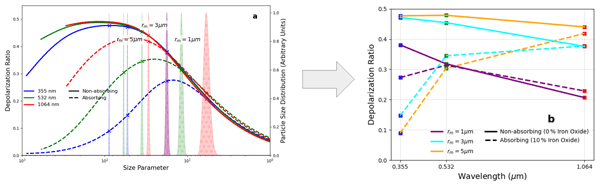
Especially, for multiple citations as at the beginning of your introduction, you should use the first comment and all citations will be combined in one. It really disturbs reading, if the citations are not set properly, especially in long lists of refences like in the introduction and in case of duplications as in lines 80-83. - The asymptotic behavior discussed in Sect. 3 widely seems to be textbook-like. You conclude, that for the asymptotic behavior the shape model does not matter. And in fact, the conclusions hold for spherical particles as well. For very low size parameters, the depolarization ratio is zero and for very large ones as well. Similar conclusions can be drawn for the lidar ratio. In between, the shape matters as you show with the two non-spherical particle models. Epecially, the comparison to spherical particles shows that the shape matters for in between size parameters. Thus, you should include spherical particles in your considerations as well. Therefore, this asymptotic behavior is not new, but very general and should hold for all particles shapes. Actually, this behavior does not help us very much in finding the best description for mineral dust, but sets a frame for all particle shape models what they should reach in the asymptotic behavior. By including spherical particles, it gets even more obvious that the asymptotic behavior alone is not concessive for the correct description of the optical properties of mineral dust.
- Tabular values of the optical properties shown in Fig 6 and 8 at the 3 lidar wavelengths for absorbing and non-absorbing aerosols are recommended. Only in this way, you are able to compare it lidar field observations. Furthermore, you might add some lidar field observations to your respective plots (Fig. 6, 8, 9, 10).
- Please provide more details about the in situ size distributions, e.g., sampling location, sampling altitude etc.
Sect 4.3 and Fig 7: Which radius is provided by the in situ observations? And how it is converted to serve as input for the calculations? For non-spherical particles, the size definitions might be ambiguous as some literature report volume equivalent diameter, others use the geometrical diameter or even other definitions. Please describe which size definition was used and how – if necessary – it was converted.
It puzzled me a lot to see the AERONET PSD in Fig 7 which goes well beyond 50 µm in radius. In your text, you state that it is truncated at 10 – 15 µm, which would be shortly after the peak. How can this behavior be explained? - Fig 2 is only partly showing the content which is described in the text. Not data at 355 and 1064 nm is shown. Be sure that the figures fit to the text. Such issues make the review process more difficult.
Minor comments
- As you mentioned, the linkage of dust optical and microphysical properties is an emerging field and the review process serves to update you with some recent relevant literature in the field. I would consider the work of
- Yuyang Chang et al., 2025 (ACP) and 2026 (JGR) about the spectral modelling of dust particles.
- Sofia Gomez Maqueo Anaya et al. 2024 (GMD), 2025 (ACP) about mineralogically resolved dust transport modelling and its implications on optical properties.
- And the recent work of Claudia Di Biagio (2026, ACP) on dust properties at longer wavelengths and Moritz Haarig (2025, ACP) on the spectral slope of the lidar ratio.
- Looking at your figures 4+5, one might argue, that the absorption plays a role, but all your conclusions hold also for the non-absorbing particles. After reaching a peak, the depolarization ratio is decaying and the lidar ratio is increasing for increasing size. The only difference is that the non-absorbing particles have to be larger to see the same effect. Therefore, I would not say that it is an absorption effect alone (e.g., L303). However, in real world, there the PSD is given, the optical properties change for stronger absorption as you show in your next section.
- Why do you have chosen those specific in situ size distributions? General dust size distribution at different stages of transport are available, see e.g., Formenti & Di Biagio (2024).
- L287 EarthCARE’s lidar measures the extinction and lidar ratio directly (HSRL) and needs no assumptions about the lidar ratio.
- L314-315 Again, the HSRL technique is wrongly conceived. A lidar ratio has to be assumed for backscatter lidars (like CALIPSO), but not for HSRL.
- Sect 3.3: Please consider also the differences between the two models, e.g., for large size parameters the lidar ratio shows a plateau for spheroids and an increase for irregular hexahedra. So, the asymptotic lidar ratio is only present for spheroids, isn’t it? Or do we have to go to even larger size parameters for the irregular hexahedra to see a plateau?
- L258-259: Actually, I don’t see so much of the difference for absorbing and non-absorbing particles. Even for non-absorbing particles the depolarization ratio decreases for spheroids, the particle has to just a bit larger to bring the depolarization ratio to zero. Please be more careful in your statements about the effect of absorption.
- L294-296 Please check Vesselovskii et al., ACP 2020 for lidar ratios at 355 nm.
- Sect 4.2 & Fig 6: I would recommend to show 1, 3 and 10 µm instead of 1, 5 and 10 µm, because a logarithmic spacing (here approx. factor 3) covers better the relevant processes than the linear spacing. The results at 5 and 10 µm are too similar. Furthermore, I would recommend to highlight the 3 relevant lidar wavelengths in the plot.
- Please specify the shape model used for your results also in the figure captions of Fig 6 onwards.
- Fig 9a is not understandable from the caption and the text. Which size distributions are shown?
- L357-359 It highlights the necessity of using multiwavelength depolarization information for aerosol typing as started by Shang et al., AMT 2026.
- Fig 10: It is sufficient to show the y-axis until a value of approx. 5 to enlarge the relevant part. Higher depolarization color ratios are rarely observed underlying the fact that super coarse dust alone is rarely found in the atmosphere. Again, it would be valuable to compare to lidar field observations to set your modelling into context.
After all my critical points, it is still a very good manuscript which will envolve after review process to an excellent paper. Well done.
References:
Chang et al., 2025: https://acp.copernicus.org/articles/25/6787/2025/
Chang et al., 2026: https://agupubs.onlinelibrary.wiley.com/doi/10.1029/2025JD045677
Di Biagio et al., 2026: https://acp.copernicus.org/articles/26/1079/2026/
Formenti & Di Biagio (2024): https://essd.copernicus.org/articles/16/4995/2024/
Gomez Maqueo Anaya et al., 2024: https://gmd.copernicus.org/articles/17/1271/2024/
Gomez Maqueo Anaya et al., 2025: https://acp.copernicus.org/articles/25/9737/2025/
Haarig et al., 2025: https://acp.copernicus.org/articles/25/7741/2025/
Shang et al., 2026: https://amt.copernicus.org/articles/19/679/2026/
Veselovskii et al., 2020: https://acp.copernicus.org/articles/20/6563/2020/
Citation: https://doi.org/10.5194/egusphere-2026-1675-RC2 - AC2: 'Reply on RC2', Zhibo Zhang, 28 Jul 2026
- The citation style (probably originating from a citation style using numbers), does not fit to ACP. In latex, you have two comments
Peer review completion


Interactive discussion
Status: closed
-
RC1: 'Comment on egusphere-2026-1675', Anonymous Referee #1, 14 Jun 2026
The comment was uploaded in the form of a supplement: https://egusphere.copernicus.org/preprints/2026/egusphere-2026-1675/egusphere-2026-1675-RC1-supplement.pdf
- AC1: 'Reply on RC1', Zhibo Zhang, 28 Jul 2026
-
RC2: 'Comment on egusphere-2026-1675', Anonymous Referee #2, 19 Jun 2026
The manuscript by Anthony La Luna and co-authors investigates the influence of absorption on the aerosol optical properties like the linear depolarization ratio, the extinction-to-backscatter ratio (so-called lidar ratio) and the single scattering albedo. Their work focuses on active remote sensing observations with lidar (180 degree scattering angle) for the non-spherical dust particles. The topic is relevant and the manuscript makes a significant contribution. Unfortunately, the authors were not using a correct citation key that messed up the in-text references. An issue which should have been eliminated before submission. Besides of this, some major revisions are required before publication.
Major points
- The citation style (probably originating from a citation style using numbers), does not fit to ACP. In latex, you have two comments
\citep{LaLuna2025} – (La Luna et al., 2025)
and \citet{LaLuna2025} or \cite{LaLuna2025} – La Luna et al. (2025)
Especially, for multiple citations as at the beginning of your introduction, you should use the first comment and all citations will be combined in one. It really disturbs reading, if the citations are not set properly, especially in long lists of refences like in the introduction and in case of duplications as in lines 80-83. - The asymptotic behavior discussed in Sect. 3 widely seems to be textbook-like. You conclude, that for the asymptotic behavior the shape model does not matter. And in fact, the conclusions hold for spherical particles as well. For very low size parameters, the depolarization ratio is zero and for very large ones as well. Similar conclusions can be drawn for the lidar ratio. In between, the shape matters as you show with the two non-spherical particle models. Epecially, the comparison to spherical particles shows that the shape matters for in between size parameters. Thus, you should include spherical particles in your considerations as well. Therefore, this asymptotic behavior is not new, but very general and should hold for all particles shapes. Actually, this behavior does not help us very much in finding the best description for mineral dust, but sets a frame for all particle shape models what they should reach in the asymptotic behavior. By including spherical particles, it gets even more obvious that the asymptotic behavior alone is not concessive for the correct description of the optical properties of mineral dust.
- Tabular values of the optical properties shown in Fig 6 and 8 at the 3 lidar wavelengths for absorbing and non-absorbing aerosols are recommended. Only in this way, you are able to compare it lidar field observations. Furthermore, you might add some lidar field observations to your respective plots (Fig. 6, 8, 9, 10).
- Please provide more details about the in situ size distributions, e.g., sampling location, sampling altitude etc.
Sect 4.3 and Fig 7: Which radius is provided by the in situ observations? And how it is converted to serve as input for the calculations? For non-spherical particles, the size definitions might be ambiguous as some literature report volume equivalent diameter, others use the geometrical diameter or even other definitions. Please describe which size definition was used and how – if necessary – it was converted.
It puzzled me a lot to see the AERONET PSD in Fig 7 which goes well beyond 50 µm in radius. In your text, you state that it is truncated at 10 – 15 µm, which would be shortly after the peak. How can this behavior be explained? - Fig 2 is only partly showing the content which is described in the text. Not data at 355 and 1064 nm is shown. Be sure that the figures fit to the text. Such issues make the review process more difficult.
Minor comments
- As you mentioned, the linkage of dust optical and microphysical properties is an emerging field and the review process serves to update you with some recent relevant literature in the field. I would consider the work of
- Yuyang Chang et al., 2025 (ACP) and 2026 (JGR) about the spectral modelling of dust particles.
- Sofia Gomez Maqueo Anaya et al. 2024 (GMD), 2025 (ACP) about mineralogically resolved dust transport modelling and its implications on optical properties.
- And the recent work of Claudia Di Biagio (2026, ACP) on dust properties at longer wavelengths and Moritz Haarig (2025, ACP) on the spectral slope of the lidar ratio.
- Looking at your figures 4+5, one might argue, that the absorption plays a role, but all your conclusions hold also for the non-absorbing particles. After reaching a peak, the depolarization ratio is decaying and the lidar ratio is increasing for increasing size. The only difference is that the non-absorbing particles have to be larger to see the same effect. Therefore, I would not say that it is an absorption effect alone (e.g., L303). However, in real world, there the PSD is given, the optical properties change for stronger absorption as you show in your next section.
- Why do you have chosen those specific in situ size distributions? General dust size distribution at different stages of transport are available, see e.g., Formenti & Di Biagio (2024).
- L287 EarthCARE’s lidar measures the extinction and lidar ratio directly (HSRL) and needs no assumptions about the lidar ratio.
- L314-315 Again, the HSRL technique is wrongly conceived. A lidar ratio has to be assumed for backscatter lidars (like CALIPSO), but not for HSRL.
- Sect 3.3: Please consider also the differences between the two models, e.g., for large size parameters the lidar ratio shows a plateau for spheroids and an increase for irregular hexahedra. So, the asymptotic lidar ratio is only present for spheroids, isn’t it? Or do we have to go to even larger size parameters for the irregular hexahedra to see a plateau?
- L258-259: Actually, I don’t see so much of the difference for absorbing and non-absorbing particles. Even for non-absorbing particles the depolarization ratio decreases for spheroids, the particle has to just a bit larger to bring the depolarization ratio to zero. Please be more careful in your statements about the effect of absorption.
- L294-296 Please check Vesselovskii et al., ACP 2020 for lidar ratios at 355 nm.
- Sect 4.2 & Fig 6: I would recommend to show 1, 3 and 10 µm instead of 1, 5 and 10 µm, because a logarithmic spacing (here approx. factor 3) covers better the relevant processes than the linear spacing. The results at 5 and 10 µm are too similar. Furthermore, I would recommend to highlight the 3 relevant lidar wavelengths in the plot.
- Please specify the shape model used for your results also in the figure captions of Fig 6 onwards.
- Fig 9a is not understandable from the caption and the text. Which size distributions are shown?
- L357-359 It highlights the necessity of using multiwavelength depolarization information for aerosol typing as started by Shang et al., AMT 2026.
- Fig 10: It is sufficient to show the y-axis until a value of approx. 5 to enlarge the relevant part. Higher depolarization color ratios are rarely observed underlying the fact that super coarse dust alone is rarely found in the atmosphere. Again, it would be valuable to compare to lidar field observations to set your modelling into context.
After all my critical points, it is still a very good manuscript which will envolve after review process to an excellent paper. Well done.
References:
Chang et al., 2025: https://acp.copernicus.org/articles/25/6787/2025/
Chang et al., 2026: https://agupubs.onlinelibrary.wiley.com/doi/10.1029/2025JD045677
Di Biagio et al., 2026: https://acp.copernicus.org/articles/26/1079/2026/
Formenti & Di Biagio (2024): https://essd.copernicus.org/articles/16/4995/2024/
Gomez Maqueo Anaya et al., 2024: https://gmd.copernicus.org/articles/17/1271/2024/
Gomez Maqueo Anaya et al., 2025: https://acp.copernicus.org/articles/25/9737/2025/
Haarig et al., 2025: https://acp.copernicus.org/articles/25/7741/2025/
Shang et al., 2026: https://amt.copernicus.org/articles/19/679/2026/
Veselovskii et al., 2020: https://acp.copernicus.org/articles/20/6563/2020/
Citation: https://doi.org/10.5194/egusphere-2026-1675-RC2 - AC2: 'Reply on RC2', Zhibo Zhang, 28 Jul 2026
- The citation style (probably originating from a citation style using numbers), does not fit to ACP. In latex, you have two comments
Peer review completion
Journal article(s) based on this preprint
Viewed
Since the preprint corresponding to this journal article was posted outside of Copernicus Publications, the preprint-related metrics are limited to HTML views.
| HTML | XML | Total | BibTeX | EndNote | |
|---|---|---|---|---|---|
| 306 | 0 | 3 | 309 | 0 | 0 |
- HTML: 306
- PDF: 0
- XML: 3
- Total: 309
- BibTeX: 0
- EndNote: 0
Viewed (geographical distribution)
Since the preprint corresponding to this journal article was posted outside of Copernicus Publications, the preprint-related metrics are limited to HTML views.
| Country | # | Views | % |
|---|
| Total: | 0 |
| HTML: | 0 |
| PDF: | 0 |
| XML: | 0 |
- 1
Anthony La Luna

Qianqian Song
Hongbin Yu
John E. Yorks
Ping Yang
The requested preprint has a corresponding peer-reviewed final revised paper. You are encouraged to refer to the final revised version.