
the Creative Commons Attribution 4.0 License.
the Creative Commons Attribution 4.0 License.
 | 31 Mar 2026
How beech ecophysiology shapes temperate forest gross primary productivity – Part 2: Identifying critical timeframes across phenological stages
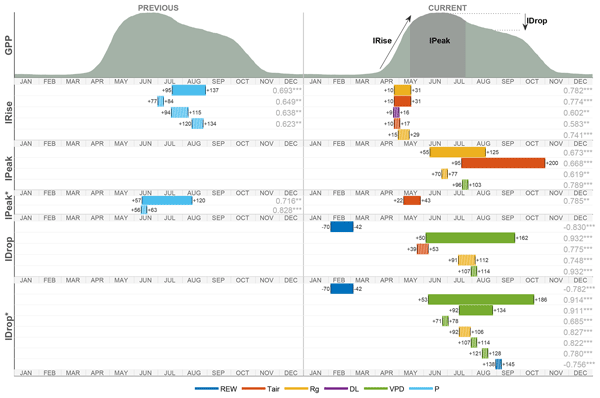
Abstract. Seasonal processes fundamentally shape forest carbon uptake, yet their timing and sensitivity remain poorly resolved. Using a 24‑year eddy‑covariance record from a maturing beech forest (FR‑Hes), we developed three annual ecophysiological indicators (IRise, IPeak and IDrop) of gross primary productivity (GPP) and assessed their environmental controls using phenology‑aligned sliding correlations across multiple window lengths and start dates relative to the start of season (SOS). This framework allowed us to identify precise seasonal timeframes in which climate drivers exert disproportionate influence on ecosystem productivity. Early‑season growth rate (IRise) emerged from the interaction between reserve availability, leaf ontogeny and early-spring (SOS+10 to SOS+31) light/temperature conditions. Peak productivity (IPeak) was strongly shaped by canopy structural development and, critically, by a one‑week precipitation window around bud‑set (SOS+56 to SOS+63) in the previous year, highlighting a developmental bottleneck that governs next‑year canopy potential. Mid‑season decline (IDrop) was driven overwhelmingly by atmospheric demand: two short VPD‑sensitive windows (SOS+92 to SOS+106 and SOS+107 to SOS+114) determined the onset and intensity of the summer drop, with flash‑drought years exhibiting earlier and sharper declines when these windows coincide with rapid early‑summer warming. Extreme summers produced a second striking pattern: when soil water remained available, peak GPP increased proportionally to temperature and radiation, suggesting active acclimation via thermotolerance, stomatal cooling and structural adjustments. Thinning effects, by contrast, were modest and transient. These findings demonstrate that beech forest productivity is governed by brief, phenologically constrained time windows that integrate physiology, developmental history and atmospheric forcing. By resolving these windows, our approach provides a mechanistic foundation for phenology‑explicit carbon‑cycle models and sharper predictions of forest responses under increasing climatic variability.
-
Notice on discussion status
The requested preprint has a corresponding peer-reviewed final revised paper. You are encouraged to refer to the final revised version.
-
Preprint
(1979 KB)
-
Supplement
(1732 KB)
-
The requested preprint has a corresponding peer-reviewed final revised paper. You are encouraged to refer to the final revised version.
- Preprint
(1979 KB) - Metadata XML
-
Supplement
(1732 KB) - BibTeX
- EndNote
- Final revised paper


Journal article(s) based on this preprint
Interactive discussion
Status: closed
-
RC1: 'Comment on egusphere-2026-1674', Anonymous Referee #1, 28 May 2026
- AC1: 'Reply on RC1', Jonathan Bitton, 28 Jun 2026
-
RC2: 'Comment on egusphere-2026-1674', Anonymous Referee #2, 29 May 2026
This is an ambitious and successful paper. The authors bring 24 years of high-quality eddy covariance data to bear on a genuinely important question: how do brief, seasonally specific environmental windows shape annual forest carbon uptake? The phenology-aligned sliding window correlation framework is creative, the discussion is impressively well-grounded in beech physiology, and Figure 4 in particular is a model of information-dense, intuitive visualization. I expect this will be a well-cited contribution to forest carbon cycling literature. Below I detail a handful of suggestions and questions regarding the statistical approach and methodological transparency, which I believe the authors can address in a minor revision. I provide these suggestions with the hope that they help clarify sections of the paper I found more opaque, and make the contribution stronger in its final published form.
Multiple comparisons are not addressed
The core analysis computes thousands of Pearson correlation coefficients, roughly one per window length (1-week steps, up to ~25 levels) × start date (1-day steps, ~300+ dates) × number of environmental variables (~6) × three indicators, for both current and previous year. With n = 24, even p ≤ 0.05 thresholds will yield many false positives by chance across this search space. The smoothed correlograms and the requirement for coherent spatial clusters of significance partially mitigate this concern visually, but no formal correction (Bonferroni, FDR, or permutation-based) is described or applied. I suggest that the authors either apply a correction or explicitly justify why the spatial coherence criterion is sufficient, and acknowledge the exploratory nature of the analysis.Sample size after sequential exclusions becomes very small for some key results
The full dataset is n = 22 usable years. For some analyses the effective n shrinks considerably further: the IPeak* analysis excludes 4 thinning years and 5 extreme-summer years, leaving ~13 years. The headline finding about the P56–63 one-week bud-set bottleneck for IPeak* (r = 0.828, p < 0.001) is based on this reduced dataset. I recommend that the authors state the exact sample size for each analysis and discuss the robustness of the P56–63 result explicitly (e.g., with a leave-one-out sensitivity check).The dependency on Part 1 is at times inhibiting
The WAI methodology, the foundation for all three indicators, is described only in the broadest strokes here. Readers who have not read Part 1 cannot evaluate whether the indicators are well-defined, whether the wavelet decomposition is appropriate, or whether the edge-padding strategy is valid. In particular:- The physical meaning of IDrop (ratio of DOG2 April peak to DOG2 November peak at 6-month period) is opaque. I had difficulty understanding what this captures: does a high IDrop value mean a large decline, a steep decline, or something else? Is there always a November peak? A brief schematic or supplementary figure showing the wavelet peaks and how each indicator is extracted would be very helpful.
- The normalization applied for IRise ("scaled between 0 and 1") is mentioned but not explained in detail: normalized across which time period? Does this normalization affect comparability across years?
- The Gaussian window used for IPeak extraction is not described.
Forest maturation versus climate change in the trend analyses
The forest was approximately 31 years old at the start of the record (1997) and 55 years old at the end (2020). This is a period of substantial stand development: LAI, canopy height, and stand structure all evolved considerably, and thinning events further altered stand composition. The paper discusses thinning effects but does not explicitly address whether the significant positive trend in IPeak and the negative trend in IRise could partly reflect forest ontogeny (increasing canopy closure, shift from rapid leaf expansion to sustained peak production as the canopy matures) rather than climate forcing alone. The extreme IPeak years (2013–2020) cluster at the end of the record, when the forest is also oldest. Could the authors test the effect of removing this trend?The section 3.1.1. & 3.1.2 headings are duplicated between pages 10 & 11
The negative IRise trend could have more discussion
The significant decline in IRise over 24 years (Fig. 3) is noted but its ecological interpretation is discussed leak than IPeak. As the stand matures and canopy closure increases, one might expect slower early-season GPP rise (less light penetration to understory, more self-shading) alongside higher peak productivity. This maturation interpretation could be contrasted against alternatives (e.g., earlier SOS reducing the "room to rise"). The negative IRise/IPeak correlation (stronger without thinning years) suggests these two indicators trade off against each other in a way that may be structurally driven (relating to forest maturation) rather than climatically driven.Line-by-Line Comments
L195–200: The WAI description mentions the "companion paper that forms the first part of this study". I’d provide the full citation here so readers can locate it.
L285: "IPeak exhibited a strong positive trend". I’d add the slope and p-value explicitly in the text, not just in Figure 3.
L288: "IDrop showed no significant long-term trend". I’d include the actual p-value here.
L300–303: The negative IRise–IPeak correlation is discussed as possibly reflecting "earlier saturation or stress onset." I would be good to mention other explanations here, too (canopy structure, leaf area development trade-offs, forest maturation).
L659: "a second, shot period": "short"?
L142: The reference to "Ottorini, personal communication" for the allometric equation (L142) is bit unusual. Is this equation available in any citable form?Overall, this is a well-conceived study with real scientific value. The findings are interesting and I thought that the figures were very well made. I believe the work should be published in Biogeosciences, and I hope that the suggestions that I’ve provided here help strengthen the final contribution. I look forward to seeing this work in print soon.
Citation: https://doi.org/10.5194/egusphere-2026-1674-RC2 - AC2: 'Reply on RC2', Jonathan Bitton, 28 Jun 2026
Peer review completion


Interactive discussion
Status: closed
-
RC1: 'Comment on egusphere-2026-1674', Anonymous Referee #1, 28 May 2026
In this study, the authors analyzed 24 years of carbon flux data at a European beech forest in northeastern France. They applied a Wavelet Area Interpretation approach to define GPP metrics characterizing (a) the rate of early season GPP increase, (b) the magnitude of peak GPP, and (c) declining late summer GPP. They then analyzed the effect of environmental variables on each metric by correlating various versions of the variables with the metrics, with versions defined by window length (e.g. VPD averaged over 1 week, 2 weeks, 3 weeks, etc.) and start date (referenced to the start of spring; 1 day increments). The authors provide an extensive and well-cited discussion of the correlation results in the context of beech’s physiological and ecophysiological seasonal patterns. They conclude, among many specifics about the correlations and their likely (eco)physiological implications, that “forest carbon dynamics must be understood through the lens of seasonal physiology, not annual summaries” (lines 831-32).
This is a useful study, carefully executed and thorough. I appreciate the authors’ deep thinking about their study site, and I hope, after some clarification and streamlining of the narrative, that this will be published in Biogeosciences.
Overarching suggestions:
- Regarding your three GPP metrics: why these particular metrics? (Why not, for example, the rate of decline rather than the offset between two peaks)? Do you really need to name them “IRise,” “IPeak,” and “IDrop,” rather than using short phrases to call them what they are? At the least, please include a detailed schematic labeling these metrics when they are introduced; I didn’t understand what IDrop was until I made it to Figure 4, and even then, I still had some questions (is there always a second peak? What is the usefulness of this particular metric?).
- Statistical methods require some clarification. I don’t understand: (i) how longer correlation windows were “decomposed” into shorter windows (L240, L251-254); (ii) how “overlapping correlations” (L243) were defined (for example: what if the window for A overlaps with B and the B window overlaps with C, but C and A don’t overlap – are these all in the same group?); or (iii) how the partial correlation analyses were done to identify the most influential variables. What if VPD and Tair both, individually, “rendered remaining [variables] non-significant” (L247) – how would you decide which was more influential?
- I appreciate your well-researched introduction and discussion, but they often stray quite far from the actual study. Wherever possible, it would be helpful if you can directly connect to your study topic and results. (See line-by-line notes for, e.g., L43, 66, 621-636). In the discussion, I suggest leading with the main result and then following with the (possibly) explanatory details, continuing to reference results as useful.
- Your discussion is thorough in contextualizing results, but it is missing some key points related to the methods. How do you expect that the fact that beech is only ~75% of the basal area to influence results, if at all? What is the implication, if any, of using the nighttime partitioning method? Why did you choose to test just one year of legacy effect? Could you discuss the variability of timing in the GPP indicators across years and how that might influence the correlations with environmental variables quantified in particular windows?
Line-by-line comments:
L18. At this stage in the manuscript, it’s not clear why VPD92-106 and VPD107-114 would be considered separate windows.
L43. Short-term climatic drivers of what?
L63. influences -> influence
L66. Re. “how beech responds” – in terms of what? Carbon? Mortality? Something else? This is still very broad.
L110. What are “Warm Winter records”?
L127. aerial drought -> atmospheric drought
L128-133. Provide equations please (and number all equations, to be referenced in the text).
L142. What is the relationship between “trunk” and “shoot”? What data support the inclusion of root biomass in “B”?
L151-4. Provide equations please
L175-77. What sensors were used to measure albedo and NDVI?
L182-5. Why were there times when the GPP definition wasn’t available? Did these definitions, when multiple were available, typically agree (this could be in a supplement)?
L220. Are all the correlations linear?
L229. I suggest a “for example” parenthetical here to clarify: “This approach produced one average value per year for each window configuration (for example, one VPD value for a week-long window beginning at SOS+0, one for a week long window beginning SOS+1, etc.).”
L244. influent -> influential
L256. Residuals of what model?
L303. indicating -> suggesting
L306. Again, I’m confused by where these residuals are coming from.
L342. Rg15-29 is also in Fig. 4 (in addition to Rg10-31), and it has a larger correlation than Rg10-31 – why isn’t is considered here?
L379. The Rg significant window was actually 9 days later than maximum incident radiation; does this really correspond?
L38506. I don’t see any thresholds in these figures…
L387. Consider labeling 2003 on Fig. 6
L413. What about prior year P56-63?
L424. But none of the extreme years were next to each other except 2018/19
L426. I don’t see “Rg began correlating with IDrop from SOS+8 onward in either Fig 4. Or Fig S3 – what am I missing?
L433. But VPD and REW are correlated (and causally related) – how did you decide which of these was more important (see broad note about statistical method clarification)
L446-49. Why should stress AFTER the drop influence the drop?
L455. This seems to conflict with L438.
L461. show with -> have
L513 – 514. I don’t really understand this.
L541. It looks like pretty strong coupling in Figure 6 to me.
L542. 2013, 2014, 2018, 2019, 2020 are not notably less scattered around the fit line than the other years.
L621-36. How is this section connected to your analyses?
L644. Higher sensitivity to atmospheric demand than to what?
L645-6. This is a convoluted sentence, and I don’t think it’s supported by the fact that VPD correlates well with IDrop.
L660. shot -> short
L664. aerial -> atmospheric
L671. drought -> droughts
L779-784. I don’t think this all follows. Severe thinning reduces IPeak whereas minor thinning doesn’t; how does this suggest that loss of photosynthetic surface outweighs effects of increased light availability and competition release? – this would only be the case for severe thinning, presumably.
Figure 1. Nice figure! Please connect the references with the processes using, for example, superscripts.
Figure 3. What are the units for IRise, IPeak, and IDrop? The second column of figures is NOT residuals from the models in the first column, which is confusing… where do these residuals come from? Consider labeling all the years, not just extreme years. Re. “Years affected by thinning” – what makes you think that the thinning is only influential in the year it is done?
Figure 4. What a great figure! It really gets a lot of information across in an intuitive way. Would it be useful to scale the thickness of the bars to the correlation coefficient (maybe not?). How did you decide how to order the correlation bars from top to bottom within each section? Consider ordering by correlation magnitude or by beginning date of the correlation window. **Which correlations are shown? Sometimes, in the text, windows are referenced as though they’re significant but they’re not in this figure – e.g. L355, L382, L427-430, L518. Or, windows are in the figure but are omitted from the text as though they’re not significant -- e.g. L413.
Figure 7. This is a particularly information-light figure; add all year labels; consider scatter plots with Reco, gc on the y axis and extremity on the x axis.
Table S1. What does bold mean? It’s not clear which effects are dominant.
Citation: https://doi.org/10.5194/egusphere-2026-1674-RC1 - AC1: 'Reply on RC1', Jonathan Bitton, 28 Jun 2026
-
RC2: 'Comment on egusphere-2026-1674', Anonymous Referee #2, 29 May 2026
This is an ambitious and successful paper. The authors bring 24 years of high-quality eddy covariance data to bear on a genuinely important question: how do brief, seasonally specific environmental windows shape annual forest carbon uptake? The phenology-aligned sliding window correlation framework is creative, the discussion is impressively well-grounded in beech physiology, and Figure 4 in particular is a model of information-dense, intuitive visualization. I expect this will be a well-cited contribution to forest carbon cycling literature. Below I detail a handful of suggestions and questions regarding the statistical approach and methodological transparency, which I believe the authors can address in a minor revision. I provide these suggestions with the hope that they help clarify sections of the paper I found more opaque, and make the contribution stronger in its final published form.
Multiple comparisons are not addressed
The core analysis computes thousands of Pearson correlation coefficients, roughly one per window length (1-week steps, up to ~25 levels) × start date (1-day steps, ~300+ dates) × number of environmental variables (~6) × three indicators, for both current and previous year. With n = 24, even p ≤ 0.05 thresholds will yield many false positives by chance across this search space. The smoothed correlograms and the requirement for coherent spatial clusters of significance partially mitigate this concern visually, but no formal correction (Bonferroni, FDR, or permutation-based) is described or applied. I suggest that the authors either apply a correction or explicitly justify why the spatial coherence criterion is sufficient, and acknowledge the exploratory nature of the analysis.Sample size after sequential exclusions becomes very small for some key results
The full dataset is n = 22 usable years. For some analyses the effective n shrinks considerably further: the IPeak* analysis excludes 4 thinning years and 5 extreme-summer years, leaving ~13 years. The headline finding about the P56–63 one-week bud-set bottleneck for IPeak* (r = 0.828, p < 0.001) is based on this reduced dataset. I recommend that the authors state the exact sample size for each analysis and discuss the robustness of the P56–63 result explicitly (e.g., with a leave-one-out sensitivity check).The dependency on Part 1 is at times inhibiting
The WAI methodology, the foundation for all three indicators, is described only in the broadest strokes here. Readers who have not read Part 1 cannot evaluate whether the indicators are well-defined, whether the wavelet decomposition is appropriate, or whether the edge-padding strategy is valid. In particular:- The physical meaning of IDrop (ratio of DOG2 April peak to DOG2 November peak at 6-month period) is opaque. I had difficulty understanding what this captures: does a high IDrop value mean a large decline, a steep decline, or something else? Is there always a November peak? A brief schematic or supplementary figure showing the wavelet peaks and how each indicator is extracted would be very helpful.
- The normalization applied for IRise ("scaled between 0 and 1") is mentioned but not explained in detail: normalized across which time period? Does this normalization affect comparability across years?
- The Gaussian window used for IPeak extraction is not described.
Forest maturation versus climate change in the trend analyses
The forest was approximately 31 years old at the start of the record (1997) and 55 years old at the end (2020). This is a period of substantial stand development: LAI, canopy height, and stand structure all evolved considerably, and thinning events further altered stand composition. The paper discusses thinning effects but does not explicitly address whether the significant positive trend in IPeak and the negative trend in IRise could partly reflect forest ontogeny (increasing canopy closure, shift from rapid leaf expansion to sustained peak production as the canopy matures) rather than climate forcing alone. The extreme IPeak years (2013–2020) cluster at the end of the record, when the forest is also oldest. Could the authors test the effect of removing this trend?The section 3.1.1. & 3.1.2 headings are duplicated between pages 10 & 11
The negative IRise trend could have more discussion
The significant decline in IRise over 24 years (Fig. 3) is noted but its ecological interpretation is discussed leak than IPeak. As the stand matures and canopy closure increases, one might expect slower early-season GPP rise (less light penetration to understory, more self-shading) alongside higher peak productivity. This maturation interpretation could be contrasted against alternatives (e.g., earlier SOS reducing the "room to rise"). The negative IRise/IPeak correlation (stronger without thinning years) suggests these two indicators trade off against each other in a way that may be structurally driven (relating to forest maturation) rather than climatically driven.Line-by-Line Comments
L195–200: The WAI description mentions the "companion paper that forms the first part of this study". I’d provide the full citation here so readers can locate it.
L285: "IPeak exhibited a strong positive trend". I’d add the slope and p-value explicitly in the text, not just in Figure 3.
L288: "IDrop showed no significant long-term trend". I’d include the actual p-value here.
L300–303: The negative IRise–IPeak correlation is discussed as possibly reflecting "earlier saturation or stress onset." I would be good to mention other explanations here, too (canopy structure, leaf area development trade-offs, forest maturation).
L659: "a second, shot period": "short"?
L142: The reference to "Ottorini, personal communication" for the allometric equation (L142) is bit unusual. Is this equation available in any citable form?Overall, this is a well-conceived study with real scientific value. The findings are interesting and I thought that the figures were very well made. I believe the work should be published in Biogeosciences, and I hope that the suggestions that I’ve provided here help strengthen the final contribution. I look forward to seeing this work in print soon.
Citation: https://doi.org/10.5194/egusphere-2026-1674-RC2 - AC2: 'Reply on RC2', Jonathan Bitton, 28 Jun 2026
Peer review completion
Journal article(s) based on this preprint
Data sets
FR-Hes dataset (1997–2020) Jonathan Bitton and Bernard Longdoz https://doi.org/10.5281/zenodo.19207876
Model code and software
WAI matlab/python codes Jonathan Bitton https://doi.org/10.5281/zenodo.19207876
Viewed
| HTML | XML | Total | Supplement | BibTeX | EndNote | |
|---|---|---|---|---|---|---|
| 459 | 200 | 49 | 708 | 105 | 41 | 45 |
- HTML: 459
- PDF: 200
- XML: 49
- Total: 708
- Supplement: 105
- BibTeX: 41
- EndNote: 45
Viewed (geographical distribution)
| Country | # | Views | % |
|---|
| Total: | 0 |
| HTML: | 0 |
| PDF: | 0 |
| XML: | 0 |
- 1
Jonathan Bitton

Bernard Heinesch
Catherine Charles
Bernard Longdoz
The requested preprint has a corresponding peer-reviewed final revised paper. You are encouraged to refer to the final revised version.
- Preprint
(1979 KB) - Metadata XML
-
Supplement
(1732 KB) - BibTeX
- EndNote
- Final revised paper
In this study, the authors analyzed 24 years of carbon flux data at a European beech forest in northeastern France. They applied a Wavelet Area Interpretation approach to define GPP metrics characterizing (a) the rate of early season GPP increase, (b) the magnitude of peak GPP, and (c) declining late summer GPP. They then analyzed the effect of environmental variables on each metric by correlating various versions of the variables with the metrics, with versions defined by window length (e.g. VPD averaged over 1 week, 2 weeks, 3 weeks, etc.) and start date (referenced to the start of spring; 1 day increments). The authors provide an extensive and well-cited discussion of the correlation results in the context of beech’s physiological and ecophysiological seasonal patterns. They conclude, among many specifics about the correlations and their likely (eco)physiological implications, that “forest carbon dynamics must be understood through the lens of seasonal physiology, not annual summaries” (lines 831-32).
This is a useful study, carefully executed and thorough. I appreciate the authors’ deep thinking about their study site, and I hope, after some clarification and streamlining of the narrative, that this will be published in Biogeosciences.
Overarching suggestions:
Line-by-line comments:
L18. At this stage in the manuscript, it’s not clear why VPD92-106 and VPD107-114 would be considered separate windows.
L43. Short-term climatic drivers of what?
L63. influences -> influence
L66. Re. “how beech responds” – in terms of what? Carbon? Mortality? Something else? This is still very broad.
L110. What are “Warm Winter records”?
L127. aerial drought -> atmospheric drought
L128-133. Provide equations please (and number all equations, to be referenced in the text).
L142. What is the relationship between “trunk” and “shoot”? What data support the inclusion of root biomass in “B”?
L151-4. Provide equations please
L175-77. What sensors were used to measure albedo and NDVI?
L182-5. Why were there times when the GPP definition wasn’t available? Did these definitions, when multiple were available, typically agree (this could be in a supplement)?
L220. Are all the correlations linear?
L229. I suggest a “for example” parenthetical here to clarify: “This approach produced one average value per year for each window configuration (for example, one VPD value for a week-long window beginning at SOS+0, one for a week long window beginning SOS+1, etc.).”
L244. influent -> influential
L256. Residuals of what model?
L303. indicating -> suggesting
L306. Again, I’m confused by where these residuals are coming from.
L342. Rg15-29 is also in Fig. 4 (in addition to Rg10-31), and it has a larger correlation than Rg10-31 – why isn’t is considered here?
L379. The Rg significant window was actually 9 days later than maximum incident radiation; does this really correspond?
L38506. I don’t see any thresholds in these figures…
L387. Consider labeling 2003 on Fig. 6
L413. What about prior year P56-63?
L424. But none of the extreme years were next to each other except 2018/19
L426. I don’t see “Rg began correlating with IDrop from SOS+8 onward in either Fig 4. Or Fig S3 – what am I missing?
L433. But VPD and REW are correlated (and causally related) – how did you decide which of these was more important (see broad note about statistical method clarification)
L446-49. Why should stress AFTER the drop influence the drop?
L455. This seems to conflict with L438.
L461. show with -> have
L513 – 514. I don’t really understand this.
L541. It looks like pretty strong coupling in Figure 6 to me.
L542. 2013, 2014, 2018, 2019, 2020 are not notably less scattered around the fit line than the other years.
L621-36. How is this section connected to your analyses?
L644. Higher sensitivity to atmospheric demand than to what?
L645-6. This is a convoluted sentence, and I don’t think it’s supported by the fact that VPD correlates well with IDrop.
L660. shot -> short
L664. aerial -> atmospheric
L671. drought -> droughts
L779-784. I don’t think this all follows. Severe thinning reduces IPeak whereas minor thinning doesn’t; how does this suggest that loss of photosynthetic surface outweighs effects of increased light availability and competition release? – this would only be the case for severe thinning, presumably.
Figure 1. Nice figure! Please connect the references with the processes using, for example, superscripts.
Figure 3. What are the units for IRise, IPeak, and IDrop? The second column of figures is NOT residuals from the models in the first column, which is confusing… where do these residuals come from? Consider labeling all the years, not just extreme years. Re. “Years affected by thinning” – what makes you think that the thinning is only influential in the year it is done?
Figure 4. What a great figure! It really gets a lot of information across in an intuitive way. Would it be useful to scale the thickness of the bars to the correlation coefficient (maybe not?). How did you decide how to order the correlation bars from top to bottom within each section? Consider ordering by correlation magnitude or by beginning date of the correlation window. **Which correlations are shown? Sometimes, in the text, windows are referenced as though they’re significant but they’re not in this figure – e.g. L355, L382, L427-430, L518. Or, windows are in the figure but are omitted from the text as though they’re not significant -- e.g. L413.
Figure 7. This is a particularly information-light figure; add all year labels; consider scatter plots with Reco, gc on the y axis and extremity on the x axis.
Table S1. What does bold mean? It’s not clear which effects are dominant.