
the Creative Commons Attribution 4.0 License.
the Creative Commons Attribution 4.0 License.
 | 08 Apr 2026
Land carbon response to positive, zero, and negative CO2 emissions across Earth system models
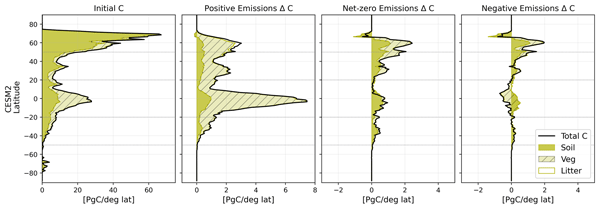
Abstract. Land carbon sinks are responsible for removing about a quarter of anthropogenic CO2 emissions, and make up approximately half of total global carbon sinks. Uncertainty in the response of land carbon sinks to climate and changing atmospheric CO2 are large, and dominate the uncertainty in total carbon sinks under future climate. Understanding the carbon cycle response to net-zero and net-negative emissions has important implications for projecting future climate. Experiments in the "flat10" model intercomparison were designed for directly estimating key climate metrics that underlie carbon budgeting frameworks. Here we characterize the response of land carbon pools and fluxes from ten emissions-driven Earth system models (ESMs) under positive, net-zero, and net-negative CO2 emissions. Although there are many differences in simulated land carbon pools and fluxes across models, we find some consistent behavior across ESMs. 1) During the positive emissions phase, carbon is gained on land primarily in vegetation pools. 2) Following net-negative emissions to the point of cumulative zero emissions, carbon is lost from land in tropical latitudes, primarily from vegetation pools, but in mid- and high-latitudes most models show net land carbon gain, primarily in soil pools. 3) Following an extended period of net-zero emissions, a majority of models again show carbon gain in mid- and high-latitudes and vegetation carbon loss in the tropics. Under net-negative emissions the timing of vegetation carbon response relative to peak emissions is relatively consistent across ESMs, but timing of soil carbon response varies widely, implying larger intermodel disagreement associated with responses of soil carbon which tends to have longer timescales relative to vegetation carbon. Our findings highlight that tropical carbon is most likely to be both gained and subsequently lost under positive, zero, declining, and negative emissions, with possible implications for carbon dioxide removal efforts.
-
Notice on discussion status
The requested preprint has a corresponding peer-reviewed final revised paper. You are encouraged to refer to the final revised version.
-
Preprint
(5766 KB)
-
The requested preprint has a corresponding peer-reviewed final revised paper. You are encouraged to refer to the final revised version.
- Preprint
(5766 KB) - Metadata XML
- BibTeX
- EndNote
- Final revised paper


Journal article(s) based on this preprint
Interactive discussion
Status: closed
-
RC1: 'Comment on egusphere-2026-1673', Anonymous Referee #1, 08 May 2026
- AC1: 'Reply on RC1', Abigail Swann, 26 Jun 2026
-
RC2: 'Comment on egusphere-2026-1673', Anonymous Referee #2, 18 May 2026
Synopsis and general comments
The manuscript “Land carbon response to positive, zero, and negative CO2 emissions across Earth system models” reports on the carbon stock and flux responses of a ten-member model ensemble forced with schematic “flat10MIP” emission trajectories. Model spread is generally substantial, but common responses can also be identified, particularly under ongoing (positive) emissions and in tropical latitudes following sustained net-negative-emission forcing. This paper is relevant to the Earth system modeling community and, although it draws on schematic scenarios, has societal implications beyond.
I have three general comments on (i) the scope, (ii) the model description and comparison, and (iii) accessibility.
(i) The paper’s motivation, as described in the introduction, draws on the zero emissions commitment. Its introduction also discusses previous estimates and the recent “flat10MIP” trial. However, although this is the predominant motivation, the manuscript neither refers to a companion paper that provides an updated estimate nor does it provide such an estimate itself. Because the ZEC is sort of in the graphs of Figure 1, but is nowhere discussed (unless I have completely overlooked it), this is a bit irritating when reading the paper. I would prefer that the number be computed and discussed, or that a reference to a companion paper be added ahead of publication.
(ii) The model description (Section 2.2) confused me because it seems arbitrary that some ESMs are described in great detail (e.g., including ocean components and sea ice dynamics), while for other ESMs, the land components are the only focus. This complicates comparisons between models because it is unclear whether a model does not represent a specific process described elsewhere or whether it was simply left out of its description paragraph. I suggest restricting the model description to essential ESM parameters, soil biogeochemistry, photosynthesis, vegetation dynamics, maybe water budget, and balancing the level of detail across all descriptions. For example, one aspect that should be added to all model descriptions is the atmospheric/land model grid size. Right now, this is only the case for some of the models. If the authors decide to detail the representation of natural disturbances or the spin-up (e.g. GFDL-ESM4), they would also have to do so for the other ones. On the other hand, Farquahar et al.’s and Collatz et al.’s work are presumably the fundamental basis for parameterizing photosynthesis in every one of the models (?), so this could be summarized in a common paragraph, for example, in 2.4.
In turn, I encourage the authors to use the additional space to discuss model differences that could have mechanistic implications for explaining the large spread in more detail. Currently, the paper does not systematically identify specific takeaways that could prompt model development, especially regarding soil carbon dynamics. Is it only permafrost that sets the models apart? Is the spread across ESM with more intricate soil components smaller than between those with less comprehensive soil models? Or is there something else that could be a pointer for future development? Which process(es) would be most relevant to investigate for reducing model spread under flat10MIP-style experiments? A suitable spot for summarizing these sorts of differences could be Sections 2.3-2.5, and this could then be picked up in the results & discussion. Also, I wonder if these Sections 2.3-2.5 could be grouped under a common subtitle, “commonalities and differences between model setup,” or something similar, since this is their shared (and important) theme, though they do not currently discuss it in great detail.
(iii) The figures are clean and supportive of the findings discussed in the text. However, it seems to me that most figures are not colorblind-friendly, which should be checked. The text presentation is generally okay, but I got the impression that the manuscript was written quickly and has not received much proofreading. I encourage investing additional time in proofreading to remove punctuation mistakes, redundancies, and cluttered sentences (some of which are specified below, but the list is not extensive).
A question remained open for me: Partly (e.g. paragraph about GFDL-ESM4), it appeared as if land use (change) and harvest were considered a boundary condition for the simulations, which would complicate interpreting these otherwise idealized experiments. If so, model differences regarding land use and harvest would need to be clarified, and potential effects on the results discussed later. For example, it would be critical to know in which C pool harvests end up over short/medium/long term. However, land use/harvest shouldn’t be different between models contributing flat10 experiments, should it?
Based on my impression, I recommend minor revisions.
Specific comments & technical corrections
l. 3-4 Sentence could be more specific and linked to the subsequent sentence. What is the research gap that the flat10 experiments specifically fill?
l. 25 Is this Friedlingstein et al. 2025, too? If so, the reference should be put here as well and not only at the end of the paragraph. Otherwise, the quoted figures need a reference.
l. 26 Since the budget is broken down into contributions of individual compartments, it should be noted where the remaining 10% end up.
l. 28 biologically? Also, “biogeochemically” might be more fitting and comprehensive
l. 46-7 three times “large” - maybe there is a way to come up with a different expression?
l. 48 does this spread really apply to all models? Are there more recent examples from CMIP5/6 than from the CMIP3 era?
l. 49-53 This is a long sentence, could be split
l. 55 The second phrase of the paragraph doesn’t really fit to the remaining paragraph. It could be cut or moved to the previous paragraph.
l. 67 The ZEC should have a unit.
l. 82 The “intriguing behavior” should be specified.
Intro in general: I figure it is important to specify that removals in this type of experiment are effective removals in the forcing and not made (spatially) explicit in any way in the ESMs. Spelling out CDR in an ESM may reveal different effects on (land) carbon uptake and climate-C cycle feedbacks depending on the specific method(s) being used for removals (e.g. Zickfeld et al. 2023 Nat Clim Change). Later on, I found a sentence touching on this aspect in the conclusions, but I consider it a core limitation of the experimental design that should appear in the introduction or methods.
l. 104 “emissions are"
Fig 1
- Indicating the time frames that are used to define the points of “net-zero emissions DeltaC” (Fig 2), “zero cumulative emissions DeltaC” (Fig 2, l. 420), etc. could help bridge between all the different panels & figures.
- For me, the caption should explain the averaging timescale and method employed to obtain the thick curves compared to the presumably annual (?), unsmoothed data.
- It is obvious, but an x axis label “simulation year” or similar could be added
- panels c & f have a line label that is redundant with y axis labels and caption. Could be removed.
- vertical lines indicate the timing of net-zero emissions etc, but I couldn’t find it being specified in the text. Might have overlooked it, but it should be specified.l. 115 Because “negative emissions” is also being used synonymously with “carbon removals”, using the term “positive emissions” instead of just “emissions” here would be unambiguous
l. 115 I would specify that the “average around” refers to a time point. The sentence is quite long, and initially I got confused by the way it is phrased at the moment.
l. 134 representation (no “s”)
Section 2.2 Is there a reason why the length of model descriptions vary widely between the different models? Are GFDL-ESM4, GISS-E2.1-G-CC2 and CNRM-ESM2-1 specifically relevant for the study? Or do these model versions just differ the most to the citeable literature?
l. 246 The “q10” dependence should be briefly explained and referenced.
l. 261 I reckon “MATSIRO” should be outside brackets?
l. 271 Where does the litter end up in the models that do not report cLitter? Looking at F2, in comparison to the other models, it looks like the soil pool?
l. 275 In the table, it says “4 for each 20 layers” also for GFDL-ESM4. Is the GFDL land model similar to CLM?
l. 294 Missing comma: In GFDL-ESM4, plants
Section 3.1.1 This section lacks a clear storyline and appears quickly drafted, making it hard to read. I suggest giving it another round of a makeover. Maybe a brief introductory statement could help (potentially by reordering parts of the section) and avoiding too many sentences that build on “have”.
l. 235-8 Is there an indication that spin-up is really the dominant reason for model spread? I would expect the models to be properly spun up before the start of the transient experiments. Otherwise, it would be really hard to draw any meaningful results, for example, from comparing positive and negative emission phases/asymmetries.
l. 235-40 Does this conform with the results in the transient phases of the scenarios?
Fig 2 I would maybe avoid “phase” in the caption because the three types of scenarios shown in the figure do not follow after one another chronologically.
l. 325-7 Something is wrong with this sentence
l. 349, 357 missing commas (consider checking throughout the manuscript): During the .. phase, ..; As cumulative emissions increase, it…
l. 372 This is not directly obvious, so I’d suggest adding a reference.
l. 383-5 The second half of this sentence is confusing. Consider splitting it up.
l. 390-7 What should those notes tell the reader, how do they relate to the two hypotheses? I don’t really get the focus/intention of this paragraph.
l. 395 MPI-ESM1-2-LR
l. 401 global carbon stocks
l. 402-4 This is misleading: 5 out of 10 models showing tropical C losses is not “most” and vegetation C decline in 6 out of ten models is not “all” (referring to Fig 2i).
l. 408 I’d suggest “constant” instead of “flat”.
l. 431-3 This sentence is also confusing.
l. 443 Would the vegetation models actually be able to represent substantial delays (>= decadal) of fertilization effects, given that modeled photosynthesis and NPP respond immediately to CO2? Or would the authors expect any such delay from observations/first principles?
l. 447 punctuation: world. In particular,
l. 449 As far as I know, at least the MPI model operationally contains a component for fires. Has it been disabled for these simulations? If enabled, I don’t see its response being particularly strong compared to the other models, so I wonder if this aspect would actually play a substantial role.
l. 465 Is there a possibility to verify this based on GFDL-ESM4 papers/model documentation? Then, this could be turned into a definite statement.
l. 468 word order: both due to
l. 512-4 This sounds a bit as if the ESMs were more or less deliberately “mistuned”. “Accurate” land carbon stocks are an important tuning objective of ESMs, as documented in model description papers. I agree with the second part of the sentence; perhaps the first half could be rephrased or specified?
l. 524 CO2 removals are relevant for net-zero emission scenarios too, maybe even for low-emission stabilization. Therefore, net-zero emission scenarios (such as esm-flat10-zec) also contain implicit removals, so this should be added.
Citation: https://doi.org/10.5194/egusphere-2026-1673-RC2 - AC1: 'Reply on RC1', Abigail Swann, 26 Jun 2026
Peer review completion


Interactive discussion
Status: closed
-
RC1: 'Comment on egusphere-2026-1673', Anonymous Referee #1, 08 May 2026
Review of Land carbon response to positive, zero, and negative CO2 emissions across ESMs by A.L.S. Swann et al.
The paper begins by pointing out that the land has served as a carbon sink over the historical period, suggesting that increases in photosynthesis have outpaced increases in respiration. However, the future of this land carbon sink is highly uncertain, due to competing impacts of meteorological and atmospheric conditions on the individual processes, as well as potential effects from events like fires and pest/disease outbreaks.
The “zero emissions commitment” (ZEC) is defined as the Earth system response when emissions cease, and it is quantified as the change in global mean temperature after annual emissions reach zero. Prior ESM experiments suggest that after zero emissions are reached, the land and oceans continue to uptake CO2 (leading to cooling), but ocean heat uptake slows down (leading to warming). These processes generally balance to give a ZEC of 0+/-0.3. A limitation of these previous experiments is that the emissions were different in each model, so timescales for carbon cycle responses were not consistent across models. Now in a new set of experiments, flat10MIP, the emission rates are specified ahead of time. This paper focuses on the response of the land carbon pools and fluxes to specified emissions in 10 ESMs that participated in flat10MIP.
This paper provides an important contribution to our understanding of the land carbon cycle response to net zero emissions, a policy-relevant concept that can help us anticipate carbon-climate feedbacks if countries keep to the ambitions of the Paris Climate Agreement. It comprehensively covers the responses during phases of positive emissions, net zero, and net negative emissions. The figures are very helpful for understanding the text, as well.
I have several minor editorial comments. My most substantial comment relates to Section 4. I believe the authors have rightly pointed out the importance of soil carbon processes as a key limiting factor in predicting Earth system responses under net zero emissions. Can any information be gleaned from the analysis of this group of models about specific directions for future research and development for soil carbon, other than the obvious broad area of better representing permafrost? Also, for tropical carbon, it was suggested that missing processes are causing a high bias in carbon storage (Lines 445-453) – is there enough evidence to suggest whether missing processes or structural representation in the soil carbon components could be biasing the results in one direction? It would be elucidating to have a brief discussion of these implications.
Minor comments
Lines 68-70: The wording of these two sentences is a little confusing, making it sound like ZECMIP simulations were not emissions-driven, or at least leaving it a little ambiguous. I suggest minor rewording to make it clear that they were emissions-driven.
Line 95ish: I understand the necessity of a paper focusing on the land carbon response, but what happens with ocean carbon in these experiments (very generally / briefly)? Is there a companion paper focusing on the ocean that can be mentioned here?
Methods: Clear description of the protocol, and all panels in Figure 1 are helpful! My one suggestion is to summarize the metrics described in Section 2.1 in a table or graphically – I found myself drawing boxes and arrows on the figure to distinguish the timeframes discussed.
Line 196: Please confirm how land use was specified in all experiments – my understanding was that flat10MIP applied constant preindustrial land use, but this statement makes it sound like NASA-GISS-ES may have used something else.
Line 206: Are the land models exactly the same between these versions of CESM and Nor-ESM?
Lines 364-365: Only 2 out of 4 continue this pattern to 3000 PgC. The wording “Many” is misleading.
Line 478: The figure reference here is incorrect, since there’s not a Figure 11.
Table 1: This is a very helpful summary table. But two additional factors could be at play – how many of the models use interactive fires? (Sounds like MPI, but maybe others?) Also, what is the maximum depth of the soil C pools? The number of pools doesn’t seem to summarize this info, since for example NASA-GISS ha 9 pools but only represents the top 30 cm, but it could be helpful for interpreting some of the results.
Citation: https://doi.org/10.5194/egusphere-2026-1673-RC1 - AC1: 'Reply on RC1', Abigail Swann, 26 Jun 2026
-
RC2: 'Comment on egusphere-2026-1673', Anonymous Referee #2, 18 May 2026
Synopsis and general comments
The manuscript “Land carbon response to positive, zero, and negative CO2 emissions across Earth system models” reports on the carbon stock and flux responses of a ten-member model ensemble forced with schematic “flat10MIP” emission trajectories. Model spread is generally substantial, but common responses can also be identified, particularly under ongoing (positive) emissions and in tropical latitudes following sustained net-negative-emission forcing. This paper is relevant to the Earth system modeling community and, although it draws on schematic scenarios, has societal implications beyond.
I have three general comments on (i) the scope, (ii) the model description and comparison, and (iii) accessibility.
(i) The paper’s motivation, as described in the introduction, draws on the zero emissions commitment. Its introduction also discusses previous estimates and the recent “flat10MIP” trial. However, although this is the predominant motivation, the manuscript neither refers to a companion paper that provides an updated estimate nor does it provide such an estimate itself. Because the ZEC is sort of in the graphs of Figure 1, but is nowhere discussed (unless I have completely overlooked it), this is a bit irritating when reading the paper. I would prefer that the number be computed and discussed, or that a reference to a companion paper be added ahead of publication.
(ii) The model description (Section 2.2) confused me because it seems arbitrary that some ESMs are described in great detail (e.g., including ocean components and sea ice dynamics), while for other ESMs, the land components are the only focus. This complicates comparisons between models because it is unclear whether a model does not represent a specific process described elsewhere or whether it was simply left out of its description paragraph. I suggest restricting the model description to essential ESM parameters, soil biogeochemistry, photosynthesis, vegetation dynamics, maybe water budget, and balancing the level of detail across all descriptions. For example, one aspect that should be added to all model descriptions is the atmospheric/land model grid size. Right now, this is only the case for some of the models. If the authors decide to detail the representation of natural disturbances or the spin-up (e.g. GFDL-ESM4), they would also have to do so for the other ones. On the other hand, Farquahar et al.’s and Collatz et al.’s work are presumably the fundamental basis for parameterizing photosynthesis in every one of the models (?), so this could be summarized in a common paragraph, for example, in 2.4.
In turn, I encourage the authors to use the additional space to discuss model differences that could have mechanistic implications for explaining the large spread in more detail. Currently, the paper does not systematically identify specific takeaways that could prompt model development, especially regarding soil carbon dynamics. Is it only permafrost that sets the models apart? Is the spread across ESM with more intricate soil components smaller than between those with less comprehensive soil models? Or is there something else that could be a pointer for future development? Which process(es) would be most relevant to investigate for reducing model spread under flat10MIP-style experiments? A suitable spot for summarizing these sorts of differences could be Sections 2.3-2.5, and this could then be picked up in the results & discussion. Also, I wonder if these Sections 2.3-2.5 could be grouped under a common subtitle, “commonalities and differences between model setup,” or something similar, since this is their shared (and important) theme, though they do not currently discuss it in great detail.
(iii) The figures are clean and supportive of the findings discussed in the text. However, it seems to me that most figures are not colorblind-friendly, which should be checked. The text presentation is generally okay, but I got the impression that the manuscript was written quickly and has not received much proofreading. I encourage investing additional time in proofreading to remove punctuation mistakes, redundancies, and cluttered sentences (some of which are specified below, but the list is not extensive).
A question remained open for me: Partly (e.g. paragraph about GFDL-ESM4), it appeared as if land use (change) and harvest were considered a boundary condition for the simulations, which would complicate interpreting these otherwise idealized experiments. If so, model differences regarding land use and harvest would need to be clarified, and potential effects on the results discussed later. For example, it would be critical to know in which C pool harvests end up over short/medium/long term. However, land use/harvest shouldn’t be different between models contributing flat10 experiments, should it?
Based on my impression, I recommend minor revisions.
Specific comments & technical corrections
l. 3-4 Sentence could be more specific and linked to the subsequent sentence. What is the research gap that the flat10 experiments specifically fill?
l. 25 Is this Friedlingstein et al. 2025, too? If so, the reference should be put here as well and not only at the end of the paragraph. Otherwise, the quoted figures need a reference.
l. 26 Since the budget is broken down into contributions of individual compartments, it should be noted where the remaining 10% end up.
l. 28 biologically? Also, “biogeochemically” might be more fitting and comprehensive
l. 46-7 three times “large” - maybe there is a way to come up with a different expression?
l. 48 does this spread really apply to all models? Are there more recent examples from CMIP5/6 than from the CMIP3 era?
l. 49-53 This is a long sentence, could be split
l. 55 The second phrase of the paragraph doesn’t really fit to the remaining paragraph. It could be cut or moved to the previous paragraph.
l. 67 The ZEC should have a unit.
l. 82 The “intriguing behavior” should be specified.
Intro in general: I figure it is important to specify that removals in this type of experiment are effective removals in the forcing and not made (spatially) explicit in any way in the ESMs. Spelling out CDR in an ESM may reveal different effects on (land) carbon uptake and climate-C cycle feedbacks depending on the specific method(s) being used for removals (e.g. Zickfeld et al. 2023 Nat Clim Change). Later on, I found a sentence touching on this aspect in the conclusions, but I consider it a core limitation of the experimental design that should appear in the introduction or methods.
l. 104 “emissions are"
Fig 1
- Indicating the time frames that are used to define the points of “net-zero emissions DeltaC” (Fig 2), “zero cumulative emissions DeltaC” (Fig 2, l. 420), etc. could help bridge between all the different panels & figures.
- For me, the caption should explain the averaging timescale and method employed to obtain the thick curves compared to the presumably annual (?), unsmoothed data.
- It is obvious, but an x axis label “simulation year” or similar could be added
- panels c & f have a line label that is redundant with y axis labels and caption. Could be removed.
- vertical lines indicate the timing of net-zero emissions etc, but I couldn’t find it being specified in the text. Might have overlooked it, but it should be specified.l. 115 Because “negative emissions” is also being used synonymously with “carbon removals”, using the term “positive emissions” instead of just “emissions” here would be unambiguous
l. 115 I would specify that the “average around” refers to a time point. The sentence is quite long, and initially I got confused by the way it is phrased at the moment.
l. 134 representation (no “s”)
Section 2.2 Is there a reason why the length of model descriptions vary widely between the different models? Are GFDL-ESM4, GISS-E2.1-G-CC2 and CNRM-ESM2-1 specifically relevant for the study? Or do these model versions just differ the most to the citeable literature?
l. 246 The “q10” dependence should be briefly explained and referenced.
l. 261 I reckon “MATSIRO” should be outside brackets?
l. 271 Where does the litter end up in the models that do not report cLitter? Looking at F2, in comparison to the other models, it looks like the soil pool?
l. 275 In the table, it says “4 for each 20 layers” also for GFDL-ESM4. Is the GFDL land model similar to CLM?
l. 294 Missing comma: In GFDL-ESM4, plants
Section 3.1.1 This section lacks a clear storyline and appears quickly drafted, making it hard to read. I suggest giving it another round of a makeover. Maybe a brief introductory statement could help (potentially by reordering parts of the section) and avoiding too many sentences that build on “have”.
l. 235-8 Is there an indication that spin-up is really the dominant reason for model spread? I would expect the models to be properly spun up before the start of the transient experiments. Otherwise, it would be really hard to draw any meaningful results, for example, from comparing positive and negative emission phases/asymmetries.
l. 235-40 Does this conform with the results in the transient phases of the scenarios?
Fig 2 I would maybe avoid “phase” in the caption because the three types of scenarios shown in the figure do not follow after one another chronologically.
l. 325-7 Something is wrong with this sentence
l. 349, 357 missing commas (consider checking throughout the manuscript): During the .. phase, ..; As cumulative emissions increase, it…
l. 372 This is not directly obvious, so I’d suggest adding a reference.
l. 383-5 The second half of this sentence is confusing. Consider splitting it up.
l. 390-7 What should those notes tell the reader, how do they relate to the two hypotheses? I don’t really get the focus/intention of this paragraph.
l. 395 MPI-ESM1-2-LR
l. 401 global carbon stocks
l. 402-4 This is misleading: 5 out of 10 models showing tropical C losses is not “most” and vegetation C decline in 6 out of ten models is not “all” (referring to Fig 2i).
l. 408 I’d suggest “constant” instead of “flat”.
l. 431-3 This sentence is also confusing.
l. 443 Would the vegetation models actually be able to represent substantial delays (>= decadal) of fertilization effects, given that modeled photosynthesis and NPP respond immediately to CO2? Or would the authors expect any such delay from observations/first principles?
l. 447 punctuation: world. In particular,
l. 449 As far as I know, at least the MPI model operationally contains a component for fires. Has it been disabled for these simulations? If enabled, I don’t see its response being particularly strong compared to the other models, so I wonder if this aspect would actually play a substantial role.
l. 465 Is there a possibility to verify this based on GFDL-ESM4 papers/model documentation? Then, this could be turned into a definite statement.
l. 468 word order: both due to
l. 512-4 This sounds a bit as if the ESMs were more or less deliberately “mistuned”. “Accurate” land carbon stocks are an important tuning objective of ESMs, as documented in model description papers. I agree with the second part of the sentence; perhaps the first half could be rephrased or specified?
l. 524 CO2 removals are relevant for net-zero emission scenarios too, maybe even for low-emission stabilization. Therefore, net-zero emission scenarios (such as esm-flat10-zec) also contain implicit removals, so this should be added.
Citation: https://doi.org/10.5194/egusphere-2026-1673-RC2 - AC1: 'Reply on RC1', Abigail Swann, 26 Jun 2026
Peer review completion
Journal article(s) based on this preprint
Data sets
Flat10 Land Carbon analysis Abigail L. S. Swann https://doi.org/10.5281/zenodo.19197571
Interactive computing environment
Flat10 Land Carbon analysis Abigail L. S. Swann https://doi.org/10.5281/zenodo.19197571
Viewed
| HTML | XML | Total | BibTeX | EndNote | |
|---|---|---|---|---|---|
| 700 | 272 | 63 | 1,035 | 67 | 80 |
- HTML: 700
- PDF: 272
- XML: 63
- Total: 1,035
- BibTeX: 67
- EndNote: 80
Viewed (geographical distribution)
| Country | # | Views | % |
|---|
| Total: | 0 |
| HTML: | 0 |
| PDF: | 0 |
| XML: | 0 |
- 1

Charles D. Koven
Cristian Proistosecu
Rosie A. Fisher
Benjamin M. Sanderson
Victor Brovkin
Tomohiro Hajima
Chris D. Jones
Nancy Y. Kiang
David M. Lawrence
Spencer Liddicoat
Hannah Liddy
Anastasia Romanou
Roland Séférian
Lori T. Sentman
Norman J. Steinert
Jerry Tjiputra
Tilo Ziehn
The requested preprint has a corresponding peer-reviewed final revised paper. You are encouraged to refer to the final revised version.
- Preprint
(5766 KB) - Metadata XML
Review of Land carbon response to positive, zero, and negative CO2 emissions across ESMs by A.L.S. Swann et al.
The paper begins by pointing out that the land has served as a carbon sink over the historical period, suggesting that increases in photosynthesis have outpaced increases in respiration. However, the future of this land carbon sink is highly uncertain, due to competing impacts of meteorological and atmospheric conditions on the individual processes, as well as potential effects from events like fires and pest/disease outbreaks.
The “zero emissions commitment” (ZEC) is defined as the Earth system response when emissions cease, and it is quantified as the change in global mean temperature after annual emissions reach zero. Prior ESM experiments suggest that after zero emissions are reached, the land and oceans continue to uptake CO2 (leading to cooling), but ocean heat uptake slows down (leading to warming). These processes generally balance to give a ZEC of 0+/-0.3. A limitation of these previous experiments is that the emissions were different in each model, so timescales for carbon cycle responses were not consistent across models. Now in a new set of experiments, flat10MIP, the emission rates are specified ahead of time. This paper focuses on the response of the land carbon pools and fluxes to specified emissions in 10 ESMs that participated in flat10MIP.
This paper provides an important contribution to our understanding of the land carbon cycle response to net zero emissions, a policy-relevant concept that can help us anticipate carbon-climate feedbacks if countries keep to the ambitions of the Paris Climate Agreement. It comprehensively covers the responses during phases of positive emissions, net zero, and net negative emissions. The figures are very helpful for understanding the text, as well.
I have several minor editorial comments. My most substantial comment relates to Section 4. I believe the authors have rightly pointed out the importance of soil carbon processes as a key limiting factor in predicting Earth system responses under net zero emissions. Can any information be gleaned from the analysis of this group of models about specific directions for future research and development for soil carbon, other than the obvious broad area of better representing permafrost? Also, for tropical carbon, it was suggested that missing processes are causing a high bias in carbon storage (Lines 445-453) – is there enough evidence to suggest whether missing processes or structural representation in the soil carbon components could be biasing the results in one direction? It would be elucidating to have a brief discussion of these implications.
Minor comments
Lines 68-70: The wording of these two sentences is a little confusing, making it sound like ZECMIP simulations were not emissions-driven, or at least leaving it a little ambiguous. I suggest minor rewording to make it clear that they were emissions-driven.
Line 95ish: I understand the necessity of a paper focusing on the land carbon response, but what happens with ocean carbon in these experiments (very generally / briefly)? Is there a companion paper focusing on the ocean that can be mentioned here?
Methods: Clear description of the protocol, and all panels in Figure 1 are helpful! My one suggestion is to summarize the metrics described in Section 2.1 in a table or graphically – I found myself drawing boxes and arrows on the figure to distinguish the timeframes discussed.
Line 196: Please confirm how land use was specified in all experiments – my understanding was that flat10MIP applied constant preindustrial land use, but this statement makes it sound like NASA-GISS-ES may have used something else.
Line 206: Are the land models exactly the same between these versions of CESM and Nor-ESM?
Lines 364-365: Only 2 out of 4 continue this pattern to 3000 PgC. The wording “Many” is misleading.
Line 478: The figure reference here is incorrect, since there’s not a Figure 11.
Table 1: This is a very helpful summary table. But two additional factors could be at play – how many of the models use interactive fires? (Sounds like MPI, but maybe others?) Also, what is the maximum depth of the soil C pools? The number of pools doesn’t seem to summarize this info, since for example NASA-GISS ha 9 pools but only represents the top 30 cm, but it could be helpful for interpreting some of the results.