
the Creative Commons Attribution 4.0 License.
the Creative Commons Attribution 4.0 License.
 | 26 Mar 2026
An Automated Method for Polynya Detection Using a Geomorphon Algorithm
Abstract. Polynyas, persistent areas of open water within sea ice, are critical features of polar marine systems, facilitating ocean-atmosphere heat exchange, deep water formation, nutrient cycling, and biological productivity. However, current remote detection methods, typically based on sea ice concentration thresholds, often struggle to capture the complex morphology of polynyas, especially fine-scale coastal features, and can be time-consuming to use and inconsistent across spatial scales. This study presents a novel application of a geomorphon pattern recognition algorithm, originally developed for terrestrial landform classification, to automate polynya detection using sea ice concentration data. Focusing on two key Southern Ocean regions, the Weddell and Amundsen Seas, we assess the algorithm’s performance through a comprehensive sensitivity analysis, involving 96 and 144 parameter combinations respectively, and compare the results to polynyas identified using a traditional sea ice concentration threshold-based method. By identifying morphological analogues, such as depressions and valleys in sea ice concentration data, the geomorphon method effectively captures spatial patterns and areal extents of polynyas, closely aligning with results from traditional threshold-based approaches and literature reports. The method's scalability and self-adaptive lookup distance allows detection of both large-scale open water and small coastal polynyas. Application of analytically rescaled parameters to an independent passive microwave sea ice concentration dataset further demonstrated transferability across datasets and spatial resolutions without additional optimisation. Critically, its automated nature enables rapid processing of time series data, up to two orders of magnitude faster than traditional methods, making it well-suited for investigating long-term polynya dynamics. By enabling consistent detection across large datasets, the method provides a framework to support investigations into climate-sensitive ocean processes, including air-sea fluxes, water mass formation, carbon cycling, and ecosystem dynamics in polar regions.
Competing interests: The contact author has declared that neither of the authors has any competing interests.
Publisher's note: Copernicus Publications remains neutral with regard to jurisdictional claims made in the text, published maps, institutional affiliations, or any other geographical representation in this paper. While Copernicus Publications makes every effort to include appropriate place names, the final responsibility lies with the authors. Views expressed in the text are those of the authors and do not necessarily reflect the views of the publisher.-
Notice on discussion status
The requested preprint has a corresponding peer-reviewed final revised paper. You are encouraged to refer to the final revised version.
-
Preprint
(6006 KB)
-
The requested preprint has a corresponding peer-reviewed final revised paper. You are encouraged to refer to the final revised version.
- Preprint
(6006 KB) - Metadata XML
- BibTeX
- EndNote
- Final revised paper


Journal article(s) based on this preprint
Interactive discussion
Status: closed
-
RC1: 'Comment on egusphere-2026-1653', Anonymous Referee #1, 28 Apr 2026
-
AC1: 'Reply on RC1', Mia Hurst, 18 Jun 2026
We thank the reviewer for their positive assessment of the manuscript. The constructive feedback provided has helped us improve the manuscript substantially.
For clarification, reviewer comments are italicised, whilst authors’ response is in bold.
“Summary:
This paper demonstrates how a method that is used by the geological land surface community to delineate topographical features in DEMs can be applied to sea-ice concentration data to delineate polynyas. Polynyas are openings in the sea ice cover that can be considered as depressions in a land surface topography the authors suggest. This is quite cool. The paper describes the method very well and evaluates its technical performance. The paper provides examples of time series of polynya area for two regions in the Southern Ocean derived from sea-ice concentration data of an ocean reanalysis. The paper utilizes mainly monthly data but also shows daily data. While the demonstration itself is quite convincing, the paper is very light when it comes to the evaluation of the obtained results. In addition, little to no information is provided about potential uncertainties of the approach itself - taking into account uncertainties in the assumptions and input data.”We thank the reviewer for their thoughtful and constructive assessment of our manuscript. We are particularly encouraged by their positive evaluation of the geomorphon approach and their recognition of the novelty of adapting a land-surface classification method for the detection of sea-ice polynyas. We appreciate the reviewer’s assessment that the methodological framework is clearly described and that the proof-of-concept application is convincing.
We also thank the reviewer for highlighting several areas where the manuscript required further development, particularly regarding the evaluation of the resulting polynya estimates and the treatment of methodological and data-related uncertainties. These comments were highly valuable and have helped us substantially strengthen the study.
In response, we have undertaken a major revision of the manuscript. The revised version includes: (i) the adoption of the University of Bremen ASI AMSR2 daily sea-ice concentration product in place of the original reanalysis dataset, (ii) a substantially expanded evaluation framework, including comparisons with published polynya area estimates and conventional threshold-based detection methods, (iii) a comprehensive seasonal assessment of geomorphon parameter performance using daily observations across the annual cycle, (iv) new sensitivity analyses examining both geomorphon parameter selection and the influence of sea-ice concentration uncertainty on derived polynya areas, and (v) an expanded discussion of the strengths, limitations, uncertainties, and potential future applications of the method.
We have also revised the Introduction and Discussion sections to better position the geomorphon approach within the broader context of existing polynya detection methodologies and to provide a more balanced assessment of its current capabilities. Throughout the manuscript, we have clarified that this work should be viewed as a proof-of-concept study demonstrating the potential of geomorphon-based detection, rather than as a fully operational detection framework.
We believe that these revisions directly address the reviewer’s concerns regarding validation and uncertainty quantification and have significantly improved the scientific rigor, clarity, and overall contribution of the manuscript. Detailed responses to each specific comment are provided below.
“General Comments:
GC1: Evaluation:
I can understand that this manuscript is kind of a proof-of-concept study and that because of that you focused a bit more on demonstrating the technical skills of your approach. However, your attempts to evaluate the results obtained, i.e. the temporal development of the actual polynya area, are not sufficiently mature and should be improved in two ways. One of these ways would be find more actual estimates of the size of the polynyas you investigated in the published literature and compare your results with those. Another one would be to find more examples where you map the polynya area maps obtained with your approach onto alternative sources of sea-ice cover information - the easiest of these would be high-resolution sea-ice concentration maps (e.g. of the ASI algorithm based on AMSR2 data at 3.125 km grid resolution). Of course you could also try to find more maps of the kind shown in Fig. 8 and perform an inter-comparison but I guess that this is too much work at this stage because i) it would not be sufficient to dig out 2-3 more of such images and ii) you would need to find a quantitative means to do this intercomparison.”
We thank the reviewer for this valuable suggestion regarding the evaluation of the detected polynya areas. We agree that the original manuscript placed greater emphasis on demonstrating the technical implementation of the geomorphon approach than on a comprehensive assessment of the resulting polynya area estimates.
In response, we have substantially expanded the evaluation component of the manuscript. First, we have added a dedicated evaluation section and expanded the discussion to include a quantitative comparison of polynya areas derived from our method with published estimates reported in the literature. These comparisons include both reported polynya extents and the detection methodologies used in previous studies, allowing us to assess the consistency of our results relative to established observations and providing a more rigorous quantitative evaluation of the approach.
Second, we have included additional figures that compare polynya areas identified using the geomorphon method with those derived from traditional sea-ice concentration threshold approaches across multiple seasonal case studies for both regions. These comparisons are performed using the same sea-ice concentration dataset and are intended to evaluate differences between the morphology-based and threshold-based detection frameworks rather than to validate polynya boundaries against independent optical imagery. The resulting figures demonstrate the degree of spatial agreement between the methods and provide further insight into how the geomorphon algorithm captures the extent and morphology of both coastal and open-ocean polynyas.
Together, these additions provide both quantitative and qualitative validation of the geomorphon-derived polynya areas and strengthen the evaluation of the method beyond the proof-of-concept analysis presented in the original manuscript.
“GC2: Seasonal development of signatures / input data uncertainties:
Even though the product onto which you apply the geomorphon algorithm primarily is based on numerical modeling I recommend to add information about the uncertainty and credibility of the sea-ice concentration data you used as input. This drives the uncertainty and plausibility of your results to a considerable amount. The same applies to an even larger degree to the results that are based on sea-ice concentration data sets based on satellite observations. As detailed in the specific comments it is very likely that the seasonal cycle of how sea-ice concentrations can be retrieved inside and in vicinity of a polynya leads to a different uncertainty / credibility of the sea-ice concentrations input into the geopmorhon algorithm. It appears therefore to me mandatory to come up with a sensitivity analysis that takes into account the influence of the seasonally varying sea-ice concentration bias in and around a polynya.”
We thank the reviewer for this important comment regarding the uncertainty of the sea-ice concentration input data and the potential influence of seasonal variability on the performance of the geomorphon algorithm. We agree that both the choice of input dataset and the seasonal evolution of sea-ice concentration fields are critical factors that influence the robustness and credibility of the results.
In response, we have substantially revised both the data sources and evaluation framework used in this study.
First, we replaced the monthly averaged Copernicus reanalysis product that was originally used for method optimisation with the University of Bremen ASI sea-ice concentration product derived from AMSR2 observations. This dataset provides a higher spatial resolution (6.25 km) and is based directly on daily satellite observations, making it a more appropriate dataset for evaluating an automated polynya detection method. We have also expanded the discussion of the strengths, limitations, and uncertainty characteristics of the input sea-ice concentration data within the revised manuscript.
Second, to address the reviewer's concern regarding seasonal variability, the parameter optimisation procedure has been substantially expanded. In the original manuscript, parameter combinations were evaluated using a single representative month for each study region (October 2017 for the Weddell Sea and December 2020 for the Amundsen Sea). In the revised manuscript, all geomorphon parameter combinations are evaluated across the entire annual cycle by analysing sea-ice concentration fields from daily data of each month. Precision, recall, and F1-score metrics were calculated for each monthly case, allowing the performance of the geomorphon algorithm to be assessed under a wide range of seasonal sea-ice conditions. This analysis demonstrated that the parameter combinations originally selected as best for the key tuning months consistently ranked amongst the highest-performing combinations throughout the remainder of the year (the analysis of which will now be presented in the manuscript), indicating that the method is robust across different seasonal polynya states and is not dependent on a single calibration period.
Third, we have added a dedicated sensitivity analysis section to explicitly investigate the influence of both geomorphon parameter selection and sea-ice concentration uncertainty. For each study region, a series of representative polynya states were identified from the annual time series and supported by published literature. These states include periods of absent, developing, peak, and decaying polynya conditions, as well as winter-time or open-ocean states where appropriate. For each scenario, the full suite of geomorphon parameter combinations was evaluated. In cases where polynyas were present, parameter combinations were ranked using F1-score. For scenarios where no polynya was present, parameter combinations were instead evaluated using False Positive Rate, as precision, recall, and F1-score become uninformative when no positive observations exist. This allowed us to assess both the algorithm's ability to detect polynyas when present and its ability to avoid false detections when absent.
Finally, to quantify the influence of uncertainty in the sea-ice concentration observations themselves, we incorporated the published uncertainty estimates associated with the ASI product. Following the uncertainty characteristics reported by Spreen et al. (2008) in the data product manual, modified sea-ice concentration fields were generated using the reported concentration-dependent error ranges, and polynya areas were recalculated. This enabled us to estimate the sensitivity of the geomorphon-derived polynya areas to plausible uncertainties in the underlying sea-ice concentration data and provide uncertainty bounds on the resulting area estimates.
We believe these substantial additions directly address the reviewer's concerns by demonstrating that the geomorphon method remains robust across a range of seasonal polynya states, parameter combinations, and realistic sea-ice concentration uncertainties.
“GC3: Overselling:
I might be over-critical but neither the discussion of the uncertainties inherent in the retrieval thanks to the input data nor your attempts to evaluate the results are convincing enough to make statements about the usefulness and application potential of the geomorphon approach. The manuscript is clearly overselling the approach, neglecting that the state-of-the-art of polynya detection and mapping is potentially at a diTerent level than what is written in the manuscript. To transfer the geomorphon approach from a land to a sea ice application is already cool enough and you demonstrated technically that it seems to function well. But clearly there is much more work that needs to be done before the approach can be applied in a credible and reliable manner to the suite of sea-ice concentration data sets that is around.”
We thank the reviewer for this thoughtful comment. We agree that the original manuscript may have overstated the maturity and immediate applicability of the geomorphon approach, particularly given the limited evaluation and uncertainty analysis presented in the initial submission.
In response, we have substantially strengthened the validation framework of the study. As described in our responses to GC1 and GC2, the revised manuscript now includes additional quantitative comparisons with published polynya area estimates, expanded spatial comparisons between geomorphon-derived and threshold-based polynya extents, evaluation across the full seasonal cycle, and a dedicated sensitivity analysis examining both geomorphon parameter selection and uncertainty in the underlying sea-ice concentration data. These additions provide a more rigorous assessment of the strengths and limitations of the method than was presented in the original manuscript.
We also agree that the original manuscript contained language that could be interpreted as overstating the current level of development and validation of the approach. To address this, we have carefully revised the discussion and conclusions throughout the manuscript to adopt more measured language and more clearly communicate that the geomorphon approach remains under development. Statements regarding the utility, transferability, and potential applications of the method have been moderated where appropriate, and the manuscript now consistently frames the approach as a proof-of-concept demonstration rather than a fully validated operational tool.
At the same time, we agree that further work is required before the approach can be considered suitable for widespread application across the diverse range of available sea-ice concentration products and polynya environments. We have therefore expanded the discussion of future research directions to explicitly acknowledge these remaining challenges. In particular, we highlight the need for further testing across additional sea-ice concentration products, spatial resolutions, geographical regions, and polynya types, as well as evaluation against independent observational datasets. We also discuss the importance of future studies investigating the sensitivity of the method to differing sensor characteristics and retrieval uncertainties.
We believe these revisions provide a more balanced assessment of the current capabilities of the geomorphon approach while still demonstrating its promise as a novel framework for automated polynya detection. The primary contribution of this study is therefore the introduction and initial evaluation of a new methodological approach, rather than the presentation of a fully mature detection system.
“GC4: Other products:
The manuscript would benefit from a more comprehensive layout of existing other products and approaches to derive the location and extent of polynyas. This would have two advantages. One is that a reader gets a better feeling about how unique your approach is - hence a worthwhile addition to your manuscript. The second advantage is that you could use results of these other approaches for the evaluation - a mandatory, yet not convincing element of your manuscript (see GC1).”
We thank the reviewer for this valuable suggestion. We agree that the original manuscript did not provide sufficient context regarding the broader landscape of existing polynya detection approaches and products.
In response, we have expanded the Introduction to provide a more comprehensive overview of current methods used for polynya detection and mapping. This now includes a wider range of traditional threshold-based approaches, image-processing techniques, multi-sensor methodologies, machine-learning frameworks, and other automated detection methods. By providing this broader context, the revised manuscript more clearly positions the geomorphon approach within the existing body of work and allows readers to better assess both its novelty and its potential advantages and limitations relative to established techniques.
We also agree that comparison with results derived using alternative approaches is important for evaluating the performance of the geomorphon method. As discussed in our response to GC1, we have expanded the evaluation component of the manuscript to include quantitative comparisons between geomorphon-derived polynya areas and published estimates reported in the literature. The revised evaluation table now includes details of the detection methodology used in each study, allowing direct comparison of area estimates obtained using threshold-based methods, alternative automated approaches, and other published techniques. This provides additional context for interpreting differences in reported polynya extents and enables a more comprehensive assessment of the geomorphon-derived results.
Together, these revisions improve both the contextualisation and evaluation of the geomorphon approach, allowing it to be assessed more clearly against existing polynya detection methodologies and published products.
“GC5: I suggest to be more concise about potential application areas. Perhaps you choose an ocean reanalyses for a particular reason but your manuscript does not state this in a sufficiently clear manner. I think you could increase the value of your work when you indicate a bit more clearly, that your intention was to develop something for numerical model outputs - simply because you did not discuss the uncertainty sources that are linked to the choice of the input data.”
We thank the reviewer for this constructive comment. We agree that the original manuscript could have more clearly articulated the intended application areas of the geomorphon approach and may have placed too much emphasis on potential applications without sufficiently defining the scope of the method.
In response, we have revised the Discussion and Conclusions to provide a more focused and balanced description of the potential applications of the approach. We have reduced speculative statements where appropriate and expanded the discussion of both the opportunities and limitations associated with applying the method to different sea-ice concentration products and study regions.
We also note that the revised manuscript now uses the University of Bremen ASI sea-ice concentration product derived from daily AMSR2 observations as the primary dataset for method evaluation. This change better aligns the study with observational polynya detection applications and allows a more direct assessment of the method using a widely used satellite-derived sea-ice concentration product.
Our primary objective in developing the geomorphon approach was not to create a replacement for specialist polynya detection products, but rather to provide an automated and computationally efficient framework for generating consistent polynya area datasets from large sea-ice concentration archives. We envisage the greatest utility of the method being in studies where polynya characteristics are incorporated into broader analyses, such as investigations of ecosystem dynamics, biological productivity, ocean-atmosphere interactions, sea-ice variability, and climate-related changes in polar environments. By reducing the manual effort typically required for polynya identification, the method has the potential to facilitate the inclusion of long-term polynya records within interdisciplinary studies that could otherwise be challenging to undertake.
To better reflect this intended use, we have expanded the discussion of future applications while also acknowledging that additional testing across a wider range of datasets, regions, and polynya types would help further establish the generality and transferability of the approach.
“Specific Comments:
L82: Kern et al. (2007) used the so-called polynya signature simulation method (PSSM) (as the title of that paper actually states) to derive the polynya area. It is one of the few studies NOT using sea ice concentration thresholds to define a polynya.”
Thank you for pointing this out. We agree that Kern et al. (2007) is primarily a PSSM study rather than an example of a sea-ice concentration threshold-based detection method. To avoid confusion, we will replace this citation with a more appropriate reference focused on threshold-based polynya identification.
“L111-116: Passive microwave based algorithms usually come up with a grid resolution of 12.5 km or finer. I am wondering which re-analysis products you had in mind when you wrote about "high-resolution" gridded fields in the context of re-analyses. It would be good to have a few references here. Also, I was wondering which input data sets these ocean reanalyses use. Any fine-resolved information about the sea-ice concentration must come from somewhere and there are not too many products around that go, for instance, below 12.5km.”
Thank you for this comment. We agree that our original discussion of reanalysis products was not sufficiently precise, particularly regarding the relationship between the effective spatial resolution of reanalyses and that of the assimilated observational datasets.
Since the original submission, we have substantially revised the data component of the study and now use the University of Bremen ASI sea-ice concentration product derived from AMSR2 observations as the primary dataset for method development and evaluation. As a result, the revised manuscript places much greater emphasis on the characteristics, strengths, and uncertainties of the satellite-derived sea-ice concentration data itself, rather than on reanalysis products. We have therefore updated this section and revised the surrounding discussion to focus more directly on the observational datasets that underpin the analysis.
“L122: Kern et al. (2007) used the PSSM which was developed in the 1990s. I invite you to carefully study the references in that paper as well as in Kern, 2009: GEOPHYSICAL RESEARCH LETTERS, VOL. 36, L14501, doi:10.1029/2009GL038062 to understand the advantages (and disadvantages) of that method and to complete the list of approaches that exist. There are certainly more.”
Thank you for this suggestion. We agree that our original overview of polynya detection approaches was not sufficiently comprehensive and did not adequately place the PSSM approach within the broader context of existing methodologies.
We will review the references highlighted in Kern et al. (2007) and Kern (2009) and incorporate additional discussion of alternative polynya detection approaches where appropriate. More generally, we have expanded the Introduction to provide a broader overview of existing detection methods, including threshold-based approaches, image-processing techniques, multi-sensor methods, and more recent automated and machine-learning approaches. This will help to better position the geomorphon method within the existing literature and provide readers with a clearer understanding of how it relates to other available techniques.
“L127-129: This sentence is a bit too dense. Thresholding approaches (using sea-ice concentration or sea-ice thickness thresholds) struggle in general - whether the polynya is irrregularly shaped or not and whether the coastal geometry is complex or not. Sea ice formation in polynyas often involves streaks of new ice that align along the principal wind direction and by that create a quite heterogeneous sea ice distribution within the polynya. Hence, what you write about here are two different aspects.”
Thank you for this helpful observation. We agree that the original sentence conflated two separate limitations of threshold-based approaches. One relates to the challenge of accurately representing complex coastal and irregular polynya geometries, while the other concerns the heterogeneous sea-ice conditions that can occur within polynyas, including newly formed ice and variable ice concentrations associated with wind-driven ice production.
We will revise this section to separate these concepts and more clearly describe how each can influence the performance of threshold-based detection methods.
“L130: Please provide an example (reference) where such a manual correction has been applied.”
Thank you for this comment. We agree that the term “manual correction” was too broad and could be misleading in this context. Our intention was not to imply that extensive manual delineation is routinely applied, but rather to highlight the region-specific masking approaches, threshold selection decisions, and post-processing steps that are often required when applying threshold-based methods.
To improve clarity, we will revise this section to focus on these methodological choices and provide appropriate references illustrating how such decisions can introduce variability between studies.
“L131/132: I doubt that the methods using thresholds are overly time consuming. On the contrary. Some of these even have the advantage that one can retrieve polynya area and landfast occurrence in one go - e.g. Nihashi and Ohshima (2015: DOI: 10.1175/JCLI-D-14-00369.1)”
Thank you for this clarification. We agree that threshold-based methods themselves are generally computationally efficient and have been successfully applied to large datasets, including studies deriving both polynya area and landfast ice occurrence (e.g., Nihashi and Ohshima, 2015). Our original wording was therefore too broad.
Our intention was not to suggest that thresholding approaches are inherently time consuming, but rather that the selection of thresholds, masking strategies, and other methodological decisions can influence the resulting polynya extent and may require adaptation depending on the dataset, region, and research objective. We will revise the text accordingly to avoid overstating this limitation and to better distinguish between computational efficiency and methodological subjectivity.
In addition, the revised manuscript includes new comparisons between polynya areas derived using a range of commonly applied sea-ice concentration thresholds (0.2, 0.3, 0.6, and 0.8) and those obtained using the geomorphon approach. These comparisons help illustrate how different threshold choices can produce substantially different estimates of polynya extent, providing additional context for the motivation behind exploring an alternative morphology-based detection framework.
L133-136: "Consequently ... accessible way." --> I can understand that you want to come up with a credible motivation of your study. But ... any properly tuned / developed polynya detection method based on passive microwave data enables automated polynya area retrieval. I strongly recommend that you tone down these statements.
Perhaps your main motivation could come from the fact that - as you described already - the coarse resolution of passive microwave data causes artefacts (key word: land-spillover effect and smearing), causes too small polynyas to not be detected, and causes difficult-to-quantify retrieval uncertainties. Using sea-ice concentration thresholds is affected by the low bias in basically all sea-ice concentration algorithms for thin ice. Using sea-ice thickness thresholds is affected by the additional data that are typically required to derive the thickness of the predominantly thin sea ice (e.g. atmospheric reanalyses which are not necessarily overly realistic in polynya areas). And you have mixed-pixel issues - in the Antarctic but also in the Arctic, e.g. the Kara Sea - also due to the presence of landfast ice.Thank you for this thoughtful comment. We agree that the original wording overstated the novelty of automation in polynya detection. As you note, a number of existing passive microwave-based approaches are already capable of automatically deriving polynya area from large datasets.
We will therefore revise this section and tone down the associated statements. Our intention was not to suggest that automated polynya detection does not already exist, but rather to explore whether a morphology-based approach can provide an alternative framework for identifying polynyas without relying on a predefined sea-ice concentration or thickness threshold.
We also agree that the challenges associated with passive microwave observations, including spatial resolution limitations, land-spillover effects, mixed-pixel issues, uncertainty in thin-ice retrievals, and the sensitivity of derived polynya extents to threshold selection do exist. The revised manuscript now places greater emphasis on these considerations and includes additional comparisons between geomorphon-derived polynya extents and those obtained using a range of commonly applied sea-ice concentration thresholds. These comparisons help illustrate how threshold choice can influence the resulting polynya area estimates.
More broadly, the aims of the revised study have been clarified. The focus is now on evaluating the suitability of the geomorphon approach for identifying coastal and open-ocean polynyas, assessing its performance across seasonal conditions, investigating its sensitivity to parameter selection and sea-ice concentration uncertainty, and comparing the resulting polynya areas with published estimates from the literature. We believe this framing more accurately reflects the scope and contribution of the study.
“L146: "spaceborne infrared imagery" does not have "coarse spatial resolution" - at least not compared to passive microwave data and also not to the data you actually used in your study.”
Thank you for this comment. We agree that describing spaceborne infrared imagery as having a “coarse spatial resolution” was inaccurate, particularly in comparison with passive microwave sea-ice concentration products.
Our intention was instead to highlight the limitations associated with cloud cover and the reduced availability of infrared observations during periods of persistent cloudiness and polar winter. We will revise the text accordingly to better reflect the strengths and limitations of this approach.
“L149-151: "Collectively ... type" --> I would say that also all approaches that are based on passive microwave data - be it using sea-ice concentration thresholds or be it using sea-ice thickness thresholds - are automated, data-driven techniques. So I don't understand for what we need this sentence here.
In addition, I suggest that you check the existing literature a bit more to complete the list of approaches. I mentioned the work of Kern et al. (2007) already. You might want to take a look into the paper by Aparicio et al. https://egusphere.copernicus.org/preprints/2025/egusphere-2025-4480/ and there are other studies that should perhaps be mentioned, e.g. by Ciappa, A., et al. who studied Antarctic polynyas using MODIS and/or COSMO SkyMed satellite data. That discussion should perhaps also check other optical imagery from Sentinel-1 / -2 / -3 approaches that might exist, or Sentinel-1 SAR approaches and also take into account that both AMSR2 and AMSR3 allow for about 3 km resolution sea-ice concentration data.”Thank you for these suggestions. We agree that the wording in this sentence was not ideal. As you note, a number of existing approaches based on passive microwave sea-ice concentration and thickness products are already automated and data-driven. We will therefore revise this section to avoid implying that automation itself is a novel aspect of recent polynya detection studies.
We also agree that the original discussion of existing detection approaches was not sufficiently broad. In response to this and related comments, we have expanded the Introduction to include a wider range of polynya detection methodologies and observational datasets, including additional discussion of approaches based on passive microwave observations, optical and infrared imagery, SAR data, and more recent automated classification methods.
While the manuscript is not intended to provide a comprehensive review of all existing polynya detection techniques, we agree that it is important to better position the geomorphon approach within the wider methodological landscape. We will therefore review the references suggested here and incorporate additional discussion where it helps provide context for the motivation and contribution of this study.
“L165/166: Please bear in mind that using sea-ice concentration as the base layer for the geomorphon algorithm introduces - potentially - the same biases that are common when using a threshold based algorithm - namely the low bias over thin ice and mixed pixel issues.”
Thank you for this important observation. We agree that the geomorphon approach does not remove uncertainties inherent to the underlying sea-ice concentration data. Although the method avoids the use of predefined sea-ice concentration thresholds for feature identification, it remains dependent on the characteristics of the input dataset and is therefore potentially affected by issues such as mixed-pixel effects near polynya boundaries and reduced accuracy over thin or newly formed ice.
To address this more clearly, we have expanded the discussion of sea-ice concentration data uncertainties in the revised manuscript and explicitly distinguish between uncertainties associated with the input data and those associated with the detection methodology itself. We have also added a dedicated sensitivity analysis that investigates the influence of sea-ice concentration uncertainty on the resulting polynya area estimates using the published uncertainty characteristics of the ASI sea-ice concentration product. This allows us to quantify how plausible uncertainties in the underlying sea-ice concentration data propagate through to the geomorphon-derived polynya areas.
At the same time, our intention is not to suggest that the geomorphon approach eliminates input-data uncertainties, but rather that it may reduce some of the methodological subjectivities associated with conventional threshold-based approaches, such as the selection of fixed concentration thresholds and other region-specific detection choices.
“L184-191: Why did you chose a reanalysis data set for the sea-ice concentration? What is your motivation to prefer a numerical model result over a data set based on observations? What is the source of the sea-ice concentration information in that model, how has that been evaluated and how realistic is it? How well, do you think, is the model able to represent polynya conditions in general?
You state "daily and monthly" output as if this was an advantage for investigating polynya dynamics. Since polynyas can change on sub-daily time-scales (e.g. van Woert, 1999; Kern et al., 2007) it would have been of advantage to use (observational) data that allow to take sub-daily time-scales into account and by this have a more adequate representation of sub-daily dynamics.
How up-to-date is the land mask used in the model. What is its source?”Thank you for these comments. We agree that the rationale for using the reanalysis product was not sufficiently justified in the original manuscript and that greater consideration should be given to the characteristics and uncertainties of the underlying sea-ice concentration data.
In response, we have substantially revised the data component of the study. Rather than using the monthly averaged Copernicus reanalysis product, the revised manuscript now uses the University of Bremen ASI daily sea-ice concentration product derived from AMSR2 observations as the primary dataset for method development and evaluation. This change allows the geomorphon approach to be assessed directly using an observational sea-ice concentration product and avoids many of the concerns associated with evaluating a novel detection method using model-derived sea-ice fields.
We have also expanded the discussion of the strengths and limitations of the sea-ice concentration data used, including the uncertainty characteristics of the ASI product and their potential influence on polynya detection. In addition, the revised manuscript now includes a dedicated sensitivity analysis that investigates how uncertainty in the sea-ice concentration data propagates into the resulting polynya area estimates.
Regarding the land mask, we will clarify its source and characteristics in the revised manuscript and provide additional information on the land-sea mask used within the ASI product.
“L200: Selecting data from December means that you are selecting summer conditions - a time of the year when the delineation of polynyas with basically all kinds of remote sensing data is particularly easy - for many reasons.”
Thank you for this observation. We agree that December represents summer conditions in the Amundsen Sea and that polynya identification is generally less challenging during this period than during winter or transitional seasons.
The original motivation for selecting December 2020 in the Amundsen Sea and October 2017 in the Weddell Sea was to tune and evaluate the geomorphon approach using well-developed and well-documented polynya events. October 2017 corresponds to the largest and most persistent occurrence of the Weddell Sea Polynya since 1976 (Mchedlishvili et al., 2022; Zhou et al., 2023), while December 2020 represents a period when the recurring coastal polynyas of the Amundsen Sea were particularly well documented in previous studies (Lee et al., 2022; Macdonald et al., 2023). We therefore considered these periods to provide suitable reference cases for the initial development and evaluation of the method.
However, we agree that evaluating the approach only under these favourable conditions would provide an incomplete assessment of its performance. In response to this concern, we have substantially expanded the evaluation framework in the revised manuscript. Rather than assessing parameter combinations only for the original tuning months, we now evaluate the full suite of geomorphon parameter combinations across the annual cycle. This allows us to examine algorithm performance under a much broader range of sea-ice and polynya conditions than was considered in the original submission.
In addition, we have introduced a sensitivity analysis based on representative polynya states identified from the annual time series, including absent, developing, peak, decaying, and winter-time conditions where appropriate. This analysis enables us to assess both the robustness of the selected parameter combinations and the sensitivity of the resulting polynya areas across a range of realistic seasonal scenarios.
These additions provide a more rigorous assessment of the geomorphon approach beyond the well-developed polynya conditions represented by the original tuning cases.
“L202-204: You selected monthly mean data to account for short-term ... fluctuations ... influence polynas on DAILY time scale ... I don't understand why you select monthly data.”
Thank you for this comment. We agree that the use of monthly mean data was not ideal for evaluating a method intended to detect polynyas, as temporal averaging can smooth short-term variability and obscure important features of polynya evolution.
In response, we have revised the methodology and now use daily sea-ice concentration data throughout the analysis. This allows the geomorphon approach to be evaluated using individual polynya states rather than temporally averaged conditions and is more consistent with the time scales over which polynyas develop and evolve.
“L207-210: I don't understand what you state in this paragraph. In the previous paragraph you wrote that you are studying two polynyas for just one month each. So, a long-term consistent data set is not important?
Also, you did not yet specify the time period for which the modeled sea ice fraction data set would be available (in principle).”Thank you for this observation. We agree that the original wording was unclear and did not align well with the analysis being described in this section. The purpose of the study was to evaluate the geomorphon method using selected case-study periods rather than to analyse a long-term time series, and therefore the discussion of long-term temporal coverage was not directly relevant here.
Since the original submission, the dataset used in the study has also been updated to the University of Bremen ASI sea ice concentration product derived from AMSR2 observations. We have therefore removed the original paragraph and replaced it with a revised description that focuses on the characteristics of the ASI dataset that are relevant to method evaluation, including its 6.25 km spatial resolution, daily temporal coverage, and suitability for resolving coastal polynya morphology and sea ice concentration gradients.
“L220: All coastal polynyas in the Southern Ocean might be not just bounded by the coastline but by land-fast sea ice and/or by an ice shelf or glacier front. How is this taken into account by your approach.”
Thank you for this important clarification. We agree that the original wording oversimplified the range of physical boundaries that can define coastal polynyas in the Southern Ocean. In reality, coastal polynyas may be bounded by coastlines, land-fast sea ice, ice shelves, glacier fronts, or other regions of consolidated sea ice.
Within the geomorphon approach, the specific nature of the boundary is less important than the resulting morphology within the sea ice concentration field. The algorithm identifies relative depressions in sea ice concentration surrounded by areas of higher concentration and/or land. Land areas, including grounded ice-covered regions, were assigned a sea ice concentration value of 1.00, ensuring that coastlines and ice-covered land masses act as enclosing boundaries within the analysis. Similarly, land-fast ice and consolidated sea ice are represented as regions of high sea ice concentration. Consequently, the method does not explicitly distinguish between different boundary types, but instead responds to the spatial structure they create within the sea ice concentration field.
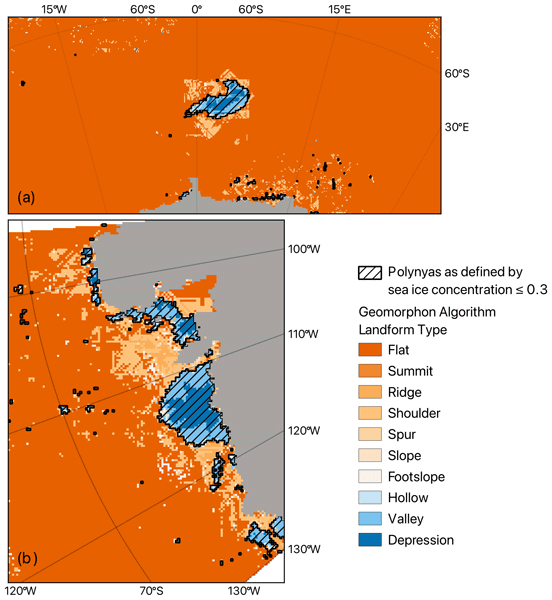
“Fig. 3 / Fig. 1: I recommend to show the same region in Fig. 1 as you show here in Fig. 3. This would make it a bit easier to assign the 3-D structure shown in Fig. 3 to the map and the sea-ice concentration distribution shown in Fig. 1.”
Thank you for this helpful suggestion. We agree that the original figure did not make the relationship between the sea ice concentration map and the corresponding 3D representation sufficiently clear. To improve interpretation and facilitate direct comparison between the two visualisations, we have substantially revised Fig. 3.
The updated figure now includes a 2D sea ice concentration panel alongside the 3D representation, uses the same spatial extent and colour scaling, and overlays the land mask to clearly identify coastlines and land boundaries. These revisions make it easier to relate the three-dimensional morphology shown in Fig. 3 to the underlying sea ice concentration patterns presented in Fig. 1.
“L274-280: What you write in this paragraph sounds a bit complicated. If you would have used a sea-ice concentration product based on observations you might have benefitted from a product on the so-called EASE2 grid. Most of these products come with cartesian coordinates (i.e. x and y in meters) anyways and it would be much easier to prepare these for the purposes of the geopmorphon approach.”
Thank you for this comment. We agree that sea ice concentration products distributed on projected grids, such as the EASE2 grid used by many passive microwave products, simplify preprocessing for distance-based analyses because grid spacing is already expressed in Cartesian coordinates. Since the original submission, the study has been revised to use the University of Bremen ASI AMSR2 sea ice concentration product rather than the Copernicus reanalysis dataset. Consequently, the preprocessing workflow described in the original manuscript has also been simplified.
Regardless of the input dataset, the geomorphon algorithm requires distance parameters to be expressed in meters. We therefore retain a brief description of the coordinate system and grid resolution used in the analysis, but have revised the text to focus on the key methodological requirement rather than the details of the reprojection procedure.
“L298: "thresholds" --> "differences" - see my comment to Table 2.
Table 2, caption: I don't think that "sea ice concentration threshold" is the right term to use here. If I understood your explanation of how you derive the flat parameters then the values you are listing here denote the sea-ice concentration difference between two neighboring grid cells; they have nothing to do with any threshold to define a polynya.”
Thank you for this important observation. We agree that the terminology used in Table 2 and the surrounding text was imprecise and could be confused with the sea ice concentration threshold subsequently used for polynya detection. The values presented in Table 2 do not represent thresholds used to define polynyas, but rather sea ice concentration differences between neighbouring grid cells that are used to derive the geomorphon flat parameter. To improve clarity, we have revised the terminology throughout this section by replacing references to "sea ice concentration thresholds" with "sea ice concentration differences". The caption of Table 2 has also been updated to explicitly state that the listed values represent sea ice concentration differences between neighbouring grid cells used in the derivation of the flat parameter. In addition, the accompanying text has been revised to clarify that the range of flat parameter values was selected to represent different magnitudes of local sea ice concentration difference that may influence geomorphon landform classification.
“L323-326: After all the disadvantages you have been listing up earlier in your paper, I am surprized to see that for the evaluation of your approach you use products of exactly those methods that you were criticising and/or aiming to improve with your approach. I am therefore wondering whether you haven't considered to use independent, higher-resolution estimates of the polynya location and area. The most obvious thing to do would be to take a look at MODIS and/or VIIRS and/or AVHRR imagery. Another alternative would be using Sentinel-1 SAR imagery. Readers might appreciate clarification in this regard because as written you seem to contradict yourself.”
Thank you for this thoughtful comment. We agree that the wording of the original Introduction may have implied that the primary objective of this study was to demonstrate that the geomorphon approach provides a more accurate representation of polynyas than existing threshold-based methods. This was not our intention.
The aim of the study is to evaluate whether the geomorphon algorithm can successfully identify polynyas as morphologically distinct areas of reduced sea ice concentration surrounded by regions of higher sea ice concentration and/or physical boundaries. To assess this, we compared geomorphon-derived polynya classifications with those obtained using an established threshold-based approach applied to the same sea ice concentration dataset. This provides a consistent framework for evaluating how the morphology-based method behaves relative to a widely used detection technique.
We agree that independent validation using higher-resolution observations such as MODIS, VIIRS, or Sentinel-1 imagery would provide an additional assessment of absolute detection accuracy. However, such an analysis falls beyond the scope of the present study, which is intended as a proof-of-concept evaluation of the geomorphon approach rather than a comprehensive intercomparison of all available polynya detection methods.
To avoid this ambiguity, we have revised the Introduction and Discussion to more clearly distinguish between limitations of existing threshold-based approaches and the specific objective of this study, which is to investigate the feasibility and characteristics of a morphology-based detection framework.
“L332-334: You chose an opposite set of values than before (there you set open water to 0 and land to 1; here you set open water to 1). Why?
Why are you utilizing a "new polynya detection threshold variable"? Why new?
The work of Mohrmann et al. utilized CMIP6 climate model data with a substantially coarser grid resolution. Their paper clearly reveals that the definition of the sea-ice concentration threshold needed to define polynyas is strongly dependent on the grid resolution. You yourself stated above that sea-ice concentration thresholds that have been used to define polynyas range between 0.2 and 0.8. You are at the lower end. Why?”Thank you for these comments. We recognise that the description of the threshold-based comparison method was not sufficiently clear and has led to some confusion regarding the purpose of the thresholding procedure and the choice of threshold value.
Regarding the binary classification, the inversion of values relative to the sea ice concentration field was intentional. In the sea ice concentration data, lower values correspond to open water and higher values correspond to sea ice. However, once the threshold-based classification is applied, pixels identified as polynya are assigned a value of 1 and non-polynya pixels a value of 0. This binary representation was adopted because it simplifies subsequent raster processing and polygon extraction steps.
We also agree that the term "new polynya detection threshold variable" is unnecessarily confusing. Our intention was simply to describe the binary raster created after applying the sea ice concentration threshold. This terminology has been revised for clarity.
With respect to the choice of sea ice concentration threshold, we acknowledge that the literature contains a wide range of values and that optimal thresholds can depend on dataset characteristics, spatial resolution, and study objectives, as discussed by Mohrmann et al. (2021). We selected a threshold of 0.3 as a compromise value that produced realistic polynya delineation in both the Amundsen Sea and Weddell Sea case studies and remained applicable across a range of seasonal conditions. The threshold-based approach is used here as a benchmark against which the geomorphon method can be compared, rather than as a definitive representation of true polynya extent. To assess the sensitivity of this comparison to threshold selection, the revised manuscript now includes additional comparisons using thresholds of 0.2, 0.3, 0.6, and 0.8, spanning the range reported in previous studies.
More generally, this section has been revised to place greater emphasis on the post-processing steps required by the threshold method. Following threshold application, the binary raster is converted to polygons and features connected to the open ocean or associated with the marginal ice zone are removed. This allows the comparison to focus on isolated polynya features rather than all areas of low sea ice concentration.
“L339: "were manually drawn" --> but why? What the advantage of chosing a manual delineation over a statistical one where you simply assign all grid cells below the threshold to open water / polynyas and all grid cells above to sea ice?”
Thank you for this comment. We agree that manual delineation is unnecessary when applying a threshold-based detection method and that a more objective, reproducible approach is preferable.
In the revised manuscript, this section has been substantially updated and no longer relies on manual delineation of polynyas. Instead, sea ice concentration thresholds are applied directly to generate a binary raster identifying potential polynya pixels. The resulting raster is then converted to polygons and subjected to a series of post-processing steps to remove features connected to the open ocean and regions associated with the marginal ice zone. This procedure provides a semi-automated and reproducible means of identifying isolated polynya features while maintaining consistency with the underlying threshold-based methodology.
We have therefore revised the description of the threshold-based comparison method to focus on these processing steps rather than manual delineation.
“L390: Why only the Amundsen Sea region? And: For which time period did you perform this comparison? Also: so far you used monthly mean sea-ice concentration maps. Here the temporal resolution is daily. Why?”
Thank you for these comments. We agree that the original presentation of this section lacked sufficient detail regarding the spatial and temporal scope of the analysis and was potentially confusing because it compared monthly Copernicus data with daily ASI AMSR2 observations.
Since the original submission, the study has been substantially revised and no longer focuses on transferability between the Copernicus reanalysis and ASI AMSR2 datasets. The revised manuscript uses the University of Bremen ASI AMSR2 sea ice concentration product throughout the analysis. Consequently, this section has been restructured and the previous transferability experiment removed.
Rather than demonstrating transferability between datasets, the revised analysis applies the optimised geomorphon parameter set to daily sea ice concentration data in both the Amundsen Sea and Weddell Sea regions. This allows us to demonstrate that the method can be readily extended beyond the initial proof-of-concept and tuning exercises to generate daily polynya detections and continuous time series of polynya area. The revised manuscript now clearly describes the spatial domains, temporal coverage, and purpose of this analysis.
“L415-448: For somebody who is not overly well familiar with the geopmorphon algorithm it would be cool to learn a bit more about how the different parameter values chosen actually map to sea-ice concentration values and gradients. Why? Because especially for the December 2020 case of the Amundsen Sea the border between the open water and the sea ice is possibly very sharp and distinct because this is an example of summer melt; there is no new ice formation within the polynya. Hence, your december 2020 example will possibly work well for a set of parameters that represent high sea-ice concentration gradients from one grid cell to the next. During winter, however, with new ice formation, sea-ice concentration gradients are less sharp and the geomorphon algorithm should work better with parameter settings that take into account better weaker gradients in the sea-ice concentration. Is this the case? Did you investigate this? I would hypothesize that you cannot use the same set of parameters throughout the entire year. While what you show for the Weddell Sea open ocean polynya might work the way shown, I doubt that for the Amundsen Sea polynya the results shown for the freezing season are as accurate as during the melting season - simply because of a change in the sea-ice concentration gradient.”
Thank you for this insightful comment. We agree that seasonal changes in sea-ice concentration gradients could plausibly influence geomorphon performance and that this is an important consideration when assessing the robustness of the method. As you note, the December 2020 Amundsen Sea case represents late-summer conditions characterised by relatively sharp sea ice concentration gradients, whereas winter polynyas often contain newly formed ice and more gradual transitions between open water and consolidated pack ice.
In the original manuscript, parameter optimisation was based on a single representative month for each study region, and therefore did not allow this hypothesis to be evaluated directly. In response to this comment, we have substantially expanded the parameter evaluation procedure. Rather than considering only the original tuning months, geomorphon parameter combinations are now evaluated across the full annual cycle using representative daily sea ice concentration fields from each month. Precision, recall, F1-score, and false positive rate metrics are used to assess performance under a wide range of seasonal sea ice conditions.
This expanded analysis allows us to directly examine whether optimal parameter combinations vary systematically with season. While some seasonal variability in performance is observed, the parameter combinations originally identified as optimal for the tuning months consistently rank among the highest-performing parameter sets throughout the remainder of the year. These results suggest that the geomorphon method is relatively robust to seasonal changes in sea-ice concentration gradients, although the influence of differing polynya states and ice conditions is now discussed more explicitly in the revised manuscript.
To further explore this issue, we have also added a dedicated sensitivity analysis that examines the range of high-performing parameter combinations across representative seasonal scenarios. This provides additional insight into how parameter selection relates to differing sea-ice concentration gradients and polynya morphologies throughout the year.
“Figure 6: I think, since you superposed a lat/lon grid onto the maps you do not need to show the arrows that are supposed to point to the North but are not universally correct across the maps.
I suggest to superpose an isoline that marks the ice edge to highlight better where sea ice transitions into open water.
In the caption you should state the temporal resolution and the date of the maps shown.”Thank you for these helpful suggestions. We agree that the latitude/longitude grid provides sufficient geographic reference and that the north arrows are unnecessary. These will therefore be removed from the figure. We also agree that an ice-edge isoline would improve visual interpretation of the sea ice distribution and provide a clearer indication of the transition between sea ice and open water. This has been added to the revised figure. In addition, the figure caption has been updated to explicitly state the date and temporal resolution of the sea ice concentration maps shown.
“L484-492: You have not worked out very well what the advantage of your algorithm is over using a simple sea-ice concentration threshold-based algorithm where polynyas are identified by assigning all grid cells below a certain sea-ice concentration threshold (which might be grid-resolution dependent) to a polynya.
Apart from that I am not entirely sure I "buy" your argument that you method is particularly fast. You might want to run both methods in parallel - the geomorphon one and an automatic sea-ice concentration threshold one (using R or IDL or python).”Thank you for this comment. We agree that the original Discussion did not clearly articulate the distinction between the geomorphon approach and more traditional sea-ice concentration threshold methods. We also agree that the statement regarding computational efficiency was not sufficiently supported by quantitative analysis.
Our intention is not to argue that geomorphon detection should necessarily replace threshold-based approaches, nor that it is inherently faster than them. Rather, the objective of this study is to evaluate whether a morphology-based classification framework can be used to identify polynyas within sea ice concentration fields. Unlike threshold methods, which rely on an absolute sea ice concentration value to define a polynya, the geomorphon algorithm identifies features based on their spatial morphology and relative concentration gradients within the surrounding ice field.
In response to this comment, we have substantially revised the Discussion to better clarify the contribution of the study and to avoid unsupported claims regarding computational efficiency. The revised manuscript places greater emphasis on the geomorphon method as a proof-of-concept morphology-based detection framework and discusses its strengths and limitations relative to threshold-based approaches. In particular, the expanded seasonal analysis demonstrates that a single optimised parameter set remains among the highest-performing combinations across a wide range of sea ice conditions, suggesting that the method is robust to seasonal variability in sea ice concentration gradients. We believe this provides a more appropriate basis for evaluating the utility of the approach than claims regarding computational speed.
“L499-502: It would be cool if you could show an example where these geomorphon features map onto real-world sea-ice concentration distributions so that a reader is able to better understand what you are writing here.”
Thank you for this suggestion. We agree that visualising how individual geomorphon classes correspond to specific sea ice concentration structures would provide additional insight into the physical interpretation of the landform classifications and could help readers better understand the associations discussed in this section.
However, the primary objective of this study is to evaluate the ability of the geomorphon framework to identify polynyas, rather than to undertake a comprehensive investigation of the relationship between individual geomorphon landforms and sea ice morphology. While such an analysis would be valuable, we believe it falls beyond the scope of the present proof-of-concept study.
In the revised manuscript, we have therefore moderated the interpretation of these geomorphon classes and note that a more detailed examination of how geomorphon landforms relate to specific sea ice concentration structures represents an interesting avenue for future research. Such work may help determine whether the geomorphon framework has broader applicability for characterising sea ice morphology beyond polynya detection alone.
“L526-529: Here you begin a discussion about the actual sea-ice concentration values within a polynya I voiced this as a missing aspect of your paper already earlier. Please expand on this along the lines I mentioned in my respective comment.”
Thank you for this comment. We agree that the original discussion did not sufficiently explain the relationship between the geomorphon flat parameter and the underlying sea ice concentration characteristics of polynyas.
Our intention was to highlight that many polynyas, particularly coastal polynyas, contain a mixture of open water, thin ice, and newly formed sea ice, resulting in substantial spatial variability in sea ice concentration within the polynya itself. Consequently, a geomorphon parameterisation that is sensitive only to very sharp sea ice concentration gradients may not perform well under all conditions. The fact that the best-performing parameter combinations corresponded to moderate sea ice concentration differences suggests that the geomorphon algorithm is able to identify polynya morphology despite this internal variability.
To clarify this point, we have expanded the discussion and linked it more explicitly to the new seasonal performance analysis and threshold sensitivity experiments. These additional analyses demonstrate that the selected parameter combinations remain effective across a wide range of sea ice conditions, including periods when polynyas contain newly formed ice and weaker sea ice concentration gradients. This provides further support for the robustness of the morphology-based approach.
“L533: 130 to 20 000 km² ... this is three orders of magnitude. I suggest to be much more specific and find literature where the area of the Amundsea Sea polynya(s) are reported in more detail and not with such a range. This is quite unspecific and does not "help" with the interpretation of your results I find. Maybe the various papers by Arrigo et al., by Kern, by Tamura et al. or by Nihashi and Ohshima might help in this regard.”
Thank you for this comment. We agree that the broad range reported for Antarctic coastal polynyas provides limited context for interpreting the realism of the geomorphon-derived polynya areas in the Amundsen Sea. Our intention was to demonstrate that the detected polynyas fell within the range of values reported for Antarctic coastal polynyas more generally. However, we agree that region-specific comparisons are more informative.
In the revised manuscript, the evaluation of polynya area has been substantially expanded. Rather than relying primarily on broad Antarctic-wide area ranges, we now compare geomorphon-derived polynya areas directly with published estimates for the Amundsen Sea Polynya, Pine Island Polynya, and Weddell Sea Polynya reported in the literature. We have also separated the Amundsen Sea analysis into regional totals and individual polynya systems, allowing a more detailed assessment of detected polynya extent.
In addition, a new evaluation table has been included that summarises published polynya area estimates alongside the detection methodologies used in each study. This provides a clearer framework for comparing geomorphon-derived areas with results obtained using threshold-based approaches and other published methods, and enables differences in reported polynya extent to be interpreted in the context of methodological choices.
We agree that these region-specific comparisons provide a more meaningful assessment of the geomorphon results than broad Antarctic-wide polynya size ranges and have revised the discussion accordingly.
“L534/535: The values you specify here fall outside the range you mentioned just a line before ...
In case of the Amundsen Sea polynya, I recommend that you check the daily development of the polynya location and appearance - just to exclude that the polynya has connected to the open water north of the ice edge - which happens regularly during summer.”Thank you for this observation. We agree that the presentation of polynya area within the Amundsen Sea in the original manuscript could lead to confusion. The value reported represents the total polynya area detected across the entire Amundsen Sea study region, calculated as the sum of all identified polynya features, rather than the area of the Amundsen Sea Polynya alone.
To improve clarity, the revised manuscript no longer relies solely on regional total polynya area. Instead, the analysis has been expanded to separately evaluate the Amundsen Sea Polynya and Pine Island Polynya, allowing direct comparison with published estimates reported for these individual systems. In addition, the discussion now includes a more comprehensive comparison with literature values and with the threshold-based detection method applied to the same sea ice concentration dataset.
We agree that these revisions provide a more meaningful basis for interpreting the detected polynya extents and help avoid ambiguity between regional total polynya area and the area of individual polynya features.
“L539-540: "Unlike ... austral winter." I doubt this statement is correct because the Amundsen Sea polynya can be identified very well in sea-ice concentration maps based on microwave radiometry and is certainly among the polynyas that can be detected with a threshold based method - simply because it is large enough. If you would speak about the Terra Nova Bay polynya then your statement might be correct.”
Thank you for this comment. In the original manuscript, this result was obtained using monthly-averaged Copernicus reanalysis sea ice concentration fields, which likely smoothed small-scale and short-lived open-water features during winter. Since the original submission, the analysis has been revised to use the University of Bremen ASI AMSR2 sea ice concentration product throughout. The higher spatial resolution and daily temporal resolution of this dataset provide a more realistic representation of polynya variability and wintertime openings.
Under the revised analysis, both the geomorphon and threshold-based approaches successfully identify winter polynyas in the Amundsen Sea. We have therefore removed the original statement and revised the discussion to focus on differences in the morphology-based and threshold-based detection frameworks rather than implying that the threshold method is incapable of detecting winter Amundsen Sea polynyas.
“L546-552: Exactly! I was very surprized to see that your aim was to identify polynyas in monthly mean sea-ice concentration fields. I was close to recommend that you move away completely from using and demonstrating results that are based on monthly sea-ice concentration data - especially if the focus is on coastal polynyas.”
Thank you for this comment. We agree that monthly-averaged sea ice concentration fields are not ideal for investigating coastal polynyas, particularly given the highly dynamic nature of these systems and their sensitivity to short-term atmospheric and oceanic forcing. Monthly averaging can obscure transient openings, smooth sea ice concentration gradients, and reduce the visibility of short-lived polynya events.
In response to this concern, the revised manuscript has been substantially restructured around daily sea ice concentration observations from the University of Bremen ASI AMSR2 dataset. Daily data are now used throughout the parameter optimisation and seasonal evaluation analyses, allowing geomorphon performance to be assessed under a much wider range of sea ice conditions than was possible using monthly means alone.
In addition, we now demonstrate application of the optimised geomorphon parameter set to continuous daily observations in both the Amundsen Sea and Weddell Sea regions. This allows the method to capture short-term variability and provides a more realistic assessment of its suitability for monitoring polynya evolution through time. We agree that this represents a more appropriate framework for evaluating coastal polynya detection than analyses based primarily on monthly-averaged sea ice concentration fields.
“L558/559: Highlighting the spectrum of polynya sizes that can be retrieved is certainly a good thing but you should come up with an uncertainty estimate and with an idea how reliably polynyas can be obtained over this large range. The uncertainty is not only driven by the geomorphon approach itself but also by the uncertainty of the input sea-ice concentration data which is unknown - at least as written.
For a sea-ice concentration threshold based algorithm it is relatively easy to come up with a sensitivity - by simply changing the thresholds used. In case of the geomorphon approach I don't see a straightforward way to carry out such an uncertainty assessment.”Thank you for this important comment. We agree that uncertainty in geomorphon-derived polynya area arises from two primary sources: (i) uncertainty associated with the choice of geomorphon parameter combinations and (ii) uncertainty in the underlying sea ice concentration data used as input to the algorithm. We also agree that, unlike threshold-based methods where sensitivity can be explored by varying the concentration threshold, an equivalent uncertainty assessment for the geomorphon approach was not sufficiently developed in the original manuscript.
In response, we have added a dedicated uncertainty and sensitivity analysis that explicitly addresses both sources of uncertainty.
First, we quantify uncertainty associated with geomorphon parameter selection. Representative sea ice and polynya scenarios spanning a range of seasonal and polynya conditions were selected for each study region. For scenes containing observed polynya pixels, parameter combinations were evaluated using the F1 score and all combinations achieving at least 95% of the maximum scene-specific F1 score were retained. For scenes containing no observed polynya pixels, parameter combinations were instead evaluated using the False Positive Rate (FPR), and all combinations within a small tolerance of the minimum FPR were retained. Polynya area was then calculated for all retained high-performing parameter combinations, allowing the sensitivity of detected polynya area to parameter selection to be quantified.
Second, we assess uncertainty associated with the input ASI sea ice concentration data. Following the uncertainty estimates provided in the ASI product documentation, concentration-dependent uncertainty fields were applied directly to the sea ice concentration raster before geomorphon classification. The geomorphon algorithm was then rerun using the original sea ice concentration field as well as SIC-minus-uncertainty and SIC-plus-uncertainty perturbations. The resulting range of polynya area estimates provides a sensitivity envelope describing how uncertainty in the underlying sea ice concentration data propagates through the geomorphon detection process.
Together, these analyses provide a systematic assessment of both algorithmic and input-data uncertainty and allow the robustness of geomorphon-derived polynya area estimates to be evaluated across a range of sea ice conditions.
“L563: I don't think that products that are used to derive long-term time series of polynya dynamics - such as those derived by Tamura et al., or Nihashi and Ohshima, use manual delineation. I am not aware of a method that is used seriously in the sea ice community that uses manual delineation. Whether "static" is the correct setting is something you need to check for the geopmorhon algorithm as well for the reasons I stated earlier.”
Thank you for this comment. We agree that the original wording was misleading. Existing long-term polynya products, including those developed by Tamura et al. (2011) and Nihashi and Ohshima (2015), are generated using semi-automated methodologies rather than manual delineation.
We have therefore revised this section to remove the comparison with manual approaches and to better distinguish the geomorphon method from threshold-based techniques. The revised manuscript instead focuses on the distinction between morphology-based and threshold-based detection frameworks. In particular, threshold methods require the selection of sea ice concentration thresholds, which may vary depending on dataset characteristics, spatial resolution, season, and study objectives. Similarly, the geomorphon approach requires the selection of algorithm parameters, the influence of which is now explored through the expanded sensitivity and uncertainty analyses. We therefore present the geomorphon method not as a replacement for existing approaches, but as an alternative morphology-based framework that can be used to identify polynyas within sea ice concentration fields.
We also agree that the suitability of a single parameter configuration across different sea ice conditions should be evaluated rather than assumed. In response to earlier comments, we have substantially expanded the seasonal parameter evaluation and sensitivity analyses to assess the robustness of the selected parameter combinations throughout the annual cycle.
“L562-583: This entire paragraph should be condensed substantially - because i) manual delineation of polynyas is not the state of the art; ii) using monthly data to study polynya dynamics is not a common thing to do; iii) there exist retrieval methods that automatically derive polynya area using sea-ice concentration of sea-ice thickness threshold based methods.”
Thank you for this comment. We agree that this section overstated some of the advantages of the geomorphon approach and did not adequately reflect the current state of automated polynya detection. Existing threshold-based sea ice concentration and sea ice thickness methods are widely used, automated, and capable of generating long-term polynya records. We also agree that the original emphasis on monthly-averaged data was not appropriate for evaluating highly dynamic coastal polynyas.
In response, this section has been substantially revised and condensed. The revised discussion no longer frames the geomorphon method as a replacement for existing automated approaches or emphasises comparisons with manual delineation. Instead, it focuses on the primary objective of this study: evaluating whether a morphology-based framework can successfully identify polynyas within sea ice concentration fields.
The discussion has also been updated to reflect the revised methodology, which now uses daily ASI AMSR2 sea ice concentration data for parameter optimisation, seasonal evaluation, and demonstration of time-series application. Rather than emphasising computational speed, the revised manuscript focuses on the behaviour, robustness, and potential applications of the geomorphon approach relative to more traditional threshold-based methods.
“L594/595: "which often rely on fixed ... variability." --> I don't think this statement is correct as it stands. Again this entire paragraph aims for highlighting the apparent advantages of your approach beyond that it is by itself cool to transfer that method from land applications to sea ice applications. I believe you would do good to be a bit more modest and simply consider that for many applications it is sufficient to look into ~3 km sea-ice concentration maps to check whether there is a polynya or not. Other applications might simply use optical imagery or SAR imagery which are increasingly available and offer considerably finer spatial resolutions.
I also would like to stress - again - that possibly researchers interested in monitoring the Weddell Sea polynya will use a different approach than researchers that are after monitoring Antarctic coastal polynyas around the continent or with a focus on a particular coastal polynya. And while your study is clearly a right step into the direction to spread the word and to invite people to use the geomorphon approach, substantially more work is needed to assess the uncertainty and the maturity of the approach.”Thank you for this thoughtful comment. We agree that the original discussion overstated some of the potential advantages of the geomorphon approach and did not sufficiently acknowledge that the suitability of any polynya detection method depends on the scientific question, study region, temporal scale, and available data sources. We also agree that many applications can be effectively addressed using existing sea ice concentration threshold methods, while others may benefit from higher-resolution optical or SAR observations.
Our intention is not to argue that the geomorphon approach should replace existing methodologies, but rather to evaluate whether a morphology-based framework can successfully identify polynyas within sea ice concentration fields. In response to this and several related comments, we have substantially revised the Introduction, Discussion, and Conclusions to more clearly frame the study as a proof-of-concept evaluation of the geomorphon approach rather than a demonstration of methodological superiority.
We also agree that further work is required to assess the maturity, uncertainty, and broader applicability of the method. To address this, the revised manuscript now includes expanded seasonal evaluation, parameter sensitivity analysis, uncertainty assessment, and comparison against published polynya area estimates. While these additions increase confidence in the robustness of the approach, they also highlight areas where additional validation and testing would be beneficial.
Finally, to support future applications and evaluation of the method, we have added a workflow schematic outlining the recommended steps for implementing the geomorphon approach. We hope this provides a transparent framework that can be tested, refined, and adapted by future studies investigating different polynya types, regions, and datasets.
“Fig. 8 and the paragraph describing and assessing it: These are melting season cases - e.g. easy cases because there is no new ice formation in the polynyas. In both cases the visible images clearly show a different shape and morphology of the polynyas as identified by the geomorphon approach. This figure (and the way you interprete it) clearly confirms what I stated in my previous comment: There is substantilly more work required to demonstrate the quality of the algorithm. The figure also suggests - as said before - that you should perhaps tone done parts of your statements about what the approach can do and what it cannot do to not mislead readers. I suggest that you modify Fig. 8 in a way that you overplot both maps of the polynya in one map - by using transparent colors for instance. That way you could visualize much better how the two products "match". And I suggest you come up with a follow-up study where you present results of an adequate evaluation study - using independent estimates of polynya location and size - or simply high-resolution sea-ice concentration maps or classified Sentinel-1 SAR imagery.”
Thank you for this comment. We agree that Figure 8, as originally presented, does not constitute a rigorous validation of geomorphon-derived polynya boundaries and that a comprehensive assessment against independent high-resolution observations would require substantially more analysis than is possible within the scope of the present study.
Following the extensive revisions made in response to this review, the primary objective of the manuscript is now more clearly defined as a proof-of-concept evaluation of whether a morphology-based framework can be used to identify polynyas within sea ice concentration fields. The focus of the study is therefore on the behaviour, performance, sensitivity, and robustness of the geomorphon approach when applied to sea ice concentration data, rather than on reproducing the exact boundaries observed in optical imagery.
For this reason, Figure 8 has been removed from the revised manuscript. Instead, the evaluation has been substantially strengthened through the inclusion of seasonal performance assessment, expanded comparison with threshold-based detection methods, parameter sensitivity analysis, uncertainty quantification associated with both geomorphon parameters and sea ice concentration uncertainty, and comparison against published polynya area estimates from the literature. We believe these additions provide a more rigorous and objective assessment of the geomorphon method than the qualitative visual comparison previously presented.
We agree that further validation against independent observations, including optical or SAR imagery, would be valuable future work. However, we consider this to be a separate research objective from the one addressed in the present study.
“L610-619: Again you "praise" the advantages of your method - without having really proven that your application of the method to ASI-algorithm sea-ice concentration data provides accurate data - simply because you did not perform an adequate evaluation. Please consider toning down statements that oversell your approach.”
Thank you for this comment. We agree that several statements in the original Discussion overstated the demonstrated advantages of the geomorphon approach relative to existing methods. The manuscript has therefore been revised to adopt a more balanced interpretation of the results and to avoid claims that extend beyond the evidence presented.
In response to this concern, the evaluation of the geomorphon method has also been substantially expanded. As discussed in response to previous comments, the revised manuscript now includes seasonal performance assessment, parameter sensitivity analysis, uncertainty quantification associated with both geomorphon parameter selection and sea ice concentration uncertainty, comparison with threshold-based detection methods, and comparison with published polynya area estimates. These additions provide a more robust assessment of the method's performance and limitations. The Discussion has been revised accordingly to reflect the level of confidence supported by these analyses and to clearly identify areas requiring further investigation.
“L635-642: Also this paragraph you need to tone down in light of the discussion provided. The main point to keep it that it is cool to port the approach from a land application to a sea ice application. This step is successfully done. The rest needs work - evaluation and checking the seasonally changing ice conditions in a polynya and their impact on the choice of the geomorphon algorithm parameters.”
Thank you for this comment. We agree that the primary contribution of this study is the successful transfer and evaluation of the geomorphon framework within a sea ice application, rather than demonstrating that it is superior to existing polynya detection methodologies.
The Conclusions have therefore been revised to better reflect the proof-of-concept nature of the study and to avoid overstating the maturity or applicability of the approach. We now place greater emphasis on demonstrating that morphology-based classification can be used to identify polynyas within sea ice concentration fields, while acknowledging that further validation across a wider range of regions, datasets, and sea ice conditions is required. The expanded seasonal evaluation, sensitivity analyses, and uncertainty assessment strengthen confidence in the method, but we agree that continued testing and refinement will be necessary to fully assess its broader applicability.
“Editoral Comments / Typos:
L125: Please be more specific: What is a "sea ice threshold"?”Thank you for this comment. We agree that the original wording was ambiguous. The revised manuscript now explicitly refers to a sea ice concentration threshold and clarifies its role within threshold-based polynya detection methods.
“L144: What do you mean by "manual validation"? Shouldn't all these products be validated?”
Thank you for this clarification. We agree that the phrase "manual validation" was imprecise. The revised manuscript now more clearly distinguishes between automated detection methods and the use of manually delineated polynya regions for evaluation and quality control.
“L237/238: "Notably .. manner" --> How?”
Thank you for highlighting this point. We agree that the original explanation was unclear. The description of the geomorphon algorithm has been revised to better explain how the lookup distance is determined and how the algorithm evaluates surrounding spatial patterns during classification.
“L335/337: Typo: Morhmann --> Mohrmann”
Thank you for noting this typographical error. The spelling has been corrected throughout the manuscript.
“L473: "corresponding ... threshold" --> better: corresponding to a grid cell-to-grid cell change in sea-ice concentration of 0.4.”
Thank you for this suggestion. We agree that describing the parameter in terms of a grid cell-to-grid cell sea ice concentration change is clearer. The terminology has been revised accordingly.
“L523: As I mentioned already, I think this term is not well chosen and should rather be termed "grid cell-to-grid cell sea-ice concentration difference"”
Thank you for this comment. We agree that the original terminology was misleading. Throughout the revised manuscript, references to these values have been replaced with terminology describing grid cell-to-grid cell sea ice concentration differences.
“L524: I note that the Barber et al. (2001) paper is quite specific, dealing with the North Open water polynya which is in the Arctic. How well does this paper fit to the polynyas you have been investigating in your paper?”
Thank you for this observation. We agree that Barber et al. (2001) was not the most appropriate reference in this context. The discussion has been revised and more suitable references have been incorporated.
“L538/539: I suggest to also mention the data and the method that is used by Macdonald et al. (2023) - Envisat-1 SAR and 3.125 km AMSR2 sea-ice concentration data - hence they are using a quite advanced approach with "true" high-resolution data.”
Thank you for this suggestion. Additional methodological context has been added when discussing published Amundsen Sea Polynya area estimates so that differences between studies can be interpreted in light of the datasets and detection approaches used.
“L541 ... suggests." I would start a new paragraph here to separate the results of the Weddell Sea polynya better since this is a different polynya type.”
Thank you for this suggestion. We agree that the discussion of the Weddell Sea Polynya should be separated from that of the Amundsen Sea Polynya. The revised manuscript now presents these discussions more distinctly.
“L544/545: What do you mean by "winter months" here? September? Not clear.”
Thank you for this comment. We agree that the wording was vague. The revised manuscript now explicitly states the months being referred to where relevant.
“L569: "relative to the conventional .. method" --> "relative to our conventional ... method that involves manual delineation ..."”
Thank you for this suggestion. This section has been substantially revised as part of the broader restructuring of the Discussion and no longer relies on comparisons with manual delineation approaches.
“L644-654: Certainly your approach has potential to be applied to various sorts of data - also other data sets based on numerical modeling such as the CMIP6 model suite - but all this in parallel to a proper evaluation of the results. I suggest that you re-formulate this paragraph accordingly.”
Thank you for this comment. We agree that any future application of the geomorphon framework to alternative datasets, including numerical model output, must be accompanied by appropriate evaluation and uncertainty assessment. The revised manuscript now adopts a more cautious interpretation of the method's future applicability and explicitly acknowledges the need for further testing and validation beyond the proof-of-concept demonstrated here.
Citation: https://doi.org/10.5194/egusphere-2026-1653-AC1
-
AC1: 'Reply on RC1', Mia Hurst, 18 Jun 2026
-
RC2: 'Comment on egusphere-2026-1653', Anonymous Referee #2, 13 May 2026
General Comments
This manuscript presents an automated polynya detection method based on the geomorphon algorithm, which innovatively adapts a technique originally developed for terrestrial landform classification to sea ice concentration (SIC) data. The authors conducted systematic parameter sensitivity analyses in two key Southern Ocean regions, the Weddell Sea and the Amundsen Sea, and compared the performance of the proposed method with the traditional threshold-based approach to validate its feasibility. The method is novel and promising: it is the first application of the geomorphon algorithm to polynya detection, leveraging spatial morphological features of SIC rather than fixed thresholds, which offers a new perspective to address the subjectivity and poor cross-scale consistency of traditional methods. Additionally, the comprehensive sensitivity tests on three key parameters (search radius, flatness threshold, and flat distance) provide a solid foundation for parameter optimization of the method. However, the manuscript has significant deficiencies in the rationality of data selection, clarity of research questions, demonstration of methodological advantages, and rigor of the evaluation system. Some of my comments might seem a bit harsh, but that's mainly because I really love this new approach and want to show it in the best possible way. Major revisions are therefore recommended before the manuscript can be considered for publication.
Specific Comments
Major Comments
SC1. Unjustified Data Selection
The authors primarily use the GLORYS12v1 for their analyses, but do not explicitly justify why reanalysis data was preferred over direct remote sensing observations. Reanalysis SIC fields are valuable for their spatiotemporal continuity, but as model-assimilated products, they inevitably contain inherent biases. These biases may explain the noticeable discrepancies between the algorithm’s detection results and the MODIS true-color imagery shown in Figure 8. Additionally, the reanalysis product has a coarser spatial resolution (9.25 km) than widely available passive microwave remote sensing products such as AMSR2 ASI (6.25 km). Given that the study periods are limited to 2017 (Weddell Sea) and 2020 (Amundsen Sea)—with a maximum temporal resolution of daily (and most analyses using monthly averages)—high-quality remote sensing data fully covering these periods is readily accessible. If there is no specific reason, we recommend that the authors replace the primary dataset with remote sensing observations.
SC2. Overly Lengthy Introduction with Unclear Core Research Gap
The introduction section is somewhat lengthy (approximately one-third of the full manuscript). While it provides a thorough review of traditional threshold-based methods and their limitations, it could more clearly articulate the specific core scientific problem that this study aims to solve. The authors suggest that the main drawback of traditional methods is the lack of automation. However, recent studies including Landrum et al. (2026, doi: 10.5194/tc-20-1815-2026), Lin et al. (2024, doi: 10.1038/s41597-024-03848-2), and Duffy et al. (2024, doi: 10.1073/pnas.2321595121) have already achieved automated polynya detection. The authors do not compare the geomorphon algorithm with these state-of-the-art automated approaches, which makes it difficult to fully highlight the unique advantages of the proposed approach. The author may should at least compare the results of one threshold-based automatic polynya identification method. Furthermore, while the authors criticize traditional methods for relying on arbitrarily defined SIC thresholds and persistence criteria, the geomorphon algorithm also requires manual tuning of multiple parameters (search radius, flatness threshold, etc.), and the optimal parameters vary across regions. The authors claim that the new method better identifies small or fragmented polynyas and avoids misclassifying thin or broken ice as open water, but the comparative evidence provided is not strong and sufficient enough to support this assertion (see details in SC3), and relevant discussions are missing from both the abstract and conclusion.
SC3. Result Comparisons Could Be Expanded to Better Demonstrate Methodological Advantages
The manuscript devotes considerable space to describing the parameter sensitivity analyses, which is valuable, but provides more limited validation of the new method’s reliability and its specific advantages over existing approaches. Currently, the authors only compare the geomorphon algorithm with the traditional method using a single SIC threshold (30%). However, commonly used thresholds for polynya detection range widely from 20% to 80%, with higher thresholds (60%-80%) typically used in winter to better distinguish thin ice from open water. Results from the traditional method can vary significantly across different thresholds, so a comparison with only one threshold cannot comprehensively assess the relative performance of the two methods. Supplementing the analysis with comparisons between the geomorphon algorithm and the traditional method using multiple commonly used SIC thresholds (e.g., 60% and 70%). This will provide a more complete picture of how the methods perform under different detection criteria. Furthermore, the authors’ conclusion that the new method better identifies rapidly changing, ephemeral polynyas is based solely on differences in winter polynya area from monthly averaged data. Detailed comparisons using daily resolution data are required, along with at least three specific case studies demonstrating scenarios where the geomorphon algorithm accurately identifies polynyas that the traditional threshold method fails to detect, providing intuitive evidence of the new method's advantages.
Minor Comments
SC4.
The authors evaluate the geomorphon algorithm ’s performance by calculating F1-scores against results from the traditional 30% SIC threshold method, which is implicitly treated as the reference standard. While this is a common first step for method validation, it has an important limitation: the traditional threshold method itself suffers from inherent subjectivity and lots of errors. Even a perfect F1-score of 1 would only indicate that the new method closely matches the results of the traditional method, not that it produces more accurate or physically realistic results. Therefore, the author should hereby clarify that these three indicators indicates whether the results are consistent with those obtained by traditional methods, rather than how they are correct. Additionally, the manuscript would benefit from including the mathematical formulas for precision, recall, and F1-score to ensure full transparency and reproducibility.
SC5.
In Section 3, the authors note that "the geomorphon algorithm appears to underestimate polynya area in the Weddell Sea, whereas it predicts slightly higher polynya area in the Amundsen Sea". The authors could explore the causes of this regional discrepancy in the discussion section, particularly whether it relates to differences in the formation mechanisms and morphological characteristics of polynyas in the two regions
SC6.
In Section 4.3, the authors state that the geomorphon method is two orders of magnitude faster than traditional methods. Providing specific computational time comparison data (e.g., time required to process the same volume of data on comparable hardware) would help substantiate this claim.
Technical Corrections
TC1.
When MODIS is first introduced, its full name is not labeled.
Citation: https://doi.org/10.5194/egusphere-2026-1653-RC2 -
AC2: 'Reply on RC2', Mia Hurst, 18 Jun 2026
We thank the reviewer for their positive assessment of the manuscript. The constructive feedback provided has helped us improve the manuscript substantially.
For clarification, reviewer comments are italicised, whilst authors’ response is in bold.
“General Comments
This manuscript presents an automated polynya detection method based on the geomorphon algorithm, which innovatively adapts a technique originally developed for terrestrial landform classification to sea ice concentration (SIC) data. The authors conducted systematic parameter sensitivity analyses in two key Southern Ocean regions, the Weddell Sea and the Amundsen Sea, and compared the performance of the proposed method with the traditional threshold-based approach to validate its feasibility. The method is novel and promising: it is the first application of the geomorphon algorithm to polynya detection, leveraging spatial morphological features of SIC rather than fixed thresholds, which offers a new perspective to address the subjectivity and poor cross-scale consistency of traditional methods. Additionally, the comprehensive sensitivity tests on three key parameters (search radius, flatness threshold, and flat distance) provide a solid foundation for parameter optimization of the method. However, the manuscript has significant deficiencies in the rationality of data selection, clarity of research questions, demonstration of methodological advantages, and rigor of the evaluation system. Some of my comments might seem a bit harsh, but that's mainly because I really love this new approach and want to show it in the best possible way. Major revisions are therefore recommended before the manuscript can be considered for publication.”
We thank the reviewer for their thorough and highly constructive assessment of our manuscript. We are particularly encouraged by their recognition of the novelty of applying the geomorphon algorithm to polynya detection and their positive evaluation of the method’s potential to address some of the limitations associated with traditional threshold-based approaches.
We appreciate the reviewer’s detailed feedback regarding the selection of input data, the clarity of the study objectives, the demonstration of methodological advantages, and the rigor of the evaluation framework. These comments have been invaluable in strengthening the manuscript.
In response, we have substantially revised the manuscript. The revised version includes: (i) the adoption of the University of Bremen ASI AMSR2 daily sea-ice concentration product in place of the original reanalysis dataset, (ii) a clearer definition of the research objectives and methodological scope, (iii) an expanded validation framework including comparisons with published polynya area estimates and traditional threshold-based approaches, (iv) a comprehensive seasonal evaluation of geomorphon parameter performance using daily observations throughout the annual cycle, (v) new sensitivity analyses examining both parameter selection and sea-ice concentration uncertainty, and (vi) a more balanced discussion of the strengths, limitations, and future applications of the method.
We have also revised the Introduction to provide broader context regarding existing polynya detection methodologies and to better position the geomorphon approach within the current state of the field. Throughout the manuscript, we have moderated several statements regarding the maturity and applicability of the method to ensure that it is presented as a proof-of-concept study with promising potential rather than a fully operational detection framework.
We believe that these revisions directly address the reviewer’s major concerns and have substantially improved the scientific rigor, clarity, and overall contribution of the manuscript. Detailed responses to each specific comment are provided below.
“Specific Comments
Major Comments
SC1. Unjustified Data Selection
The authors primarily use the GLORYS12v1 for their analyses, but do not explicitly justify why reanalysis data was preferred over direct remote sensing observations. Reanalysis SIC fields are valuable for their spatiotemporal continuity, but as model-assimilated products, they inevitably contain inherent biases. These biases may explain the noticeable discrepancies between the algorithm’s detection results and the MODIS true-color imagery shown in Figure 8. Additionally, the reanalysis product has a coarser spatial resolution (9.25 km) than widely available passive microwave remote sensing products such as AMSR2 ASI (6.25 km). Given that the study periods are limited to 2017 (Weddell Sea) and 2020 (Amundsen Sea)—with a maximum temporal resolution of daily (and most analyses using monthly averages)—high-quality remote sensing data fully covering these periods is readily accessible. If there is no specific reason, we recommend that the authors replace the primary dataset with remote sensing observations.”
We thank the reviewer for this valuable comment and agree that the rationale for using the GLORYS12v1 reanalysis product was not sufficiently justified in the original manuscript. We also agree that, for the purpose of evaluating a novel polynya detection method, direct satellite observations provide a more appropriate basis for assessment than a model-assimilated reanalysis product.
In response to this comment, we have substantially revised the data component of the study and replaced the GLORYS12v1 sea-ice concentration dataset with the University of Bremen ASI daily sea-ice concentration product derived from AMSR2 passive microwave observations. This dataset provides daily observational sea-ice concentration fields at a higher spatial resolution (6.25 km) than the original reanalysis product and is widely used in polar sea-ice research. The use of a satellite-derived observational dataset removes the dependence on model-assimilated sea-ice fields and allows the geomorphon algorithm to be evaluated directly using remotely sensed observations.
This change also addresses the concern regarding potential biases associated with reanalysis products. While all sea-ice concentration products contain uncertainties, the revised manuscript now includes an expanded discussion of the characteristics and uncertainty estimates associated with the ASI product, together with a dedicated sensitivity analysis investigating how these uncertainties influence the resulting polynya area estimates.
In addition, the higher spatial resolution of the ASI dataset improves the representation of coastal polynyas and smaller-scale sea-ice concentration gradients that are important for geomorphon classification. The parameter optimisation, validation, and temporal analyses have therefore been repeated using the ASI dataset throughout the revised manuscript.
We therefore agree with the reviewer's recommendation and have adopted a satellite-derived observational product as the primary dataset for method development, evaluation, and application in the revised study.
“SC2. Overly Lengthy Introduction with Unclear Core Research Gap
The introduction section is somewhat lengthy (approximately one-third of the full manuscript). While it provides a thorough review of traditional threshold-based methods and their limitations, it could more clearly articulate the specific core scientific problem that this study aims to solve. The authors suggest that the main drawback of traditional methods is the lack of automation. However, recent studies including Landrum et al. (2026, doi: 10.5194/tc-20-1815-2026), Lin et al. (2024, doi: 10.1038/s41597-024-03848-2), and Duffy et al. (2024, doi: 10.1073/pnas.2321595121) have already achieved automated polynya detection. The authors do not compare the geomorphon algorithm with these state-of-the-art automated approaches, which makes it difficult to fully highlight the unique advantages of the proposed approach. The author may should at least compare the results of one threshold-based automatic polynya identification method. Furthermore, while the authors criticize traditional methods for relying on arbitrarily defined SIC thresholds and persistence criteria, the geomorphon algorithm also requires manual tuning of multiple parameters (search radius, flatness threshold, etc.), and the optimal parameters vary across regions. The authors claim that the new method better identifies small or fragmented polynyas and avoids misclassifying thin or broken ice as open water, but the comparative evidence provided is not strong and sufficient enough to support this assertion (see details in SC3), and relevant discussions are missing from both the abstract and conclusion.”
We thank the reviewer for this thoughtful comment and agree that the original Introduction was overly long and that the central research gap and contribution of the study were not communicated as clearly as they could have been.
In response, we have substantially revised and updated the Introduction to focus more directly on the scientific motivation and objectives of the study. The aims of the revised study are now stated more clearly. Specifically, the focus is on evaluating the suitability of the geomorphon algorithm as a morphology-based framework for identifying coastal and open-ocean polynyas, assessing its performance across a range of seasonal conditions, investigating its sensitivity to parameter selection and sea-ice concentration uncertainty, and comparing the resulting polynya extents with published estimates from the literature.
We also agree that automation alone is not a novel contribution. As the reviewer notes, several recent studies have developed automated approaches for polynya detection and mapping. The revised manuscript therefore no longer presents automation as the primary innovation of the geomorphon approach. Instead, the central contribution is framed as the introduction and evaluation of a morphology-based detection framework that identifies polynyas from their spatial structure within sea-ice concentration fields rather than through predefined sea-ice concentration thresholds alone.
To better position the study within the existing literature, we have expanded the discussion of recent automated detection approaches, including threshold-based and machine-learning methodologies. While we agree that direct comparison with these approaches would be valuable, we consider a comprehensive intercomparison of multiple automated detection frameworks to be beyond the scope of the present proof-of-concept study. We have therefore identified this as an important avenue for future research in the Discussion and Conclusions.
We also acknowledge that the geomorphon algorithm requires parameter selection and optimisation. The revised manuscript now discusses this limitation more explicitly and avoids implying that the method is entirely free from user-defined decisions. However, once an optimal parameter set has been identified through sensitivity analysis, the workflow can be applied consistently without requiring additional threshold selection or manual delineation of polynya boundaries.
Finally, we agree that some of the claims regarding the capabilities of the geomorphon approach were stronger than could be supported by the evidence presented in the original manuscript. Consequently, we have revised the Abstract, Discussion, and Conclusions to adopt more measured language and now present the method as a proof-of-concept framework whose strengths and limitations are evaluated through the analyses presented in this study.
“SC3. Result Comparisons Could Be Expanded to Better Demonstrate Methodological Advantages
The manuscript devotes considerable space to describing the parameter sensitivity analyses, which is valuable, but provides more limited validation of the new method’s reliability and its specific advantages over existing approaches. Currently, the authors only compare the geomorphon algorithm with the traditional method using a single SIC threshold (30%). However, commonly used thresholds for polynya detection range widely from 20% to 80%, with higher thresholds (60%-80%) typically used in winter to better distinguish thin ice from open water. Results from the traditional method can vary significantly across different thresholds, so a comparison with only one threshold cannot comprehensively assess the relative performance of the two methods. Supplementing the analysis with comparisons between the geomorphon algorithm and the traditional method using multiple commonly used SIC thresholds (e.g., 60% and 70%). This will provide a more complete picture of how the methods perform under different detection criteria. Furthermore, the authors’ conclusion that the new method better identifies rapidly changing, ephemeral polynyas is based solely on differences in winter polynya area from monthly averaged data. Detailed comparisons using daily resolution data are required, along with at least three specific case studies demonstrating scenarios where the geomorphon algorithm accurately identifies polynyas that the traditional threshold method fails to detect, providing intuitive evidence of the new method's advantages.”
We thank the reviewer for this valuable comment and agree that the original manuscript placed greater emphasis on parameter optimisation than on evaluating the performance of the geomorphon approach relative to existing detection methods.
In response, we have substantially expanded the validation framework presented in the manuscript. First, we agree that comparison with a single 30% sea-ice concentration threshold was insufficient given the wide range of thresholds used throughout the polynya literature. The revised manuscript now compares geomorphon-derived polynya extents with those obtained using multiple commonly applied sea-ice concentration thresholds (0.2, 0.3, 0.6, and 0.8), providing a more comprehensive assessment of how the morphology-based and threshold-based approaches compare under different detection criteria.
Second, we have expanded the evaluation of the method through comparison with published polynya area estimates reported in the literature. This provides an additional benchmark for assessing the realism and consistency of the geomorphon-derived results.
We also agree that the original manuscript provided limited evidence to support the conclusion that the geomorphon approach performs differently from conventional threshold-based methods during rapidly evolving or ephemeral polynya conditions. To address this, the revised manuscript now includes additional daily-resolution case studies from both the Weddell and Amundsen Seas that directly compare polynya extents identified using the geomorphon and threshold-based approaches.
These examples were identified during winter conditions and developing polynya scenarios. In several cases, the geomorphon approach identifies coherent polynya features that are not fully captured using a 0.3 sea-ice concentration threshold. The differences are particularly evident during transitional stages of polynya development, when sea-ice concentrations remain above lower threshold values but distinct morphological structures are already present within the sea-ice field. These examples provide intuitive illustrations of where the morphology-based framework may capture features that would otherwise require adjustment of the threshold-based detection criteria. We do not present these examples as definitive evidence that the geomorphon approach is superior to threshold-based methods. Rather, they demonstrate situations where a morphology-based framework may provide additional information beyond that obtained from a single fixed sea-ice concentration threshold. Importantly, these results suggest that the geomorphon approach may have broader applicability across different seasonal polynya states without requiring threshold adjustments, although further investigation across additional regions, datasets, and polynya types is required to fully evaluate this potential.
Finally, we agree that some of the original claims regarding the advantages of the geomorphon approach were stronger than could be supported by the evidence presented. Consequently, we have revised the Abstract, Discussion, and Conclusions to adopt more measured language and now focus on identifying where differences arise between the geomorphon and threshold-based approaches rather than claiming universal superiority of one method over another.
We believe these additions provide a substantially more rigorous evaluation of the geomorphon approach and allow its performance to be assessed more comprehensively relative to conventional threshold-based methods.
“Minor Comments
SC4.
The authors evaluate the geomorphon algorithm ’s performance by calculating F1-scores against results from the traditional 30% SIC threshold method, which is implicitly treated as the reference standard. While this is a common first step for method validation, it has an important limitation: the traditional threshold method itself suffers from inherent subjectivity and lots of errors. Even a perfect F1-score of 1 would only indicate that the new method closely matches the results of the traditional method, not that it produces more accurate or physically realistic results. Therefore, the author should hereby clarify that these three indicators indicates whether the results are consistent with those obtained by traditional methods, rather than how they are correct. Additionally, the manuscript would benefit from including the mathematical formulas for precision, recall, and F1-score to ensure full transparency and reproducibility.”
We thank the reviewer for this important comment and agree that the F1-score, precision, and recall metrics evaluate the level of agreement between the geomorphon and threshold-based approaches rather than providing a direct measure of the absolute correctness or physical realism of either method.
In response, we have revised the manuscript to make this distinction clearer. The Methods and Discussion sections now explicitly state that these metrics are used to assess consistency between the geomorphon-derived polynya extents and those identified using the 0.3 sea-ice concentration threshold method, rather than to establish which approach is more accurate.
We also agree that the mathematical definitions of the evaluation metrics should be provided. Accordingly, the revised manuscript now includes the equations for precision, recall, and F1-score to improve transparency and reproducibility. In addition, we have included the False Positive Rate (FPR), which is now used to evaluate algorithm performance in scenarios where no polynya is present and metrics such as precision, recall, and F1-score are not informative.
“SC5.
In Section 3, the authors note that "the geomorphon algorithm appears to underestimate polynya area in the Weddell Sea, whereas it predicts slightly higher polynya area in the Amundsen Sea". The authors could explore the causes of this regional discrepancy in the discussion section, particularly whether it relates to differences in the formation mechanisms and morphological characteristics of polynyas in the two regions”
We thank the reviewer for this helpful suggestion. We agree that differences between the geomorphon-derived and threshold-derived polynya area estimates may be influenced by regional variations in polynya morphology, formation mechanisms, and sea-ice conditions.
Since the original submission, the area estimates have changed following the adoption of the higher-resolution AMSR2 ASI sea-ice concentration product. However, we agree that differences between the methods remain evident in some cases and warrant further discussion.
In response, we have expanded the Discussion section to consider potential causes of these differences, including the contrasting characteristics of coastal and open-ocean polynyas, differences in sea-ice concentration gradients and morphology, and the influence of regional sea-ice conditions on the performance of both morphology-based and threshold-based detection approaches. We believe this additional discussion provides important context for interpreting the observed differences between the methods.
“SC6.
In Section 4.3, the authors state that the geomorphon method is two orders of magnitude faster than traditional methods. Providing specific computational time comparison data (e.g., time required to process the same volume of data on comparable hardware) would help substantiate this claim.”
We thank the reviewer for this comment and agree that the original statement regarding computational performance was not sufficiently supported by quantitative benchmarking.
Following revisions to the manuscript and consideration of comments from Reviewer 1, we have also revised our description of the threshold-based comparison method. The threshold workflow now includes the application of a sea-ice concentration threshold followed by objective post-processing steps to isolate polynya features, rather than the more manual delineation approach described in the original manuscript.
As a result, we no longer consider a direct comparison of processing times presented in the original manuscript to be appropriate. Rather than introducing an incomplete or potentially misleading benchmark, we have removed the statement regarding the geomorphon method being two orders of magnitude faster than traditional approaches and revised the Absrtact/Discussion accordingly.
The revised manuscript therefore focuses on comparing the detection characteristics of the methods rather than their computational performance.
“Technical Corrections
TC1.
When MODIS is first introduced, its full name is not labeled.”
We thank the reviewer for noting this oversight. Following the substantial revisions made to the manuscript, Figure 8 has been removed and replaced by an expanded evaluation framework based on seasonal performance assessment, threshold-based comparisons, uncertainty analyses, and comparisons with published polynya area estimates. Consequently, the issue concerning the definition of MODIS is no longer applicable in the revised manuscript.
Citation: https://doi.org/10.5194/egusphere-2026-1653-AC2
-
AC2: 'Reply on RC2', Mia Hurst, 18 Jun 2026
Peer review completion


Interactive discussion
Status: closed
-
RC1: 'Comment on egusphere-2026-1653', Anonymous Referee #1, 28 Apr 2026
Review of
An automated method for polynya detection using a geomorphon algorithm
by
Hurst, M., and L. Boehme
Summary:
This paper demonstrates how a method that is used by the geological land surface community to delineate topographical features in DEMs can be applied to sea-ice concentration data to delineate polynyas. Polynyas are openings in the sea ice cover that can be considered as depressions in a land surface topography the authors suggest. This is quite cool. The paper describes the method very well and evaluates its technical performance. The paper provides examples of time series of polynya area for two regions in the Southern Ocean derived from sea-ice concentration data of an ocean reanalysis. The paper utilizes mainly monthly data but also shows daily data. While the demonstration itself is quite convincing, the paper is very light when it comes to the evaluation of the obtained results. In addition, little to no information is provided about potential uncertainties of the approach itself - taking into account uncertainties in the assumptions and input data.General Comments:
GC1: Evaluation:
I can understand that this manuscript is kind of a proof-of-concept study and that because of that you focused a bit more on demonstrating the technical skills of your approach. However, your attempts to evaluate the results obtained, i.e. the temporal development of the actual polynya area, are not sufficiently mature and should be improved in two ways. One of these ways would be find more actual estimates of the size of the polynyas you investigated in the published literature and compare your results with those. Another one would be to find more examples where you map the polynya area maps obtained with your approach onto alternative sources of sea-ice cover information - the easiest of these would be high-resolution sea-ice concentration maps (e.g. of the ASI algorithm based on AMSR2 data at 3.125 km grid resolution). Of course you could also try to find more maps of the kind shown in Fig. 8 and perform an inter-comparison but I guess that this is too much work at this stage because i) it would not be sufficient to dig out 2-3 more of such images and ii) you would need to find a quantitative means to do this intercomparison.GC2: Seasonal development of signatures / input data uncertainties:
Even though the product onto which you apply the geomorphon algorithm primarily is based on numerical modeling I recommend to add information about the uncertainty and credibility of the sea-ice concentration data you used as input. This drives the uncertainty and plausibility of your results to a considerable amount. The same applies to an even larger degree to the results that are based on sea-ice concentration data sets based on satellite observations. As detailed in the specific comments it is very likely that the seasonal cycle of how sea-ice concentrations can be retrieved inside and in vicinity of a polynya leads to a different uncertainty / credibility of the sea-ice concentrations input into the geopmorhon algorithm. It appears therefore to me mandatory to come up with a sensitivity analysis that takes into account the influence of the seasonally varying sea-ice concentration bias in and around a polynya.GC3: Overselling:
I might be over-critical but neither the discussion of the uncertainties inherent in the retrieval thanks to the input data nor your attempts to evaluate the results are convincing enough to make statements about the usefulness and application potential of the geomorphon approach. The manuscript is clearly overselling the approach, neglecting that the state-of-the-art of polynya detection and mapping is potentially at a different level than what is written in the manuscript. To transfer the geomorphon approach from a land to a sea ice application is already cool enough and you demonstrated technically that it seems to function well. But clearly there is much more work that needs to be done before the approach can be applied in a credible and reliable manner to the suite of sea-ice concentration data sets that is around.GC4: Other products:
The manuscript would benefit from a more comprehensive layout of existing other products and approaches to derive the location and extent of polynyas. This would have two advantages. One is that a reader gets a better feeling about how unique your approach is - hence a worthwhile addition to your manuscript. The second advantage is that you could use results of these other approaches for the evaluation - a mandatory, yet not convincing element of your manuscript (see GC1).GC5: I suggest to be more concise about potential application areas. Perhaps you choose an ocean reanalyses for a particular reason but your manuscript does not state this in a sufficiently clear manner. I think you could increase the value of your work when you indiecate a bit more clearly, that your intention was to develop something for numerical model outputs - simply because you did not discuss the uncertainty sources that are linked to the choice of the input data.
Specific Comments:
L82: Kern et al. (2007) used the so-called polynya signature simulation method (PSSM) (as the title of that paper actually states) to derive the polynya area. It is one of the few studies NOT using sea ice concentration thresholds to define a polynya.L111-116: Passive microwave based algorithms usually come up with a grid resolution of 12.5 km or finer. I am wondering which re-analysis products you had in mind when you wrote about "high-resolution" gridded fields in the context of re-analyses. It would be good to have a few references here. Also, I was wondering which input data sets these ocean reanalyses use. Any fine-resolved information about the sea-ice concentration must come from somewhere and there are not too many products around that go, for instance, below 12.5km.
L122: Kern et al. (2007) used the PSSM which was developed in the 1990s. I invite you to carefully study the references in that paper as well as in Kern, 2009: GEOPHYSICAL RESEARCH LETTERS, VOL. 36, L14501, doi:10.1029/2009GL038062 to understand the advantages (and disadvantages) of that method and to complete the list of approaches that exist. There are certainly more.
L127-129: This sentence is a bit too dense. Thresholding approaches (using sea-ice concentration or sea-ice thickness thresholds) struggle in general - whether the polynya is irrregularly shaped or not and whether the coastal geometry is complex or not. Sea ice formation in polynyas often involves streaks of new ice that align along the principal wind direction and by that create a quite heterogeneous sea ice distribution within the polynya. Hence, what you write about here are two different aspects.
L130: Please provide an example (reference) where such a manual correction has been applied.
L131/132: I doubt that the methods using thresholds are overly time consuming. On the contrary. Some of these even have the advantage that one can retrieve polynya area and landfast occurrence in one go - e.g. Nihashi and Ohshima (2015: DOI: 10.1175/JCLI-D-14-00369.1)
L133-136: "Consequently ... accessible way." --> I can understand that you want to come up with a credible motivation of your study. But ... any properly tuned / developed polynya detection method based on passive microwave data enables automated polynya area retrieval. I strongly recommend that you tone down these statements.
Perhaps your main motivation could come from the fact that - as you described already - the coarse resolution of passive microwave data causes artefacts (key word: land-spillover effect and smearing), causes too small polynyas to not be detected, and causes difficult-to-quantify retrieval uncertainties. Using sea-ice concentration thresholds is affected by the low bias in basically all sea-ice concentration algorithms for thin ice. Using sea-ice thickness thresholds is affected by the additional data that are typically required to derive the thickness of the predominantly thin sea ice (e.g. atmospheric reanalyses which are not necessarily overly realistic in polynya areas). And you have mixed-pixel issues - in the Antarctic but also in the Arctic, e.g. the Kara Sea - also due to the presence of landfast ice.L146: "spaceborne infrared imagery" does not have "coarse spatial resolution" - at least not compared to passive microwave data and also not to the data you actually used in your study.
L149-151: "Collectively ... type" --> I would say that also all approaches that are based on passive microwave data - be it using sea-ice concentration thresholds or be it using sea-ice thickness thresholds - are automated, data-driven techniques. So I don't understand for what we need this sentence here.
In addition, I suggest that you check the existing literature a bit more to complete the list of approaches. I mentioned the work of Kern et al. (2007) already. You might want to take a look into the paper by Aparicio et al. https://egusphere.copernicus.org/preprints/2025/egusphere-2025-4480/ and there are other studies that should perhaps be mentioned, e.g. by Ciappa, A., et al. who studied Antarctic polynyas using MODIS and/or COSMO SkyMed satellite data. That discussion should perhaps also check other optical imagery from Sentinel-1 / -2 / -3 approaches that might exist, or Sentinel-1 SAR approaches and also take into account that both AMSR2 and AMSR3 allow for about 3 km resolution sea-ice concentration data.L165/166: Please bear in mind that using sea-ice concentration as the base layer for the geomorphon algorithm introduces - potentially - the same biases that are common when using a threshold based algorithm - namely the low bias over thin ice and mixed pixel issues.
L184-191: Why did you chose a reanalysis data set for the sea-ice concentration? What is your motivation to prefer a numerical model result over a data set based on observations? What is the source of the sea-ice concentration information in that model, how has that been evaluated and how realistic is it? How well, do you think, is the model able to represent polynya conditions in general?
You state "daily and monthly" output as if this was an advantage for investigating polynya dynamics. Since polynyas can change on sub-daily time-scales (e.g. van Woert, 1999; Kern et al., 2007) it would have been of advantage to use (observational) data that allow to take sub-daily time-scales into account and by this have a more adequate representation of sub-daily dynamics.
How up-to-date is the land mask used in the model. What is its source?L200: Selecting data from December means that you are selecting summer conditions - a time of the year when the delineation of polynyas with basically all kinds of remote sensing data is particularly easy - for many reasons.
L202-204: You selected monthly mean data to account for short-term ... fluctuations ... influence polynas on DAILY time scale ... I don't understand why you select monthly data.
L207-210: I don't understand what you state in this paragraph. In the previous paragraph you wrote that you are studying two polynyas for just one month each. So, a long-term consistent data set is not important?
Also, you did not yet specify the time period for which the modeled sea ice fraction data set would be available (in principle).L220: All coastal polynyas in the Southern Ocean might be not just bounded by the coastline but by land-fast sea ice and/or by an ice shelf or glacier front. How is this taken into account by your approach.
Fig. 3 / Fig. 1: I recommend to show the same region in Fig. 1 as you show here in Fig. 3. This would make it a bit easier to assign the 3-D structure shown in Fig. 3 to the map and the sea-ice concentration distribution shown in Fig. 1.
L274-280: What you write in this paragraph sounds a bit complicated. If you would have used a sea-ice concentration product based on observations you might have benefitted from a product on the so-called EASE2 grid. Most of these products come with cartesian coordinates (i.e. x and y in meters) anyways and it would be much easier to prepare these for the purposes of the geopmorphon approach.
L298: "thresholds" --> "differences" - see my comment to Table 2.
Table 2, caption: I don't think that "sea ice concentration threshold" is the right term to use here. If I understood your explanation of how you derive the flat parameters then the values you are listing here denote the sea-ice concentration difference between two neighboring grid cells; they have nothing to do with any threshold to define a polynya.
L323-326: After all the disadvantages you have been listing up earlier in your paper, I am surprized to see that for the evaluation of your approach you use products of exactly those methods that you were criticising and/or aiming to improve with your approach. I am therefore wondering whether you haven't considered to use independent, higher-resolution estimates of the polynya location and area. The most obvious thing to do would be to take a look at MODIS and/or VIIRS and/or AVHRR imagery. Another alternative would be using Sentinel-1 SAR imagery. Readers might appreciate clarification in this regard because as written you seem to contradict yourself.
L332-334: You chose an opposite set of values than before (there you set open water to 0 and land to 1; here you set open water to 1). Why?
Why are you utilizing a "new polynya detection threshold variable"? Why new?
The work of Mohrmann et al. utilized CMIP6 climate model data with a substantially coarser grid resolution. Their paper clearly reveals that the definition of the sea-ice concentration threshold needed to define polynyas is strongly dependent on the grid resolution. You yourself stated above that sea-ice concentration thresholds that have been used to define polynyas range between 0.2 and 0.8. You are at the lower end. Why?L339: "were manually drawn" --> but why? What the advantage of chosing a manual delineation over a statistical one where you simply assign all grid cells below the threshold to open water / polynyas and all grid cells above to sea ice?
L390: Why only the Amundsen Sea region? And: For which time period did you perform this comparison? Also: so far you used monthly mean sea-ice concentration maps. Here the temporal resolution is daily. Why?
L415-448: For somebody who is not overly well familiar with the geopmorphon algorithm it would be cool to learn a bit more about how the different parameter values chosen actually map to sea-ice concentration values and gradients. Why? Because especially for the December 2020 case of the Amundsen Sea the border between the open water and the sea ice is possibly very sharp and distinct because this is an example of summer melt; there is no new ice formation within the polynya. Hence, your december 2020 example will possibly work well for a set of parameters that represent high sea-ice concentration gradients from one grid cell to the next. During winter, however, with new ice formation, sea-ice concentration gradients are less sharp and the geomorphon algorithm should work better with parameter settings that take into account better weaker gradients in the sea-ice concentration. Is this the case? Did you investigate this? I would hypothesize that you cannot use the same set of parameters throughout the entire year. While what you show for the Weddell Sea open ocean polynya might work the way shown, I doubt that for the Amundsen Sea polynya the results shown for the freezing season are as accurate as during the melting season - simply because of a change in the sea-ice concentration gradient.
Figure 6: I think, since you superposed a lat/lon grid onto the maps you do not need to show the arrows that are supposed to point to the North but are not universally correct across the maps.
I suggest to superpose an isoline that marks the ice edge to highlight better where sea ice transitions into open water.
In the caption you should state the temporal resolution and the date of the maps shown.L484-492: You have not worked out very well what the advantage of your algorithm is over using a simple sea-ice concentration threshold-based algorithm where polynyas are identified by assigning all grid cells below a certain sea-ice concentration threshold (which might be grid-resolution dependent) to a polynya.
Apart from that I am not entirely sure I "buy" your argument that you method is particularly fast. You might want to run both methods in parallel - the geomorphon one and an automatic sea-ice concentration threshold one (using R or IDL or python).L499-502: It would be cool if you could show an example where these geomorphon features map onto real-world sea-ice concentration distributions so that a reader is able to better understand what you are writing here.
L526-529: Here you begin a discussion about the actual sea-ice concentration values within a polynya I voiced this as a missing aspect of your paper already earlier. Please expand on this along the lines I mentioned in my respective comment.
L533: 130 to 20 000 km² ... this is three orders of magnitude. I suggest to be much more specific and find literature where the area of the Amundsea Sea polynya(s) are reported in more detail and not with such a range. This is quite unspecific and does not "help" with the interpretation of your results I find. Maybe the various papers by Arrigo et al., by Kern, by Tamura et al. or by Nihashi and Ohshima might help in this regard.
L534/535: The values you specify here fall outside the range you mentioned just a line before ...
In case of the Amundsen Sea polynya, I recommend that you check the daily development of the polynya location and appearance - just to exclude that the polynya has connected to the open water north of the ice edge - which happens regularly during summer.L539-540: "Unlike ... austral winter." I doubt this statement is correct because the Amundsen Sea polynya can be identified very well in sea-ice concentration maps based on microwave radiometry and is certainly among the polynyas that can be detected with a threshold based method - simply because it is large enough. If you would speak about the Terra Nova Bay polynya then your statement might be correct.
L546-552: Exactly! I was very surprized to see that your aim was to identify polynyas in monthly mean sea-ice concentration fields. I was close to recommend that you move away completely from using and demonstrating results that are based on monthly sea-ice concentration data - especially if the focus is on coastal polynyas.
L558/559: Highlighting the spectrum of polynya sizes that can be retrieved is certainly a good thing but you should come up with an uncertainty estimate and with an idea how reliably polynyas can be obtained over this large range. The uncertainty is not only driven by the geomorphon approach itself but also by the uncertainty of the input sea-ice concentration data which is unknown - at least as written.
For a sea-ice concentration threshold based algorithm it is relatively easy to come up with a sensitivity - by simply changing the thresholds used. In case of the geomorphon approach I don't see a straightforward way to carry out such an uncertainty assessment.L563: I don't think that products that are used to derive long-term time series of polynya dynamics - such as those derived by Tamura et al., or Nihashi and Ohshima, use manual delineation. I am not aware of a method that is used seriously in the sea ice community that uses manual delineation. Whether "static" is the correct setting is something you need to check for the geopmorhon algorithm as well for the reasons I stated earlier.
L562-583: This entire paragraph should be condensed substantially - because i) manual delineation of polynyas is not the state of the art; ii) using monthly data to study polynya dynamics is not a common thing to do; iii) there exist retrieval methods that automatically derive polynya area using sea-ice concentration of sea-ice thickness threshold based methods.
L594/595: "which often rely on fixed ... variability." --> I don't think this statement is correct as it stands. Again this entire paragraph aims for highlighting the apparent advantages of your approach beyond that it is by itself cool to transfer that method from land applications to sea ice applications. I believe you would do good to be a bit more modest and simply consider that for many applications it is sufficient to look into ~3 km sea-ice concentration maps to check whether there is a polynya or not. Other applications might simply use optical imagery or SAR imagery which are increasingly available and offer considerably finer spatial resolutions.
I also would like to stress - again - that possibly researchers interested in monitoring the Weddell Sea polynya will use a different approach than researchers that are after monitoring Antarctic coastal polynyas around the continent or with a focus on a particular coastal polynya. And while your study is clearly a right step into the direction to spread the word and to invite people to use the geomorphon approach, substantially more work is needed to assess the uncertainty and the maturity of the approach.Fig. 8 and the paragraph describing and assessing it: These are melting season cases - e.g. easy cases because there is no new ice formation in the polynyas. In both cases the visible images clearly show a different shape and morphology of the polynyas as identified by the geomorphon approach. This figure (and the way you interprete it) clearly confirms what I stated in my previous comment: There is substantilly more work required to demonstrate the quality of the algorithm. The figure also suggests - as said before - that you should perhaps tone done parts of your statements about what the approach can do and what it cannot do to not mislead readers. I suggest that you modify Fig. 8 in a way that you overplot both maps of the polynya in one map - by using transparent colors for instance. That way you could visualize much better how the two products "match". And I suggest you come up with a follow-up study where you present results of an adequate evaluation study - using independent estimates of polynya location and size - or simply high-resolution sea-ice concentration maps or classified Sentinel-1 SAR imagery.
L610-619: Again you "praise" the advantages of your method - without having really proven that your application of the method to ASI-algorithm sea-ice concentration data provides accurate data - simply because you did not perform an adequate evaluation. Please consider toning down statements that oversell your approach.
L635-642: Also this paragraph you need to tone down in light of the discussion provided. The main point to keep it that it is cool to port the approach from a land application to a sea ice application. This step is successfully done. The rest needs work - evaluation and checking the seasonally changing ice conditions in a polynya and their impact on the choice of the geomorphon algorithm parameters.
Editoral Comments / Typos:
L125: Please be more specific: What is a "sea ice threshold"?L144: What do you mean by "manual validation"? Shouldn't all these products be validated?
L237/238: "Notably .. manner" --> How?
L335/337: Typo: Morhmann --> Mohrmann
L473: "corresponding ... threshold" --> better: corresponding to a grid cell-to-grid cell change in sea-ice concentration of 0.4.
L523: As I mentioned already, I think this term is not well chosen and should rather be termed "grid cell-to-grid cell sea-ice concentration difference"
L524: I note that the Barber et al. (2001) paper is quite specific, dealing with the North Open water polynya which is in the Arctic. How well does this paper fit to the polynyas you have been investigating in your paper?
L538/539: I suggest to also mention the data and the method that is used by Macdonald et al. (2023) - Envisat-1 SAR and 3.125 km AMSR2 sea-ice concentration data - hence they are using a quite advanced approach with "true" high-resolution data.
L541 ... suggests." I would start a new paragraph here to separate the results of the Weddell Sea polynya better since this is a different polynya type.
L544/545: What do you mean by "winter months" here? September? Not clear.
L569: "relative to the conventional .. method" --> "relative to our conventional ... method that involves manual delineation ..."
L644-654: Certainly your approach has potential to be applied to various sorts of data - also other data sets based on numerical modeling such as the CMIP6 model suite - but all this in parallel to a proper evaluation of the results. I suggest that you re-formulate this paragraph accordingly.
Citation: https://doi.org/10.5194/egusphere-2026-1653-RC1 -
AC1: 'Reply on RC1', Mia Hurst, 18 Jun 2026
We thank the reviewer for their positive assessment of the manuscript. The constructive feedback provided has helped us improve the manuscript substantially.
For clarification, reviewer comments are italicised, whilst authors’ response is in bold.
“Summary:
This paper demonstrates how a method that is used by the geological land surface community to delineate topographical features in DEMs can be applied to sea-ice concentration data to delineate polynyas. Polynyas are openings in the sea ice cover that can be considered as depressions in a land surface topography the authors suggest. This is quite cool. The paper describes the method very well and evaluates its technical performance. The paper provides examples of time series of polynya area for two regions in the Southern Ocean derived from sea-ice concentration data of an ocean reanalysis. The paper utilizes mainly monthly data but also shows daily data. While the demonstration itself is quite convincing, the paper is very light when it comes to the evaluation of the obtained results. In addition, little to no information is provided about potential uncertainties of the approach itself - taking into account uncertainties in the assumptions and input data.”We thank the reviewer for their thoughtful and constructive assessment of our manuscript. We are particularly encouraged by their positive evaluation of the geomorphon approach and their recognition of the novelty of adapting a land-surface classification method for the detection of sea-ice polynyas. We appreciate the reviewer’s assessment that the methodological framework is clearly described and that the proof-of-concept application is convincing.
We also thank the reviewer for highlighting several areas where the manuscript required further development, particularly regarding the evaluation of the resulting polynya estimates and the treatment of methodological and data-related uncertainties. These comments were highly valuable and have helped us substantially strengthen the study.
In response, we have undertaken a major revision of the manuscript. The revised version includes: (i) the adoption of the University of Bremen ASI AMSR2 daily sea-ice concentration product in place of the original reanalysis dataset, (ii) a substantially expanded evaluation framework, including comparisons with published polynya area estimates and conventional threshold-based detection methods, (iii) a comprehensive seasonal assessment of geomorphon parameter performance using daily observations across the annual cycle, (iv) new sensitivity analyses examining both geomorphon parameter selection and the influence of sea-ice concentration uncertainty on derived polynya areas, and (v) an expanded discussion of the strengths, limitations, uncertainties, and potential future applications of the method.
We have also revised the Introduction and Discussion sections to better position the geomorphon approach within the broader context of existing polynya detection methodologies and to provide a more balanced assessment of its current capabilities. Throughout the manuscript, we have clarified that this work should be viewed as a proof-of-concept study demonstrating the potential of geomorphon-based detection, rather than as a fully operational detection framework.
We believe that these revisions directly address the reviewer’s concerns regarding validation and uncertainty quantification and have significantly improved the scientific rigor, clarity, and overall contribution of the manuscript. Detailed responses to each specific comment are provided below.
“General Comments:
GC1: Evaluation:
I can understand that this manuscript is kind of a proof-of-concept study and that because of that you focused a bit more on demonstrating the technical skills of your approach. However, your attempts to evaluate the results obtained, i.e. the temporal development of the actual polynya area, are not sufficiently mature and should be improved in two ways. One of these ways would be find more actual estimates of the size of the polynyas you investigated in the published literature and compare your results with those. Another one would be to find more examples where you map the polynya area maps obtained with your approach onto alternative sources of sea-ice cover information - the easiest of these would be high-resolution sea-ice concentration maps (e.g. of the ASI algorithm based on AMSR2 data at 3.125 km grid resolution). Of course you could also try to find more maps of the kind shown in Fig. 8 and perform an inter-comparison but I guess that this is too much work at this stage because i) it would not be sufficient to dig out 2-3 more of such images and ii) you would need to find a quantitative means to do this intercomparison.”
We thank the reviewer for this valuable suggestion regarding the evaluation of the detected polynya areas. We agree that the original manuscript placed greater emphasis on demonstrating the technical implementation of the geomorphon approach than on a comprehensive assessment of the resulting polynya area estimates.
In response, we have substantially expanded the evaluation component of the manuscript. First, we have added a dedicated evaluation section and expanded the discussion to include a quantitative comparison of polynya areas derived from our method with published estimates reported in the literature. These comparisons include both reported polynya extents and the detection methodologies used in previous studies, allowing us to assess the consistency of our results relative to established observations and providing a more rigorous quantitative evaluation of the approach.
Second, we have included additional figures that compare polynya areas identified using the geomorphon method with those derived from traditional sea-ice concentration threshold approaches across multiple seasonal case studies for both regions. These comparisons are performed using the same sea-ice concentration dataset and are intended to evaluate differences between the morphology-based and threshold-based detection frameworks rather than to validate polynya boundaries against independent optical imagery. The resulting figures demonstrate the degree of spatial agreement between the methods and provide further insight into how the geomorphon algorithm captures the extent and morphology of both coastal and open-ocean polynyas.
Together, these additions provide both quantitative and qualitative validation of the geomorphon-derived polynya areas and strengthen the evaluation of the method beyond the proof-of-concept analysis presented in the original manuscript.
“GC2: Seasonal development of signatures / input data uncertainties:
Even though the product onto which you apply the geomorphon algorithm primarily is based on numerical modeling I recommend to add information about the uncertainty and credibility of the sea-ice concentration data you used as input. This drives the uncertainty and plausibility of your results to a considerable amount. The same applies to an even larger degree to the results that are based on sea-ice concentration data sets based on satellite observations. As detailed in the specific comments it is very likely that the seasonal cycle of how sea-ice concentrations can be retrieved inside and in vicinity of a polynya leads to a different uncertainty / credibility of the sea-ice concentrations input into the geopmorhon algorithm. It appears therefore to me mandatory to come up with a sensitivity analysis that takes into account the influence of the seasonally varying sea-ice concentration bias in and around a polynya.”
We thank the reviewer for this important comment regarding the uncertainty of the sea-ice concentration input data and the potential influence of seasonal variability on the performance of the geomorphon algorithm. We agree that both the choice of input dataset and the seasonal evolution of sea-ice concentration fields are critical factors that influence the robustness and credibility of the results.
In response, we have substantially revised both the data sources and evaluation framework used in this study.
First, we replaced the monthly averaged Copernicus reanalysis product that was originally used for method optimisation with the University of Bremen ASI sea-ice concentration product derived from AMSR2 observations. This dataset provides a higher spatial resolution (6.25 km) and is based directly on daily satellite observations, making it a more appropriate dataset for evaluating an automated polynya detection method. We have also expanded the discussion of the strengths, limitations, and uncertainty characteristics of the input sea-ice concentration data within the revised manuscript.
Second, to address the reviewer's concern regarding seasonal variability, the parameter optimisation procedure has been substantially expanded. In the original manuscript, parameter combinations were evaluated using a single representative month for each study region (October 2017 for the Weddell Sea and December 2020 for the Amundsen Sea). In the revised manuscript, all geomorphon parameter combinations are evaluated across the entire annual cycle by analysing sea-ice concentration fields from daily data of each month. Precision, recall, and F1-score metrics were calculated for each monthly case, allowing the performance of the geomorphon algorithm to be assessed under a wide range of seasonal sea-ice conditions. This analysis demonstrated that the parameter combinations originally selected as best for the key tuning months consistently ranked amongst the highest-performing combinations throughout the remainder of the year (the analysis of which will now be presented in the manuscript), indicating that the method is robust across different seasonal polynya states and is not dependent on a single calibration period.
Third, we have added a dedicated sensitivity analysis section to explicitly investigate the influence of both geomorphon parameter selection and sea-ice concentration uncertainty. For each study region, a series of representative polynya states were identified from the annual time series and supported by published literature. These states include periods of absent, developing, peak, and decaying polynya conditions, as well as winter-time or open-ocean states where appropriate. For each scenario, the full suite of geomorphon parameter combinations was evaluated. In cases where polynyas were present, parameter combinations were ranked using F1-score. For scenarios where no polynya was present, parameter combinations were instead evaluated using False Positive Rate, as precision, recall, and F1-score become uninformative when no positive observations exist. This allowed us to assess both the algorithm's ability to detect polynyas when present and its ability to avoid false detections when absent.
Finally, to quantify the influence of uncertainty in the sea-ice concentration observations themselves, we incorporated the published uncertainty estimates associated with the ASI product. Following the uncertainty characteristics reported by Spreen et al. (2008) in the data product manual, modified sea-ice concentration fields were generated using the reported concentration-dependent error ranges, and polynya areas were recalculated. This enabled us to estimate the sensitivity of the geomorphon-derived polynya areas to plausible uncertainties in the underlying sea-ice concentration data and provide uncertainty bounds on the resulting area estimates.
We believe these substantial additions directly address the reviewer's concerns by demonstrating that the geomorphon method remains robust across a range of seasonal polynya states, parameter combinations, and realistic sea-ice concentration uncertainties.
“GC3: Overselling:
I might be over-critical but neither the discussion of the uncertainties inherent in the retrieval thanks to the input data nor your attempts to evaluate the results are convincing enough to make statements about the usefulness and application potential of the geomorphon approach. The manuscript is clearly overselling the approach, neglecting that the state-of-the-art of polynya detection and mapping is potentially at a diTerent level than what is written in the manuscript. To transfer the geomorphon approach from a land to a sea ice application is already cool enough and you demonstrated technically that it seems to function well. But clearly there is much more work that needs to be done before the approach can be applied in a credible and reliable manner to the suite of sea-ice concentration data sets that is around.”
We thank the reviewer for this thoughtful comment. We agree that the original manuscript may have overstated the maturity and immediate applicability of the geomorphon approach, particularly given the limited evaluation and uncertainty analysis presented in the initial submission.
In response, we have substantially strengthened the validation framework of the study. As described in our responses to GC1 and GC2, the revised manuscript now includes additional quantitative comparisons with published polynya area estimates, expanded spatial comparisons between geomorphon-derived and threshold-based polynya extents, evaluation across the full seasonal cycle, and a dedicated sensitivity analysis examining both geomorphon parameter selection and uncertainty in the underlying sea-ice concentration data. These additions provide a more rigorous assessment of the strengths and limitations of the method than was presented in the original manuscript.
We also agree that the original manuscript contained language that could be interpreted as overstating the current level of development and validation of the approach. To address this, we have carefully revised the discussion and conclusions throughout the manuscript to adopt more measured language and more clearly communicate that the geomorphon approach remains under development. Statements regarding the utility, transferability, and potential applications of the method have been moderated where appropriate, and the manuscript now consistently frames the approach as a proof-of-concept demonstration rather than a fully validated operational tool.
At the same time, we agree that further work is required before the approach can be considered suitable for widespread application across the diverse range of available sea-ice concentration products and polynya environments. We have therefore expanded the discussion of future research directions to explicitly acknowledge these remaining challenges. In particular, we highlight the need for further testing across additional sea-ice concentration products, spatial resolutions, geographical regions, and polynya types, as well as evaluation against independent observational datasets. We also discuss the importance of future studies investigating the sensitivity of the method to differing sensor characteristics and retrieval uncertainties.
We believe these revisions provide a more balanced assessment of the current capabilities of the geomorphon approach while still demonstrating its promise as a novel framework for automated polynya detection. The primary contribution of this study is therefore the introduction and initial evaluation of a new methodological approach, rather than the presentation of a fully mature detection system.
“GC4: Other products:
The manuscript would benefit from a more comprehensive layout of existing other products and approaches to derive the location and extent of polynyas. This would have two advantages. One is that a reader gets a better feeling about how unique your approach is - hence a worthwhile addition to your manuscript. The second advantage is that you could use results of these other approaches for the evaluation - a mandatory, yet not convincing element of your manuscript (see GC1).”
We thank the reviewer for this valuable suggestion. We agree that the original manuscript did not provide sufficient context regarding the broader landscape of existing polynya detection approaches and products.
In response, we have expanded the Introduction to provide a more comprehensive overview of current methods used for polynya detection and mapping. This now includes a wider range of traditional threshold-based approaches, image-processing techniques, multi-sensor methodologies, machine-learning frameworks, and other automated detection methods. By providing this broader context, the revised manuscript more clearly positions the geomorphon approach within the existing body of work and allows readers to better assess both its novelty and its potential advantages and limitations relative to established techniques.
We also agree that comparison with results derived using alternative approaches is important for evaluating the performance of the geomorphon method. As discussed in our response to GC1, we have expanded the evaluation component of the manuscript to include quantitative comparisons between geomorphon-derived polynya areas and published estimates reported in the literature. The revised evaluation table now includes details of the detection methodology used in each study, allowing direct comparison of area estimates obtained using threshold-based methods, alternative automated approaches, and other published techniques. This provides additional context for interpreting differences in reported polynya extents and enables a more comprehensive assessment of the geomorphon-derived results.
Together, these revisions improve both the contextualisation and evaluation of the geomorphon approach, allowing it to be assessed more clearly against existing polynya detection methodologies and published products.
“GC5: I suggest to be more concise about potential application areas. Perhaps you choose an ocean reanalyses for a particular reason but your manuscript does not state this in a sufficiently clear manner. I think you could increase the value of your work when you indicate a bit more clearly, that your intention was to develop something for numerical model outputs - simply because you did not discuss the uncertainty sources that are linked to the choice of the input data.”
We thank the reviewer for this constructive comment. We agree that the original manuscript could have more clearly articulated the intended application areas of the geomorphon approach and may have placed too much emphasis on potential applications without sufficiently defining the scope of the method.
In response, we have revised the Discussion and Conclusions to provide a more focused and balanced description of the potential applications of the approach. We have reduced speculative statements where appropriate and expanded the discussion of both the opportunities and limitations associated with applying the method to different sea-ice concentration products and study regions.
We also note that the revised manuscript now uses the University of Bremen ASI sea-ice concentration product derived from daily AMSR2 observations as the primary dataset for method evaluation. This change better aligns the study with observational polynya detection applications and allows a more direct assessment of the method using a widely used satellite-derived sea-ice concentration product.
Our primary objective in developing the geomorphon approach was not to create a replacement for specialist polynya detection products, but rather to provide an automated and computationally efficient framework for generating consistent polynya area datasets from large sea-ice concentration archives. We envisage the greatest utility of the method being in studies where polynya characteristics are incorporated into broader analyses, such as investigations of ecosystem dynamics, biological productivity, ocean-atmosphere interactions, sea-ice variability, and climate-related changes in polar environments. By reducing the manual effort typically required for polynya identification, the method has the potential to facilitate the inclusion of long-term polynya records within interdisciplinary studies that could otherwise be challenging to undertake.
To better reflect this intended use, we have expanded the discussion of future applications while also acknowledging that additional testing across a wider range of datasets, regions, and polynya types would help further establish the generality and transferability of the approach.
“Specific Comments:
L82: Kern et al. (2007) used the so-called polynya signature simulation method (PSSM) (as the title of that paper actually states) to derive the polynya area. It is one of the few studies NOT using sea ice concentration thresholds to define a polynya.”
Thank you for pointing this out. We agree that Kern et al. (2007) is primarily a PSSM study rather than an example of a sea-ice concentration threshold-based detection method. To avoid confusion, we will replace this citation with a more appropriate reference focused on threshold-based polynya identification.
“L111-116: Passive microwave based algorithms usually come up with a grid resolution of 12.5 km or finer. I am wondering which re-analysis products you had in mind when you wrote about "high-resolution" gridded fields in the context of re-analyses. It would be good to have a few references here. Also, I was wondering which input data sets these ocean reanalyses use. Any fine-resolved information about the sea-ice concentration must come from somewhere and there are not too many products around that go, for instance, below 12.5km.”
Thank you for this comment. We agree that our original discussion of reanalysis products was not sufficiently precise, particularly regarding the relationship between the effective spatial resolution of reanalyses and that of the assimilated observational datasets.
Since the original submission, we have substantially revised the data component of the study and now use the University of Bremen ASI sea-ice concentration product derived from AMSR2 observations as the primary dataset for method development and evaluation. As a result, the revised manuscript places much greater emphasis on the characteristics, strengths, and uncertainties of the satellite-derived sea-ice concentration data itself, rather than on reanalysis products. We have therefore updated this section and revised the surrounding discussion to focus more directly on the observational datasets that underpin the analysis.
“L122: Kern et al. (2007) used the PSSM which was developed in the 1990s. I invite you to carefully study the references in that paper as well as in Kern, 2009: GEOPHYSICAL RESEARCH LETTERS, VOL. 36, L14501, doi:10.1029/2009GL038062 to understand the advantages (and disadvantages) of that method and to complete the list of approaches that exist. There are certainly more.”
Thank you for this suggestion. We agree that our original overview of polynya detection approaches was not sufficiently comprehensive and did not adequately place the PSSM approach within the broader context of existing methodologies.
We will review the references highlighted in Kern et al. (2007) and Kern (2009) and incorporate additional discussion of alternative polynya detection approaches where appropriate. More generally, we have expanded the Introduction to provide a broader overview of existing detection methods, including threshold-based approaches, image-processing techniques, multi-sensor methods, and more recent automated and machine-learning approaches. This will help to better position the geomorphon method within the existing literature and provide readers with a clearer understanding of how it relates to other available techniques.
“L127-129: This sentence is a bit too dense. Thresholding approaches (using sea-ice concentration or sea-ice thickness thresholds) struggle in general - whether the polynya is irrregularly shaped or not and whether the coastal geometry is complex or not. Sea ice formation in polynyas often involves streaks of new ice that align along the principal wind direction and by that create a quite heterogeneous sea ice distribution within the polynya. Hence, what you write about here are two different aspects.”
Thank you for this helpful observation. We agree that the original sentence conflated two separate limitations of threshold-based approaches. One relates to the challenge of accurately representing complex coastal and irregular polynya geometries, while the other concerns the heterogeneous sea-ice conditions that can occur within polynyas, including newly formed ice and variable ice concentrations associated with wind-driven ice production.
We will revise this section to separate these concepts and more clearly describe how each can influence the performance of threshold-based detection methods.
“L130: Please provide an example (reference) where such a manual correction has been applied.”
Thank you for this comment. We agree that the term “manual correction” was too broad and could be misleading in this context. Our intention was not to imply that extensive manual delineation is routinely applied, but rather to highlight the region-specific masking approaches, threshold selection decisions, and post-processing steps that are often required when applying threshold-based methods.
To improve clarity, we will revise this section to focus on these methodological choices and provide appropriate references illustrating how such decisions can introduce variability between studies.
“L131/132: I doubt that the methods using thresholds are overly time consuming. On the contrary. Some of these even have the advantage that one can retrieve polynya area and landfast occurrence in one go - e.g. Nihashi and Ohshima (2015: DOI: 10.1175/JCLI-D-14-00369.1)”
Thank you for this clarification. We agree that threshold-based methods themselves are generally computationally efficient and have been successfully applied to large datasets, including studies deriving both polynya area and landfast ice occurrence (e.g., Nihashi and Ohshima, 2015). Our original wording was therefore too broad.
Our intention was not to suggest that thresholding approaches are inherently time consuming, but rather that the selection of thresholds, masking strategies, and other methodological decisions can influence the resulting polynya extent and may require adaptation depending on the dataset, region, and research objective. We will revise the text accordingly to avoid overstating this limitation and to better distinguish between computational efficiency and methodological subjectivity.
In addition, the revised manuscript includes new comparisons between polynya areas derived using a range of commonly applied sea-ice concentration thresholds (0.2, 0.3, 0.6, and 0.8) and those obtained using the geomorphon approach. These comparisons help illustrate how different threshold choices can produce substantially different estimates of polynya extent, providing additional context for the motivation behind exploring an alternative morphology-based detection framework.
L133-136: "Consequently ... accessible way." --> I can understand that you want to come up with a credible motivation of your study. But ... any properly tuned / developed polynya detection method based on passive microwave data enables automated polynya area retrieval. I strongly recommend that you tone down these statements.
Perhaps your main motivation could come from the fact that - as you described already - the coarse resolution of passive microwave data causes artefacts (key word: land-spillover effect and smearing), causes too small polynyas to not be detected, and causes difficult-to-quantify retrieval uncertainties. Using sea-ice concentration thresholds is affected by the low bias in basically all sea-ice concentration algorithms for thin ice. Using sea-ice thickness thresholds is affected by the additional data that are typically required to derive the thickness of the predominantly thin sea ice (e.g. atmospheric reanalyses which are not necessarily overly realistic in polynya areas). And you have mixed-pixel issues - in the Antarctic but also in the Arctic, e.g. the Kara Sea - also due to the presence of landfast ice.Thank you for this thoughtful comment. We agree that the original wording overstated the novelty of automation in polynya detection. As you note, a number of existing passive microwave-based approaches are already capable of automatically deriving polynya area from large datasets.
We will therefore revise this section and tone down the associated statements. Our intention was not to suggest that automated polynya detection does not already exist, but rather to explore whether a morphology-based approach can provide an alternative framework for identifying polynyas without relying on a predefined sea-ice concentration or thickness threshold.
We also agree that the challenges associated with passive microwave observations, including spatial resolution limitations, land-spillover effects, mixed-pixel issues, uncertainty in thin-ice retrievals, and the sensitivity of derived polynya extents to threshold selection do exist. The revised manuscript now places greater emphasis on these considerations and includes additional comparisons between geomorphon-derived polynya extents and those obtained using a range of commonly applied sea-ice concentration thresholds. These comparisons help illustrate how threshold choice can influence the resulting polynya area estimates.
More broadly, the aims of the revised study have been clarified. The focus is now on evaluating the suitability of the geomorphon approach for identifying coastal and open-ocean polynyas, assessing its performance across seasonal conditions, investigating its sensitivity to parameter selection and sea-ice concentration uncertainty, and comparing the resulting polynya areas with published estimates from the literature. We believe this framing more accurately reflects the scope and contribution of the study.
“L146: "spaceborne infrared imagery" does not have "coarse spatial resolution" - at least not compared to passive microwave data and also not to the data you actually used in your study.”
Thank you for this comment. We agree that describing spaceborne infrared imagery as having a “coarse spatial resolution” was inaccurate, particularly in comparison with passive microwave sea-ice concentration products.
Our intention was instead to highlight the limitations associated with cloud cover and the reduced availability of infrared observations during periods of persistent cloudiness and polar winter. We will revise the text accordingly to better reflect the strengths and limitations of this approach.
“L149-151: "Collectively ... type" --> I would say that also all approaches that are based on passive microwave data - be it using sea-ice concentration thresholds or be it using sea-ice thickness thresholds - are automated, data-driven techniques. So I don't understand for what we need this sentence here.
In addition, I suggest that you check the existing literature a bit more to complete the list of approaches. I mentioned the work of Kern et al. (2007) already. You might want to take a look into the paper by Aparicio et al. https://egusphere.copernicus.org/preprints/2025/egusphere-2025-4480/ and there are other studies that should perhaps be mentioned, e.g. by Ciappa, A., et al. who studied Antarctic polynyas using MODIS and/or COSMO SkyMed satellite data. That discussion should perhaps also check other optical imagery from Sentinel-1 / -2 / -3 approaches that might exist, or Sentinel-1 SAR approaches and also take into account that both AMSR2 and AMSR3 allow for about 3 km resolution sea-ice concentration data.”Thank you for these suggestions. We agree that the wording in this sentence was not ideal. As you note, a number of existing approaches based on passive microwave sea-ice concentration and thickness products are already automated and data-driven. We will therefore revise this section to avoid implying that automation itself is a novel aspect of recent polynya detection studies.
We also agree that the original discussion of existing detection approaches was not sufficiently broad. In response to this and related comments, we have expanded the Introduction to include a wider range of polynya detection methodologies and observational datasets, including additional discussion of approaches based on passive microwave observations, optical and infrared imagery, SAR data, and more recent automated classification methods.
While the manuscript is not intended to provide a comprehensive review of all existing polynya detection techniques, we agree that it is important to better position the geomorphon approach within the wider methodological landscape. We will therefore review the references suggested here and incorporate additional discussion where it helps provide context for the motivation and contribution of this study.
“L165/166: Please bear in mind that using sea-ice concentration as the base layer for the geomorphon algorithm introduces - potentially - the same biases that are common when using a threshold based algorithm - namely the low bias over thin ice and mixed pixel issues.”
Thank you for this important observation. We agree that the geomorphon approach does not remove uncertainties inherent to the underlying sea-ice concentration data. Although the method avoids the use of predefined sea-ice concentration thresholds for feature identification, it remains dependent on the characteristics of the input dataset and is therefore potentially affected by issues such as mixed-pixel effects near polynya boundaries and reduced accuracy over thin or newly formed ice.
To address this more clearly, we have expanded the discussion of sea-ice concentration data uncertainties in the revised manuscript and explicitly distinguish between uncertainties associated with the input data and those associated with the detection methodology itself. We have also added a dedicated sensitivity analysis that investigates the influence of sea-ice concentration uncertainty on the resulting polynya area estimates using the published uncertainty characteristics of the ASI sea-ice concentration product. This allows us to quantify how plausible uncertainties in the underlying sea-ice concentration data propagate through to the geomorphon-derived polynya areas.
At the same time, our intention is not to suggest that the geomorphon approach eliminates input-data uncertainties, but rather that it may reduce some of the methodological subjectivities associated with conventional threshold-based approaches, such as the selection of fixed concentration thresholds and other region-specific detection choices.
“L184-191: Why did you chose a reanalysis data set for the sea-ice concentration? What is your motivation to prefer a numerical model result over a data set based on observations? What is the source of the sea-ice concentration information in that model, how has that been evaluated and how realistic is it? How well, do you think, is the model able to represent polynya conditions in general?
You state "daily and monthly" output as if this was an advantage for investigating polynya dynamics. Since polynyas can change on sub-daily time-scales (e.g. van Woert, 1999; Kern et al., 2007) it would have been of advantage to use (observational) data that allow to take sub-daily time-scales into account and by this have a more adequate representation of sub-daily dynamics.
How up-to-date is the land mask used in the model. What is its source?”Thank you for these comments. We agree that the rationale for using the reanalysis product was not sufficiently justified in the original manuscript and that greater consideration should be given to the characteristics and uncertainties of the underlying sea-ice concentration data.
In response, we have substantially revised the data component of the study. Rather than using the monthly averaged Copernicus reanalysis product, the revised manuscript now uses the University of Bremen ASI daily sea-ice concentration product derived from AMSR2 observations as the primary dataset for method development and evaluation. This change allows the geomorphon approach to be assessed directly using an observational sea-ice concentration product and avoids many of the concerns associated with evaluating a novel detection method using model-derived sea-ice fields.
We have also expanded the discussion of the strengths and limitations of the sea-ice concentration data used, including the uncertainty characteristics of the ASI product and their potential influence on polynya detection. In addition, the revised manuscript now includes a dedicated sensitivity analysis that investigates how uncertainty in the sea-ice concentration data propagates into the resulting polynya area estimates.
Regarding the land mask, we will clarify its source and characteristics in the revised manuscript and provide additional information on the land-sea mask used within the ASI product.
“L200: Selecting data from December means that you are selecting summer conditions - a time of the year when the delineation of polynyas with basically all kinds of remote sensing data is particularly easy - for many reasons.”
Thank you for this observation. We agree that December represents summer conditions in the Amundsen Sea and that polynya identification is generally less challenging during this period than during winter or transitional seasons.
The original motivation for selecting December 2020 in the Amundsen Sea and October 2017 in the Weddell Sea was to tune and evaluate the geomorphon approach using well-developed and well-documented polynya events. October 2017 corresponds to the largest and most persistent occurrence of the Weddell Sea Polynya since 1976 (Mchedlishvili et al., 2022; Zhou et al., 2023), while December 2020 represents a period when the recurring coastal polynyas of the Amundsen Sea were particularly well documented in previous studies (Lee et al., 2022; Macdonald et al., 2023). We therefore considered these periods to provide suitable reference cases for the initial development and evaluation of the method.
However, we agree that evaluating the approach only under these favourable conditions would provide an incomplete assessment of its performance. In response to this concern, we have substantially expanded the evaluation framework in the revised manuscript. Rather than assessing parameter combinations only for the original tuning months, we now evaluate the full suite of geomorphon parameter combinations across the annual cycle. This allows us to examine algorithm performance under a much broader range of sea-ice and polynya conditions than was considered in the original submission.
In addition, we have introduced a sensitivity analysis based on representative polynya states identified from the annual time series, including absent, developing, peak, decaying, and winter-time conditions where appropriate. This analysis enables us to assess both the robustness of the selected parameter combinations and the sensitivity of the resulting polynya areas across a range of realistic seasonal scenarios.
These additions provide a more rigorous assessment of the geomorphon approach beyond the well-developed polynya conditions represented by the original tuning cases.
“L202-204: You selected monthly mean data to account for short-term ... fluctuations ... influence polynas on DAILY time scale ... I don't understand why you select monthly data.”
Thank you for this comment. We agree that the use of monthly mean data was not ideal for evaluating a method intended to detect polynyas, as temporal averaging can smooth short-term variability and obscure important features of polynya evolution.
In response, we have revised the methodology and now use daily sea-ice concentration data throughout the analysis. This allows the geomorphon approach to be evaluated using individual polynya states rather than temporally averaged conditions and is more consistent with the time scales over which polynyas develop and evolve.
“L207-210: I don't understand what you state in this paragraph. In the previous paragraph you wrote that you are studying two polynyas for just one month each. So, a long-term consistent data set is not important?
Also, you did not yet specify the time period for which the modeled sea ice fraction data set would be available (in principle).”Thank you for this observation. We agree that the original wording was unclear and did not align well with the analysis being described in this section. The purpose of the study was to evaluate the geomorphon method using selected case-study periods rather than to analyse a long-term time series, and therefore the discussion of long-term temporal coverage was not directly relevant here.
Since the original submission, the dataset used in the study has also been updated to the University of Bremen ASI sea ice concentration product derived from AMSR2 observations. We have therefore removed the original paragraph and replaced it with a revised description that focuses on the characteristics of the ASI dataset that are relevant to method evaluation, including its 6.25 km spatial resolution, daily temporal coverage, and suitability for resolving coastal polynya morphology and sea ice concentration gradients.
“L220: All coastal polynyas in the Southern Ocean might be not just bounded by the coastline but by land-fast sea ice and/or by an ice shelf or glacier front. How is this taken into account by your approach.”
Thank you for this important clarification. We agree that the original wording oversimplified the range of physical boundaries that can define coastal polynyas in the Southern Ocean. In reality, coastal polynyas may be bounded by coastlines, land-fast sea ice, ice shelves, glacier fronts, or other regions of consolidated sea ice.
Within the geomorphon approach, the specific nature of the boundary is less important than the resulting morphology within the sea ice concentration field. The algorithm identifies relative depressions in sea ice concentration surrounded by areas of higher concentration and/or land. Land areas, including grounded ice-covered regions, were assigned a sea ice concentration value of 1.00, ensuring that coastlines and ice-covered land masses act as enclosing boundaries within the analysis. Similarly, land-fast ice and consolidated sea ice are represented as regions of high sea ice concentration. Consequently, the method does not explicitly distinguish between different boundary types, but instead responds to the spatial structure they create within the sea ice concentration field.
“Fig. 3 / Fig. 1: I recommend to show the same region in Fig. 1 as you show here in Fig. 3. This would make it a bit easier to assign the 3-D structure shown in Fig. 3 to the map and the sea-ice concentration distribution shown in Fig. 1.”
Thank you for this helpful suggestion. We agree that the original figure did not make the relationship between the sea ice concentration map and the corresponding 3D representation sufficiently clear. To improve interpretation and facilitate direct comparison between the two visualisations, we have substantially revised Fig. 3.
The updated figure now includes a 2D sea ice concentration panel alongside the 3D representation, uses the same spatial extent and colour scaling, and overlays the land mask to clearly identify coastlines and land boundaries. These revisions make it easier to relate the three-dimensional morphology shown in Fig. 3 to the underlying sea ice concentration patterns presented in Fig. 1.
“L274-280: What you write in this paragraph sounds a bit complicated. If you would have used a sea-ice concentration product based on observations you might have benefitted from a product on the so-called EASE2 grid. Most of these products come with cartesian coordinates (i.e. x and y in meters) anyways and it would be much easier to prepare these for the purposes of the geopmorphon approach.”
Thank you for this comment. We agree that sea ice concentration products distributed on projected grids, such as the EASE2 grid used by many passive microwave products, simplify preprocessing for distance-based analyses because grid spacing is already expressed in Cartesian coordinates. Since the original submission, the study has been revised to use the University of Bremen ASI AMSR2 sea ice concentration product rather than the Copernicus reanalysis dataset. Consequently, the preprocessing workflow described in the original manuscript has also been simplified.
Regardless of the input dataset, the geomorphon algorithm requires distance parameters to be expressed in meters. We therefore retain a brief description of the coordinate system and grid resolution used in the analysis, but have revised the text to focus on the key methodological requirement rather than the details of the reprojection procedure.
“L298: "thresholds" --> "differences" - see my comment to Table 2.
Table 2, caption: I don't think that "sea ice concentration threshold" is the right term to use here. If I understood your explanation of how you derive the flat parameters then the values you are listing here denote the sea-ice concentration difference between two neighboring grid cells; they have nothing to do with any threshold to define a polynya.”
Thank you for this important observation. We agree that the terminology used in Table 2 and the surrounding text was imprecise and could be confused with the sea ice concentration threshold subsequently used for polynya detection. The values presented in Table 2 do not represent thresholds used to define polynyas, but rather sea ice concentration differences between neighbouring grid cells that are used to derive the geomorphon flat parameter. To improve clarity, we have revised the terminology throughout this section by replacing references to "sea ice concentration thresholds" with "sea ice concentration differences". The caption of Table 2 has also been updated to explicitly state that the listed values represent sea ice concentration differences between neighbouring grid cells used in the derivation of the flat parameter. In addition, the accompanying text has been revised to clarify that the range of flat parameter values was selected to represent different magnitudes of local sea ice concentration difference that may influence geomorphon landform classification.
“L323-326: After all the disadvantages you have been listing up earlier in your paper, I am surprized to see that for the evaluation of your approach you use products of exactly those methods that you were criticising and/or aiming to improve with your approach. I am therefore wondering whether you haven't considered to use independent, higher-resolution estimates of the polynya location and area. The most obvious thing to do would be to take a look at MODIS and/or VIIRS and/or AVHRR imagery. Another alternative would be using Sentinel-1 SAR imagery. Readers might appreciate clarification in this regard because as written you seem to contradict yourself.”
Thank you for this thoughtful comment. We agree that the wording of the original Introduction may have implied that the primary objective of this study was to demonstrate that the geomorphon approach provides a more accurate representation of polynyas than existing threshold-based methods. This was not our intention.
The aim of the study is to evaluate whether the geomorphon algorithm can successfully identify polynyas as morphologically distinct areas of reduced sea ice concentration surrounded by regions of higher sea ice concentration and/or physical boundaries. To assess this, we compared geomorphon-derived polynya classifications with those obtained using an established threshold-based approach applied to the same sea ice concentration dataset. This provides a consistent framework for evaluating how the morphology-based method behaves relative to a widely used detection technique.
We agree that independent validation using higher-resolution observations such as MODIS, VIIRS, or Sentinel-1 imagery would provide an additional assessment of absolute detection accuracy. However, such an analysis falls beyond the scope of the present study, which is intended as a proof-of-concept evaluation of the geomorphon approach rather than a comprehensive intercomparison of all available polynya detection methods.
To avoid this ambiguity, we have revised the Introduction and Discussion to more clearly distinguish between limitations of existing threshold-based approaches and the specific objective of this study, which is to investigate the feasibility and characteristics of a morphology-based detection framework.
“L332-334: You chose an opposite set of values than before (there you set open water to 0 and land to 1; here you set open water to 1). Why?
Why are you utilizing a "new polynya detection threshold variable"? Why new?
The work of Mohrmann et al. utilized CMIP6 climate model data with a substantially coarser grid resolution. Their paper clearly reveals that the definition of the sea-ice concentration threshold needed to define polynyas is strongly dependent on the grid resolution. You yourself stated above that sea-ice concentration thresholds that have been used to define polynyas range between 0.2 and 0.8. You are at the lower end. Why?”Thank you for these comments. We recognise that the description of the threshold-based comparison method was not sufficiently clear and has led to some confusion regarding the purpose of the thresholding procedure and the choice of threshold value.
Regarding the binary classification, the inversion of values relative to the sea ice concentration field was intentional. In the sea ice concentration data, lower values correspond to open water and higher values correspond to sea ice. However, once the threshold-based classification is applied, pixels identified as polynya are assigned a value of 1 and non-polynya pixels a value of 0. This binary representation was adopted because it simplifies subsequent raster processing and polygon extraction steps.
We also agree that the term "new polynya detection threshold variable" is unnecessarily confusing. Our intention was simply to describe the binary raster created after applying the sea ice concentration threshold. This terminology has been revised for clarity.
With respect to the choice of sea ice concentration threshold, we acknowledge that the literature contains a wide range of values and that optimal thresholds can depend on dataset characteristics, spatial resolution, and study objectives, as discussed by Mohrmann et al. (2021). We selected a threshold of 0.3 as a compromise value that produced realistic polynya delineation in both the Amundsen Sea and Weddell Sea case studies and remained applicable across a range of seasonal conditions. The threshold-based approach is used here as a benchmark against which the geomorphon method can be compared, rather than as a definitive representation of true polynya extent. To assess the sensitivity of this comparison to threshold selection, the revised manuscript now includes additional comparisons using thresholds of 0.2, 0.3, 0.6, and 0.8, spanning the range reported in previous studies.
More generally, this section has been revised to place greater emphasis on the post-processing steps required by the threshold method. Following threshold application, the binary raster is converted to polygons and features connected to the open ocean or associated with the marginal ice zone are removed. This allows the comparison to focus on isolated polynya features rather than all areas of low sea ice concentration.
“L339: "were manually drawn" --> but why? What the advantage of chosing a manual delineation over a statistical one where you simply assign all grid cells below the threshold to open water / polynyas and all grid cells above to sea ice?”
Thank you for this comment. We agree that manual delineation is unnecessary when applying a threshold-based detection method and that a more objective, reproducible approach is preferable.
In the revised manuscript, this section has been substantially updated and no longer relies on manual delineation of polynyas. Instead, sea ice concentration thresholds are applied directly to generate a binary raster identifying potential polynya pixels. The resulting raster is then converted to polygons and subjected to a series of post-processing steps to remove features connected to the open ocean and regions associated with the marginal ice zone. This procedure provides a semi-automated and reproducible means of identifying isolated polynya features while maintaining consistency with the underlying threshold-based methodology.
We have therefore revised the description of the threshold-based comparison method to focus on these processing steps rather than manual delineation.
“L390: Why only the Amundsen Sea region? And: For which time period did you perform this comparison? Also: so far you used monthly mean sea-ice concentration maps. Here the temporal resolution is daily. Why?”
Thank you for these comments. We agree that the original presentation of this section lacked sufficient detail regarding the spatial and temporal scope of the analysis and was potentially confusing because it compared monthly Copernicus data with daily ASI AMSR2 observations.
Since the original submission, the study has been substantially revised and no longer focuses on transferability between the Copernicus reanalysis and ASI AMSR2 datasets. The revised manuscript uses the University of Bremen ASI AMSR2 sea ice concentration product throughout the analysis. Consequently, this section has been restructured and the previous transferability experiment removed.
Rather than demonstrating transferability between datasets, the revised analysis applies the optimised geomorphon parameter set to daily sea ice concentration data in both the Amundsen Sea and Weddell Sea regions. This allows us to demonstrate that the method can be readily extended beyond the initial proof-of-concept and tuning exercises to generate daily polynya detections and continuous time series of polynya area. The revised manuscript now clearly describes the spatial domains, temporal coverage, and purpose of this analysis.
“L415-448: For somebody who is not overly well familiar with the geopmorphon algorithm it would be cool to learn a bit more about how the different parameter values chosen actually map to sea-ice concentration values and gradients. Why? Because especially for the December 2020 case of the Amundsen Sea the border between the open water and the sea ice is possibly very sharp and distinct because this is an example of summer melt; there is no new ice formation within the polynya. Hence, your december 2020 example will possibly work well for a set of parameters that represent high sea-ice concentration gradients from one grid cell to the next. During winter, however, with new ice formation, sea-ice concentration gradients are less sharp and the geomorphon algorithm should work better with parameter settings that take into account better weaker gradients in the sea-ice concentration. Is this the case? Did you investigate this? I would hypothesize that you cannot use the same set of parameters throughout the entire year. While what you show for the Weddell Sea open ocean polynya might work the way shown, I doubt that for the Amundsen Sea polynya the results shown for the freezing season are as accurate as during the melting season - simply because of a change in the sea-ice concentration gradient.”
Thank you for this insightful comment. We agree that seasonal changes in sea-ice concentration gradients could plausibly influence geomorphon performance and that this is an important consideration when assessing the robustness of the method. As you note, the December 2020 Amundsen Sea case represents late-summer conditions characterised by relatively sharp sea ice concentration gradients, whereas winter polynyas often contain newly formed ice and more gradual transitions between open water and consolidated pack ice.
In the original manuscript, parameter optimisation was based on a single representative month for each study region, and therefore did not allow this hypothesis to be evaluated directly. In response to this comment, we have substantially expanded the parameter evaluation procedure. Rather than considering only the original tuning months, geomorphon parameter combinations are now evaluated across the full annual cycle using representative daily sea ice concentration fields from each month. Precision, recall, F1-score, and false positive rate metrics are used to assess performance under a wide range of seasonal sea ice conditions.
This expanded analysis allows us to directly examine whether optimal parameter combinations vary systematically with season. While some seasonal variability in performance is observed, the parameter combinations originally identified as optimal for the tuning months consistently rank among the highest-performing parameter sets throughout the remainder of the year. These results suggest that the geomorphon method is relatively robust to seasonal changes in sea-ice concentration gradients, although the influence of differing polynya states and ice conditions is now discussed more explicitly in the revised manuscript.
To further explore this issue, we have also added a dedicated sensitivity analysis that examines the range of high-performing parameter combinations across representative seasonal scenarios. This provides additional insight into how parameter selection relates to differing sea-ice concentration gradients and polynya morphologies throughout the year.
“Figure 6: I think, since you superposed a lat/lon grid onto the maps you do not need to show the arrows that are supposed to point to the North but are not universally correct across the maps.
I suggest to superpose an isoline that marks the ice edge to highlight better where sea ice transitions into open water.
In the caption you should state the temporal resolution and the date of the maps shown.”Thank you for these helpful suggestions. We agree that the latitude/longitude grid provides sufficient geographic reference and that the north arrows are unnecessary. These will therefore be removed from the figure. We also agree that an ice-edge isoline would improve visual interpretation of the sea ice distribution and provide a clearer indication of the transition between sea ice and open water. This has been added to the revised figure. In addition, the figure caption has been updated to explicitly state the date and temporal resolution of the sea ice concentration maps shown.
“L484-492: You have not worked out very well what the advantage of your algorithm is over using a simple sea-ice concentration threshold-based algorithm where polynyas are identified by assigning all grid cells below a certain sea-ice concentration threshold (which might be grid-resolution dependent) to a polynya.
Apart from that I am not entirely sure I "buy" your argument that you method is particularly fast. You might want to run both methods in parallel - the geomorphon one and an automatic sea-ice concentration threshold one (using R or IDL or python).”Thank you for this comment. We agree that the original Discussion did not clearly articulate the distinction between the geomorphon approach and more traditional sea-ice concentration threshold methods. We also agree that the statement regarding computational efficiency was not sufficiently supported by quantitative analysis.
Our intention is not to argue that geomorphon detection should necessarily replace threshold-based approaches, nor that it is inherently faster than them. Rather, the objective of this study is to evaluate whether a morphology-based classification framework can be used to identify polynyas within sea ice concentration fields. Unlike threshold methods, which rely on an absolute sea ice concentration value to define a polynya, the geomorphon algorithm identifies features based on their spatial morphology and relative concentration gradients within the surrounding ice field.
In response to this comment, we have substantially revised the Discussion to better clarify the contribution of the study and to avoid unsupported claims regarding computational efficiency. The revised manuscript places greater emphasis on the geomorphon method as a proof-of-concept morphology-based detection framework and discusses its strengths and limitations relative to threshold-based approaches. In particular, the expanded seasonal analysis demonstrates that a single optimised parameter set remains among the highest-performing combinations across a wide range of sea ice conditions, suggesting that the method is robust to seasonal variability in sea ice concentration gradients. We believe this provides a more appropriate basis for evaluating the utility of the approach than claims regarding computational speed.
“L499-502: It would be cool if you could show an example where these geomorphon features map onto real-world sea-ice concentration distributions so that a reader is able to better understand what you are writing here.”
Thank you for this suggestion. We agree that visualising how individual geomorphon classes correspond to specific sea ice concentration structures would provide additional insight into the physical interpretation of the landform classifications and could help readers better understand the associations discussed in this section.
However, the primary objective of this study is to evaluate the ability of the geomorphon framework to identify polynyas, rather than to undertake a comprehensive investigation of the relationship between individual geomorphon landforms and sea ice morphology. While such an analysis would be valuable, we believe it falls beyond the scope of the present proof-of-concept study.
In the revised manuscript, we have therefore moderated the interpretation of these geomorphon classes and note that a more detailed examination of how geomorphon landforms relate to specific sea ice concentration structures represents an interesting avenue for future research. Such work may help determine whether the geomorphon framework has broader applicability for characterising sea ice morphology beyond polynya detection alone.
“L526-529: Here you begin a discussion about the actual sea-ice concentration values within a polynya I voiced this as a missing aspect of your paper already earlier. Please expand on this along the lines I mentioned in my respective comment.”
Thank you for this comment. We agree that the original discussion did not sufficiently explain the relationship between the geomorphon flat parameter and the underlying sea ice concentration characteristics of polynyas.
Our intention was to highlight that many polynyas, particularly coastal polynyas, contain a mixture of open water, thin ice, and newly formed sea ice, resulting in substantial spatial variability in sea ice concentration within the polynya itself. Consequently, a geomorphon parameterisation that is sensitive only to very sharp sea ice concentration gradients may not perform well under all conditions. The fact that the best-performing parameter combinations corresponded to moderate sea ice concentration differences suggests that the geomorphon algorithm is able to identify polynya morphology despite this internal variability.
To clarify this point, we have expanded the discussion and linked it more explicitly to the new seasonal performance analysis and threshold sensitivity experiments. These additional analyses demonstrate that the selected parameter combinations remain effective across a wide range of sea ice conditions, including periods when polynyas contain newly formed ice and weaker sea ice concentration gradients. This provides further support for the robustness of the morphology-based approach.
“L533: 130 to 20 000 km² ... this is three orders of magnitude. I suggest to be much more specific and find literature where the area of the Amundsea Sea polynya(s) are reported in more detail and not with such a range. This is quite unspecific and does not "help" with the interpretation of your results I find. Maybe the various papers by Arrigo et al., by Kern, by Tamura et al. or by Nihashi and Ohshima might help in this regard.”
Thank you for this comment. We agree that the broad range reported for Antarctic coastal polynyas provides limited context for interpreting the realism of the geomorphon-derived polynya areas in the Amundsen Sea. Our intention was to demonstrate that the detected polynyas fell within the range of values reported for Antarctic coastal polynyas more generally. However, we agree that region-specific comparisons are more informative.
In the revised manuscript, the evaluation of polynya area has been substantially expanded. Rather than relying primarily on broad Antarctic-wide area ranges, we now compare geomorphon-derived polynya areas directly with published estimates for the Amundsen Sea Polynya, Pine Island Polynya, and Weddell Sea Polynya reported in the literature. We have also separated the Amundsen Sea analysis into regional totals and individual polynya systems, allowing a more detailed assessment of detected polynya extent.
In addition, a new evaluation table has been included that summarises published polynya area estimates alongside the detection methodologies used in each study. This provides a clearer framework for comparing geomorphon-derived areas with results obtained using threshold-based approaches and other published methods, and enables differences in reported polynya extent to be interpreted in the context of methodological choices.
We agree that these region-specific comparisons provide a more meaningful assessment of the geomorphon results than broad Antarctic-wide polynya size ranges and have revised the discussion accordingly.
“L534/535: The values you specify here fall outside the range you mentioned just a line before ...
In case of the Amundsen Sea polynya, I recommend that you check the daily development of the polynya location and appearance - just to exclude that the polynya has connected to the open water north of the ice edge - which happens regularly during summer.”Thank you for this observation. We agree that the presentation of polynya area within the Amundsen Sea in the original manuscript could lead to confusion. The value reported represents the total polynya area detected across the entire Amundsen Sea study region, calculated as the sum of all identified polynya features, rather than the area of the Amundsen Sea Polynya alone.
To improve clarity, the revised manuscript no longer relies solely on regional total polynya area. Instead, the analysis has been expanded to separately evaluate the Amundsen Sea Polynya and Pine Island Polynya, allowing direct comparison with published estimates reported for these individual systems. In addition, the discussion now includes a more comprehensive comparison with literature values and with the threshold-based detection method applied to the same sea ice concentration dataset.
We agree that these revisions provide a more meaningful basis for interpreting the detected polynya extents and help avoid ambiguity between regional total polynya area and the area of individual polynya features.
“L539-540: "Unlike ... austral winter." I doubt this statement is correct because the Amundsen Sea polynya can be identified very well in sea-ice concentration maps based on microwave radiometry and is certainly among the polynyas that can be detected with a threshold based method - simply because it is large enough. If you would speak about the Terra Nova Bay polynya then your statement might be correct.”
Thank you for this comment. In the original manuscript, this result was obtained using monthly-averaged Copernicus reanalysis sea ice concentration fields, which likely smoothed small-scale and short-lived open-water features during winter. Since the original submission, the analysis has been revised to use the University of Bremen ASI AMSR2 sea ice concentration product throughout. The higher spatial resolution and daily temporal resolution of this dataset provide a more realistic representation of polynya variability and wintertime openings.
Under the revised analysis, both the geomorphon and threshold-based approaches successfully identify winter polynyas in the Amundsen Sea. We have therefore removed the original statement and revised the discussion to focus on differences in the morphology-based and threshold-based detection frameworks rather than implying that the threshold method is incapable of detecting winter Amundsen Sea polynyas.
“L546-552: Exactly! I was very surprized to see that your aim was to identify polynyas in monthly mean sea-ice concentration fields. I was close to recommend that you move away completely from using and demonstrating results that are based on monthly sea-ice concentration data - especially if the focus is on coastal polynyas.”
Thank you for this comment. We agree that monthly-averaged sea ice concentration fields are not ideal for investigating coastal polynyas, particularly given the highly dynamic nature of these systems and their sensitivity to short-term atmospheric and oceanic forcing. Monthly averaging can obscure transient openings, smooth sea ice concentration gradients, and reduce the visibility of short-lived polynya events.
In response to this concern, the revised manuscript has been substantially restructured around daily sea ice concentration observations from the University of Bremen ASI AMSR2 dataset. Daily data are now used throughout the parameter optimisation and seasonal evaluation analyses, allowing geomorphon performance to be assessed under a much wider range of sea ice conditions than was possible using monthly means alone.
In addition, we now demonstrate application of the optimised geomorphon parameter set to continuous daily observations in both the Amundsen Sea and Weddell Sea regions. This allows the method to capture short-term variability and provides a more realistic assessment of its suitability for monitoring polynya evolution through time. We agree that this represents a more appropriate framework for evaluating coastal polynya detection than analyses based primarily on monthly-averaged sea ice concentration fields.
“L558/559: Highlighting the spectrum of polynya sizes that can be retrieved is certainly a good thing but you should come up with an uncertainty estimate and with an idea how reliably polynyas can be obtained over this large range. The uncertainty is not only driven by the geomorphon approach itself but also by the uncertainty of the input sea-ice concentration data which is unknown - at least as written.
For a sea-ice concentration threshold based algorithm it is relatively easy to come up with a sensitivity - by simply changing the thresholds used. In case of the geomorphon approach I don't see a straightforward way to carry out such an uncertainty assessment.”Thank you for this important comment. We agree that uncertainty in geomorphon-derived polynya area arises from two primary sources: (i) uncertainty associated with the choice of geomorphon parameter combinations and (ii) uncertainty in the underlying sea ice concentration data used as input to the algorithm. We also agree that, unlike threshold-based methods where sensitivity can be explored by varying the concentration threshold, an equivalent uncertainty assessment for the geomorphon approach was not sufficiently developed in the original manuscript.
In response, we have added a dedicated uncertainty and sensitivity analysis that explicitly addresses both sources of uncertainty.
First, we quantify uncertainty associated with geomorphon parameter selection. Representative sea ice and polynya scenarios spanning a range of seasonal and polynya conditions were selected for each study region. For scenes containing observed polynya pixels, parameter combinations were evaluated using the F1 score and all combinations achieving at least 95% of the maximum scene-specific F1 score were retained. For scenes containing no observed polynya pixels, parameter combinations were instead evaluated using the False Positive Rate (FPR), and all combinations within a small tolerance of the minimum FPR were retained. Polynya area was then calculated for all retained high-performing parameter combinations, allowing the sensitivity of detected polynya area to parameter selection to be quantified.
Second, we assess uncertainty associated with the input ASI sea ice concentration data. Following the uncertainty estimates provided in the ASI product documentation, concentration-dependent uncertainty fields were applied directly to the sea ice concentration raster before geomorphon classification. The geomorphon algorithm was then rerun using the original sea ice concentration field as well as SIC-minus-uncertainty and SIC-plus-uncertainty perturbations. The resulting range of polynya area estimates provides a sensitivity envelope describing how uncertainty in the underlying sea ice concentration data propagates through the geomorphon detection process.
Together, these analyses provide a systematic assessment of both algorithmic and input-data uncertainty and allow the robustness of geomorphon-derived polynya area estimates to be evaluated across a range of sea ice conditions.
“L563: I don't think that products that are used to derive long-term time series of polynya dynamics - such as those derived by Tamura et al., or Nihashi and Ohshima, use manual delineation. I am not aware of a method that is used seriously in the sea ice community that uses manual delineation. Whether "static" is the correct setting is something you need to check for the geopmorhon algorithm as well for the reasons I stated earlier.”
Thank you for this comment. We agree that the original wording was misleading. Existing long-term polynya products, including those developed by Tamura et al. (2011) and Nihashi and Ohshima (2015), are generated using semi-automated methodologies rather than manual delineation.
We have therefore revised this section to remove the comparison with manual approaches and to better distinguish the geomorphon method from threshold-based techniques. The revised manuscript instead focuses on the distinction between morphology-based and threshold-based detection frameworks. In particular, threshold methods require the selection of sea ice concentration thresholds, which may vary depending on dataset characteristics, spatial resolution, season, and study objectives. Similarly, the geomorphon approach requires the selection of algorithm parameters, the influence of which is now explored through the expanded sensitivity and uncertainty analyses. We therefore present the geomorphon method not as a replacement for existing approaches, but as an alternative morphology-based framework that can be used to identify polynyas within sea ice concentration fields.
We also agree that the suitability of a single parameter configuration across different sea ice conditions should be evaluated rather than assumed. In response to earlier comments, we have substantially expanded the seasonal parameter evaluation and sensitivity analyses to assess the robustness of the selected parameter combinations throughout the annual cycle.
“L562-583: This entire paragraph should be condensed substantially - because i) manual delineation of polynyas is not the state of the art; ii) using monthly data to study polynya dynamics is not a common thing to do; iii) there exist retrieval methods that automatically derive polynya area using sea-ice concentration of sea-ice thickness threshold based methods.”
Thank you for this comment. We agree that this section overstated some of the advantages of the geomorphon approach and did not adequately reflect the current state of automated polynya detection. Existing threshold-based sea ice concentration and sea ice thickness methods are widely used, automated, and capable of generating long-term polynya records. We also agree that the original emphasis on monthly-averaged data was not appropriate for evaluating highly dynamic coastal polynyas.
In response, this section has been substantially revised and condensed. The revised discussion no longer frames the geomorphon method as a replacement for existing automated approaches or emphasises comparisons with manual delineation. Instead, it focuses on the primary objective of this study: evaluating whether a morphology-based framework can successfully identify polynyas within sea ice concentration fields.
The discussion has also been updated to reflect the revised methodology, which now uses daily ASI AMSR2 sea ice concentration data for parameter optimisation, seasonal evaluation, and demonstration of time-series application. Rather than emphasising computational speed, the revised manuscript focuses on the behaviour, robustness, and potential applications of the geomorphon approach relative to more traditional threshold-based methods.
“L594/595: "which often rely on fixed ... variability." --> I don't think this statement is correct as it stands. Again this entire paragraph aims for highlighting the apparent advantages of your approach beyond that it is by itself cool to transfer that method from land applications to sea ice applications. I believe you would do good to be a bit more modest and simply consider that for many applications it is sufficient to look into ~3 km sea-ice concentration maps to check whether there is a polynya or not. Other applications might simply use optical imagery or SAR imagery which are increasingly available and offer considerably finer spatial resolutions.
I also would like to stress - again - that possibly researchers interested in monitoring the Weddell Sea polynya will use a different approach than researchers that are after monitoring Antarctic coastal polynyas around the continent or with a focus on a particular coastal polynya. And while your study is clearly a right step into the direction to spread the word and to invite people to use the geomorphon approach, substantially more work is needed to assess the uncertainty and the maturity of the approach.”Thank you for this thoughtful comment. We agree that the original discussion overstated some of the potential advantages of the geomorphon approach and did not sufficiently acknowledge that the suitability of any polynya detection method depends on the scientific question, study region, temporal scale, and available data sources. We also agree that many applications can be effectively addressed using existing sea ice concentration threshold methods, while others may benefit from higher-resolution optical or SAR observations.
Our intention is not to argue that the geomorphon approach should replace existing methodologies, but rather to evaluate whether a morphology-based framework can successfully identify polynyas within sea ice concentration fields. In response to this and several related comments, we have substantially revised the Introduction, Discussion, and Conclusions to more clearly frame the study as a proof-of-concept evaluation of the geomorphon approach rather than a demonstration of methodological superiority.
We also agree that further work is required to assess the maturity, uncertainty, and broader applicability of the method. To address this, the revised manuscript now includes expanded seasonal evaluation, parameter sensitivity analysis, uncertainty assessment, and comparison against published polynya area estimates. While these additions increase confidence in the robustness of the approach, they also highlight areas where additional validation and testing would be beneficial.
Finally, to support future applications and evaluation of the method, we have added a workflow schematic outlining the recommended steps for implementing the geomorphon approach. We hope this provides a transparent framework that can be tested, refined, and adapted by future studies investigating different polynya types, regions, and datasets.
“Fig. 8 and the paragraph describing and assessing it: These are melting season cases - e.g. easy cases because there is no new ice formation in the polynyas. In both cases the visible images clearly show a different shape and morphology of the polynyas as identified by the geomorphon approach. This figure (and the way you interprete it) clearly confirms what I stated in my previous comment: There is substantilly more work required to demonstrate the quality of the algorithm. The figure also suggests - as said before - that you should perhaps tone done parts of your statements about what the approach can do and what it cannot do to not mislead readers. I suggest that you modify Fig. 8 in a way that you overplot both maps of the polynya in one map - by using transparent colors for instance. That way you could visualize much better how the two products "match". And I suggest you come up with a follow-up study where you present results of an adequate evaluation study - using independent estimates of polynya location and size - or simply high-resolution sea-ice concentration maps or classified Sentinel-1 SAR imagery.”
Thank you for this comment. We agree that Figure 8, as originally presented, does not constitute a rigorous validation of geomorphon-derived polynya boundaries and that a comprehensive assessment against independent high-resolution observations would require substantially more analysis than is possible within the scope of the present study.
Following the extensive revisions made in response to this review, the primary objective of the manuscript is now more clearly defined as a proof-of-concept evaluation of whether a morphology-based framework can be used to identify polynyas within sea ice concentration fields. The focus of the study is therefore on the behaviour, performance, sensitivity, and robustness of the geomorphon approach when applied to sea ice concentration data, rather than on reproducing the exact boundaries observed in optical imagery.
For this reason, Figure 8 has been removed from the revised manuscript. Instead, the evaluation has been substantially strengthened through the inclusion of seasonal performance assessment, expanded comparison with threshold-based detection methods, parameter sensitivity analysis, uncertainty quantification associated with both geomorphon parameters and sea ice concentration uncertainty, and comparison against published polynya area estimates from the literature. We believe these additions provide a more rigorous and objective assessment of the geomorphon method than the qualitative visual comparison previously presented.
We agree that further validation against independent observations, including optical or SAR imagery, would be valuable future work. However, we consider this to be a separate research objective from the one addressed in the present study.
“L610-619: Again you "praise" the advantages of your method - without having really proven that your application of the method to ASI-algorithm sea-ice concentration data provides accurate data - simply because you did not perform an adequate evaluation. Please consider toning down statements that oversell your approach.”
Thank you for this comment. We agree that several statements in the original Discussion overstated the demonstrated advantages of the geomorphon approach relative to existing methods. The manuscript has therefore been revised to adopt a more balanced interpretation of the results and to avoid claims that extend beyond the evidence presented.
In response to this concern, the evaluation of the geomorphon method has also been substantially expanded. As discussed in response to previous comments, the revised manuscript now includes seasonal performance assessment, parameter sensitivity analysis, uncertainty quantification associated with both geomorphon parameter selection and sea ice concentration uncertainty, comparison with threshold-based detection methods, and comparison with published polynya area estimates. These additions provide a more robust assessment of the method's performance and limitations. The Discussion has been revised accordingly to reflect the level of confidence supported by these analyses and to clearly identify areas requiring further investigation.
“L635-642: Also this paragraph you need to tone down in light of the discussion provided. The main point to keep it that it is cool to port the approach from a land application to a sea ice application. This step is successfully done. The rest needs work - evaluation and checking the seasonally changing ice conditions in a polynya and their impact on the choice of the geomorphon algorithm parameters.”
Thank you for this comment. We agree that the primary contribution of this study is the successful transfer and evaluation of the geomorphon framework within a sea ice application, rather than demonstrating that it is superior to existing polynya detection methodologies.
The Conclusions have therefore been revised to better reflect the proof-of-concept nature of the study and to avoid overstating the maturity or applicability of the approach. We now place greater emphasis on demonstrating that morphology-based classification can be used to identify polynyas within sea ice concentration fields, while acknowledging that further validation across a wider range of regions, datasets, and sea ice conditions is required. The expanded seasonal evaluation, sensitivity analyses, and uncertainty assessment strengthen confidence in the method, but we agree that continued testing and refinement will be necessary to fully assess its broader applicability.
“Editoral Comments / Typos:
L125: Please be more specific: What is a "sea ice threshold"?”Thank you for this comment. We agree that the original wording was ambiguous. The revised manuscript now explicitly refers to a sea ice concentration threshold and clarifies its role within threshold-based polynya detection methods.
“L144: What do you mean by "manual validation"? Shouldn't all these products be validated?”
Thank you for this clarification. We agree that the phrase "manual validation" was imprecise. The revised manuscript now more clearly distinguishes between automated detection methods and the use of manually delineated polynya regions for evaluation and quality control.
“L237/238: "Notably .. manner" --> How?”
Thank you for highlighting this point. We agree that the original explanation was unclear. The description of the geomorphon algorithm has been revised to better explain how the lookup distance is determined and how the algorithm evaluates surrounding spatial patterns during classification.
“L335/337: Typo: Morhmann --> Mohrmann”
Thank you for noting this typographical error. The spelling has been corrected throughout the manuscript.
“L473: "corresponding ... threshold" --> better: corresponding to a grid cell-to-grid cell change in sea-ice concentration of 0.4.”
Thank you for this suggestion. We agree that describing the parameter in terms of a grid cell-to-grid cell sea ice concentration change is clearer. The terminology has been revised accordingly.
“L523: As I mentioned already, I think this term is not well chosen and should rather be termed "grid cell-to-grid cell sea-ice concentration difference"”
Thank you for this comment. We agree that the original terminology was misleading. Throughout the revised manuscript, references to these values have been replaced with terminology describing grid cell-to-grid cell sea ice concentration differences.
“L524: I note that the Barber et al. (2001) paper is quite specific, dealing with the North Open water polynya which is in the Arctic. How well does this paper fit to the polynyas you have been investigating in your paper?”
Thank you for this observation. We agree that Barber et al. (2001) was not the most appropriate reference in this context. The discussion has been revised and more suitable references have been incorporated.
“L538/539: I suggest to also mention the data and the method that is used by Macdonald et al. (2023) - Envisat-1 SAR and 3.125 km AMSR2 sea-ice concentration data - hence they are using a quite advanced approach with "true" high-resolution data.”
Thank you for this suggestion. Additional methodological context has been added when discussing published Amundsen Sea Polynya area estimates so that differences between studies can be interpreted in light of the datasets and detection approaches used.
“L541 ... suggests." I would start a new paragraph here to separate the results of the Weddell Sea polynya better since this is a different polynya type.”
Thank you for this suggestion. We agree that the discussion of the Weddell Sea Polynya should be separated from that of the Amundsen Sea Polynya. The revised manuscript now presents these discussions more distinctly.
“L544/545: What do you mean by "winter months" here? September? Not clear.”
Thank you for this comment. We agree that the wording was vague. The revised manuscript now explicitly states the months being referred to where relevant.
“L569: "relative to the conventional .. method" --> "relative to our conventional ... method that involves manual delineation ..."”
Thank you for this suggestion. This section has been substantially revised as part of the broader restructuring of the Discussion and no longer relies on comparisons with manual delineation approaches.
“L644-654: Certainly your approach has potential to be applied to various sorts of data - also other data sets based on numerical modeling such as the CMIP6 model suite - but all this in parallel to a proper evaluation of the results. I suggest that you re-formulate this paragraph accordingly.”
Thank you for this comment. We agree that any future application of the geomorphon framework to alternative datasets, including numerical model output, must be accompanied by appropriate evaluation and uncertainty assessment. The revised manuscript now adopts a more cautious interpretation of the method's future applicability and explicitly acknowledges the need for further testing and validation beyond the proof-of-concept demonstrated here.
Citation: https://doi.org/10.5194/egusphere-2026-1653-AC1
-
AC1: 'Reply on RC1', Mia Hurst, 18 Jun 2026
-
RC2: 'Comment on egusphere-2026-1653', Anonymous Referee #2, 13 May 2026
General Comments
This manuscript presents an automated polynya detection method based on the geomorphon algorithm, which innovatively adapts a technique originally developed for terrestrial landform classification to sea ice concentration (SIC) data. The authors conducted systematic parameter sensitivity analyses in two key Southern Ocean regions, the Weddell Sea and the Amundsen Sea, and compared the performance of the proposed method with the traditional threshold-based approach to validate its feasibility. The method is novel and promising: it is the first application of the geomorphon algorithm to polynya detection, leveraging spatial morphological features of SIC rather than fixed thresholds, which offers a new perspective to address the subjectivity and poor cross-scale consistency of traditional methods. Additionally, the comprehensive sensitivity tests on three key parameters (search radius, flatness threshold, and flat distance) provide a solid foundation for parameter optimization of the method. However, the manuscript has significant deficiencies in the rationality of data selection, clarity of research questions, demonstration of methodological advantages, and rigor of the evaluation system. Some of my comments might seem a bit harsh, but that's mainly because I really love this new approach and want to show it in the best possible way. Major revisions are therefore recommended before the manuscript can be considered for publication.
Specific Comments
Major Comments
SC1. Unjustified Data Selection
The authors primarily use the GLORYS12v1 for their analyses, but do not explicitly justify why reanalysis data was preferred over direct remote sensing observations. Reanalysis SIC fields are valuable for their spatiotemporal continuity, but as model-assimilated products, they inevitably contain inherent biases. These biases may explain the noticeable discrepancies between the algorithm’s detection results and the MODIS true-color imagery shown in Figure 8. Additionally, the reanalysis product has a coarser spatial resolution (9.25 km) than widely available passive microwave remote sensing products such as AMSR2 ASI (6.25 km). Given that the study periods are limited to 2017 (Weddell Sea) and 2020 (Amundsen Sea)—with a maximum temporal resolution of daily (and most analyses using monthly averages)—high-quality remote sensing data fully covering these periods is readily accessible. If there is no specific reason, we recommend that the authors replace the primary dataset with remote sensing observations.
SC2. Overly Lengthy Introduction with Unclear Core Research Gap
The introduction section is somewhat lengthy (approximately one-third of the full manuscript). While it provides a thorough review of traditional threshold-based methods and their limitations, it could more clearly articulate the specific core scientific problem that this study aims to solve. The authors suggest that the main drawback of traditional methods is the lack of automation. However, recent studies including Landrum et al. (2026, doi: 10.5194/tc-20-1815-2026), Lin et al. (2024, doi: 10.1038/s41597-024-03848-2), and Duffy et al. (2024, doi: 10.1073/pnas.2321595121) have already achieved automated polynya detection. The authors do not compare the geomorphon algorithm with these state-of-the-art automated approaches, which makes it difficult to fully highlight the unique advantages of the proposed approach. The author may should at least compare the results of one threshold-based automatic polynya identification method. Furthermore, while the authors criticize traditional methods for relying on arbitrarily defined SIC thresholds and persistence criteria, the geomorphon algorithm also requires manual tuning of multiple parameters (search radius, flatness threshold, etc.), and the optimal parameters vary across regions. The authors claim that the new method better identifies small or fragmented polynyas and avoids misclassifying thin or broken ice as open water, but the comparative evidence provided is not strong and sufficient enough to support this assertion (see details in SC3), and relevant discussions are missing from both the abstract and conclusion.
SC3. Result Comparisons Could Be Expanded to Better Demonstrate Methodological Advantages
The manuscript devotes considerable space to describing the parameter sensitivity analyses, which is valuable, but provides more limited validation of the new method’s reliability and its specific advantages over existing approaches. Currently, the authors only compare the geomorphon algorithm with the traditional method using a single SIC threshold (30%). However, commonly used thresholds for polynya detection range widely from 20% to 80%, with higher thresholds (60%-80%) typically used in winter to better distinguish thin ice from open water. Results from the traditional method can vary significantly across different thresholds, so a comparison with only one threshold cannot comprehensively assess the relative performance of the two methods. Supplementing the analysis with comparisons between the geomorphon algorithm and the traditional method using multiple commonly used SIC thresholds (e.g., 60% and 70%). This will provide a more complete picture of how the methods perform under different detection criteria. Furthermore, the authors’ conclusion that the new method better identifies rapidly changing, ephemeral polynyas is based solely on differences in winter polynya area from monthly averaged data. Detailed comparisons using daily resolution data are required, along with at least three specific case studies demonstrating scenarios where the geomorphon algorithm accurately identifies polynyas that the traditional threshold method fails to detect, providing intuitive evidence of the new method's advantages.
Minor Comments
SC4.
The authors evaluate the geomorphon algorithm ’s performance by calculating F1-scores against results from the traditional 30% SIC threshold method, which is implicitly treated as the reference standard. While this is a common first step for method validation, it has an important limitation: the traditional threshold method itself suffers from inherent subjectivity and lots of errors. Even a perfect F1-score of 1 would only indicate that the new method closely matches the results of the traditional method, not that it produces more accurate or physically realistic results. Therefore, the author should hereby clarify that these three indicators indicates whether the results are consistent with those obtained by traditional methods, rather than how they are correct. Additionally, the manuscript would benefit from including the mathematical formulas for precision, recall, and F1-score to ensure full transparency and reproducibility.
SC5.
In Section 3, the authors note that "the geomorphon algorithm appears to underestimate polynya area in the Weddell Sea, whereas it predicts slightly higher polynya area in the Amundsen Sea". The authors could explore the causes of this regional discrepancy in the discussion section, particularly whether it relates to differences in the formation mechanisms and morphological characteristics of polynyas in the two regions
SC6.
In Section 4.3, the authors state that the geomorphon method is two orders of magnitude faster than traditional methods. Providing specific computational time comparison data (e.g., time required to process the same volume of data on comparable hardware) would help substantiate this claim.
Technical Corrections
TC1.
When MODIS is first introduced, its full name is not labeled.
Citation: https://doi.org/10.5194/egusphere-2026-1653-RC2 -
AC2: 'Reply on RC2', Mia Hurst, 18 Jun 2026
We thank the reviewer for their positive assessment of the manuscript. The constructive feedback provided has helped us improve the manuscript substantially.
For clarification, reviewer comments are italicised, whilst authors’ response is in bold.
“General Comments
This manuscript presents an automated polynya detection method based on the geomorphon algorithm, which innovatively adapts a technique originally developed for terrestrial landform classification to sea ice concentration (SIC) data. The authors conducted systematic parameter sensitivity analyses in two key Southern Ocean regions, the Weddell Sea and the Amundsen Sea, and compared the performance of the proposed method with the traditional threshold-based approach to validate its feasibility. The method is novel and promising: it is the first application of the geomorphon algorithm to polynya detection, leveraging spatial morphological features of SIC rather than fixed thresholds, which offers a new perspective to address the subjectivity and poor cross-scale consistency of traditional methods. Additionally, the comprehensive sensitivity tests on three key parameters (search radius, flatness threshold, and flat distance) provide a solid foundation for parameter optimization of the method. However, the manuscript has significant deficiencies in the rationality of data selection, clarity of research questions, demonstration of methodological advantages, and rigor of the evaluation system. Some of my comments might seem a bit harsh, but that's mainly because I really love this new approach and want to show it in the best possible way. Major revisions are therefore recommended before the manuscript can be considered for publication.”
We thank the reviewer for their thorough and highly constructive assessment of our manuscript. We are particularly encouraged by their recognition of the novelty of applying the geomorphon algorithm to polynya detection and their positive evaluation of the method’s potential to address some of the limitations associated with traditional threshold-based approaches.
We appreciate the reviewer’s detailed feedback regarding the selection of input data, the clarity of the study objectives, the demonstration of methodological advantages, and the rigor of the evaluation framework. These comments have been invaluable in strengthening the manuscript.
In response, we have substantially revised the manuscript. The revised version includes: (i) the adoption of the University of Bremen ASI AMSR2 daily sea-ice concentration product in place of the original reanalysis dataset, (ii) a clearer definition of the research objectives and methodological scope, (iii) an expanded validation framework including comparisons with published polynya area estimates and traditional threshold-based approaches, (iv) a comprehensive seasonal evaluation of geomorphon parameter performance using daily observations throughout the annual cycle, (v) new sensitivity analyses examining both parameter selection and sea-ice concentration uncertainty, and (vi) a more balanced discussion of the strengths, limitations, and future applications of the method.
We have also revised the Introduction to provide broader context regarding existing polynya detection methodologies and to better position the geomorphon approach within the current state of the field. Throughout the manuscript, we have moderated several statements regarding the maturity and applicability of the method to ensure that it is presented as a proof-of-concept study with promising potential rather than a fully operational detection framework.
We believe that these revisions directly address the reviewer’s major concerns and have substantially improved the scientific rigor, clarity, and overall contribution of the manuscript. Detailed responses to each specific comment are provided below.
“Specific Comments
Major Comments
SC1. Unjustified Data Selection
The authors primarily use the GLORYS12v1 for their analyses, but do not explicitly justify why reanalysis data was preferred over direct remote sensing observations. Reanalysis SIC fields are valuable for their spatiotemporal continuity, but as model-assimilated products, they inevitably contain inherent biases. These biases may explain the noticeable discrepancies between the algorithm’s detection results and the MODIS true-color imagery shown in Figure 8. Additionally, the reanalysis product has a coarser spatial resolution (9.25 km) than widely available passive microwave remote sensing products such as AMSR2 ASI (6.25 km). Given that the study periods are limited to 2017 (Weddell Sea) and 2020 (Amundsen Sea)—with a maximum temporal resolution of daily (and most analyses using monthly averages)—high-quality remote sensing data fully covering these periods is readily accessible. If there is no specific reason, we recommend that the authors replace the primary dataset with remote sensing observations.”
We thank the reviewer for this valuable comment and agree that the rationale for using the GLORYS12v1 reanalysis product was not sufficiently justified in the original manuscript. We also agree that, for the purpose of evaluating a novel polynya detection method, direct satellite observations provide a more appropriate basis for assessment than a model-assimilated reanalysis product.
In response to this comment, we have substantially revised the data component of the study and replaced the GLORYS12v1 sea-ice concentration dataset with the University of Bremen ASI daily sea-ice concentration product derived from AMSR2 passive microwave observations. This dataset provides daily observational sea-ice concentration fields at a higher spatial resolution (6.25 km) than the original reanalysis product and is widely used in polar sea-ice research. The use of a satellite-derived observational dataset removes the dependence on model-assimilated sea-ice fields and allows the geomorphon algorithm to be evaluated directly using remotely sensed observations.
This change also addresses the concern regarding potential biases associated with reanalysis products. While all sea-ice concentration products contain uncertainties, the revised manuscript now includes an expanded discussion of the characteristics and uncertainty estimates associated with the ASI product, together with a dedicated sensitivity analysis investigating how these uncertainties influence the resulting polynya area estimates.
In addition, the higher spatial resolution of the ASI dataset improves the representation of coastal polynyas and smaller-scale sea-ice concentration gradients that are important for geomorphon classification. The parameter optimisation, validation, and temporal analyses have therefore been repeated using the ASI dataset throughout the revised manuscript.
We therefore agree with the reviewer's recommendation and have adopted a satellite-derived observational product as the primary dataset for method development, evaluation, and application in the revised study.
“SC2. Overly Lengthy Introduction with Unclear Core Research Gap
The introduction section is somewhat lengthy (approximately one-third of the full manuscript). While it provides a thorough review of traditional threshold-based methods and their limitations, it could more clearly articulate the specific core scientific problem that this study aims to solve. The authors suggest that the main drawback of traditional methods is the lack of automation. However, recent studies including Landrum et al. (2026, doi: 10.5194/tc-20-1815-2026), Lin et al. (2024, doi: 10.1038/s41597-024-03848-2), and Duffy et al. (2024, doi: 10.1073/pnas.2321595121) have already achieved automated polynya detection. The authors do not compare the geomorphon algorithm with these state-of-the-art automated approaches, which makes it difficult to fully highlight the unique advantages of the proposed approach. The author may should at least compare the results of one threshold-based automatic polynya identification method. Furthermore, while the authors criticize traditional methods for relying on arbitrarily defined SIC thresholds and persistence criteria, the geomorphon algorithm also requires manual tuning of multiple parameters (search radius, flatness threshold, etc.), and the optimal parameters vary across regions. The authors claim that the new method better identifies small or fragmented polynyas and avoids misclassifying thin or broken ice as open water, but the comparative evidence provided is not strong and sufficient enough to support this assertion (see details in SC3), and relevant discussions are missing from both the abstract and conclusion.”
We thank the reviewer for this thoughtful comment and agree that the original Introduction was overly long and that the central research gap and contribution of the study were not communicated as clearly as they could have been.
In response, we have substantially revised and updated the Introduction to focus more directly on the scientific motivation and objectives of the study. The aims of the revised study are now stated more clearly. Specifically, the focus is on evaluating the suitability of the geomorphon algorithm as a morphology-based framework for identifying coastal and open-ocean polynyas, assessing its performance across a range of seasonal conditions, investigating its sensitivity to parameter selection and sea-ice concentration uncertainty, and comparing the resulting polynya extents with published estimates from the literature.
We also agree that automation alone is not a novel contribution. As the reviewer notes, several recent studies have developed automated approaches for polynya detection and mapping. The revised manuscript therefore no longer presents automation as the primary innovation of the geomorphon approach. Instead, the central contribution is framed as the introduction and evaluation of a morphology-based detection framework that identifies polynyas from their spatial structure within sea-ice concentration fields rather than through predefined sea-ice concentration thresholds alone.
To better position the study within the existing literature, we have expanded the discussion of recent automated detection approaches, including threshold-based and machine-learning methodologies. While we agree that direct comparison with these approaches would be valuable, we consider a comprehensive intercomparison of multiple automated detection frameworks to be beyond the scope of the present proof-of-concept study. We have therefore identified this as an important avenue for future research in the Discussion and Conclusions.
We also acknowledge that the geomorphon algorithm requires parameter selection and optimisation. The revised manuscript now discusses this limitation more explicitly and avoids implying that the method is entirely free from user-defined decisions. However, once an optimal parameter set has been identified through sensitivity analysis, the workflow can be applied consistently without requiring additional threshold selection or manual delineation of polynya boundaries.
Finally, we agree that some of the claims regarding the capabilities of the geomorphon approach were stronger than could be supported by the evidence presented in the original manuscript. Consequently, we have revised the Abstract, Discussion, and Conclusions to adopt more measured language and now present the method as a proof-of-concept framework whose strengths and limitations are evaluated through the analyses presented in this study.
“SC3. Result Comparisons Could Be Expanded to Better Demonstrate Methodological Advantages
The manuscript devotes considerable space to describing the parameter sensitivity analyses, which is valuable, but provides more limited validation of the new method’s reliability and its specific advantages over existing approaches. Currently, the authors only compare the geomorphon algorithm with the traditional method using a single SIC threshold (30%). However, commonly used thresholds for polynya detection range widely from 20% to 80%, with higher thresholds (60%-80%) typically used in winter to better distinguish thin ice from open water. Results from the traditional method can vary significantly across different thresholds, so a comparison with only one threshold cannot comprehensively assess the relative performance of the two methods. Supplementing the analysis with comparisons between the geomorphon algorithm and the traditional method using multiple commonly used SIC thresholds (e.g., 60% and 70%). This will provide a more complete picture of how the methods perform under different detection criteria. Furthermore, the authors’ conclusion that the new method better identifies rapidly changing, ephemeral polynyas is based solely on differences in winter polynya area from monthly averaged data. Detailed comparisons using daily resolution data are required, along with at least three specific case studies demonstrating scenarios where the geomorphon algorithm accurately identifies polynyas that the traditional threshold method fails to detect, providing intuitive evidence of the new method's advantages.”
We thank the reviewer for this valuable comment and agree that the original manuscript placed greater emphasis on parameter optimisation than on evaluating the performance of the geomorphon approach relative to existing detection methods.
In response, we have substantially expanded the validation framework presented in the manuscript. First, we agree that comparison with a single 30% sea-ice concentration threshold was insufficient given the wide range of thresholds used throughout the polynya literature. The revised manuscript now compares geomorphon-derived polynya extents with those obtained using multiple commonly applied sea-ice concentration thresholds (0.2, 0.3, 0.6, and 0.8), providing a more comprehensive assessment of how the morphology-based and threshold-based approaches compare under different detection criteria.
Second, we have expanded the evaluation of the method through comparison with published polynya area estimates reported in the literature. This provides an additional benchmark for assessing the realism and consistency of the geomorphon-derived results.
We also agree that the original manuscript provided limited evidence to support the conclusion that the geomorphon approach performs differently from conventional threshold-based methods during rapidly evolving or ephemeral polynya conditions. To address this, the revised manuscript now includes additional daily-resolution case studies from both the Weddell and Amundsen Seas that directly compare polynya extents identified using the geomorphon and threshold-based approaches.
These examples were identified during winter conditions and developing polynya scenarios. In several cases, the geomorphon approach identifies coherent polynya features that are not fully captured using a 0.3 sea-ice concentration threshold. The differences are particularly evident during transitional stages of polynya development, when sea-ice concentrations remain above lower threshold values but distinct morphological structures are already present within the sea-ice field. These examples provide intuitive illustrations of where the morphology-based framework may capture features that would otherwise require adjustment of the threshold-based detection criteria. We do not present these examples as definitive evidence that the geomorphon approach is superior to threshold-based methods. Rather, they demonstrate situations where a morphology-based framework may provide additional information beyond that obtained from a single fixed sea-ice concentration threshold. Importantly, these results suggest that the geomorphon approach may have broader applicability across different seasonal polynya states without requiring threshold adjustments, although further investigation across additional regions, datasets, and polynya types is required to fully evaluate this potential.
Finally, we agree that some of the original claims regarding the advantages of the geomorphon approach were stronger than could be supported by the evidence presented. Consequently, we have revised the Abstract, Discussion, and Conclusions to adopt more measured language and now focus on identifying where differences arise between the geomorphon and threshold-based approaches rather than claiming universal superiority of one method over another.
We believe these additions provide a substantially more rigorous evaluation of the geomorphon approach and allow its performance to be assessed more comprehensively relative to conventional threshold-based methods.
“Minor Comments
SC4.
The authors evaluate the geomorphon algorithm ’s performance by calculating F1-scores against results from the traditional 30% SIC threshold method, which is implicitly treated as the reference standard. While this is a common first step for method validation, it has an important limitation: the traditional threshold method itself suffers from inherent subjectivity and lots of errors. Even a perfect F1-score of 1 would only indicate that the new method closely matches the results of the traditional method, not that it produces more accurate or physically realistic results. Therefore, the author should hereby clarify that these three indicators indicates whether the results are consistent with those obtained by traditional methods, rather than how they are correct. Additionally, the manuscript would benefit from including the mathematical formulas for precision, recall, and F1-score to ensure full transparency and reproducibility.”
We thank the reviewer for this important comment and agree that the F1-score, precision, and recall metrics evaluate the level of agreement between the geomorphon and threshold-based approaches rather than providing a direct measure of the absolute correctness or physical realism of either method.
In response, we have revised the manuscript to make this distinction clearer. The Methods and Discussion sections now explicitly state that these metrics are used to assess consistency between the geomorphon-derived polynya extents and those identified using the 0.3 sea-ice concentration threshold method, rather than to establish which approach is more accurate.
We also agree that the mathematical definitions of the evaluation metrics should be provided. Accordingly, the revised manuscript now includes the equations for precision, recall, and F1-score to improve transparency and reproducibility. In addition, we have included the False Positive Rate (FPR), which is now used to evaluate algorithm performance in scenarios where no polynya is present and metrics such as precision, recall, and F1-score are not informative.
“SC5.
In Section 3, the authors note that "the geomorphon algorithm appears to underestimate polynya area in the Weddell Sea, whereas it predicts slightly higher polynya area in the Amundsen Sea". The authors could explore the causes of this regional discrepancy in the discussion section, particularly whether it relates to differences in the formation mechanisms and morphological characteristics of polynyas in the two regions”
We thank the reviewer for this helpful suggestion. We agree that differences between the geomorphon-derived and threshold-derived polynya area estimates may be influenced by regional variations in polynya morphology, formation mechanisms, and sea-ice conditions.
Since the original submission, the area estimates have changed following the adoption of the higher-resolution AMSR2 ASI sea-ice concentration product. However, we agree that differences between the methods remain evident in some cases and warrant further discussion.
In response, we have expanded the Discussion section to consider potential causes of these differences, including the contrasting characteristics of coastal and open-ocean polynyas, differences in sea-ice concentration gradients and morphology, and the influence of regional sea-ice conditions on the performance of both morphology-based and threshold-based detection approaches. We believe this additional discussion provides important context for interpreting the observed differences between the methods.
“SC6.
In Section 4.3, the authors state that the geomorphon method is two orders of magnitude faster than traditional methods. Providing specific computational time comparison data (e.g., time required to process the same volume of data on comparable hardware) would help substantiate this claim.”
We thank the reviewer for this comment and agree that the original statement regarding computational performance was not sufficiently supported by quantitative benchmarking.
Following revisions to the manuscript and consideration of comments from Reviewer 1, we have also revised our description of the threshold-based comparison method. The threshold workflow now includes the application of a sea-ice concentration threshold followed by objective post-processing steps to isolate polynya features, rather than the more manual delineation approach described in the original manuscript.
As a result, we no longer consider a direct comparison of processing times presented in the original manuscript to be appropriate. Rather than introducing an incomplete or potentially misleading benchmark, we have removed the statement regarding the geomorphon method being two orders of magnitude faster than traditional approaches and revised the Absrtact/Discussion accordingly.
The revised manuscript therefore focuses on comparing the detection characteristics of the methods rather than their computational performance.
“Technical Corrections
TC1.
When MODIS is first introduced, its full name is not labeled.”
We thank the reviewer for noting this oversight. Following the substantial revisions made to the manuscript, Figure 8 has been removed and replaced by an expanded evaluation framework based on seasonal performance assessment, threshold-based comparisons, uncertainty analyses, and comparisons with published polynya area estimates. Consequently, the issue concerning the definition of MODIS is no longer applicable in the revised manuscript.
Citation: https://doi.org/10.5194/egusphere-2026-1653-AC2
-
AC2: 'Reply on RC2', Mia Hurst, 18 Jun 2026
Peer review completion
Journal article(s) based on this preprint
Viewed
| HTML | XML | Total | BibTeX | EndNote | |
|---|---|---|---|---|---|
| 448 | 147 | 42 | 637 | 35 | 42 |
- HTML: 448
- PDF: 147
- XML: 42
- Total: 637
- BibTeX: 35
- EndNote: 42
Viewed (geographical distribution)
| Country | # | Views | % |
|---|
| Total: | 0 |
| HTML: | 0 |
| PDF: | 0 |
| XML: | 0 |
- 1
Lars Boehme
The requested preprint has a corresponding peer-reviewed final revised paper. You are encouraged to refer to the final revised version.
- Preprint
(6006 KB) - Metadata XML
Review of
An automated method for polynya detection using a geomorphon algorithm
by
Hurst, M., and L. Boehme
Summary:
This paper demonstrates how a method that is used by the geological land surface community to delineate topographical features in DEMs can be applied to sea-ice concentration data to delineate polynyas. Polynyas are openings in the sea ice cover that can be considered as depressions in a land surface topography the authors suggest. This is quite cool. The paper describes the method very well and evaluates its technical performance. The paper provides examples of time series of polynya area for two regions in the Southern Ocean derived from sea-ice concentration data of an ocean reanalysis. The paper utilizes mainly monthly data but also shows daily data. While the demonstration itself is quite convincing, the paper is very light when it comes to the evaluation of the obtained results. In addition, little to no information is provided about potential uncertainties of the approach itself - taking into account uncertainties in the assumptions and input data.
General Comments:
GC1: Evaluation:
I can understand that this manuscript is kind of a proof-of-concept study and that because of that you focused a bit more on demonstrating the technical skills of your approach. However, your attempts to evaluate the results obtained, i.e. the temporal development of the actual polynya area, are not sufficiently mature and should be improved in two ways. One of these ways would be find more actual estimates of the size of the polynyas you investigated in the published literature and compare your results with those. Another one would be to find more examples where you map the polynya area maps obtained with your approach onto alternative sources of sea-ice cover information - the easiest of these would be high-resolution sea-ice concentration maps (e.g. of the ASI algorithm based on AMSR2 data at 3.125 km grid resolution). Of course you could also try to find more maps of the kind shown in Fig. 8 and perform an inter-comparison but I guess that this is too much work at this stage because i) it would not be sufficient to dig out 2-3 more of such images and ii) you would need to find a quantitative means to do this intercomparison.
GC2: Seasonal development of signatures / input data uncertainties:
Even though the product onto which you apply the geomorphon algorithm primarily is based on numerical modeling I recommend to add information about the uncertainty and credibility of the sea-ice concentration data you used as input. This drives the uncertainty and plausibility of your results to a considerable amount. The same applies to an even larger degree to the results that are based on sea-ice concentration data sets based on satellite observations. As detailed in the specific comments it is very likely that the seasonal cycle of how sea-ice concentrations can be retrieved inside and in vicinity of a polynya leads to a different uncertainty / credibility of the sea-ice concentrations input into the geopmorhon algorithm. It appears therefore to me mandatory to come up with a sensitivity analysis that takes into account the influence of the seasonally varying sea-ice concentration bias in and around a polynya.
GC3: Overselling:
I might be over-critical but neither the discussion of the uncertainties inherent in the retrieval thanks to the input data nor your attempts to evaluate the results are convincing enough to make statements about the usefulness and application potential of the geomorphon approach. The manuscript is clearly overselling the approach, neglecting that the state-of-the-art of polynya detection and mapping is potentially at a different level than what is written in the manuscript. To transfer the geomorphon approach from a land to a sea ice application is already cool enough and you demonstrated technically that it seems to function well. But clearly there is much more work that needs to be done before the approach can be applied in a credible and reliable manner to the suite of sea-ice concentration data sets that is around.
GC4: Other products:
The manuscript would benefit from a more comprehensive layout of existing other products and approaches to derive the location and extent of polynyas. This would have two advantages. One is that a reader gets a better feeling about how unique your approach is - hence a worthwhile addition to your manuscript. The second advantage is that you could use results of these other approaches for the evaluation - a mandatory, yet not convincing element of your manuscript (see GC1).
GC5: I suggest to be more concise about potential application areas. Perhaps you choose an ocean reanalyses for a particular reason but your manuscript does not state this in a sufficiently clear manner. I think you could increase the value of your work when you indiecate a bit more clearly, that your intention was to develop something for numerical model outputs - simply because you did not discuss the uncertainty sources that are linked to the choice of the input data.
Specific Comments:
L82: Kern et al. (2007) used the so-called polynya signature simulation method (PSSM) (as the title of that paper actually states) to derive the polynya area. It is one of the few studies NOT using sea ice concentration thresholds to define a polynya.
L111-116: Passive microwave based algorithms usually come up with a grid resolution of 12.5 km or finer. I am wondering which re-analysis products you had in mind when you wrote about "high-resolution" gridded fields in the context of re-analyses. It would be good to have a few references here. Also, I was wondering which input data sets these ocean reanalyses use. Any fine-resolved information about the sea-ice concentration must come from somewhere and there are not too many products around that go, for instance, below 12.5km.
L122: Kern et al. (2007) used the PSSM which was developed in the 1990s. I invite you to carefully study the references in that paper as well as in Kern, 2009: GEOPHYSICAL RESEARCH LETTERS, VOL. 36, L14501, doi:10.1029/2009GL038062 to understand the advantages (and disadvantages) of that method and to complete the list of approaches that exist. There are certainly more.
L127-129: This sentence is a bit too dense. Thresholding approaches (using sea-ice concentration or sea-ice thickness thresholds) struggle in general - whether the polynya is irrregularly shaped or not and whether the coastal geometry is complex or not. Sea ice formation in polynyas often involves streaks of new ice that align along the principal wind direction and by that create a quite heterogeneous sea ice distribution within the polynya. Hence, what you write about here are two different aspects.
L130: Please provide an example (reference) where such a manual correction has been applied.
L131/132: I doubt that the methods using thresholds are overly time consuming. On the contrary. Some of these even have the advantage that one can retrieve polynya area and landfast occurrence in one go - e.g. Nihashi and Ohshima (2015: DOI: 10.1175/JCLI-D-14-00369.1)
L133-136: "Consequently ... accessible way." --> I can understand that you want to come up with a credible motivation of your study. But ... any properly tuned / developed polynya detection method based on passive microwave data enables automated polynya area retrieval. I strongly recommend that you tone down these statements.
Perhaps your main motivation could come from the fact that - as you described already - the coarse resolution of passive microwave data causes artefacts (key word: land-spillover effect and smearing), causes too small polynyas to not be detected, and causes difficult-to-quantify retrieval uncertainties. Using sea-ice concentration thresholds is affected by the low bias in basically all sea-ice concentration algorithms for thin ice. Using sea-ice thickness thresholds is affected by the additional data that are typically required to derive the thickness of the predominantly thin sea ice (e.g. atmospheric reanalyses which are not necessarily overly realistic in polynya areas). And you have mixed-pixel issues - in the Antarctic but also in the Arctic, e.g. the Kara Sea - also due to the presence of landfast ice.
L146: "spaceborne infrared imagery" does not have "coarse spatial resolution" - at least not compared to passive microwave data and also not to the data you actually used in your study.
L149-151: "Collectively ... type" --> I would say that also all approaches that are based on passive microwave data - be it using sea-ice concentration thresholds or be it using sea-ice thickness thresholds - are automated, data-driven techniques. So I don't understand for what we need this sentence here.
In addition, I suggest that you check the existing literature a bit more to complete the list of approaches. I mentioned the work of Kern et al. (2007) already. You might want to take a look into the paper by Aparicio et al. https://egusphere.copernicus.org/preprints/2025/egusphere-2025-4480/ and there are other studies that should perhaps be mentioned, e.g. by Ciappa, A., et al. who studied Antarctic polynyas using MODIS and/or COSMO SkyMed satellite data. That discussion should perhaps also check other optical imagery from Sentinel-1 / -2 / -3 approaches that might exist, or Sentinel-1 SAR approaches and also take into account that both AMSR2 and AMSR3 allow for about 3 km resolution sea-ice concentration data.
L165/166: Please bear in mind that using sea-ice concentration as the base layer for the geomorphon algorithm introduces - potentially - the same biases that are common when using a threshold based algorithm - namely the low bias over thin ice and mixed pixel issues.
L184-191: Why did you chose a reanalysis data set for the sea-ice concentration? What is your motivation to prefer a numerical model result over a data set based on observations? What is the source of the sea-ice concentration information in that model, how has that been evaluated and how realistic is it? How well, do you think, is the model able to represent polynya conditions in general?
You state "daily and monthly" output as if this was an advantage for investigating polynya dynamics. Since polynyas can change on sub-daily time-scales (e.g. van Woert, 1999; Kern et al., 2007) it would have been of advantage to use (observational) data that allow to take sub-daily time-scales into account and by this have a more adequate representation of sub-daily dynamics.
How up-to-date is the land mask used in the model. What is its source?
L200: Selecting data from December means that you are selecting summer conditions - a time of the year when the delineation of polynyas with basically all kinds of remote sensing data is particularly easy - for many reasons.
L202-204: You selected monthly mean data to account for short-term ... fluctuations ... influence polynas on DAILY time scale ... I don't understand why you select monthly data.
L207-210: I don't understand what you state in this paragraph. In the previous paragraph you wrote that you are studying two polynyas for just one month each. So, a long-term consistent data set is not important?
Also, you did not yet specify the time period for which the modeled sea ice fraction data set would be available (in principle).
L220: All coastal polynyas in the Southern Ocean might be not just bounded by the coastline but by land-fast sea ice and/or by an ice shelf or glacier front. How is this taken into account by your approach.
Fig. 3 / Fig. 1: I recommend to show the same region in Fig. 1 as you show here in Fig. 3. This would make it a bit easier to assign the 3-D structure shown in Fig. 3 to the map and the sea-ice concentration distribution shown in Fig. 1.
L274-280: What you write in this paragraph sounds a bit complicated. If you would have used a sea-ice concentration product based on observations you might have benefitted from a product on the so-called EASE2 grid. Most of these products come with cartesian coordinates (i.e. x and y in meters) anyways and it would be much easier to prepare these for the purposes of the geopmorphon approach.
L298: "thresholds" --> "differences" - see my comment to Table 2.
Table 2, caption: I don't think that "sea ice concentration threshold" is the right term to use here. If I understood your explanation of how you derive the flat parameters then the values you are listing here denote the sea-ice concentration difference between two neighboring grid cells; they have nothing to do with any threshold to define a polynya.
L323-326: After all the disadvantages you have been listing up earlier in your paper, I am surprized to see that for the evaluation of your approach you use products of exactly those methods that you were criticising and/or aiming to improve with your approach. I am therefore wondering whether you haven't considered to use independent, higher-resolution estimates of the polynya location and area. The most obvious thing to do would be to take a look at MODIS and/or VIIRS and/or AVHRR imagery. Another alternative would be using Sentinel-1 SAR imagery. Readers might appreciate clarification in this regard because as written you seem to contradict yourself.
L332-334: You chose an opposite set of values than before (there you set open water to 0 and land to 1; here you set open water to 1). Why?
Why are you utilizing a "new polynya detection threshold variable"? Why new?
The work of Mohrmann et al. utilized CMIP6 climate model data with a substantially coarser grid resolution. Their paper clearly reveals that the definition of the sea-ice concentration threshold needed to define polynyas is strongly dependent on the grid resolution. You yourself stated above that sea-ice concentration thresholds that have been used to define polynyas range between 0.2 and 0.8. You are at the lower end. Why?
L339: "were manually drawn" --> but why? What the advantage of chosing a manual delineation over a statistical one where you simply assign all grid cells below the threshold to open water / polynyas and all grid cells above to sea ice?
L390: Why only the Amundsen Sea region? And: For which time period did you perform this comparison? Also: so far you used monthly mean sea-ice concentration maps. Here the temporal resolution is daily. Why?
L415-448: For somebody who is not overly well familiar with the geopmorphon algorithm it would be cool to learn a bit more about how the different parameter values chosen actually map to sea-ice concentration values and gradients. Why? Because especially for the December 2020 case of the Amundsen Sea the border between the open water and the sea ice is possibly very sharp and distinct because this is an example of summer melt; there is no new ice formation within the polynya. Hence, your december 2020 example will possibly work well for a set of parameters that represent high sea-ice concentration gradients from one grid cell to the next. During winter, however, with new ice formation, sea-ice concentration gradients are less sharp and the geomorphon algorithm should work better with parameter settings that take into account better weaker gradients in the sea-ice concentration. Is this the case? Did you investigate this? I would hypothesize that you cannot use the same set of parameters throughout the entire year. While what you show for the Weddell Sea open ocean polynya might work the way shown, I doubt that for the Amundsen Sea polynya the results shown for the freezing season are as accurate as during the melting season - simply because of a change in the sea-ice concentration gradient.
Figure 6: I think, since you superposed a lat/lon grid onto the maps you do not need to show the arrows that are supposed to point to the North but are not universally correct across the maps.
I suggest to superpose an isoline that marks the ice edge to highlight better where sea ice transitions into open water.
In the caption you should state the temporal resolution and the date of the maps shown.
L484-492: You have not worked out very well what the advantage of your algorithm is over using a simple sea-ice concentration threshold-based algorithm where polynyas are identified by assigning all grid cells below a certain sea-ice concentration threshold (which might be grid-resolution dependent) to a polynya.
Apart from that I am not entirely sure I "buy" your argument that you method is particularly fast. You might want to run both methods in parallel - the geomorphon one and an automatic sea-ice concentration threshold one (using R or IDL or python).
L499-502: It would be cool if you could show an example where these geomorphon features map onto real-world sea-ice concentration distributions so that a reader is able to better understand what you are writing here.
L526-529: Here you begin a discussion about the actual sea-ice concentration values within a polynya I voiced this as a missing aspect of your paper already earlier. Please expand on this along the lines I mentioned in my respective comment.
L533: 130 to 20 000 km² ... this is three orders of magnitude. I suggest to be much more specific and find literature where the area of the Amundsea Sea polynya(s) are reported in more detail and not with such a range. This is quite unspecific and does not "help" with the interpretation of your results I find. Maybe the various papers by Arrigo et al., by Kern, by Tamura et al. or by Nihashi and Ohshima might help in this regard.
L534/535: The values you specify here fall outside the range you mentioned just a line before ...
In case of the Amundsen Sea polynya, I recommend that you check the daily development of the polynya location and appearance - just to exclude that the polynya has connected to the open water north of the ice edge - which happens regularly during summer.
L539-540: "Unlike ... austral winter." I doubt this statement is correct because the Amundsen Sea polynya can be identified very well in sea-ice concentration maps based on microwave radiometry and is certainly among the polynyas that can be detected with a threshold based method - simply because it is large enough. If you would speak about the Terra Nova Bay polynya then your statement might be correct.
L546-552: Exactly! I was very surprized to see that your aim was to identify polynyas in monthly mean sea-ice concentration fields. I was close to recommend that you move away completely from using and demonstrating results that are based on monthly sea-ice concentration data - especially if the focus is on coastal polynyas.
L558/559: Highlighting the spectrum of polynya sizes that can be retrieved is certainly a good thing but you should come up with an uncertainty estimate and with an idea how reliably polynyas can be obtained over this large range. The uncertainty is not only driven by the geomorphon approach itself but also by the uncertainty of the input sea-ice concentration data which is unknown - at least as written.
For a sea-ice concentration threshold based algorithm it is relatively easy to come up with a sensitivity - by simply changing the thresholds used. In case of the geomorphon approach I don't see a straightforward way to carry out such an uncertainty assessment.
L563: I don't think that products that are used to derive long-term time series of polynya dynamics - such as those derived by Tamura et al., or Nihashi and Ohshima, use manual delineation. I am not aware of a method that is used seriously in the sea ice community that uses manual delineation. Whether "static" is the correct setting is something you need to check for the geopmorhon algorithm as well for the reasons I stated earlier.
L562-583: This entire paragraph should be condensed substantially - because i) manual delineation of polynyas is not the state of the art; ii) using monthly data to study polynya dynamics is not a common thing to do; iii) there exist retrieval methods that automatically derive polynya area using sea-ice concentration of sea-ice thickness threshold based methods.
L594/595: "which often rely on fixed ... variability." --> I don't think this statement is correct as it stands. Again this entire paragraph aims for highlighting the apparent advantages of your approach beyond that it is by itself cool to transfer that method from land applications to sea ice applications. I believe you would do good to be a bit more modest and simply consider that for many applications it is sufficient to look into ~3 km sea-ice concentration maps to check whether there is a polynya or not. Other applications might simply use optical imagery or SAR imagery which are increasingly available and offer considerably finer spatial resolutions.
I also would like to stress - again - that possibly researchers interested in monitoring the Weddell Sea polynya will use a different approach than researchers that are after monitoring Antarctic coastal polynyas around the continent or with a focus on a particular coastal polynya. And while your study is clearly a right step into the direction to spread the word and to invite people to use the geomorphon approach, substantially more work is needed to assess the uncertainty and the maturity of the approach.
Fig. 8 and the paragraph describing and assessing it: These are melting season cases - e.g. easy cases because there is no new ice formation in the polynyas. In both cases the visible images clearly show a different shape and morphology of the polynyas as identified by the geomorphon approach. This figure (and the way you interprete it) clearly confirms what I stated in my previous comment: There is substantilly more work required to demonstrate the quality of the algorithm. The figure also suggests - as said before - that you should perhaps tone done parts of your statements about what the approach can do and what it cannot do to not mislead readers. I suggest that you modify Fig. 8 in a way that you overplot both maps of the polynya in one map - by using transparent colors for instance. That way you could visualize much better how the two products "match". And I suggest you come up with a follow-up study where you present results of an adequate evaluation study - using independent estimates of polynya location and size - or simply high-resolution sea-ice concentration maps or classified Sentinel-1 SAR imagery.
L610-619: Again you "praise" the advantages of your method - without having really proven that your application of the method to ASI-algorithm sea-ice concentration data provides accurate data - simply because you did not perform an adequate evaluation. Please consider toning down statements that oversell your approach.
L635-642: Also this paragraph you need to tone down in light of the discussion provided. The main point to keep it that it is cool to port the approach from a land application to a sea ice application. This step is successfully done. The rest needs work - evaluation and checking the seasonally changing ice conditions in a polynya and their impact on the choice of the geomorphon algorithm parameters.
Editoral Comments / Typos:
L125: Please be more specific: What is a "sea ice threshold"?
L144: What do you mean by "manual validation"? Shouldn't all these products be validated?
L237/238: "Notably .. manner" --> How?
L335/337: Typo: Morhmann --> Mohrmann
L473: "corresponding ... threshold" --> better: corresponding to a grid cell-to-grid cell change in sea-ice concentration of 0.4.
L523: As I mentioned already, I think this term is not well chosen and should rather be termed "grid cell-to-grid cell sea-ice concentration difference"
L524: I note that the Barber et al. (2001) paper is quite specific, dealing with the North Open water polynya which is in the Arctic. How well does this paper fit to the polynyas you have been investigating in your paper?
L538/539: I suggest to also mention the data and the method that is used by Macdonald et al. (2023) - Envisat-1 SAR and 3.125 km AMSR2 sea-ice concentration data - hence they are using a quite advanced approach with "true" high-resolution data.
L541 ... suggests." I would start a new paragraph here to separate the results of the Weddell Sea polynya better since this is a different polynya type.
L544/545: What do you mean by "winter months" here? September? Not clear.
L569: "relative to the conventional .. method" --> "relative to our conventional ... method that involves manual delineation ..."
L644-654: Certainly your approach has potential to be applied to various sorts of data - also other data sets based on numerical modeling such as the CMIP6 model suite - but all this in parallel to a proper evaluation of the results. I suggest that you re-formulate this paragraph accordingly.