
the Creative Commons Attribution 4.0 License.
the Creative Commons Attribution 4.0 License.
 | 14 Apr 2026
CMIP7 Data Request: co-created guidance for the production of CMIP7 data [v1.2.2.3]
Abstract. This paper outlines the scope, development and publication of data requirements for a set of reference climate simulations, and describes the methodology used to gather and synthesise them into a cohesive 'Data Request' usable by data producers. The simulations supported by this Data Request comprise the initial phase of the next upgrade of research activities under the World Climate Research Programme (WCRP). Dunne et al. (2025) set out the scientific scope and objectives of the Assessment Fast Track and its role in initiating the seventh phase of the Coupled Model Intercomparison Project (CMIP7), a key part of the next WCRP activity upgrade.
Building on the successes of past CMIP phases which have supported an ever-expanding scope of work, the Data Request Task Team reached out to new communities to enhance engagement in CMIP. A transparent and community-led approach was adopted, where domain experts from the CMIP community were recruited into five teams by domain called 'Thematic Author Teams' to co-create data requirements through wide consultation. This paper describes the process of gathering data requirements in the initial phase of CMIP7, along with the structure of the CMIP7 Data Request itself.
Version 1.2.2.3 of the CMIP7 Data Request (DR7) covers the data production requirements for i) control simulations of the past climate (both distant and recent), ii) key sensitivity experiments focusing on critical aspects of climate and model behaviour, and iii) a range of future climate scenarios. It consists of a relational database that maps climate variables to reference experiments according to scientific objectives, with associated metadata to enable data production and tools to allow interoperability and content exploration.
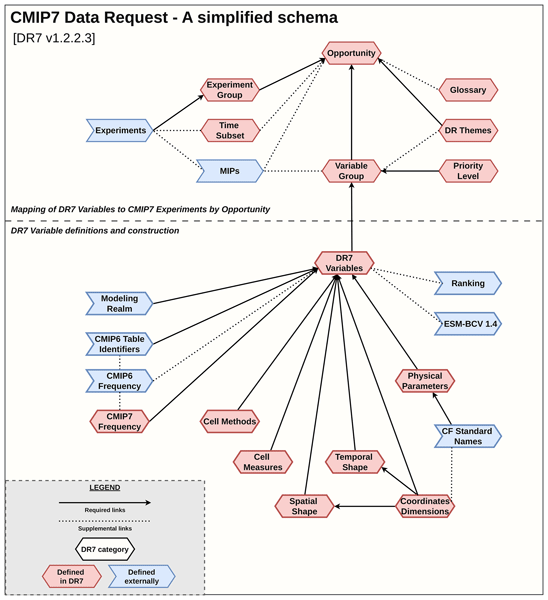
The usage of climate models and CMIP data is broadening from its origins in scientific study of the physical environment to support the analysis of climate impacts, and planning for an ever-increasing portfolio of mitigation and adaptation measures. To support this growing scope, DR7 introduces a new organising component, Opportunities, to support transparent mapping between variables and experiments. The 46 Opportunities in DR7 represent the key community-driven use cases across CMIP data users – each describing why its combination of variables and experiments is important and how they contribute to impact, providing both scientific justification and technical requirements.
It is challenging to represent the needs of the rapidly expanding CMIP community and user base while respecting the capacity limitations of CMIP data production. DR7 addresses this through a process of wide stakeholder engagement centred around an open consultation and community co-creation, while prioritising stakeholder representation and diversity. Innovations in interactive web tools and enhanced WCRP support through the CMIP IPO and Task Teams were also critical to the process of developing data requirements in collaboration with the community.
Competing interests: JA and MM are co-chairs, and MJ an emeritus member, of the WCRP ESMO Infrastructure Panel (WIP). BD, EO, BT and DE are employees of HE Space Ltd which delivers the CMIP IPO service to the European Space Agency. At least one of the (co-)authors is a member of the editorial board of Geoscientific Model Development.
Publisher's note: Copernicus Publications remains neutral with regard to jurisdictional claims made in the text, published maps, institutional affiliations, or any other geographical representation in this paper. While Copernicus Publications makes every effort to include appropriate place names, the final responsibility lies with the authors. Views expressed in the text are those of the authors and do not necessarily reflect the views of the publisher.-
Notice on discussion status
The requested preprint has a corresponding peer-reviewed final revised paper. You are encouraged to refer to the final revised version.
-
Preprint
(820 KB)
-
The requested preprint has a corresponding peer-reviewed final revised paper. You are encouraged to refer to the final revised version.
- Preprint
(820 KB) - Metadata XML
- BibTeX
- EndNote
- Final revised paper


Journal article(s) based on this preprint
Interactive discussion
Status: closed
-
RC1: 'Comment on egusphere-2026-1641', Paola Petrelli, 14 May 2026
-
AC1: 'Reply on RC1', Chloe Mackallah, 05 Aug 2026
Overall, I was impressed with how the paper delivers a comprehensive and detailed description of the Data Request, its evolution, and the past and present CMIP context in which the Data Request operates. Considering the complexity of this endeavor I think the authors did a good job of presenting a clear and comprehensive picture.
The Data Request evolution is well documented with plenty of information included in forms of tables and diagrams that simplify the complex relationships mentioned throughout and with extensive references to relevant documentation. The authors did also a good job in providing concrete examples of the necessary steps, their associated challenges and the way these were resolved. This provides valuable information for anyone embarking on a similar project and for the maintainers and developers of future Data Requests.
This paper represents an important testimony of the amount of work and planning that goes into designing a governance and technical framework to a scientific collaboration project of this magnitude. By pointing out in a clear way the role that governance and funding have in these kinds of activities, it provides an opportunity to reflect on what should be done at governance and community level for these projects to be successful and sustainable.
We thank the reviewer for carefully reviewing this manuscript, and your kind words of support. We are immensely proud of what we achieved, and very glad to hear that this paper captured our work well. The manuscript is significantly clearer now thanks to your suggestions, responses to which are included below each specific comment.
Specific comments
- The paper is overall well structured; I only have one question about why are the summary statistics from DR7 (Section 6.3) part of the final discussion session? Wouldn’t they fit better at the end of Section 5 (“a description of the technical structure, assets and versioned releases of the CMIP7 Data Request “) ?
Thank you, we agree – the summary statistics section is now at the end of Section 5
- CMIP7 is not the seventh phase of CMIP and where this is mentioned (line 5 and 92) it could be changed to “current” or omitted. Likewise, CMIP5 is not the fifth iteration in line 149 and “the fifth CMIP iteration (CMIP5)” you could use directly “CMIP5”.
Instances of “seventh” and “fifth” CMIPs have changed to “current” or just “CMIP7/CMIP5”
- I think there are opportunities to simplify or shorten some of the sentences to improve readability. In particular, the introduction could benefit from some adjustments, as there's are a lot of details included that could be left to other sections of the paper. This would also avoid excessive duplication of the concepts. I tried to include some suggestions in the technical corrections section.
Your readability suggestions have been fully adopted which has improved clarity and reduced repetition in the introduction
The technical corrections are included in the attached pdf to preserve the formatting.
All technical corrections were adopted, with some specific responses:
- Line 53-55 sentence dropped completely
- Line 84 split into 2 sentences and now reads: “These experiments are expected to underpin the most critical evaluations of Working Group I”
- Line 105 has “scientific” added instead of “community”; now reads ”against specific scientific requirements set through community consultation”
- Lines 406-409 has been split into separate sentences.
- Line 89 changed to “and non-AFT experiments are being developed by Community MIPs”
- Line 120 now reads “Adoption and adaption by the MIP community” – it is intended that the community can adopt the DR7 as-is, or adapt it to their unique requirements.
Citation: https://doi.org/10.5194/egusphere-2026-1641-AC1
-
AC1: 'Reply on RC1', Chloe Mackallah, 05 Aug 2026
-
RC2: 'Comment on egusphere-2026-1641', Anonymous Referee #2, 20 May 2026
I enjoyed reading this preprint, learning a lot through the development of CMIP and DR summarised in one place – a first timer, clearly articulating the motivation/demand of the change in approach for DR7 compared to previous phases. The process and technical details of DR7 are both clearly described with great attention to detail, well articulated in flowchart/schema. The case of revolutionising DR is well-justified, and its implication is thoroughly and profoundly discussed in connection with user needs and practicalities. I particularly like the reflection that consultations and community engagement activities should become a common practice for CMIP development.
Overall, the paper is well-structured, flows nicely, with the main ideas well-articulated. I have several suggestions for further improvements:
- I wondered why the account of integrating with CF conventions is in Section 3.3. It breaks the flow of the article especially because the first part of this Section consists of a description on the historical aspects. I would like to see a justification of this by the author team or some restructuring. An alternative that I can think of is to break into two parts – Chapter 2 on how things were done before and the feedback received, and Chapter 4 on the current practice (where the flowchart, Figure 2, may be cross-referenced).
- In Section 5.1, apart from the definitions of individual terms, one would wonder how the DR7 schema differs from that of DR6 overall, structurally? Perhaps a short paragraph to illustrate such difference would further strengthen the case of a community-driven structural reform.
- Summary statistics are results, not discussions. I suggest adding another section in the Results chapter for the statistical reporting (including Table 3), then refer back to it briefly in the discussions when it comes to an overall reflection of how things have evolved (integrating into Section 6.4).
Other suggestions mainly concern about the clarity of expression/language, as follows:
- Line 18 – I would prefer to express it as “adaptation and mitigation” since it's about "the usage of climate models", there are more users for adaptation than mitigation, especially as highlighted by the "Impacts and Adaptation" author team whilst none of the author teams is explicitly about mitigation. If the authors wanted to keep 'mitigation and adaptation' as it is, consider adding "the intercomparison and usage of climate models and CMIP data".
- Over the introduction, the definition of “CMIP Community” needs to be strengthened, as not even those within the community appreciate the breadth that it has grown into, let alone the other readers. Putting a better definition of this term in Section 1.2 (around Line 90, and signposting to the references in Table 1) will be beneficial for the article’s flow and clarity, especially as the statement “The usage of climate models and CMIP data is broadening from its origins in scientific study of the physical environment to support the analysis of climate impacts, and planning for an ever-increasing portfolio of mitigation and adaptation measures” is already mentioned in the abstract but any account of this kind is missing in the introduction. Also I wondered if it has any connection with the term “CMIP and Climate Community” officially defined in Line 338 – this could be a source of cross-referencing as well.
- Line 50 – Not immediately clear what it means by “It contains”, especially as it’s in a new paragraph. Suggest clarifying or merging into the above paragraph.
- Line 157 – Why “More than 2026”, but not an exact number? (especially as the number of experiments, 322, could be exactly given?)
- Line 266 – Unclear what it means by “a Cross-Theme Working Group” – are the DR-TT Theme liaisons part of it? Is it the same group as the “cross-thematic group” described in lines 366-369? If so, it might be useful to cross-reference. If not, then describe more specifically.
- Throughout the article there is inconsistency in abbreviating the Data Request Task Team. For example, it is abbreviated as “the Task Team” over various places from Lines 385-457, and as “DR-TT” in Line 424 and across Section 5.4. A unification of such would improve readability.
- Sections 5.3 – 5.4 could benefit from a better summarisation, particularly regarding the evolution from v1.0 to post-v1.2 which are described over two separate places (Lines 584-586, Lines 632-641).
Please find the attachment for the technical corrections/typo fixes required.
-
AC2: 'Reply on RC2', Chloe Mackallah, 05 Aug 2026
I enjoyed reading this preprint, learning a lot through the development of CMIP and DR summarised in one place – a first timer, clearly articulating the motivation/demand of the change in approach for DR7 compared to previous phases. The process and technical details of DR7 are both clearly described with great attention to detail, well articulated in flowchart/schema. The case of revolutionising DR is well-justified, and its implication is thoroughly and profoundly discussed in connection with user needs and practicalities. I particularly like the reflection that consultations and community engagement activities should become a common practice for CMIP development.
We thank the reviewer for their time and suggestions, it is encouraging to hear that our efforts were explained thoroughly and our choices well-justified – we also hope that CMIP continues toward community consultation and co-creation as the norm. The flow of the paper is now much improved with your advice, with specific responses in-line below.
Overall, the paper is well-structured, flows nicely, with the main ideas well-articulated. I have several suggestions for further improvements:
- I wondered why the account of integrating with CF conventions is in Section 3.3. It breaks the flow of the article especially because the first part of this Section consists of a description on the historical aspects. I would like to see a justification of this by the author team or some restructuring. An alternative that I can think of is to break into two parts – Chapter 2 on how things were done before and the feedback received, and Chapter 4 on the current practice (where the flowchart, Figure 2, may be cross-referenced).
Thank you for this feedback and we appreciate the suggestions. The CF section has been split into two, with the historical description moved to the end of Section 2 (now: 2.2. CF Conventions and the CMIP Data Request), and the CMIP7-era integration with CF moved to the end of Section 4 (now: 4.5. Continued integration with CF Conventions)
- In Section 5.1, apart from the definitions of individual terms, one would wonder how the DR7 schema differs from that of DR6 overall, structurally? Perhaps a short paragraph to illustrate such difference would further strengthen the case of a community-driven structural reform.
Agree that a clearer statement of step-change should be made.
To the first paragraph in Section 5.1 we added “This mapping section saw the largest changes in terms of structure from DR6 to DR7. In particular, the introduction of Opportunities greatly simplified the way in which variables map to experiments. Previously this mapping was managed by several database items that were not readily visible to users (see Figure 3 in Juckes et al. 2020), while the DR7 Opportunity component is now the primary user-facing index of the Data Request.”
To the second paragraph we added “The construction of DR7 Variables are largely the same as in DR7, with minor changes made to variables during importation...”
- Summary statistics are results, not discussions. I suggest adding another section in the Results chapter for the statistical reporting (including Table 3), then refer back to it briefly in the discussions when it comes to an overall reflection of how things have evolved (integrating into Section 6.4).
Yes we agree – the summary statistics section is now at the end of Section 5
Other suggestions mainly concern about the clarity of expression/language, as follows:
- Line 18 – I would prefer to express it as “adaptation and mitigation” since it's about "the usage of climate models", there are more users for adaptation than mitigation, especially as highlighted by the "Impacts and Adaptation" author team whilst none of the author teams is explicitly about mitigation. If the authors wanted to keep 'mitigation and adaptation' as it is, consider adding "the intercomparison and usage of climate models and CMIP data".
Line 18 changed to “adaptation and mitigation”
- Over the introduction, the definition of “CMIP Community” needs to be strengthened, as not even those within the community appreciate the breadth that it has grown into, let alone the other readers. Putting a better definition of this term in Section 1.2 (around Line 90, and signposting to the references in Table 1) will be beneficial for the article’s flow and clarity, especially as the statement “The usage of climate models and CMIP data is broadening from its origins in scientific study of the physical environment to support the analysis of climate impacts, and planning for an ever-increasing portfolio of mitigation and adaptation measures” is already mentioned in the abstract but any account of this kind is missing in the introduction. Also I wondered if it has any connection with the term “CMIP and Climate Community” officially defined in Line 338 – this could be a source of cross-referencing as well.
Your suggestion has brought significant clarity and flow to the introduction.
Paragraph 2 of Section 1.2 (Role of the Data Request in the CMIP and climate science community) now reads: “However, CMIP7 is a much broader activity than supporting the current IPCC cycle. There will be extensive use of data from DECK and AFT experiments beyond IPCC AR7, along with the many non-AFT experiments which are being developed by Community MIPs. This community of CMIP data users participated in DR7-dev primarily through the Thematic Author Teams and wider consultation (described in Section 4, with specific communities listed in Table 1), and included representation from WCRP activities such as CORDEX, most registered Community MIPs, and those working on climate impacts, adaptation and mitigation (e.g. fisheries, human health, and energy). Thanks to the active participation of the CMIP and climate community throughout DR7-dev, the Data Request can provide ongoing utility to the CMIP community throughout and beyond the CMIP7 cycle.”
- Line 50 – Not immediately clear what it means by “It contains”, especially as it’s in a new paragraph. Suggest clarifying or merging into the above paragraph.
Changed to “DR7 contains...”
- Line 157 – Why “More than 2026”, but not an exact number? (especially as the number of experiments, 322, could be exactly given?)
Removed “More than” and correct the value as per the summary statistics page, sentence now just starts with “2,063 Earth system variables...”.
- Line 266 – Unclear what it means by “a Cross-Theme Working Group” – are the DR-TT Theme liaisons part of it? Is it the same group as the “cross-thematic group” described in lines 366-369? If so, it might be useful to cross-reference. If not, then describe more specifically.
These are the same group, however the mentions of it are somewhat inconsistent in formatting. A cross-reference has been added to line 266 (“see Section 4 for more information on the roles in DR7-dev and the harmonisation process”), and references to the Cross-Theme Working Group have been clarified throughout.
- Throughout the article there is inconsistency in abbreviating the Data Request Task Team. For example, it is abbreviated as “the Task Team” over various places from Lines 385-457, and as “DR-TT” in Line 424 and across Section 5.4. A unification of such would improve readability.
All abbreviated instances of the Data Request Task Team changed to DR-TT for readability.
- Sections 5.3 – 5.4 could benefit from a better summarisation, particularly regarding the evolution from v1.0 to post-v1.2 which are described over two separate places (Lines 584-586, Lines 632-641).
Upon review, we think that some of the confusion is from the order of sections, where the API description in 5.3 referred to the DR7 release versions described in 5.4 (especially because the API versions were decoupled from DR7 after v1.2.2).
Changes made:- moved 5.4 (Release cycle and version management) to 5.2 to be before the Airtable and API descriptions.
- added to the paragraph about DR7 v1.0-1.2 releases: “Major developments over these first three versions were largely focused on constructing and reviewing Opportunity descriptions through community consultation, with DR Themes establishing and beginning to harmonise Opportunity variable lists.”
- added to the next paragraph about DR7 post-v1.2 releases: “Most changes made to DR7 post-v1.2 were at the metadata level, such as clarifying variable descriptions, correcting errors and inconsistencies, and small changes to Opportunity variable lists.”
- The paragraph in the API section now reads: “Software versions are not tied to specific Data Request releases -- they are separate from the versioning of the DR content exports. DR7 releases v1.0 to v1.2.2 were followed by corresponding software release with the same version string. After v1.2.2, however, API software versions were decoupled from the main DR7 releases and published independently according to user needs and development progression. Post-v1.2.2 DR7 API software versions use the standard three-part semantic versioning (major, minor, patch), as distinct from the four-part scheme used for the Data Request (see next Section).”
Please find the attachment for the technical corrections/typo fixes required.
All technical corrections were adopted, with one specific response:
- Lines 280-290 are quoted directly from the CMIP Panel decision log for transparency, so have been left unchanged. The nature of the quote is now introduced more explicitly: “Quoted directly from the CMIP Panel governance decision log (Decision ID 09)”
Citation: https://doi.org/10.5194/egusphere-2026-1641-AC2
- I wondered why the account of integrating with CF conventions is in Section 3.3. It breaks the flow of the article especially because the first part of this Section consists of a description on the historical aspects. I would like to see a justification of this by the author team or some restructuring. An alternative that I can think of is to break into two parts – Chapter 2 on how things were done before and the feedback received, and Chapter 4 on the current practice (where the flowchart, Figure 2, may be cross-referenced).
Peer review completion


Interactive discussion
Status: closed
-
RC1: 'Comment on egusphere-2026-1641', Paola Petrelli, 14 May 2026
General comments
Overall, I was impressed with how the paper delivers a comprehensive and detailed description of the Data Request, its evolution, and the past and present CMIP context in which the Data Request operates. Considering the complexity of this endeavor I think the authors did a good job of presenting a clear and comprehensive picture.
The Data Request evolution is well documented with plenty of information included in forms of tables and diagrams that simplify the complex relationships mentioned throughout and with extensive references to relevant documentation. The authors did also a good job in providing concrete examples of the necessary steps, their associated challenges and the way these were resolved. This provides valuable information for anyone embarking on a similar project and for the maintainers and developers of future Data Requests.
This paper represents an important testimony of the amount of work and planning that goes into designing a governance and technical framework to a scientific collaboration project of this magnitude. By pointing out in a clear way the role that governance and funding have in these kinds of activities, it provides an opportunity to reflect on what should be done at governance and community level for these projects to be successful and sustainable.
Specific comments
- The paper is overall well structured; I only have one question about why are the summary statistics from DR7 (Section 6.3) part of the final discussion session? Wouldn’t they fit better at the end of Section 5 (“a description of the technical structure, assets and versioned releases of the CMIP7 Data Request “) ?
- CMIP7 is not the seventh phase of CMIP and where this is mentioned (line 5 and 92) it could be changed to “current” or omitted. Likewise, CMIP5 is not the fifth iteration in line 149 and “the fifth CMIP iteration (CMIP5)” you could use directly “CMIP5”.
- I think there are opportunities to simplify or shorten some of the sentences to improve readability. In particular, the introduction could benefit from some adjustments, as there's are a lot of details included that could be left to other sections of the paper. This would also avoid excessive duplication of the concepts. I tried to include some suggestions in the technical corrections section.
The technical corrections are included in the attached pdf to preserve the formatting.
-
AC1: 'Reply on RC1', Chloe Mackallah, 05 Aug 2026
Overall, I was impressed with how the paper delivers a comprehensive and detailed description of the Data Request, its evolution, and the past and present CMIP context in which the Data Request operates. Considering the complexity of this endeavor I think the authors did a good job of presenting a clear and comprehensive picture.
The Data Request evolution is well documented with plenty of information included in forms of tables and diagrams that simplify the complex relationships mentioned throughout and with extensive references to relevant documentation. The authors did also a good job in providing concrete examples of the necessary steps, their associated challenges and the way these were resolved. This provides valuable information for anyone embarking on a similar project and for the maintainers and developers of future Data Requests.
This paper represents an important testimony of the amount of work and planning that goes into designing a governance and technical framework to a scientific collaboration project of this magnitude. By pointing out in a clear way the role that governance and funding have in these kinds of activities, it provides an opportunity to reflect on what should be done at governance and community level for these projects to be successful and sustainable.
We thank the reviewer for carefully reviewing this manuscript, and your kind words of support. We are immensely proud of what we achieved, and very glad to hear that this paper captured our work well. The manuscript is significantly clearer now thanks to your suggestions, responses to which are included below each specific comment.
Specific comments
- The paper is overall well structured; I only have one question about why are the summary statistics from DR7 (Section 6.3) part of the final discussion session? Wouldn’t they fit better at the end of Section 5 (“a description of the technical structure, assets and versioned releases of the CMIP7 Data Request “) ?
Thank you, we agree – the summary statistics section is now at the end of Section 5
- CMIP7 is not the seventh phase of CMIP and where this is mentioned (line 5 and 92) it could be changed to “current” or omitted. Likewise, CMIP5 is not the fifth iteration in line 149 and “the fifth CMIP iteration (CMIP5)” you could use directly “CMIP5”.
Instances of “seventh” and “fifth” CMIPs have changed to “current” or just “CMIP7/CMIP5”
- I think there are opportunities to simplify or shorten some of the sentences to improve readability. In particular, the introduction could benefit from some adjustments, as there's are a lot of details included that could be left to other sections of the paper. This would also avoid excessive duplication of the concepts. I tried to include some suggestions in the technical corrections section.
Your readability suggestions have been fully adopted which has improved clarity and reduced repetition in the introduction
The technical corrections are included in the attached pdf to preserve the formatting.
All technical corrections were adopted, with some specific responses:
- Line 53-55 sentence dropped completely
- Line 84 split into 2 sentences and now reads: “These experiments are expected to underpin the most critical evaluations of Working Group I”
- Line 105 has “scientific” added instead of “community”; now reads ”against specific scientific requirements set through community consultation”
- Lines 406-409 has been split into separate sentences.
- Line 89 changed to “and non-AFT experiments are being developed by Community MIPs”
- Line 120 now reads “Adoption and adaption by the MIP community” – it is intended that the community can adopt the DR7 as-is, or adapt it to their unique requirements.
Citation: https://doi.org/10.5194/egusphere-2026-1641-AC1
-
RC2: 'Comment on egusphere-2026-1641', Anonymous Referee #2, 20 May 2026
I enjoyed reading this preprint, learning a lot through the development of CMIP and DR summarised in one place – a first timer, clearly articulating the motivation/demand of the change in approach for DR7 compared to previous phases. The process and technical details of DR7 are both clearly described with great attention to detail, well articulated in flowchart/schema. The case of revolutionising DR is well-justified, and its implication is thoroughly and profoundly discussed in connection with user needs and practicalities. I particularly like the reflection that consultations and community engagement activities should become a common practice for CMIP development.
Overall, the paper is well-structured, flows nicely, with the main ideas well-articulated. I have several suggestions for further improvements:
- I wondered why the account of integrating with CF conventions is in Section 3.3. It breaks the flow of the article especially because the first part of this Section consists of a description on the historical aspects. I would like to see a justification of this by the author team or some restructuring. An alternative that I can think of is to break into two parts – Chapter 2 on how things were done before and the feedback received, and Chapter 4 on the current practice (where the flowchart, Figure 2, may be cross-referenced).
- In Section 5.1, apart from the definitions of individual terms, one would wonder how the DR7 schema differs from that of DR6 overall, structurally? Perhaps a short paragraph to illustrate such difference would further strengthen the case of a community-driven structural reform.
- Summary statistics are results, not discussions. I suggest adding another section in the Results chapter for the statistical reporting (including Table 3), then refer back to it briefly in the discussions when it comes to an overall reflection of how things have evolved (integrating into Section 6.4).
Other suggestions mainly concern about the clarity of expression/language, as follows:
- Line 18 – I would prefer to express it as “adaptation and mitigation” since it's about "the usage of climate models", there are more users for adaptation than mitigation, especially as highlighted by the "Impacts and Adaptation" author team whilst none of the author teams is explicitly about mitigation. If the authors wanted to keep 'mitigation and adaptation' as it is, consider adding "the intercomparison and usage of climate models and CMIP data".
- Over the introduction, the definition of “CMIP Community” needs to be strengthened, as not even those within the community appreciate the breadth that it has grown into, let alone the other readers. Putting a better definition of this term in Section 1.2 (around Line 90, and signposting to the references in Table 1) will be beneficial for the article’s flow and clarity, especially as the statement “The usage of climate models and CMIP data is broadening from its origins in scientific study of the physical environment to support the analysis of climate impacts, and planning for an ever-increasing portfolio of mitigation and adaptation measures” is already mentioned in the abstract but any account of this kind is missing in the introduction. Also I wondered if it has any connection with the term “CMIP and Climate Community” officially defined in Line 338 – this could be a source of cross-referencing as well.
- Line 50 – Not immediately clear what it means by “It contains”, especially as it’s in a new paragraph. Suggest clarifying or merging into the above paragraph.
- Line 157 – Why “More than 2026”, but not an exact number? (especially as the number of experiments, 322, could be exactly given?)
- Line 266 – Unclear what it means by “a Cross-Theme Working Group” – are the DR-TT Theme liaisons part of it? Is it the same group as the “cross-thematic group” described in lines 366-369? If so, it might be useful to cross-reference. If not, then describe more specifically.
- Throughout the article there is inconsistency in abbreviating the Data Request Task Team. For example, it is abbreviated as “the Task Team” over various places from Lines 385-457, and as “DR-TT” in Line 424 and across Section 5.4. A unification of such would improve readability.
- Sections 5.3 – 5.4 could benefit from a better summarisation, particularly regarding the evolution from v1.0 to post-v1.2 which are described over two separate places (Lines 584-586, Lines 632-641).
Please find the attachment for the technical corrections/typo fixes required.
-
AC2: 'Reply on RC2', Chloe Mackallah, 05 Aug 2026
I enjoyed reading this preprint, learning a lot through the development of CMIP and DR summarised in one place – a first timer, clearly articulating the motivation/demand of the change in approach for DR7 compared to previous phases. The process and technical details of DR7 are both clearly described with great attention to detail, well articulated in flowchart/schema. The case of revolutionising DR is well-justified, and its implication is thoroughly and profoundly discussed in connection with user needs and practicalities. I particularly like the reflection that consultations and community engagement activities should become a common practice for CMIP development.
We thank the reviewer for their time and suggestions, it is encouraging to hear that our efforts were explained thoroughly and our choices well-justified – we also hope that CMIP continues toward community consultation and co-creation as the norm. The flow of the paper is now much improved with your advice, with specific responses in-line below.
Overall, the paper is well-structured, flows nicely, with the main ideas well-articulated. I have several suggestions for further improvements:
- I wondered why the account of integrating with CF conventions is in Section 3.3. It breaks the flow of the article especially because the first part of this Section consists of a description on the historical aspects. I would like to see a justification of this by the author team or some restructuring. An alternative that I can think of is to break into two parts – Chapter 2 on how things were done before and the feedback received, and Chapter 4 on the current practice (where the flowchart, Figure 2, may be cross-referenced).
Thank you for this feedback and we appreciate the suggestions. The CF section has been split into two, with the historical description moved to the end of Section 2 (now: 2.2. CF Conventions and the CMIP Data Request), and the CMIP7-era integration with CF moved to the end of Section 4 (now: 4.5. Continued integration with CF Conventions)
- In Section 5.1, apart from the definitions of individual terms, one would wonder how the DR7 schema differs from that of DR6 overall, structurally? Perhaps a short paragraph to illustrate such difference would further strengthen the case of a community-driven structural reform.
Agree that a clearer statement of step-change should be made.
To the first paragraph in Section 5.1 we added “This mapping section saw the largest changes in terms of structure from DR6 to DR7. In particular, the introduction of Opportunities greatly simplified the way in which variables map to experiments. Previously this mapping was managed by several database items that were not readily visible to users (see Figure 3 in Juckes et al. 2020), while the DR7 Opportunity component is now the primary user-facing index of the Data Request.”
To the second paragraph we added “The construction of DR7 Variables are largely the same as in DR7, with minor changes made to variables during importation...”
- Summary statistics are results, not discussions. I suggest adding another section in the Results chapter for the statistical reporting (including Table 3), then refer back to it briefly in the discussions when it comes to an overall reflection of how things have evolved (integrating into Section 6.4).
Yes we agree – the summary statistics section is now at the end of Section 5
Other suggestions mainly concern about the clarity of expression/language, as follows:
- Line 18 – I would prefer to express it as “adaptation and mitigation” since it's about "the usage of climate models", there are more users for adaptation than mitigation, especially as highlighted by the "Impacts and Adaptation" author team whilst none of the author teams is explicitly about mitigation. If the authors wanted to keep 'mitigation and adaptation' as it is, consider adding "the intercomparison and usage of climate models and CMIP data".
Line 18 changed to “adaptation and mitigation”
- Over the introduction, the definition of “CMIP Community” needs to be strengthened, as not even those within the community appreciate the breadth that it has grown into, let alone the other readers. Putting a better definition of this term in Section 1.2 (around Line 90, and signposting to the references in Table 1) will be beneficial for the article’s flow and clarity, especially as the statement “The usage of climate models and CMIP data is broadening from its origins in scientific study of the physical environment to support the analysis of climate impacts, and planning for an ever-increasing portfolio of mitigation and adaptation measures” is already mentioned in the abstract but any account of this kind is missing in the introduction. Also I wondered if it has any connection with the term “CMIP and Climate Community” officially defined in Line 338 – this could be a source of cross-referencing as well.
Your suggestion has brought significant clarity and flow to the introduction.
Paragraph 2 of Section 1.2 (Role of the Data Request in the CMIP and climate science community) now reads: “However, CMIP7 is a much broader activity than supporting the current IPCC cycle. There will be extensive use of data from DECK and AFT experiments beyond IPCC AR7, along with the many non-AFT experiments which are being developed by Community MIPs. This community of CMIP data users participated in DR7-dev primarily through the Thematic Author Teams and wider consultation (described in Section 4, with specific communities listed in Table 1), and included representation from WCRP activities such as CORDEX, most registered Community MIPs, and those working on climate impacts, adaptation and mitigation (e.g. fisheries, human health, and energy). Thanks to the active participation of the CMIP and climate community throughout DR7-dev, the Data Request can provide ongoing utility to the CMIP community throughout and beyond the CMIP7 cycle.”
- Line 50 – Not immediately clear what it means by “It contains”, especially as it’s in a new paragraph. Suggest clarifying or merging into the above paragraph.
Changed to “DR7 contains...”
- Line 157 – Why “More than 2026”, but not an exact number? (especially as the number of experiments, 322, could be exactly given?)
Removed “More than” and correct the value as per the summary statistics page, sentence now just starts with “2,063 Earth system variables...”.
- Line 266 – Unclear what it means by “a Cross-Theme Working Group” – are the DR-TT Theme liaisons part of it? Is it the same group as the “cross-thematic group” described in lines 366-369? If so, it might be useful to cross-reference. If not, then describe more specifically.
These are the same group, however the mentions of it are somewhat inconsistent in formatting. A cross-reference has been added to line 266 (“see Section 4 for more information on the roles in DR7-dev and the harmonisation process”), and references to the Cross-Theme Working Group have been clarified throughout.
- Throughout the article there is inconsistency in abbreviating the Data Request Task Team. For example, it is abbreviated as “the Task Team” over various places from Lines 385-457, and as “DR-TT” in Line 424 and across Section 5.4. A unification of such would improve readability.
All abbreviated instances of the Data Request Task Team changed to DR-TT for readability.
- Sections 5.3 – 5.4 could benefit from a better summarisation, particularly regarding the evolution from v1.0 to post-v1.2 which are described over two separate places (Lines 584-586, Lines 632-641).
Upon review, we think that some of the confusion is from the order of sections, where the API description in 5.3 referred to the DR7 release versions described in 5.4 (especially because the API versions were decoupled from DR7 after v1.2.2).
Changes made:- moved 5.4 (Release cycle and version management) to 5.2 to be before the Airtable and API descriptions.
- added to the paragraph about DR7 v1.0-1.2 releases: “Major developments over these first three versions were largely focused on constructing and reviewing Opportunity descriptions through community consultation, with DR Themes establishing and beginning to harmonise Opportunity variable lists.”
- added to the next paragraph about DR7 post-v1.2 releases: “Most changes made to DR7 post-v1.2 were at the metadata level, such as clarifying variable descriptions, correcting errors and inconsistencies, and small changes to Opportunity variable lists.”
- The paragraph in the API section now reads: “Software versions are not tied to specific Data Request releases -- they are separate from the versioning of the DR content exports. DR7 releases v1.0 to v1.2.2 were followed by corresponding software release with the same version string. After v1.2.2, however, API software versions were decoupled from the main DR7 releases and published independently according to user needs and development progression. Post-v1.2.2 DR7 API software versions use the standard three-part semantic versioning (major, minor, patch), as distinct from the four-part scheme used for the Data Request (see next Section).”
Please find the attachment for the technical corrections/typo fixes required.
All technical corrections were adopted, with one specific response:
- Lines 280-290 are quoted directly from the CMIP Panel decision log for transparency, so have been left unchanged. The nature of the quote is now introduced more explicitly: “Quoted directly from the CMIP Panel governance decision log (Decision ID 09)”
Citation: https://doi.org/10.5194/egusphere-2026-1641-AC2
- I wondered why the account of integrating with CF conventions is in Section 3.3. It breaks the flow of the article especially because the first part of this Section consists of a description on the historical aspects. I would like to see a justification of this by the author team or some restructuring. An alternative that I can think of is to break into two parts – Chapter 2 on how things were done before and the feedback received, and Chapter 4 on the current practice (where the flowchart, Figure 2, may be cross-referenced).
Peer review completion
Journal article(s) based on this preprint
Data sets
CMIP-Data-Request/CMIP7_DReq_Content: Data request content for v1.2.2.3 J. Anstey et al. https://doi.org/10.5281/zenodo.17986580
DR7 v1.2.2.3 (Airtable) C. Mackallah et al. https://bit.ly/CMIP7-DReq-v1_2_2_3
DR7 v1.2.2.3 (web viewer) C. Mackallah et al. https://cmip-data-request.github.io/cmip7-dreq-webview/index.html
Model code and software
CMIP-Data-Request/CMIP7_DReq_Software: v1.4 CMIP7 data request software J. Anstey et al. https://doi.org/10.5281/zenodo.17993659
Viewed
| HTML | XML | Total | BibTeX | EndNote | |
|---|---|---|---|---|---|
| 710 | 254 | 64 | 1,028 | 73 | 65 |
- HTML: 710
- PDF: 254
- XML: 64
- Total: 1,028
- BibTeX: 73
- EndNote: 65
Viewed (geographical distribution)
| Country | # | Views | % |
|---|
| Total: | 0 |
| HTML: | 0 |
| PDF: | 0 |
| XML: | 0 |
- 1
Cited


4 citations as recorded by crossref.
- CMIP7 data request: ocean and sea ice priorities and opportunities B. Fox-Kemper et al. https://doi.org/10.5194/gmd-19-6043-2026
- CMIP7 Data Request: atmosphere priorities and opportunities B. Dingley et al. https://doi.org/10.5194/gmd-19-2945-2026
- CMIP7 data request: Earth system priorities and opportunities M. McPartland et al. https://doi.org/10.5194/gmd-19-2849-2026
- CMIP7 data request: land and land ice priorities and opportunities Y. Li et al. https://doi.org/10.5194/gmd-19-3129-2026

Martin Juckes
James Anstey
Beth Dingley
Charlotte Pascoe
Gaëlle Rigoudy
Marie-Pierre Moine
Tomas Lovato
Alison Pamment
Martin Schupfner
Michio Kawamiya
Tommi Bergman
Charles Koven
Eleanor O'Rourke
Briony Turner
Daniel Ellis
Matthew Mizielinski
The requested preprint has a corresponding peer-reviewed final revised paper. You are encouraged to refer to the final revised version.
- Preprint
(820 KB) - Metadata XML
General comments
Overall, I was impressed with how the paper delivers a comprehensive and detailed description of the Data Request, its evolution, and the past and present CMIP context in which the Data Request operates. Considering the complexity of this endeavor I think the authors did a good job of presenting a clear and comprehensive picture.
The Data Request evolution is well documented with plenty of information included in forms of tables and diagrams that simplify the complex relationships mentioned throughout and with extensive references to relevant documentation. The authors did also a good job in providing concrete examples of the necessary steps, their associated challenges and the way these were resolved. This provides valuable information for anyone embarking on a similar project and for the maintainers and developers of future Data Requests.
This paper represents an important testimony of the amount of work and planning that goes into designing a governance and technical framework to a scientific collaboration project of this magnitude. By pointing out in a clear way the role that governance and funding have in these kinds of activities, it provides an opportunity to reflect on what should be done at governance and community level for these projects to be successful and sustainable.
Specific comments
The technical corrections are included in the attached pdf to preserve the formatting.