
the Creative Commons Attribution 4.0 License.
the Creative Commons Attribution 4.0 License.
 | 21 Jan 2026
Climate models with moderate climate sensitivity best simulate the magnitude of Earth's energy imbalance
Abstract. Recent studies have highlighted that state-of-the-art climate models are not able to simulate the large observed trend in Earth's energy imbalance. Here we evaluate climate models' ability to represent both the trend and the magnitude of the imbalance, while accounting for model energy leakage and remnant drift. As reference we use satellite observations and we find that every observed annual mean energy imbalance is within the range simulated by models, including the record year 2023, and when averaged over the 2001–2024 period, 15 out of 30 models simulate magnitudes of the imbalance that are statistically consistent with the observations. Models, however, generally underestimate the positive trend in the energy imbalance, albeit barely within the range of uncertainty. We suspected that a discontinuity in volcanic forcing between the historical and future scenario in 2014–2015 could have caused the underestimated trend, but only found evidence of such artifacts for a few models. Finally, we find a weak correlation between short-term decadal warming and energy imbalance, but a surprisingly close relationship between energy imbalance and equilibrium climate sensitivity. Based on observational constraints, the relationship suggests that models with moderate climate sensitivity are most realistic.
-
Notice on discussion status
The requested preprint has a corresponding peer-reviewed final revised paper. You are encouraged to refer to the final revised version.
-
Preprint
(3353 KB)
-
The requested preprint has a corresponding peer-reviewed final revised paper. You are encouraged to refer to the final revised version.
- Preprint
(3353 KB) - Metadata XML
- BibTeX
- EndNote
- Final revised paper


Journal article(s) based on this preprint
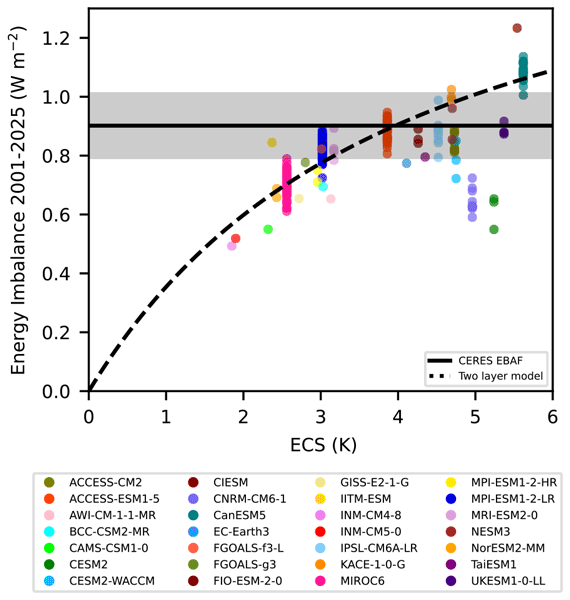
Observations show an increasing imbalance between how much energy the Earth absorbs from the Sun and emits back to space, leading to climate change. We evaluate how well climate models simulate both the magnitude and trend of the imbalance. We find that models capture the magnitude but underestimate the trend, which is not related to how models handle volcanic aerosols when switching to future scenarios. The models that best simulate the magnitude are the ones with moderate climate sensitivity.
Interactive discussion
Status: closed
-
RC1: 'Comment on egusphere-2026-163', Anonymous Referee #1, 06 Feb 2026
General comments
This study examines the recent positive trend and magnitude of the observed Earth’s Energy Imbalance (EEI) and evaluates their reproducibility in CMIP6 models. The authors demonstrate that while the magnitude of EEI is well captured by CMIP6 models, its positive trend is underestimated by most of them. They further identify a close relationship between EEI and equilibrium climate sensitivity (ECS) and attempt to constrain ECS using the observed EEI magnitude, suggesting that models with moderate ECS values are more consistent with observations.
Overall, the manuscript is well written, and the results are interesting and supported by robust analyses. I recommend publication after minor revisions.
Specific comments
- L86–87:
I understood that a positive sign indicates energy input into the system, whereas a negative sign indicates energy loss. If this understanding is incorrect, please clarify. Based on Figure 2, the global mean temperature appears to increase when the energy imbalance is positive, which seems consistent with net energy input. - L243–246:
I found this discussion somewhat confusing. You state that the cooler global temperature associated with internal variability during the first period leads to a larger energy imbalance through the negative feedback term (λΔTs). However, my understanding is that this term represents the response to anthropogenic forcing, while the effect of internal variability is captured by ε. Please clarify this point and elaborate on the underlying argument in more detail. - L250–251:
I understand that models with larger ECS tend to have smaller (weaker) negative climate feedback parameters λ. However, the magnitude of λΔT also depends on the value of ΔT. My understanding is that larger-ECS models compensate for energy imbalance through a larger increase in ΔT compared to smaller-ECS models, suggesting that the behavior of λΔT may not be straightforward. Please clarify this interpretation. - L289-298: As discussed, the observed sea surface temperature exhibits a La Niña–like trend pattern, whereas most climate models simulate an El Niño–like trend pattern. As shown in, for example, Gregory and Andrews (2016, https://doi.org/10.1002/2016GL068406) and Andrews et al. (2018, https://doi.org/10.1029/2018GL078887), climate feedbacks under real-world conditions are expected to be more strongly negative than those estimated from abrupt-4×CO₂ or historical experiments. If the external forcing term F and ΔT are the same in the models and in the real world, the observed energy imbalance N would be expected to be smaller. However, this does not appear to be the case based on observations. Could this discrepancy arise because F is not fully represented in the models, or because ΔT is relatively small in the observations? I would appreciate further clarification and discussion of this apparent inconsistency.
Technical corrections
- L25:
Shared Socioeconomic Pathway SSP2-4.5 → Shared Socioeconomic Pathway (SSP) 2-4.5 - Figure 4:
The gray lines are too thin to be easily distinguishable. It would be helpful to slightly thicken the lines or use different colors. In addition, please include information about these lines in the figure legend. - Figure 8:
“Multi-model ensemble mean/range” would be more appropriate than “Model mean/range.” - Figures 10 and 11:
The legends are too small. I suggest placing the legends outside the figures, increasing the font size, and arranging them in two columns.
Citation: https://doi.org/10.5194/egusphere-2026-163-RC1 -
AC1: 'Reply on RC1', Kyriaki Bimpiri, 02 Apr 2026
The comment was uploaded in the form of a supplement: https://egusphere.copernicus.org/preprints/2026/egusphere-2026-163/egusphere-2026-163-AC1-supplement.pdf
- L86–87:
-
RC2: 'Comment on egusphere-2026-163', Anonymous Referee #2, 13 Mar 2026
"Climate models with moderate climate sensitivity best simulate the magnitude of Earth's energy imbalance" by Bimpiri et al. analyze coupled climate model simulations of Earth's energy imbalance and find that those with moderate ECS agree more with observations of EEI (magnitude). The paper is interesting and well-written. I only have minor comments below, mostly related to clarifications, wording, and references, that should be addressed prior to publication.
1. Para 15: Didn’t Fourier and Arrhenius only describe the greenhouse effect? Not EEI? Please clarify.
2. Para 20: Underestimate, not “unable to”, would be more appropriate. Please consider.
3. Para 25: von Schuckmann et al., 2016 would be an appropriate reference here. Please add.
4. Para 40: Park and Soden, 2025 suggest a minimal aerosol role and should be mentioned. Please add.
5. Para 70: The use of DEEP-C is concerning. It uses ERA5 which has a near-zero EEI trend due to faulty SWCRE changes (Loeb et al., 2022; Raghuraman et al., 2023). This should be acknowledged with these references (all references below). Please add.
6. Para 80: SSP2-4.5 is from 2015 onward, not 2014. Please correct.
7. Para 85: "A positive energy imbalance corresponds to energy leakage, and a negative energy imbalance is associated with an artificial input or source of energy."
Shouldn’t it be the opposite? Also, the range is to be expected from natural variability, not something artificial. Please clarify.
8. Para 115: It would be more appropriate to do S.E. for large ensembles as \sigma/sqrt(n), so CI = +/- 1.64*\sigma/sqrt(n). Please consider.
9. Para 120: Units should be 0.1 Wm^-2/decade, not Wm^-2, as it is the observational uncertainty due to drift (temporally varying). Please correct.
10. Para 125: This is not clear…why not just use the continuous time series? Please clarify.
11. Para 160: Fan et al., 2025 too would be a good reference here. Please add.
12. Figure 10: Is 12 years enough? especially when 2001-2012 is the heart of the hiatus. Please clarify.
13. Fig. 11: What if the y-axis was changed to trend in EEI? How would the results change? Please consider.
14. Para 260: Since this is the headline result and title perhaps worth quantifying this better? i.e., some correlation or some other statistic rather than just eye-balling Fig. 11. Please consider.
15. Para 290: Didn’t you rule out incorrectly applied forcing? Please clarify.
16. Internal variability alone cannot explain the positive trend in EEI (Raghuraman et al., 2021) so this paragraph needs to be revised with this being restated/acknowledged. Please consider.
References
Fan, C., Paynter, D., Kramer, R. J., & Lin, P. (2025). Sensitivity of Earth's radiation budget to lower boundary condition data sets in historical climate simulations. Geophysical Research Letters, 52(17), e2025GL115914.
Loeb, N. G., Mayer, M., Kato, S., Fasullo, J. T., Zuo, H., Senan, R., ... & Balmaseda, M. (2022). Evaluating twenty‐year trends in Earth's energy flows from observations and reanalyses. Journal of Geophysical Research: Atmospheres, 127(12), e2022JD036686.
Park, C., & Soden, B. J. (2025). Negligible contribution from aerosols to recent trends in Earth’s energy imbalance. Science advances, 11(48), eadv9429.
Raghuraman, S. P., Paynter, D., Menzel, R., & Ramaswamy, V. (2023). Forcing, cloud feedbacks, cloud masking, and internal variability in the cloud radiative effect satellite record. Journal of Climate, 36(12), 4151-4167.
von Schuckmann, K., Palmer, M. D., Trenberth, K. E., Cazenave, A., Chambers, D., Champollion, N., ... & Wild, M. (2016). An imperative to monitor Earth's energy imbalance. Nature Climate Change, 6(2), 138-144.
Citation: https://doi.org/10.5194/egusphere-2026-163-RC2 -
AC1: 'Reply on RC1', Kyriaki Bimpiri, 02 Apr 2026
The comment was uploaded in the form of a supplement: https://egusphere.copernicus.org/preprints/2026/egusphere-2026-163/egusphere-2026-163-AC1-supplement.pdf
-
AC1: 'Reply on RC1', Kyriaki Bimpiri, 02 Apr 2026
Peer review completion


Interactive discussion
Status: closed
-
RC1: 'Comment on egusphere-2026-163', Anonymous Referee #1, 06 Feb 2026
General comments
This study examines the recent positive trend and magnitude of the observed Earth’s Energy Imbalance (EEI) and evaluates their reproducibility in CMIP6 models. The authors demonstrate that while the magnitude of EEI is well captured by CMIP6 models, its positive trend is underestimated by most of them. They further identify a close relationship between EEI and equilibrium climate sensitivity (ECS) and attempt to constrain ECS using the observed EEI magnitude, suggesting that models with moderate ECS values are more consistent with observations.
Overall, the manuscript is well written, and the results are interesting and supported by robust analyses. I recommend publication after minor revisions.
Specific comments
- L86–87:
I understood that a positive sign indicates energy input into the system, whereas a negative sign indicates energy loss. If this understanding is incorrect, please clarify. Based on Figure 2, the global mean temperature appears to increase when the energy imbalance is positive, which seems consistent with net energy input. - L243–246:
I found this discussion somewhat confusing. You state that the cooler global temperature associated with internal variability during the first period leads to a larger energy imbalance through the negative feedback term (λΔTs). However, my understanding is that this term represents the response to anthropogenic forcing, while the effect of internal variability is captured by ε. Please clarify this point and elaborate on the underlying argument in more detail. - L250–251:
I understand that models with larger ECS tend to have smaller (weaker) negative climate feedback parameters λ. However, the magnitude of λΔT also depends on the value of ΔT. My understanding is that larger-ECS models compensate for energy imbalance through a larger increase in ΔT compared to smaller-ECS models, suggesting that the behavior of λΔT may not be straightforward. Please clarify this interpretation. - L289-298: As discussed, the observed sea surface temperature exhibits a La Niña–like trend pattern, whereas most climate models simulate an El Niño–like trend pattern. As shown in, for example, Gregory and Andrews (2016, https://doi.org/10.1002/2016GL068406) and Andrews et al. (2018, https://doi.org/10.1029/2018GL078887), climate feedbacks under real-world conditions are expected to be more strongly negative than those estimated from abrupt-4×CO₂ or historical experiments. If the external forcing term F and ΔT are the same in the models and in the real world, the observed energy imbalance N would be expected to be smaller. However, this does not appear to be the case based on observations. Could this discrepancy arise because F is not fully represented in the models, or because ΔT is relatively small in the observations? I would appreciate further clarification and discussion of this apparent inconsistency.
Technical corrections
- L25:
Shared Socioeconomic Pathway SSP2-4.5 → Shared Socioeconomic Pathway (SSP) 2-4.5 - Figure 4:
The gray lines are too thin to be easily distinguishable. It would be helpful to slightly thicken the lines or use different colors. In addition, please include information about these lines in the figure legend. - Figure 8:
“Multi-model ensemble mean/range” would be more appropriate than “Model mean/range.” - Figures 10 and 11:
The legends are too small. I suggest placing the legends outside the figures, increasing the font size, and arranging them in two columns.
Citation: https://doi.org/10.5194/egusphere-2026-163-RC1 -
AC1: 'Reply on RC1', Kyriaki Bimpiri, 02 Apr 2026
The comment was uploaded in the form of a supplement: https://egusphere.copernicus.org/preprints/2026/egusphere-2026-163/egusphere-2026-163-AC1-supplement.pdf
- L86–87:
-
RC2: 'Comment on egusphere-2026-163', Anonymous Referee #2, 13 Mar 2026
"Climate models with moderate climate sensitivity best simulate the magnitude of Earth's energy imbalance" by Bimpiri et al. analyze coupled climate model simulations of Earth's energy imbalance and find that those with moderate ECS agree more with observations of EEI (magnitude). The paper is interesting and well-written. I only have minor comments below, mostly related to clarifications, wording, and references, that should be addressed prior to publication.
1. Para 15: Didn’t Fourier and Arrhenius only describe the greenhouse effect? Not EEI? Please clarify.
2. Para 20: Underestimate, not “unable to”, would be more appropriate. Please consider.
3. Para 25: von Schuckmann et al., 2016 would be an appropriate reference here. Please add.
4. Para 40: Park and Soden, 2025 suggest a minimal aerosol role and should be mentioned. Please add.
5. Para 70: The use of DEEP-C is concerning. It uses ERA5 which has a near-zero EEI trend due to faulty SWCRE changes (Loeb et al., 2022; Raghuraman et al., 2023). This should be acknowledged with these references (all references below). Please add.
6. Para 80: SSP2-4.5 is from 2015 onward, not 2014. Please correct.
7. Para 85: "A positive energy imbalance corresponds to energy leakage, and a negative energy imbalance is associated with an artificial input or source of energy."
Shouldn’t it be the opposite? Also, the range is to be expected from natural variability, not something artificial. Please clarify.
8. Para 115: It would be more appropriate to do S.E. for large ensembles as \sigma/sqrt(n), so CI = +/- 1.64*\sigma/sqrt(n). Please consider.
9. Para 120: Units should be 0.1 Wm^-2/decade, not Wm^-2, as it is the observational uncertainty due to drift (temporally varying). Please correct.
10. Para 125: This is not clear…why not just use the continuous time series? Please clarify.
11. Para 160: Fan et al., 2025 too would be a good reference here. Please add.
12. Figure 10: Is 12 years enough? especially when 2001-2012 is the heart of the hiatus. Please clarify.
13. Fig. 11: What if the y-axis was changed to trend in EEI? How would the results change? Please consider.
14. Para 260: Since this is the headline result and title perhaps worth quantifying this better? i.e., some correlation or some other statistic rather than just eye-balling Fig. 11. Please consider.
15. Para 290: Didn’t you rule out incorrectly applied forcing? Please clarify.
16. Internal variability alone cannot explain the positive trend in EEI (Raghuraman et al., 2021) so this paragraph needs to be revised with this being restated/acknowledged. Please consider.
References
Fan, C., Paynter, D., Kramer, R. J., & Lin, P. (2025). Sensitivity of Earth's radiation budget to lower boundary condition data sets in historical climate simulations. Geophysical Research Letters, 52(17), e2025GL115914.
Loeb, N. G., Mayer, M., Kato, S., Fasullo, J. T., Zuo, H., Senan, R., ... & Balmaseda, M. (2022). Evaluating twenty‐year trends in Earth's energy flows from observations and reanalyses. Journal of Geophysical Research: Atmospheres, 127(12), e2022JD036686.
Park, C., & Soden, B. J. (2025). Negligible contribution from aerosols to recent trends in Earth’s energy imbalance. Science advances, 11(48), eadv9429.
Raghuraman, S. P., Paynter, D., Menzel, R., & Ramaswamy, V. (2023). Forcing, cloud feedbacks, cloud masking, and internal variability in the cloud radiative effect satellite record. Journal of Climate, 36(12), 4151-4167.
von Schuckmann, K., Palmer, M. D., Trenberth, K. E., Cazenave, A., Chambers, D., Champollion, N., ... & Wild, M. (2016). An imperative to monitor Earth's energy imbalance. Nature Climate Change, 6(2), 138-144.
Citation: https://doi.org/10.5194/egusphere-2026-163-RC2 -
AC1: 'Reply on RC1', Kyriaki Bimpiri, 02 Apr 2026
The comment was uploaded in the form of a supplement: https://egusphere.copernicus.org/preprints/2026/egusphere-2026-163/egusphere-2026-163-AC1-supplement.pdf
-
AC1: 'Reply on RC1', Kyriaki Bimpiri, 02 Apr 2026
Peer review completion
Journal article(s) based on this preprint
Observations show an increasing imbalance between how much energy the Earth absorbs from the Sun and emits back to space, leading to climate change. We evaluate how well climate models simulate both the magnitude and trend of the imbalance. We find that models capture the magnitude but underestimate the trend, which is not related to how models handle volcanic aerosols when switching to future scenarios. The models that best simulate the magnitude are the ones with moderate climate sensitivity.
Viewed
| HTML | XML | Total | BibTeX | EndNote | |
|---|---|---|---|---|---|
| 1,898 | 2,394 | 149 | 4,441 | 126 | 253 |
- HTML: 1,898
- PDF: 2,394
- XML: 149
- Total: 4,441
- BibTeX: 126
- EndNote: 253
Viewed (geographical distribution)
| Country | # | Views | % |
|---|
| Total: | 0 |
| HTML: | 0 |
| PDF: | 0 |
| XML: | 0 |
- 1
Kyriaki Bimpiri

Thomas Hocking
Thorsten Mauritsen
The requested preprint has a corresponding peer-reviewed final revised paper. You are encouraged to refer to the final revised version.
- Preprint
(3353 KB) - Metadata XML
Observations show an increasing imbalance between how much energy the Earth absorbs from the Sun and emits back to space, leading to climate change. We evaluate how well climate models simulate both the magnitude and trend of the imbalance. We find that models capture the magnitude but underestimate the trend, which is not related to how models handle volcanic aerosols when switching to future scenarios. The models that best simulate the magnitude are the ones with moderate climate sensitivity.
Observations show an increasing imbalance between how much energy the Earth absorbs from the Sun...