
the Creative Commons Attribution 4.0 License.
the Creative Commons Attribution 4.0 License.
 | 02 Apr 2026
Bayesian forecasting of triggered landslides
Abstract. We present a Bayesian probabilistic framework for landslide forecasting, explicitly accounting for the sources of epistemic uncertainty that affect landslide occurrence. The method describes the probability of landslide occurrence as a distribution, rather than a single value, allowing a more realistic treatment of uncertainty arising from incomplete landslide inventories, variable measurements, and the inherent complexity of landslide processes. We apply the probabilistic framework to a 22-year dataset of shallow landslides and daily rainfall records from the Campania region (southern Italy). Each landslide is associated with the nearest rain gauge, and forecasts are computed within Thiessen polygons representing the area of influence of each rain gauge. Posterior landslide probabilities are calculated for different daily rainfall thresholds using Bayes' theorem, with prior and likelihood terms modelled as uniform and Beta distributions, respectively. Results show that posterior probabilities increase progressively with rainfall, and no sharp physical threshold emerges. The retrospective forecast skill improves with rainfall information, as demonstrated by consistent gains in posterior over prior probabilities. This gradual trend supports the view of landslide triggering as a probabilistic process, challenging the use of deterministic rainfall thresholds in operational contexts. The proposed Bayesian probabilistic framework is designed to be generalizable to other triggering mechanism (e.g., earthquakes) and potentially adaptable to other regions, provided that sufficient data are available. Although the method is data-intensive, it enables transparent, uncertainty-informed forecasts, with potential applications in early warning systems and risk management strategies. Future developments may include the incorporation of antecedent rainfall and geological conditioning factors across broader spatial and temporal scales.
-
Notice on discussion status
The requested preprint has a corresponding peer-reviewed final revised paper. You are encouraged to refer to the final revised version.
-
Preprint
(2611 KB)
-
Supplement
(157 KB)
-
The requested preprint has a corresponding peer-reviewed final revised paper. You are encouraged to refer to the final revised version.
- Preprint
(2611 KB) - Metadata XML
-
Supplement
(157 KB) - BibTeX
- EndNote
- Final revised paper


Journal article(s) based on this preprint
Interactive discussion
Status: closed
-
RC1: 'Comment on egusphere-2026-1624', Farhad Hossain, 04 May 2026
-
AC1: 'Reply on RC1', Flavia Ferriero, 09 Jun 2026
We thank the Reviewer for the comments and suggestions. Please find our point-by-point responses below.
1. The use of Thiessen polygons (Section 3.3) is purely geometric and disregards orographic controls on rainfall, which are substantial given the study area’s elevation range (0–1,444 m) and Mediterranean climate. Topographically informed alternatives such as hydrological catchment delineation, cost-path allocation using a DEM-derived friction surface, or kriging with elevation as an external drift - would yield physically more defensible gauge influence zones. The authors should either test one such alternative or provide quantitative justification that spatial rainfall variability within each polygon is small enough to render the geometric approximation acceptable. If neither is feasible, this limitation must be prominently discussed in Section 6 with appropriate citations.
Alternative approaches exist; however, the spatial density and distribution of both landslides and rain gauges must be carefully considered, because our objective is to analyze how landslide occurrence probability varies not only around individual rain gauges, but across the entire study area. We tested a subdivision based on slope units, defined as geomorphological homogenous terrain units bounded by drainage lines (Alvioli et al., 2016). However, this approach proved impractical given the available landslide and rainfall data. Specifically, the analysis produced a large number of slope units, most of which either contained no landslide information or included only a single landslide or a single rain gauge. It was therefore not possible to define slope units large enough to include both landslides and rain gauges while still ensuring complete coverage of the study area.
Thiessen polygons are a standard and widely adopted approach in operational early warning applications. For instance, the Campania regional early warning system uses Thiessen polygons to define the area of influence of rain gauges and their proximity to municipalities for landslide hazard analysis. Nevertheless, we acknowledge that this method is a geometric approximation and does not explicitly account for topographic or orographic controls on rainfall variability. We will add text to the manuscript to clarify this limitation.We expect to modify the text as (line 563-572):
“A further limitation concerns the spatial association between rainfall measurements and landslide occurrence. In the present study, Thiessen polygons are adopted to define the area of influence of each rain gauge, consistently with approaches commonly used in operational early warning systems, including the Campania regional landslide early warning system for hydrogeological hazards (Biafore and Calcara, 2005). The method provides a pragmatic and computationally efficient spatial partitioning, but it represents a geometric approximation that does not explicitly account for topographic and orographic controls on rainfall and landslide variability. Alternative approaches based on hydrological catchments or topographically informed interpolation methods could potentially provide a more physically based representation of rainfall forcing. However, the available spatial density and distribution of landslides and rain gauges hampers the applicability of more detailed spatial subdivisions, which frequently resulted in spatial units containing insufficient data for the probabilistic analysis.”2. The analysis conditions landslide occurrence on 1-day cumulative rainfall only. Antecedent moisture - governed by multi-day to multi-week accumulations - is a well-established conditioning factor for shallow failures in pyroclastic soils (Cascini et al., 2008; De Vita et al., 2013). Since the temporal resolution of the catalogue (date-level) is equally compatible with 3-day and 7-day windows, extending the analysis to these accumulation periods is straightforward within the existing framework. The authors themselves propose this as future work (lines 526–528); the reviewer encourages inclusion in the present study. At minimum, a substantive sensitivity argument explaining why 1-day rainfall is expected to be sufficient should be added to Section 6.
We focused on 1-day cumulative rainfall as a first and simplified implementation of our modelling framework. The choice was motivated by different considerations, including the temporal accuracy of the available landslide catalogue, and the temporal scale adopted in the operational warning procedures of the Campania regional landslide early warning system. Moreover, although antecedent rainfall conditions are known to influence shallow landslide occurrence, daily rainfall can still provide meaningful predictive information because shallow landslides are often associated with short-duration intense rainfall events occurring during the wet season, when antecedent conditions are already close to critical levels. In this sense, part of the effect of antecedent wetness conditions may already be implicitly embedded in the empirical rainfall-landslide relationship captured by the dataset, since many landslides of the catalogue occurred in autumn and winter (see Figure 3a).
We will add language to the Discussion to address the issue. The new text will read (lines 554-560):
“Within this context, the use of daily rainfall data represents an additional limitation of the present application of the framework. The choice was primarily dictated by the temporal accuracy of the available landslide catalogue, which predominantly reports event occurrence at the daily scale and often relies on inferred rather than directly observed timing of landslide occurrence (Peruccacci et al., 2023), and by the availability of rainfall data at daily temporal resolution. Adopting rainfall data at finer temporal resolutions would therefore not be consistent with the resolution of the landslide records and could introduce further uncertainty. At the same time, the daily scale reflects the temporal resolution at which operational warning assessments are commonly issued by the Campania Regional Authority, supporting the practical applicability of the framework. Although antecedent rainfall conditions are known to influence shallow landslide occurrence in pyroclastic soils (Napolitano et al., 2016), daily rainfall can still provide meaningful predictive information because many landslides are associated with short-duration intense rainfall events occurring during the wet season (Rianna et al., 2014), when antecedent conditions are often already close to critical levels. In this sense, part of the effect of antecedent wetness conditions may already be implicitly embedded in the empirical rainfall-landslide relationship captured by the dataset, since many landslides of the catalogue occurred in autumn and winter (see figure 3a). Future research could explore the influence of different rainfall accumulation periods to assess whether, and to what extent, antecedent conditions affect landslide occurrence. This could be investigated by cumulating antecedent rainfall over progressively longer periods (e.g., 1, 2, 7, 15 days).”3. The Introduction (~30 lines) is brief relative to the methodological scope, while Sections 3.1–3.2 contain catalogue and gauge metadata at a granularity more suited to supplementary material. Several fields in Table 1 (e.g., PIFF classification, movement codes) are not used in the model. The authors should condense Tables 1–2, move full metadata to supplementary material, and use the recovered space to expand the Introduction with a more critical synthesis of prior probabilistic frameworks and an explicit articulation of the gaps this study fills.
We agree with reviewer’s suggestion, therefore, we will move Table 1 to the Appendix, and we will rewrite the Introduction (lines 64-90):
“…To address these limitations, Bayesian inference has been applied to estimate minimum rainfall conditions sufficient for landslide initiation e.g., through rainfall thresholds (Guzzetti et al., 2007, 2008, Brunetti et al., 2010). Scholars have proposed probabilistic frameworks that incorporate uncertainty in rainfall thresholds, quantifying the probability of landslide occurrence conditional on rainfall metrics (Berti et al., 2012; Pecoraro and Calvello, 2021; Jiang et al., 2022; Zhao et al., 2025). Zhang et al. (2025) further proposed a Bayesian framework to define probabilistic thresholds using rainfall variables automatically extracted from rainfall time-series.
Most of the existing probabilistic approaches for landslide forecasting rely on rainfall thresholds, treating uncertainty primarily as variability around the threshold parameters. For instance, through confidence intervals on cumulated rainfall – rainfall duration curves, or through non-exceedance probability levels (Peruccacci et al., 2017; Rossi et al., 2017). If such approaches represent a meaningful step beyond purely deterministic methods, the available landslide hazard modelling frameworks rarely address a thorough quantification of uncertainty, and uncertainty in rainfall datasets and landslide inventories is known to degrade the reliability of threshold estimates (Peres et al., 2018). The probabilistic content of these frameworks is largely restricted to the estimation of the uncertainty about the threshold, rather than a fundamental reconceptualization of landslide triggering as an inherently probabilistic process (Felsberg et al., 2023). However, most existing probabilistic frameworks yield point-valued probability estimates and assume a priori the existence of a sharp physical boundary separating triggering from non-triggering conditions. A further complication is the definition and sampling of non-triggering rainfall conditions. In real-world datasets, rainfall events that do not trigger landslides are far more common than those that do, resulting in highly imbalanced datasets, particularly in regions where data are sparse. The choice of how to sample non-events is therefore not a neutral methodological decision: it directly shapes the estimated probability of landslide occurrence and can introduce substantial bias into early warning systems (Peres and Cancelliere, 2014, 2018).
More generally, data-driven learning techniques have increasingly been adopted to estimate landslide probability in both space and time (Lombardo et al., 2020; Mondini et al., 2023) combining prior knowledge and observations within probabilistic frameworks that explicitly account for uncertainty. Although machine-learning approaches have shown promising predictive capabilities, they often require large training datasets, may suffer from limited interpretability, and do not always provide an explicit characterization of epistemic uncertainty (Chen et al., 2025).
Addressing these gaps requires a framework that treats landslide probability not as a function of threshold exceedance, but as a distribution that reflects the current state of knowledge given the available evidence.
Here, we present a formal probabilistic framework that incorporates the natural variability and uncertainties in landslide occurrence and triggering factors. The proposed framework addresses epistemic uncertainty arising from incomplete observations, measurement limitations, and imperfect knowledge of landslide-triggering processes. Our approach does not assume the existence of a physical threshold and, instead, allows landslide probability to be estimated as a function of the relevant triggering conditions. To illustrate the method, we apply the probabilistic framework to rain-triggered landslides in Campania region, Italy.”4. Line 33-34: The phrase 'This gradual trend supports the view of landslide triggering as a probabilistic process' could be made more precise. The gradual trend in probability gain supports the absence of a sharp physical threshold, which in turn is consistent with a probabilistic view — but the latter is already an assumption built into the framework. Minor rephrasing is suggested for logical clarity.
To respond to the request of R1, we will rephrase the text in lines 35-37: “The retrospective forecast skill improves with rainfall information, as demonstrated by consistent gains in posterior over prior probabilities. The gradual increase in probability, without the emergence of a sharp physical threshold, supports the use of probabilistic rather than deterministic approaches for landslide forecasting in operational contexts.”
5. Line 168: Missing data days are assigned 0 mm rainfall for convenience. This choice should be explicitly noted as a potential source of bias — particularly if missing data days disproportionately occur during active weather events. A short sentence acknowledging this would be appropriate.
To respond to the comment of R1, we will add the following text (lines 192-196): “For two rain gauges (#1, Ischia Porto and #4, Piano Liguori, Table 2) the daily record is complete and, on average, for 0.4 % of the days in the records (31 days) no rainfall measurement is available (“no data”). For convenience, we assigned a value of 0.0 mm of rainfall to all the days in the records with missing rainfall information. The assumption may introduce a potential source of bias if missing observations occurred preferentially during intense or prolonged rainfall events, potentially leading to a slight underestimation of rainfall. However, the proportion of missing data is very limited (approx. 1.5 days each year, on average), and therefore the potential bias introduced by this assumption is expected to have a negligible impact on the overall analyses.”
6. Lines 290-293: The justification for setting the upper bound of the prior as one order of magnitude above the lower bound is stated as an assumption. A citation to any study that has independently estimated landslide under-reporting ratios for the Campania region or similar environments would strengthen this choice.
To respond to the request of R1, we will add specific references (lines 319-320): “We set the upper limit one order of magnitude higher than the lower limit, assuming that we were able to record one landslide for every ten that occurred in reality, consistent with the well-documented incompleteness of landslide catalogues (Guzzetti, 2002; Peruccacci et al., 2023).”
7. Abstract and Conclusions: The abstract could be slightly enriched by briefly mentioning the specific range of posterior probabilities achieved (e.g., 0.2 to 0.8 at the 70 mm threshold when uncertainty is considered), giving readers a more concrete sense of the magnitude of the estimated probabilities.
To respond to the request of R1, we will add the following text to the Abstract (lines 31-34):
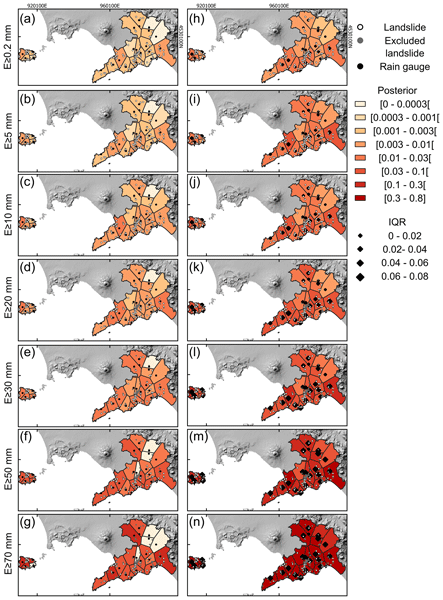
“Results show that posterior probabilities increase progressively with rainfall, ranging from 0 to 10⁻³ at the lowest threshold (0.2 mm) to up to 10⁻¹ at the highest threshold (70 mm) when uncertainty is not considered, and from 10⁻³ to values between 0.2 and 0.8 at the highest threshold (70 mm) when uncertainty is accounted for, and no sharp physical threshold emerges.”and (lines 608-610):
“The results reveal a progressive increase in posterior probability with increasing rainfall thresholds, ranging from 0 to 10⁻³ for the lowest threshold (0.2 mm), to up to 10⁻¹ for the highest threshold (70 mm) when uncertainty is not considered, and from 10⁻³ to values between 0.2 and 0.8 for the highest threshold (70 mm) when uncertainty is accounted for, without evidence of a sharp, physical threshold.”Citation: https://doi.org/10.5194/egusphere-2026-1624-AC1
-
AC1: 'Reply on RC1', Flavia Ferriero, 09 Jun 2026
-
RC2: 'Comment on egusphere-2026-1624', Anonymous Referee #2, 12 May 2026
This study presents a Bayesian probabilistic framework for forecasting rainfall-triggered landslides, explicitly treating epistemic uncertainties through probability distributions rather than point estimates. The topic addresses a genuine need in landslide early warning, and the core idea of replacing deterministic thresholds with uncertainty-informed probabilities is well-motivated. The application to the Campania region provides a useful demonstration. However, the methodological implementation contains several simplifications that weaken the physical basis of the forecasts, the treatment of input data limitations is uneven, and the operational applicability is asserted without sufficient quantitative validation. Major revision is recommended.
1. The likelihood is constructed from all rain gauges combined despite their differing record lengths and climatological settings, implicitly assuming stationarity and homogeneity that are neither tested nor justified.
2. The statement that probability gain curves exhibit approximately linear behavior and therefore no physical threshold exists conflates a property of the Bayesian update with a conclusion about the physical process, since the linearity is partially inherited from the uniform prior.
3. The discussion claims generalizability to earthquake-triggered landslides, but the complete absence of any demonstration or even conceptual mapping to seismic triggers makes this assertion premature.
Citation: https://doi.org/10.5194/egusphere-2026-1624-RC2 -
AC2: 'Reply on RC2', Flavia Ferriero, 09 Jun 2026
Our responses to Reviewer’s comments are provided below.
1. The likelihood is constructed from all rain gauges combined despite their differing record lengths and climatological settings, implicitly assuming stationarity and homogeneity that are neither tested nor justified.
To respond to the comment of R2, we clarify the assumptions in the Discussion section (lines 573-590). We expect to add to the text the following paragraph: “Related to the spatial assumptions discussed above, the construction of a single likelihood distribution from all rain gauges combined implicitly assumes stationarity and spatial homogeneity of the rainfall-landslide relationship across the study area. This is an assumption, partly motivated by the limited size of the available landslide catalogue. Indeed, pooling data across rain gauges increases the sample size and reduces the uncertainty in the likelihood estimates, at the cost of smoothing out local variability. Stationarity implies that the statistical relationship between rainfall and landslide occurrence is assumed constant over the observation period, an assumption that could be violated if climate change progressively alters the frequency and intensity of extreme rainfall events, or if land use changes. However, the assumption is considered reasonable over the 22-year observation period and within the geologically homogeneous setting of the study area. The assumption of homogeneity is broadly consistent with the geological and geomorphological setting of the study area, which includes similar shallow landslide types triggered by short-duration, high-intensity rainfall events. Noteworthy, the validity of these assumptions is indirectly supported by the results themselves: the consistent increase in probability gain with rainfall threshold across all rain gauges would not emerge if the assumed likelihood structure were fundamentally inconsistent with the data. A spatially heterogeneous or non-stationary relationship would tend to introduce noise and suppress the trend observed in Fig. 12. Nevertheless, we recognize that these assumptions represent a limitation of the current implementation. Future developments incorporating gauge-specific likelihood distributions, longer records, or higher-resolution rainfall data would allow these assumptions to be explicitly tested, potentially improving both the accuracy and the spatial resolution of the posterior probability estimates.”
2. The statement that probability gain curves exhibit approximately linear behavior and therefore no physical threshold exists conflates a property of the Bayesian update with a conclusion about the physical process, since the linearity is partially inherited from the uniform prior.
Figure 12 shows that the observed gradual increase in probability gain is not specific to the use of a uniform prior. A similar trend is obtained both when uncertainties are explicitly considered and modelled through probability distributions, and when uncertainties are ignored and probabilities are treated as single values. The latter case is equivalent to assuming a Dirac distribution rather than a uniform prior. The persistence of the same behaviour under these two markedly different assumptions suggests that the observed trend is primarily associated with the empirical relationship between rainfall and landslide occurrence in the analysed dataset, rather than being a consequence of the specific prior adopted. However, the observed trend should be interpreted in the context of the analysed dataset and modelling assumptions. Within this framework, the results do not show the emergence of a sharp deterministic transition in landslide occurrence probability as rainfall increases.
3. The discussion claims generalizability to earthquake-triggered landslides, but the complete absence of any demonstration or even conceptual mapping to seismic triggers makes this assertion premature.
Our statement about the use of different triggers refers to the general structure of the Bayesian framework. As reported in the Discussion (Section 6), and formalized in eq. 2, the variable y represents any triggering factor; it is not specific to rainfall. The model does not depend on the nature of the trigger but only on the availability of the corresponding datasets (e.g., an earthquake catalogue and a coseismic landslide catalogue). Therefore, the same probabilistic framework could, in principle, be applied to earthquake-induced landslides. However, demonstrating this would require performing the same full workflow (data preprocessing, model fitting, analysis of the results) using earthquake-related data. Such a complete application is beyond the scope of the present paper and naturally warrants a dedicated study. For this reason, we highlighted the generalizability of the framework but did not include a coseismic case study here.
We can add in the text the following language to better explain this concept (line 516-522):
“A strength of the proposed probabilistic framework lies in its potential for generalization. Since the approach models the evolution of landslide occurrence probability as a function of the probability of a generic triggering process, the term y in Eq. (2) could equally represent, for example, the ground shaking caused by an earthquake. The only requirement is the availability of a time series of historical records of the chosen trigger alongside a corresponding record of landslide occurrences. Therefore, the posterior probability can be obtained either without accounting for uncertainty (by using the frequencies of days with landslides triggered by a specific type of ground shaking) or by incorporating uncertainty using probabilistic distributions.”Citation: https://doi.org/10.5194/egusphere-2026-1624-AC2
-
AC2: 'Reply on RC2', Flavia Ferriero, 09 Jun 2026
-
RC3: 'Comment on egusphere-2026-1624', Anonymous Referee #3, 20 May 2026
This manuscript describes a Bayesian probabilistic framework for forecasting rainfall-triggered landslides. The notion that forecasting should follow from a probabilistic study rather than guessing point estimates is completely appropriate and the authors should be commended for their attempt to do so. The authors attempt to estimate uncertainties and, not unexpectedly, estimating these uncertainties requires simplifications that may or may not hold in fact. Given such simplifying assumptions, careful validation is mandatory. The application region provides a useful demonstration.
The exposition is clear.
The finding that the probability of landslide increases linearly with rainfall threshold is interesting, and challenges commonly-held beliefs.
However I have several significant concerns about the manuscript.
*First, the authors associate rain gauges with landslides, but this association does not respect the influence of terrain and watersheds. This seems like a major issue.
*Other work such as post-wildfire debris flows suggests the important ingredients for triggering are (i) steep slopes and (ii) 15 minute high intensity rainfall. The authors principally consider only local longer-term rainfall as a possible trigger. If the authors wish to put forward a new idea for triggering, together with its consequent linearity, it is incumbent on them to provide strong evidence to that effect, evidence that I suggest is not present in the current manuscript.
*Lastly the suggestion that this approach could be applied to other events such as earthquake-generated landslides is not appropriate to make without significant evidence.
This reviewer suggests the weakness in the causality analysis precludes publication without significant revision.
Citation: https://doi.org/10.5194/egusphere-2026-1624-RC3 -
AC3: 'Reply on RC3', Flavia Ferriero, 09 Jun 2026
Below, we provide detailed responses to the Reviewer’s comments.
1. First, the authors associate rain gauges with landslides, but this association does not respect the influence of terrain and watersheds. This seems like a major issue.
In the present study, Thiessen polygons are adopted as a standard and widely used approach to spatially associate rainfall observations with landslide occurrence over the entire regional study area, consistently with operational procedures currently adopted in the Campania regional early warning system. We agree that this is a simplified geometric approximation that does not explicitly account for terrain morphology and that more physically based approaches could potentially provide a more realistic representation of rainfall forcing. However, the available spatial density and distribution of both rain gauges and landslides limited the applicability of more detailed spatial subdivisions, which frequently resulted in spatial units containing insufficient data for the probabilistic analysis. Following the reviewer’s suggestion, we will expand the Discussion section to explicitly acknowledge this limitation and to identify more physically based spatial association methods as an important direction for future developments.
We expect to add the following paragraph (line 563-572):
“A further limitation concerns the spatial association between rainfall measurements and landslide occurrence. In the present study, Thiessen polygons are adopted to define the area of influence of each rain gauge, consistently with approaches commonly used in operational early warning systems, including the Campania regional landslide early warning system for hydrogeological hazards (Biafore and Calcara, 2005). The method provides a pragmatic and computationally efficient spatial partitioning, but it represents a geometric approximation that does not explicitly account for topographic and orographic controls on rainfall and landslide variability. Alternative approaches based on hydrological catchments or topographically informed interpolation methods could potentially provide a more physically based representation of rainfall forcing. However, the available spatial density and distribution of landslides and rain gauges hampers the applicability of more detailed spatial subdivisions, which frequently resulted in spatial units containing insufficient data for the probabilistic analysis.”2. Other work such as post-wildfire debris flows suggests the important ingredients for triggering are (i) steep slopes and (ii) 15 minute high intensity rainfall. The authors principally consider only local longer-term rainfall as a possible trigger. If the authors wish to put forward a new idea for triggering, together with its consequent linearity, it is incumbent on them to provide strong evidence to that effect, evidence that I suggest is not present in the current manuscript.
We agree with R3 that landslide triggering processes are controlled by multiple interacting factors, but the present study does not aim to propose a new physical triggering mechanism, nor to claim that daily rainfall alone fully explains landslide occurrence. Rather, our objective is to present and test a probabilistic forecasting framework using a simplified and operationally available triggering variable, namely daily cumulative rainfall. The observed gradual increase in landslide probability with rainfall should therefore be interpreted in the context of the analyzed dataset and modelling assumptions, reflecting the empirical relationship captured by the available data within which no sharp deterministic transition in landslide occurrence probability is observed. The use of higher-quality input data, including rainfall observations at finer temporal resolution and additional triggering or conditioning variables, could potentially improve the predictive capability of the framework and represents an important direction for future developments. Nevertheless, in the present study we adopted daily rainfall because it is consistent with the temporal resolution of both the available landslide catalogue and the operational procedures currently used by the Campania regional early warning system. Despite its simplified nature, daily rainfall can still provide meaningful predictive information, since many shallow landslides are associated with short-duration intense rainfall events occurring during the wet season (Rianna et al., 2014), when antecedent soil moisture conditions are often already close to critical levels. Accordingly, part of the effect of antecedent wetness conditions may already be implicitly embedded in the empirical rainfall-landslide relationship captured by the dataset, as many landslides in the catalogue occurred during autumn and winter (Fig. 3a). We also acknowledge that slope and other morphological factors play an important role in landslide susceptibility. However, previous studies have shown that, for short-term landslide forecasting over large areas, rainfall forcing alone can provide meaningful predictive information on the spatial and temporal occurrence of landslides, even without the explicit inclusion of detailed terrain and environmental variables (Mondini et al. 2023).
3. Lastly the suggestion that this approach could be applied to other events such as earthquake-generated landslides is not appropriate to make without significant evidence.
Our statement regarding the possible application of the framework to earthquake-triggered landslides refers to the general structure of the Bayesian formulation, in which the triggering variable is not restricted to rainfall but may represent any external forcing factor associated with landslide occurrence. Our intention was not to suggest that the present study demonstrates applicability to coseismic landslides, nor to imply that the same results obtained for rainfall-triggered landslides would necessarily hold for seismic triggering conditions. Demonstrating the applicability of the framework to earthquake-induced landslides would require a dedicated study, including the collection and analysis of appropriate seismic and coseismic landslide datasets, together with a complete reapplication of the workflow.
Citation: https://doi.org/10.5194/egusphere-2026-1624-AC3
-
AC3: 'Reply on RC3', Flavia Ferriero, 09 Jun 2026
Peer review completion


Interactive discussion
Status: closed
-
RC1: 'Comment on egusphere-2026-1624', Farhad Hossain, 04 May 2026
Manuscript Title: Bayesian forecasting of triggered landslides
General Comments
This manuscript presents a Bayesian probabilistic framework for forecasting rainfall-induced landslides, applied to a 22-year record of shallow landslides and daily rainfall data from the Campania region of southern Italy. This is a well-conceived and rigorously executed study that addresses a recognized gap in landslide forecasting literature: the lack of a formal probabilistic framework that explicitly and systematically propagates multiple sources of epistemic uncertainty. The authors make a compelling case for moving beyond deterministic or semi-probabilistic threshold-based approaches toward a fully Bayesian formulation. The manuscript is clearly written, methodologically sound, and the real-world application to Campania provides meaningful scientific insights.
The finding that the probability gain increases approximately linearly with rainfall threshold, rather than exhibiting a step-function response, is particularly noteworthy and challenges the long-standing paradigm of deterministic threshold-based early warning in operational landslide risk management. The manuscript is suitable for publication in Natural Hazards and Earth System Sciences. I recommend acceptance with a few minor revisions
Specific Comments
- The use of Thiessen polygons (Section 3.3) is purely geometric and disregards orographic controls on rainfall, which are substantial given the study area’s elevation range (0–1,444 m) and Mediterranean climate. Topographically informed alternatives such as hydrological catchment delineation, cost-path allocation using a DEM-derived friction surface, or kriging with elevation as an external drift - would yield physically more defensible gauge influence zones. The authors should either test one such alternative or provide quantitative justification that spatial rainfall variability within each polygon is small enough to render the geometric approximation acceptable. If neither is feasible, this limitation must be prominently discussed in Section 6 with appropriate citations.
- The analysis conditions landslide occurrence on 1-day cumulative rainfall only. Antecedent moisture - governed by multi-day to multi-week accumulations - is a well-established conditioning factor for shallow failures in pyroclastic soils (Cascini et al., 2008; De Vita et al., 2013). Since the temporal resolution of the catalogue (date-level) is equally compatible with 3-day and 7-day windows, extending the analysis to these accumulation periods is straightforward within the existing framework. The authors themselves propose this as future work (lines 526–528); the reviewer encourages inclusion in the present study. At minimum, a substantive sensitivity argument explaining why 1-day rainfall is expected to be sufficient should be added to Section 6.
- The Introduction (~30 lines) is brief relative to the methodological scope, while Sections 3.1–3.2 contain catalogue and gauge metadata at a granularity more suited to supplementary material. Several fields in Table 1 (e.g., PIFF classification, movement codes) are not used in the model. The authors should condense Tables 1–2, move full metadata to supplementary material, and use the recovered space to expand the Introduction with a more critical synthesis of prior probabilistic frameworks and an explicit articulation of the gaps this study fills.
- Line 33-34: The phrase 'This gradual trend supports the view of landslide triggering as a probabilistic process' could be made more precise. The gradual trend in probability gain supports the absence of a sharp physical threshold, which in turn is consistent with a probabilistic view — but the latter is already an assumption built into the framework. Minor rephrasing is suggested for logical clarity.
- Line 168: Missing data days are assigned 0 mm rainfall for convenience. This choice should be explicitly noted as a potential source of bias — particularly if missing data days disproportionately occur during active weather events. A short sentence acknowledging this would be appropriate.
- Lines 290-293: The justification for setting the upper bound of the prior as one order of magnitude above the lower bound is stated as an assumption. A citation to any study that has independently estimated landslide under-reporting ratios for the Campania region or similar environments would strengthen this choice.
- Abstract and Conclusions: The abstract could be slightly enriched by briefly mentioning the specific range of posterior probabilities achieved (e.g., 0.2 to 0.8 at the 70 mm threshold when uncertainty is considered), giving readers a more concrete sense of the magnitude of the estimated probabilities.
Recommendation: Minor revision.
Citation: https://doi.org/10.5194/egusphere-2026-1624-RC1 -
AC1: 'Reply on RC1', Flavia Ferriero, 09 Jun 2026
We thank the Reviewer for the comments and suggestions. Please find our point-by-point responses below.
1. The use of Thiessen polygons (Section 3.3) is purely geometric and disregards orographic controls on rainfall, which are substantial given the study area’s elevation range (0–1,444 m) and Mediterranean climate. Topographically informed alternatives such as hydrological catchment delineation, cost-path allocation using a DEM-derived friction surface, or kriging with elevation as an external drift - would yield physically more defensible gauge influence zones. The authors should either test one such alternative or provide quantitative justification that spatial rainfall variability within each polygon is small enough to render the geometric approximation acceptable. If neither is feasible, this limitation must be prominently discussed in Section 6 with appropriate citations.
Alternative approaches exist; however, the spatial density and distribution of both landslides and rain gauges must be carefully considered, because our objective is to analyze how landslide occurrence probability varies not only around individual rain gauges, but across the entire study area. We tested a subdivision based on slope units, defined as geomorphological homogenous terrain units bounded by drainage lines (Alvioli et al., 2016). However, this approach proved impractical given the available landslide and rainfall data. Specifically, the analysis produced a large number of slope units, most of which either contained no landslide information or included only a single landslide or a single rain gauge. It was therefore not possible to define slope units large enough to include both landslides and rain gauges while still ensuring complete coverage of the study area.
Thiessen polygons are a standard and widely adopted approach in operational early warning applications. For instance, the Campania regional early warning system uses Thiessen polygons to define the area of influence of rain gauges and their proximity to municipalities for landslide hazard analysis. Nevertheless, we acknowledge that this method is a geometric approximation and does not explicitly account for topographic or orographic controls on rainfall variability. We will add text to the manuscript to clarify this limitation.We expect to modify the text as (line 563-572):
“A further limitation concerns the spatial association between rainfall measurements and landslide occurrence. In the present study, Thiessen polygons are adopted to define the area of influence of each rain gauge, consistently with approaches commonly used in operational early warning systems, including the Campania regional landslide early warning system for hydrogeological hazards (Biafore and Calcara, 2005). The method provides a pragmatic and computationally efficient spatial partitioning, but it represents a geometric approximation that does not explicitly account for topographic and orographic controls on rainfall and landslide variability. Alternative approaches based on hydrological catchments or topographically informed interpolation methods could potentially provide a more physically based representation of rainfall forcing. However, the available spatial density and distribution of landslides and rain gauges hampers the applicability of more detailed spatial subdivisions, which frequently resulted in spatial units containing insufficient data for the probabilistic analysis.”2. The analysis conditions landslide occurrence on 1-day cumulative rainfall only. Antecedent moisture - governed by multi-day to multi-week accumulations - is a well-established conditioning factor for shallow failures in pyroclastic soils (Cascini et al., 2008; De Vita et al., 2013). Since the temporal resolution of the catalogue (date-level) is equally compatible with 3-day and 7-day windows, extending the analysis to these accumulation periods is straightforward within the existing framework. The authors themselves propose this as future work (lines 526–528); the reviewer encourages inclusion in the present study. At minimum, a substantive sensitivity argument explaining why 1-day rainfall is expected to be sufficient should be added to Section 6.
We focused on 1-day cumulative rainfall as a first and simplified implementation of our modelling framework. The choice was motivated by different considerations, including the temporal accuracy of the available landslide catalogue, and the temporal scale adopted in the operational warning procedures of the Campania regional landslide early warning system. Moreover, although antecedent rainfall conditions are known to influence shallow landslide occurrence, daily rainfall can still provide meaningful predictive information because shallow landslides are often associated with short-duration intense rainfall events occurring during the wet season, when antecedent conditions are already close to critical levels. In this sense, part of the effect of antecedent wetness conditions may already be implicitly embedded in the empirical rainfall-landslide relationship captured by the dataset, since many landslides of the catalogue occurred in autumn and winter (see Figure 3a).
We will add language to the Discussion to address the issue. The new text will read (lines 554-560):
“Within this context, the use of daily rainfall data represents an additional limitation of the present application of the framework. The choice was primarily dictated by the temporal accuracy of the available landslide catalogue, which predominantly reports event occurrence at the daily scale and often relies on inferred rather than directly observed timing of landslide occurrence (Peruccacci et al., 2023), and by the availability of rainfall data at daily temporal resolution. Adopting rainfall data at finer temporal resolutions would therefore not be consistent with the resolution of the landslide records and could introduce further uncertainty. At the same time, the daily scale reflects the temporal resolution at which operational warning assessments are commonly issued by the Campania Regional Authority, supporting the practical applicability of the framework. Although antecedent rainfall conditions are known to influence shallow landslide occurrence in pyroclastic soils (Napolitano et al., 2016), daily rainfall can still provide meaningful predictive information because many landslides are associated with short-duration intense rainfall events occurring during the wet season (Rianna et al., 2014), when antecedent conditions are often already close to critical levels. In this sense, part of the effect of antecedent wetness conditions may already be implicitly embedded in the empirical rainfall-landslide relationship captured by the dataset, since many landslides of the catalogue occurred in autumn and winter (see figure 3a). Future research could explore the influence of different rainfall accumulation periods to assess whether, and to what extent, antecedent conditions affect landslide occurrence. This could be investigated by cumulating antecedent rainfall over progressively longer periods (e.g., 1, 2, 7, 15 days).”3. The Introduction (~30 lines) is brief relative to the methodological scope, while Sections 3.1–3.2 contain catalogue and gauge metadata at a granularity more suited to supplementary material. Several fields in Table 1 (e.g., PIFF classification, movement codes) are not used in the model. The authors should condense Tables 1–2, move full metadata to supplementary material, and use the recovered space to expand the Introduction with a more critical synthesis of prior probabilistic frameworks and an explicit articulation of the gaps this study fills.
We agree with reviewer’s suggestion, therefore, we will move Table 1 to the Appendix, and we will rewrite the Introduction (lines 64-90):
“…To address these limitations, Bayesian inference has been applied to estimate minimum rainfall conditions sufficient for landslide initiation e.g., through rainfall thresholds (Guzzetti et al., 2007, 2008, Brunetti et al., 2010). Scholars have proposed probabilistic frameworks that incorporate uncertainty in rainfall thresholds, quantifying the probability of landslide occurrence conditional on rainfall metrics (Berti et al., 2012; Pecoraro and Calvello, 2021; Jiang et al., 2022; Zhao et al., 2025). Zhang et al. (2025) further proposed a Bayesian framework to define probabilistic thresholds using rainfall variables automatically extracted from rainfall time-series.
Most of the existing probabilistic approaches for landslide forecasting rely on rainfall thresholds, treating uncertainty primarily as variability around the threshold parameters. For instance, through confidence intervals on cumulated rainfall – rainfall duration curves, or through non-exceedance probability levels (Peruccacci et al., 2017; Rossi et al., 2017). If such approaches represent a meaningful step beyond purely deterministic methods, the available landslide hazard modelling frameworks rarely address a thorough quantification of uncertainty, and uncertainty in rainfall datasets and landslide inventories is known to degrade the reliability of threshold estimates (Peres et al., 2018). The probabilistic content of these frameworks is largely restricted to the estimation of the uncertainty about the threshold, rather than a fundamental reconceptualization of landslide triggering as an inherently probabilistic process (Felsberg et al., 2023). However, most existing probabilistic frameworks yield point-valued probability estimates and assume a priori the existence of a sharp physical boundary separating triggering from non-triggering conditions. A further complication is the definition and sampling of non-triggering rainfall conditions. In real-world datasets, rainfall events that do not trigger landslides are far more common than those that do, resulting in highly imbalanced datasets, particularly in regions where data are sparse. The choice of how to sample non-events is therefore not a neutral methodological decision: it directly shapes the estimated probability of landslide occurrence and can introduce substantial bias into early warning systems (Peres and Cancelliere, 2014, 2018).
More generally, data-driven learning techniques have increasingly been adopted to estimate landslide probability in both space and time (Lombardo et al., 2020; Mondini et al., 2023) combining prior knowledge and observations within probabilistic frameworks that explicitly account for uncertainty. Although machine-learning approaches have shown promising predictive capabilities, they often require large training datasets, may suffer from limited interpretability, and do not always provide an explicit characterization of epistemic uncertainty (Chen et al., 2025).
Addressing these gaps requires a framework that treats landslide probability not as a function of threshold exceedance, but as a distribution that reflects the current state of knowledge given the available evidence.
Here, we present a formal probabilistic framework that incorporates the natural variability and uncertainties in landslide occurrence and triggering factors. The proposed framework addresses epistemic uncertainty arising from incomplete observations, measurement limitations, and imperfect knowledge of landslide-triggering processes. Our approach does not assume the existence of a physical threshold and, instead, allows landslide probability to be estimated as a function of the relevant triggering conditions. To illustrate the method, we apply the probabilistic framework to rain-triggered landslides in Campania region, Italy.”4. Line 33-34: The phrase 'This gradual trend supports the view of landslide triggering as a probabilistic process' could be made more precise. The gradual trend in probability gain supports the absence of a sharp physical threshold, which in turn is consistent with a probabilistic view — but the latter is already an assumption built into the framework. Minor rephrasing is suggested for logical clarity.
To respond to the request of R1, we will rephrase the text in lines 35-37: “The retrospective forecast skill improves with rainfall information, as demonstrated by consistent gains in posterior over prior probabilities. The gradual increase in probability, without the emergence of a sharp physical threshold, supports the use of probabilistic rather than deterministic approaches for landslide forecasting in operational contexts.”
5. Line 168: Missing data days are assigned 0 mm rainfall for convenience. This choice should be explicitly noted as a potential source of bias — particularly if missing data days disproportionately occur during active weather events. A short sentence acknowledging this would be appropriate.
To respond to the comment of R1, we will add the following text (lines 192-196): “For two rain gauges (#1, Ischia Porto and #4, Piano Liguori, Table 2) the daily record is complete and, on average, for 0.4 % of the days in the records (31 days) no rainfall measurement is available (“no data”). For convenience, we assigned a value of 0.0 mm of rainfall to all the days in the records with missing rainfall information. The assumption may introduce a potential source of bias if missing observations occurred preferentially during intense or prolonged rainfall events, potentially leading to a slight underestimation of rainfall. However, the proportion of missing data is very limited (approx. 1.5 days each year, on average), and therefore the potential bias introduced by this assumption is expected to have a negligible impact on the overall analyses.”
6. Lines 290-293: The justification for setting the upper bound of the prior as one order of magnitude above the lower bound is stated as an assumption. A citation to any study that has independently estimated landslide under-reporting ratios for the Campania region or similar environments would strengthen this choice.
To respond to the request of R1, we will add specific references (lines 319-320): “We set the upper limit one order of magnitude higher than the lower limit, assuming that we were able to record one landslide for every ten that occurred in reality, consistent with the well-documented incompleteness of landslide catalogues (Guzzetti, 2002; Peruccacci et al., 2023).”
7. Abstract and Conclusions: The abstract could be slightly enriched by briefly mentioning the specific range of posterior probabilities achieved (e.g., 0.2 to 0.8 at the 70 mm threshold when uncertainty is considered), giving readers a more concrete sense of the magnitude of the estimated probabilities.
To respond to the request of R1, we will add the following text to the Abstract (lines 31-34):
“Results show that posterior probabilities increase progressively with rainfall, ranging from 0 to 10⁻³ at the lowest threshold (0.2 mm) to up to 10⁻¹ at the highest threshold (70 mm) when uncertainty is not considered, and from 10⁻³ to values between 0.2 and 0.8 at the highest threshold (70 mm) when uncertainty is accounted for, and no sharp physical threshold emerges.”and (lines 608-610):
“The results reveal a progressive increase in posterior probability with increasing rainfall thresholds, ranging from 0 to 10⁻³ for the lowest threshold (0.2 mm), to up to 10⁻¹ for the highest threshold (70 mm) when uncertainty is not considered, and from 10⁻³ to values between 0.2 and 0.8 for the highest threshold (70 mm) when uncertainty is accounted for, without evidence of a sharp, physical threshold.”Citation: https://doi.org/10.5194/egusphere-2026-1624-AC1
-
RC2: 'Comment on egusphere-2026-1624', Anonymous Referee #2, 12 May 2026
This study presents a Bayesian probabilistic framework for forecasting rainfall-triggered landslides, explicitly treating epistemic uncertainties through probability distributions rather than point estimates. The topic addresses a genuine need in landslide early warning, and the core idea of replacing deterministic thresholds with uncertainty-informed probabilities is well-motivated. The application to the Campania region provides a useful demonstration. However, the methodological implementation contains several simplifications that weaken the physical basis of the forecasts, the treatment of input data limitations is uneven, and the operational applicability is asserted without sufficient quantitative validation. Major revision is recommended.
1. The likelihood is constructed from all rain gauges combined despite their differing record lengths and climatological settings, implicitly assuming stationarity and homogeneity that are neither tested nor justified.
2. The statement that probability gain curves exhibit approximately linear behavior and therefore no physical threshold exists conflates a property of the Bayesian update with a conclusion about the physical process, since the linearity is partially inherited from the uniform prior.
3. The discussion claims generalizability to earthquake-triggered landslides, but the complete absence of any demonstration or even conceptual mapping to seismic triggers makes this assertion premature.
Citation: https://doi.org/10.5194/egusphere-2026-1624-RC2 -
AC2: 'Reply on RC2', Flavia Ferriero, 09 Jun 2026
Our responses to Reviewer’s comments are provided below.
1. The likelihood is constructed from all rain gauges combined despite their differing record lengths and climatological settings, implicitly assuming stationarity and homogeneity that are neither tested nor justified.
To respond to the comment of R2, we clarify the assumptions in the Discussion section (lines 573-590). We expect to add to the text the following paragraph: “Related to the spatial assumptions discussed above, the construction of a single likelihood distribution from all rain gauges combined implicitly assumes stationarity and spatial homogeneity of the rainfall-landslide relationship across the study area. This is an assumption, partly motivated by the limited size of the available landslide catalogue. Indeed, pooling data across rain gauges increases the sample size and reduces the uncertainty in the likelihood estimates, at the cost of smoothing out local variability. Stationarity implies that the statistical relationship between rainfall and landslide occurrence is assumed constant over the observation period, an assumption that could be violated if climate change progressively alters the frequency and intensity of extreme rainfall events, or if land use changes. However, the assumption is considered reasonable over the 22-year observation period and within the geologically homogeneous setting of the study area. The assumption of homogeneity is broadly consistent with the geological and geomorphological setting of the study area, which includes similar shallow landslide types triggered by short-duration, high-intensity rainfall events. Noteworthy, the validity of these assumptions is indirectly supported by the results themselves: the consistent increase in probability gain with rainfall threshold across all rain gauges would not emerge if the assumed likelihood structure were fundamentally inconsistent with the data. A spatially heterogeneous or non-stationary relationship would tend to introduce noise and suppress the trend observed in Fig. 12. Nevertheless, we recognize that these assumptions represent a limitation of the current implementation. Future developments incorporating gauge-specific likelihood distributions, longer records, or higher-resolution rainfall data would allow these assumptions to be explicitly tested, potentially improving both the accuracy and the spatial resolution of the posterior probability estimates.”
2. The statement that probability gain curves exhibit approximately linear behavior and therefore no physical threshold exists conflates a property of the Bayesian update with a conclusion about the physical process, since the linearity is partially inherited from the uniform prior.
Figure 12 shows that the observed gradual increase in probability gain is not specific to the use of a uniform prior. A similar trend is obtained both when uncertainties are explicitly considered and modelled through probability distributions, and when uncertainties are ignored and probabilities are treated as single values. The latter case is equivalent to assuming a Dirac distribution rather than a uniform prior. The persistence of the same behaviour under these two markedly different assumptions suggests that the observed trend is primarily associated with the empirical relationship between rainfall and landslide occurrence in the analysed dataset, rather than being a consequence of the specific prior adopted. However, the observed trend should be interpreted in the context of the analysed dataset and modelling assumptions. Within this framework, the results do not show the emergence of a sharp deterministic transition in landslide occurrence probability as rainfall increases.
3. The discussion claims generalizability to earthquake-triggered landslides, but the complete absence of any demonstration or even conceptual mapping to seismic triggers makes this assertion premature.
Our statement about the use of different triggers refers to the general structure of the Bayesian framework. As reported in the Discussion (Section 6), and formalized in eq. 2, the variable y represents any triggering factor; it is not specific to rainfall. The model does not depend on the nature of the trigger but only on the availability of the corresponding datasets (e.g., an earthquake catalogue and a coseismic landslide catalogue). Therefore, the same probabilistic framework could, in principle, be applied to earthquake-induced landslides. However, demonstrating this would require performing the same full workflow (data preprocessing, model fitting, analysis of the results) using earthquake-related data. Such a complete application is beyond the scope of the present paper and naturally warrants a dedicated study. For this reason, we highlighted the generalizability of the framework but did not include a coseismic case study here.
We can add in the text the following language to better explain this concept (line 516-522):
“A strength of the proposed probabilistic framework lies in its potential for generalization. Since the approach models the evolution of landslide occurrence probability as a function of the probability of a generic triggering process, the term y in Eq. (2) could equally represent, for example, the ground shaking caused by an earthquake. The only requirement is the availability of a time series of historical records of the chosen trigger alongside a corresponding record of landslide occurrences. Therefore, the posterior probability can be obtained either without accounting for uncertainty (by using the frequencies of days with landslides triggered by a specific type of ground shaking) or by incorporating uncertainty using probabilistic distributions.”Citation: https://doi.org/10.5194/egusphere-2026-1624-AC2
-
AC2: 'Reply on RC2', Flavia Ferriero, 09 Jun 2026
-
RC3: 'Comment on egusphere-2026-1624', Anonymous Referee #3, 20 May 2026
This manuscript describes a Bayesian probabilistic framework for forecasting rainfall-triggered landslides. The notion that forecasting should follow from a probabilistic study rather than guessing point estimates is completely appropriate and the authors should be commended for their attempt to do so. The authors attempt to estimate uncertainties and, not unexpectedly, estimating these uncertainties requires simplifications that may or may not hold in fact. Given such simplifying assumptions, careful validation is mandatory. The application region provides a useful demonstration.
The exposition is clear.
The finding that the probability of landslide increases linearly with rainfall threshold is interesting, and challenges commonly-held beliefs.
However I have several significant concerns about the manuscript.
*First, the authors associate rain gauges with landslides, but this association does not respect the influence of terrain and watersheds. This seems like a major issue.
*Other work such as post-wildfire debris flows suggests the important ingredients for triggering are (i) steep slopes and (ii) 15 minute high intensity rainfall. The authors principally consider only local longer-term rainfall as a possible trigger. If the authors wish to put forward a new idea for triggering, together with its consequent linearity, it is incumbent on them to provide strong evidence to that effect, evidence that I suggest is not present in the current manuscript.
*Lastly the suggestion that this approach could be applied to other events such as earthquake-generated landslides is not appropriate to make without significant evidence.
This reviewer suggests the weakness in the causality analysis precludes publication without significant revision.
Citation: https://doi.org/10.5194/egusphere-2026-1624-RC3 -
AC3: 'Reply on RC3', Flavia Ferriero, 09 Jun 2026
Below, we provide detailed responses to the Reviewer’s comments.
1. First, the authors associate rain gauges with landslides, but this association does not respect the influence of terrain and watersheds. This seems like a major issue.
In the present study, Thiessen polygons are adopted as a standard and widely used approach to spatially associate rainfall observations with landslide occurrence over the entire regional study area, consistently with operational procedures currently adopted in the Campania regional early warning system. We agree that this is a simplified geometric approximation that does not explicitly account for terrain morphology and that more physically based approaches could potentially provide a more realistic representation of rainfall forcing. However, the available spatial density and distribution of both rain gauges and landslides limited the applicability of more detailed spatial subdivisions, which frequently resulted in spatial units containing insufficient data for the probabilistic analysis. Following the reviewer’s suggestion, we will expand the Discussion section to explicitly acknowledge this limitation and to identify more physically based spatial association methods as an important direction for future developments.
We expect to add the following paragraph (line 563-572):
“A further limitation concerns the spatial association between rainfall measurements and landslide occurrence. In the present study, Thiessen polygons are adopted to define the area of influence of each rain gauge, consistently with approaches commonly used in operational early warning systems, including the Campania regional landslide early warning system for hydrogeological hazards (Biafore and Calcara, 2005). The method provides a pragmatic and computationally efficient spatial partitioning, but it represents a geometric approximation that does not explicitly account for topographic and orographic controls on rainfall and landslide variability. Alternative approaches based on hydrological catchments or topographically informed interpolation methods could potentially provide a more physically based representation of rainfall forcing. However, the available spatial density and distribution of landslides and rain gauges hampers the applicability of more detailed spatial subdivisions, which frequently resulted in spatial units containing insufficient data for the probabilistic analysis.”2. Other work such as post-wildfire debris flows suggests the important ingredients for triggering are (i) steep slopes and (ii) 15 minute high intensity rainfall. The authors principally consider only local longer-term rainfall as a possible trigger. If the authors wish to put forward a new idea for triggering, together with its consequent linearity, it is incumbent on them to provide strong evidence to that effect, evidence that I suggest is not present in the current manuscript.
We agree with R3 that landslide triggering processes are controlled by multiple interacting factors, but the present study does not aim to propose a new physical triggering mechanism, nor to claim that daily rainfall alone fully explains landslide occurrence. Rather, our objective is to present and test a probabilistic forecasting framework using a simplified and operationally available triggering variable, namely daily cumulative rainfall. The observed gradual increase in landslide probability with rainfall should therefore be interpreted in the context of the analyzed dataset and modelling assumptions, reflecting the empirical relationship captured by the available data within which no sharp deterministic transition in landslide occurrence probability is observed. The use of higher-quality input data, including rainfall observations at finer temporal resolution and additional triggering or conditioning variables, could potentially improve the predictive capability of the framework and represents an important direction for future developments. Nevertheless, in the present study we adopted daily rainfall because it is consistent with the temporal resolution of both the available landslide catalogue and the operational procedures currently used by the Campania regional early warning system. Despite its simplified nature, daily rainfall can still provide meaningful predictive information, since many shallow landslides are associated with short-duration intense rainfall events occurring during the wet season (Rianna et al., 2014), when antecedent soil moisture conditions are often already close to critical levels. Accordingly, part of the effect of antecedent wetness conditions may already be implicitly embedded in the empirical rainfall-landslide relationship captured by the dataset, as many landslides in the catalogue occurred during autumn and winter (Fig. 3a). We also acknowledge that slope and other morphological factors play an important role in landslide susceptibility. However, previous studies have shown that, for short-term landslide forecasting over large areas, rainfall forcing alone can provide meaningful predictive information on the spatial and temporal occurrence of landslides, even without the explicit inclusion of detailed terrain and environmental variables (Mondini et al. 2023).
3. Lastly the suggestion that this approach could be applied to other events such as earthquake-generated landslides is not appropriate to make without significant evidence.
Our statement regarding the possible application of the framework to earthquake-triggered landslides refers to the general structure of the Bayesian formulation, in which the triggering variable is not restricted to rainfall but may represent any external forcing factor associated with landslide occurrence. Our intention was not to suggest that the present study demonstrates applicability to coseismic landslides, nor to imply that the same results obtained for rainfall-triggered landslides would necessarily hold for seismic triggering conditions. Demonstrating the applicability of the framework to earthquake-induced landslides would require a dedicated study, including the collection and analysis of appropriate seismic and coseismic landslide datasets, together with a complete reapplication of the workflow.
Citation: https://doi.org/10.5194/egusphere-2026-1624-AC3
-
AC3: 'Reply on RC3', Flavia Ferriero, 09 Jun 2026
Peer review completion
Journal article(s) based on this preprint
Viewed
| HTML | XML | Total | Supplement | BibTeX | EndNote | |
|---|---|---|---|---|---|---|
| 602 | 212 | 66 | 880 | 64 | 33 | 46 |
- HTML: 602
- PDF: 212
- XML: 66
- Total: 880
- Supplement: 64
- BibTeX: 33
- EndNote: 46
Viewed (geographical distribution)
| Country | # | Views | % |
|---|
| Total: | 0 |
| HTML: | 0 |
| PDF: | 0 |
| XML: | 0 |
- 1
Flavia Ferriero

Fausto Guzzetti
Warner Marzocchi
The requested preprint has a corresponding peer-reviewed final revised paper. You are encouraged to refer to the final revised version.
- Preprint
(2611 KB) - Metadata XML
-
Supplement
(157 KB) - BibTeX
- EndNote
- Final revised paper
Manuscript Title: Bayesian forecasting of triggered landslides
General Comments
This manuscript presents a Bayesian probabilistic framework for forecasting rainfall-induced landslides, applied to a 22-year record of shallow landslides and daily rainfall data from the Campania region of southern Italy. This is a well-conceived and rigorously executed study that addresses a recognized gap in landslide forecasting literature: the lack of a formal probabilistic framework that explicitly and systematically propagates multiple sources of epistemic uncertainty. The authors make a compelling case for moving beyond deterministic or semi-probabilistic threshold-based approaches toward a fully Bayesian formulation. The manuscript is clearly written, methodologically sound, and the real-world application to Campania provides meaningful scientific insights.
The finding that the probability gain increases approximately linearly with rainfall threshold, rather than exhibiting a step-function response, is particularly noteworthy and challenges the long-standing paradigm of deterministic threshold-based early warning in operational landslide risk management. The manuscript is suitable for publication in Natural Hazards and Earth System Sciences. I recommend acceptance with a few minor revisions
Specific Comments
Recommendation: Minor revision.