
the Creative Commons Attribution 4.0 License.
the Creative Commons Attribution 4.0 License.
 | 02 Apr 2026
Impacts of Droughts on Biomass Burning Emissions, Air Quality, and Public Health in the Amazon
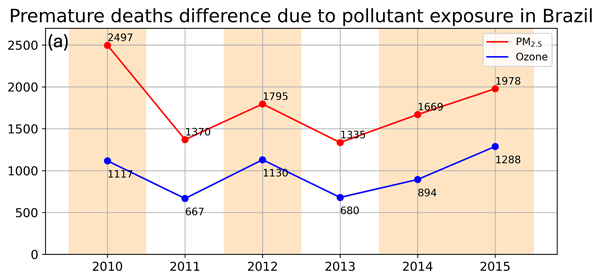
Abstract. Wildfires in the Amazon, increasingly influenced by climate variability and anthropogenic activities, pose severe environmental and health challenges. While drought events amplify fire activity and emissions, the cascading effects of droughts and deforestation on air quality and health remain underexplored. This study addresses this gap by combining satellite observations of fire activities with the Global Fire Emissions Database (GFEDv4s) and the chemical transport model, GEOS-Chem High Performance (GCHP) to quantify the impacts of droughts and deforestation on fire emissions, air quality, and health risks from 2010 to 2015. “Fire-on” and “fire-off” simulation reveal that biomass burning dominates dry-season (July–November) air quality, contributing 50 % to regional CO and PM2.5 and 33 % for ozone in non-drought years. These contributions increase to 60–80 % for CO and PM2.5 and 50 % for ozone during drought years. Significant correlations between pollutant levels and drought intensity reflect a climate-driven amplification of fire impacts. Using the Global Exposure Mortality Model (GEMM) and exposure-response relations, we estimate that fire-induced PM2.5 and ozone increase premature mortality by 6.0 % and 18.6 % in non-drought years, which rise to 8.9 % and 24.4 % during drought years. These findings underscore the critical roles of droughts in exacerbating fire emissions and health risks, even under stable deforestation rates. This study highlights the urgent need for integrated wildfire management and climate adaptation strategies to protect public health and achieve sustainability goals.
Competing interests: At least one of the (co-)authors is a member of the editorial board of Atmospheric Chemistry and Physics.
Publisher's note: Copernicus Publications remains neutral with regard to jurisdictional claims made in the text, published maps, institutional affiliations, or any other geographical representation in this paper. While Copernicus Publications makes every effort to include appropriate place names, the final responsibility lies with the authors. Views expressed in the text are those of the authors and do not necessarily reflect the views of the publisher.-
Notice on discussion status
The requested preprint has a corresponding peer-reviewed final revised paper. You are encouraged to refer to the final revised version.
-
Preprint
(3054 KB)
-
Supplement
(2321 KB)
-
The requested preprint has a corresponding peer-reviewed final revised paper. You are encouraged to refer to the final revised version.
- Preprint
(3054 KB) - Metadata XML
-
Supplement
(2321 KB) - BibTeX
- EndNote
- Final revised paper


Journal article(s) based on this preprint
Interactive discussion
Status: closed
- RC1: 'Comment on egusphere-2026-1614', Anonymous Referee #1, 30 May 2026
-
RC2: 'Comment on egusphere-2026-1614', Anonymous Referee #2, 05 Jun 2026
The Amazon is an important source of wildfire emissions into the atmosphere, and understanding drivers of wildfire emission variability in this region has potential for global significance. The authors study the relationship between drought influence on wildfire and the resulting impacts on fire emissions, air quality and health. They use satellite derived fire emissions in a global chemical transport model (GEOS-Chem) to evaluate impacts between 2010 and 2015, categorizing results by drought intensity. Additionally, health impacts are evaluated using a fire sensitivity study and exposure response algorithms for PM2.5 and ozone.
Overall the study is comprehensive and rigorous. The paper is well written, with a thorough discussion. Please find my specific comments below.
------------------------------------------------------
Main Comments:
My main question is whether the length of time simulated is enough to fully capture the variability space. I suggest a brief statement about the fire emission variability during the 2010-2015 period compared to the longer record of GFEDv4s to quantify whether the study covers typical variability seen in the region.
------------------------------------------------------
Minor Comments:
Abstract (and elsewhere): Add standard deviations to the estimates, for example in the abstract it is stated fires contribute 50% to regional CO, I suggest to clarify this is an average and add plus or minus a specific range.
Methods: Perhaps I missed the definition of the spatial bounds of the Amazon, presented in regional averages for many results. Please add a definition.
L171 to L172: It would be helpful to be slightly more specific that the stable deforestation rates from 2010-2015 were the reason this time period was chosen for the study presented, and that outside these times the high variability in deforestation could mask any signal from drought impacts. For example on line 200 to 201.
L179 to L180: The description of SPEI values is confusing, please double check. I think the word “larger” should be replaced with “greater” or “less negative than”. Also, from Figure 1, The SPEI is a 3 month index, so it is confusing that two bars would not indicate a 6 month values and therefore be “more than 3 month” definition of drought.
L202 to L204: Clarify whether the “fire off” emissions are global fires off, or only Amazon/South America fires off.
L204 to L206: Clarify whether you are comparing DMB just for the 2010 to 2015 period, or the whole GFEDv4s period. Mention somewhere about the limitation of data impacts drawing robust conclusions, a broad statement like “drought years generally double to triple that in non-drought years” could be a little misleading – because there are only two non-drought years and three drought years.
L206 to L210: Convoluted and long sentence. Consider rewording for clarity.
L213: The PM2.5 are not satellite-observed PM2.5, reword to satellite-informed or satellite-derived.
L276 to L280: Clarify how the model might be impacted by plume height – are the plumes low in reality and the plumes are too high in altitude in GEOS chem, or are the plumes too low in the model compared to reality. How exactly is this impacting comparison between model and measurements? e.g., does the plume height impact chemistry and the ozone production in the plume? Why was the updated emission scheme not used in this study?
Figure 2: Add units to the y-axis of Fig. 2d
L363 to L365: For clarity, it would be valuable to swap the order of discussion: Isoprene in the fire on and fire off simulations are equivalent, which means that the simulation of isoprene is independent of wildfire impact. Consider mentioning here that wildfires might impact biogenic emissions through the interaction of aerosols with vegetation in reality, but the GEOS-Chem model does not include this feedback mechanism.
L369 to L370: Add in a reference for the 0.16 isop:NOx threshold indicates a NOx limitation of ozone production.
L391 to L393: The text suggests Fig. 6 is a comparison of ozone between the fire on and fire off simulations, however, the caption of Fig. 6 does not state this. Please clarify.
Figure 5: I suggest to alter the plot so the ozone scatterplot points are more centered. Perhaps start the y-axis at 10. Also, add units to the y-axis.
Section 3.4: It seems Figure 8 and 9 are discussed in the main text before Figure 7. I would suggest to move Figure 7 after Figure 8.
L413 to 414: Check the ozone mortality values and the reference to the figure – Should it be Fig 8?
Figure 9: This mortality data is modeled. Is there a way to validate this data against reality? The authors suggest ozone and PM2.5 would be dominated by fire emissions, so the overall mortality for the investigated diseases may be dominated by and follow a sum of the ozone and PM2.5 versus SPEI patterns shown in Figures 9b and 9c (although total true mortality would be higher). I suggest the authors briefly look into publicly available mortality data for the studied deiseases, if available, which could strengthen this argument considerably.
------------------------------------------------------
Technical Corrections:
L42-43: Is this sentence meaning half of the fire emissions from the Amazon was sourced from old-growth forest burning?
L99: Besides → Additionally,
L174: evapotranpiration → evapotranspiration
L272: “in which the modeled ozone level…”
L273 and L275: overestimates
L274: reproduces
L293: “Although model underestimation…”
L301: to gether → together
L324: “dry season mean CO concentration for each year from …”
L360: In the meantime → Additionally,
L365 to L366: Add Fig. 4b and Fig 4c notes to this sentence to make it less confusing.
L393: fire-emitted ozone → fire-influenced ozone
L395: fire emission contribution of ozone → fire contribution to ozone
L396: “Therefore, fire emissions are…”
L508: Besides → Additionally,
Citation: https://doi.org/10.5194/egusphere-2026-1614-RC2 - AC1: 'Author Comment (AC) on egusphere-2026-1614', Tsin Hung Leo Ng, 08 Jul 2026
Peer review completion


Interactive discussion
Status: closed
-
RC1: 'Comment on egusphere-2026-1614', Anonymous Referee #1, 30 May 2026
This paper examines the public health implications of fire-contributed air pollution in the Amazon. This is an important and growing topic given the influence that fires can have on regional air pollution and links with deforestation and climate. With that said, I have some questions about how the analysis is set up and connections with the existing literature. My major comments are that the authors need to justify: (1) their selection of 2010-16 as their analysis period rather than examining more recent years, (2) the use of a satellite-derived dataset in the validation and health impact analysis in combination with the CTM results, and (3) the use of annual dose-response functions developed for all-source annual air pollution rather than specifically for fires. Some more specific comments are listed below.
Introduction
L82-106: I would suggest reorganize this material a bit for clarity. First you could distill the key literature on PM2.5 and O3 health effects from all source pollution, then what is known about fire-specific pollution (see link below for a global study but there are several others), and finally discuss the health burden from smoke pollution that has been estimated by prior studies in the Amazon. The authors do already cite prior studies in the introduction that have estimated this health burden for the region but clearly describing what is missing from these studies beyond the drought connection would be helpful to better motivate this analysis.
https://doi.org/10.1016/S0140-6736(24)02251-7)
L118: The authors need to set up here why this time period was selected rather than including more recent years. In the methods you discuss needing stable deforestation rates but I would like to understand more why anthropogenic deforestation and drought couldn’t both be included in the analysis so that the interaction is also examined. Even if deforestation area is relatively constant over the period, could the spatial patterns be shifting and exposing different cities?
Methods
L141: Why was the new GFED version not used here? Figure 5 in van der Werf et al. (2025) suggests rather substantial regional differences in fire emissions. I appreciate that it’s a substantial amount of work to run these simulations, but the authors should at least include a justification for using an older version of the inventory given that a newer version is available if they are unable to update the analysis.
https://www.nature.com/articles/s41597-025-06127-w
L170-172: Figure 1 a shows an uptick in deforestation in more recent years. The authors should clearly articulate why this period wasn’t included (see prior comment).
L203: Why wasn’t daily fire emissions data used? Monthly data can obscure peak exposures and GEOS-Chem is running at a subdaily timestep.
L219-220: Please justify why this satellite PM2.5 dataset was used rather than sticking with the GEOS-Chem data. The satellite PM2.5 product is available at a finer resolution, so was it regridded to match the GEOS-Chem output? Can you give validation statistics?
L225: Recent research has suggested the use of fire specific dose response functions rather than those developed for general air pollution. Can you include a justification here for this approach.
L230: If I’m understanding correctly, the counterfactual PM2.5 is basically assuming that the satellite PM2.5 is correct and trying to back out the non-fire fraction. But then in line 231 you say that the counterfactual is 2.4 ug/m3. Can you articulate more clearly how the counterfactual and GEOS-Chem runs were incorporated into the PM2.5 equation? Another approach could be to estimate the fire-specific PM2.5 component(fires-on - fires-off from GEOS-Chem) to use as the exposure variable.
L230: Was this performed at the monthly or annual scale? Is the dose response relationship for specific exposure intervals?
L260-262: How were these O3 counterfactuals determined? Should they represent the no-fire concentration?
Results
L281: Did the authors validate the PM2.5 simulations with the same satellite data that you used to determine the counterfactual? My understanding is that the Shen et al. data also uses GEOS-Chem as an input to the satellite-derived model, which wouldn’t make it an independent dataset. Did the authors consider using station data to validate as with the O3 data?
L305: This assumes that the satellite-derived PM2.5 is more accurate in the region. Can you provide validation statistics from the Shen et al. datasets specific for this time period and region?
L309: Why are CO and PM2.5 lumped together in this section? Were CO concentrations validated?
L407: Are the health effects of PM2.5 on O3 considered to be independent?
Discussion
-I would also like to see a discussion of the influence of different toxicity and temporal patterns of fire-specific PM2.5 compared to non-fire PM2.5 and how this would influence the results of this study. In addition, this study is applying dose response curves and long-term exposure metrics that were not developed specifically for fires. How could this influence the results?
-The above comment could be incorporated into a broader discussion of the uncertainties of this work.
Minor:
-I suggest adding a color bar to Fig 1b rather than explaining in the caption.
-I think that the Figure S3 caption is wrong (orange=dry season, blue=wet season).
-Does Figure S4 show the simulated PM2.5 for the fire-only fraction or all sources?
-I’m not sure that Table S1 is necessary if the authors can cite the most recent GFED paper.
Citation: https://doi.org/10.5194/egusphere-2026-1614-RC1 -
RC2: 'Comment on egusphere-2026-1614', Anonymous Referee #2, 05 Jun 2026
The Amazon is an important source of wildfire emissions into the atmosphere, and understanding drivers of wildfire emission variability in this region has potential for global significance. The authors study the relationship between drought influence on wildfire and the resulting impacts on fire emissions, air quality and health. They use satellite derived fire emissions in a global chemical transport model (GEOS-Chem) to evaluate impacts between 2010 and 2015, categorizing results by drought intensity. Additionally, health impacts are evaluated using a fire sensitivity study and exposure response algorithms for PM2.5 and ozone.
Overall the study is comprehensive and rigorous. The paper is well written, with a thorough discussion. Please find my specific comments below.
------------------------------------------------------
Main Comments:
My main question is whether the length of time simulated is enough to fully capture the variability space. I suggest a brief statement about the fire emission variability during the 2010-2015 period compared to the longer record of GFEDv4s to quantify whether the study covers typical variability seen in the region.
------------------------------------------------------
Minor Comments:
Abstract (and elsewhere): Add standard deviations to the estimates, for example in the abstract it is stated fires contribute 50% to regional CO, I suggest to clarify this is an average and add plus or minus a specific range.
Methods: Perhaps I missed the definition of the spatial bounds of the Amazon, presented in regional averages for many results. Please add a definition.
L171 to L172: It would be helpful to be slightly more specific that the stable deforestation rates from 2010-2015 were the reason this time period was chosen for the study presented, and that outside these times the high variability in deforestation could mask any signal from drought impacts. For example on line 200 to 201.
L179 to L180: The description of SPEI values is confusing, please double check. I think the word “larger” should be replaced with “greater” or “less negative than”. Also, from Figure 1, The SPEI is a 3 month index, so it is confusing that two bars would not indicate a 6 month values and therefore be “more than 3 month” definition of drought.
L202 to L204: Clarify whether the “fire off” emissions are global fires off, or only Amazon/South America fires off.
L204 to L206: Clarify whether you are comparing DMB just for the 2010 to 2015 period, or the whole GFEDv4s period. Mention somewhere about the limitation of data impacts drawing robust conclusions, a broad statement like “drought years generally double to triple that in non-drought years” could be a little misleading – because there are only two non-drought years and three drought years.
L206 to L210: Convoluted and long sentence. Consider rewording for clarity.
L213: The PM2.5 are not satellite-observed PM2.5, reword to satellite-informed or satellite-derived.
L276 to L280: Clarify how the model might be impacted by plume height – are the plumes low in reality and the plumes are too high in altitude in GEOS chem, or are the plumes too low in the model compared to reality. How exactly is this impacting comparison between model and measurements? e.g., does the plume height impact chemistry and the ozone production in the plume? Why was the updated emission scheme not used in this study?
Figure 2: Add units to the y-axis of Fig. 2d
L363 to L365: For clarity, it would be valuable to swap the order of discussion: Isoprene in the fire on and fire off simulations are equivalent, which means that the simulation of isoprene is independent of wildfire impact. Consider mentioning here that wildfires might impact biogenic emissions through the interaction of aerosols with vegetation in reality, but the GEOS-Chem model does not include this feedback mechanism.
L369 to L370: Add in a reference for the 0.16 isop:NOx threshold indicates a NOx limitation of ozone production.
L391 to L393: The text suggests Fig. 6 is a comparison of ozone between the fire on and fire off simulations, however, the caption of Fig. 6 does not state this. Please clarify.
Figure 5: I suggest to alter the plot so the ozone scatterplot points are more centered. Perhaps start the y-axis at 10. Also, add units to the y-axis.
Section 3.4: It seems Figure 8 and 9 are discussed in the main text before Figure 7. I would suggest to move Figure 7 after Figure 8.
L413 to 414: Check the ozone mortality values and the reference to the figure – Should it be Fig 8?
Figure 9: This mortality data is modeled. Is there a way to validate this data against reality? The authors suggest ozone and PM2.5 would be dominated by fire emissions, so the overall mortality for the investigated diseases may be dominated by and follow a sum of the ozone and PM2.5 versus SPEI patterns shown in Figures 9b and 9c (although total true mortality would be higher). I suggest the authors briefly look into publicly available mortality data for the studied deiseases, if available, which could strengthen this argument considerably.
------------------------------------------------------
Technical Corrections:
L42-43: Is this sentence meaning half of the fire emissions from the Amazon was sourced from old-growth forest burning?
L99: Besides → Additionally,
L174: evapotranpiration → evapotranspiration
L272: “in which the modeled ozone level…”
L273 and L275: overestimates
L274: reproduces
L293: “Although model underestimation…”
L301: to gether → together
L324: “dry season mean CO concentration for each year from …”
L360: In the meantime → Additionally,
L365 to L366: Add Fig. 4b and Fig 4c notes to this sentence to make it less confusing.
L393: fire-emitted ozone → fire-influenced ozone
L395: fire emission contribution of ozone → fire contribution to ozone
L396: “Therefore, fire emissions are…”
L508: Besides → Additionally,
Citation: https://doi.org/10.5194/egusphere-2026-1614-RC2 - AC1: 'Author Comment (AC) on egusphere-2026-1614', Tsin Hung Leo Ng, 08 Jul 2026
Peer review completion
Journal article(s) based on this preprint
Viewed
| HTML | XML | Total | Supplement | BibTeX | EndNote | |
|---|---|---|---|---|---|---|
| 378 | 233 | 52 | 663 | 79 | 44 | 41 |
- HTML: 378
- PDF: 233
- XML: 52
- Total: 663
- Supplement: 79
- BibTeX: 44
- EndNote: 41
Viewed (geographical distribution)
| Country | # | Views | % |
|---|
| Total: | 0 |
| HTML: | 0 |
| PDF: | 0 |
| XML: | 0 |
- 1
Leo T. H. Ng
Jia Mao
Xueying Liu
Shixian Zhai
Dominic Fawcett
Stephen Sitch
Luiz E. O. C. Aragao

The requested preprint has a corresponding peer-reviewed final revised paper. You are encouraged to refer to the final revised version.
- Preprint
(3054 KB) - Metadata XML
-
Supplement
(2321 KB) - BibTeX
- EndNote
- Final revised paper
This paper examines the public health implications of fire-contributed air pollution in the Amazon. This is an important and growing topic given the influence that fires can have on regional air pollution and links with deforestation and climate. With that said, I have some questions about how the analysis is set up and connections with the existing literature. My major comments are that the authors need to justify: (1) their selection of 2010-16 as their analysis period rather than examining more recent years, (2) the use of a satellite-derived dataset in the validation and health impact analysis in combination with the CTM results, and (3) the use of annual dose-response functions developed for all-source annual air pollution rather than specifically for fires. Some more specific comments are listed below.
Introduction
L82-106: I would suggest reorganize this material a bit for clarity. First you could distill the key literature on PM2.5 and O3 health effects from all source pollution, then what is known about fire-specific pollution (see link below for a global study but there are several others), and finally discuss the health burden from smoke pollution that has been estimated by prior studies in the Amazon. The authors do already cite prior studies in the introduction that have estimated this health burden for the region but clearly describing what is missing from these studies beyond the drought connection would be helpful to better motivate this analysis.
https://doi.org/10.1016/S0140-6736(24)02251-7)
L118: The authors need to set up here why this time period was selected rather than including more recent years. In the methods you discuss needing stable deforestation rates but I would like to understand more why anthropogenic deforestation and drought couldn’t both be included in the analysis so that the interaction is also examined. Even if deforestation area is relatively constant over the period, could the spatial patterns be shifting and exposing different cities?
Methods
L141: Why was the new GFED version not used here? Figure 5 in van der Werf et al. (2025) suggests rather substantial regional differences in fire emissions. I appreciate that it’s a substantial amount of work to run these simulations, but the authors should at least include a justification for using an older version of the inventory given that a newer version is available if they are unable to update the analysis.
https://www.nature.com/articles/s41597-025-06127-w
L170-172: Figure 1 a shows an uptick in deforestation in more recent years. The authors should clearly articulate why this period wasn’t included (see prior comment).
L203: Why wasn’t daily fire emissions data used? Monthly data can obscure peak exposures and GEOS-Chem is running at a subdaily timestep.
L219-220: Please justify why this satellite PM2.5 dataset was used rather than sticking with the GEOS-Chem data. The satellite PM2.5 product is available at a finer resolution, so was it regridded to match the GEOS-Chem output? Can you give validation statistics?
L225: Recent research has suggested the use of fire specific dose response functions rather than those developed for general air pollution. Can you include a justification here for this approach.
L230: If I’m understanding correctly, the counterfactual PM2.5 is basically assuming that the satellite PM2.5 is correct and trying to back out the non-fire fraction. But then in line 231 you say that the counterfactual is 2.4 ug/m3. Can you articulate more clearly how the counterfactual and GEOS-Chem runs were incorporated into the PM2.5 equation? Another approach could be to estimate the fire-specific PM2.5 component(fires-on - fires-off from GEOS-Chem) to use as the exposure variable.
L230: Was this performed at the monthly or annual scale? Is the dose response relationship for specific exposure intervals?
L260-262: How were these O3 counterfactuals determined? Should they represent the no-fire concentration?
Results
L281: Did the authors validate the PM2.5 simulations with the same satellite data that you used to determine the counterfactual? My understanding is that the Shen et al. data also uses GEOS-Chem as an input to the satellite-derived model, which wouldn’t make it an independent dataset. Did the authors consider using station data to validate as with the O3 data?
L305: This assumes that the satellite-derived PM2.5 is more accurate in the region. Can you provide validation statistics from the Shen et al. datasets specific for this time period and region?
L309: Why are CO and PM2.5 lumped together in this section? Were CO concentrations validated?
L407: Are the health effects of PM2.5 on O3 considered to be independent?
Discussion
-I would also like to see a discussion of the influence of different toxicity and temporal patterns of fire-specific PM2.5 compared to non-fire PM2.5 and how this would influence the results of this study. In addition, this study is applying dose response curves and long-term exposure metrics that were not developed specifically for fires. How could this influence the results?
-The above comment could be incorporated into a broader discussion of the uncertainties of this work.
Minor:
-I suggest adding a color bar to Fig 1b rather than explaining in the caption.
-I think that the Figure S3 caption is wrong (orange=dry season, blue=wet season).
-Does Figure S4 show the simulated PM2.5 for the fire-only fraction or all sources?
-I’m not sure that Table S1 is necessary if the authors can cite the most recent GFED paper.