
the Creative Commons Attribution 4.0 License.
the Creative Commons Attribution 4.0 License.
 | 02 Apr 2026
Atmospheric Simulation Chambers in the ACTRIS Research Infrastructure
Abstract. Atmospheric simulation chambers are one of the best available tools to study atmospheric processes, as they enable experiments under conditions that are both reproducible and well-controlled. 14 unique simulation chamber facilities are part of the distributed pan-European Aerosol, Clouds and Trace Gases Research Infrastructure (ACTRIS). Their research focuses on fundamental gas-phase reaction kinetics, complex reaction mechanisms, aerosol formation and cloud chemistry, as well as other aspects of atmospheric processes. They use both simplified and complex air mixtures in their research. Results of chamber experiments enable the discovery of unknown chemical mechanisms and the determination of physicochemical parameters of atmospheric constituents. Simulation chambers are ideal for testing instruments and quality assurance of their data. The variability of their research capability is reflected in differences in the size (ranging from approximately 1 to 270 m3, the wall material, and the type of instrumentation used to measure physical parameters, gas-phase species, physicochemical properties of aerosol particles as well as cloud droplets and ice crystals. Most chambers in ACTRIS are indoors and use artificial light sources to initiate photochemical reactions while some chambers are located outside so that natural sunlight can be used. During experiments, steady state conditions may be achieved, the evolution of initial conditions may be observed, or expansion and mixing techniques may induce cloud formation. In this paper, the ACTRIS simulation chambers are described along with the quality control measures for carrying out experiments and reporting data. An overview of how users from the research community and industry can gain access to the ACTRIS simulation chambers and associated data centre is presented. Recent developments in the application of ACTRIS simulation chambers for answering current and future atmospheric research questions are discussed.
Competing interests: At least one of the (co-)authors is a member of the editorial board of Atmospheric Measurement Techniques.
Publisher's note: Copernicus Publications remains neutral with regard to jurisdictional claims made in the text, published maps, institutional affiliations, or any other geographical representation in this paper. While Copernicus Publications makes every effort to include appropriate place names, the final responsibility lies with the authors. Views expressed in the text are those of the authors and do not necessarily reflect the views of the publisher.-
Notice on discussion status
The requested preprint has a corresponding peer-reviewed final revised paper. You are encouraged to refer to the final revised version.
-
Preprint
(5060 KB)
-
The requested preprint has a corresponding peer-reviewed final revised paper. You are encouraged to refer to the final revised version.
- Preprint
(5060 KB) - Metadata XML
- BibTeX
- EndNote
- Final revised paper


Journal article(s) based on this preprint
Interactive discussion
Status: closed
-
RC1: 'Comment on egusphere-2026-1612', Anonymous Referee #1, 21 Apr 2026
-
AC1: 'Reply on RC1', Hendrik Fuchs, 05 Jun 2026
We thank the reviewer for the helpful comments.
Comment: In the Introduction section, the authors list a large number of previous studies to illustrate the contributions of simulation chambers to atmospheric science, including structure–activity relationships, MCM/GECKO-A, HOMs, VBS, and mineral dust optical properties. However, this part mainly presents a compilation of references without sufficient synthesis. It remains unclear how these studies collectively advance mechanistic understanding, model development, or the interpretation of atmospheric observations. Further clarification and integration are needed.
Response: There are many types of information derived from chamber experiments, which is used in various ways as also pointed out by the reviewer. Describing the “collective” advancement of a multitude of atmospheric science aspects is a formidable endeavour, because the research programmes and campaigns running at the individual chambers are not centrally coordinated and are running for decades. Therefore, various topics and future directions of chamber experiments are extensively discussed and shown in Section 6. We believe that this should remain in Section 6 and that the introduction can only give a flavour of what has been achieved. To address the reviewer’s comment, added in Line 55:
“The simulation of the atmosphere led to the discovery of new processes and quantitative information about reaction kinetics and other physical and chemical processes used in chemical transport models.”
Comment: The manuscript describes numerous applications, but the connection between specific chamber features (e.g., size, light source, material) and their suitability for particular research topics is not clearly articulated. Please clarify how different chamber designs enable different types of studies.Response: Most chambers are suitable for experiments on different research topics with a few exceptions of chambers that were specifically designed for specific purposes. Some of the obvious requirements on the design of the chamber (ice / water surface, turbulence, temperature range) for specific types of experiments are listed in Line 485. To better show the link between chamber features and the type of experiment we changed / added:
Line 490 will be moved to Line 485.
In Line 485: “These types of research can be conducted in most ACTRIS chambers as they require mainly a reaction volume. The level of reactants used in the different chambers may differ as effects on observables from the atmospheric processes should be larger than effects from the chamber itself (for example dilution, wall interactions). The type of chamber wall affects the loss rates for different atmospheric constituents. Whereas Teflon is often preferred to minimise gas-phase loss of species, the loss rate of particles is smaller on metal surface than on Teflon. The emission spectrum of lamps or use of sunlight clearly affects the strength and type of photolytic processes that can be observed. Reactive nitrogen species as well as small oxygenated organic compounds can be emitted, and low-volatile product species and particles can be lost on the chamber walls. This can be a challenge for studying atmospheric conditions as it can alter the distribution of products and the chemical composition of particles. Chambers are often custom-designed for specific research due to the availability of suitable instrumentation and/or the expertise required to conduct specific types of experiments.”
Line 490: “The study of these research questions requires specific designs of the chambers.”
We added an additional Table (Table 2), which summarises how chamber features influence their suitability for studying different atmospheric processes. Experimental suitability depends on the combination of chamber characteristics rather than on any single feature alone.
Table 2: Links between chamber characteristics and types of experiments that can be carried out in the chambers.
Volume and surface-to-volume ratio
Wall effects; Dilution rate (experiment duration); Reactants concentration range
Wall material
Gas and particle wall loss (electrostatic effects); Cleaning process; Light transmission; Chemical inertness
Irradiation source
Photolysis rates; Oxidant production; Reproducibility; Representativeness of atmospheric conditions
Range of temperature, pressure and relative humidity
Representativeness of atmospheric (extreme) conditions; Opportunity to study cloud formation, ice nucleation, temperature/pressure dependent processes
Capabilities for using complex sources / studying multi-phase systems
Representativeness of atmospheric (complex) conditions; Opportunities to study biomass burning, vehicle emissions, plant emissions, sea spray aerosol, bioaerosols, air/ice/water interactions, real-world composition of air, heterogeneous chemistry
Availability of instruments
Complexity and type of studies
Comment: Given the importance of simulation chamber data for atmospheric modeling, could the authors clarify how ACTRIS chamber data are currently integrated into chemical transport models or mechanism development?Response: The chambers are primarily involved in model and mechanism development by conducting research on specific scientific questions. This is, for example, reflected in the way the chambers are being utilized and accessed by users. However, there is currently no systematic or formalised oversight. The development of effort coordination, the standardization of experimental methodologies, and the integration of activities with specific scientific goals including data consolidation is exactly what ACTRIS is striving to enable better collective approaches to mechanism development. The integration process is complex and only in its infancy. For now, we think that the use and importance of chambers for model and mechanism development is sufficiently emphasised in the paper, particularly in the introduction, section 6, and the conclusions.
Comment: The current manuscript provides insufficient discussion of the inherent limitations of simulation chamber studies. In particular, key issues such as wall losses of both gas-phase species and particles, the use of precursor concentrations that deviate from real atmospheric levels, discrepancies between artificial light sources and natural solar radiation, and differences in chemical timescales compared to ambient atmospheric conditions should be addressed more thoroughly.Response: This is a valid point, and we thus further extended the discussion in Line 485 to address the issues involved:
“Smaller chambers with volumes of a few m³ and dilution rates of several percent per hour often require higher-than-ambient levels of reactants to build up sufficiently high concentrations of products in the gas and/or aerosol phase. This is either because the process timescale mainly covers the formation of first-generation products, or because higher-than-ambient oxidant and/or reactant concentrations accelerate the process rate. In contrast, larger chambers with volumes of up to several 100 m³ can often work with low, ambient-like reactant concentrations, enabling studies at process timescales of up to several days. Many chambers have extended their capabilities to work with realistic mixtures of emissions (Section 6.4).
Overall, the loss of low-volatile product species and particles from the walls of chambers used to study atmospheric conditions can be challenging, as this can alter the distribution of products and the chemical composition of particles. The emission spectrum of lamps or the use of sunlight clearly affects the strength and type of photolytic processes that can be observed.
While the range of conditions and scientific questions that can be studied in a specific chamber is limited, the specialisation and expertise associated with these limitations can also be considered a strength. Integrating European chambers with a diverse scientific focus into ACTRIS ensures that users are guided towards the chamber best suited to answering their scientific question.”
Comment: The manuscript would benefit from additional figures or schematics, such as classification diagrams or conceptual workflows, to better illustrate the diversity of chamber systems.Response: We added a new figure (Figure 3), which shows the different chamber effects that need to be considered in the interpretation of experiments described in Section 4.2 and 4.3. We believe that the conceptual workflows of QA/QC and access are already well illustrated in Fig. 2 and Fig. 3. We also added another figure illustrating the diversity of research topics (Figure 5).
We added in Line 700: “Figure 5 summarizes research topics addressed by atmospheric simulation chambers, ranging from fundamental kinetic to complex atmospheric systems and impact-related studies. The categories are not mutually exclusive, and many chambers can address several topics simultaneously.”
Citation: https://doi.org/10.5194/egusphere-2026-1612-AC1
-
AC1: 'Reply on RC1', Hendrik Fuchs, 05 Jun 2026
-
RC2: 'Comment on egusphere-2026-1612', Anonymous Referee #2, 28 Apr 2026
This manuscript presents a comprehensive overview of the atmospheric simulation chambers that are part of, or closely linked to, the ACTRIS research infrastructure. The paper covers the scientific motivations for chamber studies, the diversity of chamber designs and operating modes, available instrumentation, quality assurance procedures, and the research, training, and innovation opportunities offered to users. This is a valuable contribution and will likely become a useful reference for both new users and experienced chamber scientists. I support publication after minor revision, mainly to improve its usability for readers.
- The manuscript would be strengthened by adding one or two synthesis tables or summary figures comparing the chambers across a common set of dimensions, such as volume, material, temperature range, pressure capability, irradiation type, main scientific focus, key instrumentation, and unique capabilities.
- It would be helpful to provide a more explicit and concise summary of the user access process, including what types of access are available, how proposals are reviewed, what data obligations apply, and how users can combine chamber access with ACTRIS data-centre services or topical centres.
- The QA/QC section is important, but a concise checklist or tiered framework would make it more actionable, especially for external users who may not already be familiar with ACTRIS terminology and procedures.
- One of the strengths of ACTRIS is the diversity of its chamber facilities, but this diversity also means that experimental outcomes may not always be directly comparable because of differences in wall materials, chamber size, irradiation, mixing, cleanliness, replenishment flow, and instrumentation. The manuscript already alludes to chamber effects and characterization needs, but it would benefit from a more explicit discussion of what types of intercomparison are realistic across facilities, what limitations remain, and how ACTRIS intends to harmonize reporting without losing facility-specific strengths. This would be particularly useful for readers who might otherwise interpret the infrastructure as more standardized than it actually is.
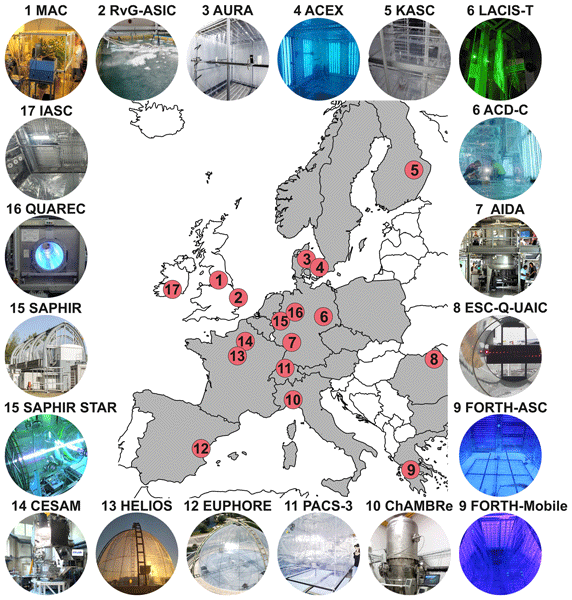
- Figure 1 is visually appealing, but it is somewhat crowded and could be simplified for better readability.
- The terminology around “ACTRIS National Facilities,” “facilities closely connected with ACTRIS,” and chambers located in countries not yet in ACTRIS ERIC member states should be clarified and used consistently throughout the manuscript.
- Some readers would benefit from a short concluding subsection summarizing future priorities for ACTRIS chamber science, for example harmonized protocols, cross-facility intercomparison, emerging analytical needs, or links to health and climate applications.
Citation: https://doi.org/10.5194/egusphere-2026-1612-RC2 -
AC2: 'Reply on RC2', Hendrik Fuchs, 05 Jun 2026
We thank the reviewer for the helpful comments.
Comment: The manuscript would be strengthened by adding one or two synthesis tables or summary figures comparing the chambers across a common set of dimensions, such as volume, material, temperature range, pressure capability, irradiation type, main scientific focus, key instrumentation, and unique capabilities.
Response: The reviewer may have overlooked Table 1 (in Section 2), where several of the parameters that are mentioned in the comment are listed. We will extend this table with additional information. We considered to add a table with key instrumentation but thought that this is better placed in the descriptions of the chambers due to the large diversity of instruments among the chambers.
Comment: It would be helpful to provide a more explicit and concise summary of the user access process, including what types of access are available, how proposals are reviewed, what data obligations apply, and how users can combine chamber access with ACTRIS data-centre services or topical centres.
Response: We will add in Line 923:
“ACTRIS provides users with a single-entry point to access the chambers via the ACTRIS Service Access Management Unit, SAMU. The feasibility of the suggested experiments is checked by the chamber providers. Proposals can be submitted via an online form and will be reviewed by external experts if funding is available, for example from EC-funded transnational access programmes. Experiment data must be made public via the ACTRIS data centre.”
Comment: The QA/QC section is important, but a concise checklist or tiered framework would make it more actionable, especially for external users who may not already be familiar with ACTRIS terminology and procedures.
Response: The QA/QC workflow of chamber experiments in the context of the ACTRIS infrastructure is already shown in Fig. 2. We added a new figure (Fgure 3), which shows the different chamber effects that need to be considered in the interpretation of experiments described in Sections 4.2 and 4.3.
Comment: One of the strengths of ACTRIS is the diversity of its chamber facilities, but this diversity also means that experimental outcomes may not always be directly comparable because of differences in wall materials, chamber size, irradiation, mixing, cleanliness, replenishment flow, and instrumentation. The manuscript already alludes to chamber effects and characterization needs, but it would benefit from a more explicit discussion of what types of intercomparison are realistic across facilities, what limitations remain, and how ACTRIS intends to harmonize reporting without losing facility-specific strengths. This would be particularly useful for readers who might otherwise interpret the infrastructure as more standardized than it actually is.
Response: We agree that one of the challenges of the diversity of chambers is to directly compare results. We added the following text in Line 617:
“The diversity of chambers makes it often challenging to perform experiments in exactly the same way. One difference is, for example, the dilution rate, which leads to different process time scale while affecting the formation of products. This makes it more difficult to directly compare results. However, as the underlying atmospheric processes are the same, the findings (e.g. kinetic information) obtained after all chamber specific effects are adequately considered (Section 4.2) are expected to be the same. One key requirement is an appropriate experimental design ensuring that branching ratios of processes are similar, for example, that the fate of peroxy radicals in oxidation experiments is comparable (Section 6.2, Kenagy et al., 2024). One task for the further development of the ACTRIS chambers will be to demonstrate the comparability of results (Urici et al., 2026).
Recently a comparison of chamber performance was conducted between IASC and SAPHIR based on set of typical day- and night-time standard oxidation experiments using the same key instrumentation on both chambers (Fuchs et al. 2026). Exercises like this help to develop standards in the characterization of the most critical chamber parameters to be able to generalize chamber results and to harmonize the comparability of chamber data.
However, the diversity of the type of studies that can be performed in the different chambers and the specialization and availability of different instrumental approaches is also important to be recognized and fostered, because different aspects of the same atmospheric processes can then be studied in different chambers. A good degree of complementarity is an advantage to obtain a more comprehensive picture of the atmospheric chemistry involved in the processes.”
Concerning the challenges of chamber experiments linked to the type of chamber, we would like to refer to the answers to the comments of the first reviewer.
Comment: Figure 1 is visually appealing, but it is somewhat crowded and could be simplified for better readability.
Response: We improved the readability by moving the chamber names out of the pictures.
Comment: The terminology around “ACTRIS National Facilities,” “facilities closely connected with ACTRIS,” and chambers located in countries not yet in ACTRIS ERIC member states should be clarified and used consistently throughout the manuscript.
Response: We changed the text at the start of Section 2. For the remaining part of the manuscript, we do not distinguish between the formal connection between chambers and ACTRIS as all points we make apply to all chambers in the same way. This is now clarified in Section 2.
We added in L92: “Statements and discussions in this work apply to all chambers in the same way regardless of whether they are in an ACTRIS member country or not. This aspect is not of relevance for the remainder of this publication.”
We changed the caption of Figure 1: “European atmospheric simulation chambers, which are part of ACTRIS or closely connected with ACTRIS through previous projects but are in countries, which are not members of ACTRIS. ACTRIS member countries are coloured in grey.”
Comment: Some readers would benefit from a short concluding subsection summarizing future priorities for ACTRIS chamber science, for example harmonized protocols, cross-facility intercomparison, emerging analytical needs, or links to health and climate applications.
Response: Like the reviewer pointed out in one of the earlier comments, there is a large diversity of chamber types with different scientific focus. In addition, the research performed in the facilities is funded by various national and international funding programmes not related to ACTRIS so that we do not think that this paper can easily summarise future scientific priorities beyond the extensive discussion presented in Section 6. However, we added a short summary of priorities for the further development of quality assurance of the chambers as part of the activities in the ACTRIS research infrastructure in Line 929:
“One priority of the further development of chambers as part of the ACTRIS research infrastructure will be quality assurance of chamber experiments by demonstrating the interoperability of chambers in cross-facility intercomparisons (Uruci et al. 2025). In addition, the use of chambers for quality assurance of observational methods and development of emerging analytical tools will be an important task that will strengthen the ties of the chamber facilities and the ACTRIS Topical Centres.”
Citation: https://doi.org/10.5194/egusphere-2026-1612-AC2
-
RC3: 'Comment on egusphere-2026-1612', Anonymous Referee #3, 05 May 2026
This paper provides a nice summary of the 14 simulation chamber facilities that comprise ACTRIS infrastructure. A comparison of the chambers highlighting the unique aspects and applications for each is definitely a worthwhile contribution to the community; however, I fail to see what new value is added in this paper that was not already covered in Laj et al 2024, the previous ACTRIS paper, which is referenced in this manuscript (DOI:https://doi.org/10.1175/BAMS-D-23-0064.1). Overall I think this manuscript is overly detailed and could introduce a little more comparison across the chambers to highlight the significance of differences in chambers and explain the rationale behind operating chambers in certain ways. My main comments are as follows:
1. Figure 1 is a bit messy. Do we really need images of each chamber? Maybe coloring by the main focus(es) for each chamber (e.g. gas-phase kinetics, aerosols, clouds, other) would be more useful. Also the grey shading is too light.
2. The most useful section to me was 2.1 which summarizes typical chamber instrumentation, as well as the Table 1 (which seems like an expansion of Table 1 from Laj et al 2024. The sections detailing each of the individual chambers are way too detailed and are often overly repetitive. It seems like a lot of extraneous information could be cut for conciseness. Also, including a list of typical instrumentation in section 2.1 and only mentioning unique instruments in the individual sections would better highlight differences between chambers.
3. Another section with typical chamber aspects / modes of operation would be helpful. Details like the source for clean air, procedures for cleaning, or how they humidify a chamber could be outlined once rather than stated in almost every single chamber section - this would help reduce the repetition. It could also help with some synthesis across the chambers, maybe by including some discussion on trade-offs of certain choices like chamber material - why do some use teflon and others use metal or quartz? Is one better for certain applications? Addressing these questions would better demonstrate the importance of some of these differences in chamber design rather than just laundry listing values / aspects for each chamber.
4. Consistency is lacking in some of the details. For example, you include wavelength of the lights for some chambers but not for others. Or you include a humidity range for some chambers and just say that others can be humidified. If you are going to include details like that, then include the same for all.
5. Some acronyms are not defined, for example, HEPA, FEP and PTFE. Please define these.
6. Later sections also seem to include a large amount of unnecessary information. For example, the reactions for jNO2 in section 4.2 could be removed. You already mention actinometry. Including one reference for this should be sufficient instead of explaining all of it in detail.
7. Also in section 4.2, the phrase "memory effects" sticks out to me. I would either define what you mean or use a different phrase that is more clear.
8. Section 6.4, please include a reference for your second listed example on the hydrogen economy
9. Section 6.5 seems unnecessary
Citation: https://doi.org/10.5194/egusphere-2026-1612-RC3 -
AC3: 'Reply on RC3', Hendrik Fuchs, 05 Jun 2026
Comment: Figure 1 is a bit messy. Do we really need images of each chamber? Maybe coloring by the main focus(es) for each chamber (e.g. gas-phase kinetics, aerosols, clouds, other) would be more useful. Also the grey shading is too light.
Response: We think that the images are important to give a full visual representation of the diverse characters of the chambers and would prefer to keep them in Figure 1. Only few chambers have a clear focus on one research topic (see also Table 1) so that it is difficult to visually assign each chamber to one research focus. We nevertheless changed the colour of the ACTRIS member states and improved the Figure’s readability as outlined in our reply to reviewer 2.
Comment: The most useful section to me was 2.1 which summarizes typical chamber instrumentation, as well as the Table 1 (which seems like an expansion of Table 1 from Laj et al 2024. The sections detailing each of the individual chambers are way too detailed and are often overly repetitive. It seems like a lot of extraneous information could be cut for conciseness. Also, including a list of typical instrumentation in section 2.1 and only mentioning unique instruments in the individual sections would better highlight differences between chambers.
Response: We appreciate the comment and understand the reviewer’s concern of the apparent perceived repetitiveness. However, by having more detailed descriptions of chambers one does not run the risk of merely glossing over certain aspects. Mentioning some key instruments for each chamber is important to convey the overall experimental strategy of that chamber to investigate particular atmospheric aspects. Strengths and weaknesses of individual chambers become more apparent in that way. We nevertheless scrutinized the chamber descriptions for repetitions and tried to avoid them where possible.
Comment: Another section with typical chamber aspects / modes of operation would be helpful. Details like the source for clean air, procedures for cleaning, or how they humidify a chamber could be outlined once rather than stated in almost every single chamber section - this would help reduce the repetition. It could also help with some synthesis across the chambers, maybe by including some discussion on trade-offs of certain choices like chamber material - why do some use teflon and others use metal or quartz? Is one better for certain applications? Addressing these questions would better demonstrate the importance of some of these differences in chamber design rather than just laundry listing values / aspects for each chamber.
Response: A similar comment was raised by reviewer 1 and as outlined previously we added a paragraph in Section 3 to address how specific chamber properties are linked to the research focus of the respective chamber. In addition, we also added the following text in Line 100:
“Most chambers use an air purification system for ambient air consisting of a compressor, drier, aerosol filter, and charcoal filters to produce clean air, which is free from reactive inorganic and organic species. Some chambers also use bottled zero air or produce air from high-purity liquid nitrogen and oxygen. Nearly all chambers are equipped with a stirring system to ensure homogeneous mixing of the air. Typical mixing times are in the range of a few minutes.”
Comment: Consistency is lacking in some of the details. For example, you include wavelength of the lights for some chambers but not for others. Or you include a humidity range for some chambers and just say that others can be humidified. If you are going to include details like that, then include the same for all.
Response: We went through the chamber descriptions and ensured that the descriptions are consistent.
Comment: Some acronyms are not defined, for example, HEPA, FEP and PTFE. Please define these.
Response: Definitions for these acronyms were added to the manuscript.
Comment: Later sections also seem to include a large amount of unnecessary information. For example, the reactions for jNO2 in section 4.2 could be removed. You already mention actinometry. Including one reference for this should be sufficient instead of explaining all of it in detail.
Response: We shortened Section 4.2 as suggested by the reviewer.
Comment: Also in section 4.2, the phrase "memory effects" sticks out to me. I would either define what you mean or use a different phrase that is more clear.
Response: We changed the wording in L568 to “as properties of the chamber wall can depend on the history of previous experiments”; in L596 “reduce chamber wall effects”; in L608 “adsorption and desorption”.
Comment: Section 6.4, please include a reference for your second listed example on the hydrogen economy
Response: We added as reference Kumar et al., 2024 (doi: 10.1002/celc.202300845)
Comment: Section 6.5 seems unnecessary
Response: We think that this section gives useful information as to how results from chamber experiments can be directly linked to other parts of the ACTRIS infrastructure. Therefore, we would prefer to keep this section.
Citation: https://doi.org/10.5194/egusphere-2026-1612-AC3
-
AC3: 'Reply on RC3', Hendrik Fuchs, 05 Jun 2026
Peer review completion


Interactive discussion
Status: closed
-
RC1: 'Comment on egusphere-2026-1612', Anonymous Referee #1, 21 Apr 2026
This manuscript presents a comprehensive overview of atmospheric simulation chambers within the ACTRIS research infrastructure, including their technical characteristics, instrumentation, quality assurance procedures, and application areas. The topic is timely and highly relevant, as simulation chambers play a crucial role in advancing gas-phase chemistry, secondary organic aerosol (SOA) formation, and multiphase processes.
The manuscript is generally well organized and compiles detailed information on a wide range of chamber facilities across Europe. However, in its current form, the manuscript is overly descriptive and still lacks sufficient cross-platform synthesis, clear identification of key scientific questions, and a comprehensive summary of its major scientific contributions.Specific Comments:
1. In the Introduction section, the authors list a large number of previous studies to illustrate the contributions of simulation chambers to atmospheric science, including structure–activity relationships, MCM/GECKO-A, HOMs, VBS, and mineral dust optical properties. However, this part mainly presents a compilation of references without sufficient synthesis. It remains unclear how these studies collectively advance mechanistic understanding, model development, or the interpretation of atmospheric observations. Further clarification and integration are needed.
2. The manuscript describes numerous applications, but the connection between specific chamber features (e.g., size, light source, material) and their suitability for particular research topics is not clearly articulated. Please clarify how different chamber designs enable different types of studies.
3. Given the importance of simulation chamber data for atmospheric modeling, could the authors clarify how ACTRIS chamber data are currently integrated into chemical transport models or mechanism development?
4. The current manuscript provides insufficient discussion of the inherent limitations of simulation chamber studies. In particular, key issues such as wall losses of both gas-phase species and particles, the use of precursor concentrations that deviate from real atmospheric levels, discrepancies between artificial light sources and natural solar radiation, and differences in chemical timescales compared to ambient atmospheric conditions should be addressed more thoroughly.
5. The manuscript would benefit from additional figures or schematics, such as classification diagrams or conceptual workflows, to better illustrate the diversity of chamber systems.Citation: https://doi.org/10.5194/egusphere-2026-1612-RC1 -
AC1: 'Reply on RC1', Hendrik Fuchs, 05 Jun 2026
We thank the reviewer for the helpful comments.
Comment: In the Introduction section, the authors list a large number of previous studies to illustrate the contributions of simulation chambers to atmospheric science, including structure–activity relationships, MCM/GECKO-A, HOMs, VBS, and mineral dust optical properties. However, this part mainly presents a compilation of references without sufficient synthesis. It remains unclear how these studies collectively advance mechanistic understanding, model development, or the interpretation of atmospheric observations. Further clarification and integration are needed.
Response: There are many types of information derived from chamber experiments, which is used in various ways as also pointed out by the reviewer. Describing the “collective” advancement of a multitude of atmospheric science aspects is a formidable endeavour, because the research programmes and campaigns running at the individual chambers are not centrally coordinated and are running for decades. Therefore, various topics and future directions of chamber experiments are extensively discussed and shown in Section 6. We believe that this should remain in Section 6 and that the introduction can only give a flavour of what has been achieved. To address the reviewer’s comment, added in Line 55:
“The simulation of the atmosphere led to the discovery of new processes and quantitative information about reaction kinetics and other physical and chemical processes used in chemical transport models.”
Comment: The manuscript describes numerous applications, but the connection between specific chamber features (e.g., size, light source, material) and their suitability for particular research topics is not clearly articulated. Please clarify how different chamber designs enable different types of studies.Response: Most chambers are suitable for experiments on different research topics with a few exceptions of chambers that were specifically designed for specific purposes. Some of the obvious requirements on the design of the chamber (ice / water surface, turbulence, temperature range) for specific types of experiments are listed in Line 485. To better show the link between chamber features and the type of experiment we changed / added:
Line 490 will be moved to Line 485.
In Line 485: “These types of research can be conducted in most ACTRIS chambers as they require mainly a reaction volume. The level of reactants used in the different chambers may differ as effects on observables from the atmospheric processes should be larger than effects from the chamber itself (for example dilution, wall interactions). The type of chamber wall affects the loss rates for different atmospheric constituents. Whereas Teflon is often preferred to minimise gas-phase loss of species, the loss rate of particles is smaller on metal surface than on Teflon. The emission spectrum of lamps or use of sunlight clearly affects the strength and type of photolytic processes that can be observed. Reactive nitrogen species as well as small oxygenated organic compounds can be emitted, and low-volatile product species and particles can be lost on the chamber walls. This can be a challenge for studying atmospheric conditions as it can alter the distribution of products and the chemical composition of particles. Chambers are often custom-designed for specific research due to the availability of suitable instrumentation and/or the expertise required to conduct specific types of experiments.”
Line 490: “The study of these research questions requires specific designs of the chambers.”
We added an additional Table (Table 2), which summarises how chamber features influence their suitability for studying different atmospheric processes. Experimental suitability depends on the combination of chamber characteristics rather than on any single feature alone.
Table 2: Links between chamber characteristics and types of experiments that can be carried out in the chambers.
Volume and surface-to-volume ratio
Wall effects; Dilution rate (experiment duration); Reactants concentration range
Wall material
Gas and particle wall loss (electrostatic effects); Cleaning process; Light transmission; Chemical inertness
Irradiation source
Photolysis rates; Oxidant production; Reproducibility; Representativeness of atmospheric conditions
Range of temperature, pressure and relative humidity
Representativeness of atmospheric (extreme) conditions; Opportunity to study cloud formation, ice nucleation, temperature/pressure dependent processes
Capabilities for using complex sources / studying multi-phase systems
Representativeness of atmospheric (complex) conditions; Opportunities to study biomass burning, vehicle emissions, plant emissions, sea spray aerosol, bioaerosols, air/ice/water interactions, real-world composition of air, heterogeneous chemistry
Availability of instruments
Complexity and type of studies
Comment: Given the importance of simulation chamber data for atmospheric modeling, could the authors clarify how ACTRIS chamber data are currently integrated into chemical transport models or mechanism development?Response: The chambers are primarily involved in model and mechanism development by conducting research on specific scientific questions. This is, for example, reflected in the way the chambers are being utilized and accessed by users. However, there is currently no systematic or formalised oversight. The development of effort coordination, the standardization of experimental methodologies, and the integration of activities with specific scientific goals including data consolidation is exactly what ACTRIS is striving to enable better collective approaches to mechanism development. The integration process is complex and only in its infancy. For now, we think that the use and importance of chambers for model and mechanism development is sufficiently emphasised in the paper, particularly in the introduction, section 6, and the conclusions.
Comment: The current manuscript provides insufficient discussion of the inherent limitations of simulation chamber studies. In particular, key issues such as wall losses of both gas-phase species and particles, the use of precursor concentrations that deviate from real atmospheric levels, discrepancies between artificial light sources and natural solar radiation, and differences in chemical timescales compared to ambient atmospheric conditions should be addressed more thoroughly.Response: This is a valid point, and we thus further extended the discussion in Line 485 to address the issues involved:
“Smaller chambers with volumes of a few m³ and dilution rates of several percent per hour often require higher-than-ambient levels of reactants to build up sufficiently high concentrations of products in the gas and/or aerosol phase. This is either because the process timescale mainly covers the formation of first-generation products, or because higher-than-ambient oxidant and/or reactant concentrations accelerate the process rate. In contrast, larger chambers with volumes of up to several 100 m³ can often work with low, ambient-like reactant concentrations, enabling studies at process timescales of up to several days. Many chambers have extended their capabilities to work with realistic mixtures of emissions (Section 6.4).
Overall, the loss of low-volatile product species and particles from the walls of chambers used to study atmospheric conditions can be challenging, as this can alter the distribution of products and the chemical composition of particles. The emission spectrum of lamps or the use of sunlight clearly affects the strength and type of photolytic processes that can be observed.
While the range of conditions and scientific questions that can be studied in a specific chamber is limited, the specialisation and expertise associated with these limitations can also be considered a strength. Integrating European chambers with a diverse scientific focus into ACTRIS ensures that users are guided towards the chamber best suited to answering their scientific question.”
Comment: The manuscript would benefit from additional figures or schematics, such as classification diagrams or conceptual workflows, to better illustrate the diversity of chamber systems.Response: We added a new figure (Figure 3), which shows the different chamber effects that need to be considered in the interpretation of experiments described in Section 4.2 and 4.3. We believe that the conceptual workflows of QA/QC and access are already well illustrated in Fig. 2 and Fig. 3. We also added another figure illustrating the diversity of research topics (Figure 5).
We added in Line 700: “Figure 5 summarizes research topics addressed by atmospheric simulation chambers, ranging from fundamental kinetic to complex atmospheric systems and impact-related studies. The categories are not mutually exclusive, and many chambers can address several topics simultaneously.”
Citation: https://doi.org/10.5194/egusphere-2026-1612-AC1
-
AC1: 'Reply on RC1', Hendrik Fuchs, 05 Jun 2026
-
RC2: 'Comment on egusphere-2026-1612', Anonymous Referee #2, 28 Apr 2026
This manuscript presents a comprehensive overview of the atmospheric simulation chambers that are part of, or closely linked to, the ACTRIS research infrastructure. The paper covers the scientific motivations for chamber studies, the diversity of chamber designs and operating modes, available instrumentation, quality assurance procedures, and the research, training, and innovation opportunities offered to users. This is a valuable contribution and will likely become a useful reference for both new users and experienced chamber scientists. I support publication after minor revision, mainly to improve its usability for readers.
- The manuscript would be strengthened by adding one or two synthesis tables or summary figures comparing the chambers across a common set of dimensions, such as volume, material, temperature range, pressure capability, irradiation type, main scientific focus, key instrumentation, and unique capabilities.
- It would be helpful to provide a more explicit and concise summary of the user access process, including what types of access are available, how proposals are reviewed, what data obligations apply, and how users can combine chamber access with ACTRIS data-centre services or topical centres.
- The QA/QC section is important, but a concise checklist or tiered framework would make it more actionable, especially for external users who may not already be familiar with ACTRIS terminology and procedures.
- One of the strengths of ACTRIS is the diversity of its chamber facilities, but this diversity also means that experimental outcomes may not always be directly comparable because of differences in wall materials, chamber size, irradiation, mixing, cleanliness, replenishment flow, and instrumentation. The manuscript already alludes to chamber effects and characterization needs, but it would benefit from a more explicit discussion of what types of intercomparison are realistic across facilities, what limitations remain, and how ACTRIS intends to harmonize reporting without losing facility-specific strengths. This would be particularly useful for readers who might otherwise interpret the infrastructure as more standardized than it actually is.
- Figure 1 is visually appealing, but it is somewhat crowded and could be simplified for better readability.
- The terminology around “ACTRIS National Facilities,” “facilities closely connected with ACTRIS,” and chambers located in countries not yet in ACTRIS ERIC member states should be clarified and used consistently throughout the manuscript.
- Some readers would benefit from a short concluding subsection summarizing future priorities for ACTRIS chamber science, for example harmonized protocols, cross-facility intercomparison, emerging analytical needs, or links to health and climate applications.
Citation: https://doi.org/10.5194/egusphere-2026-1612-RC2 -
AC2: 'Reply on RC2', Hendrik Fuchs, 05 Jun 2026
We thank the reviewer for the helpful comments.
Comment: The manuscript would be strengthened by adding one or two synthesis tables or summary figures comparing the chambers across a common set of dimensions, such as volume, material, temperature range, pressure capability, irradiation type, main scientific focus, key instrumentation, and unique capabilities.
Response: The reviewer may have overlooked Table 1 (in Section 2), where several of the parameters that are mentioned in the comment are listed. We will extend this table with additional information. We considered to add a table with key instrumentation but thought that this is better placed in the descriptions of the chambers due to the large diversity of instruments among the chambers.
Comment: It would be helpful to provide a more explicit and concise summary of the user access process, including what types of access are available, how proposals are reviewed, what data obligations apply, and how users can combine chamber access with ACTRIS data-centre services or topical centres.
Response: We will add in Line 923:
“ACTRIS provides users with a single-entry point to access the chambers via the ACTRIS Service Access Management Unit, SAMU. The feasibility of the suggested experiments is checked by the chamber providers. Proposals can be submitted via an online form and will be reviewed by external experts if funding is available, for example from EC-funded transnational access programmes. Experiment data must be made public via the ACTRIS data centre.”
Comment: The QA/QC section is important, but a concise checklist or tiered framework would make it more actionable, especially for external users who may not already be familiar with ACTRIS terminology and procedures.
Response: The QA/QC workflow of chamber experiments in the context of the ACTRIS infrastructure is already shown in Fig. 2. We added a new figure (Fgure 3), which shows the different chamber effects that need to be considered in the interpretation of experiments described in Sections 4.2 and 4.3.
Comment: One of the strengths of ACTRIS is the diversity of its chamber facilities, but this diversity also means that experimental outcomes may not always be directly comparable because of differences in wall materials, chamber size, irradiation, mixing, cleanliness, replenishment flow, and instrumentation. The manuscript already alludes to chamber effects and characterization needs, but it would benefit from a more explicit discussion of what types of intercomparison are realistic across facilities, what limitations remain, and how ACTRIS intends to harmonize reporting without losing facility-specific strengths. This would be particularly useful for readers who might otherwise interpret the infrastructure as more standardized than it actually is.
Response: We agree that one of the challenges of the diversity of chambers is to directly compare results. We added the following text in Line 617:
“The diversity of chambers makes it often challenging to perform experiments in exactly the same way. One difference is, for example, the dilution rate, which leads to different process time scale while affecting the formation of products. This makes it more difficult to directly compare results. However, as the underlying atmospheric processes are the same, the findings (e.g. kinetic information) obtained after all chamber specific effects are adequately considered (Section 4.2) are expected to be the same. One key requirement is an appropriate experimental design ensuring that branching ratios of processes are similar, for example, that the fate of peroxy radicals in oxidation experiments is comparable (Section 6.2, Kenagy et al., 2024). One task for the further development of the ACTRIS chambers will be to demonstrate the comparability of results (Urici et al., 2026).
Recently a comparison of chamber performance was conducted between IASC and SAPHIR based on set of typical day- and night-time standard oxidation experiments using the same key instrumentation on both chambers (Fuchs et al. 2026). Exercises like this help to develop standards in the characterization of the most critical chamber parameters to be able to generalize chamber results and to harmonize the comparability of chamber data.
However, the diversity of the type of studies that can be performed in the different chambers and the specialization and availability of different instrumental approaches is also important to be recognized and fostered, because different aspects of the same atmospheric processes can then be studied in different chambers. A good degree of complementarity is an advantage to obtain a more comprehensive picture of the atmospheric chemistry involved in the processes.”
Concerning the challenges of chamber experiments linked to the type of chamber, we would like to refer to the answers to the comments of the first reviewer.
Comment: Figure 1 is visually appealing, but it is somewhat crowded and could be simplified for better readability.
Response: We improved the readability by moving the chamber names out of the pictures.
Comment: The terminology around “ACTRIS National Facilities,” “facilities closely connected with ACTRIS,” and chambers located in countries not yet in ACTRIS ERIC member states should be clarified and used consistently throughout the manuscript.
Response: We changed the text at the start of Section 2. For the remaining part of the manuscript, we do not distinguish between the formal connection between chambers and ACTRIS as all points we make apply to all chambers in the same way. This is now clarified in Section 2.
We added in L92: “Statements and discussions in this work apply to all chambers in the same way regardless of whether they are in an ACTRIS member country or not. This aspect is not of relevance for the remainder of this publication.”
We changed the caption of Figure 1: “European atmospheric simulation chambers, which are part of ACTRIS or closely connected with ACTRIS through previous projects but are in countries, which are not members of ACTRIS. ACTRIS member countries are coloured in grey.”
Comment: Some readers would benefit from a short concluding subsection summarizing future priorities for ACTRIS chamber science, for example harmonized protocols, cross-facility intercomparison, emerging analytical needs, or links to health and climate applications.
Response: Like the reviewer pointed out in one of the earlier comments, there is a large diversity of chamber types with different scientific focus. In addition, the research performed in the facilities is funded by various national and international funding programmes not related to ACTRIS so that we do not think that this paper can easily summarise future scientific priorities beyond the extensive discussion presented in Section 6. However, we added a short summary of priorities for the further development of quality assurance of the chambers as part of the activities in the ACTRIS research infrastructure in Line 929:
“One priority of the further development of chambers as part of the ACTRIS research infrastructure will be quality assurance of chamber experiments by demonstrating the interoperability of chambers in cross-facility intercomparisons (Uruci et al. 2025). In addition, the use of chambers for quality assurance of observational methods and development of emerging analytical tools will be an important task that will strengthen the ties of the chamber facilities and the ACTRIS Topical Centres.”
Citation: https://doi.org/10.5194/egusphere-2026-1612-AC2
-
RC3: 'Comment on egusphere-2026-1612', Anonymous Referee #3, 05 May 2026
This paper provides a nice summary of the 14 simulation chamber facilities that comprise ACTRIS infrastructure. A comparison of the chambers highlighting the unique aspects and applications for each is definitely a worthwhile contribution to the community; however, I fail to see what new value is added in this paper that was not already covered in Laj et al 2024, the previous ACTRIS paper, which is referenced in this manuscript (DOI:https://doi.org/10.1175/BAMS-D-23-0064.1). Overall I think this manuscript is overly detailed and could introduce a little more comparison across the chambers to highlight the significance of differences in chambers and explain the rationale behind operating chambers in certain ways. My main comments are as follows:
1. Figure 1 is a bit messy. Do we really need images of each chamber? Maybe coloring by the main focus(es) for each chamber (e.g. gas-phase kinetics, aerosols, clouds, other) would be more useful. Also the grey shading is too light.
2. The most useful section to me was 2.1 which summarizes typical chamber instrumentation, as well as the Table 1 (which seems like an expansion of Table 1 from Laj et al 2024. The sections detailing each of the individual chambers are way too detailed and are often overly repetitive. It seems like a lot of extraneous information could be cut for conciseness. Also, including a list of typical instrumentation in section 2.1 and only mentioning unique instruments in the individual sections would better highlight differences between chambers.
3. Another section with typical chamber aspects / modes of operation would be helpful. Details like the source for clean air, procedures for cleaning, or how they humidify a chamber could be outlined once rather than stated in almost every single chamber section - this would help reduce the repetition. It could also help with some synthesis across the chambers, maybe by including some discussion on trade-offs of certain choices like chamber material - why do some use teflon and others use metal or quartz? Is one better for certain applications? Addressing these questions would better demonstrate the importance of some of these differences in chamber design rather than just laundry listing values / aspects for each chamber.
4. Consistency is lacking in some of the details. For example, you include wavelength of the lights for some chambers but not for others. Or you include a humidity range for some chambers and just say that others can be humidified. If you are going to include details like that, then include the same for all.
5. Some acronyms are not defined, for example, HEPA, FEP and PTFE. Please define these.
6. Later sections also seem to include a large amount of unnecessary information. For example, the reactions for jNO2 in section 4.2 could be removed. You already mention actinometry. Including one reference for this should be sufficient instead of explaining all of it in detail.
7. Also in section 4.2, the phrase "memory effects" sticks out to me. I would either define what you mean or use a different phrase that is more clear.
8. Section 6.4, please include a reference for your second listed example on the hydrogen economy
9. Section 6.5 seems unnecessary
Citation: https://doi.org/10.5194/egusphere-2026-1612-RC3 -
AC3: 'Reply on RC3', Hendrik Fuchs, 05 Jun 2026
Comment: Figure 1 is a bit messy. Do we really need images of each chamber? Maybe coloring by the main focus(es) for each chamber (e.g. gas-phase kinetics, aerosols, clouds, other) would be more useful. Also the grey shading is too light.
Response: We think that the images are important to give a full visual representation of the diverse characters of the chambers and would prefer to keep them in Figure 1. Only few chambers have a clear focus on one research topic (see also Table 1) so that it is difficult to visually assign each chamber to one research focus. We nevertheless changed the colour of the ACTRIS member states and improved the Figure’s readability as outlined in our reply to reviewer 2.
Comment: The most useful section to me was 2.1 which summarizes typical chamber instrumentation, as well as the Table 1 (which seems like an expansion of Table 1 from Laj et al 2024. The sections detailing each of the individual chambers are way too detailed and are often overly repetitive. It seems like a lot of extraneous information could be cut for conciseness. Also, including a list of typical instrumentation in section 2.1 and only mentioning unique instruments in the individual sections would better highlight differences between chambers.
Response: We appreciate the comment and understand the reviewer’s concern of the apparent perceived repetitiveness. However, by having more detailed descriptions of chambers one does not run the risk of merely glossing over certain aspects. Mentioning some key instruments for each chamber is important to convey the overall experimental strategy of that chamber to investigate particular atmospheric aspects. Strengths and weaknesses of individual chambers become more apparent in that way. We nevertheless scrutinized the chamber descriptions for repetitions and tried to avoid them where possible.
Comment: Another section with typical chamber aspects / modes of operation would be helpful. Details like the source for clean air, procedures for cleaning, or how they humidify a chamber could be outlined once rather than stated in almost every single chamber section - this would help reduce the repetition. It could also help with some synthesis across the chambers, maybe by including some discussion on trade-offs of certain choices like chamber material - why do some use teflon and others use metal or quartz? Is one better for certain applications? Addressing these questions would better demonstrate the importance of some of these differences in chamber design rather than just laundry listing values / aspects for each chamber.
Response: A similar comment was raised by reviewer 1 and as outlined previously we added a paragraph in Section 3 to address how specific chamber properties are linked to the research focus of the respective chamber. In addition, we also added the following text in Line 100:
“Most chambers use an air purification system for ambient air consisting of a compressor, drier, aerosol filter, and charcoal filters to produce clean air, which is free from reactive inorganic and organic species. Some chambers also use bottled zero air or produce air from high-purity liquid nitrogen and oxygen. Nearly all chambers are equipped with a stirring system to ensure homogeneous mixing of the air. Typical mixing times are in the range of a few minutes.”
Comment: Consistency is lacking in some of the details. For example, you include wavelength of the lights for some chambers but not for others. Or you include a humidity range for some chambers and just say that others can be humidified. If you are going to include details like that, then include the same for all.
Response: We went through the chamber descriptions and ensured that the descriptions are consistent.
Comment: Some acronyms are not defined, for example, HEPA, FEP and PTFE. Please define these.
Response: Definitions for these acronyms were added to the manuscript.
Comment: Later sections also seem to include a large amount of unnecessary information. For example, the reactions for jNO2 in section 4.2 could be removed. You already mention actinometry. Including one reference for this should be sufficient instead of explaining all of it in detail.
Response: We shortened Section 4.2 as suggested by the reviewer.
Comment: Also in section 4.2, the phrase "memory effects" sticks out to me. I would either define what you mean or use a different phrase that is more clear.
Response: We changed the wording in L568 to “as properties of the chamber wall can depend on the history of previous experiments”; in L596 “reduce chamber wall effects”; in L608 “adsorption and desorption”.
Comment: Section 6.4, please include a reference for your second listed example on the hydrogen economy
Response: We added as reference Kumar et al., 2024 (doi: 10.1002/celc.202300845)
Comment: Section 6.5 seems unnecessary
Response: We think that this section gives useful information as to how results from chamber experiments can be directly linked to other parts of the ACTRIS infrastructure. Therefore, we would prefer to keep this section.
Citation: https://doi.org/10.5194/egusphere-2026-1612-AC3
-
AC3: 'Reply on RC3', Hendrik Fuchs, 05 Jun 2026
Peer review completion
Journal article(s) based on this preprint
Viewed
| HTML | XML | Total | BibTeX | EndNote | |
|---|---|---|---|---|---|
| 649 | 529 | 69 | 1,247 | 42 | 47 |
- HTML: 649
- PDF: 529
- XML: 69
- Total: 1,247
- BibTeX: 42
- EndNote: 47
Viewed (geographical distribution)
| Country | # | Views | % |
|---|
| Total: | 0 |
| HTML: | 0 |
| PDF: | 0 |
| XML: | 0 |
- 1

Niklas Illmann
Amalia Muñoz
Mila Ródenas
Bénédicte Picquet-Varrault
M. Rami Alfarra
Cecilia Arsene
Iustinian G. Bejan
David M. Bell
Merete Bilde
Alexander Böhmländer
Mixtli Campos-Pineda
Mathieu Cazaunau
Patrice Coll
Véronique Daële
Claudia Di Biagio
Michael Flynn
Paola Formenti
Hartmut Herrmann
Kristina Höhler
Thorsten Hohaus
Matthew S. Johnson
Eija Juurola
Niku Kivekäs
Jan Kaiser
Christos Kaltsonoudis
Paolo Laj
Dario Massabò
Federico Mazzei
Gordon McFiggans
Max R. McGillen
Abdelwahid Mellouki
Peter Mettke
Ottmar Möhler
Falk Mothes
Dennis Niedermeier
Anna Novelli
Romeo I. Olariu
Spyros N. Pandis
Iulia Patroescu-Klotz
Rosa Maria Petracca Altieri
Paolo Prati
Claudiu Roman
Albert A. Ruth
Harald Saathoff
Silvio Schmalfuß
Frank Stratmann
Virginia Vernocchi
Aristeidis Voliotis
Jens Voigtländer
Annele Virtanen
Andreas Wahner
Robert Wagner
John Wenger
Sören Zorn
Peter Wiesen
Jean-Francois Doussin
The requested preprint has a corresponding peer-reviewed final revised paper. You are encouraged to refer to the final revised version.
- Preprint
(5060 KB) - Metadata XML
This manuscript presents a comprehensive overview of atmospheric simulation chambers within the ACTRIS research infrastructure, including their technical characteristics, instrumentation, quality assurance procedures, and application areas. The topic is timely and highly relevant, as simulation chambers play a crucial role in advancing gas-phase chemistry, secondary organic aerosol (SOA) formation, and multiphase processes.
The manuscript is generally well organized and compiles detailed information on a wide range of chamber facilities across Europe. However, in its current form, the manuscript is overly descriptive and still lacks sufficient cross-platform synthesis, clear identification of key scientific questions, and a comprehensive summary of its major scientific contributions.
Specific Comments:
1. In the Introduction section, the authors list a large number of previous studies to illustrate the contributions of simulation chambers to atmospheric science, including structure–activity relationships, MCM/GECKO-A, HOMs, VBS, and mineral dust optical properties. However, this part mainly presents a compilation of references without sufficient synthesis. It remains unclear how these studies collectively advance mechanistic understanding, model development, or the interpretation of atmospheric observations. Further clarification and integration are needed.
2. The manuscript describes numerous applications, but the connection between specific chamber features (e.g., size, light source, material) and their suitability for particular research topics is not clearly articulated. Please clarify how different chamber designs enable different types of studies.
3. Given the importance of simulation chamber data for atmospheric modeling, could the authors clarify how ACTRIS chamber data are currently integrated into chemical transport models or mechanism development?
4. The current manuscript provides insufficient discussion of the inherent limitations of simulation chamber studies. In particular, key issues such as wall losses of both gas-phase species and particles, the use of precursor concentrations that deviate from real atmospheric levels, discrepancies between artificial light sources and natural solar radiation, and differences in chemical timescales compared to ambient atmospheric conditions should be addressed more thoroughly.
5. The manuscript would benefit from additional figures or schematics, such as classification diagrams or conceptual workflows, to better illustrate the diversity of chamber systems.