
the Creative Commons Attribution 4.0 License.
the Creative Commons Attribution 4.0 License.
 | 29 Jan 2026
Linking In-Canopy Chemistry to Above-Canopy O3, BVOCs, and NOx Gas Fluxes in the Amazon Rainforest
Abstract. The forest canopy is a distinct chemical and dynamical environment compared to the atmosphere above, characterised by natural emissions, deposition processes, and chemistry that vary with height. However, the role of in-canopy chemistry and its influence on above-canopy concentrations of ozone (O3) and bi-directional exchange of natural compounds are necessarily simplified within large-scale models. Whilst canopy models have been applied to temperate forests, there are few studies in tropical forests. Here, we apply the FORCAsT canopy column model to an Amazonian site. Simulation of the 2015 El Niño shows that biomass burning enhances O3 flux into the canopy, increases oxidation chemistry and elevates O3 deposition to vegetation. Sensitivity tests show sesquiterpenes enhance O3 chemical loss from approximately 3 % of the total in-canopy losses to 10 %–15 %, but only marginally reduce the total canopy O3 flux. Sesquiterpene canopy escape efficiency varies by 45 %–55 % across simulations, controlled by O3 oxidation and vertical turbulence. For other biogenic volatile organic compounds (BVOCs), pool-dependent emissions demonstrate greatest variability in escape efficiency with environmental conditions (monoterpenes 84 %–95 %, isoprene 95 %). Average soil NOx escape efficiency (40 %–50 %) is higher than many existing models suggest and exhibits a strong diurnal cycle that drives O3 production, especially in the early morning, which may be important to consider in global atmospheric chemistry models. Overall, we highlight reactive BVOCs by inclusion of sesquiterpene emissions and reactivity as major sources of uncertainty in in-canopy chemistry and emphasise the critical role of turbulence in linking canopy processes to above-canopy atmospheric composition.
-
Notice on discussion status
The requested preprint has a corresponding peer-reviewed final revised paper. You are encouraged to refer to the final revised version.
-
Preprint
(3390 KB)
-
Supplement
(5178 KB)
-
The requested preprint has a corresponding peer-reviewed final revised paper. You are encouraged to refer to the final revised version.
- Preprint
(3390 KB) - Metadata XML
-
Supplement
(5178 KB) - BibTeX
- EndNote
- Final revised paper


Journal article(s) based on this preprint
Interactive discussion
Status: closed
- RC1: 'Comment on egusphere-2026-161', Anonymous Referee #1, 24 Mar 2026
-
RC2: 'Comment on egusphere-2026-161', Laurens Ganzeveld, 08 Apr 2026
The comment was uploaded in the form of a supplement: https://egusphere.copernicus.org/preprints/2026/egusphere-2026-161/egusphere-2026-161-RC2-supplement.pdf
- AC1: 'Comment on egusphere-2026-161', Flossie Brown, 19 May 2026
Peer review completion


Interactive discussion
Status: closed
-
RC1: 'Comment on egusphere-2026-161', Anonymous Referee #1, 24 Mar 2026
Overall comment and rating:
This paper has some interesting results in Sections 3 and 4, but Section 2 provides an inadequate description of the model for me to recommend publication at this time. My overall rating is therefore “major revisions”: the description of the model needs to be considerably more detailed, in order for readers to be able to place the subsequent results in context. Care needs to be taken to describe components such as the gas-phase mechanism and the means by which gas-phase chemistry is solved numerically, the manner in which boundary conditions for emissions and deposition are included into the model’s diffusion equation and the numerical means for solving the diffusion equation, and the deposition parameterization and its component resistances and the algorithm approach used (big leaf / layered/ other). Several pages of model descriptive information need to be supplied, in Section 2, to better bolster the subsequent analysis and findings. A concise precis of the model is needed in order for this paper to be suitable for ACP.
Similarly, more details are needed on some of aspects of model setup, boundary conditions, and treatment of advected NO2 is needed, as described in my detailed comments below. I’ve placed an asterisk beside some of the more important points
Having said that, I think that the strength of the paper in sections 3 and 4 will make publication (once Section 2 has been properly updated), likely. I look forward to seeing the revised manuscript.
Specific comments by page and line number:
Page 3, line 76: Another reference is Makar et al., 1998, https://agupubs.onlinelibrary.wiley.com/doi/epdf/10.1029/1998JD100065): removal rates of O3 within a mixed forest in North America there had rapid changes with height, maximum oxidation rates of 0.80 ppbv/hour; that paper was aimed at the biogenic emissions, but the oxidation rate applies to both the monoterpenes present and O3 (see Figure 4 of that paper).
Page 3, line 78: Some chemical transport models are including surrogate monoterpenes and sequiterpenes; while the details of the products for sequiterpenes aren’t known, the approach taken is usually to included at least the emitted precursor monoterpene and an organic radical, to get the first stage of oxidation correct.
Page 3, line 84: perhaps also worth noting that Makar et al (2017) found that an adequate representation of forest canopies for regional modelling purposes can be done with three layers, representing the below foliage, within foliage, and near-top of the canopy. More recent work suggests that at least some of the canopy effects can be captured at the relatively low vertical resolution of numerical transport models by generating integrated or averaged values of diffusion and photolysis taking place within forest canopies (Tang et al., ACP, 2025, https://doi.org/10.5194/acp-25-16631-2025). The latter paper shows one approach for parameterizing canopy effects without significant changes to the regional modelling framework, though the effects are likely underestimated due to the use of lower resolution in the vertical.
Page 4, line 114: a small nit-picking correction: its better to use “evaluate” rather than “validate” here – validation implies that the model is “valid” thereafter, “evaluate” is better in that it describes the model performance without giving judgement on the outcome of the evaluation.
Page 4, lines 104-125: the description of the site would benefit from an additional Figure with a to-scale sketch of the tower noting the heights at which the different quantities were observed, as well as the LAI profile of the canopy.
*Page 4, line 130: The model’s vertical extent is to 5km, and the text mentions that the model is forced by observations at 30 minute intervals, but it’s not clear where the forcing conditions for the upper part of the model domain are originating. I’m wondering in particular about the magnitude and strength of the horizontal and vertical components of wind, and the K theory values that are used in the bulk of the 5km that are above the canopy. The SI has information from 55 m for the above-canopy environment – what was done for higher elevations above the surface? The paper needs a paragraph or two description of how the K values above the canopy are derived using K-theory, how wind speeds are determined, and how the above and below-canopy values are blended together (to replace the sentence on line 155).
The paper also needs a paragraph or two explaining how the variables in S5 through S9 were used in the simulations. For example, S4a shows a K value vertical profile for each year, and a shaded region – shaded region is not explained in the SI or in the main paper text – is this max and minimum at the given height over the year, a 90% limit on variability, a daily average maximum and minimum for the two years, or something else, and more importantly, what was used in the model itself, for the period the authors are simulating, and where did it originate?
Figure S3 shows a good correspondence between equation 2 and the 21 m sigma-w and the observed values; what values of tau/Tl was used in this case?
*Page 5, lines 158-165, and equation (1): The details have been moved to the SI, but I think they should appear in the main document, since this is a central part of their model construction. Re: “The equation describes the reduction in K explicitly” I assume this is “reduction in K from the above canopy values”? – but from what value of K? i.e. how were the above-canopy values of K determined? (see above comment). There needs to be a few more paragraphs describing model setup. As part of that description, there needs to be some discussion on what tau/Tl represents (with reference to Raupach’s work), and whether the parameterized values in table S2 are within a reasonable range or not. Similarly, how do the temperature and/or light dependent emission factors in Table S2 compare to those appearing in the literature for databases such as BEIS or MEGAN? What were the temperature and light dependent functions used (the tabulated values in S2 are for basal emission rates – I’m wondering whether the exponential decay constants used in the authors functions are similar to ones appearing elsewhere in the literature.
Overall, there needs to be better description of the model’s input formulae and choice of parameters used in the paper. There’s insufficient information at present to allow a reader to be able to reproduce the authors’ work.
*Page 5, equation 2: There are some problems with open brackets that do not have closing brackets in this equation. Please correct the equation. Also, the reader has not been told the vertical extent over which the equation applies. I’m assuming that this is between the surface and z= 0 and the top of the canopy at z = h, but this is not clear from the text (h also needs to be defined, I think, prior to this equation).
Page 5, line 174: Authors have mentioned something called the “Arc of Deforestation” – they need to define this, for readers unfamiliar with the area.
*Page 6, lines 174 to 176: the “adding NO2 to heights 75 m – 200m when the wind direction comes from 90o - 150o” has been stated without describing the amounts of NO2 or the observational evidence justifying the approach taken. This section needs to clearly explain where these boundary conditions originated and give reasoning for why they are appropriate. For example, were these based on past observations as a function of wind direction using sonde measurements, or something similar? The boundary conditions could have an important influence on the model results, but the information presented makes the values sound a bit arbitrary. What’s the rationale for a wind-strength-based scaling of the NO2 values at higher levels? The authors need to describe the information sources used and present a justification for the procedure used for “adding NO2” in more detail.
Page 6, line 187: is “light-dependent emission factor” the same as “basal emission rate”?
Page 6, line 188: do the authors mean “measured emission rates ->at this site<-”, rather than just measured emission rates, here?
Page 6, lines 190, 191, 195 – what are the temperature dependence values? Maybe this is in the SI?
Page 7, line 201: “We run 3-day sensitivity studies to identify the optimal vertical mixing parameter (τ/Tl),” etc.:
Page 7, line 199: à howß are soil emissions added into the model? For example, this can be done as a flux boundary condition on the lower boundary vertical diffusion equation, or as a direct injection of mass into the lowest model layer. The former is a better approach numerically.
**Page 7, equation 3: at this point the reader/reviewer does not know how the model carries out chemistry, deposition or emissions, and that needs to be included in the model description. I’m assuming the terms in the equation are for the ->rates of change<- of each of these variables at each level, at a given time (please clarify – add this to the text or otherwise define what is meant by “chemistry” “deposition” “emission” and “storage”)? What is meant by “storage”? in the context of Equation (3)?
What are the numerical methods used by the model to determine these rates of change? E.g. what was the numerical approach to solver the equation of vertical diffusion, and how were the above-canopy K values determined?
*Page 7, line 219: This is the first instance that the reader learns that the upwind NO2 transport into the column is provided as an “emissions” term. Is there a similar downwind removal term? How are these terms used in the net equation describing the rates of change of chemical concentrations? The paper would benefit from a background theory section describing the rate of change of chemical concentration as an equation, and a few sentences on how each component is solved numerically, and how boundary conditions such as this are incorporated into the model.
*Page 8, line 239: it’s a bit frustrating as a reviewer to get to this point in the code and see that temperature and wind are prognostic variables of the 1-D model, without having seen equations describing how the temperature or wind speeds are being predicted. It’s not clear to the reader how the model is predicting temperature, from the information presented about the model prior to this point. The equations in section 2 deal with diagnostics of the model, but not about the model itself, or that it is predicting meteorological in addition to chemical variables. There needs to be a better description of the model than currently appears in the paper before I can recommend it for publication. I’m not suggesting reproducing work appearing in past papers, but a several page summary of the main prognostic equations in the model along with the references, to place the current work in context, and their numerical implementation, is needed. This information could possibly be summarized in a single large table. The information presented prior to section 3 is insufficient for a reader (or a reviewer) to understand how the model works, its theoretical basis for its predictions, what it’s using as input, etc.. For example, gas-phase reactions are important for ozone formation and destruction, but there’s no description of the gas-phase mechanism or the numerical method used for predicting future concentrations. Ozone (and other gas) deposition is an important process – but I don’t see a description of how deposition is handled (either the calculation of deposition fluxes or how those fluxes are incorporated numerically into the model). Is ozone a completely prognostic variable of the model, or are there O3 boundary condition terms in the model as well (e.g. similar to the NO2 “transport” term)? Biogenic emissions are going into the layers (I think), but how this is done numerically, as a height dependent flux condition on the diffusion equation or an injection into layers – and how the parameters such as LAI are being used, are absent from the standpoint of a layer-dependent equation describing these terms. The biogenic emissions are stated to be temperature dependence, but the formulae for that temperature dependence is not given. How or if operator splitting is used to combine the different terms in the equations being solved need to be described. My point with all these questions: this information is necessary in order for the reader (and this reviewer) to understand the model and its good points versus weaknesses, and also to put the parameter fitting in Table S2 and Table 1 into context. Several pages of background information describing the canopy model employed, its processes and how they are parameterized, with the relevant equations, needs to be added to the main document in section 2.
Page 8: somewhere earlier in the document (section 2) the period being simulated needs to be more clearly stated. At one point in the document mention is made of previous simulations of a few days in duration, whereas Figure 1 shows month-long simulations.
Page 9, Figure 1 caption, Horizontal is misspelled.
*Page 9, line 257: its not clear how the NO2 used for transport from upwind was determined in the first place, or how it is incorporated into the model. It sounds like on lines 219-220 that the NOx due to transport is some sort of free parameter of the model, added until the predicted concentrations are about right, but I may be mistaken. Please clarify how horizontally transported species are included into the 1D model, in a few more sentences by equation (4).
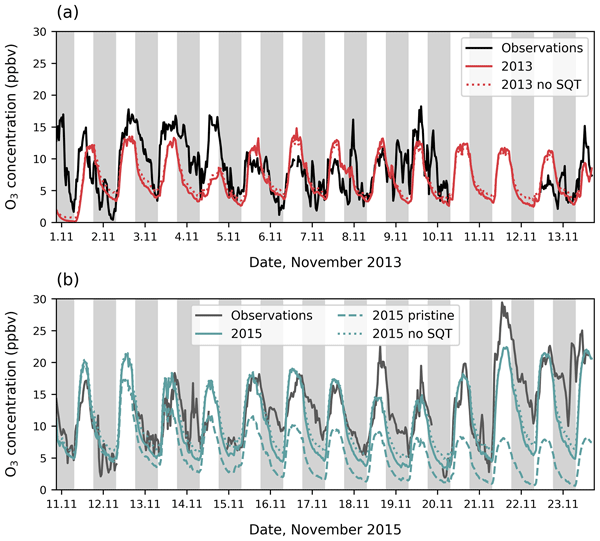
Page 10, Figure 2: its not clear to me why sensitivities to sesquiterpene concentrations were examined for 2013, and to NO2 transport in 2015, and not both aspects in both years? Less NO2 transport in 2015 from observations?
Page 10, lines 270-275: More information earlier in Section 2 on the model would help in diagnosing the cause of the ozone underestimates at night. The formulae for biogenic emissions including the temperature dependence would be useful at this point - this is an exponential decay equation relative to a base temperature like 300K – and whether some of the overestimates might be a result of the exponential decay constant used, as opposed to the basal emission rate employed. Same possibility for surface NO emissions – if the temperature constants in the emission equations are not right, the NO emissions at night could be overestimated, leading to excess NOx titration. The other possibility is that the nighttime diffusion constants in the lower part of the canopy are too weak. The authors description of how Raupach’s formula have been employed (equations 1 and 2) with respect to the diffusion equation K values need to be clarified. For example, by showing the diffusion equation first, then how K is determined as a function of height more explicitly with equations would make it easier to determine what’s happening with the model at night. Perhaps the sigma-w term in equation (2) is underestimating K values at night leading to too-high NOx titration. A model description including the gas-phase mechanism or a reference to same is needed in order and a corrected version of equation (2) is needed in order to suggest possible causes.
Page 11, lines 279 – 284: I’m not sure I agree that this a lack of decoupling – the NO and O3 behavior of the model at night (line 290) implies that either NO emissions are too high or that the vertical mixing is insufficient…it would be helpful for the paper to include more details earlier, which could then be used to bolster the arguments made here. Lack of decoupling could mean that the cosine function employed in equation (2) is insufficiently “steep” in the vertical to describe the observed shelf in diffusivity shown in Raupach’s work, but the 100% NO near the surface at night (line 289) implies that there is strong decoupling of below-canopy versus above canopy. Question: were the observations in Figure S4(a) available such that day and night values could be determined separately? This might show that a different functional dependence, perhaps a variation between day and night in the Tl values might account for the ozone differences. It might be worthwhile to compare to other parameterizations of Raupach’s work in the literature if sufficient information is available – for example, the Makar et al reference quoted by the reviewers has a vertical coordinate dependence of the value of Tl, while the authors are apparently not including any variation in Tl with height. In the reference the sigma-w went to 0.25u* at z=0 and the Tl went to 0.3 * canopy height / u* - how do these numbers compare to the authors’ equation (2) and their tau/Tl assumption (assuming u* is available for their forest)?
Another possibility: how well did the authors’ model simulate near-surface nighttime temperatures? Perhaps the nighttime NO and sesquiterpene emissions might have been too high as a result?
Page 11, line 290: Does “NO2 transport” reset the concentration of NO2 in the model at every timestep?
Page 11, line 290: total conversion of NO to NO2 at night, along with ozone underestimates at night implies that the diffusivity values near the surface are too low, or the gradient in diffusion in the near-surface environment is too steep.
Page 12, Figure 3: I’m wondering what was used for the lower boundary condition on the diffusion equation in the authors’ model? Zero concentration or zero gradient? The latter might force the concentrations further from the observations. It occurred to me that the boundary condition might be affecting the model results (ditto for the top boundary condition). How boundary conditions have been applied to the model should be added to Section 2.
Page 13, line 324: Suggest “reduce deposition to vegetation” should be “reduce the deposition flux to vegetation through reducing the ozone available for deposition”.
Page 14, Figure 4: how were the numbers derived from the layered structure of the model? For example, are these vertically averaged values throughout the forest canopy vis-à-vis equation (3)?
Page 14, lines 330 to 336: interesting. One aspect of the authors work worth highlighting is the estimate of ozone loss rates. What drives the difference in deposition velocity between the two years? Having a description of the deposition algorithm in Section 2 that could be referred to here would help.
Page 14, line 336: I’m wondering to what extent the simulated ozone fluxes are dependent on how the above-canopy concentrations are determined for both ozone and its precursors. If ozone is a free variable, then the NO2 profile used for the transport term may have a large influence on the calculated flux of ozone (and if this profile is a time average of many observations, then the resulting smoothing might reduce the calculated ozone flux). The NO2 profile should be discussed more in Section 2.
Page 15, line 341, good discussion on Figure 5. It would also be worthwhile to provide a similar figure for the net diffusion transport and the deposition removal of ozone, to see how the three terms interact. Line 350: the convergence of chemical losses between the two years may reflect model boundary conditions more than year to year variability, or that the surface is relatively decoupled from the layers above.
Page 16, Figure 6 and related analysis through the end of section 3.2 is also good. Line 365: why is there an 8-fold increase in deposition of ozone during the day rather than the night? I’m guessing that this is the stomatal term in the author’s deposition code – it would be good to include a description of the algorithm, and how it is employed in Section 2 (see Clifton et al 2023, https://doi.org/10.5194/acp-23-9911-2023 for a overview of recent deposition algorithms). With regards to how the algorithm is employed - are the authors calculating a layer-dependent deposition flux of ozone? I ask since many larger scale (regional) models make use of a “big leaf” assumption in which deposition fluxes effectively go to an equivalent surface at the ground; the authors’ parameterization might be of interest to the larger community. Again, a sketch of the tower including the observation heights and the model levels would be good to have at the start of the paper, along with the variation in LAI with height on the same figure; this would aid the reader in visualizing where the 25m is with respect to the canopy.
Page 18, lines 400-403: It could be that a dependence of the escape efficiency on a function of u*, canopy height, and height within the canopy, rather than u* itself, might yield a higher correlation. Note that some parameterizations of Raupach’s work have both sigma-w and Tl parameterized as functions of u* and canopy height, as noted above, with the net value of K being dependent on u* plus these other terms.
Page 18, lines 404 – 405: Escape efficiencies likely will likely inversely correlate with the oxidation rate ( oxidant concentration x reaction rate constant) where the oxidants are OH, O3 and NO3: the fastest reacting VOCs present at the site would have the lower escape efficiencies, the slower reacting VOCs would have the higher escape efficiencies. A plot of oxidant rate using typical concentrations of those species versus escape efficiency would probably show this.
Page 19, line 415: it’s worth reminding the reader how the soil NOx contribution was isolated here, by turning the transport source off. Figure 7: also explain or remind the reader here what the “store” component represents and how it is calculated. Storage? What is meant by storage, in the context of the equations governing the rate of change of the chemical concentration? Section 2 would benefit from a discussion on how the terms are calculated.
Page 20, line 430-431: note that the sentence “Daylight hours have…” would seem to indicate a pretty strong separation between above and below canopy environment.
Page 21, line 457-458: Not sure what the authors mean by “not described by K” here. Did the authors do a separate correlation at morning hours and find it was zero? Or just different from the correlation over all?
Page 22, section 3.4.2: Very interesting results. Storage in this context I assume means “trapped within the lower canopy once it reaches that level due to the lower K values there”? Yes, makes sense. Note that figure 9 also is likely influenced by lower deposition velocities at night, due to the stomatal resistance shutting down (I assume – please make sure the revision includes details on the deposition parameterization’s component resistances): you can see the deposition component is lower at night. It’s worth mentioning this in the write-up at this point, since its another factor resulting in more nighttime storage of NOx within the below-canopy environment.
Page 23, line 494. Section 2 needs to mention the time span(s) used for simulations and include a sentence like “Hereafter, ‘2013’ is used to represent the two week simulation period from November 1st through November 14th of the year 2013, and ‘2015’ refers to the two week period from November 11th through November 24th of the year ‘2015’. ” It might also be better to use phrases like “in the 2013 and 2015 simulation periods” rather than “2013 and 2015”, since the latter may be indirectly confused with the entire year in the minds of the readers.
Page 23, lines 499-500: “This suggests that …”. I think this phrase overstates the case; it’s not a matter of the ability of the canopy being reduced, per se, but the ozone concentration due to chemistry associated with transport being greater than the canopy’s capacity to reduce through terpene emissions”. Something like “biomass burning pollution generates ozone in sufficient quantities to be greater than the canopy’s ozone destruction capacity due to terpene oxidation”. How dependent is this conclusion on the accuracy of the sesquiterpene emission rates?
Page 23, line 501: “Biomass burning therefore increases stomatal O3 flux, leading to a heightened risk of O3 damage to the forest (e.g., Cheesman et al., 2024).” This is something that could be tracked in the model; see Galmarini et al., ACP, 2021; https://doi.org/10.5194/acp-21-15663-2021, Figure 4 and related discussion). The relative contributions of each deposition pathway towards the net deposition velocity can be tracked in models using effective conductances, and the contributions towards net deposition fluxes can be tracked via effective fluxes.
Page 24, line 509-511: The authors mention deposition schemes as being highly parameterized here, without describing theirs, aside from referring to it as a simple parameterization at the end of this paragraph; is it a “big leaf” parameterization, leaf or soil level parameterization? A more detailed description of deposition is needed in Section 2, which could then place the authors statement here in context. Both the Galmarini et al and Clifton et al references provide good examples of overview descriptions of different deposition algorithms used in regional models – what was used here?
Page 24, line 524: The authors should mention that the monoterpene and sequiterpene basal emission rates of their own scheme were effectively a free parameter of the model at this point; the initial values for sesquiterpenes came from another Amazon site, and the values were varied to help get the best fit for O3, correct?
Page 25, line 559-560: what about the assumed shape of the vertical profile of NO2 due to transport as another factor worth considering? What is being used at the moment (another thing to clarify in Section 2).
Page 25, line 565-567: I’m wondering about the model’s lower level air temperatures. At some parts of the paper they seem to be a prognostic variable, at other parts possibly a boundary condition driven by observations. This needs to be clarified in Section 2. If the lower canopy temperatures do not match well with observations, especially at night, the NO emissions will be affected.
Citation: https://doi.org/10.5194/egusphere-2026-161-RC1 -
RC2: 'Comment on egusphere-2026-161', Laurens Ganzeveld, 08 Apr 2026
The comment was uploaded in the form of a supplement: https://egusphere.copernicus.org/preprints/2026/egusphere-2026-161/egusphere-2026-161-RC2-supplement.pdf
- AC1: 'Comment on egusphere-2026-161', Flossie Brown, 19 May 2026
Peer review completion
Journal article(s) based on this preprint
Viewed
| HTML | XML | Total | Supplement | BibTeX | EndNote | |
|---|---|---|---|---|---|---|
| 1,423 | 829 | 131 | 2,383 | 370 | 134 | 196 |
- HTML: 1,423
- PDF: 829
- XML: 131
- Total: 2,383
- Supplement: 370
- BibTeX: 134
- EndNote: 196
Viewed (geographical distribution)
| Country | # | Views | % |
|---|
| Total: | 0 |
| HTML: | 0 |
| PDF: | 0 |
| XML: | 0 |
- 1
Saved


Colette L. Heald
Allison Steiner
Ana Maria Yáñez-Serrano
Jürgen Kesselmeier
Carolina de A. Monteiro
Hartwig Harder
Alessandro C. de Araújo
Denisi H. Hall
Cléo Quaresma Dias-Júnior
The requested preprint has a corresponding peer-reviewed final revised paper. You are encouraged to refer to the final revised version.
- Preprint
(3390 KB) - Metadata XML
-
Supplement
(5178 KB) - BibTeX
- EndNote
- Final revised paper
Overall comment and rating:
This paper has some interesting results in Sections 3 and 4, but Section 2 provides an inadequate description of the model for me to recommend publication at this time. My overall rating is therefore “major revisions”: the description of the model needs to be considerably more detailed, in order for readers to be able to place the subsequent results in context. Care needs to be taken to describe components such as the gas-phase mechanism and the means by which gas-phase chemistry is solved numerically, the manner in which boundary conditions for emissions and deposition are included into the model’s diffusion equation and the numerical means for solving the diffusion equation, and the deposition parameterization and its component resistances and the algorithm approach used (big leaf / layered/ other). Several pages of model descriptive information need to be supplied, in Section 2, to better bolster the subsequent analysis and findings. A concise precis of the model is needed in order for this paper to be suitable for ACP.
Similarly, more details are needed on some of aspects of model setup, boundary conditions, and treatment of advected NO2 is needed, as described in my detailed comments below. I’ve placed an asterisk beside some of the more important points
Having said that, I think that the strength of the paper in sections 3 and 4 will make publication (once Section 2 has been properly updated), likely. I look forward to seeing the revised manuscript.
Specific comments by page and line number:
Page 3, line 76: Another reference is Makar et al., 1998, https://agupubs.onlinelibrary.wiley.com/doi/epdf/10.1029/1998JD100065): removal rates of O3 within a mixed forest in North America there had rapid changes with height, maximum oxidation rates of 0.80 ppbv/hour; that paper was aimed at the biogenic emissions, but the oxidation rate applies to both the monoterpenes present and O3 (see Figure 4 of that paper).
Page 3, line 78: Some chemical transport models are including surrogate monoterpenes and sequiterpenes; while the details of the products for sequiterpenes aren’t known, the approach taken is usually to included at least the emitted precursor monoterpene and an organic radical, to get the first stage of oxidation correct.
Page 3, line 84: perhaps also worth noting that Makar et al (2017) found that an adequate representation of forest canopies for regional modelling purposes can be done with three layers, representing the below foliage, within foliage, and near-top of the canopy. More recent work suggests that at least some of the canopy effects can be captured at the relatively low vertical resolution of numerical transport models by generating integrated or averaged values of diffusion and photolysis taking place within forest canopies (Tang et al., ACP, 2025, https://doi.org/10.5194/acp-25-16631-2025). The latter paper shows one approach for parameterizing canopy effects without significant changes to the regional modelling framework, though the effects are likely underestimated due to the use of lower resolution in the vertical.
Page 4, line 114: a small nit-picking correction: its better to use “evaluate” rather than “validate” here – validation implies that the model is “valid” thereafter, “evaluate” is better in that it describes the model performance without giving judgement on the outcome of the evaluation.
Page 4, lines 104-125: the description of the site would benefit from an additional Figure with a to-scale sketch of the tower noting the heights at which the different quantities were observed, as well as the LAI profile of the canopy.
*Page 4, line 130: The model’s vertical extent is to 5km, and the text mentions that the model is forced by observations at 30 minute intervals, but it’s not clear where the forcing conditions for the upper part of the model domain are originating. I’m wondering in particular about the magnitude and strength of the horizontal and vertical components of wind, and the K theory values that are used in the bulk of the 5km that are above the canopy. The SI has information from 55 m for the above-canopy environment – what was done for higher elevations above the surface? The paper needs a paragraph or two description of how the K values above the canopy are derived using K-theory, how wind speeds are determined, and how the above and below-canopy values are blended together (to replace the sentence on line 155).
The paper also needs a paragraph or two explaining how the variables in S5 through S9 were used in the simulations. For example, S4a shows a K value vertical profile for each year, and a shaded region – shaded region is not explained in the SI or in the main paper text – is this max and minimum at the given height over the year, a 90% limit on variability, a daily average maximum and minimum for the two years, or something else, and more importantly, what was used in the model itself, for the period the authors are simulating, and where did it originate?
Figure S3 shows a good correspondence between equation 2 and the 21 m sigma-w and the observed values; what values of tau/Tl was used in this case?
*Page 5, lines 158-165, and equation (1): The details have been moved to the SI, but I think they should appear in the main document, since this is a central part of their model construction. Re: “The equation describes the reduction in K explicitly” I assume this is “reduction in K from the above canopy values”? – but from what value of K? i.e. how were the above-canopy values of K determined? (see above comment). There needs to be a few more paragraphs describing model setup. As part of that description, there needs to be some discussion on what tau/Tl represents (with reference to Raupach’s work), and whether the parameterized values in table S2 are within a reasonable range or not. Similarly, how do the temperature and/or light dependent emission factors in Table S2 compare to those appearing in the literature for databases such as BEIS or MEGAN? What were the temperature and light dependent functions used (the tabulated values in S2 are for basal emission rates – I’m wondering whether the exponential decay constants used in the authors functions are similar to ones appearing elsewhere in the literature.
Overall, there needs to be better description of the model’s input formulae and choice of parameters used in the paper. There’s insufficient information at present to allow a reader to be able to reproduce the authors’ work.
*Page 5, equation 2: There are some problems with open brackets that do not have closing brackets in this equation. Please correct the equation. Also, the reader has not been told the vertical extent over which the equation applies. I’m assuming that this is between the surface and z= 0 and the top of the canopy at z = h, but this is not clear from the text (h also needs to be defined, I think, prior to this equation).
Page 5, line 174: Authors have mentioned something called the “Arc of Deforestation” – they need to define this, for readers unfamiliar with the area.
*Page 6, lines 174 to 176: the “adding NO2 to heights 75 m – 200m when the wind direction comes from 90o - 150o” has been stated without describing the amounts of NO2 or the observational evidence justifying the approach taken. This section needs to clearly explain where these boundary conditions originated and give reasoning for why they are appropriate. For example, were these based on past observations as a function of wind direction using sonde measurements, or something similar? The boundary conditions could have an important influence on the model results, but the information presented makes the values sound a bit arbitrary. What’s the rationale for a wind-strength-based scaling of the NO2 values at higher levels? The authors need to describe the information sources used and present a justification for the procedure used for “adding NO2” in more detail.
Page 6, line 187: is “light-dependent emission factor” the same as “basal emission rate”?
Page 6, line 188: do the authors mean “measured emission rates ->at this site<-”, rather than just measured emission rates, here?
Page 6, lines 190, 191, 195 – what are the temperature dependence values? Maybe this is in the SI?
Page 7, line 201: “We run 3-day sensitivity studies to identify the optimal vertical mixing parameter (τ/Tl),” etc.:
Page 7, line 199: à howß are soil emissions added into the model? For example, this can be done as a flux boundary condition on the lower boundary vertical diffusion equation, or as a direct injection of mass into the lowest model layer. The former is a better approach numerically.
**Page 7, equation 3: at this point the reader/reviewer does not know how the model carries out chemistry, deposition or emissions, and that needs to be included in the model description. I’m assuming the terms in the equation are for the ->rates of change<- of each of these variables at each level, at a given time (please clarify – add this to the text or otherwise define what is meant by “chemistry” “deposition” “emission” and “storage”)? What is meant by “storage”? in the context of Equation (3)?
What are the numerical methods used by the model to determine these rates of change? E.g. what was the numerical approach to solver the equation of vertical diffusion, and how were the above-canopy K values determined?
*Page 7, line 219: This is the first instance that the reader learns that the upwind NO2 transport into the column is provided as an “emissions” term. Is there a similar downwind removal term? How are these terms used in the net equation describing the rates of change of chemical concentrations? The paper would benefit from a background theory section describing the rate of change of chemical concentration as an equation, and a few sentences on how each component is solved numerically, and how boundary conditions such as this are incorporated into the model.
*Page 8, line 239: it’s a bit frustrating as a reviewer to get to this point in the code and see that temperature and wind are prognostic variables of the 1-D model, without having seen equations describing how the temperature or wind speeds are being predicted. It’s not clear to the reader how the model is predicting temperature, from the information presented about the model prior to this point. The equations in section 2 deal with diagnostics of the model, but not about the model itself, or that it is predicting meteorological in addition to chemical variables. There needs to be a better description of the model than currently appears in the paper before I can recommend it for publication. I’m not suggesting reproducing work appearing in past papers, but a several page summary of the main prognostic equations in the model along with the references, to place the current work in context, and their numerical implementation, is needed. This information could possibly be summarized in a single large table. The information presented prior to section 3 is insufficient for a reader (or a reviewer) to understand how the model works, its theoretical basis for its predictions, what it’s using as input, etc.. For example, gas-phase reactions are important for ozone formation and destruction, but there’s no description of the gas-phase mechanism or the numerical method used for predicting future concentrations. Ozone (and other gas) deposition is an important process – but I don’t see a description of how deposition is handled (either the calculation of deposition fluxes or how those fluxes are incorporated numerically into the model). Is ozone a completely prognostic variable of the model, or are there O3 boundary condition terms in the model as well (e.g. similar to the NO2 “transport” term)? Biogenic emissions are going into the layers (I think), but how this is done numerically, as a height dependent flux condition on the diffusion equation or an injection into layers – and how the parameters such as LAI are being used, are absent from the standpoint of a layer-dependent equation describing these terms. The biogenic emissions are stated to be temperature dependence, but the formulae for that temperature dependence is not given. How or if operator splitting is used to combine the different terms in the equations being solved need to be described. My point with all these questions: this information is necessary in order for the reader (and this reviewer) to understand the model and its good points versus weaknesses, and also to put the parameter fitting in Table S2 and Table 1 into context. Several pages of background information describing the canopy model employed, its processes and how they are parameterized, with the relevant equations, needs to be added to the main document in section 2.
Page 8: somewhere earlier in the document (section 2) the period being simulated needs to be more clearly stated. At one point in the document mention is made of previous simulations of a few days in duration, whereas Figure 1 shows month-long simulations.
Page 9, Figure 1 caption, Horizontal is misspelled.
*Page 9, line 257: its not clear how the NO2 used for transport from upwind was determined in the first place, or how it is incorporated into the model. It sounds like on lines 219-220 that the NOx due to transport is some sort of free parameter of the model, added until the predicted concentrations are about right, but I may be mistaken. Please clarify how horizontally transported species are included into the 1D model, in a few more sentences by equation (4).
Page 10, Figure 2: its not clear to me why sensitivities to sesquiterpene concentrations were examined for 2013, and to NO2 transport in 2015, and not both aspects in both years? Less NO2 transport in 2015 from observations?
Page 10, lines 270-275: More information earlier in Section 2 on the model would help in diagnosing the cause of the ozone underestimates at night. The formulae for biogenic emissions including the temperature dependence would be useful at this point - this is an exponential decay equation relative to a base temperature like 300K – and whether some of the overestimates might be a result of the exponential decay constant used, as opposed to the basal emission rate employed. Same possibility for surface NO emissions – if the temperature constants in the emission equations are not right, the NO emissions at night could be overestimated, leading to excess NOx titration. The other possibility is that the nighttime diffusion constants in the lower part of the canopy are too weak. The authors description of how Raupach’s formula have been employed (equations 1 and 2) with respect to the diffusion equation K values need to be clarified. For example, by showing the diffusion equation first, then how K is determined as a function of height more explicitly with equations would make it easier to determine what’s happening with the model at night. Perhaps the sigma-w term in equation (2) is underestimating K values at night leading to too-high NOx titration. A model description including the gas-phase mechanism or a reference to same is needed in order and a corrected version of equation (2) is needed in order to suggest possible causes.
Page 11, lines 279 – 284: I’m not sure I agree that this a lack of decoupling – the NO and O3 behavior of the model at night (line 290) implies that either NO emissions are too high or that the vertical mixing is insufficient…it would be helpful for the paper to include more details earlier, which could then be used to bolster the arguments made here. Lack of decoupling could mean that the cosine function employed in equation (2) is insufficiently “steep” in the vertical to describe the observed shelf in diffusivity shown in Raupach’s work, but the 100% NO near the surface at night (line 289) implies that there is strong decoupling of below-canopy versus above canopy. Question: were the observations in Figure S4(a) available such that day and night values could be determined separately? This might show that a different functional dependence, perhaps a variation between day and night in the Tl values might account for the ozone differences. It might be worthwhile to compare to other parameterizations of Raupach’s work in the literature if sufficient information is available – for example, the Makar et al reference quoted by the reviewers has a vertical coordinate dependence of the value of Tl, while the authors are apparently not including any variation in Tl with height. In the reference the sigma-w went to 0.25u* at z=0 and the Tl went to 0.3 * canopy height / u* - how do these numbers compare to the authors’ equation (2) and their tau/Tl assumption (assuming u* is available for their forest)?
Another possibility: how well did the authors’ model simulate near-surface nighttime temperatures? Perhaps the nighttime NO and sesquiterpene emissions might have been too high as a result?
Page 11, line 290: Does “NO2 transport” reset the concentration of NO2 in the model at every timestep?
Page 11, line 290: total conversion of NO to NO2 at night, along with ozone underestimates at night implies that the diffusivity values near the surface are too low, or the gradient in diffusion in the near-surface environment is too steep.
Page 12, Figure 3: I’m wondering what was used for the lower boundary condition on the diffusion equation in the authors’ model? Zero concentration or zero gradient? The latter might force the concentrations further from the observations. It occurred to me that the boundary condition might be affecting the model results (ditto for the top boundary condition). How boundary conditions have been applied to the model should be added to Section 2.
Page 13, line 324: Suggest “reduce deposition to vegetation” should be “reduce the deposition flux to vegetation through reducing the ozone available for deposition”.
Page 14, Figure 4: how were the numbers derived from the layered structure of the model? For example, are these vertically averaged values throughout the forest canopy vis-à-vis equation (3)?
Page 14, lines 330 to 336: interesting. One aspect of the authors work worth highlighting is the estimate of ozone loss rates. What drives the difference in deposition velocity between the two years? Having a description of the deposition algorithm in Section 2 that could be referred to here would help.
Page 14, line 336: I’m wondering to what extent the simulated ozone fluxes are dependent on how the above-canopy concentrations are determined for both ozone and its precursors. If ozone is a free variable, then the NO2 profile used for the transport term may have a large influence on the calculated flux of ozone (and if this profile is a time average of many observations, then the resulting smoothing might reduce the calculated ozone flux). The NO2 profile should be discussed more in Section 2.
Page 15, line 341, good discussion on Figure 5. It would also be worthwhile to provide a similar figure for the net diffusion transport and the deposition removal of ozone, to see how the three terms interact. Line 350: the convergence of chemical losses between the two years may reflect model boundary conditions more than year to year variability, or that the surface is relatively decoupled from the layers above.
Page 16, Figure 6 and related analysis through the end of section 3.2 is also good. Line 365: why is there an 8-fold increase in deposition of ozone during the day rather than the night? I’m guessing that this is the stomatal term in the author’s deposition code – it would be good to include a description of the algorithm, and how it is employed in Section 2 (see Clifton et al 2023, https://doi.org/10.5194/acp-23-9911-2023 for a overview of recent deposition algorithms). With regards to how the algorithm is employed - are the authors calculating a layer-dependent deposition flux of ozone? I ask since many larger scale (regional) models make use of a “big leaf” assumption in which deposition fluxes effectively go to an equivalent surface at the ground; the authors’ parameterization might be of interest to the larger community. Again, a sketch of the tower including the observation heights and the model levels would be good to have at the start of the paper, along with the variation in LAI with height on the same figure; this would aid the reader in visualizing where the 25m is with respect to the canopy.
Page 18, lines 400-403: It could be that a dependence of the escape efficiency on a function of u*, canopy height, and height within the canopy, rather than u* itself, might yield a higher correlation. Note that some parameterizations of Raupach’s work have both sigma-w and Tl parameterized as functions of u* and canopy height, as noted above, with the net value of K being dependent on u* plus these other terms.
Page 18, lines 404 – 405: Escape efficiencies likely will likely inversely correlate with the oxidation rate ( oxidant concentration x reaction rate constant) where the oxidants are OH, O3 and NO3: the fastest reacting VOCs present at the site would have the lower escape efficiencies, the slower reacting VOCs would have the higher escape efficiencies. A plot of oxidant rate using typical concentrations of those species versus escape efficiency would probably show this.
Page 19, line 415: it’s worth reminding the reader how the soil NOx contribution was isolated here, by turning the transport source off. Figure 7: also explain or remind the reader here what the “store” component represents and how it is calculated. Storage? What is meant by storage, in the context of the equations governing the rate of change of the chemical concentration? Section 2 would benefit from a discussion on how the terms are calculated.
Page 20, line 430-431: note that the sentence “Daylight hours have…” would seem to indicate a pretty strong separation between above and below canopy environment.
Page 21, line 457-458: Not sure what the authors mean by “not described by K” here. Did the authors do a separate correlation at morning hours and find it was zero? Or just different from the correlation over all?
Page 22, section 3.4.2: Very interesting results. Storage in this context I assume means “trapped within the lower canopy once it reaches that level due to the lower K values there”? Yes, makes sense. Note that figure 9 also is likely influenced by lower deposition velocities at night, due to the stomatal resistance shutting down (I assume – please make sure the revision includes details on the deposition parameterization’s component resistances): you can see the deposition component is lower at night. It’s worth mentioning this in the write-up at this point, since its another factor resulting in more nighttime storage of NOx within the below-canopy environment.
Page 23, line 494. Section 2 needs to mention the time span(s) used for simulations and include a sentence like “Hereafter, ‘2013’ is used to represent the two week simulation period from November 1st through November 14th of the year 2013, and ‘2015’ refers to the two week period from November 11th through November 24th of the year ‘2015’. ” It might also be better to use phrases like “in the 2013 and 2015 simulation periods” rather than “2013 and 2015”, since the latter may be indirectly confused with the entire year in the minds of the readers.
Page 23, lines 499-500: “This suggests that …”. I think this phrase overstates the case; it’s not a matter of the ability of the canopy being reduced, per se, but the ozone concentration due to chemistry associated with transport being greater than the canopy’s capacity to reduce through terpene emissions”. Something like “biomass burning pollution generates ozone in sufficient quantities to be greater than the canopy’s ozone destruction capacity due to terpene oxidation”. How dependent is this conclusion on the accuracy of the sesquiterpene emission rates?
Page 23, line 501: “Biomass burning therefore increases stomatal O3 flux, leading to a heightened risk of O3 damage to the forest (e.g., Cheesman et al., 2024).” This is something that could be tracked in the model; see Galmarini et al., ACP, 2021; https://doi.org/10.5194/acp-21-15663-2021, Figure 4 and related discussion). The relative contributions of each deposition pathway towards the net deposition velocity can be tracked in models using effective conductances, and the contributions towards net deposition fluxes can be tracked via effective fluxes.
Page 24, line 509-511: The authors mention deposition schemes as being highly parameterized here, without describing theirs, aside from referring to it as a simple parameterization at the end of this paragraph; is it a “big leaf” parameterization, leaf or soil level parameterization? A more detailed description of deposition is needed in Section 2, which could then place the authors statement here in context. Both the Galmarini et al and Clifton et al references provide good examples of overview descriptions of different deposition algorithms used in regional models – what was used here?
Page 24, line 524: The authors should mention that the monoterpene and sequiterpene basal emission rates of their own scheme were effectively a free parameter of the model at this point; the initial values for sesquiterpenes came from another Amazon site, and the values were varied to help get the best fit for O3, correct?
Page 25, line 559-560: what about the assumed shape of the vertical profile of NO2 due to transport as another factor worth considering? What is being used at the moment (another thing to clarify in Section 2).
Page 25, line 565-567: I’m wondering about the model’s lower level air temperatures. At some parts of the paper they seem to be a prognostic variable, at other parts possibly a boundary condition driven by observations. This needs to be clarified in Section 2. If the lower canopy temperatures do not match well with observations, especially at night, the NO emissions will be affected.