
the Creative Commons Attribution 4.0 License.
the Creative Commons Attribution 4.0 License.
 | 18 May 2026
Mechanisms and Patterns of Snow–Temperature Interactions in Arid Mountains: Coupling Coordination and Lagged Responses Across Xinjiang, China
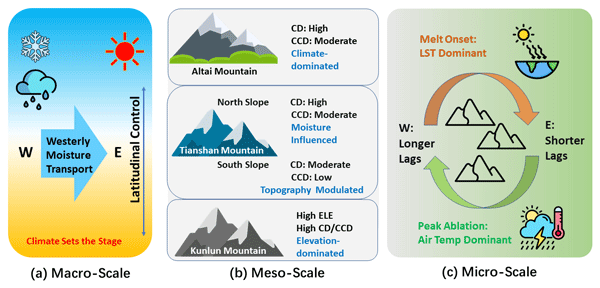
Abstract. The interaction between snow depth (SD) and land surface temperature (LST) is a critical yet underexplored process in arid mountain hydrology. This study introduces an integrated analytical framework combining Coupling Coordination Degree Model (CCDM) and time-lagged correlation analysis to systematically quantify the interaction strength, synergistic quality, and dynamic response times between SD and LST across the complex mountain-basin systems of Xinjiang, China. Using long-term, high-resolution remote sensing data, we reveal a hierarchical control system governing snow–temperature interactions: macro-scale latitudinal climate divides establish a north–south contrast in coupling potential; meso-scale topography overrides this pattern in southern mountains, where elevation becomes the dominant control on coupling and coordination; and micro-scale local factors drive east–west divergences in response lags. Key findings include: (1) pronounced north–south asymmetry in the Tianshan Mountains, with the sensitive south slope showing significant spring lag lengthening; (2) elevation-dependent thresholds in the Kunlun Mountains, where snow–temperature coordination improves only above 3500 m; and (3) region-specific lag dynamics indicating altered snowpack thermal inertia (e.g., prolonged spring lags in the Tianshan) and memory effects. The discrepancy between coupling degree and coordination degree emerges as a key diagnostic, identifying vulnerable regions where strong temperature forcing is mismatched with sustainable snowpack evolution. This study provides a process-aware framework that moves beyond statistical correlation, offering quantitative metrics to improve the representation of mountain snow–climate feedbacks in hydrological and climate models under accelerating warming.
-
Notice on discussion status
The requested preprint has a corresponding peer-reviewed final revised paper. You are encouraged to refer to the final revised version.
-
Preprint
(2674 KB)
-
The requested preprint has a corresponding peer-reviewed final revised paper. You are encouraged to refer to the final revised version.
- Preprint
(2674 KB) - Metadata XML
- BibTeX
- EndNote
- Final revised paper


Journal article(s) based on this preprint
Interactive discussion
Status: closed
-
RC1: 'Comment on egusphere-2026-1603', Pengfeng Xiao, 20 May 2026
-
AC1: 'Reply on RC1', Haixing Li, 13 Jun 2026
Dear Reviewer and Editor,
Thank you very much for your constructive comments. Please find our detailed point‑by‑point response in the attached PDF file, which includes the full revised Introduction, the revised Conclusions, and responses to all four comments. Please let us know if any further modifications are needed. We appreciate your time and guidance.
Sincerely,
Haixing Li (on behalf of all authors)-
RC2: 'Reply on AC1', Pengfeng Xiao, 17 Jun 2026
The authors have not only addressed each comment directly but have gone beyond the minimum requirements—most notably by thoroughly restructuring the Introduction and condensing the Conclusions, which improves the manuscript's scientific framing and practical impact. The proposed title revision and terminology standardization are appropriate. And a few specific commitments (e.g., the distinction between "relation" and "relationship", and "study" and "research") would benefit to the revised manuscript. Nevertheless, the core scientific concerns have been properly resolved, and the overall quality of the revision is satisfactory.
Citation: https://doi.org/10.5194/egusphere-2026-1603-RC2 -
AC2: 'Reply on RC2', Haixing Li, 18 Jun 2026
Dear Reviewer and Editors,
We sincerely thank you for your encouraging evaluation. We are glad that our revisions—especially the restructuring of the Introduction, the condensing of the Conclusions, and the title refinement—have improved the manuscript’s clarity and impact.
Following your suggestion, we have carefully distinguished “relation” vs. “relationship” and “study” vs. “research” throughout the text. We have also double‑checked the font size and heading hierarchy to ensure readability and journal compliance.
We appreciate your time and expertise, and we remain ready to address any further comments from the reviewers or the editorial team.
Yours sincerely,
Haixing LiCitation: https://doi.org/10.5194/egusphere-2026-1603-AC2
-
AC2: 'Reply on RC2', Haixing Li, 18 Jun 2026
-
RC2: 'Reply on AC1', Pengfeng Xiao, 17 Jun 2026
-
AC1: 'Reply on RC1', Haixing Li, 13 Jun 2026
-
RC3: 'Comment on egusphere-2026-1603', Xuemei Li, 02 Jul 2026
This study investigates the interactions between snow depth and land surface temperature across Xinjiang, China, by combining the Coupling Coordination Degree Model and time-lagged cross-correlation analysis. The topic is relevant to mountain cryosphere and arid-region water resources, and the manuscript is generally well structured. The results provide useful information on regional differences in SD–LST relationships.
Overall, the study has publication potential. However, several methodological details need to be clarified. Some interpretations should also be made more cautious. There are a few important comments that should be considered.
(1) Abstract.
Some statements in the abstract are slightly strong. The manuscript mentions a ‘hierarchical control system’, a ‘process-aware framework’, and metrics that may improve the representation of mountain snow–climate feedbacks in hydrological and climate models. However, the current study mainly provides an empirical diagnostic analysis. The authors should tone down these claims or provide clearer support for them.
(2) Section 1. 1) L46-48:“The dominant thermal driver is not static but can shift across ablation phases, as seen in the central Tianshan where surface temperature initiates melt while air temperature governs peak ablation (Li et al., 2022). ” was mentioned. So why you only choose land surface temperature (LST) as the driving variable in your manuscript. 2) The authors should explain why CCDM is suitable for studying snow-temperature relationships. They should also clarify how this method improves upon simple correlation analysis.
(3)Section 3. The physical meaning of CD and CCD should be explained more carefully. The authors should clearly state whether SD and LST were normalized before the calculation.
(4)Section 4.2. The manuscript shows that some regions have high coupling degree, while their coordination degree remains moderate or even low. This difference is important, but it is not fully discussed. The authors should explain more clearly what a high CD but relatively low CCD means for the SD–LST relationship.
(5)Section 4.3. The manuscript links lag time directly to snow thermal inertia or memory effects. These explanations are reasonable, but they are not directly measured in this study. The authors should state that the lag patterns may indicate these processes.
(6) Section 5.1. The authors should specify which findings support climate control in the Altay Mountains, elevation control in the Kunlun Mountains, and slope-related contrast in the Tianshan Mountains. This would make the framework easier to follow.
(7)Section 5.2. Could the authors further explain the physical meaning of high CD but relatively low CCD in different regions? For example, does this mismatch indicate different snow–temperature interaction states in the southern Tianshan and northern Tianshan?
(8) Section 6. The CD–CCD–lag framework is a useful analytical approach. The authors should state that the framework may support future model development, rather than saying that it directly improves model representation.
Below are some minor issues; it is recommended that the author make revisions.
(1) The treatment of snow-free pixels should be explained.
(2) Some figure labels are small. Increasing the font size would improve readability.
(3) Some strong words should be used more cautiously.
(4) Some expressions could be polished for clarity. Could the authors check non-standard phrases such as ‘Data introduction’ and ‘Break-in stag’? In addition, the explanatory sentences after equations could be revised in a more standard style.
Citation: https://doi.org/10.5194/egusphere-2026-1603-RC3 -
AC3: 'Reply on RC3', Haixing Li, 14 Jul 2026
Dear Editor and Reviewers,
Thank you very much for your constructive comments on our manuscript (Manuscript ID: EGUSPHERE-2026-1603). We have carefully considered all the suggestions and have substantially revised the manuscript accordingly.
Please find our detailed point-by-point responses in the attached PDF file. We hope that the revisions have adequately addressed all the concerns raised. Please let us know if any further modifications are needed. We appreciate your time and guidance.
Sincerely,
Haixing Li (on behalf of all authors)
-
AC3: 'Reply on RC3', Haixing Li, 14 Jul 2026
-
RC4: 'Comment on egusphere-2026-1603', Anonymous Referee #3, 05 Jul 2026
This study addresses the quantification of interactions between snow depth (SD) and land surface temperature (LST) across the Xinjiang region by combining the Coupling Coordination Degree Model (CCDM) with time-lagged cross-correlation analysis. The results provide useful insights into the spatially varying relationships between SD and LST, along with an assessment of snow-climate system health derived from those relationships. The proposed analytical framework is of broad value, as it is potentially applicable to other regions of Central Asia where snow serves as a critical water resource.
Overall, the manuscript is well structured, the paper is written with clear sentences, and the figures are well-designed and visually appealing. However, I have some comments and suggestions for improvement.
Major comments:
- Introduction (L51-59):The expression "cannot distinguish" feels somewhat too strong. For instance, established methods such as wavelet coherence do allow for the examination of time lags and phase differences between variables. Furthermore, in a paragraph that argues the limitations of previous studies, citing only Clark et al. (2011) appears insufficient. The motivation for the proposed framework would be strengthened by a broader review of previous studies.
- Method section: Overall, the Methods section would benefit from additional methodological details. In particular, I suggest providing the following information.
- General for Section 3, When CD and CCD are applied to SD and LST, what physical meaning do these metrics carry in this context? Please clarify the physical interpretation more explicitly.
-
L116, The basis for the claim that "the larger the value, the better the system development" is unclear. Please provide justification for why a higher coupling degree C is considered to indicate a more favorable system state.
- L156/160, Both SD and LST exhibit large interannual variability, which makes visual trend detection unreliable. Please verify whether the reported increase/decrease trends are statistically robust using an appropriate significance test, such as the Mann-Kendall test.
- L188-192 & Figure 4b, The text discusses the annual trend in CD, but no description of the trend analysis method is provided. Please add this information to the Methods section. In addition, please include a discussion of statistical significance. As it is likely that some pixels will show statistically significant trends while others will not, Figure 4b should be revised to make this distinction clearly visible (e.g., by coloring only statistically significant pixels, or by overlaying stippling on non-significant areas).
- L219-226 & Figure 6b, As with Comment 2-4 above, please provide a description of the trend analysis method used, and address the issue of statistical significance.
- L241, The text states "statistically significant," but the statistical method used is not described. Please specify which test was used to confirm significance, and add this information to Section 3.
- Section 4.3.3: Trend slopes and p-values are reported in this section, but the methods used to calculate the slopes and to conduct the significance tests are not described. Please add these methodological details to Section 3. Furthermore, the concluding sentences of several paragraphs in this section contain interpretations that extend beyond what the data directly demonstrate. Please ensure that the Results section is confined to findings that are directly supported by the data, and that any broader interpretation is reserved for the Discussion.
- Section 4.3.3 のAutumnとWinter: Both paragraphs report a decrease in lag time over the study period, yet the interpretations offered are asymmetric: the autumn decrease is attributed to "cooling temperatures," while the winter decrease is attributed to "warming winters." Please provide clear justification for this asymmetric interpretation. Note, however, that this type of interpretive discussion is more appropriately placed in the Discussion section rather than the Results.
- Section 5.1: While this section addresses important mechanisms governing snow–temperature interactions, the discussion of the Tianshan Mountains feels relatively underdeveloped compared to the treatment of the other mountain systems. Adding an explanation of how "the rain-shadow effect and differential solar radiation" specifically influence CD and CCD, and why these factors render S1 a more sensitive and vulnerable subsystem, would make this section considerably more convincing.
Minor Comments
General – The manuscript employs a six-region classification (N1–N3, S1–S3), but in some parts of the text, only regional names are provided without the corresponding region codes. Consistently including the region codes (N1–N3, S1–S3) throughout the text would improve readability.
Section 2.2.1 – While I understand that the full methodological details are available in the referenced data repository, it would be helpful to include at minimum the source satellite data, the original spatial resolution, and any auxiliary datasets used. These basic pieces of information should be provided directly in the manuscript.
L153 – According to Figure 2a, S1 and S3 appear to follow similar trajectories throughout the study period. Please report the mean SD values for both S1 and S3 explicitly, and explain why S3 alone is highlighted in this context.
Figure 5 and Figure 7 – Please add an explanation of the gray color to both the legend and the figure caption.
L237 – The term "resilience" generally implies recovery from some form of loss or disturbance. Please consider rephrasing with a more appropriate term.
Section 4.3.2 – Please define which months are assigned to each season (spring, summer, autumn, and winter).
L304 – Please add a p-value for the trend reported for the Kunlun Mountains (S3).
Citation: https://doi.org/10.5194/egusphere-2026-1603-RC4 -
AC4: 'Reply on RC4', Haixing Li, 14 Jul 2026
Dear Editor and Reviewers,
Thank you very much for your constructive comments on our manuscript (Manuscript ID: EGUSPHERE-2026-1603). We have carefully considered all the suggestions and have substantially revised the manuscript accordingly.
Please find our detailed point-by-point responses in the attached PDF file. We hope that the revisions have adequately addressed all the concerns raised. Please let us know if any further modifications are needed. We appreciate your time and guidance.
Sincerely,
Haixing Li (on behalf of all authors)
Peer review completion


Interactive discussion
Status: closed
-
RC1: 'Comment on egusphere-2026-1603', Pengfeng Xiao, 20 May 2026
This study develops an integrated analytical framework combining the Coupling Coordination Degree Model and time‑lagged cross‑correlation analysis to quantify the interactions between snow depth and land surface temperature across the arid mountain‑basin systems of Xinjiang. Using long‑term, high‑resolution remote sensing data, the authors systematically reveal the spatial heterogeneity of coupling strength, the regional contrasts in coordination degree, and the seasonal and elevation‑dependent patterns of response lags. The research topic has clear hydrological and climatic significance, the methodological design is innovative, the data analysis is detailed, and the figures are informative. The findings provide valuable references for understanding snow‑climate feedbacks in arid mountains, improving snowmelt runoff forecasting, and identifying climatically vulnerable areas. Overall, the manuscript has a solid foundation, but several important issues need to be addressed before publication.
First, the title uses the broad term “Snow‑Temperature Interactions,” which does not accurately reflect the actual variables analyzed in the paper. The study focuses specifically on snow depth and land surface temperature, not on snow or temperature in a general sense. I recommend revising the title to a more precise expression, such as “Mechanisms and Patterns of Snow Depth and Land Surface Temperature Interactions in Arid Mountains: Coupling Coordination and Lagged Responses Across Xinjiang, China.” Similar precision should be applied consistently throughout the abstract and the main text to avoid misleading readers about the core study object.
Second, the scientific significance and practical value of the study are not sufficiently highlighted. Readers need to understand, from the outset, what concrete scientific advances or practical improvements can be achieved by quantifying the coupling coordination and time‑lagged responses between snow depth and land surface temperature. For example, does this approach help quantitatively identify changes in snowpack thermal inertia, improve the timing of snowmelt predictions, provide empirical constraints for snow parameterization schemes in land surface models, or establish critical thresholds for water resource management in arid regions? I suggest that the authors add a concise, forceful paragraph at the end of the Introduction and another at the beginning of the Conclusions to clearly articulate the unique contributions and specific application scenarios of this work, rather than dispersing these points vaguely across multiple sections.
Third, the deepest heading level used in the manuscript is level three, for a journal article this makes the structure appear somewhat fragmented and increases the cognitive load for readers. I recommend simplifying the heading hierarchy to no more than two levels, i.e., only main sections and subsections, without deeper numbering such as 4.2.1 or 4.3.2. Different subtopics within a subsection can be separated by lead‑in sentences or bolded phrases without creating additional numbered headings. Furthermore, the Conclusions section is overly long, containing many specific numerical values and repetitive descriptions, which dilutes the key messages. I advise condensing the Conclusions to core findings, each focusing on one essential insight, and moving the remaining detailed information to the Discussion or to supplementary materials.
Fourth, the font size used in the main text is somewhat small, which makes reading somewhat tiring. While the line spacing is not excessively dense, the small font size still impairs readability and the overall reading experience. I suggest that the authors increase the font size appropriately, for example to 11 or 12 points, while maintaining clear line spacing, so as to improve the accessibility and communication efficiency of the paper.
None of these issues negate the core scientific conclusions of the work. However, they significantly affect the clarity, impact, and reader‑friendliness of the manuscript. I recommend revision before reconsideration, with particular attention to the precision of the title, the prominence of the scientific and practical significance, the simplification of the heading structure, and the improvement of typographic readability. I look forward to a revised version that presents this valuable research more clearly and effectively.
Citation: https://doi.org/10.5194/egusphere-2026-1603-RC1 -
AC1: 'Reply on RC1', Haixing Li, 13 Jun 2026
Dear Reviewer and Editor,
Thank you very much for your constructive comments. Please find our detailed point‑by‑point response in the attached PDF file, which includes the full revised Introduction, the revised Conclusions, and responses to all four comments. Please let us know if any further modifications are needed. We appreciate your time and guidance.
Sincerely,
Haixing Li (on behalf of all authors)-
RC2: 'Reply on AC1', Pengfeng Xiao, 17 Jun 2026
The authors have not only addressed each comment directly but have gone beyond the minimum requirements—most notably by thoroughly restructuring the Introduction and condensing the Conclusions, which improves the manuscript's scientific framing and practical impact. The proposed title revision and terminology standardization are appropriate. And a few specific commitments (e.g., the distinction between "relation" and "relationship", and "study" and "research") would benefit to the revised manuscript. Nevertheless, the core scientific concerns have been properly resolved, and the overall quality of the revision is satisfactory.
Citation: https://doi.org/10.5194/egusphere-2026-1603-RC2 -
AC2: 'Reply on RC2', Haixing Li, 18 Jun 2026
Dear Reviewer and Editors,
We sincerely thank you for your encouraging evaluation. We are glad that our revisions—especially the restructuring of the Introduction, the condensing of the Conclusions, and the title refinement—have improved the manuscript’s clarity and impact.
Following your suggestion, we have carefully distinguished “relation” vs. “relationship” and “study” vs. “research” throughout the text. We have also double‑checked the font size and heading hierarchy to ensure readability and journal compliance.
We appreciate your time and expertise, and we remain ready to address any further comments from the reviewers or the editorial team.
Yours sincerely,
Haixing LiCitation: https://doi.org/10.5194/egusphere-2026-1603-AC2
-
AC2: 'Reply on RC2', Haixing Li, 18 Jun 2026
-
RC2: 'Reply on AC1', Pengfeng Xiao, 17 Jun 2026
-
AC1: 'Reply on RC1', Haixing Li, 13 Jun 2026
-
RC3: 'Comment on egusphere-2026-1603', Xuemei Li, 02 Jul 2026
This study investigates the interactions between snow depth and land surface temperature across Xinjiang, China, by combining the Coupling Coordination Degree Model and time-lagged cross-correlation analysis. The topic is relevant to mountain cryosphere and arid-region water resources, and the manuscript is generally well structured. The results provide useful information on regional differences in SD–LST relationships.
Overall, the study has publication potential. However, several methodological details need to be clarified. Some interpretations should also be made more cautious. There are a few important comments that should be considered.
(1) Abstract.
Some statements in the abstract are slightly strong. The manuscript mentions a ‘hierarchical control system’, a ‘process-aware framework’, and metrics that may improve the representation of mountain snow–climate feedbacks in hydrological and climate models. However, the current study mainly provides an empirical diagnostic analysis. The authors should tone down these claims or provide clearer support for them.
(2) Section 1. 1) L46-48:“The dominant thermal driver is not static but can shift across ablation phases, as seen in the central Tianshan where surface temperature initiates melt while air temperature governs peak ablation (Li et al., 2022). ” was mentioned. So why you only choose land surface temperature (LST) as the driving variable in your manuscript. 2) The authors should explain why CCDM is suitable for studying snow-temperature relationships. They should also clarify how this method improves upon simple correlation analysis.
(3)Section 3. The physical meaning of CD and CCD should be explained more carefully. The authors should clearly state whether SD and LST were normalized before the calculation.
(4)Section 4.2. The manuscript shows that some regions have high coupling degree, while their coordination degree remains moderate or even low. This difference is important, but it is not fully discussed. The authors should explain more clearly what a high CD but relatively low CCD means for the SD–LST relationship.
(5)Section 4.3. The manuscript links lag time directly to snow thermal inertia or memory effects. These explanations are reasonable, but they are not directly measured in this study. The authors should state that the lag patterns may indicate these processes.
(6) Section 5.1. The authors should specify which findings support climate control in the Altay Mountains, elevation control in the Kunlun Mountains, and slope-related contrast in the Tianshan Mountains. This would make the framework easier to follow.
(7)Section 5.2. Could the authors further explain the physical meaning of high CD but relatively low CCD in different regions? For example, does this mismatch indicate different snow–temperature interaction states in the southern Tianshan and northern Tianshan?
(8) Section 6. The CD–CCD–lag framework is a useful analytical approach. The authors should state that the framework may support future model development, rather than saying that it directly improves model representation.
Below are some minor issues; it is recommended that the author make revisions.
(1) The treatment of snow-free pixels should be explained.
(2) Some figure labels are small. Increasing the font size would improve readability.
(3) Some strong words should be used more cautiously.
(4) Some expressions could be polished for clarity. Could the authors check non-standard phrases such as ‘Data introduction’ and ‘Break-in stag’? In addition, the explanatory sentences after equations could be revised in a more standard style.
Citation: https://doi.org/10.5194/egusphere-2026-1603-RC3 -
AC3: 'Reply on RC3', Haixing Li, 14 Jul 2026
Dear Editor and Reviewers,
Thank you very much for your constructive comments on our manuscript (Manuscript ID: EGUSPHERE-2026-1603). We have carefully considered all the suggestions and have substantially revised the manuscript accordingly.
Please find our detailed point-by-point responses in the attached PDF file. We hope that the revisions have adequately addressed all the concerns raised. Please let us know if any further modifications are needed. We appreciate your time and guidance.
Sincerely,
Haixing Li (on behalf of all authors)
-
AC3: 'Reply on RC3', Haixing Li, 14 Jul 2026
-
RC4: 'Comment on egusphere-2026-1603', Anonymous Referee #3, 05 Jul 2026
This study addresses the quantification of interactions between snow depth (SD) and land surface temperature (LST) across the Xinjiang region by combining the Coupling Coordination Degree Model (CCDM) with time-lagged cross-correlation analysis. The results provide useful insights into the spatially varying relationships between SD and LST, along with an assessment of snow-climate system health derived from those relationships. The proposed analytical framework is of broad value, as it is potentially applicable to other regions of Central Asia where snow serves as a critical water resource.
Overall, the manuscript is well structured, the paper is written with clear sentences, and the figures are well-designed and visually appealing. However, I have some comments and suggestions for improvement.
Major comments:
- Introduction (L51-59):The expression "cannot distinguish" feels somewhat too strong. For instance, established methods such as wavelet coherence do allow for the examination of time lags and phase differences between variables. Furthermore, in a paragraph that argues the limitations of previous studies, citing only Clark et al. (2011) appears insufficient. The motivation for the proposed framework would be strengthened by a broader review of previous studies.
- Method section: Overall, the Methods section would benefit from additional methodological details. In particular, I suggest providing the following information.
- General for Section 3, When CD and CCD are applied to SD and LST, what physical meaning do these metrics carry in this context? Please clarify the physical interpretation more explicitly.
-
L116, The basis for the claim that "the larger the value, the better the system development" is unclear. Please provide justification for why a higher coupling degree C is considered to indicate a more favorable system state.
- L156/160, Both SD and LST exhibit large interannual variability, which makes visual trend detection unreliable. Please verify whether the reported increase/decrease trends are statistically robust using an appropriate significance test, such as the Mann-Kendall test.
- L188-192 & Figure 4b, The text discusses the annual trend in CD, but no description of the trend analysis method is provided. Please add this information to the Methods section. In addition, please include a discussion of statistical significance. As it is likely that some pixels will show statistically significant trends while others will not, Figure 4b should be revised to make this distinction clearly visible (e.g., by coloring only statistically significant pixels, or by overlaying stippling on non-significant areas).
- L219-226 & Figure 6b, As with Comment 2-4 above, please provide a description of the trend analysis method used, and address the issue of statistical significance.
- L241, The text states "statistically significant," but the statistical method used is not described. Please specify which test was used to confirm significance, and add this information to Section 3.
- Section 4.3.3: Trend slopes and p-values are reported in this section, but the methods used to calculate the slopes and to conduct the significance tests are not described. Please add these methodological details to Section 3. Furthermore, the concluding sentences of several paragraphs in this section contain interpretations that extend beyond what the data directly demonstrate. Please ensure that the Results section is confined to findings that are directly supported by the data, and that any broader interpretation is reserved for the Discussion.
- Section 4.3.3 のAutumnとWinter: Both paragraphs report a decrease in lag time over the study period, yet the interpretations offered are asymmetric: the autumn decrease is attributed to "cooling temperatures," while the winter decrease is attributed to "warming winters." Please provide clear justification for this asymmetric interpretation. Note, however, that this type of interpretive discussion is more appropriately placed in the Discussion section rather than the Results.
- Section 5.1: While this section addresses important mechanisms governing snow–temperature interactions, the discussion of the Tianshan Mountains feels relatively underdeveloped compared to the treatment of the other mountain systems. Adding an explanation of how "the rain-shadow effect and differential solar radiation" specifically influence CD and CCD, and why these factors render S1 a more sensitive and vulnerable subsystem, would make this section considerably more convincing.
Minor Comments
General – The manuscript employs a six-region classification (N1–N3, S1–S3), but in some parts of the text, only regional names are provided without the corresponding region codes. Consistently including the region codes (N1–N3, S1–S3) throughout the text would improve readability.
Section 2.2.1 – While I understand that the full methodological details are available in the referenced data repository, it would be helpful to include at minimum the source satellite data, the original spatial resolution, and any auxiliary datasets used. These basic pieces of information should be provided directly in the manuscript.
L153 – According to Figure 2a, S1 and S3 appear to follow similar trajectories throughout the study period. Please report the mean SD values for both S1 and S3 explicitly, and explain why S3 alone is highlighted in this context.
Figure 5 and Figure 7 – Please add an explanation of the gray color to both the legend and the figure caption.
L237 – The term "resilience" generally implies recovery from some form of loss or disturbance. Please consider rephrasing with a more appropriate term.
Section 4.3.2 – Please define which months are assigned to each season (spring, summer, autumn, and winter).
L304 – Please add a p-value for the trend reported for the Kunlun Mountains (S3).
Citation: https://doi.org/10.5194/egusphere-2026-1603-RC4 -
AC4: 'Reply on RC4', Haixing Li, 14 Jul 2026
Dear Editor and Reviewers,
Thank you very much for your constructive comments on our manuscript (Manuscript ID: EGUSPHERE-2026-1603). We have carefully considered all the suggestions and have substantially revised the manuscript accordingly.
Please find our detailed point-by-point responses in the attached PDF file. We hope that the revisions have adequately addressed all the concerns raised. Please let us know if any further modifications are needed. We appreciate your time and guidance.
Sincerely,
Haixing Li (on behalf of all authors)
Peer review completion
Journal article(s) based on this preprint
Viewed
| HTML | XML | Total | BibTeX | EndNote | |
|---|---|---|---|---|---|
| 345 | 141 | 45 | 531 | 38 | 35 |
- HTML: 345
- PDF: 141
- XML: 45
- Total: 531
- BibTeX: 38
- EndNote: 35
Viewed (geographical distribution)
| Country | # | Views | % |
|---|
| Total: | 0 |
| HTML: | 0 |
| PDF: | 0 |
| XML: | 0 |
- 1

Xiaolong Bao
Shiqi Lu
Yi Chu
Jun Lu
Mengge Xiao
Xuelei Lei
The requested preprint has a corresponding peer-reviewed final revised paper. You are encouraged to refer to the final revised version.
- Preprint
(2674 KB) - Metadata XML
This study develops an integrated analytical framework combining the Coupling Coordination Degree Model and time‑lagged cross‑correlation analysis to quantify the interactions between snow depth and land surface temperature across the arid mountain‑basin systems of Xinjiang. Using long‑term, high‑resolution remote sensing data, the authors systematically reveal the spatial heterogeneity of coupling strength, the regional contrasts in coordination degree, and the seasonal and elevation‑dependent patterns of response lags. The research topic has clear hydrological and climatic significance, the methodological design is innovative, the data analysis is detailed, and the figures are informative. The findings provide valuable references for understanding snow‑climate feedbacks in arid mountains, improving snowmelt runoff forecasting, and identifying climatically vulnerable areas. Overall, the manuscript has a solid foundation, but several important issues need to be addressed before publication.
First, the title uses the broad term “Snow‑Temperature Interactions,” which does not accurately reflect the actual variables analyzed in the paper. The study focuses specifically on snow depth and land surface temperature, not on snow or temperature in a general sense. I recommend revising the title to a more precise expression, such as “Mechanisms and Patterns of Snow Depth and Land Surface Temperature Interactions in Arid Mountains: Coupling Coordination and Lagged Responses Across Xinjiang, China.” Similar precision should be applied consistently throughout the abstract and the main text to avoid misleading readers about the core study object.
Second, the scientific significance and practical value of the study are not sufficiently highlighted. Readers need to understand, from the outset, what concrete scientific advances or practical improvements can be achieved by quantifying the coupling coordination and time‑lagged responses between snow depth and land surface temperature. For example, does this approach help quantitatively identify changes in snowpack thermal inertia, improve the timing of snowmelt predictions, provide empirical constraints for snow parameterization schemes in land surface models, or establish critical thresholds for water resource management in arid regions? I suggest that the authors add a concise, forceful paragraph at the end of the Introduction and another at the beginning of the Conclusions to clearly articulate the unique contributions and specific application scenarios of this work, rather than dispersing these points vaguely across multiple sections.
Third, the deepest heading level used in the manuscript is level three, for a journal article this makes the structure appear somewhat fragmented and increases the cognitive load for readers. I recommend simplifying the heading hierarchy to no more than two levels, i.e., only main sections and subsections, without deeper numbering such as 4.2.1 or 4.3.2. Different subtopics within a subsection can be separated by lead‑in sentences or bolded phrases without creating additional numbered headings. Furthermore, the Conclusions section is overly long, containing many specific numerical values and repetitive descriptions, which dilutes the key messages. I advise condensing the Conclusions to core findings, each focusing on one essential insight, and moving the remaining detailed information to the Discussion or to supplementary materials.
Fourth, the font size used in the main text is somewhat small, which makes reading somewhat tiring. While the line spacing is not excessively dense, the small font size still impairs readability and the overall reading experience. I suggest that the authors increase the font size appropriately, for example to 11 or 12 points, while maintaining clear line spacing, so as to improve the accessibility and communication efficiency of the paper.
None of these issues negate the core scientific conclusions of the work. However, they significantly affect the clarity, impact, and reader‑friendliness of the manuscript. I recommend revision before reconsideration, with particular attention to the precision of the title, the prominence of the scientific and practical significance, the simplification of the heading structure, and the improvement of typographic readability. I look forward to a revised version that presents this valuable research more clearly and effectively.