
the Creative Commons Attribution 4.0 License.
the Creative Commons Attribution 4.0 License.
 | 01 Apr 2026
Fault and fracture networks as long-lived conduits for lithium transport
Abstract. Lithium brine systems are critical resources for the energy transition, yet the mechanisms governing lithium mobilization, transport, and concentration remain poorly constrained. In particular, the role of fault and fracture networks in controlling fluid flow and lithium distribution is not well resolved. Here we investigate the structural controls on lithium transport in Clayton Valley, Nevada, a key lithium-producing basin in the USA. We present new analyses of calcite-mineralized faults, opening-mode fractures, and spring deposits that record lithium-bearing fluid flow over >10 Myr of Basin and Range extension. Hereafter, opening-mode fractures are referred to as “fractures,” and mineral-cemented faults or fractures as “veins.” Calcite U–Pb ages (15–4 Ma), clumped-isotope formation temperatures (25–140 °C), and lithium concentrations (up to 460 ppm) demonstrate that fault and fracture networks repeatedly transported lithium-bearing fluids through basement, along basin margins, and within basin fill throughout basin evolution. Lithium concentrations vary systematically with host setting, with the highest values recorded in basin-fill-hosted veins and spring deposits and generally lower values in basement-hosted and basin-bounding fault veins. Several lithium-bearing calcite veins yield U–Pb ages that predate emplacement of late Miocene silicic volcanic units by up to ~9 Myr, demonstrating that structurally focused lithium transport occurred prior to emplacement of widely cited volcanic source reservoirs. Temperature and stable isotope constraints indicate dominantly meteoric fluids advected to depth and focused along faults, suggesting that lithium transport and enrichment in Clayton Valley does not necessarily require ascent of lithium-enriched magmatic fluids along deeply rooted crustal-scale faults. These results show that long-lived fault and fracture networks act as persistent pathways for lithium transport and redistribution within closed extensional basins. Although fault-controlled lithium enrichment has been recognized previously, this study provides direct evidence for structurally focused lithium transport over multi-Myr timescales.
-
Notice on discussion status
The requested preprint has a corresponding peer-reviewed final revised paper. You are encouraged to refer to the final revised version.
-
Preprint
(9933 KB)
-
Supplement
(1693 KB)
-
The requested preprint has a corresponding peer-reviewed final revised paper. You are encouraged to refer to the final revised version.
- Preprint
(9933 KB) - Metadata XML
-
Supplement
(1693 KB) - BibTeX
- EndNote
- Final revised paper


Journal article(s) based on this preprint
Interactive discussion
Status: closed
-
RC1: 'Comment on egusphere-2026-1596', Michael Darin, 01 May 2026
-
AC1: 'Reply on RC1', Adam Cawood, 10 Jun 2026
Reviewer comments and responses
We thank the reviewers for their careful evaluation of our manuscript and for their constructive comments and suggestions. We have revised the manuscript extensively in response to the reviews. Our responses are provided in blue text. All figure, table, and section references refer to the revised manuscript unless otherwise noted.
REVIEWER 1 (Michael Darin): comments and responses
GENERAL COMMENTS: The manuscript presents new calcite U-Pb geochronologic ages, carbonate clumped-isotope formation temperatures, and lithium concentration data from fault- and fracture-hosted veins, basin-bounding faults, and spring deposits in and around Clayton Valley, a prominent and developing lithium district in southwestern Nevada. The authors interpret these data as evidence that structurally connected fault networks served as long-lived conduits for Li-enriched fluid flow since at least ~15 Ma, predating the emplacement of the ~6 Ma Rhyolite Ridge tuff which has been suggested as a primary Li source reservoir for the Clayton Valley system. The paper addresses a genuinely important and underexplored question: the role of faults and fractures as fluid transport pathways in sediment-hosted Li and Li-brine systems is poorly constrained, and the multi-proxy analytical approach employed here is well suited to the problem. The topic is within scope, and the dataset is novel.
Unfortunately, the manuscript falls well short of supporting its central conclusions, and in its current form I do not recommend it for publication without major revision. My principal concerns are as follows. The paper's most significant interpretive claim – that Li-enriched fluids were circulating along faults prior to 6 Ma, before establishment of the volcanic Li source – is not supported by the data. All fault calcite samples with robustly pre-6 Ma U-Pb ages yield Li concentrations of only 2–21 ppm, at or below average upper continental crust (~35 ± 11 ppm; Teng et al., 2004), providing no geochemical evidence of Li enrichment. Compounding this, the manuscript does not discuss the 2σ uncertainties on U-Pb dates, which are substantial: eight of thirteen dated samples have age uncertainties large enough to overlap the 6.05 Ma age of the Rhyolite Ridge tuff, and cannot be used to argue for pre-source fluid flow. The authors' conclusion that long-lived, pre-volcanic Li transport occurred within the basin is therefore unsupported, and represents a significant overinterpretation of the available data.
The manuscript also contains errors in the representation of average upper continental crust Li content. They cite inconsistent values (~20-30 ppm and 8.5–11.5 ppm in Fig. 3a; ~30 ppm in text) that are neither internally consistent nor traceable to the cited source, which further undermine the interpretive framework. The correct reference value from Teng et al. (2004) renders the statement that "many samples yield Li concentrations that exceed average upper continental crust" incorrect for the majority of the dataset.
Beyond the geochemical interpretations, the petrographic characterization of dated calcite is insufficiently documented to establish that U-Pb ages reflect fault-controlled fluid flow rather than diagenetic, recrystallized, or mixed-generation calcite. CL imaging and textural descriptions linking each sample to its structural position are absent, which is a meaningful gap given current best practices in fault calcite U-Pb geochronology.
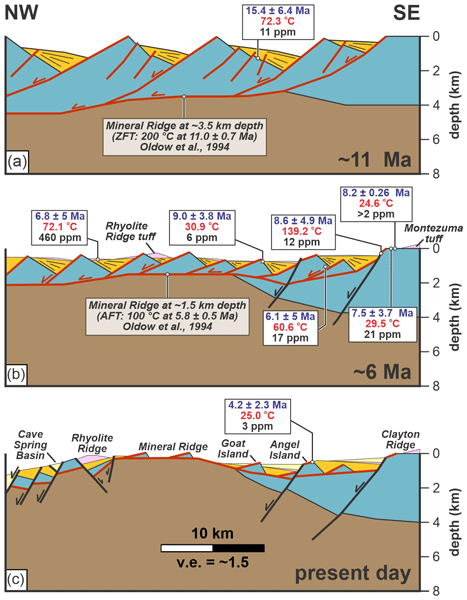
The structural figures (Figs. 1, 5, and 8) contain geometric and stratigraphic errors inconsistent with published mapping and structural analyses of the region, including incorrect crustal thickness at Mineral Ridge and Rhyolite Ridge, omission of key SE-dipping fault structures, erroneous detachment timing, and the conspicuous absence of the Rhyolite Ridge tuff from beneath Clayton Valley — despite its documented subsurface occurrence in work by several coauthors. These figures require substantial revision and should be explicitly labeled as conceptual or schematic where appropriate.
More broadly, the discussion is insufficiently developed to support the claims made. The significance of results is overstated and engagement with the existing structural and stratigraphic literature is incomplete. Addressing these issues – particularly the Li content interpretation, age uncertainty treatment, petrographic documentation, and structural figures – would require substantive revision but could yield a much stronger contribution.
Accept. We thank the reviewer for the detailed review of the manuscript. Many of the points raised have helped strengthen both the interpretations and presentation of the study. In response, we substantially revised the manuscript, figures, and supplementary material. Major revisions include expanded petrographic and structural documentation, revised treatment of Li concentrations and partitioning behavior in calcite, additional discussion of age uncertainties and interpretation, and substantial revision of the schematic structural figures and associated captions. We also substantially expanded the discussion and engagement with the existing structural, stratigraphic, and lithium-system literature in the Clayton Valley region, as recommended. More broadly, the revised manuscript adopts a more cautious interpretation of the dataset, including clearer discussion of uncertainties, alternative interpretations, and the limitations of the current data. We believe these revisions have significantly improved the manuscript and clarified the scope and limitations of our interpretations. Detailed responses to each comment are provided below.
MAJOR COMMENT 1: Inconsistency and unsupported citation for Li reference values for average upper continental crust (UCC) Li reference value. The authors report average UCC Li as ~20-30 ppm in the legend of Figure 3a, but depict as a red bar only spanning 8.5–10.5 ppm in the figure, citing Watts (2025) in the caption and on Line 235 This is internally inconsistent and neither value is traceable to Watts (2025), which does not report a UCC Li value; rather, she makes an offhand (and uncited) comparison noting that rhyolitic magmas of the McDermitt volcanic field in Oregon/Nevada have Li contents of "…200–2000 ppm Li (∼10X–100X average continental crust)," from which a value of ~20 ppm appears to have been inferred and then inconsistently applied in the current manuscript. The appropriate citation for average UCC Li is Teng et al. (2004, GCA), who report 35 ± 11 ppm (1σ), corresponding to a range of ~24–46 ppm. The authors should correct both the figure and text to reflect this value with proper attribution. This is not a minor issue: the inflated baseline used by the authors artificially lowers the threshold for what counts as 'enriched,' and the statement that "many samples yield Li concentrations that exceed avg UCC (~30 ppm)" (Line 235) is demonstrably incorrect under the Teng et al. (2004) value.
Accept. The revised Fig. 5 and text now use the Teng et al. (2004) estimate and corresponding range for upper continental crust Li concentrations, and we have corrected the terminology throughout the manuscript where appropriate. See next response for further discussion of the calcite Li concentrations.
MAJOR COMMENT 2: Misinterpretation of Li contents in fault calcite Using the correct UCC baseline of 35 ± 11 ppm (Teng et al., 2004), 20 of 26 fault calcite samples have Li contents below mean UCC (Table 1), and all samples with pre-6 Ma U-Pb dates yield Li of only 2–21 ppm – values which are depleted, or at best unremarkable, relative to average UCC. There is no geochemical basis in these data for concluding that Li-enriched fluids were present in pre-6 Ma fault systems. The only substantially anomalous Li value in fault calcite (460 ppm) derives from a minor fault within Li-enriched lacustrine strata in Cave Spring basin far to the west of Clayton Valley, and is dated at ~6 Ma, consistent with derivation from the Rhyolite Ridge tuff source (6.05 ± 0.08 Ma; Darin et al., 2025) rather than a pre-existing Li reservoir.
We thank the reviewer for this comment, which prompted us to substantially re-evaluate how Li concentrations in fault-hosted calcite are interpreted in the manuscript. We agree that many of the analyzed calcite samples contain relatively modest absolute Li concentrations, and that many of these values are lower than the average upper continental crust (UCC) Li abundance reported by Teng et al. (2004). However, after further analysis during revision, we do not believe that bulk upper continental crust compositions represent the most appropriate comparator for fault-hosted calcite mineralization. As discussed by Teng et al. (2004), upper continental crust Li abundances are derived largely from silicate- and clay-rich lithologies including shales, granites, crustal composites, and metamorphic rocks, all of which are substantially more favorable hosts for Li than calcite. Published experimental and natural-system studies (Füger et al., 2019; Drake et al., 2023; Branson et al., 2024) constrain low and variable Li partition coefficients and demonstrate that Li is generally incorporated only weakly into calcite during precipitation. Further, Li incorporation into calcite is strongly dependent on a range of factors, including fluid chemistry, precipitation rate, and pH. As a result, relatively modest Li concentrations in calcite may still be compatible with precipitation from Li-bearing fluids. To address this issue, we compiled Li and Ca concentrations from modern Clayton Valley brines reported by Coffey et al. (2021; their Table S10) and calculated fluid Li/Ca compositions (Fig. R1, this document). We then propagated these Li/Ca through experimentally derived calcite-fluid partition coefficients from Füger et al. (2019), Drake et al. (2023), and Branson et al. (2024) to generate predicted calcite Li distributions for comparison with the calcite samples collected in this study.
The result of these comparisons demonstrate that Li concentrations in our vein calcites are potentially consistent with precipitation from Li-bearing basin fluids, given the low and variable partitioning behavior of Li in calcite. In particular, intermediate partition coefficients from Füger et al. (2019) produce predicted calcite Li distributions that compare favorably with the observed dataset (Fig. R2, this document). We emphasize that this approach is not intended as a formal paleo-fluid reconstruction and that (i) the chemistry of present-day basin waters compositions reported by Coffey et al. (2021) may differ from paleo-fluid compositions, (ii) partitioning behavior likely varied among veins as a function of evolving fluid chemistry and precipitation conditions, (iii) this analysis represents a first-order forward-modeling approach designed to evaluate whether the observed calcite Li concentrations are geochemically feasible products of precipitation from Li-bearing basin fluids. We thank the reviewer for raising this important point. We believe that the revised partitioning-based framework provides a substantially more robust and geochemically appropriate basis for interpreting Li concentrations in fracture-hosted calcite and a framework for interpreting similar data in the future. We have nevertheless retained the upper continental crust reference field in revised Fig. 5 to provide broader geochemical context for the measured calcite Li values. The revised manuscript and supplementary material (Supplement 8) now include all of this additional material.
MAJOR COMMENT 3: Age uncertainties undermine the pre-6 Ma fluid flow argument. The manuscript does not discuss 2σ uncertainties on U-Pb dates, which are substantial (ranging from ~20–97% of the reported age). These are only listed in the supplemental table and otherwise ignored in the paper. Of 13 dated samples, 8 have ages spanning 3.9 ± 3.7 to 9.0 ± 3.8 Ma, all of which overlap the 6.05 ± 0.08 Ma age of the Rhyolite Ridge tuff at 2σ and therefore cannot be used to argue for pre-source Li transport. The five remaining dates (15.4 ± 6.4 to 60 ± 19 Ma) that are robustly pre-6 Ma yield Li contents of only 2–11 ppm — the lowest values in the dataset. Taken together, the data show an inverse relationship between age confidence and Li enrichment, which is the opposite of what the authors' interpretation requires. In light of the above, the authors' main conclusion on Lines 315-319 that "the presence of lithium-bearing fluids prior to emplacement of major late Miocene silicic volcanic units indicates that lithium transport was already occurring within the basin before establishment of the most commonly cited volcanic source reservoirs" is not supported. The data are more parsimoniously interpreted as reflecting background crustal fluid flow in pre-6 Ma fault systems, with Li enrichment appearing only in samples that post-date or are contemporaneous with the 6.0-Ma Rhyolite Ridge tuff. The authors should revise their conclusions accordingly and refrain from invoking a long-lived, pre-volcanic Li source unless additional evidence can be brought to bear.
We thank the reviewer for this comment and agree that the age uncertainties associated with several of the younger calcite U-Pb dates require a more cautious interpretation than was presented in the original manuscript. In particular, we agree that multiple calcite ages overlap, within 2σ uncertainty, with emplacement of the ~6.05 Ma Rhyolite Ridge Tuff and therefore cannot be used to confidently demonstrate widespread pre-6 Ma Li enrichment or establishment of a long-lived pre-volcanic Li reservoir. We have revised the manuscript throughout to more explicitly discuss these uncertainties and have softened the corresponding interpretations and conclusions. We do not, however, agree that the current dataset supports a strictly binary interpretation in which pre-6 Ma fluids simply represent “background crustal fluid flow” and meaningful Li enrichment appears only after emplacement of the Rhyolite Ridge Tuff. As discussed in our response above, our revised forward-modeling analysis demonstrates that calcite containing only ppm- to tens-of-ppm Li may plausibly precipitate from fluids spanning a broad range of dissolved Li concentrations, including Li-bearing basin fluids. Consequently, relatively modest Li concentrations in older calcites cannot be uniquely interpreted as evidence for Li-poor parent fluids. We agree that the strongest evidence for substantial Li enrichment within Clayton Valley is associated with late Miocene volcanic and basin-fill systems, and we consider the Rhyolite Ridge Tuff and related silicic volcanic units to represent a major, and likely dominant, Li source within the basin. However, several calcites that are robustly older than the Rhyolite Ridge Tuff still contain measurable Li concentrations despite generally modest absolute values. While these data do not provide definitive evidence for a highly evolved pre-volcanic lithium brine system, we also do not consider them inconsistent with some degree of earlier Li-bearing fluid circulation and fluid-rock interaction within structurally controlled pathways. Although the current dataset does not allow us to identify a specific pre-6 Ma Li source reservoir, we do not believe existing regional models uniquely exclude earlier contributions from volcanic, hydrothermal, sedimentary, or basement-related fluid systems. We have therefore revised the manuscript to adopt a more cautious interpretation. Rather than arguing for definitive evidence of a long-lived pre-volcanic Li reservoir, we now interpret the dataset as recording evolving structurally controlled fluid systems through time, with the strongest evidence for significant Li enrichment associated with younger basin-fill and fault systems that are contemporaneous with, or post-date, emplacement of the major late Miocene silicic volcanic units. Nevertheless, we maintain that the presence of measurable Li within some older structurally hosted calcites remains compatible with some degree of lithium-bearing fluid circulation prior to emplacement of the most commonly cited volcanic source reservoirs.
MAJOR COMMENT 4: Lack of Petrographic Context for Geochronological Interpretations. The authors state on Line 140 that "analyses included petrographic characterization and screening for uranium content prior to dating," but no petrographic results are reported for the dated calcite samples. They go on to interpret that, "Vein calcite precipitation ages…span ~15.4 to 3.9 Ma, indicating that fluid flow and associated mineralization along faults and fractures persisted over multi-Myr timescales." (Lines 248-250). This is a significant gap, because the credibility of the U-Pb ages as records of fault-controlled fluid flow is inseparable from textural and structural context.
The authors frame their U-Pb ages as dating calcite precipitation and fluid flow rather than fault activity per se, which is appropriate. However, petrographic documentation remains essential to establish that the dated material is in fact primary fault- or fracture-hosted vein calcite rather than: (1) diagenetic calcite that predates faulting and was simply exposed within the fault zone, which would provide only a maximum age on fluid flow along that structure; or (2) recrystallized calcite whose U-Pb system was partially reset by a later, unrelated fluid event, which could produce apparent ages that do not correspond to any discrete geological episode. The claim that fault-controlled fluid flow 'persisted over multi-Myr timescales' also requires that the spread of ages reflects multiple discrete precipitation events rather than open-system isotopic disturbance producing an artificially dispersed isochron array — a distinction that cannot be evaluated without CL imaging and textural data.
At minimum, the authors should provide, for each dated sample: (1) the structural position of the calcite (fault core, damage zone, breccia cement, fracture vein, etc.); (2) calcite texture and morphology (fibrous, elongate-blocky, sparry, etc.); and (3) cathodoluminescence (CL) imaging results, or an explicit statement that CL was not performed with justification for why primary, single-generation calcite can nonetheless be assumed. CL imaging is effectively standard practice in fault calcite U-Pb studies (e.g., Nuriel et al., 2017, EPSL; Roberts and Holdsworth, 2022, JSG) because it is the primary means of identifying mixed-generation ablation and recrystallization textures, either of which can yield geologically meaningless apparent ages.
The 460 ppm Li outlier from faults cutting Li-enriched strata is a case in point: without petrographic context, it cannot be determined whether this calcite precipitated from migrating Li-enriched fluids (supporting the authors' interpretation) or incorporated Li diagenetically from the enclosing host stratigraphy. The authors are encouraged to expand their petrographic documentation to the level needed to support their interpretations, ideally in a supplementary table accompanied by representative photomicrographs in plane-polarized light and CL for each sample setting, which are lacking.
We thank the reviewer for this comment. In response, we have substantially expanded the field, structural, and petrographic documentation presented in the manuscript. We have added a new field-context figure (Fig. 3) showing the sampled faults, fractures, breccias, and mineralized structures in outcrop together with annotated sample locations. We have also added a companion transmitted-light petrography figure (Fig. 4) showing representative photomicrographs and LA-ICP-MS ablation spot locations. In addition, revised Table 1 now includes structural setting, host lithology, and petrographic descriptions for each dated calcite sample. These additions directly address the reviewer’s concern regarding sample context. The revised figures demonstrate that the analyzed materials represent structurally hosted calcite mineralization associated with faults, fractures, and breccias rather than background host-rock carbonate.
The expanded petrographic dataset also documents substantial textural variability within the sampled structures. Many samples contain multiple calcite fabrics and generations separated by sharp contacts, growth bands, dark seams, crosscutting relationships, brecciation textures, and recementation fabrics. Crack-seal textures, repeated fracture-fill relationships, and multiple generations of calcite growth indicate that several sampled structures record repeated episodes of fracturing, fluid flow, mineralization, and structural reactivation. These observations are now described in detail in the revised manuscript and illustrated in Figure 4 and Supplementary Material 4.
We agree that the presence of multiple calcite generations requires careful consideration when interpreting calcite U–Pb ages. Where multiple calcite generations were present, analyses were confined to individual growth bands, vein fills, breccia cements, crack-seal domains, or other texturally distinct calcite populations and avoided obvious vein margins, host-rock inclusions, and clearly unrelated calcite generations. This approach was intended to minimize mixing between texturally distinct calcite populations and maximize the likelihood that the resulting ages reflect discrete episodes of calcite mineralization. Although petrographic targeting was prioritized throughout, low uranium concentrations, elevated common Pb contents, and limited analyzable material occasionally required broader spatial sampling than would otherwise be desirable.
Cathodoluminescence (CL) imaging was not performed as part of this study. CL can provide useful information regarding calcite growth zoning and recrystallization textures, but CL imaging alone does not uniquely establish closed-system behavior or fully resolve open-system isotopic disturbance. Our approach instead focused on detailed field and petrographic characterization, reconnaissance screening for suitable U-rich calcite domains, and spatially targeted ablation within petrographically coherent calcite populations.
The resulting age regressions are supported by generally well-defined Tera-Wasserburg arrays (Supplementary Material 6), which are consistent with the petrographic domains targeted during analysis and provide additional support that the dated populations represent isotopically coherent calcite domains. Although open-system behavior and recrystallization cannot be completely excluded in all cases, we consider the combination of field relationships, petrographic observations, targeted analytical screening, and the resulting isotopic regressions to provide a robust basis for interpretation of the resulting calcite U–Pb ages.
With respect to the high-Li sample Li_F_02, the revised manuscript now includes additional field and petrographic documentation for this sample.
MAJOR COMMENT 5: Structural interpretations are inconsistent with published studies. The cross-sectional figures (Figs. 1d, 5, and 8) contain structural interpretations that are inconsistent with published mapping and structural analyses of the Clayton Valley region, and the evolutionary diagrams in Fig. 8 omit or misrepresent key geological features central to the paper's argument. These issues suggest insufficient engagement with the background literature and require substantial revision:
Accept. We thank the reviewer for this detailed comment. We have revised the figures and associated text to better align the structural framework with published mapping and regional constraints – detailed responses to individual comments are provided below.
Crustal geometry at Mineral Ridge and Rhyolite Ridge: The Cambrian section at Mineral Ridge is known to be dramatically attenuated, as documented in detail by Diamond and Ingersoll (2002, IGR), and the expected crustal thickness at Rhyolite Ridge is therefore well under 2 km. The cross sections as drawn depict thicknesses of 10–12 km in this position, which is inconsistent with the published structural framework by more than an order of magnitude. The authors should revise the crustal geometry in all relevant panels to reflect published constraints, with explicit reference to Diamond and Ingersoll (2002) and the more recent detailed geologic mapping and structural analyses of Ogilvie et al. (2023, NBMG OFR) and Darin et al. (2025, Economic Geology), neither of which appears to have been incorporated into the figures on the western panel margins.
Accept. We have revised the western portions of the cross sections to better reflect the published structural framework at Mineral Ridge and Rhyolite Ridge. In particular, we have reduced the thickness of the Cambrian–Ordovician upper-plate section and revised the geometry to reflect the strong attenuation documented by Diamond and Ingersoll (2002), Ogilvie et al. (2023), and Darin et al. (2025). We now explicitly cite these studies in the relevant figure captions and text. The revised figures distinguish the attenuated upper-plate section from more schematic deeper crustal elements
Post-6 Ma basin fill and the Li-brine system: The summary evolutionary diagrams in Fig. 8a and 8b do not adequately represent the post-6 Ma basin fill in Clayton Valley that hosts the prolific Li-brine system and related sediment-hosted Li deposits documented at depth (e.g., Gagnon et al., 2023). If the thin green layer in those panels is intended to represent these strata, this needs to be stated explicitly and the stratigraphic thickness and geometry should reflect published subsurface constraints.
Accept: The purpose of Fig. 8 is to illustrate the first-order tectonostratigraphic evolution of the Clayton Valley region rather than the detailed stratigraphic architecture of the basin fill. The figure is therefore intentionally simplified and does not attempt to depict individual aquifers, volcanic units, gravel packages, or the full complexity of the Li-brine host succession documented in subsurface studies. Instead, basin fill is generalized into two broad tectonostratigraphic packages: (1) syn-detachment basin fill deposited during activity on the Silver Peak detachment fault and prior to emplacement of the Rhyolite Ridge tuff, and (2) post-detachment basin fill deposited following cessation of major displacement on the Silver Peak detachment fault and subsequent emplacement of the Rhyolite Ridge tuff. The objective is to illustrate the transition from detachment-related basin development to younger high-angle fault-controlled basin evolution rather than to reconstruct the detailed stratigraphy of individual basin-fill units.
More critically, the figures appear to imply stratigraphic connectivity between the Cave Spring Basin at Rhyolite Ridge (Darin et al., 2025) and Clayton Valley proper. If this connectivity is central to the paper's fluid-flow model, it must be discussed explicitly in the text and supported with substantiating evidence; the reviewers are not aware of published data establishing this connection, and it cannot be conveyed schematically without justification.
Accept. Following revision of Fig. 1 and incorporation of the structural framework presented by Ogilvie et al. (2023) and Darin et al. (2025), Fig. 10 has been modified accordingly. The revised figure no longer implies direct stratigraphic connectivity between these basin systems. Any regional relationships shown are intended to illustrate broad tectonic evolution rather than documented basin-to-basin stratigraphic continuity.
Mineral Ridge/Silver Peak detachment timing: Fig. 8 depicts activity on the Mineral Ridge detachment extending to 3–0 Ma, which is inconsistent with the timing constraints that suggest detachment slip ceased by ~6-4 Ma (e.g., Oldow et al., 1994, Geol; Diamond and Ingersoll, 2002, IGR; Darin et al., 2025). The authors should either revise the figure to reflect the established deformation history of this structure or provide explicit citations and reasoning for departing from the published record.
Accept. As noted above, Fig. 10 has been substantially revised. The updated evolutionary model shows major detachment-related extension and lower-plate exhumation during the Miocene, with displacement waning by approximately 6 Ma. The top (present-day) panel is intended to depict the modern basin geometry and fault architecture rather than continued displacement on the detachment fault. Younger deformation is shown as high-angle Basin-and-Range faulting superimposed on the earlier detachment-related architecture. The revised figure is therefore consistent with published constraints indicating that major slip on the Silver Peak detachment fault had ceased by the late Miocene (e.g., Oldow et al., 1994; Diamond and Ingersoll, 2002; Darin et al., 2025).
General Recommendation. The structural figures as presented read as largely schematic, and several of the interpretations they convey are not defended in the text. Given that the fault network geometry is foundational to the paper's fluid-flow model, the authors are strongly encouraged to revise the cross sections to conform to published mapping and structural data, clearly distinguish between constrained geometry and schematic inference, and provide explicit discussion of any structural interpretations, particularly subsurface connectivity, that go beyond what has been documented in prior work.
Accept. As described above, the structural figures have been substantially revised to better reflect published mapping, structural interpretations, and tectonic constraints from the Clayton Valley region. The cross sections now more closely follow the geometry proposed by Diamond and Ingersoll (2002), Ogilvie et al. (2023), Darin et al. (2025), and other relevant studies. Figure captions and associated text have also been expanded to clarify which elements are directly constrained by published data and which represent schematic restorations intended to illustrate first-order tectonostratigraphic evolution. In addition, interpretations that could be construed as implying undocumented subsurface or stratigraphic connectivity have been removed or clarified. These revisions better align the figures with the published structural framework and more clearly distinguish observational constraints from conceptual interpretations.
MAJOR COMMENT 6: Issues with geologic map and legend in Figure 1. Figure 1 requires substantial revision on several grounds. The depiction of metamorphic core complexes is incomplete, omitting those in the Weepah Hills to the north of Clayton Valley (see Darin et al., 2025, Fig. 1b). The legend in Fig. 1c does not correspond to the geologic map in Fig. 1b or the cross section in Fig. 1d — many more map units are shown on the map than are included in the legend, several colored polygons appear to overlap along the western map edge, and key features lack labels; all of these issues must be corrected. The cross section in Fig. 1d should be explicitly labeled a 'conceptual' or 'schematic' diagram, as it is not geometrically restored or scaled. Its northwestern end requires revision to honor the first-order structural relationships documented by Ogilvie et al. (2023) and Darin et al. (2025), particularly the Cambrian section thickness and the major SE-dipping fault structures, both of which are misrepresented as currently drawn. Finally, the 6 Ma Rhyolite Ridge tuff is conspicuously absent from beneath Clayton Valley in the cross section, despite its documented subsurface occurrence in work by several coauthors of this manuscript (Gagnon et al., 2023, GSAB) and its regional correlation by Darin et al. (2025); given its central role in the paper's Li-sourcing argument, it must be included.
Accept. We have revised Figure 1 substantially. The regional map now includes the additional metamorphic core complexes in the Weepah Hills and at Lone Mountain, following Darin et al. (2025). We also revised the legend so that it corresponds consistently with the mapped units shown in Figure 1b and the associated cross section, corrected overlapping polygons and labeling issues along the western map margin, and added additional labels to improve readability. Figure 1d is now explicitly referred to as a schematic cross section in the figure caption rather than a geometrically restored or balanced section. We also revised the northwestern portion of the section to better reflect the first-order structural relationships described by Ogilvie et al. (2023) and Darin et al. (2025), including a substantially attenuated upper-plate section and major SE-dipping faults.
With respect to the ~6 Ma Rhyolite Ridge tuff beneath Clayton Valley, we have chosen to depict this unit as somewhat laterally discontinuous in the cross section (Fig. 1) and in the schematic evolution diagram (Fig. 10). Although volcanic and tuffaceous intervals have been documented in exploration wells within the basin, several wells in Clayton Valley did not penetrate appreciable thicknesses of this tuff before encountering the Cambrian Campito Formation (see Section 4.1 and lithostratigraphic columns for EXP1, EXP3 and EXP5 in Fig. 2 of Coffey et al., 2021). As such, we believe the lateral continuity, thickness, and stratigraphic geometry of these units beneath Clayton Valley remain uncertain. Although Darin et al. (2025) proposed a regional correlation of the Rhyolite Ridge tuff, they also explicitly noted uncertainty regarding the full extent, geometry, and source location of the unit, and stated that additional geologic mapping and subsurface investigations are required to better constrain its distribution. In that context, we do not consider the currently available subsurface dataset sufficient to justify depiction of a thick, laterally continuous, basin-wide tuff horizon in our cross section.
TECHNICAL CORRECTIONS:
Line 97: capitalize "Late Miocene"; this sub-epoch is now formally recognized by the International Commission on Stratigraphy (ICS) International Chronostratigraphic Chart v.2024/12
Accept. “Late Miocene” has been capitalized throughout the revised manuscript.
Line 97: change "west-dipping" to "mostly west-dipping"; some major structures in Rhyolite Ridge area are east-dipping (Darin et al., 2025)
Accept. The text has been revised accordingly.
Comment: Line 99: Because you include Rhyolite Ridge (RR) here and that study spans nearly half the cross-section in Fig. 1d, you should consider citing Darin et al. (2025) again here. That paper documented this well at RR, and you are talking regionally here not in specific about CV. Or if you actually intend to refer to CV in specific, then make this explicit before describing the stratigraphy and structure in this sentence.
Accept. The text has been revised to clarify the regional context and now includes an additional citation to Darin et al. (2025).
Lines 119–120: "Sampling of fault- and fracture-hosted calcite veins deliberately targeted relatively late-stage brittle structures interpreted to be related to Basin and Range extension." – How exactly were early (pre-Basin and Range) structures differentiated. By what criteria? Dip angle?
Accept. We clarified this point in the revised manuscript. Interpretation of relatively late-stage Basin and Range-related structures was based primarily on deformation style, and field relationships, particularly where brittle faults and fractures appeared to cross-cut earlier fabrics and deformation features. These relationships are now shown more clearly in the revised structural context figure (Fig. 3).
Line 242-243: "basement-hosted calcite veins generally contain low to moderate lithium concentrations (commonly <10 ppm, rarely exceeding ~30 ppm." According to Table 1, none of these samples have Li content >30 ppm, and only 2 of 26 fault/vein samples in the dataset overlap average UCC values; see prior comments above.
Accept. The text has been revised accordingly.
Figure 2c-f: it is very difficult to tell from these photos where exactly the calcite samples come from and their textural context. Consider arrows or other labels to indicate sample location on each panel.
Accept. We have revised the figure accordingly. The revised structural context figure (new Figure 3) also includes arrows and annotations showing the precise sample locations and associated structural context for each sample. Appendix Z has field photos showing sampling locations for the remaining samples not included in Figs. 2 or 3.
-
AC1: 'Reply on RC1', Adam Cawood, 10 Jun 2026
-
RC2: 'Comment on egusphere-2026-1596', Fabrizio Balsamo, 15 May 2026
Dear Editor,
This is my review of the paper Fault and fracture networks as long-lived conduits for lithium transport, by Cawood and coauthors.
The manuscript presents a multi-disciplinary dataset (field observations, U–Pb calcite geochronology, clumped isotopes, and lithium concentrations) to investigate the role of fault and fracture networks in lithium transport in Clayton Valley, Nevada. The study addresses an important question in the context of lithium brine systems and provides valuable new geochemical constraints on structurally controlled fluid flow in continental settings.
The dataset is novel and potentially significant, particularly the integration of absolute timing of vein formation with lithium geochemistry. The text is clear, terminology is correct, and figures are adequate, self-explicative and very beautiful. The comparison with literature is sound, and the overall dataset is certainly worth to be published.
However, in my view (structural geology perspective) there are three main aspects that require clarification or additional support. These concern with overall structural characterization of faults, petrographic and microstructural control on U-Pb ages, and source of lithium. Below more detailed comments.
In summary, this manuscript presents a valuable and potentially publishable dataset, but the interpretations would be substantially strengthened by a more rigorous integration of petrography, structural geology, and fluid-source discussion. I believe the paper has strong potential after revision and I therefore recommend moderate revision.
Best regards
Fabrizio Balsamo
Major points to be addressed:
- Petrographic characterization and vein microstructures
One of the main weaknesses of the manuscript is the absence of a general petrographic and microstructural characterization of the sampled veins. The paper repeatedly emphasizes the role of fault and fracture networks as long-lived conduits for lithium-bearing fluids, yet the evidence presented is almost entirely based on field observations and bulk geochemical analyses. In a contribution centered on structural controls on fluid circulation, this leaves an important gap in the overall argument.
At present, the manuscript does not provide sufficient information regarding the internal textures of the calcite veins, the relationships between different generations of calcite, or the deformation mechanisms associated with vein formation (opening-mode, shear veins?). There is little discussion of whether the veins formed during active deformation, whether they record repeated opening and sealing events, or whether multiple mineralization phases are present within individual structures. Likewise, the manuscript does not address the occurrence of crack-seal textures, recrystallization fabrics, brecciation, possible cross-cutting relationships, or evidence for vein reactivation. These observations are essential because they provide the direct structural context needed to interpret the veins as long-lived pathways for episodic fluid circulation through time (even at the scale of individual veins).
This issue becomes particularly important given that the manuscript interprets the calcite mineralization as recording repeated lithium-bearing fluid flow over multi-million-year timescales. Without petrographic evidence demonstrating multiple generations of vein growth or reactivation, it remains difficult to evaluate whether the analyzed calcites represent discrete mineralization events or composite vein histories that potentially integrate multiple fluid-flow episodes.
I strongly encourage the authors to include a dedicated section describing the petrography and microstructures of the sampled veins. Representative thin-section images, accompanied by descriptions of vein fabrics and paragenetic relationships, would substantially strengthen the manuscript. Such observations would also help clarify the temporal and structural relationships between deformation, vein formation, and fluid circulation, thereby reinforcing the broader interpretations developed in the Discussion.
- Structural characterization/description of the fault systems
A second major limitation of the manuscript is the lack of quantitative structural characterization of the studied faults, particularly the basin-bounding structures that form the basis for several of the paper’s conceptual interpretations. Although the manuscript frequently refers to “faults,” “fracture networks,” and “basin-bounding faults,” the actual geometry, scale, and internal architecture of these structures remain poorly constrained throughout the paper.
For example, the manuscript does not provide sufficient information regarding the displacement of the major faults, the thickness of the fault cores, the width of associated damage zones, or the intensity and distribution of fracturing adjacent to the principal slip surfaces. These details (even qualitative description) are fundamental in any study addressing structurally controlled permeability because the hydraulic behavior of fault systems varies significantly depending on structural attributes (in broad sense) and position within the fault architecture (i.e. wall damage zone, tip damage zone, intersecting damage zone, following recent classifications…).
At present, it is unclear where the analyzed samples were collected relative to the structural architecture of the faults. The manuscript should clarify whether the calcite samples derive from the principal slip surface, brecciated fault-core material, subsidiary fractures within the damage zone, or fractures external to the fault zone altogether. Similarly, there is little quantitative description of the sampled veins themselves, including their thickness, continuity, orientation.
These structural details are critical because the manuscript ultimately argues that faults acted as long-lived pathways organizing lithium transport through the basin. Without a more rigorous structural framework, it is difficult to assess the extent to which the analyzed veins genuinely record basin-scale fault-controlled flow as opposed to more localized fracture-related circulation.
I therefore recommend that the authors expand the structural description substantially. The paper would benefit greatly from a more detailed description of the principal faults and fracture systems, including quantitative parameters where possible, together with clearer documentation of sampling positions relative to fault zone structure and map view architecture.
- Source of lithium and implications for basin evolution
The discussion regarding the origin of lithium is one of the most interesting aspects of the manuscript, but it is currently underdeveloped relative to the importance of the conclusions being proposed. A central claim of the paper is that several lithium-bearing calcite veins predate emplacement of the late Miocene silicic volcanic units commonly invoked as the principal lithium source in Clayton Valley. This observation is potentially significant because it suggests that lithium-bearing fluids were already circulating within the evolving basin prior to the emplacement of the volcanic units typically considered critical to lithium enrichment.
However, while the manuscript questions the conventional volcanogenic source model, it does not sufficiently develop alternative explanations for the origin of the lithium. The current discussion largely demonstrates that lithium transport occurred before the emplacement of certain volcanic units, but it does not clearly establish where the lithium was sourced from during these earlier stages of basin evolution. As a result, the interpretation remains somewhat incomplete and, at times, speculative.
The manuscript would benefit from a broader and more balanced discussion of possible lithium reservoirs and mobilization mechanisms. For example, the potential role of basement lithologies, earlier volcanic sequences, sedimentary recycling, long-lived regional groundwater circulation, or inherited basin fluids deserves more careful consideration. Likewise, the extent to which the presented geochemical and isotopic data can actually discriminate among these possible sources should be discussed more explicitly.
This point is particularly important because the manuscript presently risks overextending the implications of the geochronological dataset. Demonstrating that lithium-bearing fluids predate a specific volcanic event is not necessarily equivalent to demonstrating that volcanism was unimportant in the overall lithium budget of the basin. The authors should therefore clarify the distinction between evidence for early lithium circulation and evidence for the ultimate lithium source itself.
A more nuanced treatment of lithium sourcing would considerably strengthen the manuscript and place the results in a broader basin-evolution and fluid-flow context.
-
AC2: 'Reply on RC2', Adam Cawood, 10 Jun 2026
Reviewer comments and responses
We thank the reviewers for their careful evaluation of our manuscript and for their constructive comments and suggestions. We have revised the manuscript extensively in response to the reviews. Our responses are provided in blue text. All figure, table, and section references refer to the revised manuscript unless otherwise noted.
REVIEWER 2 (Fabrizio Balsamo): comments and responses
GENERAL COMMENTS: The manuscript presents a multi-disciplinary dataset (field observations, U–Pb calcite geochronology, clumped isotopes, and lithium concentrations) to investigate the role of fault and fracture networks in lithium transport in Clayton Valley, Nevada. The study addresses an important question in the context of lithium brine systems and provides valuable new geochemical constraints on structurally controlled fluid flow in continental settings. The dataset is novel and potentially significant, particularly the integration of absolute timing of vein formation with lithium geochemistry. The text is clear, terminology is correct, and figures are adequate, self-explicative and very beautiful. The comparison with literature is sound, and the overall dataset is certainly worth to be published. However, in my view (structural geology perspective) there are three main aspects that require clarification or additional support. These concern with overall structural characterization of faults, petrographic and microstructural control on U-Pb ages, and source of lithium. Below more detailed comments. In summary, this manuscript presents a valuable and potentially publishable dataset, but the interpretations would be substantially strengthened by a more rigorous integration of petrography, structural geology, and fluid-source discussion. I believe the paper has strong potential after revision and I therefore recommend moderate revision.
Accept: We thank the reviewer for their constructive feedback. We have substantially expanded the structural geology, petrography, and discussion of lithium sources throughout the manuscript. Specifically, we have added detailed field and petrographic descriptions of sampled structures, developed a classification scheme for fault- and fracture-hosted calcite mineralization, expanded the presentation of petrographic observations and laser ablation targeting, revised the discussion of lithium source reservoirs, and incorporated additional structural restoration and fluid-flow analyses. We have also clarified the limitations of the dataset and revised several interpretations to better reflect analytical uncertainties and alternative explanations. Below, we respond to each comment in detail and describe the corresponding revisions made to the manuscript.
MAJOR COMMENT 1: Petrographic characterization and vein microstructures. One of the main weaknesses of the manuscript is the absence of a general petrographic and microstructural characterization of the sampled veins. The paper repeatedly emphasizes the role of fault and fracture networks as long-lived conduits for lithium-bearing fluids, yet the evidence presented is almost entirely based on field observations and bulk geochemical analyses. In a contribution centered on structural controls on fluid circulation, this leaves an important gap in the overall argument. At present, the manuscript does not provide sufficient information regarding the internal textures of the calcite veins, the relationships between different generations of calcite, or the deformation mechanisms associated with vein formation (opening-mode, shear veins?). There is little discussion of whether the veins formed during active deformation, whether they record repeated opening and sealing events, or whether multiple mineralization phases are present within individual structures. Likewise, the manuscript does not address the occurrence of crack-seal textures, recrystallization fabrics, brecciation, possible cross-cutting relationships, or evidence for vein reactivation. These observations are essential because they provide the direct structural context needed to interpret the veins as long-lived pathways for episodic fluid circulation through time (even at the scale of individual veins). This issue becomes particularly important given that the manuscript interprets the calcite mineralization as recording repeated lithium-bearing fluid flow over multi-million-year timescales. Without petrographic evidence demonstrating multiple generations of vein growth or reactivation, it remains difficult to evaluate whether the analyzed calcites represent discrete mineralization events or composite vein histories that potentially integrate multiple fluid-flow episodes. I strongly encourage the authors to include a dedicated section describing the petrography and microstructures of the sampled veins. Representative thin-section images, accompanied by descriptions of vein fabrics and paragenetic relationships, would substantially strengthen the manuscript. Such observations would also help clarify the temporal and structural relationships between deformation, vein formation, and fluid circulation, thereby reinforcing the broader interpretations developed in the Discussion.
Accept. We thank the reviewer for this comment and agree that additional petrographic and microstructural characterization strengthens interpretation of the U–Pb geochronology and lithium geochemistry. In response, we substantially expanded the structural and petrographic descriptions of sampled faults, fractures, veins, and travertine deposits throughout the manuscript. A new structural classification scheme has been added (Section 4.1; Table 1), together with expanded field descriptions and representative field photographs (Fig. 3). These additions distinguish opening-mode veins, fault-fill mineralization, basin-bounding faults, basement-hosted structures, and volcano-sedimentary-hosted structures, and provide additional context regarding the structural setting of sampled calcite. We also added a new suite of representative petrographic images and descriptions (Fig. 4). These observations document internal vein textures, relationships between different calcite generations, opening-mode and fault-fill textures, brecciation, cross-cutting relationships, and evidence for multiple phases of calcite mineralization and/or recrystallization within individual structures. To further strengthen the link between petrography and geochronology, Figure 4 now includes the locations of laser ablation U–Pb analyses on representative thin sections. The expanded petrographic descriptions are incorporated into both the Results and Discussion sections (Sections 4.1 and 5.1), where we discuss the implications of these textures and structural relationships for repeated fluid circulation, mineralization, and deformation through time. While not all samples preserve clear evidence for crack-seal growth, vein reactivation, or repeated opening and sealing events, the expanded dataset demonstrates that many sampled structures record complex histories involving multiple generations of calcite precipitation, deformation, and/or recrystallization. These observations provide important structural context for interpretation of the U–Pb ages and support the interpretation that fault and fracture networks acted as long-lived pathways for episodic fluid circulation.
MAJOR COMMENT 2: Structural characterization/description of the fault systems. A second major limitation of the manuscript is the lack of quantitative structural characterization of the studied faults, particularly the basin-bounding structures that form the basis for several of the paper’s conceptual interpretations. Although the manuscript frequently refers to “faults,” “fracture networks,” and “basin-bounding faults,” the actual geometry, scale, and internal architecture of these structures remain poorly constrained throughout the paper. For example, the manuscript does not provide sufficient information regarding the displacement of the major faults, the thickness of the fault cores, the width of associated damage zones, or the intensity and distribution of fracturing adjacent to the principal slip surfaces. These details (even qualitative description) are fundamental in any study addressing structurally controlled permeability because the hydraulic behavior of fault systems varies significantly depending on structural attributes (in broad sense) and position within the fault architecture (i.e. wall damage zone, tip damage zone, intersecting damage zone, following recent classifications…). At present, it is unclear where the analyzed samples were collected relative to the structural architecture of the faults. The manuscript should clarify whether the calcite samples derive from the principal slip surface, brecciated fault-core material, subsidiary fractures within the damage zone, or fractures external to the fault zone altogether. Similarly, there is little quantitative description of the sampled veins themselves, including their thickness, continuity, orientation. These structural details are critical because the manuscript ultimately argues that faults acted as long-lived pathways organizing lithium transport through the basin. Without a more rigorous structural framework, it is difficult to assess the extent to which the analyzed veins genuinely record basin-scale fault-controlled flow as opposed to more localized fracture-related circulation. I therefore recommend that the authors expand the structural description substantially. The paper would benefit greatly from a more detailed description of the principal faults and fracture systems, including quantitative parameters where possible, together with clearer documentation of sampling positions relative to fault zone structure and map view architecture.
Accept. We expanded the structural descriptions throughout the manuscript to provide additional context regarding the geometry, scale, and structural setting of sampled faults, fractures, and veins. Section 4.1 and Table 1 now include descriptions of fault and fracture type, host lithology, structural setting, vein geometry, and mineralization style for all dated and geochemically characterized samples. Representative field photographs and interpretations are provided in Figure 3 and illustrate the structural context of sampled calcites, including mineralized fault zones, subsidiary fractures, opening-mode veins, brecciated structures, and slip surfaces associated with larger fault systems. The revised manuscript also more clearly distinguishes between basin-bounding faults, normal faults, strike-slip faults, basement-hosted fractures, opening-mode veins, and volcano-sedimentary-hosted structures. These additions provide a clearer framework for evaluating the relationship between calcite mineralization and fault architecture and clarify the position of sampled calcites relative to the structures that host them. The objective of this study was to evaluate the timing, formation temperatures, and geochemistry of calcite mineralization across a broad range of structural settings distributed throughout Clayton Valley. As such, our approach focused on basin-scale patterns rather than detailed characterization of individual fault systems. Future studies focused on specific fault zones could further refine relationships between fault-core architecture, damage-zone development, fracture connectivity, and lithium-bearing fluid flow through detailed investigation of individual structures using structural transects, higher-resolution petrographic and geochemical characterization, and targeted sampling of fault cores, damage zones, and subsidiary fracture networks. Nevertheless, we believe the expanded structural descriptions, classifications, and field documentation in this manuscript provide sufficient context to relate the analyzed calcites to their host structures and to evaluate the role of faults and fractures as fluid-flow pathways within the basin.
MAJOR COMMENT 3: Source of lithium and implications for basin evolution. The discussion regarding the origin of lithium is one of the most interesting aspects of the manuscript, but it is currently underdeveloped relative to the importance of the conclusions being proposed. A central claim of the paper is that several lithium-bearing calcite veins predate emplacement of the late Miocene silicic volcanic units commonly invoked as the principal lithium source in Clayton Valley. This observation is potentially significant because it suggests that lithium-bearing fluids were already circulating within the evolving basin prior to the emplacement of the volcanic units typically considered critical to lithium enrichment. However, while the manuscript questions the conventional volcanogenic source model, it does not sufficiently develop alternative explanations for the origin of the lithium. The current discussion largely demonstrates that lithium transport occurred before the emplacement of certain volcanic units, but it does not clearly establish where the lithium was sourced from during these earlier stages of basin evolution. As a result, the interpretation remains somewhat incomplete and, at times, speculative. The manuscript would benefit from a broader and more balanced discussion of possible lithium reservoirs and mobilization mechanisms. For example, the potential role of basement lithologies, earlier volcanic sequences, sedimentary recycling, long-lived regional groundwater circulation, or inherited basin fluids deserves more careful consideration. Likewise, the extent to which the presented geochemical and isotopic data can actually discriminate among these possible sources should be discussed more explicitly. This point is particularly important because the manuscript presently risks overextending the implications of the geochronological dataset. Demonstrating that lithium-bearing fluids predate a specific volcanic event is not necessarily equivalent to demonstrating that volcanism was unimportant in the overall lithium budget of the basin. The authors should therefore clarify the distinction between evidence for early lithium circulation and evidence for the ultimate lithium source itself. A more nuanced treatment of lithium sourcing would considerably strengthen the manuscript and place the results in a broader basin-evolution and fluid-flow context.
Accept. We have substantially revised and expanded the discussion of lithium sourcing and basin evolution in response to this comment (Section 5.2). In particular, we now more clearly distinguish between evidence for lithium-bearing fluid circulation and evidence for the ultimate lithium source. The revised manuscript explicitly acknowledges that the presence of lithium-bearing calcite veins older than the ~6 Ma Rhyolite Ridge Tuff does not imply that late Miocene silicic volcanism was unimportant in the overall lithium budget of Clayton Valley. Rather, these observations indicate that lithium-bearing fluids were present prior to emplacement of the volcanic units commonly invoked as the dominant lithium source reservoir in the region. The revised discussion also provides a broader evaluation of potential lithium reservoirs and mobilization pathways. In addition to discussing the Rhyolite Ridge Tuff and related volcanic rocks of the Montezuma Range (Price et al., 2000; Darin et al., 2025), we now consider Jurassic to Tertiary granitic rocks exposed around Clayton Valley, including the Palmetto Mountains, Weepah Hills, Lone Mountain, and Mineral Ridge (Albers and Stewart, 1972; Price et al., 2000). We also discuss previously reported lithium-bearing pegmatites containing lepidolite at Mineral Ridge (Bailly, 1951; Olson and Hinrichs, 1960; Albers and Stewart, 1972) and regional models invoking long-range groundwater circulation and solute transport (Munk et al., 2016). We further expanded discussion of the limitations of the current dataset with respect to source discrimination. The revised manuscript now emphasizes that the combined geochronologic, geochemical, and isotopic data are better suited to evaluating the timing, formation temperatures, and pathways of lithium-bearing fluid circulation than to uniquely identifying lithium source reservoirs. Consideration of published calcite-fluid lithium partition coefficients further demonstrates that relatively low lithium concentrations in calcite do not necessarily imply lithium-poor parent fluids (see responses to Reviewer 1). Consequently, the revised manuscript adopts a more cautious interpretation of older lithium-bearing calcites and concludes that, although late Miocene silicic volcanic rocks likely represent the dominant lithium source in the region, the available data remain compatible with contributions from older local or regional lithium-bearing reservoirs.
Peer review completion


Interactive discussion
Status: closed
-
RC1: 'Comment on egusphere-2026-1596', Michael Darin, 01 May 2026
GENERAL COMMENTS:
The manuscript presents new calcite U-Pb geochronologic ages, carbonate clumped-isotope formation temperatures, and lithium concentration data from fault- and fracture-hosted veins, basin-bounding faults, and spring deposits in and around Clayton Valley, a prominent and developing lithium district in southwestern Nevada. The authors interpret these data as evidence that structurally connected fault networks served as long-lived conduits for Li-enriched fluid flow since at least ~15 Ma, predating the emplacement of the ~6 Ma Rhyolite Ridge tuff which has been suggested as a primary Li source reservoir for the Clayton Valley system. The paper addresses a genuinely important and underexplored question: the role of faults and fractures as fluid transport pathways in sediment-hosted Li and Li-brine systems is poorly constrained, and the multi-proxy analytical approach employed here is well suited to the problem. The topic is within scope, and the dataset is novel.
Unfortunately, the manuscript falls well short of supporting its central conclusions, and in its current form I do not recommend it for publication without major revision. My principal concerns are as follows. The paper's most significant interpretive claim – that Li-enriched fluids were circulating along faults prior to 6 Ma, before establishment of the volcanic Li source – is not supported by the data. All fault calcite samples with robustly pre-6 Ma U-Pb ages yield Li concentrations of only 2–21 ppm, at or below average upper continental crust (~35 ± 11 ppm; Teng et al., 2004), providing no geochemical evidence of Li enrichment. Compounding this, the manuscript does not discuss the 2σ uncertainties on U-Pb dates, which are substantial: eight of thirteen dated samples have age uncertainties large enough to overlap the 6.05 Ma age of the Rhyolite Ridge tuff, and cannot be used to argue for pre-source fluid flow. The authors' conclusion that long-lived, pre-volcanic Li transport occurred within the basin is therefore unsupported, and represents a significant overinterpretation of the available data.
The manuscript also contains errors in the representation of average upper continental crust Li content. They cite inconsistent values (~20-30 ppm and 8.5–11.5 ppm in Fig. 3a; ~30 ppm in text) that are neither internally consistent nor traceable to the cited source, which further undermine the interpretive framework. The correct reference value from Teng et al. (2004) renders the statement that "many samples yield Li concentrations that exceed average upper continental crust" incorrect for the majority of the dataset.
Beyond the geochemical interpretations, the petrographic characterization of dated calcite is insufficiently documented to establish that U-Pb ages reflect fault-controlled fluid flow rather than diagenetic, recrystallized, or mixed-generation calcite. CL imaging and textural descriptions linking each sample to its structural position are absent, which is a meaningful gap given current best practices in fault calcite U-Pb geochronology.
The structural figures (Figs. 1, 5, and 8) contain geometric and stratigraphic errors inconsistent with published mapping and structural analyses of the region, including incorrect crustal thickness at Mineral Ridge and Rhyolite Ridge, omission of key SE-dipping fault structures, erroneous detachment timing, and the conspicuous absence of the Rhyolite Ridge tuff from beneath Clayton Valley — despite its documented subsurface occurrence in work by several coauthors. These figures require substantial revision and should be explicitly labeled as conceptual or schematic where appropriate.
More broadly, the discussion is insufficiently developed to support the claims made. The significance of results is overstated and engagement with the existing structural and stratigraphic literature is incomplete. Addressing these issues – particularly the Li content interpretation, age uncertainty treatment, petrographic documentation, and structural figures – would require substantive revision but could yield a much stronger contribution.
Specific Comments and Technical Corrections can be found in the PDF supplement.
-
AC1: 'Reply on RC1', Adam Cawood, 10 Jun 2026
Reviewer comments and responses
We thank the reviewers for their careful evaluation of our manuscript and for their constructive comments and suggestions. We have revised the manuscript extensively in response to the reviews. Our responses are provided in blue text. All figure, table, and section references refer to the revised manuscript unless otherwise noted.
REVIEWER 1 (Michael Darin): comments and responses
GENERAL COMMENTS: The manuscript presents new calcite U-Pb geochronologic ages, carbonate clumped-isotope formation temperatures, and lithium concentration data from fault- and fracture-hosted veins, basin-bounding faults, and spring deposits in and around Clayton Valley, a prominent and developing lithium district in southwestern Nevada. The authors interpret these data as evidence that structurally connected fault networks served as long-lived conduits for Li-enriched fluid flow since at least ~15 Ma, predating the emplacement of the ~6 Ma Rhyolite Ridge tuff which has been suggested as a primary Li source reservoir for the Clayton Valley system. The paper addresses a genuinely important and underexplored question: the role of faults and fractures as fluid transport pathways in sediment-hosted Li and Li-brine systems is poorly constrained, and the multi-proxy analytical approach employed here is well suited to the problem. The topic is within scope, and the dataset is novel.
Unfortunately, the manuscript falls well short of supporting its central conclusions, and in its current form I do not recommend it for publication without major revision. My principal concerns are as follows. The paper's most significant interpretive claim – that Li-enriched fluids were circulating along faults prior to 6 Ma, before establishment of the volcanic Li source – is not supported by the data. All fault calcite samples with robustly pre-6 Ma U-Pb ages yield Li concentrations of only 2–21 ppm, at or below average upper continental crust (~35 ± 11 ppm; Teng et al., 2004), providing no geochemical evidence of Li enrichment. Compounding this, the manuscript does not discuss the 2σ uncertainties on U-Pb dates, which are substantial: eight of thirteen dated samples have age uncertainties large enough to overlap the 6.05 Ma age of the Rhyolite Ridge tuff, and cannot be used to argue for pre-source fluid flow. The authors' conclusion that long-lived, pre-volcanic Li transport occurred within the basin is therefore unsupported, and represents a significant overinterpretation of the available data.
The manuscript also contains errors in the representation of average upper continental crust Li content. They cite inconsistent values (~20-30 ppm and 8.5–11.5 ppm in Fig. 3a; ~30 ppm in text) that are neither internally consistent nor traceable to the cited source, which further undermine the interpretive framework. The correct reference value from Teng et al. (2004) renders the statement that "many samples yield Li concentrations that exceed average upper continental crust" incorrect for the majority of the dataset.
Beyond the geochemical interpretations, the petrographic characterization of dated calcite is insufficiently documented to establish that U-Pb ages reflect fault-controlled fluid flow rather than diagenetic, recrystallized, or mixed-generation calcite. CL imaging and textural descriptions linking each sample to its structural position are absent, which is a meaningful gap given current best practices in fault calcite U-Pb geochronology.
The structural figures (Figs. 1, 5, and 8) contain geometric and stratigraphic errors inconsistent with published mapping and structural analyses of the region, including incorrect crustal thickness at Mineral Ridge and Rhyolite Ridge, omission of key SE-dipping fault structures, erroneous detachment timing, and the conspicuous absence of the Rhyolite Ridge tuff from beneath Clayton Valley — despite its documented subsurface occurrence in work by several coauthors. These figures require substantial revision and should be explicitly labeled as conceptual or schematic where appropriate.
More broadly, the discussion is insufficiently developed to support the claims made. The significance of results is overstated and engagement with the existing structural and stratigraphic literature is incomplete. Addressing these issues – particularly the Li content interpretation, age uncertainty treatment, petrographic documentation, and structural figures – would require substantive revision but could yield a much stronger contribution.
Accept. We thank the reviewer for the detailed review of the manuscript. Many of the points raised have helped strengthen both the interpretations and presentation of the study. In response, we substantially revised the manuscript, figures, and supplementary material. Major revisions include expanded petrographic and structural documentation, revised treatment of Li concentrations and partitioning behavior in calcite, additional discussion of age uncertainties and interpretation, and substantial revision of the schematic structural figures and associated captions. We also substantially expanded the discussion and engagement with the existing structural, stratigraphic, and lithium-system literature in the Clayton Valley region, as recommended. More broadly, the revised manuscript adopts a more cautious interpretation of the dataset, including clearer discussion of uncertainties, alternative interpretations, and the limitations of the current data. We believe these revisions have significantly improved the manuscript and clarified the scope and limitations of our interpretations. Detailed responses to each comment are provided below.
MAJOR COMMENT 1: Inconsistency and unsupported citation for Li reference values for average upper continental crust (UCC) Li reference value. The authors report average UCC Li as ~20-30 ppm in the legend of Figure 3a, but depict as a red bar only spanning 8.5–10.5 ppm in the figure, citing Watts (2025) in the caption and on Line 235 This is internally inconsistent and neither value is traceable to Watts (2025), which does not report a UCC Li value; rather, she makes an offhand (and uncited) comparison noting that rhyolitic magmas of the McDermitt volcanic field in Oregon/Nevada have Li contents of "…200–2000 ppm Li (∼10X–100X average continental crust)," from which a value of ~20 ppm appears to have been inferred and then inconsistently applied in the current manuscript. The appropriate citation for average UCC Li is Teng et al. (2004, GCA), who report 35 ± 11 ppm (1σ), corresponding to a range of ~24–46 ppm. The authors should correct both the figure and text to reflect this value with proper attribution. This is not a minor issue: the inflated baseline used by the authors artificially lowers the threshold for what counts as 'enriched,' and the statement that "many samples yield Li concentrations that exceed avg UCC (~30 ppm)" (Line 235) is demonstrably incorrect under the Teng et al. (2004) value.
Accept. The revised Fig. 5 and text now use the Teng et al. (2004) estimate and corresponding range for upper continental crust Li concentrations, and we have corrected the terminology throughout the manuscript where appropriate. See next response for further discussion of the calcite Li concentrations.
MAJOR COMMENT 2: Misinterpretation of Li contents in fault calcite Using the correct UCC baseline of 35 ± 11 ppm (Teng et al., 2004), 20 of 26 fault calcite samples have Li contents below mean UCC (Table 1), and all samples with pre-6 Ma U-Pb dates yield Li of only 2–21 ppm – values which are depleted, or at best unremarkable, relative to average UCC. There is no geochemical basis in these data for concluding that Li-enriched fluids were present in pre-6 Ma fault systems. The only substantially anomalous Li value in fault calcite (460 ppm) derives from a minor fault within Li-enriched lacustrine strata in Cave Spring basin far to the west of Clayton Valley, and is dated at ~6 Ma, consistent with derivation from the Rhyolite Ridge tuff source (6.05 ± 0.08 Ma; Darin et al., 2025) rather than a pre-existing Li reservoir.
We thank the reviewer for this comment, which prompted us to substantially re-evaluate how Li concentrations in fault-hosted calcite are interpreted in the manuscript. We agree that many of the analyzed calcite samples contain relatively modest absolute Li concentrations, and that many of these values are lower than the average upper continental crust (UCC) Li abundance reported by Teng et al. (2004). However, after further analysis during revision, we do not believe that bulk upper continental crust compositions represent the most appropriate comparator for fault-hosted calcite mineralization. As discussed by Teng et al. (2004), upper continental crust Li abundances are derived largely from silicate- and clay-rich lithologies including shales, granites, crustal composites, and metamorphic rocks, all of which are substantially more favorable hosts for Li than calcite. Published experimental and natural-system studies (Füger et al., 2019; Drake et al., 2023; Branson et al., 2024) constrain low and variable Li partition coefficients and demonstrate that Li is generally incorporated only weakly into calcite during precipitation. Further, Li incorporation into calcite is strongly dependent on a range of factors, including fluid chemistry, precipitation rate, and pH. As a result, relatively modest Li concentrations in calcite may still be compatible with precipitation from Li-bearing fluids. To address this issue, we compiled Li and Ca concentrations from modern Clayton Valley brines reported by Coffey et al. (2021; their Table S10) and calculated fluid Li/Ca compositions (Fig. R1, this document). We then propagated these Li/Ca through experimentally derived calcite-fluid partition coefficients from Füger et al. (2019), Drake et al. (2023), and Branson et al. (2024) to generate predicted calcite Li distributions for comparison with the calcite samples collected in this study.
The result of these comparisons demonstrate that Li concentrations in our vein calcites are potentially consistent with precipitation from Li-bearing basin fluids, given the low and variable partitioning behavior of Li in calcite. In particular, intermediate partition coefficients from Füger et al. (2019) produce predicted calcite Li distributions that compare favorably with the observed dataset (Fig. R2, this document). We emphasize that this approach is not intended as a formal paleo-fluid reconstruction and that (i) the chemistry of present-day basin waters compositions reported by Coffey et al. (2021) may differ from paleo-fluid compositions, (ii) partitioning behavior likely varied among veins as a function of evolving fluid chemistry and precipitation conditions, (iii) this analysis represents a first-order forward-modeling approach designed to evaluate whether the observed calcite Li concentrations are geochemically feasible products of precipitation from Li-bearing basin fluids. We thank the reviewer for raising this important point. We believe that the revised partitioning-based framework provides a substantially more robust and geochemically appropriate basis for interpreting Li concentrations in fracture-hosted calcite and a framework for interpreting similar data in the future. We have nevertheless retained the upper continental crust reference field in revised Fig. 5 to provide broader geochemical context for the measured calcite Li values. The revised manuscript and supplementary material (Supplement 8) now include all of this additional material.
MAJOR COMMENT 3: Age uncertainties undermine the pre-6 Ma fluid flow argument. The manuscript does not discuss 2σ uncertainties on U-Pb dates, which are substantial (ranging from ~20–97% of the reported age). These are only listed in the supplemental table and otherwise ignored in the paper. Of 13 dated samples, 8 have ages spanning 3.9 ± 3.7 to 9.0 ± 3.8 Ma, all of which overlap the 6.05 ± 0.08 Ma age of the Rhyolite Ridge tuff at 2σ and therefore cannot be used to argue for pre-source Li transport. The five remaining dates (15.4 ± 6.4 to 60 ± 19 Ma) that are robustly pre-6 Ma yield Li contents of only 2–11 ppm — the lowest values in the dataset. Taken together, the data show an inverse relationship between age confidence and Li enrichment, which is the opposite of what the authors' interpretation requires. In light of the above, the authors' main conclusion on Lines 315-319 that "the presence of lithium-bearing fluids prior to emplacement of major late Miocene silicic volcanic units indicates that lithium transport was already occurring within the basin before establishment of the most commonly cited volcanic source reservoirs" is not supported. The data are more parsimoniously interpreted as reflecting background crustal fluid flow in pre-6 Ma fault systems, with Li enrichment appearing only in samples that post-date or are contemporaneous with the 6.0-Ma Rhyolite Ridge tuff. The authors should revise their conclusions accordingly and refrain from invoking a long-lived, pre-volcanic Li source unless additional evidence can be brought to bear.
We thank the reviewer for this comment and agree that the age uncertainties associated with several of the younger calcite U-Pb dates require a more cautious interpretation than was presented in the original manuscript. In particular, we agree that multiple calcite ages overlap, within 2σ uncertainty, with emplacement of the ~6.05 Ma Rhyolite Ridge Tuff and therefore cannot be used to confidently demonstrate widespread pre-6 Ma Li enrichment or establishment of a long-lived pre-volcanic Li reservoir. We have revised the manuscript throughout to more explicitly discuss these uncertainties and have softened the corresponding interpretations and conclusions. We do not, however, agree that the current dataset supports a strictly binary interpretation in which pre-6 Ma fluids simply represent “background crustal fluid flow” and meaningful Li enrichment appears only after emplacement of the Rhyolite Ridge Tuff. As discussed in our response above, our revised forward-modeling analysis demonstrates that calcite containing only ppm- to tens-of-ppm Li may plausibly precipitate from fluids spanning a broad range of dissolved Li concentrations, including Li-bearing basin fluids. Consequently, relatively modest Li concentrations in older calcites cannot be uniquely interpreted as evidence for Li-poor parent fluids. We agree that the strongest evidence for substantial Li enrichment within Clayton Valley is associated with late Miocene volcanic and basin-fill systems, and we consider the Rhyolite Ridge Tuff and related silicic volcanic units to represent a major, and likely dominant, Li source within the basin. However, several calcites that are robustly older than the Rhyolite Ridge Tuff still contain measurable Li concentrations despite generally modest absolute values. While these data do not provide definitive evidence for a highly evolved pre-volcanic lithium brine system, we also do not consider them inconsistent with some degree of earlier Li-bearing fluid circulation and fluid-rock interaction within structurally controlled pathways. Although the current dataset does not allow us to identify a specific pre-6 Ma Li source reservoir, we do not believe existing regional models uniquely exclude earlier contributions from volcanic, hydrothermal, sedimentary, or basement-related fluid systems. We have therefore revised the manuscript to adopt a more cautious interpretation. Rather than arguing for definitive evidence of a long-lived pre-volcanic Li reservoir, we now interpret the dataset as recording evolving structurally controlled fluid systems through time, with the strongest evidence for significant Li enrichment associated with younger basin-fill and fault systems that are contemporaneous with, or post-date, emplacement of the major late Miocene silicic volcanic units. Nevertheless, we maintain that the presence of measurable Li within some older structurally hosted calcites remains compatible with some degree of lithium-bearing fluid circulation prior to emplacement of the most commonly cited volcanic source reservoirs.
MAJOR COMMENT 4: Lack of Petrographic Context for Geochronological Interpretations. The authors state on Line 140 that "analyses included petrographic characterization and screening for uranium content prior to dating," but no petrographic results are reported for the dated calcite samples. They go on to interpret that, "Vein calcite precipitation ages…span ~15.4 to 3.9 Ma, indicating that fluid flow and associated mineralization along faults and fractures persisted over multi-Myr timescales." (Lines 248-250). This is a significant gap, because the credibility of the U-Pb ages as records of fault-controlled fluid flow is inseparable from textural and structural context.
The authors frame their U-Pb ages as dating calcite precipitation and fluid flow rather than fault activity per se, which is appropriate. However, petrographic documentation remains essential to establish that the dated material is in fact primary fault- or fracture-hosted vein calcite rather than: (1) diagenetic calcite that predates faulting and was simply exposed within the fault zone, which would provide only a maximum age on fluid flow along that structure; or (2) recrystallized calcite whose U-Pb system was partially reset by a later, unrelated fluid event, which could produce apparent ages that do not correspond to any discrete geological episode. The claim that fault-controlled fluid flow 'persisted over multi-Myr timescales' also requires that the spread of ages reflects multiple discrete precipitation events rather than open-system isotopic disturbance producing an artificially dispersed isochron array — a distinction that cannot be evaluated without CL imaging and textural data.
At minimum, the authors should provide, for each dated sample: (1) the structural position of the calcite (fault core, damage zone, breccia cement, fracture vein, etc.); (2) calcite texture and morphology (fibrous, elongate-blocky, sparry, etc.); and (3) cathodoluminescence (CL) imaging results, or an explicit statement that CL was not performed with justification for why primary, single-generation calcite can nonetheless be assumed. CL imaging is effectively standard practice in fault calcite U-Pb studies (e.g., Nuriel et al., 2017, EPSL; Roberts and Holdsworth, 2022, JSG) because it is the primary means of identifying mixed-generation ablation and recrystallization textures, either of which can yield geologically meaningless apparent ages.
The 460 ppm Li outlier from faults cutting Li-enriched strata is a case in point: without petrographic context, it cannot be determined whether this calcite precipitated from migrating Li-enriched fluids (supporting the authors' interpretation) or incorporated Li diagenetically from the enclosing host stratigraphy. The authors are encouraged to expand their petrographic documentation to the level needed to support their interpretations, ideally in a supplementary table accompanied by representative photomicrographs in plane-polarized light and CL for each sample setting, which are lacking.
We thank the reviewer for this comment. In response, we have substantially expanded the field, structural, and petrographic documentation presented in the manuscript. We have added a new field-context figure (Fig. 3) showing the sampled faults, fractures, breccias, and mineralized structures in outcrop together with annotated sample locations. We have also added a companion transmitted-light petrography figure (Fig. 4) showing representative photomicrographs and LA-ICP-MS ablation spot locations. In addition, revised Table 1 now includes structural setting, host lithology, and petrographic descriptions for each dated calcite sample. These additions directly address the reviewer’s concern regarding sample context. The revised figures demonstrate that the analyzed materials represent structurally hosted calcite mineralization associated with faults, fractures, and breccias rather than background host-rock carbonate.
The expanded petrographic dataset also documents substantial textural variability within the sampled structures. Many samples contain multiple calcite fabrics and generations separated by sharp contacts, growth bands, dark seams, crosscutting relationships, brecciation textures, and recementation fabrics. Crack-seal textures, repeated fracture-fill relationships, and multiple generations of calcite growth indicate that several sampled structures record repeated episodes of fracturing, fluid flow, mineralization, and structural reactivation. These observations are now described in detail in the revised manuscript and illustrated in Figure 4 and Supplementary Material 4.
We agree that the presence of multiple calcite generations requires careful consideration when interpreting calcite U–Pb ages. Where multiple calcite generations were present, analyses were confined to individual growth bands, vein fills, breccia cements, crack-seal domains, or other texturally distinct calcite populations and avoided obvious vein margins, host-rock inclusions, and clearly unrelated calcite generations. This approach was intended to minimize mixing between texturally distinct calcite populations and maximize the likelihood that the resulting ages reflect discrete episodes of calcite mineralization. Although petrographic targeting was prioritized throughout, low uranium concentrations, elevated common Pb contents, and limited analyzable material occasionally required broader spatial sampling than would otherwise be desirable.
Cathodoluminescence (CL) imaging was not performed as part of this study. CL can provide useful information regarding calcite growth zoning and recrystallization textures, but CL imaging alone does not uniquely establish closed-system behavior or fully resolve open-system isotopic disturbance. Our approach instead focused on detailed field and petrographic characterization, reconnaissance screening for suitable U-rich calcite domains, and spatially targeted ablation within petrographically coherent calcite populations.
The resulting age regressions are supported by generally well-defined Tera-Wasserburg arrays (Supplementary Material 6), which are consistent with the petrographic domains targeted during analysis and provide additional support that the dated populations represent isotopically coherent calcite domains. Although open-system behavior and recrystallization cannot be completely excluded in all cases, we consider the combination of field relationships, petrographic observations, targeted analytical screening, and the resulting isotopic regressions to provide a robust basis for interpretation of the resulting calcite U–Pb ages.
With respect to the high-Li sample Li_F_02, the revised manuscript now includes additional field and petrographic documentation for this sample.
MAJOR COMMENT 5: Structural interpretations are inconsistent with published studies. The cross-sectional figures (Figs. 1d, 5, and 8) contain structural interpretations that are inconsistent with published mapping and structural analyses of the Clayton Valley region, and the evolutionary diagrams in Fig. 8 omit or misrepresent key geological features central to the paper's argument. These issues suggest insufficient engagement with the background literature and require substantial revision:
Accept. We thank the reviewer for this detailed comment. We have revised the figures and associated text to better align the structural framework with published mapping and regional constraints – detailed responses to individual comments are provided below.
Crustal geometry at Mineral Ridge and Rhyolite Ridge: The Cambrian section at Mineral Ridge is known to be dramatically attenuated, as documented in detail by Diamond and Ingersoll (2002, IGR), and the expected crustal thickness at Rhyolite Ridge is therefore well under 2 km. The cross sections as drawn depict thicknesses of 10–12 km in this position, which is inconsistent with the published structural framework by more than an order of magnitude. The authors should revise the crustal geometry in all relevant panels to reflect published constraints, with explicit reference to Diamond and Ingersoll (2002) and the more recent detailed geologic mapping and structural analyses of Ogilvie et al. (2023, NBMG OFR) and Darin et al. (2025, Economic Geology), neither of which appears to have been incorporated into the figures on the western panel margins.
Accept. We have revised the western portions of the cross sections to better reflect the published structural framework at Mineral Ridge and Rhyolite Ridge. In particular, we have reduced the thickness of the Cambrian–Ordovician upper-plate section and revised the geometry to reflect the strong attenuation documented by Diamond and Ingersoll (2002), Ogilvie et al. (2023), and Darin et al. (2025). We now explicitly cite these studies in the relevant figure captions and text. The revised figures distinguish the attenuated upper-plate section from more schematic deeper crustal elements
Post-6 Ma basin fill and the Li-brine system: The summary evolutionary diagrams in Fig. 8a and 8b do not adequately represent the post-6 Ma basin fill in Clayton Valley that hosts the prolific Li-brine system and related sediment-hosted Li deposits documented at depth (e.g., Gagnon et al., 2023). If the thin green layer in those panels is intended to represent these strata, this needs to be stated explicitly and the stratigraphic thickness and geometry should reflect published subsurface constraints.
Accept: The purpose of Fig. 8 is to illustrate the first-order tectonostratigraphic evolution of the Clayton Valley region rather than the detailed stratigraphic architecture of the basin fill. The figure is therefore intentionally simplified and does not attempt to depict individual aquifers, volcanic units, gravel packages, or the full complexity of the Li-brine host succession documented in subsurface studies. Instead, basin fill is generalized into two broad tectonostratigraphic packages: (1) syn-detachment basin fill deposited during activity on the Silver Peak detachment fault and prior to emplacement of the Rhyolite Ridge tuff, and (2) post-detachment basin fill deposited following cessation of major displacement on the Silver Peak detachment fault and subsequent emplacement of the Rhyolite Ridge tuff. The objective is to illustrate the transition from detachment-related basin development to younger high-angle fault-controlled basin evolution rather than to reconstruct the detailed stratigraphy of individual basin-fill units.
More critically, the figures appear to imply stratigraphic connectivity between the Cave Spring Basin at Rhyolite Ridge (Darin et al., 2025) and Clayton Valley proper. If this connectivity is central to the paper's fluid-flow model, it must be discussed explicitly in the text and supported with substantiating evidence; the reviewers are not aware of published data establishing this connection, and it cannot be conveyed schematically without justification.
Accept. Following revision of Fig. 1 and incorporation of the structural framework presented by Ogilvie et al. (2023) and Darin et al. (2025), Fig. 10 has been modified accordingly. The revised figure no longer implies direct stratigraphic connectivity between these basin systems. Any regional relationships shown are intended to illustrate broad tectonic evolution rather than documented basin-to-basin stratigraphic continuity.
Mineral Ridge/Silver Peak detachment timing: Fig. 8 depicts activity on the Mineral Ridge detachment extending to 3–0 Ma, which is inconsistent with the timing constraints that suggest detachment slip ceased by ~6-4 Ma (e.g., Oldow et al., 1994, Geol; Diamond and Ingersoll, 2002, IGR; Darin et al., 2025). The authors should either revise the figure to reflect the established deformation history of this structure or provide explicit citations and reasoning for departing from the published record.
Accept. As noted above, Fig. 10 has been substantially revised. The updated evolutionary model shows major detachment-related extension and lower-plate exhumation during the Miocene, with displacement waning by approximately 6 Ma. The top (present-day) panel is intended to depict the modern basin geometry and fault architecture rather than continued displacement on the detachment fault. Younger deformation is shown as high-angle Basin-and-Range faulting superimposed on the earlier detachment-related architecture. The revised figure is therefore consistent with published constraints indicating that major slip on the Silver Peak detachment fault had ceased by the late Miocene (e.g., Oldow et al., 1994; Diamond and Ingersoll, 2002; Darin et al., 2025).
General Recommendation. The structural figures as presented read as largely schematic, and several of the interpretations they convey are not defended in the text. Given that the fault network geometry is foundational to the paper's fluid-flow model, the authors are strongly encouraged to revise the cross sections to conform to published mapping and structural data, clearly distinguish between constrained geometry and schematic inference, and provide explicit discussion of any structural interpretations, particularly subsurface connectivity, that go beyond what has been documented in prior work.
Accept. As described above, the structural figures have been substantially revised to better reflect published mapping, structural interpretations, and tectonic constraints from the Clayton Valley region. The cross sections now more closely follow the geometry proposed by Diamond and Ingersoll (2002), Ogilvie et al. (2023), Darin et al. (2025), and other relevant studies. Figure captions and associated text have also been expanded to clarify which elements are directly constrained by published data and which represent schematic restorations intended to illustrate first-order tectonostratigraphic evolution. In addition, interpretations that could be construed as implying undocumented subsurface or stratigraphic connectivity have been removed or clarified. These revisions better align the figures with the published structural framework and more clearly distinguish observational constraints from conceptual interpretations.
MAJOR COMMENT 6: Issues with geologic map and legend in Figure 1. Figure 1 requires substantial revision on several grounds. The depiction of metamorphic core complexes is incomplete, omitting those in the Weepah Hills to the north of Clayton Valley (see Darin et al., 2025, Fig. 1b). The legend in Fig. 1c does not correspond to the geologic map in Fig. 1b or the cross section in Fig. 1d — many more map units are shown on the map than are included in the legend, several colored polygons appear to overlap along the western map edge, and key features lack labels; all of these issues must be corrected. The cross section in Fig. 1d should be explicitly labeled a 'conceptual' or 'schematic' diagram, as it is not geometrically restored or scaled. Its northwestern end requires revision to honor the first-order structural relationships documented by Ogilvie et al. (2023) and Darin et al. (2025), particularly the Cambrian section thickness and the major SE-dipping fault structures, both of which are misrepresented as currently drawn. Finally, the 6 Ma Rhyolite Ridge tuff is conspicuously absent from beneath Clayton Valley in the cross section, despite its documented subsurface occurrence in work by several coauthors of this manuscript (Gagnon et al., 2023, GSAB) and its regional correlation by Darin et al. (2025); given its central role in the paper's Li-sourcing argument, it must be included.
Accept. We have revised Figure 1 substantially. The regional map now includes the additional metamorphic core complexes in the Weepah Hills and at Lone Mountain, following Darin et al. (2025). We also revised the legend so that it corresponds consistently with the mapped units shown in Figure 1b and the associated cross section, corrected overlapping polygons and labeling issues along the western map margin, and added additional labels to improve readability. Figure 1d is now explicitly referred to as a schematic cross section in the figure caption rather than a geometrically restored or balanced section. We also revised the northwestern portion of the section to better reflect the first-order structural relationships described by Ogilvie et al. (2023) and Darin et al. (2025), including a substantially attenuated upper-plate section and major SE-dipping faults.
With respect to the ~6 Ma Rhyolite Ridge tuff beneath Clayton Valley, we have chosen to depict this unit as somewhat laterally discontinuous in the cross section (Fig. 1) and in the schematic evolution diagram (Fig. 10). Although volcanic and tuffaceous intervals have been documented in exploration wells within the basin, several wells in Clayton Valley did not penetrate appreciable thicknesses of this tuff before encountering the Cambrian Campito Formation (see Section 4.1 and lithostratigraphic columns for EXP1, EXP3 and EXP5 in Fig. 2 of Coffey et al., 2021). As such, we believe the lateral continuity, thickness, and stratigraphic geometry of these units beneath Clayton Valley remain uncertain. Although Darin et al. (2025) proposed a regional correlation of the Rhyolite Ridge tuff, they also explicitly noted uncertainty regarding the full extent, geometry, and source location of the unit, and stated that additional geologic mapping and subsurface investigations are required to better constrain its distribution. In that context, we do not consider the currently available subsurface dataset sufficient to justify depiction of a thick, laterally continuous, basin-wide tuff horizon in our cross section.
TECHNICAL CORRECTIONS:
Line 97: capitalize "Late Miocene"; this sub-epoch is now formally recognized by the International Commission on Stratigraphy (ICS) International Chronostratigraphic Chart v.2024/12
Accept. “Late Miocene” has been capitalized throughout the revised manuscript.
Line 97: change "west-dipping" to "mostly west-dipping"; some major structures in Rhyolite Ridge area are east-dipping (Darin et al., 2025)
Accept. The text has been revised accordingly.
Comment: Line 99: Because you include Rhyolite Ridge (RR) here and that study spans nearly half the cross-section in Fig. 1d, you should consider citing Darin et al. (2025) again here. That paper documented this well at RR, and you are talking regionally here not in specific about CV. Or if you actually intend to refer to CV in specific, then make this explicit before describing the stratigraphy and structure in this sentence.
Accept. The text has been revised to clarify the regional context and now includes an additional citation to Darin et al. (2025).
Lines 119–120: "Sampling of fault- and fracture-hosted calcite veins deliberately targeted relatively late-stage brittle structures interpreted to be related to Basin and Range extension." – How exactly were early (pre-Basin and Range) structures differentiated. By what criteria? Dip angle?
Accept. We clarified this point in the revised manuscript. Interpretation of relatively late-stage Basin and Range-related structures was based primarily on deformation style, and field relationships, particularly where brittle faults and fractures appeared to cross-cut earlier fabrics and deformation features. These relationships are now shown more clearly in the revised structural context figure (Fig. 3).
Line 242-243: "basement-hosted calcite veins generally contain low to moderate lithium concentrations (commonly <10 ppm, rarely exceeding ~30 ppm." According to Table 1, none of these samples have Li content >30 ppm, and only 2 of 26 fault/vein samples in the dataset overlap average UCC values; see prior comments above.
Accept. The text has been revised accordingly.
Figure 2c-f: it is very difficult to tell from these photos where exactly the calcite samples come from and their textural context. Consider arrows or other labels to indicate sample location on each panel.
Accept. We have revised the figure accordingly. The revised structural context figure (new Figure 3) also includes arrows and annotations showing the precise sample locations and associated structural context for each sample. Appendix Z has field photos showing sampling locations for the remaining samples not included in Figs. 2 or 3.
-
AC1: 'Reply on RC1', Adam Cawood, 10 Jun 2026
-
RC2: 'Comment on egusphere-2026-1596', Fabrizio Balsamo, 15 May 2026
Dear Editor,
This is my review of the paper Fault and fracture networks as long-lived conduits for lithium transport, by Cawood and coauthors.
The manuscript presents a multi-disciplinary dataset (field observations, U–Pb calcite geochronology, clumped isotopes, and lithium concentrations) to investigate the role of fault and fracture networks in lithium transport in Clayton Valley, Nevada. The study addresses an important question in the context of lithium brine systems and provides valuable new geochemical constraints on structurally controlled fluid flow in continental settings.
The dataset is novel and potentially significant, particularly the integration of absolute timing of vein formation with lithium geochemistry. The text is clear, terminology is correct, and figures are adequate, self-explicative and very beautiful. The comparison with literature is sound, and the overall dataset is certainly worth to be published.
However, in my view (structural geology perspective) there are three main aspects that require clarification or additional support. These concern with overall structural characterization of faults, petrographic and microstructural control on U-Pb ages, and source of lithium. Below more detailed comments.
In summary, this manuscript presents a valuable and potentially publishable dataset, but the interpretations would be substantially strengthened by a more rigorous integration of petrography, structural geology, and fluid-source discussion. I believe the paper has strong potential after revision and I therefore recommend moderate revision.
Best regards
Fabrizio Balsamo
Major points to be addressed:
- Petrographic characterization and vein microstructures
One of the main weaknesses of the manuscript is the absence of a general petrographic and microstructural characterization of the sampled veins. The paper repeatedly emphasizes the role of fault and fracture networks as long-lived conduits for lithium-bearing fluids, yet the evidence presented is almost entirely based on field observations and bulk geochemical analyses. In a contribution centered on structural controls on fluid circulation, this leaves an important gap in the overall argument.
At present, the manuscript does not provide sufficient information regarding the internal textures of the calcite veins, the relationships between different generations of calcite, or the deformation mechanisms associated with vein formation (opening-mode, shear veins?). There is little discussion of whether the veins formed during active deformation, whether they record repeated opening and sealing events, or whether multiple mineralization phases are present within individual structures. Likewise, the manuscript does not address the occurrence of crack-seal textures, recrystallization fabrics, brecciation, possible cross-cutting relationships, or evidence for vein reactivation. These observations are essential because they provide the direct structural context needed to interpret the veins as long-lived pathways for episodic fluid circulation through time (even at the scale of individual veins).
This issue becomes particularly important given that the manuscript interprets the calcite mineralization as recording repeated lithium-bearing fluid flow over multi-million-year timescales. Without petrographic evidence demonstrating multiple generations of vein growth or reactivation, it remains difficult to evaluate whether the analyzed calcites represent discrete mineralization events or composite vein histories that potentially integrate multiple fluid-flow episodes.
I strongly encourage the authors to include a dedicated section describing the petrography and microstructures of the sampled veins. Representative thin-section images, accompanied by descriptions of vein fabrics and paragenetic relationships, would substantially strengthen the manuscript. Such observations would also help clarify the temporal and structural relationships between deformation, vein formation, and fluid circulation, thereby reinforcing the broader interpretations developed in the Discussion.
- Structural characterization/description of the fault systems
A second major limitation of the manuscript is the lack of quantitative structural characterization of the studied faults, particularly the basin-bounding structures that form the basis for several of the paper’s conceptual interpretations. Although the manuscript frequently refers to “faults,” “fracture networks,” and “basin-bounding faults,” the actual geometry, scale, and internal architecture of these structures remain poorly constrained throughout the paper.
For example, the manuscript does not provide sufficient information regarding the displacement of the major faults, the thickness of the fault cores, the width of associated damage zones, or the intensity and distribution of fracturing adjacent to the principal slip surfaces. These details (even qualitative description) are fundamental in any study addressing structurally controlled permeability because the hydraulic behavior of fault systems varies significantly depending on structural attributes (in broad sense) and position within the fault architecture (i.e. wall damage zone, tip damage zone, intersecting damage zone, following recent classifications…).
At present, it is unclear where the analyzed samples were collected relative to the structural architecture of the faults. The manuscript should clarify whether the calcite samples derive from the principal slip surface, brecciated fault-core material, subsidiary fractures within the damage zone, or fractures external to the fault zone altogether. Similarly, there is little quantitative description of the sampled veins themselves, including their thickness, continuity, orientation.
These structural details are critical because the manuscript ultimately argues that faults acted as long-lived pathways organizing lithium transport through the basin. Without a more rigorous structural framework, it is difficult to assess the extent to which the analyzed veins genuinely record basin-scale fault-controlled flow as opposed to more localized fracture-related circulation.
I therefore recommend that the authors expand the structural description substantially. The paper would benefit greatly from a more detailed description of the principal faults and fracture systems, including quantitative parameters where possible, together with clearer documentation of sampling positions relative to fault zone structure and map view architecture.
- Source of lithium and implications for basin evolution
The discussion regarding the origin of lithium is one of the most interesting aspects of the manuscript, but it is currently underdeveloped relative to the importance of the conclusions being proposed. A central claim of the paper is that several lithium-bearing calcite veins predate emplacement of the late Miocene silicic volcanic units commonly invoked as the principal lithium source in Clayton Valley. This observation is potentially significant because it suggests that lithium-bearing fluids were already circulating within the evolving basin prior to the emplacement of the volcanic units typically considered critical to lithium enrichment.
However, while the manuscript questions the conventional volcanogenic source model, it does not sufficiently develop alternative explanations for the origin of the lithium. The current discussion largely demonstrates that lithium transport occurred before the emplacement of certain volcanic units, but it does not clearly establish where the lithium was sourced from during these earlier stages of basin evolution. As a result, the interpretation remains somewhat incomplete and, at times, speculative.
The manuscript would benefit from a broader and more balanced discussion of possible lithium reservoirs and mobilization mechanisms. For example, the potential role of basement lithologies, earlier volcanic sequences, sedimentary recycling, long-lived regional groundwater circulation, or inherited basin fluids deserves more careful consideration. Likewise, the extent to which the presented geochemical and isotopic data can actually discriminate among these possible sources should be discussed more explicitly.
This point is particularly important because the manuscript presently risks overextending the implications of the geochronological dataset. Demonstrating that lithium-bearing fluids predate a specific volcanic event is not necessarily equivalent to demonstrating that volcanism was unimportant in the overall lithium budget of the basin. The authors should therefore clarify the distinction between evidence for early lithium circulation and evidence for the ultimate lithium source itself.
A more nuanced treatment of lithium sourcing would considerably strengthen the manuscript and place the results in a broader basin-evolution and fluid-flow context.
-
AC2: 'Reply on RC2', Adam Cawood, 10 Jun 2026
Reviewer comments and responses
We thank the reviewers for their careful evaluation of our manuscript and for their constructive comments and suggestions. We have revised the manuscript extensively in response to the reviews. Our responses are provided in blue text. All figure, table, and section references refer to the revised manuscript unless otherwise noted.
REVIEWER 2 (Fabrizio Balsamo): comments and responses
GENERAL COMMENTS: The manuscript presents a multi-disciplinary dataset (field observations, U–Pb calcite geochronology, clumped isotopes, and lithium concentrations) to investigate the role of fault and fracture networks in lithium transport in Clayton Valley, Nevada. The study addresses an important question in the context of lithium brine systems and provides valuable new geochemical constraints on structurally controlled fluid flow in continental settings. The dataset is novel and potentially significant, particularly the integration of absolute timing of vein formation with lithium geochemistry. The text is clear, terminology is correct, and figures are adequate, self-explicative and very beautiful. The comparison with literature is sound, and the overall dataset is certainly worth to be published. However, in my view (structural geology perspective) there are three main aspects that require clarification or additional support. These concern with overall structural characterization of faults, petrographic and microstructural control on U-Pb ages, and source of lithium. Below more detailed comments. In summary, this manuscript presents a valuable and potentially publishable dataset, but the interpretations would be substantially strengthened by a more rigorous integration of petrography, structural geology, and fluid-source discussion. I believe the paper has strong potential after revision and I therefore recommend moderate revision.
Accept: We thank the reviewer for their constructive feedback. We have substantially expanded the structural geology, petrography, and discussion of lithium sources throughout the manuscript. Specifically, we have added detailed field and petrographic descriptions of sampled structures, developed a classification scheme for fault- and fracture-hosted calcite mineralization, expanded the presentation of petrographic observations and laser ablation targeting, revised the discussion of lithium source reservoirs, and incorporated additional structural restoration and fluid-flow analyses. We have also clarified the limitations of the dataset and revised several interpretations to better reflect analytical uncertainties and alternative explanations. Below, we respond to each comment in detail and describe the corresponding revisions made to the manuscript.
MAJOR COMMENT 1: Petrographic characterization and vein microstructures. One of the main weaknesses of the manuscript is the absence of a general petrographic and microstructural characterization of the sampled veins. The paper repeatedly emphasizes the role of fault and fracture networks as long-lived conduits for lithium-bearing fluids, yet the evidence presented is almost entirely based on field observations and bulk geochemical analyses. In a contribution centered on structural controls on fluid circulation, this leaves an important gap in the overall argument. At present, the manuscript does not provide sufficient information regarding the internal textures of the calcite veins, the relationships between different generations of calcite, or the deformation mechanisms associated with vein formation (opening-mode, shear veins?). There is little discussion of whether the veins formed during active deformation, whether they record repeated opening and sealing events, or whether multiple mineralization phases are present within individual structures. Likewise, the manuscript does not address the occurrence of crack-seal textures, recrystallization fabrics, brecciation, possible cross-cutting relationships, or evidence for vein reactivation. These observations are essential because they provide the direct structural context needed to interpret the veins as long-lived pathways for episodic fluid circulation through time (even at the scale of individual veins). This issue becomes particularly important given that the manuscript interprets the calcite mineralization as recording repeated lithium-bearing fluid flow over multi-million-year timescales. Without petrographic evidence demonstrating multiple generations of vein growth or reactivation, it remains difficult to evaluate whether the analyzed calcites represent discrete mineralization events or composite vein histories that potentially integrate multiple fluid-flow episodes. I strongly encourage the authors to include a dedicated section describing the petrography and microstructures of the sampled veins. Representative thin-section images, accompanied by descriptions of vein fabrics and paragenetic relationships, would substantially strengthen the manuscript. Such observations would also help clarify the temporal and structural relationships between deformation, vein formation, and fluid circulation, thereby reinforcing the broader interpretations developed in the Discussion.
Accept. We thank the reviewer for this comment and agree that additional petrographic and microstructural characterization strengthens interpretation of the U–Pb geochronology and lithium geochemistry. In response, we substantially expanded the structural and petrographic descriptions of sampled faults, fractures, veins, and travertine deposits throughout the manuscript. A new structural classification scheme has been added (Section 4.1; Table 1), together with expanded field descriptions and representative field photographs (Fig. 3). These additions distinguish opening-mode veins, fault-fill mineralization, basin-bounding faults, basement-hosted structures, and volcano-sedimentary-hosted structures, and provide additional context regarding the structural setting of sampled calcite. We also added a new suite of representative petrographic images and descriptions (Fig. 4). These observations document internal vein textures, relationships between different calcite generations, opening-mode and fault-fill textures, brecciation, cross-cutting relationships, and evidence for multiple phases of calcite mineralization and/or recrystallization within individual structures. To further strengthen the link between petrography and geochronology, Figure 4 now includes the locations of laser ablation U–Pb analyses on representative thin sections. The expanded petrographic descriptions are incorporated into both the Results and Discussion sections (Sections 4.1 and 5.1), where we discuss the implications of these textures and structural relationships for repeated fluid circulation, mineralization, and deformation through time. While not all samples preserve clear evidence for crack-seal growth, vein reactivation, or repeated opening and sealing events, the expanded dataset demonstrates that many sampled structures record complex histories involving multiple generations of calcite precipitation, deformation, and/or recrystallization. These observations provide important structural context for interpretation of the U–Pb ages and support the interpretation that fault and fracture networks acted as long-lived pathways for episodic fluid circulation.
MAJOR COMMENT 2: Structural characterization/description of the fault systems. A second major limitation of the manuscript is the lack of quantitative structural characterization of the studied faults, particularly the basin-bounding structures that form the basis for several of the paper’s conceptual interpretations. Although the manuscript frequently refers to “faults,” “fracture networks,” and “basin-bounding faults,” the actual geometry, scale, and internal architecture of these structures remain poorly constrained throughout the paper. For example, the manuscript does not provide sufficient information regarding the displacement of the major faults, the thickness of the fault cores, the width of associated damage zones, or the intensity and distribution of fracturing adjacent to the principal slip surfaces. These details (even qualitative description) are fundamental in any study addressing structurally controlled permeability because the hydraulic behavior of fault systems varies significantly depending on structural attributes (in broad sense) and position within the fault architecture (i.e. wall damage zone, tip damage zone, intersecting damage zone, following recent classifications…). At present, it is unclear where the analyzed samples were collected relative to the structural architecture of the faults. The manuscript should clarify whether the calcite samples derive from the principal slip surface, brecciated fault-core material, subsidiary fractures within the damage zone, or fractures external to the fault zone altogether. Similarly, there is little quantitative description of the sampled veins themselves, including their thickness, continuity, orientation. These structural details are critical because the manuscript ultimately argues that faults acted as long-lived pathways organizing lithium transport through the basin. Without a more rigorous structural framework, it is difficult to assess the extent to which the analyzed veins genuinely record basin-scale fault-controlled flow as opposed to more localized fracture-related circulation. I therefore recommend that the authors expand the structural description substantially. The paper would benefit greatly from a more detailed description of the principal faults and fracture systems, including quantitative parameters where possible, together with clearer documentation of sampling positions relative to fault zone structure and map view architecture.
Accept. We expanded the structural descriptions throughout the manuscript to provide additional context regarding the geometry, scale, and structural setting of sampled faults, fractures, and veins. Section 4.1 and Table 1 now include descriptions of fault and fracture type, host lithology, structural setting, vein geometry, and mineralization style for all dated and geochemically characterized samples. Representative field photographs and interpretations are provided in Figure 3 and illustrate the structural context of sampled calcites, including mineralized fault zones, subsidiary fractures, opening-mode veins, brecciated structures, and slip surfaces associated with larger fault systems. The revised manuscript also more clearly distinguishes between basin-bounding faults, normal faults, strike-slip faults, basement-hosted fractures, opening-mode veins, and volcano-sedimentary-hosted structures. These additions provide a clearer framework for evaluating the relationship between calcite mineralization and fault architecture and clarify the position of sampled calcites relative to the structures that host them. The objective of this study was to evaluate the timing, formation temperatures, and geochemistry of calcite mineralization across a broad range of structural settings distributed throughout Clayton Valley. As such, our approach focused on basin-scale patterns rather than detailed characterization of individual fault systems. Future studies focused on specific fault zones could further refine relationships between fault-core architecture, damage-zone development, fracture connectivity, and lithium-bearing fluid flow through detailed investigation of individual structures using structural transects, higher-resolution petrographic and geochemical characterization, and targeted sampling of fault cores, damage zones, and subsidiary fracture networks. Nevertheless, we believe the expanded structural descriptions, classifications, and field documentation in this manuscript provide sufficient context to relate the analyzed calcites to their host structures and to evaluate the role of faults and fractures as fluid-flow pathways within the basin.
MAJOR COMMENT 3: Source of lithium and implications for basin evolution. The discussion regarding the origin of lithium is one of the most interesting aspects of the manuscript, but it is currently underdeveloped relative to the importance of the conclusions being proposed. A central claim of the paper is that several lithium-bearing calcite veins predate emplacement of the late Miocene silicic volcanic units commonly invoked as the principal lithium source in Clayton Valley. This observation is potentially significant because it suggests that lithium-bearing fluids were already circulating within the evolving basin prior to the emplacement of the volcanic units typically considered critical to lithium enrichment. However, while the manuscript questions the conventional volcanogenic source model, it does not sufficiently develop alternative explanations for the origin of the lithium. The current discussion largely demonstrates that lithium transport occurred before the emplacement of certain volcanic units, but it does not clearly establish where the lithium was sourced from during these earlier stages of basin evolution. As a result, the interpretation remains somewhat incomplete and, at times, speculative. The manuscript would benefit from a broader and more balanced discussion of possible lithium reservoirs and mobilization mechanisms. For example, the potential role of basement lithologies, earlier volcanic sequences, sedimentary recycling, long-lived regional groundwater circulation, or inherited basin fluids deserves more careful consideration. Likewise, the extent to which the presented geochemical and isotopic data can actually discriminate among these possible sources should be discussed more explicitly. This point is particularly important because the manuscript presently risks overextending the implications of the geochronological dataset. Demonstrating that lithium-bearing fluids predate a specific volcanic event is not necessarily equivalent to demonstrating that volcanism was unimportant in the overall lithium budget of the basin. The authors should therefore clarify the distinction between evidence for early lithium circulation and evidence for the ultimate lithium source itself. A more nuanced treatment of lithium sourcing would considerably strengthen the manuscript and place the results in a broader basin-evolution and fluid-flow context.
Accept. We have substantially revised and expanded the discussion of lithium sourcing and basin evolution in response to this comment (Section 5.2). In particular, we now more clearly distinguish between evidence for lithium-bearing fluid circulation and evidence for the ultimate lithium source. The revised manuscript explicitly acknowledges that the presence of lithium-bearing calcite veins older than the ~6 Ma Rhyolite Ridge Tuff does not imply that late Miocene silicic volcanism was unimportant in the overall lithium budget of Clayton Valley. Rather, these observations indicate that lithium-bearing fluids were present prior to emplacement of the volcanic units commonly invoked as the dominant lithium source reservoir in the region. The revised discussion also provides a broader evaluation of potential lithium reservoirs and mobilization pathways. In addition to discussing the Rhyolite Ridge Tuff and related volcanic rocks of the Montezuma Range (Price et al., 2000; Darin et al., 2025), we now consider Jurassic to Tertiary granitic rocks exposed around Clayton Valley, including the Palmetto Mountains, Weepah Hills, Lone Mountain, and Mineral Ridge (Albers and Stewart, 1972; Price et al., 2000). We also discuss previously reported lithium-bearing pegmatites containing lepidolite at Mineral Ridge (Bailly, 1951; Olson and Hinrichs, 1960; Albers and Stewart, 1972) and regional models invoking long-range groundwater circulation and solute transport (Munk et al., 2016). We further expanded discussion of the limitations of the current dataset with respect to source discrimination. The revised manuscript now emphasizes that the combined geochronologic, geochemical, and isotopic data are better suited to evaluating the timing, formation temperatures, and pathways of lithium-bearing fluid circulation than to uniquely identifying lithium source reservoirs. Consideration of published calcite-fluid lithium partition coefficients further demonstrates that relatively low lithium concentrations in calcite do not necessarily imply lithium-poor parent fluids (see responses to Reviewer 1). Consequently, the revised manuscript adopts a more cautious interpretation of older lithium-bearing calcites and concludes that, although late Miocene silicic volcanic rocks likely represent the dominant lithium source in the region, the available data remain compatible with contributions from older local or regional lithium-bearing reservoirs.
Peer review completion
Journal article(s) based on this preprint
Viewed
| HTML | XML | Total | Supplement | BibTeX | EndNote | |
|---|---|---|---|---|---|---|
| 517 | 372 | 44 | 933 | 71 | 30 | 40 |
- HTML: 517
- PDF: 372
- XML: 44
- Total: 933
- Supplement: 71
- BibTeX: 30
- EndNote: 40
Viewed (geographical distribution)
| Country | # | Views | % |
|---|
| Total: | 0 |
| HTML: | 0 |
| PDF: | 0 |
| XML: | 0 |
- 1

David A. Ferrill
Isaac A. Rangel-Landeros
Kristina L. Butler
Daniel E. Ibarra
Zachary T. Sickmann
Madigan R. Blake
Brandon Swanson
Kevin J. Smart
Lee Ann Munk
David F. Boutt
Lisa D. Stockli
Daniel F. Stockli
Catherine A. Gagnon
The requested preprint has a corresponding peer-reviewed final revised paper. You are encouraged to refer to the final revised version.
- Preprint
(9933 KB) - Metadata XML
-
Supplement
(1693 KB) - BibTeX
- EndNote
- Final revised paper
GENERAL COMMENTS:
The manuscript presents new calcite U-Pb geochronologic ages, carbonate clumped-isotope formation temperatures, and lithium concentration data from fault- and fracture-hosted veins, basin-bounding faults, and spring deposits in and around Clayton Valley, a prominent and developing lithium district in southwestern Nevada. The authors interpret these data as evidence that structurally connected fault networks served as long-lived conduits for Li-enriched fluid flow since at least ~15 Ma, predating the emplacement of the ~6 Ma Rhyolite Ridge tuff which has been suggested as a primary Li source reservoir for the Clayton Valley system. The paper addresses a genuinely important and underexplored question: the role of faults and fractures as fluid transport pathways in sediment-hosted Li and Li-brine systems is poorly constrained, and the multi-proxy analytical approach employed here is well suited to the problem. The topic is within scope, and the dataset is novel.
Unfortunately, the manuscript falls well short of supporting its central conclusions, and in its current form I do not recommend it for publication without major revision. My principal concerns are as follows. The paper's most significant interpretive claim – that Li-enriched fluids were circulating along faults prior to 6 Ma, before establishment of the volcanic Li source – is not supported by the data. All fault calcite samples with robustly pre-6 Ma U-Pb ages yield Li concentrations of only 2–21 ppm, at or below average upper continental crust (~35 ± 11 ppm; Teng et al., 2004), providing no geochemical evidence of Li enrichment. Compounding this, the manuscript does not discuss the 2σ uncertainties on U-Pb dates, which are substantial: eight of thirteen dated samples have age uncertainties large enough to overlap the 6.05 Ma age of the Rhyolite Ridge tuff, and cannot be used to argue for pre-source fluid flow. The authors' conclusion that long-lived, pre-volcanic Li transport occurred within the basin is therefore unsupported, and represents a significant overinterpretation of the available data.
The manuscript also contains errors in the representation of average upper continental crust Li content. They cite inconsistent values (~20-30 ppm and 8.5–11.5 ppm in Fig. 3a; ~30 ppm in text) that are neither internally consistent nor traceable to the cited source, which further undermine the interpretive framework. The correct reference value from Teng et al. (2004) renders the statement that "many samples yield Li concentrations that exceed average upper continental crust" incorrect for the majority of the dataset.
Beyond the geochemical interpretations, the petrographic characterization of dated calcite is insufficiently documented to establish that U-Pb ages reflect fault-controlled fluid flow rather than diagenetic, recrystallized, or mixed-generation calcite. CL imaging and textural descriptions linking each sample to its structural position are absent, which is a meaningful gap given current best practices in fault calcite U-Pb geochronology.
The structural figures (Figs. 1, 5, and 8) contain geometric and stratigraphic errors inconsistent with published mapping and structural analyses of the region, including incorrect crustal thickness at Mineral Ridge and Rhyolite Ridge, omission of key SE-dipping fault structures, erroneous detachment timing, and the conspicuous absence of the Rhyolite Ridge tuff from beneath Clayton Valley — despite its documented subsurface occurrence in work by several coauthors. These figures require substantial revision and should be explicitly labeled as conceptual or schematic where appropriate.
More broadly, the discussion is insufficiently developed to support the claims made. The significance of results is overstated and engagement with the existing structural and stratigraphic literature is incomplete. Addressing these issues – particularly the Li content interpretation, age uncertainty treatment, petrographic documentation, and structural figures – would require substantive revision but could yield a much stronger contribution.
Specific Comments and Technical Corrections can be found in the PDF supplement.