
the Creative Commons Attribution 4.0 License.
the Creative Commons Attribution 4.0 License.
 | 27 Mar 2026
Advancing Last Glacial Maximum paleoclimate reconstructions in Europe using pollen data: a multi-method (mega)biomization approach
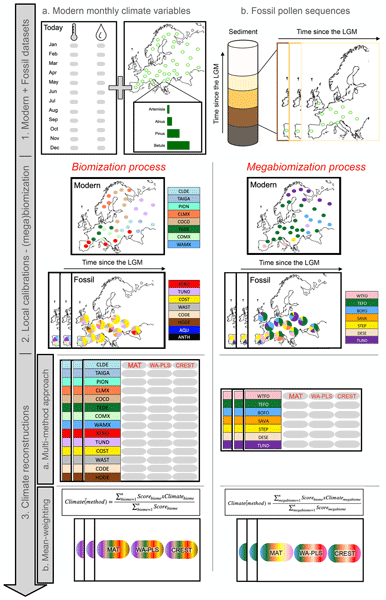
Abstract. Pollen records are one of the most spatially and temporally resolved proxies for reconstructing past vegetation dynamics, environmental changes and climate variability. Over the past decade, a large variety of methods based on different ecological or mathematical concepts has been used to reconstruct paleoclimatic conditions from pollen assemblages. However, the accuracy of these climate reconstructions strongly depends on the choice of the modern calibration dataset, the taxonomic resolution, and/or the modelling assumptions. The lack of a univocal response still limits the application of pollen-based climate reconstructions to assess key climate changes over multiple time periods especially during the Last Glacial Maximum (LGM, ~23–19 kyr BP). Here, we present a multi-method approach, including the Modern Analogue Technique (MAT), the Weighted Averaging Partial Least Squares regression (WA-PLS) and the probability density function-based Climate REconstruction SofTware (CREST), to reconstruct European climates during the LGM. The quality and performance of our climate reconstructions show strong heterogeneity when based on large calibration datasets encompassing wide climatic and vegetation gradients, making local sampling for climate reconstructions difficult. Instead of sampling the global calibration dataset, we test the effect of the latest biomization and megabiomization methods (local calibrations based on megabiome procedures) on climate reconstructions by introducing a new biome-based approach. Unlike previous studies, we use the weighted mean of climate variables from all megabiome scores rather than only considering the dominant (i.e., highest score) megabiome. This significantly reduces some of the statistical noise of climate reconstructions, drastically minimizing threshold and non-linear effects associated with megabiome classification changes. With these methodological advancements and our multi-method comparison, we evaluate the uncertainties (RMSEP) of the paleoclimate reconstructions for the LGM in Europe. Across climate reconstruction methods (MAT, WA-PLS and CREST methods), European LGM annual temperatures from the biomization method were on average 6.7±2.2 °C (mean SD) colder than today, consistent with megabiomization results (7.4±2.3 °C colder). Winter temperature (mean temperature of the coldest month, MTCO) results exhibit substantial spatial variability across Europe. Local calibration techniques significantly reduce uncertainties in LGM MTCO reconstructions, but they remain highly sensitive to the choice of calibration datasets.
Competing interests: At least one of the (co-)authors is a member of the editorial board of Climate of the Past. The peer-review process was guided by an independent editor, and the authors also have no other competing interests to declare.
Publisher's note: Copernicus Publications remains neutral with regard to jurisdictional claims made in the text, published maps, institutional affiliations, or any other geographical representation in this paper. While Copernicus Publications makes every effort to include appropriate place names, the final responsibility lies with the authors. Views expressed in the text are those of the authors and do not necessarily reflect the views of the publisher.-
Notice on discussion status
The requested preprint has a corresponding peer-reviewed final revised paper. You are encouraged to refer to the final revised version.
-
Preprint
(22582 KB)
-
Supplement
(8809 KB)
-
The requested preprint has a corresponding peer-reviewed final revised paper. You are encouraged to refer to the final revised version.
- Preprint
(22582 KB) - Metadata XML
-
Supplement
(8809 KB) - BibTeX
- EndNote
- Final revised paper


Journal article(s) based on this preprint
Interactive discussion
Status: closed
-
RC1: 'Comment on egusphere-2026-1590', Anonymous Referee #1, 29 Apr 2026
-
AC1: 'Reply on RC1', Gabriel Fénisse, 23 Jun 2026
The comment was uploaded in the form of a supplement: https://egusphere.copernicus.org/preprints/2026/egusphere-2026-1590/egusphere-2026-1590-AC1-supplement.pdf
-
AC1: 'Reply on RC1', Gabriel Fénisse, 23 Jun 2026
-
RC2: 'Comment on egusphere-2026-1590', Anonymous Referee #2, 10 May 2026
This study presents a methodologically innovative and well-organized contribution to Last Glacial Maximum (LGM) paleoclimate reconstruction in Europe. By integrating three complementary pollen-based methods (MAT, WA-PLS, and CREST) and introducing a novel (mega)biome affinity‑score weighted average approach, the authors effectively mitigate threshold effects and non‑linear biases inherent in traditional single‑biome dominance methods, thereby enhancing the robustness and spatial detail of temperature reconstructions. The paper is logically structured, with clear articulation of methods, comprehensive data handling, and rigorous cross‑validation; figures and tables effectively illustrate inter‑method consistency and regional anomalies. The open data and code further support reproducibility. Overall, this work provides valuable benchmarks for model–data comparisons and offers a transferable framework for improving paleoclimate reconstructions under non‑analogue conditions.
I recommend the paper for publication, but I have the following comments:
-
The quality of modern pollen data is more important than the methods themselves for climate reconstruction. I hope the authors can present the analogue quality for each pollen record and the locations of the best analogues for LGM fossil pollen spectra. I think the best analogues should be restricted to high altitudes and latitudes, but we need to know their locations and how many sites are involved.
-
The reconstruction results of the three methods (MAT, WA-PLS, and CREST) based on pollen percentage data should also be presented somewhere.
Line 71: It should be "~23–19 thousand years ago" (use an en dash).
Line 347: More importantly, the authors should present how many age determinations (or dating points) are available for each record during the LGM.
Line 395: However, the impression of higher quality of modern analogues may be false when temporal resolution is reduced. The biome approach for climate reconstruction might be a last resort for very long-term pollen records.
Citation: https://doi.org/10.5194/egusphere-2026-1590-RC2 -
AC2: 'Reply on RC2', Gabriel Fénisse, 23 Jun 2026
The comment was uploaded in the form of a supplement: https://egusphere.copernicus.org/preprints/2026/egusphere-2026-1590/egusphere-2026-1590-AC2-supplement.pdf
-
-
RC3: 'Comment on egusphere-2026-1590', Anonymous Referee #3, 10 May 2026
I found the manuscript submitted by Fenisse et al. to be very detailed and informative. Although I am not an expert in pollen analyses, their investigation seems highly valuable because it provides an honest attempt to address the complexities, challenges, and limitations of analyzing pollen data for paleoclimate reconstruction. The fact that they compare various approaches and techniques effectively highlights the inherent uncertainty that should be considered when analyzing such data, or when interpreting results derived from it. Overall, the manuscript is well written, and I found only a limited number of places where rewording or minor corrections would be beneficial.
One major suggestion concerns improving how the uncertainty associated with these analyses is presented. Specifically, the table on page 29 provides very broad ranges for each of the analyzed parameters, yet the authors focus primarily on mean values. For example, what does a value of −7 ±1/−12 actually convey? While this clearly suggests cooling, in reality it represents a very large range. I think the authors should make a stronger effort to present and discuss these uncertainties, as they are crucial for the paleoclimate community. Should modelers aim for −7, −10, or −20 in this region? Should geologists expect long-term glaciation or other features? This intercomparison project is a valuable opportunity to explore these uncertainties in greater depth and to indicate which records are more robust than others. For example, can the uncertainty be summarized spatially and temporally, perhaps through maps showing confidence levels alongside the reconstructed climatic parameters? Identifying and possibly excluding problematic archives (i.e., those with large discrepancies or variability), and visually indicating areas of substantial uncertainty, would significantly strengthen the impact of the study.
Minor suggestions:
L22 – Replace “resolved” with “utilized.” “Resolved” implies a definitive interpretation, whereas pollen data have multiple limitations (e.g., source area, sedimentation regime, preservation).
L61 – Similarly, consider replacing “robust” with a milder term.
L66 – Please provide examples of such “key periods.”
L72 – Revise the time notation according to the journal’s policy (e.g., ky, ka).
L75 – Please rephrase: the methods are not developed from pollen data, but rather utilize pollen data.
L149 – Please explain what “physiognomic” means.
L214 – Use “ranges from X to Y.”
L297 – Please plot the data on a map alongside current Köppen–Geiger climate and vegetation groups.
Page 10 – The table contains many acronyms that should be explained in the caption.
L365 – Please clarify what is meant by “harmonized,” including the specific procedures used (e.g., labeling, data organization).
L373 – Please include scatter plots illustrating relationships between key geographic variables (latitude, altitude, distance from the ocean) and the main climatic variables (mean temperature, precipitation, hottest/coldest month, wettest/driest periods).
L433 – Please present the RMSE as an equation for the readers.
L462 – Replace “to” with “from.”
L528 – This section is somewhat confusing, as it reads like an RMSE is being calculated from a categorical classification. Please clarify and revise.
L695 – Why is the word “correlation” in parentheses?Citation: https://doi.org/10.5194/egusphere-2026-1590-RC3 -
AC3: 'Reply on RC3', Gabriel Fénisse, 23 Jun 2026
The comment was uploaded in the form of a supplement: https://egusphere.copernicus.org/preprints/2026/egusphere-2026-1590/egusphere-2026-1590-AC3-supplement.pdf
-
AC3: 'Reply on RC3', Gabriel Fénisse, 23 Jun 2026
Peer review completion


Interactive discussion
Status: closed
-
RC1: 'Comment on egusphere-2026-1590', Anonymous Referee #1, 29 Apr 2026
## Overview
This ms reconstructs LGM climate from pollen using a new method that begins with a biomisation step, followed by reconstructions based on modern samples from that each biome which are weighted according to the biome score to give the final reconstruction.
I can understand the motivation for the proposed method.
Reconstructions based on continental scale calibration sets can give poor reconstructions, perhaps because of large secondary climate gradients, perhaps because taxa with wide climatic tolerances create bad analogues.One option would be to restrict the transfer function to base reconstructions only on calibration set samples from the same biome as the fossil sample. However uncertainty in assigning the fossil sample to a biome would lead to biases and instability in reconstructions from adjacent samples assigned to different biomes because of small differences in pollen assemblage composition.
The proposed method is analogous to model averaging with AIC weights.
However, the AIC weights are the probability that each model is the best of a set of candidate models.
Biome scores (even after transformation to have a unit sum) are not the probability of each biome occurring, so the weighted sum of reconstructions based on each biome may be a biased estimate of the climatic conditions. (If the authors believe biome affinity scores can be transformed into probabilities, they need to fully justify this).It might be worth trying the biomisation method devised by Cruz-Silva et al (2022; https://doi.org/10.1111/jbi.14448) who report that their method gives approximate probabilities of a pollen sample belonging to each biome.
## Cross-validation
The methods, should be reorganised to start with the modern and then fossil pollen data, then the biomisation, followed by the transfer function methods. In the results, the cross-validation preformance should be shown before the LGM reconstructions.
The cross-validation scheme should mimic the analysis used to reconstruct climate from the fossil data.
As far as I can tell from the description and partial code (see below), this has not been done.
The past climate estimated as the weighted mean of the reconstructions based on each biome, whereas the cross-validation is based only on one biome.
This likely biases the model performance.
Once consequence of this is that the uncertainties reported for the reconstructions are likely to be incorrect.## Modern biomes
I'm surprised to see that the biomisation scheme finds temperate forest on Svalbard. There are no trees on Svalbard; even _Betula nana_ is scarce.
The sample is Lomonosovfonna, this is a glacier sample, not a lake as the data report (the previous sample Vuoskkujávri is a lake not a glacier, and its elevation is wrong - please check if the data have further issues). Little of the pollen at Lomonosovfonna is from local sources (see the original paper), most has been transported from northern Scandinavia or further. Such extreme samples should probably be excluded to avoid them biasing the results. It should also be excluded because it, like a few other samples, has a very low pollen count (27 grains), and such low count sums cannot be expected to give a reliable reconstruction.I'm also surprised that most of the Scandinavian + Western Siberian modern megabiomes are marked as temperate forest, with a few tundra locations.
This contradicts Dallmeyer et al 2019 which limits temperate forest to about 60˚N in Scandinavia + Siberia with boreal forest covering most of the area. The ms should, at a minimum, explain why it extends temperate forest into the spruce and pine dominated northern forests. It's possible that there is an error somewhere in the analysis, the authors should make sure it does not also affect the LGM reconstructionsTo try to better understand what the authors have done, I looked at the provided R code.
The code is not easy to read, having few comments and not being well formatted (the R package `styler` can ameliorate this latter problem instantly), and does not run as it is cannot find the files it is trying to import.
This is not simply a working directory problem; the files are missing.The problems seems to be that the provided code is only a fragment of the total code used.
Some other code has been used to pre-process the provided raw data and split it into a multitude of files.
This code should also be provided, as well the code use to make the maps, figures, tables etc.
The code should be possible for the reader to run once and get all the results.
The current code appears to need running repeatedly with different lines commented out. I would recommend making functions to encapsulate the logic so it can be run repeatedly.The biomisation code used is sufficient, but makes no check that pollen types are assigned to plant functional types. If pollen types are not assigned, the biomisation procedure will be biased.
## Citations and bibliography
The citations and bibliography need more attention.
I checked two authors and found errors with both.
The ms cites:- Birks et al., 2004 - perhaps Birks and Seppä, 2004
- Birks et al., 1005 - obviously wrong year
- Birks and Seppä, 2010 - wrong year
- Ter Braak and Looman, 1986 - not in bibliography (I also don't think this paper, written several years before the development of WAPLS, should be used to describe WAPLS).The number of errors suggests that the authors are not using citation management software: zotero, jabref, endnote - take your pick, all are better than writing references by hand.
## Figures
Figures 1 & 2 have STEP in yellow and DESE in beige.
Whereas figure 3 has STEP in beige, SAVA in yellow and no DESE.
Obviously, there should be a consistent colour scheme and choice of megabiomes.
I find the yellow and beige difficult to distinguish in figure 3 because of the low contrast.Figure 3 just shows the dominant biomes. Would it be possible to make, at least for some lakes a plot of biome affinity against time, especially for the LGM.
Figure 4 seems to show that few of the samples from Lac du Bouchet (please don't switch from Lac to Lake) have highest biome affinity to temperate forest during the LGM. I'm not sure which of the site on fig 3 is Lac du Bouchet, but many of the sites show a lot of temperate forest, even near the glacial limits. I'm missing the information I need to understand this surprising result, and really don't want to have to run the partial code in its current state.
Appendix 1C I would recommend a continuous colour scale for this plot. I doubt the current colour scale is particularly accessible for people with colour deficient vision.
Appendix 4 Why are some points outlined in black and others not?
I don't see a red contour.## Mostly Minor points
I'm sure the two parts of table 2 can be merged.
241. All the methods used here could be described as statistical.
524 "WGS84 projection" the projection used to plot the data is not especially relevant (and figure 2 is not a WGS84 projection).
544 "The lack of data in Eastern Europe results in an underrepresentation of cold modern climate conditions." I'm no longer sure what is meant by Eastern Europe. Its a term with a diverging geographic and political meanings. What I think of as Eastern Europe, isn't particularly cold compared to Finland. Perhaps Western Siberia instead.
603 I have failed to parse this long sentence.
560 "biomization also helps reduce the impact of the non-analogue effect" This statement needs supporting evidence.736 "increase" - from the context, I was expecting "decease", but see above comments on the cross-validation scheme.
Table 3 would be more useful in an appendix. At the moment it is very large, and will be difficult to extract data from it.
865 I suspect the seasonal anomalies have little skill. This doubt could be assuaged by showing that this method has skill in a robust cross-validation analysis. It would probably help to explain how a seasonal anomaly should be interpreted - positive anomalies indicate increased seasonality wrt modern?
952 Any discussion of the apparently good performance of MAT without mentioning that MAT is extremely susceptible to spatial autocorrelation and its performance statistics can be very misleading is flawed.
1077 "performs well for pollen taxa with low taxonomic resolution". This statement needs supporting evidence.
The authorship contribution statement is inadequate, describing only the writing and editing stages. Please see the CREDIT taxonomy for other roles which can be recorded.
Citation: https://doi.org/10.5194/egusphere-2026-1590-RC1 -
AC1: 'Reply on RC1', Gabriel Fénisse, 23 Jun 2026
The comment was uploaded in the form of a supplement: https://egusphere.copernicus.org/preprints/2026/egusphere-2026-1590/egusphere-2026-1590-AC1-supplement.pdf
-
AC1: 'Reply on RC1', Gabriel Fénisse, 23 Jun 2026
-
RC2: 'Comment on egusphere-2026-1590', Anonymous Referee #2, 10 May 2026
This study presents a methodologically innovative and well-organized contribution to Last Glacial Maximum (LGM) paleoclimate reconstruction in Europe. By integrating three complementary pollen-based methods (MAT, WA-PLS, and CREST) and introducing a novel (mega)biome affinity‑score weighted average approach, the authors effectively mitigate threshold effects and non‑linear biases inherent in traditional single‑biome dominance methods, thereby enhancing the robustness and spatial detail of temperature reconstructions. The paper is logically structured, with clear articulation of methods, comprehensive data handling, and rigorous cross‑validation; figures and tables effectively illustrate inter‑method consistency and regional anomalies. The open data and code further support reproducibility. Overall, this work provides valuable benchmarks for model–data comparisons and offers a transferable framework for improving paleoclimate reconstructions under non‑analogue conditions.
I recommend the paper for publication, but I have the following comments:
-
The quality of modern pollen data is more important than the methods themselves for climate reconstruction. I hope the authors can present the analogue quality for each pollen record and the locations of the best analogues for LGM fossil pollen spectra. I think the best analogues should be restricted to high altitudes and latitudes, but we need to know their locations and how many sites are involved.
-
The reconstruction results of the three methods (MAT, WA-PLS, and CREST) based on pollen percentage data should also be presented somewhere.
Line 71: It should be "~23–19 thousand years ago" (use an en dash).
Line 347: More importantly, the authors should present how many age determinations (or dating points) are available for each record during the LGM.
Line 395: However, the impression of higher quality of modern analogues may be false when temporal resolution is reduced. The biome approach for climate reconstruction might be a last resort for very long-term pollen records.
Citation: https://doi.org/10.5194/egusphere-2026-1590-RC2 -
AC2: 'Reply on RC2', Gabriel Fénisse, 23 Jun 2026
The comment was uploaded in the form of a supplement: https://egusphere.copernicus.org/preprints/2026/egusphere-2026-1590/egusphere-2026-1590-AC2-supplement.pdf
-
-
RC3: 'Comment on egusphere-2026-1590', Anonymous Referee #3, 10 May 2026
I found the manuscript submitted by Fenisse et al. to be very detailed and informative. Although I am not an expert in pollen analyses, their investigation seems highly valuable because it provides an honest attempt to address the complexities, challenges, and limitations of analyzing pollen data for paleoclimate reconstruction. The fact that they compare various approaches and techniques effectively highlights the inherent uncertainty that should be considered when analyzing such data, or when interpreting results derived from it. Overall, the manuscript is well written, and I found only a limited number of places where rewording or minor corrections would be beneficial.
One major suggestion concerns improving how the uncertainty associated with these analyses is presented. Specifically, the table on page 29 provides very broad ranges for each of the analyzed parameters, yet the authors focus primarily on mean values. For example, what does a value of −7 ±1/−12 actually convey? While this clearly suggests cooling, in reality it represents a very large range. I think the authors should make a stronger effort to present and discuss these uncertainties, as they are crucial for the paleoclimate community. Should modelers aim for −7, −10, or −20 in this region? Should geologists expect long-term glaciation or other features? This intercomparison project is a valuable opportunity to explore these uncertainties in greater depth and to indicate which records are more robust than others. For example, can the uncertainty be summarized spatially and temporally, perhaps through maps showing confidence levels alongside the reconstructed climatic parameters? Identifying and possibly excluding problematic archives (i.e., those with large discrepancies or variability), and visually indicating areas of substantial uncertainty, would significantly strengthen the impact of the study.
Minor suggestions:
L22 – Replace “resolved” with “utilized.” “Resolved” implies a definitive interpretation, whereas pollen data have multiple limitations (e.g., source area, sedimentation regime, preservation).
L61 – Similarly, consider replacing “robust” with a milder term.
L66 – Please provide examples of such “key periods.”
L72 – Revise the time notation according to the journal’s policy (e.g., ky, ka).
L75 – Please rephrase: the methods are not developed from pollen data, but rather utilize pollen data.
L149 – Please explain what “physiognomic” means.
L214 – Use “ranges from X to Y.”
L297 – Please plot the data on a map alongside current Köppen–Geiger climate and vegetation groups.
Page 10 – The table contains many acronyms that should be explained in the caption.
L365 – Please clarify what is meant by “harmonized,” including the specific procedures used (e.g., labeling, data organization).
L373 – Please include scatter plots illustrating relationships between key geographic variables (latitude, altitude, distance from the ocean) and the main climatic variables (mean temperature, precipitation, hottest/coldest month, wettest/driest periods).
L433 – Please present the RMSE as an equation for the readers.
L462 – Replace “to” with “from.”
L528 – This section is somewhat confusing, as it reads like an RMSE is being calculated from a categorical classification. Please clarify and revise.
L695 – Why is the word “correlation” in parentheses?Citation: https://doi.org/10.5194/egusphere-2026-1590-RC3 -
AC3: 'Reply on RC3', Gabriel Fénisse, 23 Jun 2026
The comment was uploaded in the form of a supplement: https://egusphere.copernicus.org/preprints/2026/egusphere-2026-1590/egusphere-2026-1590-AC3-supplement.pdf
-
AC3: 'Reply on RC3', Gabriel Fénisse, 23 Jun 2026
Peer review completion
Journal article(s) based on this preprint
Viewed
| HTML | XML | Total | Supplement | BibTeX | EndNote | |
|---|---|---|---|---|---|---|
| 733 | 396 | 52 | 1,181 | 79 | 59 | 70 |
- HTML: 733
- PDF: 396
- XML: 52
- Total: 1,181
- Supplement: 79
- BibTeX: 59
- EndNote: 70
Viewed (geographical distribution)
| Country | # | Views | % |
|---|
| Total: | 0 |
| HTML: | 0 |
| PDF: | 0 |
| XML: | 0 |
- 1
Gabriel Fénisse

Manuel Chevalier
Odile Peyron
David Vincent Bekaert
Pierre-Henri Blard
The requested preprint has a corresponding peer-reviewed final revised paper. You are encouraged to refer to the final revised version.
- Preprint
(22582 KB) - Metadata XML
-
Supplement
(8809 KB) - BibTeX
- EndNote
- Final revised paper
## Overview
This ms reconstructs LGM climate from pollen using a new method that begins with a biomisation step, followed by reconstructions based on modern samples from that each biome which are weighted according to the biome score to give the final reconstruction.
I can understand the motivation for the proposed method.
Reconstructions based on continental scale calibration sets can give poor reconstructions, perhaps because of large secondary climate gradients, perhaps because taxa with wide climatic tolerances create bad analogues.
One option would be to restrict the transfer function to base reconstructions only on calibration set samples from the same biome as the fossil sample. However uncertainty in assigning the fossil sample to a biome would lead to biases and instability in reconstructions from adjacent samples assigned to different biomes because of small differences in pollen assemblage composition.
The proposed method is analogous to model averaging with AIC weights.
However, the AIC weights are the probability that each model is the best of a set of candidate models.
Biome scores (even after transformation to have a unit sum) are not the probability of each biome occurring, so the weighted sum of reconstructions based on each biome may be a biased estimate of the climatic conditions. (If the authors believe biome affinity scores can be transformed into probabilities, they need to fully justify this).
It might be worth trying the biomisation method devised by Cruz-Silva et al (2022; https://doi.org/10.1111/jbi.14448) who report that their method gives approximate probabilities of a pollen sample belonging to each biome.
## Cross-validation
The methods, should be reorganised to start with the modern and then fossil pollen data, then the biomisation, followed by the transfer function methods. In the results, the cross-validation preformance should be shown before the LGM reconstructions.
The cross-validation scheme should mimic the analysis used to reconstruct climate from the fossil data.
As far as I can tell from the description and partial code (see below), this has not been done.
The past climate estimated as the weighted mean of the reconstructions based on each biome, whereas the cross-validation is based only on one biome.
This likely biases the model performance.
Once consequence of this is that the uncertainties reported for the reconstructions are likely to be incorrect.
## Modern biomes
I'm surprised to see that the biomisation scheme finds temperate forest on Svalbard. There are no trees on Svalbard; even _Betula nana_ is scarce.
The sample is Lomonosovfonna, this is a glacier sample, not a lake as the data report (the previous sample Vuoskkujávri is a lake not a glacier, and its elevation is wrong - please check if the data have further issues). Little of the pollen at Lomonosovfonna is from local sources (see the original paper), most has been transported from northern Scandinavia or further. Such extreme samples should probably be excluded to avoid them biasing the results. It should also be excluded because it, like a few other samples, has a very low pollen count (27 grains), and such low count sums cannot be expected to give a reliable reconstruction.
I'm also surprised that most of the Scandinavian + Western Siberian modern megabiomes are marked as temperate forest, with a few tundra locations.
This contradicts Dallmeyer et al 2019 which limits temperate forest to about 60˚N in Scandinavia + Siberia with boreal forest covering most of the area. The ms should, at a minimum, explain why it extends temperate forest into the spruce and pine dominated northern forests. It's possible that there is an error somewhere in the analysis, the authors should make sure it does not also affect the LGM reconstructions
To try to better understand what the authors have done, I looked at the provided R code.
The code is not easy to read, having few comments and not being well formatted (the R package `styler` can ameliorate this latter problem instantly), and does not run as it is cannot find the files it is trying to import.
This is not simply a working directory problem; the files are missing.
The problems seems to be that the provided code is only a fragment of the total code used.
Some other code has been used to pre-process the provided raw data and split it into a multitude of files.
This code should also be provided, as well the code use to make the maps, figures, tables etc.
The code should be possible for the reader to run once and get all the results.
The current code appears to need running repeatedly with different lines commented out. I would recommend making functions to encapsulate the logic so it can be run repeatedly.
The biomisation code used is sufficient, but makes no check that pollen types are assigned to plant functional types. If pollen types are not assigned, the biomisation procedure will be biased.
## Citations and bibliography
The citations and bibliography need more attention.
I checked two authors and found errors with both.
The ms cites:
- Birks et al., 2004 - perhaps Birks and Seppä, 2004
- Birks et al., 1005 - obviously wrong year
- Birks and Seppä, 2010 - wrong year
- Ter Braak and Looman, 1986 - not in bibliography (I also don't think this paper, written several years before the development of WAPLS, should be used to describe WAPLS).
The number of errors suggests that the authors are not using citation management software: zotero, jabref, endnote - take your pick, all are better than writing references by hand.
## Figures
Figures 1 & 2 have STEP in yellow and DESE in beige.
Whereas figure 3 has STEP in beige, SAVA in yellow and no DESE.
Obviously, there should be a consistent colour scheme and choice of megabiomes.
I find the yellow and beige difficult to distinguish in figure 3 because of the low contrast.
Figure 3 just shows the dominant biomes. Would it be possible to make, at least for some lakes a plot of biome affinity against time, especially for the LGM.
Figure 4 seems to show that few of the samples from Lac du Bouchet (please don't switch from Lac to Lake) have highest biome affinity to temperate forest during the LGM. I'm not sure which of the site on fig 3 is Lac du Bouchet, but many of the sites show a lot of temperate forest, even near the glacial limits. I'm missing the information I need to understand this surprising result, and really don't want to have to run the partial code in its current state.
Appendix 1C I would recommend a continuous colour scale for this plot. I doubt the current colour scale is particularly accessible for people with colour deficient vision.
Appendix 4 Why are some points outlined in black and others not?
I don't see a red contour.
## Mostly Minor points
I'm sure the two parts of table 2 can be merged.
241. All the methods used here could be described as statistical.
524 "WGS84 projection" the projection used to plot the data is not especially relevant (and figure 2 is not a WGS84 projection).
544 "The lack of data in Eastern Europe results in an underrepresentation of cold modern climate conditions." I'm no longer sure what is meant by Eastern Europe. Its a term with a diverging geographic and political meanings. What I think of as Eastern Europe, isn't particularly cold compared to Finland. Perhaps Western Siberia instead.
603 I have failed to parse this long sentence.
560 "biomization also helps reduce the impact of the non-analogue effect" This statement needs supporting evidence.
736 "increase" - from the context, I was expecting "decease", but see above comments on the cross-validation scheme.
Table 3 would be more useful in an appendix. At the moment it is very large, and will be difficult to extract data from it.
865 I suspect the seasonal anomalies have little skill. This doubt could be assuaged by showing that this method has skill in a robust cross-validation analysis. It would probably help to explain how a seasonal anomaly should be interpreted - positive anomalies indicate increased seasonality wrt modern?
952 Any discussion of the apparently good performance of MAT without mentioning that MAT is extremely susceptible to spatial autocorrelation and its performance statistics can be very misleading is flawed.
1077 "performs well for pollen taxa with low taxonomic resolution". This statement needs supporting evidence.
The authorship contribution statement is inadequate, describing only the writing and editing stages. Please see the CREDIT taxonomy for other roles which can be recorded.