
the Creative Commons Attribution 4.0 License.
the Creative Commons Attribution 4.0 License.
 | 09 Apr 2026
Variability of Snow over Antarctic late summer sea ice on different spatial scales
Abstract. Snow on Antarctic sea ice strongly affects thermodynamic processes, sea ice mass balance, and microwave remote sensing, yet its spatial variability and characteristic length scales remain poorly quantified. The aim of this study is to provide a spatially extensive, layer-resolved characterization of Antarctic late-summer snow on sea ice and, for the first time, to quantify the variability of snow properties and their horizontal correlation length scales on first-year (FYI) and multi-year ice (MYI). We use a unique combination of manual snow pit observations and more than 900 SnowMicroPen (SMP) profiles collected along meter-scale transects during three expeditions in the Weddell Sea between 2018 and 2021. Snow stratigraphy and microstructural classes were derived from SMP force data using a supervised one-dimensional convolutional neural network trained on manually classified SMP profiles. Across both regimes, intrinsic properties of individual snow types, including density and specific surface area, were remarkably similar. Differences between FYI and MYI instead arise from contrasting snowpack structure, snow type fractions, and spatial coherence, with MYI characterized by a higher prevalence of dense melt-freeze layers and enhanced vertical heterogeneity. Spatial autocorrelation analyses reveal pronounced scale-dependent variability, with snow properties on FYI decorrelating over short distances, while MYI exhibits substantially higher spatial coherence. Individual ice floes capture only about 50 % of the variability characteristic of their respective ice regime, underscoring fundamental limits to the representativeness of point measurements. A hierarchy of variability emerges, in which snow type fractions and layer thickness dominate snowpack heterogeneity, while bulk snow density is comparatively homogeneous across spatial scales. These results demonstrate that Antarctic summer snow variability is governed primarily by stratigraphic composition and ice-regime-dependent snowpack evolution rather than bulk-integrated properties. These findings emphasize the need for spatially distributed observations and stratigraphy-aware parameterizations to improve the representation of snow on Antarctic sea ice in remote-sensing applications and sea ice and climate models.
-
Notice on discussion status
The requested preprint has a corresponding peer-reviewed final revised paper. You are encouraged to refer to the final revised version.
-
Preprint
(2161 KB)
-
The requested preprint has a corresponding peer-reviewed final revised paper. You are encouraged to refer to the final revised version.
- Preprint
(2161 KB) - Metadata XML
- BibTeX
- EndNote
- Final revised paper


Journal article(s) based on this preprint
Interactive discussion
Status: closed
-
RC1: 'Comment on egusphere-2026-1588', Martin Schneebeli, 10 May 2026
- AC1: 'Reply on RC1', Daria Paul, 03 Aug 2026
-
RC2: 'Comment on egusphere-2026-1588', Anonymous Referee #2, 25 Jun 2026
The comment was uploaded in the form of a supplement: https://egusphere.copernicus.org/preprints/2026/egusphere-2026-1588/egusphere-2026-1588-RC2-supplement.pdf
- AC2: 'Reply on RC2', Daria Paul, 03 Aug 2026
Peer review completion


Interactive discussion
Status: closed
-
RC1: 'Comment on egusphere-2026-1588', Martin Schneebeli, 10 May 2026
General comments
The article demonstrates that mechanical snow profiles can be statistically evaluated and stratigraphic features reconstructed. Traditional snow profiles are limited in number due to limitation of field work. Using 921 snowmicropen profiles from different expeditions, the authors build on the work of Kaltenborn et al, who demonstrated the use of machine-learning methods to evaluate highly resolved force profiles in snow. Based on their parameterisation and algorithm, significant differences between first-year and multi-year ice floes are quantified.The statistical quantification of snow properties is an important step towards synthetic modelling of the snowpack on Antarctic ice floes. The data are also essential to improve detailed snow pack models and develop stochastic modelling tools for these stratigraphically complex snowpacks. Concerning remote sensing, the data help to understand variation in albedo and microwave brightness temperatures. However, the article lacks standard statistical tests between observables.
On these lines, the paper is a major step towards a much more quantitative and statistically testable snowpack.
The paper is well structured. Propositions to improvements are detailed in the "Detailed comments". Figures should be adapted to the final format of TC, and the layout unified.
Detailed comments
Title: could be more specific, eg.
Different spatial scales and snow stratigraphy between first- and multiyear ice floes in the Weddell Sea, AntarcticaIntroduction: compare here the difference to the Arctic sea ice, cite the work of Sturm et al.
line 22: a short introductory paragraph on the work in the Arctic on sea ice (traditional: Sturm et al, SMP the pioneering work of King, then the MOSAiC ) that forms in many ways the base to improved methods for the Antarctic.
(This is to some degree covered in lines 68 ff, but it much more in detail)Lines 112-116: are the data of these other measurements available? Then cite data location, references. Otherwise delete
Figure 1: The background sea ice concentration is only for 2018. Likely it was different for 2019 and 2021 - relevant to the interpretation of the data? The geographic separation between PS111/PS124 (southeastern Weddell) and PS118 (northwestern Weddell) confounds the FYI/MYI comparison, since regime and region covary almost completely.
line 155: calculate a histogram of transect length and present. The calculation of autocorrelation are only statistically significant to about half of the total transect length (see Cliff & Ord 1981 on Moran's I confidence intervals).
line 163: why was the unmodified (?) Calonne parameters used? This model is calibrated to alpine snow at rather high snow temperature (average approx -5° C). Explicitly justify this choice and discuss potential biases.
line 214: "weighted Cross-Entropy Loss function": could you add a brief justification for the weighted version?
line 246 -248: repeated statement: "Rare ..." (cf line 209)
line 268: what do you mean by "and the finite vertical support of the SMP signal"?
line 274: "by a single operator": The authors acknowledge single-operator labelling as a source of subjectivity but do not discuss whether this represents the dominant source of uncertainty relative to the ambiguity of the SMP signal itself. A brief discussion of this hierarchy of uncertainties would strengthen Section 3.3.
line 293-297: paragraph repeated from the methods section (cf lines 120 ff)
Table 3 between FYI and MYI (density, layer thickness, SSA, snow type fractions) lacks any formal significance testing throughout the paper. A Welch's t-test or Wilcoxon rank-sum test would be straightforward additions.
line 320 "is closely related to the snow grain size": this is only the case in theory: see the paper by Painter, Thomas H., Noah P. Molotch, Maureen Cassidy, Mark Flanner, and Konrad Steffen. “Contact Spectroscopy for Determination of Stratigraphy of Snow Optical Grain Size.” Journal of Glaciology 53, no. 180 (2007): 121–27. https://doi.org/10.3189/172756507781833947.
line 347: replace "in the methods in Section 2.5" by "(see Section 2.5, page xx)"
Figure 7: very interesting data. I guess however that all values and interpretation beyond 30 m are spurious (see comment to line 155).
line 355 ff: Are this differences statistically significant? Perform a test.
5. Discussion
I wonder why you did not apply standard statistical tests too all your comparisons between FYI and MYI. Are the differences significant? Which differences are significant?The dataset has 19 FYI floes versus only 9 MYI floes, and the MYI floes are almost entirely from a single expedition (PS118). This is a notable limitation, as it could bias the spatial autocorrelation comparisons.
Practical recommendation for sampling in future campaigns?
Code availability: TC data policy request that the code must be made public. Without code results are irreproducible, as the machine-learning part depends on subjective choices. This is strong request for the next round of reviews.
Citation: https://doi.org/10.5194/egusphere-2026-1588-RC1 - AC1: 'Reply on RC1', Daria Paul, 03 Aug 2026
-
RC2: 'Comment on egusphere-2026-1588', Anonymous Referee #2, 25 Jun 2026
The comment was uploaded in the form of a supplement: https://egusphere.copernicus.org/preprints/2026/egusphere-2026-1588/egusphere-2026-1588-RC2-supplement.pdf
- AC2: 'Reply on RC2', Daria Paul, 03 Aug 2026
Peer review completion
Journal article(s) based on this preprint
Viewed
| HTML | XML | Total | BibTeX | EndNote | |
|---|---|---|---|---|---|
| 389 | 149 | 46 | 584 | 62 | 58 |
- HTML: 389
- PDF: 149
- XML: 46
- Total: 584
- BibTeX: 62
- EndNote: 58
Viewed (geographical distribution)
| Country | # | Views | % |
|---|
| Total: | 0 |
| HTML: | 0 |
| PDF: | 0 |
| XML: | 0 |
- 1

Danu Caus
Paul Keil
Christopher Kadow
Stefanie Arndt
The requested preprint has a corresponding peer-reviewed final revised paper. You are encouraged to refer to the final revised version.
- Preprint
(2161 KB) - Metadata XML
General comments
The article demonstrates that mechanical snow profiles can be statistically evaluated and stratigraphic features reconstructed. Traditional snow profiles are limited in number due to limitation of field work. Using 921 snowmicropen profiles from different expeditions, the authors build on the work of Kaltenborn et al, who demonstrated the use of machine-learning methods to evaluate highly resolved force profiles in snow. Based on their parameterisation and algorithm, significant differences between first-year and multi-year ice floes are quantified.
The statistical quantification of snow properties is an important step towards synthetic modelling of the snowpack on Antarctic ice floes. The data are also essential to improve detailed snow pack models and develop stochastic modelling tools for these stratigraphically complex snowpacks. Concerning remote sensing, the data help to understand variation in albedo and microwave brightness temperatures. However, the article lacks standard statistical tests between observables.
On these lines, the paper is a major step towards a much more quantitative and statistically testable snowpack.
The paper is well structured. Propositions to improvements are detailed in the "Detailed comments". Figures should be adapted to the final format of TC, and the layout unified.
Detailed comments
Title: could be more specific, eg.
Different spatial scales and snow stratigraphy between first- and multiyear ice floes in the Weddell Sea, Antarctica
Introduction: compare here the difference to the Arctic sea ice, cite the work of Sturm et al.
line 22: a short introductory paragraph on the work in the Arctic on sea ice (traditional: Sturm et al, SMP the pioneering work of King, then the MOSAiC ) that forms in many ways the base to improved methods for the Antarctic.
(This is to some degree covered in lines 68 ff, but it much more in detail)
Lines 112-116: are the data of these other measurements available? Then cite data location, references. Otherwise delete
Figure 1: The background sea ice concentration is only for 2018. Likely it was different for 2019 and 2021 - relevant to the interpretation of the data? The geographic separation between PS111/PS124 (southeastern Weddell) and PS118 (northwestern Weddell) confounds the FYI/MYI comparison, since regime and region covary almost completely.
line 155: calculate a histogram of transect length and present. The calculation of autocorrelation are only statistically significant to about half of the total transect length (see Cliff & Ord 1981 on Moran's I confidence intervals).
line 163: why was the unmodified (?) Calonne parameters used? This model is calibrated to alpine snow at rather high snow temperature (average approx -5° C). Explicitly justify this choice and discuss potential biases.
line 214: "weighted Cross-Entropy Loss function": could you add a brief justification for the weighted version?
line 246 -248: repeated statement: "Rare ..." (cf line 209)
line 268: what do you mean by "and the finite vertical support of the SMP signal"?
line 274: "by a single operator": The authors acknowledge single-operator labelling as a source of subjectivity but do not discuss whether this represents the dominant source of uncertainty relative to the ambiguity of the SMP signal itself. A brief discussion of this hierarchy of uncertainties would strengthen Section 3.3.
line 293-297: paragraph repeated from the methods section (cf lines 120 ff)
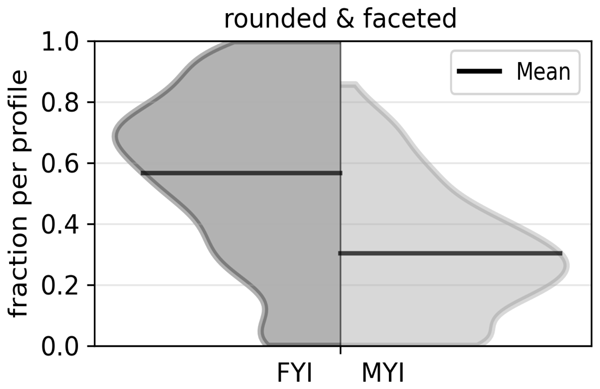
Table 3 between FYI and MYI (density, layer thickness, SSA, snow type fractions) lacks any formal significance testing throughout the paper. A Welch's t-test or Wilcoxon rank-sum test would be straightforward additions.
line 320 "is closely related to the snow grain size": this is only the case in theory: see the paper by Painter, Thomas H., Noah P. Molotch, Maureen Cassidy, Mark Flanner, and Konrad Steffen. “Contact Spectroscopy for Determination of Stratigraphy of Snow Optical Grain Size.” Journal of Glaciology 53, no. 180 (2007): 121–27. https://doi.org/10.3189/172756507781833947.
line 347: replace "in the methods in Section 2.5" by "(see Section 2.5, page xx)"
Figure 7: very interesting data. I guess however that all values and interpretation beyond 30 m are spurious (see comment to line 155).
line 355 ff: Are this differences statistically significant? Perform a test.
5. Discussion
I wonder why you did not apply standard statistical tests too all your comparisons between FYI and MYI. Are the differences significant? Which differences are significant?
The dataset has 19 FYI floes versus only 9 MYI floes, and the MYI floes are almost entirely from a single expedition (PS118). This is a notable limitation, as it could bias the spatial autocorrelation comparisons.
Practical recommendation for sampling in future campaigns?
Code availability: TC data policy request that the code must be made public. Without code results are irreproducible, as the machine-learning part depends on subjective choices. This is strong request for the next round of reviews.