
the Creative Commons Attribution 4.0 License.
the Creative Commons Attribution 4.0 License.
 | 31 Mar 2026
Changes in groundwater-surface water interactions following two centuries of irrigation practices and groundwater use in the Upper Ganges-Yamuna interfluve, North India.
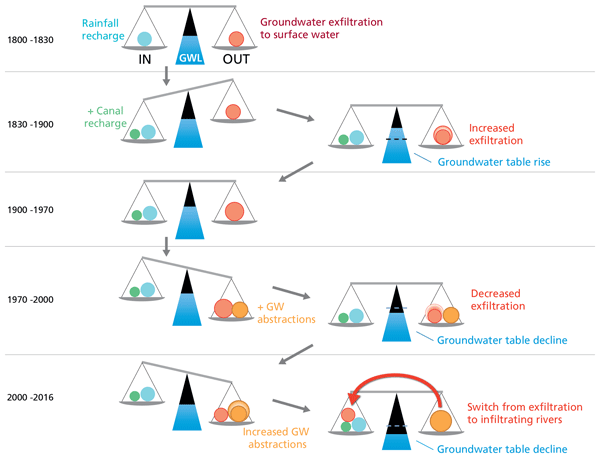
Abstract. The Indo-Gangetic Basin (IGB) is a global hotspot for groundwater overexploitation. Previous studies have shown that groundwater levels initially rose due to enhanced recharge following the construction of irrigation canals, but subsequently declined as agricultural, municipal, and industrial abstractions intensified. However, the relative impacts of separate recharge and abstraction components (precipitation, canal leakage infiltration, irrigation return flow, and irrigation, municipal and industrial abstraction), remain unclear, as do the effects on groundwater-surface water interactions and environmental flows. This study therefore aims to quantify spatio-temporal changes in groundwater recharge and abstraction components over the past two centuries and assess how these changes have impacted groundwater–surface water interactions in the Upper Ganges–Yamuna interfluve in northern India.
Groundwater model simulations indicate that canal water infiltration following canal construction after 1830 boosted recharge, but since the 1970s increased abstractions have lowered groundwater tables and reduced river exfiltration. Currently irrigation accounts for roughly 85 % of abstractions, with municipal (15 %) and industrial (< 1 %) uses accounting for much smaller shares. From around 2000, abstraction lowered groundwater tables to such an extent that local rivers likely shifted from draining to infiltrating conditions. As a result, groundwater–surface water interactions in local rivers may have fundamentally changed. This shift threatens environmental river flows, degrades surface water quality by limiting wastewater dilution, and harms groundwater quality where polluted river water infiltrates the aquifer, posing risks to both ecosystems and human health. Although both the Yamuna and the Ganges show reduced groundwater exfiltration, they are not (yet) infiltrating.
-
Notice on discussion status
The requested preprint has a corresponding peer-reviewed final revised paper. You are encouraged to refer to the final revised version.
-
Preprint
(1982 KB)
-
The requested preprint has a corresponding peer-reviewed final revised paper. You are encouraged to refer to the final revised version.
- Preprint
(1982 KB) - Metadata XML
- BibTeX
- EndNote
- Final revised paper


Journal article(s) based on this preprint
Interactive discussion
Status: closed
-
CC1: 'Comment on egusphere-2026-1584', Nima Zafarmomen, 06 Apr 2026
- AC3: 'Reply on CC1', Frank van Broekhoven, 09 Jun 2026
-
RC1: 'Comment on egusphere-2026-1584', Anonymous Referee #1, 16 Apr 2026
General comments
This is a well written paper that presents an interesting historical study on the recharge and water level dynamics of an area of the Indo-Gangetic Basin. The quantification of different sources of recharge over an almost two-hundred-year period using numerical modelling is novel and an important contribution. After moderate revisions I suspect the paper will be suitable for publication.
I have some overarching comments.
The apparent lack of model calibration and validation using in-situ groundwater level data is an important element of the analysis that is missing. Do you have any longer-term groundwater level records at all from this region? I think these would be useful as a sense check to your results. The time series length does not need to be as long as the modelled period, but some slightly longer timeseries data would really help. I think it would be worth trying to find some longer-term data. It is often available offline in local government offices. I would suspect at the very least it should be possible to get some water level data with timeseries staring sometime in the period from the 1950 - 1970s. Even if you can’t get continuous time series data, you could look at regional water level behaviour over a longer period, by collating a slightly more extensive water level dataset. At the very least it would be beneficial to present the groundwater level data you already have, but I do think it should be possible to find a little more longer-term data which would considerably improve the novelty and impact of the paper.
Can you use the groundwater level data you already have to illustrate how your model results compare to observed groundwater level trends during the period data is available?
Does your model account for the distribution canals that provide water to farmers fields? Is this accounted for implicitly in your irrigation return flows? Distribution canals are likely to play a significant role in the spatial variation of canal derived recharge in the region.
As the other reviewer has highlighted the lack of seasonality in your model has implications. For example, whether rivers are receiving or losing depends on the time of year and the range of water level fluctuation experienced in a year. The range of water level fluctuation in this region can be considerable. How might this impact your findings? How does lack of representation of seasonality more generally impact your findings?
You have made quite a lot in the summary and abstract of the threat to drinking water quality from losing rivers, but water quality isn’t something you explicitly model. So it might be worth being a little more cautious in your discussion about this.
Is it possible to present the data you compiled on groundwater abstractions and recharge in the manuscript or an appendix? It would be helpful to see the vector or raster datasets you compiled.
Specific comments
Short summary: the implication that losing waters from rivers to groundwater threatens drinking water supply isn’t inevitable. Without more context in the summary, I would reconsider the weight you attach to this conclusion.
Abstract: You say that ‘local rivers likely shifted from draining to infiltrating conditions’ and that ‘groundwater–surface water interactions in local rivers may have fundamentally changed’. It’s not clear in the abstract whether your model shows this effect explicitly or whether you infer this? It’s clear when reading the rest of the manuscript, but it needs to be made clearer here.
Likewise, the continued role of canals after 1970 is not clear in the abstract. You mention that they boosted recharge prior to 1970 but do they continue to recharge groundwater levels after this period?
Reading on the answers to these questions are clear, but they need to be made clearer in the abstract.
Introduction: arguably water resource development has been going on in the region for much longer than this. The Mughals actively managed water resources and there is evidence as far back as the Indus Valley civilisation of large-scale water resource development. To be more accurate you could say something like, ‘development of modern irrigation canal systems began in 1830 with the Eastern Yamuna irrigation canal’.
Figure 1: The model schematisation does not seem to include the canals. Is that correct?
2.2 MODFLOW 6 – model schematisation: it would be helpful to know why rivers and canals were simulated differently in your model.
2.3 Monte Carlo analysis and validation: How were the groundwater level data used to validate your model? Can you present some plots to show observed versus modelled water level changes?
3.2 Effects on groundwater table: You state that, ‘after 2000, groundwater tables declined further.’ Which appears to be based on Figure 8. However, it appears from Figure 7 that after this period groundwater decline slows and groundwater levels are arguably more stable. It would be helpful to clarify this apparent discrepancy.
Figure 8 and 10: The layout of these figures is quite confusing, I would suggest reconsidering the placement of the ‘natural situation’ and ‘current situation’ plots and their associated legends. At present it appears as if the legend on the left is for the plots it underlies and likewise on the right. However, I think the legend on the left is only for the ‘natural situation’ and ‘current situation’ plots.
4.1 Groundwater balance evolution over the past two centuries in the Upper Ganges-Yamuna interfluve: At the start of this section, you mention that changes in recharge and abstraction influence groundwater levels with a temporal delay, but this is the first time this temporal delay is mentioned. What is the temporal delay for the different recharge sources?
The discrepancy of your results with those observed by MacAllister et al. (2022) could also be related to a much less dense canal network in your study area and less continuous canal development through the 19th and 20th century.
4.2 Model uncertainties and limitations: Is the assumption of stable land use patterns over a nearly two-hundred-year period in this area really justified? This ties into the other reviewer’s comments.
4.3 Implications: It would be helpful to show evidence of the current extent of wastewater inputs to rivers. Do you have any data for this?
5 Conclusions: You conclude by saying unless substantial recharge enhancement occurs groundwater level decline is inevitable. However, India is investing in Managed Aquifer Recharge on a very large scale. It would be worth recognising this in your conclusions and/or discussions.
A.1 Irrigation groundwater demand: Is the 2011 census data the most recent data available? Could you not use consecutive census to better quantify changes with time?
Citation: https://doi.org/10.5194/egusphere-2026-1584-RC1 - AC1: 'Reply on RC1', Frank van Broekhoven, 09 Jun 2026
-
RC2: 'Comment on egusphere-2026-1584', Anonymous Referee #2, 28 Apr 2026
General Comments
This paper presents a novel and valuable contribution to understanding long-term groundwater dynamics in the Indo-Gangetic Basin. The two-century hindcast perspective is ambitious and the integration of multiple recharge and abstraction components addresses an important gap in the literature. After moderate revisions, I believe the paper will be suitable for publication.
My overarching concern is that the modelling methodology requires clearer description of what the model is actually predicting versus what is imposed through the forcing assumptions. In addition, further discussion on the challenges in constraining hindcast uncertainty (see Forstner et al. 2025) using the Monte Carlo framework would be valuable. Several clarifications would substantially strengthen the paper.
On the model conditioning and uncertainty framework
The section titled "Monte Carlo analysis and validation" describes an approach where 1,500 simulations are run and those meeting performance and realism criteria are retained. Could the authors clarify how this approach relates to formal data assimilation or history matching frameworks? In particular, Figure 3 shows that several posterior parameter distributions closely resemble their priors — could the authors discuss what this implies for the information content of the observations, and whether the reported uncertainty bounds reflect a genuinely updated posterior or primarily the prior parameter ranges? Related to this, could the authors reconsider the use of the term "validation" for this process, and "model validity" (line 197)?
As mentioned by the previous reviewer, is there additional observation data which could have been used to condition the posterior ensemble? For example, a key prediction is groundwater level trends, is there any available data on groundwater levels trends which could have informed the model ‘conditioning’ rather than only using absolute groundwater heads?
On goodness-of-fit and trend reproduction
The acceptance criteria of MAE ≤ 7.5 m and bias between ±5 m are noted. Could the authors discuss how confidently the reported ~2 m groundwater table decline (line 335) can be attributed to modelled processes given these thresholds? Furthermore, for a hindcasting study, could the authors demonstrate that accepted model runs reproduce observed groundwater level trends rather than just absolute head levels? Time series comparisons of observed versus modelled groundwater levels would considerably strengthen confidence in the results.
On model structure and predictive insight
The authors state at line 142 that the aim is to "capture overall temporal trends in a spatially distributed manner rather than precise estimates for each cell and time step." Given the relatively simple model structure (single layer, homogeneous aquifer) and that recharge and abstraction forcings dominate the output signal, could the authors more explicitly demonstrate what predictive insight the model contributes beyond what could be inferred directly from the forcing trends alone? This is particularly relevant to the SW-GW exchange conclusions, where model structural uncertainty may be as important as the parameter uncertainty quantified through the Monte Carlo approach.
Specific Comments
I would encourage the authors to use more precise terminology throughout — for example, referring to the accepted runs as a "posterior ensemble" and the filtering process as "rejection sampling" or "informal history matching" rather than "validation." The term "model validity" (line 197) should also be reconsidered. Similarly, “realizations” rather than “scenarios” (see Anderson et al, 2015) for multiple references to more widely used terminology in uncertainty quantification methods.
Line 70 (Aim): Could the authors clarify what the model is actually predicting — specifically, that groundwater table depth and SW-GW exchange fluxes are the primary model outputs, while the recharge and abstraction components are forcing terms whose uncertainty is propagated through the ensemble?
Line 109 ("multiple schematizations"): This phrasing is ambiguous. Please clarify whether this refers to multiple conceptual models or model realizations used in the uncertainty quantification.
Line 116 (yearly timesteps): Given that seasonal water table fluctuations in monsoon-dominated systems can exceed the magnitude of the long-term trends being studied, could the authors provide further justification for the annual timestep and discuss how this may affect the estimated timing and magnitude of the exfiltration-to-infiltration transition in the Hindon River?
Line 123 (CHD boundaries): Were the constant head boundaries for the Ganges and Yamuna held fixed over the full 200-year simulation? If so, could the authors discuss the potential influence of this assumption on results, given known changes to river stages from dam construction and diversions over this period?
Line 155 ("scenarios"): Consider replacing with "realizations" or "ensemble members" throughout, as these terms better reflect the probabilistic nature of the Monte Carlo approach.
Lines 181–190 (realism criteria): Could the authors discuss whether these filtering criteria introduce any systematic bias toward particular parameter combinations given the model doesn’t account for uncertainty in spatial heterogeneity in parameters? (ie. could the model be compensating for processes not captured numerically?) It would be useful to discuss how many realizations are filtered based on each criteria.
Figure 1.2: Could the authors clarify how irrigation canals are represented in the model conceptualization, and why rivers and canals were treated differently?
Figures 8 and 10: Could the authors be more explicit about which periods are being differenced (ie. from end of last period)?
Pre-1900 uncertainty bounds (Figure 5): Could the authors explain why there is an apparent narrowing of uncertainty bounds prior to 1900? Given this coincides with the inclusion of meterological data which captures greater interannual variability, could this indicate the hindcast uncertainty is being underpredicted?
Appendix A.6 (irrigation return flow): The return flow factor of 0.162 is applied uniformly across the domain. Could the authors discuss whether this uniform parameterisation may introduce systematic spatial bias, given known variability in irrigation method, soil type, and crop distribution across the region?
Citation: https://doi.org/10.5194/egusphere-2026-1584-RC2 - AC2: 'Reply on RC2', Frank van Broekhoven, 09 Jun 2026
Peer review completion


Interactive discussion
Status: closed
-
CC1: 'Comment on egusphere-2026-1584', Nima Zafarmomen, 06 Apr 2026
The manuscript presents a valuable and timely contribution to the field of hydrology, particularly in understanding long-term groundwater–surface water (GW-SW) interactions in heavily managed systems. By reconstructing two centuries of hydrological evolution using a physically based MODFLOW 6 framework, the study provides important insights into how irrigation development and groundwater abstraction have reshaped the hydrological regime in the Upper Ganges-Yamuna interfluve.
One of the key strengths of the paper is its long-term perspective (1800–2016), which is rarely achieved in groundwater studies and allows for a comprehensive understanding of system transitions from natural to human-dominated conditions. The integration of multiple recharge and abstraction components (e.g., canal leakage, irrigation return flow, sectoral water use) provides a holistic representation of groundwater balance dynamics, addressing an important gap in previous studies.
Overall, the manuscript is well-structured, methodologically sound, and highly relevant, and it significantly advances knowledge on anthropogenic impacts on groundwater systems. I will put some minor comments:
1) The manuscript assumes temporally constant spatial distributions for several components (e.g., land use, recharge patterns). While this is acknowledged, a brief discussion on how this assumption may affect historical reconstructions would strengthen the study.
2) The use of yearly time steps simplifies the system and excludes seasonal dynamics. A brief justification of why this does not affect key conclusions would be helpful.
3) While uncertainty is addressed through Monte Carlo simulations, a clearer distinction between input uncertainty and structural/model uncertainty would strengthen the discussion.
4) Given the focus on groundwater–surface water interactions, it would be valuable to acknowledge recent work. For example, “Assimilation of Sentinel‐based Leaf Area Index for Modeling Surface–Ground Water Interactions in Irrigation Districts.”
5) The manuscript could benefit from a slightly clearer comparison with previous regional/global groundwater studies to better highlight its novelty.
The manuscript is strong and suitable for publication after minor revisions. The suggested comments mainly aim to improve clarity and strengthen the interpretation rather than requiring substantial additional work.
Citation: https://doi.org/10.5194/egusphere-2026-1584-CC1 - AC3: 'Reply on CC1', Frank van Broekhoven, 09 Jun 2026
-
RC1: 'Comment on egusphere-2026-1584', Anonymous Referee #1, 16 Apr 2026
General comments
This is a well written paper that presents an interesting historical study on the recharge and water level dynamics of an area of the Indo-Gangetic Basin. The quantification of different sources of recharge over an almost two-hundred-year period using numerical modelling is novel and an important contribution. After moderate revisions I suspect the paper will be suitable for publication.
I have some overarching comments.
The apparent lack of model calibration and validation using in-situ groundwater level data is an important element of the analysis that is missing. Do you have any longer-term groundwater level records at all from this region? I think these would be useful as a sense check to your results. The time series length does not need to be as long as the modelled period, but some slightly longer timeseries data would really help. I think it would be worth trying to find some longer-term data. It is often available offline in local government offices. I would suspect at the very least it should be possible to get some water level data with timeseries staring sometime in the period from the 1950 - 1970s. Even if you can’t get continuous time series data, you could look at regional water level behaviour over a longer period, by collating a slightly more extensive water level dataset. At the very least it would be beneficial to present the groundwater level data you already have, but I do think it should be possible to find a little more longer-term data which would considerably improve the novelty and impact of the paper.
Can you use the groundwater level data you already have to illustrate how your model results compare to observed groundwater level trends during the period data is available?
Does your model account for the distribution canals that provide water to farmers fields? Is this accounted for implicitly in your irrigation return flows? Distribution canals are likely to play a significant role in the spatial variation of canal derived recharge in the region.
As the other reviewer has highlighted the lack of seasonality in your model has implications. For example, whether rivers are receiving or losing depends on the time of year and the range of water level fluctuation experienced in a year. The range of water level fluctuation in this region can be considerable. How might this impact your findings? How does lack of representation of seasonality more generally impact your findings?
You have made quite a lot in the summary and abstract of the threat to drinking water quality from losing rivers, but water quality isn’t something you explicitly model. So it might be worth being a little more cautious in your discussion about this.
Is it possible to present the data you compiled on groundwater abstractions and recharge in the manuscript or an appendix? It would be helpful to see the vector or raster datasets you compiled.
Specific comments
Short summary: the implication that losing waters from rivers to groundwater threatens drinking water supply isn’t inevitable. Without more context in the summary, I would reconsider the weight you attach to this conclusion.
Abstract: You say that ‘local rivers likely shifted from draining to infiltrating conditions’ and that ‘groundwater–surface water interactions in local rivers may have fundamentally changed’. It’s not clear in the abstract whether your model shows this effect explicitly or whether you infer this? It’s clear when reading the rest of the manuscript, but it needs to be made clearer here.
Likewise, the continued role of canals after 1970 is not clear in the abstract. You mention that they boosted recharge prior to 1970 but do they continue to recharge groundwater levels after this period?
Reading on the answers to these questions are clear, but they need to be made clearer in the abstract.
Introduction: arguably water resource development has been going on in the region for much longer than this. The Mughals actively managed water resources and there is evidence as far back as the Indus Valley civilisation of large-scale water resource development. To be more accurate you could say something like, ‘development of modern irrigation canal systems began in 1830 with the Eastern Yamuna irrigation canal’.
Figure 1: The model schematisation does not seem to include the canals. Is that correct?
2.2 MODFLOW 6 – model schematisation: it would be helpful to know why rivers and canals were simulated differently in your model.
2.3 Monte Carlo analysis and validation: How were the groundwater level data used to validate your model? Can you present some plots to show observed versus modelled water level changes?
3.2 Effects on groundwater table: You state that, ‘after 2000, groundwater tables declined further.’ Which appears to be based on Figure 8. However, it appears from Figure 7 that after this period groundwater decline slows and groundwater levels are arguably more stable. It would be helpful to clarify this apparent discrepancy.
Figure 8 and 10: The layout of these figures is quite confusing, I would suggest reconsidering the placement of the ‘natural situation’ and ‘current situation’ plots and their associated legends. At present it appears as if the legend on the left is for the plots it underlies and likewise on the right. However, I think the legend on the left is only for the ‘natural situation’ and ‘current situation’ plots.
4.1 Groundwater balance evolution over the past two centuries in the Upper Ganges-Yamuna interfluve: At the start of this section, you mention that changes in recharge and abstraction influence groundwater levels with a temporal delay, but this is the first time this temporal delay is mentioned. What is the temporal delay for the different recharge sources?
The discrepancy of your results with those observed by MacAllister et al. (2022) could also be related to a much less dense canal network in your study area and less continuous canal development through the 19th and 20th century.
4.2 Model uncertainties and limitations: Is the assumption of stable land use patterns over a nearly two-hundred-year period in this area really justified? This ties into the other reviewer’s comments.
4.3 Implications: It would be helpful to show evidence of the current extent of wastewater inputs to rivers. Do you have any data for this?
5 Conclusions: You conclude by saying unless substantial recharge enhancement occurs groundwater level decline is inevitable. However, India is investing in Managed Aquifer Recharge on a very large scale. It would be worth recognising this in your conclusions and/or discussions.
A.1 Irrigation groundwater demand: Is the 2011 census data the most recent data available? Could you not use consecutive census to better quantify changes with time?
Citation: https://doi.org/10.5194/egusphere-2026-1584-RC1 - AC1: 'Reply on RC1', Frank van Broekhoven, 09 Jun 2026
-
RC2: 'Comment on egusphere-2026-1584', Anonymous Referee #2, 28 Apr 2026
General Comments
This paper presents a novel and valuable contribution to understanding long-term groundwater dynamics in the Indo-Gangetic Basin. The two-century hindcast perspective is ambitious and the integration of multiple recharge and abstraction components addresses an important gap in the literature. After moderate revisions, I believe the paper will be suitable for publication.
My overarching concern is that the modelling methodology requires clearer description of what the model is actually predicting versus what is imposed through the forcing assumptions. In addition, further discussion on the challenges in constraining hindcast uncertainty (see Forstner et al. 2025) using the Monte Carlo framework would be valuable. Several clarifications would substantially strengthen the paper.
On the model conditioning and uncertainty framework
The section titled "Monte Carlo analysis and validation" describes an approach where 1,500 simulations are run and those meeting performance and realism criteria are retained. Could the authors clarify how this approach relates to formal data assimilation or history matching frameworks? In particular, Figure 3 shows that several posterior parameter distributions closely resemble their priors — could the authors discuss what this implies for the information content of the observations, and whether the reported uncertainty bounds reflect a genuinely updated posterior or primarily the prior parameter ranges? Related to this, could the authors reconsider the use of the term "validation" for this process, and "model validity" (line 197)?
As mentioned by the previous reviewer, is there additional observation data which could have been used to condition the posterior ensemble? For example, a key prediction is groundwater level trends, is there any available data on groundwater levels trends which could have informed the model ‘conditioning’ rather than only using absolute groundwater heads?
On goodness-of-fit and trend reproduction
The acceptance criteria of MAE ≤ 7.5 m and bias between ±5 m are noted. Could the authors discuss how confidently the reported ~2 m groundwater table decline (line 335) can be attributed to modelled processes given these thresholds? Furthermore, for a hindcasting study, could the authors demonstrate that accepted model runs reproduce observed groundwater level trends rather than just absolute head levels? Time series comparisons of observed versus modelled groundwater levels would considerably strengthen confidence in the results.
On model structure and predictive insight
The authors state at line 142 that the aim is to "capture overall temporal trends in a spatially distributed manner rather than precise estimates for each cell and time step." Given the relatively simple model structure (single layer, homogeneous aquifer) and that recharge and abstraction forcings dominate the output signal, could the authors more explicitly demonstrate what predictive insight the model contributes beyond what could be inferred directly from the forcing trends alone? This is particularly relevant to the SW-GW exchange conclusions, where model structural uncertainty may be as important as the parameter uncertainty quantified through the Monte Carlo approach.
Specific Comments
I would encourage the authors to use more precise terminology throughout — for example, referring to the accepted runs as a "posterior ensemble" and the filtering process as "rejection sampling" or "informal history matching" rather than "validation." The term "model validity" (line 197) should also be reconsidered. Similarly, “realizations” rather than “scenarios” (see Anderson et al, 2015) for multiple references to more widely used terminology in uncertainty quantification methods.
Line 70 (Aim): Could the authors clarify what the model is actually predicting — specifically, that groundwater table depth and SW-GW exchange fluxes are the primary model outputs, while the recharge and abstraction components are forcing terms whose uncertainty is propagated through the ensemble?
Line 109 ("multiple schematizations"): This phrasing is ambiguous. Please clarify whether this refers to multiple conceptual models or model realizations used in the uncertainty quantification.
Line 116 (yearly timesteps): Given that seasonal water table fluctuations in monsoon-dominated systems can exceed the magnitude of the long-term trends being studied, could the authors provide further justification for the annual timestep and discuss how this may affect the estimated timing and magnitude of the exfiltration-to-infiltration transition in the Hindon River?
Line 123 (CHD boundaries): Were the constant head boundaries for the Ganges and Yamuna held fixed over the full 200-year simulation? If so, could the authors discuss the potential influence of this assumption on results, given known changes to river stages from dam construction and diversions over this period?
Line 155 ("scenarios"): Consider replacing with "realizations" or "ensemble members" throughout, as these terms better reflect the probabilistic nature of the Monte Carlo approach.
Lines 181–190 (realism criteria): Could the authors discuss whether these filtering criteria introduce any systematic bias toward particular parameter combinations given the model doesn’t account for uncertainty in spatial heterogeneity in parameters? (ie. could the model be compensating for processes not captured numerically?) It would be useful to discuss how many realizations are filtered based on each criteria.
Figure 1.2: Could the authors clarify how irrigation canals are represented in the model conceptualization, and why rivers and canals were treated differently?
Figures 8 and 10: Could the authors be more explicit about which periods are being differenced (ie. from end of last period)?
Pre-1900 uncertainty bounds (Figure 5): Could the authors explain why there is an apparent narrowing of uncertainty bounds prior to 1900? Given this coincides with the inclusion of meterological data which captures greater interannual variability, could this indicate the hindcast uncertainty is being underpredicted?
Appendix A.6 (irrigation return flow): The return flow factor of 0.162 is applied uniformly across the domain. Could the authors discuss whether this uniform parameterisation may introduce systematic spatial bias, given known variability in irrigation method, soil type, and crop distribution across the region?
Citation: https://doi.org/10.5194/egusphere-2026-1584-RC2 - AC2: 'Reply on RC2', Frank van Broekhoven, 09 Jun 2026
Peer review completion
Journal article(s) based on this preprint
Data sets
Data and Code: Changes in groundwater-surface water interactions following two centuries of irrigation practices and groundwater use in the Upper Ganges-Yamuna interfluve, North India. Frank J. G. van Broekhoven https://doi.org/10.5281/zenodo.19131621
Viewed
| HTML | XML | Total | BibTeX | EndNote | |
|---|---|---|---|---|---|
| 624 | 241 | 65 | 930 | 33 | 42 |
- HTML: 624
- PDF: 241
- XML: 65
- Total: 930
- BibTeX: 33
- EndNote: 42
Viewed (geographical distribution)
| Country | # | Views | % |
|---|
| Total: | 0 |
| HTML: | 0 |
| PDF: | 0 |
| XML: | 0 |
- 1
Frank J. G. van Broekhoven

Stefan C. Dekker
Jasper Griffioen
Anjali Bhagwat
Paul P. Schot
The requested preprint has a corresponding peer-reviewed final revised paper. You are encouraged to refer to the final revised version.
- Preprint
(1982 KB) - Metadata XML
The manuscript presents a valuable and timely contribution to the field of hydrology, particularly in understanding long-term groundwater–surface water (GW-SW) interactions in heavily managed systems. By reconstructing two centuries of hydrological evolution using a physically based MODFLOW 6 framework, the study provides important insights into how irrigation development and groundwater abstraction have reshaped the hydrological regime in the Upper Ganges-Yamuna interfluve.
One of the key strengths of the paper is its long-term perspective (1800–2016), which is rarely achieved in groundwater studies and allows for a comprehensive understanding of system transitions from natural to human-dominated conditions. The integration of multiple recharge and abstraction components (e.g., canal leakage, irrigation return flow, sectoral water use) provides a holistic representation of groundwater balance dynamics, addressing an important gap in previous studies.
Overall, the manuscript is well-structured, methodologically sound, and highly relevant, and it significantly advances knowledge on anthropogenic impacts on groundwater systems. I will put some minor comments:
1) The manuscript assumes temporally constant spatial distributions for several components (e.g., land use, recharge patterns). While this is acknowledged, a brief discussion on how this assumption may affect historical reconstructions would strengthen the study.
2) The use of yearly time steps simplifies the system and excludes seasonal dynamics. A brief justification of why this does not affect key conclusions would be helpful.
3) While uncertainty is addressed through Monte Carlo simulations, a clearer distinction between input uncertainty and structural/model uncertainty would strengthen the discussion.
4) Given the focus on groundwater–surface water interactions, it would be valuable to acknowledge recent work. For example, “Assimilation of Sentinel‐based Leaf Area Index for Modeling Surface–Ground Water Interactions in Irrigation Districts.”
5) The manuscript could benefit from a slightly clearer comparison with previous regional/global groundwater studies to better highlight its novelty.
The manuscript is strong and suitable for publication after minor revisions. The suggested comments mainly aim to improve clarity and strengthen the interpretation rather than requiring substantial additional work.