
the Creative Commons Attribution 4.0 License.
the Creative Commons Attribution 4.0 License.
 | 24 Mar 2026
Five-channel TD-CEAS measurements of gaseous and particulate organic nitrates with NO/NO2 interference correction under high-NOx conditions
Abstract. Organic nitrates (ONs) are important temporary reservoirs of atmospheric NOx and, for sufficiently low-volatility species, contributors to secondary organic aerosol formation. However, online measurements of particle-phase ONs remain limited, hindering quantitative constraints on ON abundance and gas–particle partitioning. Here we present a five-channel thermal dissociation cavity-enhanced absorption spectrometer (TD–CEAS) for in situ, time-resolved measurements of NO2 and operationally defined ON classes in both the gas and particle phases. The instrument combines a room-temperature channel for ambient NO2 with thermal dissociation channels operated at 250 and 450 °C to quantify total peroxy nitrates (ΣPNs) and total alkyl nitrates (ΣANs), respectively. Gas–particle separation is achieved using paired inlet/filter configurations, and gas- and particle-phase ΣPNs and ΣANs are retrieved by channel differencing. The 1σ (1 s) detection limits are 49 pptv for gΣPNs, 49 pptv for pΣPNs, 48 pptv for gΣANs, and 68 pptv for pΣANs. Laboratory characterization included temperature-dependent dissociation measurements, cross-validation of PAN against GC–ECD (R2=0.988; slope = 0.987), and an operational calibration for particulate ΣANs using 2-ethylhexyl nitrate (recovery slope=1.036±0.028; method detection limit =0.029 µg NO2). Dedicated interference experiments showed that NO and NO2 can introduce substantial nonlinear biases in ΣPN measurements; these effects were parameterized using a multiple nonlinear regression model. The instrument was deployed at an urban site in Guangzhou during September–October 2025 and provided 6 min measurements of NO2, gas- and particle-phase ΣPNs, and gas- and particle-phase ΣANs under high-NOx conditions. During the October intensive period, corrected gas-phase ΣPNs covaried well with independently measured PAN (R2=0.83), and PAN accounted for 78 % of daytime gΣPNs. This five-channel TD–CEAS provides a framework for continuous observations of ON phase partitioning and reactive nitrogen processing in polluted urban atmospheres.
-
Notice on discussion status
The requested preprint has a corresponding peer-reviewed final revised paper. You are encouraged to refer to the final revised version.
-
Preprint
(1153 KB)
-
Supplement
(495 KB)
-
The requested preprint has a corresponding peer-reviewed final revised paper. You are encouraged to refer to the final revised version.
- Preprint
(1153 KB) - Metadata XML
-
Supplement
(495 KB) - BibTeX
- EndNote
- Final revised paper


Journal article(s) based on this preprint
Interactive discussion
Status: closed
-
RC1: 'Comment on egusphere-2026-1574', Anonymous Referee #1, 31 Mar 2026
-
AC1: 'Reply on RC1', Xinming Wang, 13 May 2026
The comment was uploaded in the form of a supplement: https://egusphere.copernicus.org/preprints/2026/egusphere-2026-1574/egusphere-2026-1574-AC1-supplement.pdf
-
AC1: 'Reply on RC1', Xinming Wang, 13 May 2026
-
RC2: 'Comment on egusphere-2026-1574', Anonymous Referee #2, 09 Apr 2026
This manuscript presents the development and validation of a five-channel thermal dissociation cavity-enhanced absorption spectrometer (TD-CEAS) for simultaneous, in situ measurements of gas-phase and particle-phase organic nitrates (ΣPNs and ΣANs), with a dedicated correction for NO/NO₂ interferences under high-NOₓ urban conditions. The topic is timely and important for atmospheric reactive nitrogen and aerosol research. The instrument design is logical, laboratory characterization is comprehensive, field deployment is convincing, and the interference correction method is technically innovative. Overall, the manuscript is well-structured and meets the publication standards. I recommend publication after minor revisions.
General comments:
- please strengthen comparison with existing particle-phase TD instruments, a brief detection-limit comparison is insufficient. Please add a systematic comparison with similar instruments in terms of time resolution, phase separation, interference control, and field usability.
- The authors mention that N₂O₅ and ClNO₂ may interfere with nighttime gas-phase measurements. Please provide quantitative estimates of interference magnitudes or clearly define the uncertainty and applicable scope of nighttime data.
- The manuscript uses filter configurations for gas–particle separation but does not characterize particle transmission efficiency, wall loss, or inlet adsorption effects for particulate organic nitrates. Please add discussions to quantify these artifacts.
Minor:
- Improve readability of some figures (axis labels, legends, units).
- Shorten some repetitive descriptions in the Introduction and Conclusion.
Citation: https://doi.org/10.5194/egusphere-2026-1574-RC2 -
AC2: 'Reply on RC2', Xinming Wang, 13 May 2026
The comment was uploaded in the form of a supplement: https://egusphere.copernicus.org/preprints/2026/egusphere-2026-1574/egusphere-2026-1574-AC2-supplement.pdf
-
RC3: 'Comment on egusphere-2026-1574', Anonymous Referee #3, 14 Apr 2026
This paper presents the design and characterization of a new thermal desorption / NO2 CEAS based instrument for the measurement of gas and particle-phase peroxy and alkyl nitrates, with calibration of PN and AN detection and correction for NOx interferences. The paper presents instrument laboratory characterization and some limited ambient testing. The work is well-motivated and the manuscript is clearly written; I have some questions and suggestions how the characterization and presentation could be improved which are detailed below. I recommend publication after revisions.
Major comments:
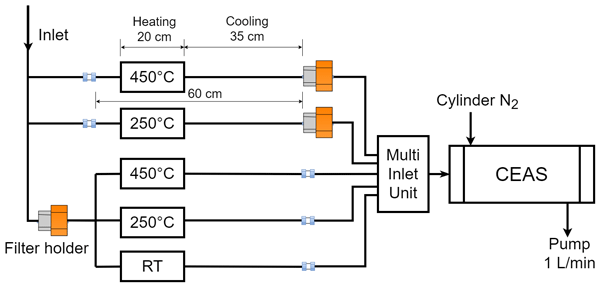
- As this is an instrument description paper, I would recommend including the instrument schematic (currently Figure S1) in the main body of the paper, perhaps moving Table 1 to the SI (less important). I also recommend adding some key details to the instrument figure: (a) for the described pure N2 sampling at the end of each measurement cycle, where is this N2 introduced? (b) how does the flow through the “Multi inlet unit” work? Does the 1 lpm sample flow go through all channels continuously and either divert to the CEAS or exhaust, or does only one inlet at a time flow? If the latter, nice to also add to the SI a figure of the NO2 signal during this switching and indicate what period of the measurements you use (there must be a switching time where the signal is stabilizing). Indicate lengths / dimensions on the figure – how long are the ovens vs. the “cooling region” after them? How large is the overall inlet box? Perhaps include a photograph to give the reader a better sense of how this looks deployed. When testing on ambient air, you mention the PM2.5 inlet. How long is the inlet line ahead of this cyclone? What is the material? A photo of the sampling head and map of ambient sampling location would also be helpful.
- Your choice of NaNO3 for particulate inorganic nitrate interference might minimize the effects you see; I think NH4NO3 is much more prevalent in the ambient atmosphere also in China, and it is much more semi-volatile and thus likely to cause interferences. It would be preferable to test with this inorganic nitrate. If this is not possible, you should at least discuss and point to literature on this.
- Section 4.3: ambient timeseries and evaluation against PAN. First paragraph of this section discusses briefly the TD-CEAS data shown in Figure 6, focusing on average and standard deviations and day/night differences. To better highlight the diel structures you discuss, I recommend adding a diurnal average plot that shows the average daily cycle of the relevant species, ideally with a second panel showing temperature, because this will help interpret the diel behavior. Then add this to the discussion: is the day /night different consistent with the temperature pattern? To me the relative concentrations of particle-phase ANs measurements compared to gas-phase look very high. Was it quite cold? DO you expect lots of high MW heavy nitrates? The particulate PNs also seem very high, if they are indeed dominated by PAN … is the gas to particle ratio you see here consistent with the known volatility of PAN and the ambient temperature? Also it would be nice to show your ambient temperature NO2 channel here compared to the Thermo 42i NO2 measurement. Is it possible to add more ambient data to better capture the representative diurnal cycles?
- Second paragraph of this section discusses the gPNs comparison to PAN, and refers to Figure S5. This figure raises another major question for me -- gPNs looks closer to PAN validation method than corrected gPNs. Is the correction biased by having been developed using PAN, so that in ambient air when sumPNs are not all PAN it will skew the data? This should be addressed in the discussion. If you check the uncorrected PNs diurnal cycle, does it make more sense in terms of expected PN volatility? Is it possible that this correction introduces spuriously high PNs signal (and then possibly in both particle and gas phase)?
Minor comments:
- Consider adding a few additional recent organic nitrate references to your introduction, e.g.: https://amt.copernicus.org/articles/15/459/2022/amt-15-459-2022.pdf, https://doi.org/10.1002/2016GL069239 , https://doi.org/10.5194/acp-18-15419-2018 , https://doi.org/10.5194/acp-16-5969-2016
- For comparison of the PAN fraction of total sumPNs: https://acp.copernicus.org/articles/25/5893/2025/
- There is another recent instrument paper in press you could check and think about how these ideas are relevant to your measurements: https://egusphere.copernicus.org/preprints/2026/egusphere-2026-157/egusphere-2026-157.pdf
- The last sentence of the introduction (lines 141-144) is repeated information from earlier in that paragraph, not needed.
- Around lines 201-204: please add more detail on the filters. What material / pore size is it? How often you need to replace it? Did you check signals before and after filter replacement in ambient sampling?
- Line 285-286: phrase “across trace to heavily polluted levels”: meaning is unclear to me.
- Line 289-290: Switch from talking about gas-phse to particulate AN standards was confusing to me at first. I think I understand now that you only used the gas-phase AN standards for the themal curves, but could not produce a stable enough concentration to calibrate with them, therefore you only calibrate the Ans channel with 2-EHN. If I’ve understood that correctly, perhaps reword this first sentence of this section to clarify.
- Also, around line 307: “calibration conditions” – did you run these EHN tests through the full inlet system with filter and all, or separately inject these samples directly into the CEAS? Good to clarify here whether this calibration is only of the CEAS instrument response to themalized EHN, or whether it also tests the filters / subtraction from the inlet system.
- Line 316: simultaneously -> independently : I think this is what you mean, that both NO and NO2 can separately vary in different ways, that they don’t necessarily always track together?
- Line 351-352: I disagree that Figure 4 shows good agreement at low concentrations -it looks pretty far off across the board.
- Line 359 & line 362: clarify the term “gradient”: you mean different sequences of NO concentrations, I think?
- Line 375: “thermally dissociates at”
- Section heading 3.3.3 on line 386: Should also already mention HNO3, HONO, NH4NO3 in the section heading and discuss them in the text below.
- Lines 445-446: nighttime gas phase OH data vs. particle-phase ON retained: Both are shown in Figure 6, and it’s not clear from that figure alone why you think nighttime gANs is particularly suspect… should be discussed in more detail, see comments about Figure 6 & interpretation above.
- Line 497: “inorganic nitrate” – hopefully you will also test NH4NO3 and then you can mention that here, but if not, please specific NaNO3 here, since I am not convinced you have generally ruled out any inorganic nitrate interferences.
- Line 513-514: This statement seems in conflict with your previous mentions that you can’t really trust nighttime gANs measurements.
- Figure 4b: Slope is misspelled in both annotations
Citation: https://doi.org/10.5194/egusphere-2026-1574-RC3 -
AC3: 'Reply on RC3', Xinming Wang, 13 May 2026
The comment was uploaded in the form of a supplement: https://egusphere.copernicus.org/preprints/2026/egusphere-2026-1574/egusphere-2026-1574-AC3-supplement.pdf
Peer review completion


Interactive discussion
Status: closed
-
RC1: 'Comment on egusphere-2026-1574', Anonymous Referee #1, 31 Mar 2026
Review of “Five-channel TD-CEAS measurements of gaseous and particulate organic nitrates with NO/NO2 interference correction under high-NOx-conditions” by Tian et al. (egusphere-2026-1574)
Tian et al. demonstrate a newly developed instrument to detect NO2 as well as total peroxy and alkyl nitrates in both gaseous and condensed phase. Detection of organic nitrate species relies on their thermal decomposition to NO2 through different heated inlets, which is monitored by a cavity enhanced absorption spectrometer. To distinguish between particle and gas phase organic nitrates, paired heated inlets equipped with particle filters positioned either upstream or downstream are used. The different species are quantified by channel differencing from subsequent measurements through each inlet within a measurement cycle. The NOx-induced bias in PAN quantification with the gPNs inlet has been thoroughly characterized and validated with a GC-ECD. These results provide basis for a nonlinear regression approach to correct field data. The pANs measurements have been validated with particulate 2-ethylhexyl nitrate, thermal decomposition behaviour of the gANs channel has been tested with isobutyl and isopropyl nitrate.
There is only very little instrumentation dedicated to the quantification of total particulate organic nitrate species and the instrumental idea is thus of general interest to the geoscience community. The presentation is clear and the manuscript is well written. However, as detailed in my comments below, major revisions are necessary before the manuscript can be considered for publication: The instrument’s ability to detect all of the above-mentioned species accurately in the presence of high NOx concentrations is insufficiently verified (especially for gANs, pPNs and pANs). The use of a NO2-based detection approach (rather than NOx), an empirical nonlinear regression model, and inappropriate reference compounds to characterize the ANs channels does not adequately take the current state-of-the-art knowledge into account.
Major concerns/ General comments
1) Monofunctional alkyl nitrates as reference compound
Dewald et al. (2021) demonstrated that monofunctional alkyl nitrates, such as isopropyl or 2-ethylhexyl nitrate, are not suitable for instrument characterization due to their oversimplified dissociation behavior. In urban atmospheres, organic nitrates typically originate from the oxidation of anthropogenic or biogenic VOCs and are therefore often multifunctional (Hamilton et al., 2021; Kumar et al., 2023). As shown for isoprene-derived organic nitrates, such complex compounds can dissociate at lower temperatures in quartz inlets in the presence of ambient ozone. As a result, ANs may partially dissociate in the PNs channels. The authors should therefore either characterize the inlets using atmospherically relevant RONO2 compounds to rule out this bias or modify the design of the PNs inlet (e.g., by using a PFA tube with increased residence time enabling operation at lower temperatures).
2) Lacking characterisation of biases in the ANs channels
Wüst et al. (2025), a reference that the authors cite themselves, showed that the presence of NO can also create substantial biases in the quantification of alkyl nitrates that even vary extremely for different parent compounds (e.g. isoprene versus limonene; note that biogenic VOCs are also present in urban areas). The potential biases caused by NOx when dissociating PNs (preferfably work with a diffusion source here, see below) and atmospherically relevant ANs in in the ANs channels (gas and particle phase) have to be assessed and discussed by the authors if they aim at quantifying ANs accurately.
3. Insufficient characterization of the PNs channels
The authors only performed experiments with PAN, admittedly by far the most relevant PNs species in the gas phase. In urban areas, mixtures of different PNs species (e.g. PAN/PPN/MPAN) can occur, which dissociate to NO2 and different RO2, which may substantially differ in their chemical behaviour, thereby also resulting in a different NOx-induced bias (similar to the different behaviour of isoprene- and limonene-derived alkyl nitrates as shown in Wüst et al. (2025)). Their regression model might only be applicable to PAN or for a certain NO/NO2 ratio (please also indicate which amounts of NO and NO2 have been added to get an idea of the NO/NO2 ratios!). The authors should at least discuss this issue. Could the authors please also demonstrate that their instrument is capable of detecting peroxy nitrates in the particle phase?
4) Detection based on NO2
If the authors aim to use this instrument in urban areas, where the NOx bias is highly significant, why did they refrain from detecting NOx instead of NO2 as demonstrated in various publications (Friedrich et al., 2020; Gingerysty, 2021; Ohara et al., 2024; Wild et al., 2014; Wüst et al., 2025) in order to easily circumvent the (often compound-specific) NOx biases as well as the majority of the problems discussed herein?
Minor concerns/ Specific comments
L88-98: After this section, it might be worth outlining the NOx bias in the ANs channel (see e.g. Sobanski et al., 2016; Thieser et al., 2016) as well.
L102/103: This approach has also been used by Sobanski et al. (2016) before the instrument has been modified by Dewald et al. (2021).
L105: This approach has also been shown in Friedrich et al. (2020), Gingerysty (2021), Ohara et al. (2024) and Wild et al. (2014).
L111-115: It might be worth citing Wüst et al. (2025) here, who thoroughly discussed problems associated to this type of PAN source.
L115-117: I agree with this statement. For that reason, the secondary inlet chemistry is modelled explicitly for some instruments in order to correct the data (Keehan et al., 2020; Sobanski et al., 2016; Taha et al., 2018; Thieser et al., 2016). In that case input of measured ambient NO, NO2 and uncorrected ANs/PNs is required in order to account for the simultaneous bias by NO and NO2 as well as the chemical regime (as implied by the authors in L334) and surface chemistry. The authors should mention it in this section.
L122: How do the authors ensure accurate ANs quantification?
L181-183/185: These reference compounds are only of limited atmospheric signficance (see general comment above).
L201-204: Did the authors perform any transmission experiments for different particle sizes during “UF” sampling periods?
L207-214: As the accurate quantification relies on NO2 and channel differencing, did the authors verify that the NO2 transmission does not vary with the inlet temperature? Sobanski et al. (2016) found small but significant NO2 losses in heated quartz inlets with glass beads.
Section 2.6: Could the authors please discuss the uncertainties associated with their measurements?
L251-255: The authors should mention that these values are used as ballpark values and do not necessarily reflect the wall losses of their own inlets since they vary with inlet geometry and operating conditions (flow, temperature etc.).
L259: “Thermal spectrum” does not appear to be a physically correct term in this context. I therefore rather recommend “thermogram” or “(thermal) decomposition profile”, as indicated in other publications.
L346/347: Here, the authors compared to the lookup table method proposed by Li et al. (2021). But how well does your method perform in comparison to the explicit numerical simulation approach using a more complex model as e.g. shown by Sobanski et al. (2016) under field conditions? In addition, it would be good to explicitly differentiate between a lookup table approach (which is based on numerical simulations of laboratory data) and the explicit numerical simulation approach with field data input throughout the text.
L351-357: Can the authors provide a reason for the overestimation of PAN by the lookup table approach under the high concentration conditions? The model by Li et al. (2021) seems to include the bias induced by both NO and NO2.
L371-373: Why would it be an advantage having to rely on measured NO/NO2? The addition of ozone is easily feasible during field deployment as well (e.g. Friedrich et al., 2020).
L366-368: Could the authors please justify their statements with additional plots and/or experiments? Previous studies reported indeed a NOx-bias in the detection of PAN in the ANs channel that significantly differs (usually weaker) from that in the PNs channel (Sobanski et al., 2016) presumably due to thermal decomposition of the acetyl peroxy radical (Thieser et al., 2016).
In addition, the presence of alkyl nitrates is highly speculative. Wüst et al. (2025) showed that the photochemical PAN source as deployed by the authors can create an artefact signal in the ANs signal in the presence of NO due to impurities of H2O2 and peracetic acid. Also, Fig. S3 shows very well some NOx-induced deviations in the ANs channel. The authors could work with a diffusion PAN source to properly characterize the behaviour of PAN in the ANs channel while avoiding impurities (alkyl nitrates, peroxides...).
In any case, the NOx-bias during the detection of an alkyl nitrate in the ANs channel has to be performed as well (see general comment above).
L429: Please specify the type of filter you used.
L454/455: As commented above, the lacking correction of the ANs data is not sufficiently justified in the current form of the manuscript.
L519-522: Most of these aspects are crucial to consider before publication. It is not clear why the authors consider this as future work.
L528: As far as I am aware, this statement does not meet Copernicus’ submission guidelines.
L680 : Same here, please reconsider the term "thermal spectrum".
Fig. 2: Could the authors please discuss the negative intercept? What would the slope be if the fit were forced through zero? Also, it seems to me that the first three points behave differently to the rest.
Fig. S3: Where does the NOx before 19:00 LT come from? Does it originate from the PAN source? And referring to one of my comments above: Could the signal in the ANs channel originate from H2O2/peracetic acid impurities in the source in the presence of NO as discussed by Wüst et al. (2025)?
References
Dewald, P., Dörich, R., Schuladen, J., Lelieveld, J., and Crowley, J. N.: Impact of ozone and inlet design on the quantification of isoprene-derived organic nitrates by thermal dissociation cavity ring-down spectroscopy (TD-CRDS), Atmos. Meas. Tech., 14, 5501–5519, https://doi.org/10.5194/amt-14-5501-2021, 2021.
Friedrich, N., Tadic, I., Schuladen, J., Brooks, J., Darbyshire, E., Drewnick, F., Fischer, H., Lelieveld, J., and Crowley, J. N.: Measurement of NOx and NOy with a thermal dissociation cavity ring-down spectrometer (TD-CRDS): instrument characterisation and first deployment, Atmos. Meas. Tech., 13, 5739–5761, https://doi.org/10.5194/amt-13-5739-2020, 2020.
Gingerysty, N. J. L.: Investigating reactive tropospheric nitrogen oxides by thermal-dissociation cavity ring-down spectroscopy, Master's thesis, University of Calgary, Calgary, Canada, https://doi.org/10.11575/PRISM/38580, 2021.
Hamilton, J. F., Bryant, D. J., Edwards, P. M., Ouyang, B., Bannan, T. J., Mehra, A., Mayhew, A. W., Hopkins, J. R., Dunmore, R. E., Squires, F. A., Lee, J. D., Newland, M. J., Worrall, S. D., Bacak, A., Coe, H., Percival, C., Whalley, L. K., Heard, D. E., Slater, E. J., Jones, R. L., Cui, T., Surratt, J. D., Reeves, C. E., Mills, G. P., Grimmond, S., Sun, Y., Xu, W., Shi, Z., and Rickard, A. R.: Key Role of NO3 Radicals in the Production of Isoprene Nitrates and Nitrooxyorganosulfates in Beijing, Environ. Sci. Technol., 55, 842–853, https://doi.org/10.1021/acs.est.0c05689, 2021.
Keehan, N. I., Brownwood, B., Marsavin, A., Day, D. A., and Fry, J. L.: A thermal-dissociation–cavity ring-down spectrometer (TD-CRDS) for the detection of organic nitrates in gas and particle phases, Atmos. Meas. Tech., 13, 6255–6269, https://doi.org/10.5194/amt-13-6255-2020, 2020.
Kumar, V., Slowik, J. G., Baltensperger, U., Prevot, A. S. H., and Bell, D. M.: Time-Resolved Molecular Characterization of Secondary Organic Aerosol Formed from OH and NO3 Radical Initiated Oxidation of a Mixture of Aromatic Precursors, Environ. Sci. Technol., 57, 11572–11582, https://doi.org/10.1021/acs.est.3c00225, 2023.
Li, C., Wang, H., Chen, X., Zhai, T., Chen, S., Li, X., Zeng, L., and Lu, K.: Thermal dissociation cavity-enhanced absorption spectrometer for measuring NO2, RO2NO2, and RONO2 in the atmosphere, Atmos. Meas. Tech., 14, 4033–4051, https://doi.org/10.5194/amt-14-4033-2021, 2021.
Ohara, N., Shioji, T., Matsumoto, J., Inomata, S., Sakamoto, Y., Kajii, Y., Shiigi, H., and Sadanaga, Y.: Improved continuous measurement system for atmospheric total peroxy and total organic nitrate under the high NOx condition, Rev. Sci. Instrum., 95, 045101, https://doi.org/10.1063/5.0172219, 2024.
Sobanski, N., Schuladen, J., Schuster, G., Lelieveld, J., and Crowley, J. N.: A five-channel cavity ring-down spectrometer for the detection of NO2, NO3, N2O5, total peroxy nitrates and total alkyl nitrates, Atmos. Meas. Tech., 9, 5103–5118, https://doi.org/10.5194/amt-9-5103-2016, 2016.
Taha, Y. M., Saowapon, M. T., Assad, F. V., Ye, C. Z., Chen, X., Garner, N. M., and Osthoff, H. D.: Quantification of peroxynitric acid and peroxyacyl nitrates using an ethane-based thermal dissociation peroxy radical chemical amplification cavity ring-down spectrometer, Atmos. Meas. Tech., 11, 4109–4127, https://doi.org/10.5194/amt-11-4109-2018, 2018.
Thieser, J., Schuster, G., Phillips, G. J., Reiffs, A., Parchatka, U., Pöhler, D., Lelieveld, J., and Crowley, J. N.: A two-channel, thermal dissociation cavity-ringdown spectrometer for the detection of ambient NO2, RO2NO2 and RONO2, Atmos. Meas. Tech., 9, 553–576, https://doi.org/10.5194/amt-9-553-2016, 2016.
Wild, R. J., Edwards, P. M., Dube, W. P., Baumann, K., Edgerton, E. S., Quinn, P. K., Roberts, J. M., Rollins, A. W., Veres, P. R., Warneke, C., Williams, E. J., Yuan, B., and Brown, S. S.: A measurement of total reactive nitrogen, NOy, together with NO2, NO, and O3 via cavity ring-down spectroscopy, Environ. Sci. Technol., 48, 9609–9615, https://doi.org/10.1021/es501896w, 2014.
Wüst, L., Dewald, P., Türk, G. N. T. E., Lelieveld, J., and Crowley, J. N.: Influence of ambient NO and NO2 on the quantification of total peroxy nitrates (ΣPNs) and total alkyl nitrates (ΣANs) by thermal dissociation cavity ring-down spectroscopy (TD-CRDS), Atmos. Meas. Tech., 18, 1943–1959, https://doi.org/10.5194/amt-18-1943-2025, 2025.
Citation: https://doi.org/10.5194/egusphere-2026-1574-RC1 -
AC1: 'Reply on RC1', Xinming Wang, 13 May 2026
The comment was uploaded in the form of a supplement: https://egusphere.copernicus.org/preprints/2026/egusphere-2026-1574/egusphere-2026-1574-AC1-supplement.pdf
-
AC1: 'Reply on RC1', Xinming Wang, 13 May 2026
-
RC2: 'Comment on egusphere-2026-1574', Anonymous Referee #2, 09 Apr 2026
This manuscript presents the development and validation of a five-channel thermal dissociation cavity-enhanced absorption spectrometer (TD-CEAS) for simultaneous, in situ measurements of gas-phase and particle-phase organic nitrates (ΣPNs and ΣANs), with a dedicated correction for NO/NO₂ interferences under high-NOₓ urban conditions. The topic is timely and important for atmospheric reactive nitrogen and aerosol research. The instrument design is logical, laboratory characterization is comprehensive, field deployment is convincing, and the interference correction method is technically innovative. Overall, the manuscript is well-structured and meets the publication standards. I recommend publication after minor revisions.
General comments:
- please strengthen comparison with existing particle-phase TD instruments, a brief detection-limit comparison is insufficient. Please add a systematic comparison with similar instruments in terms of time resolution, phase separation, interference control, and field usability.
- The authors mention that N₂O₅ and ClNO₂ may interfere with nighttime gas-phase measurements. Please provide quantitative estimates of interference magnitudes or clearly define the uncertainty and applicable scope of nighttime data.
- The manuscript uses filter configurations for gas–particle separation but does not characterize particle transmission efficiency, wall loss, or inlet adsorption effects for particulate organic nitrates. Please add discussions to quantify these artifacts.
Minor:
- Improve readability of some figures (axis labels, legends, units).
- Shorten some repetitive descriptions in the Introduction and Conclusion.
Citation: https://doi.org/10.5194/egusphere-2026-1574-RC2 -
AC2: 'Reply on RC2', Xinming Wang, 13 May 2026
The comment was uploaded in the form of a supplement: https://egusphere.copernicus.org/preprints/2026/egusphere-2026-1574/egusphere-2026-1574-AC2-supplement.pdf
-
RC3: 'Comment on egusphere-2026-1574', Anonymous Referee #3, 14 Apr 2026
This paper presents the design and characterization of a new thermal desorption / NO2 CEAS based instrument for the measurement of gas and particle-phase peroxy and alkyl nitrates, with calibration of PN and AN detection and correction for NOx interferences. The paper presents instrument laboratory characterization and some limited ambient testing. The work is well-motivated and the manuscript is clearly written; I have some questions and suggestions how the characterization and presentation could be improved which are detailed below. I recommend publication after revisions.
Major comments:
- As this is an instrument description paper, I would recommend including the instrument schematic (currently Figure S1) in the main body of the paper, perhaps moving Table 1 to the SI (less important). I also recommend adding some key details to the instrument figure: (a) for the described pure N2 sampling at the end of each measurement cycle, where is this N2 introduced? (b) how does the flow through the “Multi inlet unit” work? Does the 1 lpm sample flow go through all channels continuously and either divert to the CEAS or exhaust, or does only one inlet at a time flow? If the latter, nice to also add to the SI a figure of the NO2 signal during this switching and indicate what period of the measurements you use (there must be a switching time where the signal is stabilizing). Indicate lengths / dimensions on the figure – how long are the ovens vs. the “cooling region” after them? How large is the overall inlet box? Perhaps include a photograph to give the reader a better sense of how this looks deployed. When testing on ambient air, you mention the PM2.5 inlet. How long is the inlet line ahead of this cyclone? What is the material? A photo of the sampling head and map of ambient sampling location would also be helpful.
- Your choice of NaNO3 for particulate inorganic nitrate interference might minimize the effects you see; I think NH4NO3 is much more prevalent in the ambient atmosphere also in China, and it is much more semi-volatile and thus likely to cause interferences. It would be preferable to test with this inorganic nitrate. If this is not possible, you should at least discuss and point to literature on this.
- Section 4.3: ambient timeseries and evaluation against PAN. First paragraph of this section discusses briefly the TD-CEAS data shown in Figure 6, focusing on average and standard deviations and day/night differences. To better highlight the diel structures you discuss, I recommend adding a diurnal average plot that shows the average daily cycle of the relevant species, ideally with a second panel showing temperature, because this will help interpret the diel behavior. Then add this to the discussion: is the day /night different consistent with the temperature pattern? To me the relative concentrations of particle-phase ANs measurements compared to gas-phase look very high. Was it quite cold? DO you expect lots of high MW heavy nitrates? The particulate PNs also seem very high, if they are indeed dominated by PAN … is the gas to particle ratio you see here consistent with the known volatility of PAN and the ambient temperature? Also it would be nice to show your ambient temperature NO2 channel here compared to the Thermo 42i NO2 measurement. Is it possible to add more ambient data to better capture the representative diurnal cycles?
- Second paragraph of this section discusses the gPNs comparison to PAN, and refers to Figure S5. This figure raises another major question for me -- gPNs looks closer to PAN validation method than corrected gPNs. Is the correction biased by having been developed using PAN, so that in ambient air when sumPNs are not all PAN it will skew the data? This should be addressed in the discussion. If you check the uncorrected PNs diurnal cycle, does it make more sense in terms of expected PN volatility? Is it possible that this correction introduces spuriously high PNs signal (and then possibly in both particle and gas phase)?
Minor comments:
- Consider adding a few additional recent organic nitrate references to your introduction, e.g.: https://amt.copernicus.org/articles/15/459/2022/amt-15-459-2022.pdf, https://doi.org/10.1002/2016GL069239 , https://doi.org/10.5194/acp-18-15419-2018 , https://doi.org/10.5194/acp-16-5969-2016
- For comparison of the PAN fraction of total sumPNs: https://acp.copernicus.org/articles/25/5893/2025/
- There is another recent instrument paper in press you could check and think about how these ideas are relevant to your measurements: https://egusphere.copernicus.org/preprints/2026/egusphere-2026-157/egusphere-2026-157.pdf
- The last sentence of the introduction (lines 141-144) is repeated information from earlier in that paragraph, not needed.
- Around lines 201-204: please add more detail on the filters. What material / pore size is it? How often you need to replace it? Did you check signals before and after filter replacement in ambient sampling?
- Line 285-286: phrase “across trace to heavily polluted levels”: meaning is unclear to me.
- Line 289-290: Switch from talking about gas-phse to particulate AN standards was confusing to me at first. I think I understand now that you only used the gas-phase AN standards for the themal curves, but could not produce a stable enough concentration to calibrate with them, therefore you only calibrate the Ans channel with 2-EHN. If I’ve understood that correctly, perhaps reword this first sentence of this section to clarify.
- Also, around line 307: “calibration conditions” – did you run these EHN tests through the full inlet system with filter and all, or separately inject these samples directly into the CEAS? Good to clarify here whether this calibration is only of the CEAS instrument response to themalized EHN, or whether it also tests the filters / subtraction from the inlet system.
- Line 316: simultaneously -> independently : I think this is what you mean, that both NO and NO2 can separately vary in different ways, that they don’t necessarily always track together?
- Line 351-352: I disagree that Figure 4 shows good agreement at low concentrations -it looks pretty far off across the board.
- Line 359 & line 362: clarify the term “gradient”: you mean different sequences of NO concentrations, I think?
- Line 375: “thermally dissociates at”
- Section heading 3.3.3 on line 386: Should also already mention HNO3, HONO, NH4NO3 in the section heading and discuss them in the text below.
- Lines 445-446: nighttime gas phase OH data vs. particle-phase ON retained: Both are shown in Figure 6, and it’s not clear from that figure alone why you think nighttime gANs is particularly suspect… should be discussed in more detail, see comments about Figure 6 & interpretation above.
- Line 497: “inorganic nitrate” – hopefully you will also test NH4NO3 and then you can mention that here, but if not, please specific NaNO3 here, since I am not convinced you have generally ruled out any inorganic nitrate interferences.
- Line 513-514: This statement seems in conflict with your previous mentions that you can’t really trust nighttime gANs measurements.
- Figure 4b: Slope is misspelled in both annotations
Citation: https://doi.org/10.5194/egusphere-2026-1574-RC3 -
AC3: 'Reply on RC3', Xinming Wang, 13 May 2026
The comment was uploaded in the form of a supplement: https://egusphere.copernicus.org/preprints/2026/egusphere-2026-1574/egusphere-2026-1574-AC3-supplement.pdf
Peer review completion
Journal article(s) based on this preprint
Viewed
| HTML | XML | Total | Supplement | BibTeX | EndNote | |
|---|---|---|---|---|---|---|
| 652 | 212 | 74 | 938 | 134 | 58 | 70 |
- HTML: 652
- PDF: 212
- XML: 74
- Total: 938
- Supplement: 134
- BibTeX: 58
- EndNote: 70
Viewed (geographical distribution)
| Country | # | Views | % |
|---|
| Total: | 0 |
| HTML: | 0 |
| PDF: | 0 |
| XML: | 0 |
- 1
Xiao Tian
Hongcheng Lu
Wei Song

Xue Yu
The requested preprint has a corresponding peer-reviewed final revised paper. You are encouraged to refer to the final revised version.
- Preprint
(1153 KB) - Metadata XML
-
Supplement
(495 KB) - BibTeX
- EndNote
- Final revised paper
Review of “Five-channel TD-CEAS measurements of gaseous and particulate organic nitrates with NO/NO2 interference correction under high-NOx-conditions” by Tian et al. (egusphere-2026-1574)
Tian et al. demonstrate a newly developed instrument to detect NO2 as well as total peroxy and alkyl nitrates in both gaseous and condensed phase. Detection of organic nitrate species relies on their thermal decomposition to NO2 through different heated inlets, which is monitored by a cavity enhanced absorption spectrometer. To distinguish between particle and gas phase organic nitrates, paired heated inlets equipped with particle filters positioned either upstream or downstream are used. The different species are quantified by channel differencing from subsequent measurements through each inlet within a measurement cycle. The NOx-induced bias in PAN quantification with the gPNs inlet has been thoroughly characterized and validated with a GC-ECD. These results provide basis for a nonlinear regression approach to correct field data. The pANs measurements have been validated with particulate 2-ethylhexyl nitrate, thermal decomposition behaviour of the gANs channel has been tested with isobutyl and isopropyl nitrate.
There is only very little instrumentation dedicated to the quantification of total particulate organic nitrate species and the instrumental idea is thus of general interest to the geoscience community. The presentation is clear and the manuscript is well written. However, as detailed in my comments below, major revisions are necessary before the manuscript can be considered for publication: The instrument’s ability to detect all of the above-mentioned species accurately in the presence of high NOx concentrations is insufficiently verified (especially for gANs, pPNs and pANs). The use of a NO2-based detection approach (rather than NOx), an empirical nonlinear regression model, and inappropriate reference compounds to characterize the ANs channels does not adequately take the current state-of-the-art knowledge into account.
Major concerns/ General comments
1) Monofunctional alkyl nitrates as reference compound
Dewald et al. (2021) demonstrated that monofunctional alkyl nitrates, such as isopropyl or 2-ethylhexyl nitrate, are not suitable for instrument characterization due to their oversimplified dissociation behavior. In urban atmospheres, organic nitrates typically originate from the oxidation of anthropogenic or biogenic VOCs and are therefore often multifunctional (Hamilton et al., 2021; Kumar et al., 2023). As shown for isoprene-derived organic nitrates, such complex compounds can dissociate at lower temperatures in quartz inlets in the presence of ambient ozone. As a result, ANs may partially dissociate in the PNs channels. The authors should therefore either characterize the inlets using atmospherically relevant RONO2 compounds to rule out this bias or modify the design of the PNs inlet (e.g., by using a PFA tube with increased residence time enabling operation at lower temperatures).
2) Lacking characterisation of biases in the ANs channels
Wüst et al. (2025), a reference that the authors cite themselves, showed that the presence of NO can also create substantial biases in the quantification of alkyl nitrates that even vary extremely for different parent compounds (e.g. isoprene versus limonene; note that biogenic VOCs are also present in urban areas). The potential biases caused by NOx when dissociating PNs (preferfably work with a diffusion source here, see below) and atmospherically relevant ANs in in the ANs channels (gas and particle phase) have to be assessed and discussed by the authors if they aim at quantifying ANs accurately.
3. Insufficient characterization of the PNs channels
The authors only performed experiments with PAN, admittedly by far the most relevant PNs species in the gas phase. In urban areas, mixtures of different PNs species (e.g. PAN/PPN/MPAN) can occur, which dissociate to NO2 and different RO2, which may substantially differ in their chemical behaviour, thereby also resulting in a different NOx-induced bias (similar to the different behaviour of isoprene- and limonene-derived alkyl nitrates as shown in Wüst et al. (2025)). Their regression model might only be applicable to PAN or for a certain NO/NO2 ratio (please also indicate which amounts of NO and NO2 have been added to get an idea of the NO/NO2 ratios!). The authors should at least discuss this issue. Could the authors please also demonstrate that their instrument is capable of detecting peroxy nitrates in the particle phase?
4) Detection based on NO2
If the authors aim to use this instrument in urban areas, where the NOx bias is highly significant, why did they refrain from detecting NOx instead of NO2 as demonstrated in various publications (Friedrich et al., 2020; Gingerysty, 2021; Ohara et al., 2024; Wild et al., 2014; Wüst et al., 2025) in order to easily circumvent the (often compound-specific) NOx biases as well as the majority of the problems discussed herein?
Minor concerns/ Specific comments
L88-98: After this section, it might be worth outlining the NOx bias in the ANs channel (see e.g. Sobanski et al., 2016; Thieser et al., 2016) as well.
L102/103: This approach has also been used by Sobanski et al. (2016) before the instrument has been modified by Dewald et al. (2021).
L105: This approach has also been shown in Friedrich et al. (2020), Gingerysty (2021), Ohara et al. (2024) and Wild et al. (2014).
L111-115: It might be worth citing Wüst et al. (2025) here, who thoroughly discussed problems associated to this type of PAN source.
L115-117: I agree with this statement. For that reason, the secondary inlet chemistry is modelled explicitly for some instruments in order to correct the data (Keehan et al., 2020; Sobanski et al., 2016; Taha et al., 2018; Thieser et al., 2016). In that case input of measured ambient NO, NO2 and uncorrected ANs/PNs is required in order to account for the simultaneous bias by NO and NO2 as well as the chemical regime (as implied by the authors in L334) and surface chemistry. The authors should mention it in this section.
L122: How do the authors ensure accurate ANs quantification?
L181-183/185: These reference compounds are only of limited atmospheric signficance (see general comment above).
L201-204: Did the authors perform any transmission experiments for different particle sizes during “UF” sampling periods?
L207-214: As the accurate quantification relies on NO2 and channel differencing, did the authors verify that the NO2 transmission does not vary with the inlet temperature? Sobanski et al. (2016) found small but significant NO2 losses in heated quartz inlets with glass beads.
Section 2.6: Could the authors please discuss the uncertainties associated with their measurements?
L251-255: The authors should mention that these values are used as ballpark values and do not necessarily reflect the wall losses of their own inlets since they vary with inlet geometry and operating conditions (flow, temperature etc.).
L259: “Thermal spectrum” does not appear to be a physically correct term in this context. I therefore rather recommend “thermogram” or “(thermal) decomposition profile”, as indicated in other publications.
L346/347: Here, the authors compared to the lookup table method proposed by Li et al. (2021). But how well does your method perform in comparison to the explicit numerical simulation approach using a more complex model as e.g. shown by Sobanski et al. (2016) under field conditions? In addition, it would be good to explicitly differentiate between a lookup table approach (which is based on numerical simulations of laboratory data) and the explicit numerical simulation approach with field data input throughout the text.
L351-357: Can the authors provide a reason for the overestimation of PAN by the lookup table approach under the high concentration conditions? The model by Li et al. (2021) seems to include the bias induced by both NO and NO2.
L371-373: Why would it be an advantage having to rely on measured NO/NO2? The addition of ozone is easily feasible during field deployment as well (e.g. Friedrich et al., 2020).
L366-368: Could the authors please justify their statements with additional plots and/or experiments? Previous studies reported indeed a NOx-bias in the detection of PAN in the ANs channel that significantly differs (usually weaker) from that in the PNs channel (Sobanski et al., 2016) presumably due to thermal decomposition of the acetyl peroxy radical (Thieser et al., 2016).
In addition, the presence of alkyl nitrates is highly speculative. Wüst et al. (2025) showed that the photochemical PAN source as deployed by the authors can create an artefact signal in the ANs signal in the presence of NO due to impurities of H2O2 and peracetic acid. Also, Fig. S3 shows very well some NOx-induced deviations in the ANs channel. The authors could work with a diffusion PAN source to properly characterize the behaviour of PAN in the ANs channel while avoiding impurities (alkyl nitrates, peroxides...).
In any case, the NOx-bias during the detection of an alkyl nitrate in the ANs channel has to be performed as well (see general comment above).
L429: Please specify the type of filter you used.
L454/455: As commented above, the lacking correction of the ANs data is not sufficiently justified in the current form of the manuscript.
L519-522: Most of these aspects are crucial to consider before publication. It is not clear why the authors consider this as future work.
L528: As far as I am aware, this statement does not meet Copernicus’ submission guidelines.
L680 : Same here, please reconsider the term "thermal spectrum".
Fig. 2: Could the authors please discuss the negative intercept? What would the slope be if the fit were forced through zero? Also, it seems to me that the first three points behave differently to the rest.
Fig. S3: Where does the NOx before 19:00 LT come from? Does it originate from the PAN source? And referring to one of my comments above: Could the signal in the ANs channel originate from H2O2/peracetic acid impurities in the source in the presence of NO as discussed by Wüst et al. (2025)?
References
Dewald, P., Dörich, R., Schuladen, J., Lelieveld, J., and Crowley, J. N.: Impact of ozone and inlet design on the quantification of isoprene-derived organic nitrates by thermal dissociation cavity ring-down spectroscopy (TD-CRDS), Atmos. Meas. Tech., 14, 5501–5519, https://doi.org/10.5194/amt-14-5501-2021, 2021.
Friedrich, N., Tadic, I., Schuladen, J., Brooks, J., Darbyshire, E., Drewnick, F., Fischer, H., Lelieveld, J., and Crowley, J. N.: Measurement of NOx and NOy with a thermal dissociation cavity ring-down spectrometer (TD-CRDS): instrument characterisation and first deployment, Atmos. Meas. Tech., 13, 5739–5761, https://doi.org/10.5194/amt-13-5739-2020, 2020.
Gingerysty, N. J. L.: Investigating reactive tropospheric nitrogen oxides by thermal-dissociation cavity ring-down spectroscopy, Master's thesis, University of Calgary, Calgary, Canada, https://doi.org/10.11575/PRISM/38580, 2021.
Hamilton, J. F., Bryant, D. J., Edwards, P. M., Ouyang, B., Bannan, T. J., Mehra, A., Mayhew, A. W., Hopkins, J. R., Dunmore, R. E., Squires, F. A., Lee, J. D., Newland, M. J., Worrall, S. D., Bacak, A., Coe, H., Percival, C., Whalley, L. K., Heard, D. E., Slater, E. J., Jones, R. L., Cui, T., Surratt, J. D., Reeves, C. E., Mills, G. P., Grimmond, S., Sun, Y., Xu, W., Shi, Z., and Rickard, A. R.: Key Role of NO3 Radicals in the Production of Isoprene Nitrates and Nitrooxyorganosulfates in Beijing, Environ. Sci. Technol., 55, 842–853, https://doi.org/10.1021/acs.est.0c05689, 2021.
Keehan, N. I., Brownwood, B., Marsavin, A., Day, D. A., and Fry, J. L.: A thermal-dissociation–cavity ring-down spectrometer (TD-CRDS) for the detection of organic nitrates in gas and particle phases, Atmos. Meas. Tech., 13, 6255–6269, https://doi.org/10.5194/amt-13-6255-2020, 2020.
Kumar, V., Slowik, J. G., Baltensperger, U., Prevot, A. S. H., and Bell, D. M.: Time-Resolved Molecular Characterization of Secondary Organic Aerosol Formed from OH and NO3 Radical Initiated Oxidation of a Mixture of Aromatic Precursors, Environ. Sci. Technol., 57, 11572–11582, https://doi.org/10.1021/acs.est.3c00225, 2023.
Li, C., Wang, H., Chen, X., Zhai, T., Chen, S., Li, X., Zeng, L., and Lu, K.: Thermal dissociation cavity-enhanced absorption spectrometer for measuring NO2, RO2NO2, and RONO2 in the atmosphere, Atmos. Meas. Tech., 14, 4033–4051, https://doi.org/10.5194/amt-14-4033-2021, 2021.
Ohara, N., Shioji, T., Matsumoto, J., Inomata, S., Sakamoto, Y., Kajii, Y., Shiigi, H., and Sadanaga, Y.: Improved continuous measurement system for atmospheric total peroxy and total organic nitrate under the high NOx condition, Rev. Sci. Instrum., 95, 045101, https://doi.org/10.1063/5.0172219, 2024.
Sobanski, N., Schuladen, J., Schuster, G., Lelieveld, J., and Crowley, J. N.: A five-channel cavity ring-down spectrometer for the detection of NO2, NO3, N2O5, total peroxy nitrates and total alkyl nitrates, Atmos. Meas. Tech., 9, 5103–5118, https://doi.org/10.5194/amt-9-5103-2016, 2016.
Taha, Y. M., Saowapon, M. T., Assad, F. V., Ye, C. Z., Chen, X., Garner, N. M., and Osthoff, H. D.: Quantification of peroxynitric acid and peroxyacyl nitrates using an ethane-based thermal dissociation peroxy radical chemical amplification cavity ring-down spectrometer, Atmos. Meas. Tech., 11, 4109–4127, https://doi.org/10.5194/amt-11-4109-2018, 2018.
Thieser, J., Schuster, G., Phillips, G. J., Reiffs, A., Parchatka, U., Pöhler, D., Lelieveld, J., and Crowley, J. N.: A two-channel, thermal dissociation cavity-ringdown spectrometer for the detection of ambient NO2, RO2NO2 and RONO2, Atmos. Meas. Tech., 9, 553–576, https://doi.org/10.5194/amt-9-553-2016, 2016.
Wild, R. J., Edwards, P. M., Dube, W. P., Baumann, K., Edgerton, E. S., Quinn, P. K., Roberts, J. M., Rollins, A. W., Veres, P. R., Warneke, C., Williams, E. J., Yuan, B., and Brown, S. S.: A measurement of total reactive nitrogen, NOy, together with NO2, NO, and O3 via cavity ring-down spectroscopy, Environ. Sci. Technol., 48, 9609–9615, https://doi.org/10.1021/es501896w, 2014.
Wüst, L., Dewald, P., Türk, G. N. T. E., Lelieveld, J., and Crowley, J. N.: Influence of ambient NO and NO2 on the quantification of total peroxy nitrates (ΣPNs) and total alkyl nitrates (ΣANs) by thermal dissociation cavity ring-down spectroscopy (TD-CRDS), Atmos. Meas. Tech., 18, 1943–1959, https://doi.org/10.5194/amt-18-1943-2025, 2025.