
the Creative Commons Attribution 4.0 License.
the Creative Commons Attribution 4.0 License.
 | 09 Apr 2026
Biosignatures of microbial mats in Pleistocene coral reef cores from IODP Expedition 389 (Hawaiian Drowned Reefs)
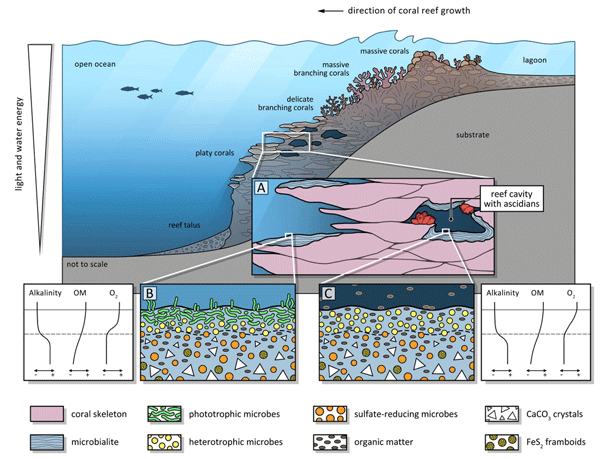
Abstract. We systematically document surfaces and biosignatures of Pleistocene reefal microbialites (Marine Isotope Stages 7–6) recovered during IODP Expedition 389 (Hawai’ian Drowned Reefs). Microbialites are abundant within Pleistocene coral reef successions and offer valuable archives of environmental information under Quaternary climate variability. However, relatively little is known about biofilm-forming microbial consortia, because biosignature preservation is usually very poor. The microbial crusts studied here form encrustations as much as 20 cm thick, ranging from laminated to thrombolitic, within the coral reef framework. Scanning electron microscopy (SEM) of samples from the windward (humid) Hilo and Kohala and the leeward (arid) Kawaihae sides of the Island of Hawai‘i reveals exceptionally well-preserved microbial fabrics that developed during Marine Isotope Stages (MIS) 7–6. Humid side samples exhibit abundant preserved putative exopolymeric substance (EPS) matrices, mineralized filaments, and near spherical, multilobate aggregates that resemble protodolomite spherules formed by modern cyanobacteria or extant coccoid cyanobacteria (e.g., Gloeocapsa-type). In either case, the surfaces appear to have been formed with significant aid of cyanobacteria suggesting formation in a euphotic setting. The microbialites from the arid side display peloidal microfabrics with fewer preserved physical biosignatures, typical of cryptic reefal microbialites, but the surfaces suggest confinement by an organic biofilm. The occurrence of pyrite framboids and huntite-like crystals in the wet-side samples suggests local redox gradients consistent with both sulphate reducing bacteria and cyanobacteria mediating carbonate precipitation. These findings provide the first direct evidence for euphotic microbial mat communities contributing to microbialite formation in Pleistocene drowned Hawai’ian reefs, and, to our knowledge, in Indopacific reefs and beyond. The outstanding preservation of mineralized EPS and microbial morphotypes highlights the potential of these Pleistocene reefal microbialites as sensitive archives of palaeoenvironmental conditions and microbial diversity under glacio-eustatic forcing and associated environmental changes.
-
Notice on discussion status
The requested preprint has a corresponding peer-reviewed final revised paper. You are encouraged to refer to the final revised version.
-
Preprint
(31074 KB)
-
The requested preprint has a corresponding peer-reviewed final revised paper. You are encouraged to refer to the final revised version.
- Preprint
(31074 KB) - Metadata XML
- BibTeX
- EndNote
- Final revised paper


Journal article(s) based on this preprint
Interactive discussion
Status: closed
-
RC1: 'Comment on egusphere-2026-1564', Nora Noffke, 30 Apr 2026
The manuscript describes microbial mats dominated by photoautotrophic microbes in modern Hawaiian reef systems. The microbial mats develop in a carbonate system. Such systems are commonly not known to preserve microbial textures such as filaments, EPS, and others. The reason is a quick recrystallization of the carbonate. However, this material presented by Westphal et al. shows a multitude of microscopic textures that allows reconstructing of the ancient microbial community and its interaction with the past environmental conditions. The manuscript offers a highly detailed description of these features. The discussion is based on many references relevant. Overall, the study is convincing and sheds light on microbial mat composition in a carbonate system. However, the text is a bit difficult to read, and some minor revisions should be considered. The Study Are section includes already some results that should be moved into the results section. There are also so many illustrations that it is difficult to navigate the text. I suggest trying to reduce the ilustations and descriptions to some major features that are typical for the individual layers (if possible). Pu your best foot forward and chose the best examples. Also, please note that figures and panels should be discussed in the text in their order, e.g. Fig. x A shows...; Fig. X B is a ... etc. This allows the reader to follow along. I made a few suggestions in the attached PDF.
-
AC1: 'Reply on RC1', Hildegard Westphal, 12 Jun 2026
Many thanks for your positive take on our manuscript, we very much appreciate that the microscopic textures and our interpretation found your interest!
Thanks a lot for pointing out where our text was difficult to read, and for the minor revisions you suggested. We changed the text throughout according to the editorial suggestions given.
Specifically, we made the following changes:
Line 44: We referred to Noffke and Awramik, 2026 where suggested, thanks for pointing out to us this new and relevant publication.
Line 64: We referred to Zhu and Dittrich, 2016 and Reid et al., 2024 as it was suggested to add more from list in Noffke and Awramik, 2026.
Line 90: We followed suggestion to geographically specify the examples given.
Line 124: We followed suggestion to reformulate the last sentence of the introduction to more clearly state the objective of the MS.
Regarding your comment on the Study Area section already presenting some results that should be moved into the Results section: Thank you for this comment. This part in Study Area and Material describes the IODP 389 cores studied. As this has been previously published by Webster et al., 2025 (Expedition 389 Proceedings) and is not the result of our present study, we decided to keep this information in the Study Area and Material as otherwise we would have to cite the Webster et al., 2025 study in the Results part.
Thank you also for pointing out that the illustrations appeared to many and difficult to navigate. We followed the suggestion and reduced the SEM imagery. We also reorganized the figures a bit. We now indicate that Figure 5 is the overview and refer to the individual layers in Figure 5 at the beginning of the descriptions while referring to Figure 6 and 7 for specific features in the description of the layers. However, we also would note that the lack of adequate illustration of microbial textures has led to confusion in the past, because verbal descriptions are usually not a sufficient representation.
Again many thanks for taking the time to review our work, your suggestions helped a lot to improve the manuscript.
Citation: https://doi.org/10.5194/egusphere-2026-1564-AC1
-
AC1: 'Reply on RC1', Hildegard Westphal, 12 Jun 2026
-
RC2: 'Comment on egusphere-2026-1564', Joachim Reitner, 27 May 2026
The authors describe intriguing various microbial mats mineralized in high-Magnesium calcite and aragonite with stromatolitic structures from Pleistocene reef systems (MIS 7–6) in Hawaii (Big Island), which were collected during the IODP 389 expedition. They describe a variety of mineralized structures, including possible bacterial remains such as filaments and cell-like structures, which they attribute to cyanobacteria. Samples were collected on the rainy side of the island near Hilo and the arid side of the island near Kawaihae, which exhibit significant microfacies differences. In carbonate systems, the preservation of morphologically intact microbial cells is rather rare and, when it occurs, is due to specific taphonomic processes based on high concentrations of divalent cations (e.g., Ca²⁺, Mg²⁺) and significantly increased carbonate alkalinity. These factors are presumably responsible for a very rapid collapse of the inhibitory function of EPS. Typical examples are the calcimicrobes, including Girvanella, most known from the Paleozoic. The authors describe a variety of structures, but it is difficult to make sense of all the details. It is also unclear what they mean by “preserved EPS”? An important point. Biochemically, EPS molecules are predominantly acidic polysaccharides and proteins (e.g., lectins), which typically serve a matrix function during mineralization and prevent metabolic ion-exchange processes between microbial cells and the surrounding environment from rapidly blocking the cell surfaces. Stromatolitic and so-called thrombolitic structures are a result of this process. The structures observed here are the result of this metabolic process. Possible organic EPS residues were not analyzed; an attempt would be worthwhile if they are discussing the preservation of EPS (e.g., analysis of sugar residues and protein residues, such as amino acids). A major shortcoming of this very interesting study is that no biogeochemical analyses were performed, nor were any detailed geochemical or isotopic analyses. EDX and XRD analyses are helpful but do not adequately substitute for these. Microbial mats cannot be validly reconstructed using morphological analyses alone. These precise data are also needed to reconstruct the original environment. The layered microbialites would also allow for a high-resolution environmental reconstruction.
It is interesting to note that so-called cryptic aphotic microbialites are observed in the arid zone. They consist predominantly of peloidal structures, as are typical for protein-rich microbial mats, often associated with flat-growing sponges. In this system, framboidal pyrite occurs, which likely originates from microbial sulfate reduction. Furthermore, the authors describe huntite-like crystals, a Ca-Mg carbonate, detected traces with XRD analyses.
The authors describe in great detail two paleoecologically interesting microbial communities from Pleistocene reefs around Big Island (Hawaii). These microbial post-reef systems are frequently observed and represent an important process in the reef carbonate factory. These structures can also be identified in many fossil reef structures. The authors could cite examples here. As already mentioned, a detailed geochemical and biogeochemical analysis of the structures found is missing to support the microbial nature of the presumed microbes.
In any case the presented paper is well organized, the quality of the figures is excellent and the reference list is state of the art. However, I recommend the use of a Raman spectrometer for determining the spatial mineralogy (e.g., Mg-calcite, huntite-dolomite, etc.) as well as for Corg+Carb analyses. I also consider the analysis of stable isotopes (δ13C and δ18O), and very important, lipid chemical analyses (e.g. Pyrolysis-GC-MS, good for small sample amounts) of the various microbialite structures. This should make it possible to distinguish microbial biomarkers and perhaps also the differentiation of phototrophic, sulfate-reducing, and general heterotrophic bacteria and other microbes.
Citation: https://doi.org/10.5194/egusphere-2026-1564-RC2 -
AC2: 'Reply on RC2', Hildegard Westphal, 12 Jun 2026
We thank the reviewer for these very insightful comments on microbial mats and in particular the topic of EPS. We fully agree on the nature of EPS and that the wording “preserved EPS” was not precise. We meant to point to signatures that we interpreted as calcified EPS. Such structures show preserved volumes and shapes characteristic of EPS, and our interpretation was proposed based on imaging comparisons with the relevant literature (e.g., Dohlkanova et al., 2011). This is now better stated in the Abstract (where we added the term “calcified”) (Line 26) and similarly later in the text to avoid any confusion (e.g., Lines 233, 285, 291), and where the word “preserved” alone could be unclear (Line 501). We fully agree that biogeochemical analyses would be most useful to better understand these microbialites. However, the biogeochemical analysis was not the purpose of the current study, and we are convinced that our conclusions are valid based on the petrography. Nevertheless, together with collaborative partners in the next step will be analysing the samples in a separate organic-biogeochemical study, which would be beyond the scope of the present study. In addition, we note that the organic content in the microbialites is low. Py-GC-MS therefore is not feasible, and a more laborious extraction is required that will be the focus of separate future study. We have added the word petrological to the last sentence of the abstract to make clear the aims of the study.
You mention that microbial post-reef systems are frequently observed and represent an important process in the reef factory. We made sure to more clearly cite and acknowledge those studies in the revised version. You also mention the absence of geochemical and biogeochemical analyses for supporting the microbial nature of the crusts in the present study. Indeed, earlier studies on the Pleistocene reef microbialites recovered during IODP 310 (Tahiti) and IODP 325 (Great Barrier Reef) have revealed most interesting patterns of lipid biomarkers. For example, Heindel et al., (2009, 2010) that revealed the important role of sulphate reducing bacteria, but interestingly no indication of cyanobacteria – these authors hypothesized that cyanobacteria could have been the primary producers while only the mineralizing sulphate reducers left a signature in the microbialite; and similarly Braga et al., (2019). However, in those Tahiti and GBR reef microbialites, the morphological record of the microbes is poor compared to the reef microbialites recovered during IODP 389 (Hawaii). Indeed, the material from Hawaii offers a unique opportunity to bring these methods and findings together for an integrated model of microbialite formation. However, this is beyond the scope of this petrographic-morphological study but will be the goal of future work as described above.
Thank you for pointing out the relevance of stable isotopes and lipid chemical analyses such as Pyrolysis-GC-MS. The stable isotope values we have determined are in the range of other publications on marine microbialites (e.g. Fogret et al. 2024; Chemical Geology), however, we have decided to include those values in the upcoming study of lipid biomarkers, to there make better sense of them in terms of metabolic pathways.
Also thank you for pointing out Raman spectroscopy as a useful method to identify the mineralogy of the Mg silicates. We will definitely follow up on that approach in a furture study. For gaining a better understanding of the organic matter that we interpret as calcified EPS, Raman spectroscopy presumably will not be as helpful as one cannot gain detailed information on the chemical characteristics, and thus the origin, of the organic matter.
We very much appreciate your positive comment on the quality of the figures and the organization of the paper! Also again many thanks for pointing out additional approaches to gain a better understanding of the microbialites that we will include in our ongoing and future work on the material from IODP 389.
Citation: https://doi.org/10.5194/egusphere-2026-1564-AC2
-
AC2: 'Reply on RC2', Hildegard Westphal, 12 Jun 2026
Peer review completion


Interactive discussion
Status: closed
-
RC1: 'Comment on egusphere-2026-1564', Nora Noffke, 30 Apr 2026
The manuscript describes microbial mats dominated by photoautotrophic microbes in modern Hawaiian reef systems. The microbial mats develop in a carbonate system. Such systems are commonly not known to preserve microbial textures such as filaments, EPS, and others. The reason is a quick recrystallization of the carbonate. However, this material presented by Westphal et al. shows a multitude of microscopic textures that allows reconstructing of the ancient microbial community and its interaction with the past environmental conditions. The manuscript offers a highly detailed description of these features. The discussion is based on many references relevant. Overall, the study is convincing and sheds light on microbial mat composition in a carbonate system. However, the text is a bit difficult to read, and some minor revisions should be considered. The Study Are section includes already some results that should be moved into the results section. There are also so many illustrations that it is difficult to navigate the text. I suggest trying to reduce the ilustations and descriptions to some major features that are typical for the individual layers (if possible). Pu your best foot forward and chose the best examples. Also, please note that figures and panels should be discussed in the text in their order, e.g. Fig. x A shows...; Fig. X B is a ... etc. This allows the reader to follow along. I made a few suggestions in the attached PDF.
-
AC1: 'Reply on RC1', Hildegard Westphal, 12 Jun 2026
Many thanks for your positive take on our manuscript, we very much appreciate that the microscopic textures and our interpretation found your interest!
Thanks a lot for pointing out where our text was difficult to read, and for the minor revisions you suggested. We changed the text throughout according to the editorial suggestions given.
Specifically, we made the following changes:
Line 44: We referred to Noffke and Awramik, 2026 where suggested, thanks for pointing out to us this new and relevant publication.
Line 64: We referred to Zhu and Dittrich, 2016 and Reid et al., 2024 as it was suggested to add more from list in Noffke and Awramik, 2026.
Line 90: We followed suggestion to geographically specify the examples given.
Line 124: We followed suggestion to reformulate the last sentence of the introduction to more clearly state the objective of the MS.
Regarding your comment on the Study Area section already presenting some results that should be moved into the Results section: Thank you for this comment. This part in Study Area and Material describes the IODP 389 cores studied. As this has been previously published by Webster et al., 2025 (Expedition 389 Proceedings) and is not the result of our present study, we decided to keep this information in the Study Area and Material as otherwise we would have to cite the Webster et al., 2025 study in the Results part.
Thank you also for pointing out that the illustrations appeared to many and difficult to navigate. We followed the suggestion and reduced the SEM imagery. We also reorganized the figures a bit. We now indicate that Figure 5 is the overview and refer to the individual layers in Figure 5 at the beginning of the descriptions while referring to Figure 6 and 7 for specific features in the description of the layers. However, we also would note that the lack of adequate illustration of microbial textures has led to confusion in the past, because verbal descriptions are usually not a sufficient representation.
Again many thanks for taking the time to review our work, your suggestions helped a lot to improve the manuscript.
Citation: https://doi.org/10.5194/egusphere-2026-1564-AC1
-
AC1: 'Reply on RC1', Hildegard Westphal, 12 Jun 2026
-
RC2: 'Comment on egusphere-2026-1564', Joachim Reitner, 27 May 2026
The authors describe intriguing various microbial mats mineralized in high-Magnesium calcite and aragonite with stromatolitic structures from Pleistocene reef systems (MIS 7–6) in Hawaii (Big Island), which were collected during the IODP 389 expedition. They describe a variety of mineralized structures, including possible bacterial remains such as filaments and cell-like structures, which they attribute to cyanobacteria. Samples were collected on the rainy side of the island near Hilo and the arid side of the island near Kawaihae, which exhibit significant microfacies differences. In carbonate systems, the preservation of morphologically intact microbial cells is rather rare and, when it occurs, is due to specific taphonomic processes based on high concentrations of divalent cations (e.g., Ca²⁺, Mg²⁺) and significantly increased carbonate alkalinity. These factors are presumably responsible for a very rapid collapse of the inhibitory function of EPS. Typical examples are the calcimicrobes, including Girvanella, most known from the Paleozoic. The authors describe a variety of structures, but it is difficult to make sense of all the details. It is also unclear what they mean by “preserved EPS”? An important point. Biochemically, EPS molecules are predominantly acidic polysaccharides and proteins (e.g., lectins), which typically serve a matrix function during mineralization and prevent metabolic ion-exchange processes between microbial cells and the surrounding environment from rapidly blocking the cell surfaces. Stromatolitic and so-called thrombolitic structures are a result of this process. The structures observed here are the result of this metabolic process. Possible organic EPS residues were not analyzed; an attempt would be worthwhile if they are discussing the preservation of EPS (e.g., analysis of sugar residues and protein residues, such as amino acids). A major shortcoming of this very interesting study is that no biogeochemical analyses were performed, nor were any detailed geochemical or isotopic analyses. EDX and XRD analyses are helpful but do not adequately substitute for these. Microbial mats cannot be validly reconstructed using morphological analyses alone. These precise data are also needed to reconstruct the original environment. The layered microbialites would also allow for a high-resolution environmental reconstruction.
It is interesting to note that so-called cryptic aphotic microbialites are observed in the arid zone. They consist predominantly of peloidal structures, as are typical for protein-rich microbial mats, often associated with flat-growing sponges. In this system, framboidal pyrite occurs, which likely originates from microbial sulfate reduction. Furthermore, the authors describe huntite-like crystals, a Ca-Mg carbonate, detected traces with XRD analyses.
The authors describe in great detail two paleoecologically interesting microbial communities from Pleistocene reefs around Big Island (Hawaii). These microbial post-reef systems are frequently observed and represent an important process in the reef carbonate factory. These structures can also be identified in many fossil reef structures. The authors could cite examples here. As already mentioned, a detailed geochemical and biogeochemical analysis of the structures found is missing to support the microbial nature of the presumed microbes.
In any case the presented paper is well organized, the quality of the figures is excellent and the reference list is state of the art. However, I recommend the use of a Raman spectrometer for determining the spatial mineralogy (e.g., Mg-calcite, huntite-dolomite, etc.) as well as for Corg+Carb analyses. I also consider the analysis of stable isotopes (δ13C and δ18O), and very important, lipid chemical analyses (e.g. Pyrolysis-GC-MS, good for small sample amounts) of the various microbialite structures. This should make it possible to distinguish microbial biomarkers and perhaps also the differentiation of phototrophic, sulfate-reducing, and general heterotrophic bacteria and other microbes.
Citation: https://doi.org/10.5194/egusphere-2026-1564-RC2 -
AC2: 'Reply on RC2', Hildegard Westphal, 12 Jun 2026
We thank the reviewer for these very insightful comments on microbial mats and in particular the topic of EPS. We fully agree on the nature of EPS and that the wording “preserved EPS” was not precise. We meant to point to signatures that we interpreted as calcified EPS. Such structures show preserved volumes and shapes characteristic of EPS, and our interpretation was proposed based on imaging comparisons with the relevant literature (e.g., Dohlkanova et al., 2011). This is now better stated in the Abstract (where we added the term “calcified”) (Line 26) and similarly later in the text to avoid any confusion (e.g., Lines 233, 285, 291), and where the word “preserved” alone could be unclear (Line 501). We fully agree that biogeochemical analyses would be most useful to better understand these microbialites. However, the biogeochemical analysis was not the purpose of the current study, and we are convinced that our conclusions are valid based on the petrography. Nevertheless, together with collaborative partners in the next step will be analysing the samples in a separate organic-biogeochemical study, which would be beyond the scope of the present study. In addition, we note that the organic content in the microbialites is low. Py-GC-MS therefore is not feasible, and a more laborious extraction is required that will be the focus of separate future study. We have added the word petrological to the last sentence of the abstract to make clear the aims of the study.
You mention that microbial post-reef systems are frequently observed and represent an important process in the reef factory. We made sure to more clearly cite and acknowledge those studies in the revised version. You also mention the absence of geochemical and biogeochemical analyses for supporting the microbial nature of the crusts in the present study. Indeed, earlier studies on the Pleistocene reef microbialites recovered during IODP 310 (Tahiti) and IODP 325 (Great Barrier Reef) have revealed most interesting patterns of lipid biomarkers. For example, Heindel et al., (2009, 2010) that revealed the important role of sulphate reducing bacteria, but interestingly no indication of cyanobacteria – these authors hypothesized that cyanobacteria could have been the primary producers while only the mineralizing sulphate reducers left a signature in the microbialite; and similarly Braga et al., (2019). However, in those Tahiti and GBR reef microbialites, the morphological record of the microbes is poor compared to the reef microbialites recovered during IODP 389 (Hawaii). Indeed, the material from Hawaii offers a unique opportunity to bring these methods and findings together for an integrated model of microbialite formation. However, this is beyond the scope of this petrographic-morphological study but will be the goal of future work as described above.
Thank you for pointing out the relevance of stable isotopes and lipid chemical analyses such as Pyrolysis-GC-MS. The stable isotope values we have determined are in the range of other publications on marine microbialites (e.g. Fogret et al. 2024; Chemical Geology), however, we have decided to include those values in the upcoming study of lipid biomarkers, to there make better sense of them in terms of metabolic pathways.
Also thank you for pointing out Raman spectroscopy as a useful method to identify the mineralogy of the Mg silicates. We will definitely follow up on that approach in a furture study. For gaining a better understanding of the organic matter that we interpret as calcified EPS, Raman spectroscopy presumably will not be as helpful as one cannot gain detailed information on the chemical characteristics, and thus the origin, of the organic matter.
We very much appreciate your positive comment on the quality of the figures and the organization of the paper! Also again many thanks for pointing out additional approaches to gain a better understanding of the microbialites that we will include in our ongoing and future work on the material from IODP 389.
Citation: https://doi.org/10.5194/egusphere-2026-1564-AC2
-
AC2: 'Reply on RC2', Hildegard Westphal, 12 Jun 2026
Peer review completion
Journal article(s) based on this preprint
Viewed
| HTML | XML | Total | BibTeX | EndNote | |
|---|---|---|---|---|---|
| 450 | 355 | 34 | 839 | 29 | 38 |
- HTML: 450
- PDF: 355
- XML: 34
- Total: 839
- BibTeX: 29
- EndNote: 38
Viewed (geographical distribution)
| Country | # | Views | % |
|---|
| Total: | 0 |
| HTML: | 0 |
| PDF: | 0 |
| XML: | 0 |
- 1
Hildegard Westphal

Elisa Garuglieri
Gregory E. Webb
Luke Nothdurft
Anna Merkel
Pankaj Khanna
Poornima Karki
Theresa Nohl
Eberhard Gischler
Jody M. Webster
The requested preprint has a corresponding peer-reviewed final revised paper. You are encouraged to refer to the final revised version.
- Preprint
(31074 KB) - Metadata XML