
the Creative Commons Attribution 4.0 License.
the Creative Commons Attribution 4.0 License.
 | 27 Mar 2026
Indoor Burning of Arabian Incense Generates Ultrafine-Rich Particles with Strong Oxidative Potential
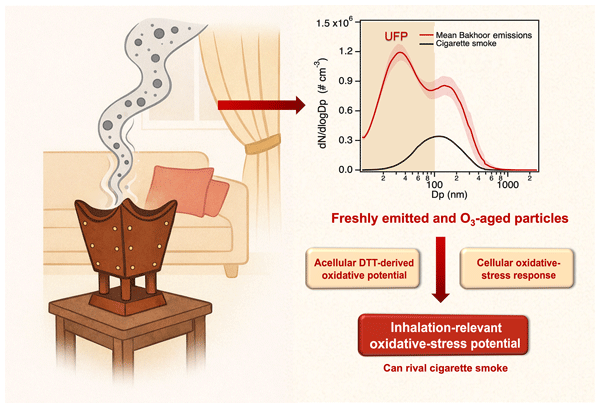
Abstract. Arabian incense (Bakhoor) burning is a widely practiced fragrancing and ceremonial activity, yet how the Bakhoor composition controls particle emissions and oxidative potential remains poorly constrained, especially under repeated use in low-ventilation settings. Here we characterized emissions from Bakhoor burning in a controlled chamber using a charcoal-assisted heating configuration representative of common practice and quantified aerosol oxidative potential using complementary acellular dithiothreitol (DTT) activity and a macrophage-based intracellular oxidative-stress response, with smoldering sidestream cigarette smoke as a benchmark source. Normalized by the initial Bakhoor mass per burn, Bakhoor burning produced particle mass and number emission rates of 670–1690 µg min-1 g-1 and (6–7) × 1011 particles min-1 g-1, respectively. Ultrafine particles contributed 70–75 % of the total particle number, and their emission rates substantially exceeded those from sidestream cigarette smoke. Across Bakhoor materials, emission magnitude followed a nonlinear power-law relationship with the loading of the hexane-soluble fraction, indicating that this fraction is an important control on particle production. In the acellular assay, the particle mass-normalized DTT consumption rate (OPDTTm) was approximately 32 pmol min-1 µg-1, modestly lower than that of cigarette smoke particles, whereas Bakhoor burning particles elicited stronger intracellular oxidative-stress responses. Ozone aging increased oxidative potential for both sources, and the acellular and cellular responses remained evident after aging equivalent to days of indoor exposure. Overall, Bakhoor burning represents a previously underrecognized source of ultrafine aerosol with substantial oxidative potential.
-
Notice on discussion status
The requested preprint has a corresponding peer-reviewed final revised paper. You are encouraged to refer to the final revised version.
-
Preprint
(2195 KB)
-
Supplement
(1881 KB)
-
The requested preprint has a corresponding peer-reviewed final revised paper. You are encouraged to refer to the final revised version.
- Preprint
(2195 KB) - Metadata XML
-
Supplement
(1881 KB) - BibTeX
- EndNote
- Final revised paper


Journal article(s) based on this preprint
Interactive discussion
Status: closed
-
RC1: 'Comment on egusphere-2026-1555', Anonymous Referee #1, 05 Apr 2026
- AC1: 'Reply on RC1', Liyuan Zhou, 24 Jun 2026
-
RC2: 'Comment on egusphere-2026-1555', Anonymous Referee #2, 27 Apr 2026
I was slightly surprised to see this in ACPD, given the strong focus on indoor air. Apart from that, this manuscript tells a coherent and interesting story, albeit with some methodological concerns that should be addressed before publication. Please find my more detailed comments below.
Specific comments
- Page 2, line 58 and following: while it is true that Arabian incense is much less characterized, than e.g. solid fuel burning, the literature isn’t quite as sparse as these sentences suggest. I would suggest adding here at least the study by Cohen et al. (2013) as a previous example of a cell tox study, and potentially some of the epidemiological evidence cited within.
- Section 2.2: Your chamber is quite small and the reached concentrations are rather high. Since nucleation and growth are dynamic phenomena and depend on a multitude of factors, I am wondering on how much the your observed values are affected by e.g. the chosen dilution rate (which will affect nucleation, condensation and coagulation)...how realistic is this when compared to room air?
- Section 2.3: I am surprised that the ozone aging was done with the already collected filters, as the aging behavior is likely to differ from those of suspended particles. Could you please comment on this?
- Page 4, line 131: Did you use ice (or some other method) to control the water bath temperature (for avoiding sample degradation)?
- Page 5, line 135: Why did you decide to use only positive mode? Are you expecting few polar compounds, or do you think those do not matter for toxicity?
- Section 2.5: The DTT assay can exhibit a non-linear mass dependence (Charrier, 2016). Did you adjust the mass loadings to be roughly the same? Or do you think this is not relevant in your case due to the specific particle composition?
- Page 5. Line 157-158: Did you filter the suspensions after the reaction? Otherwise, given the tendency of quartz fiber filters to disintegrate, I’d be surprised if there were no interference with the optical measurement. Or were these measurements done with the PTFE filters? Please clarify
- Section 2.6: have you performed any positive controls for your cell exposure experiments?
- Figure 1: there is a clear discontinuity in your size distribution data (1a & 1b). Any idea what happened there?
- Page 7, line 203-205: given that your reference emissions are usually low due to the lack of active puffing, I think the “benchmark” framing is slightly misleading as it makes the incense smoke look worse in comparison (substantially higher than an unusually low value). At the minimum, you should state some values for active smoking condition to enable the reader to better put the observed values into context.
- Page 7, line 217-218: see my previous comment: UFP concentrations likely also depend on additional parameters (e.g. the dilution rate changing coagulation & nucleation behavior).
- Page 8, line 255: was the mass determined gravimetrically or from the particle counters? In the latter case, I’d expect a rather large uncertainty due to the assumptions regarding the particle densities, which would impact the comparison with literature values.
- Page 9, line 269-270: while I think that it is fine to focus on ozone only, recent research indicates that OH chemistry is also relevant indoors (e.g. Zannoni, 2022).
- Page 9, line 274: is resuspension actually likely in your case, given that your particles are predominantly rather small?
- Section 3.6: Again, please motivate why you chose to only look at positive mode
- As you describe in the supplement, the assumption of spherical particles for LDSA calculation is likely not that appropriate (given that for your source, the particles are likely not spherical). Do you have any estimate regarding the LDSA uncertainty that is introduced this way? Either way, I think this caveat should be mentioned also in the main text.
Technical comments
- Page 6, line 195: I don’t think that “enriched” is really the right word here.
- I would suggest to use superscript (e.g. WS and tot) to distinguish between OPDTT,m for water-soluble and total OP, respectively (as you already do in one of your figures). Using the same abbreviation for both makes the text harder to parse for the reader.
- Figure 3C is currently not referred to, I would guess it’s meant to be in page 9, line 279?
References
Rebecca Cohen, Kenneth G. Sexton, Karin B. Yeatts: Hazard assessment of United Arab Emirates (UAE) incense smoke, Sci. Tot. Environ., 458–460, 2013.
Jessica G. Charrier, Alexander S. McFall, Kennedy K-T. Vu, James Baroi, Catalina Olea, Alam Hasson, Cort Anastasio: A bias in the “mass-normalized” DTT response, Atmos. Environ.,144, 2016.
Nora Zannoni et al.: The human oxidation field, Science, 377, 10711077, 2022.
Citation: https://doi.org/10.5194/egusphere-2026-1555-RC2 - AC2: 'Reply on RC2', Liyuan Zhou, 24 Jun 2026
Peer review completion


Interactive discussion
Status: closed
-
RC1: 'Comment on egusphere-2026-1555', Anonymous Referee #1, 05 Apr 2026
This manuscript characterizes the particulate emissions and associated oxidative potential (both acellular DTT and cellular macrophage ROS) generated from the indoor burning of Arabian incense (Bakhoor). Characterizing regionally significant indoor combustion sources is an important endeavor, and the authors provide a valuable dataset bridging size-resolved emission factors with toxicological endpoints. However, to fully realize the potential of this work, several methodological assumptions and analytical choices require further clarification and refinement. Addressing these points will strengthen the mechanistic insights and ensure the robustness of the conclusions prior to publication.
Major comments
1.The authors report impressive peak particle generation rates of (6-7) × 10¹¹ particles min⁻¹ g⁻¹. Given these exceptionally high concentrations within a 125 L chamber volume , treating particle decay primarily as a first-order wall loss process might underestimate the effects of size-dependent coagulation. Rapid coagulation in such dense plumes could significantly alter the observed nucleation and ultrafine modes over the residence time. The manuscript would benefit from a discussion on how coagulation dynamics were accounted for or why they are considered negligible here.
2.The 24-hour particle exposure duration for the DCFH-DA assay in MH-S alveolar macrophages provides a useful integrated response but may introduce confounding factors. Since the authors note that high doses approach cytotoxicity, extended exposure to complex combustion mixtures might inadvertently capture terminal cell death signaling rather than a direct, chemically induced oxidative response. Restricting the AUC analysis strictly to verified non-cytotoxic dose ranges would strengthen the attribution of the fluorescence signal to oxidative stress.
3.When evaluating macrophage responses to combustion products derived from raw wood and botanical additives, it is important to rule out external biological confounders. As a standard QA/QC measure, please detail any endotoxin screening performed on the filter samples, extraction media, or charcoal blanks. Environmental wood samples can sometimes harbor endotoxins that strongly activate macrophage oxidative bursts, so confirming their absence would solidify the chemical basis of the observed DCFH response.
4.The accelerated aging protocol exposes filter-bound particles to 1500 ppb of ozone for 30 minutes to simulate extensive indoor exposure. While methodologically convenient for delivering controlled oxidant doses, this static filter setup may introduce heterogeneous reaction artifacts not fully representative of typical indoor aging. Furthermore, indoor processing of volatile and semi-volatile organics is often heavily influenced by OH and NO3 radicals. Expanding the discussion to acknowledge the limitations of this high-concentration, single-oxidant proxy would provide a more balanced context.
5.The reliance on positive mode electrospray ionization (ESI+) for the UHPLC-HRMS analysis is well-suited for certain compound classes but may introduce a detection bias. ESI+ preferentially ionizes basic and nitrogen-containing compounds, potentially suppressing the detection of highly oxygenated or acidic organic species that are often strong drivers of redox activity. Discussing how this analytical choice might affect the comparison between the nitrogen-rich cigarette smoke and the Bakhoor emissions would improve the transparency of the structure-activity correlations.
6.Line 176-184: the authors mentioned that they performed MTT assay to check the cell viability. But there is not too much discussion about this cytotoxicity index. It is recommended to amend this result to the DTT and ROS data to show the oxidative stress effects of Bakhoor burning aerosol holistically
Minor comments
Line 100: Assuming a uniform effective particle density of 1 g cm⁻³ across all mobility diameters is a helpful simplification, but may not fully capture the complex morphology of fresh combustion soot and organics. The authors should consider adding a brief discussion in terms of the potential uncertainties. Also, any references for using this density?
Line 121: Wondering why these two ozone levels were selected
Line 148: Water extraction is performed via 30 minutes of sonication. Please specify if the water bath temperature was controlled (e.g., using ice to prevent heating), as elevated temperatures during sonication can sometimes degrade reactive oxygen species or alter the DTT response.
Page 7: For the operational separation of the hexane-soluble fraction , it would be reassuring to mention whether steps were taken to ensure the solvent extraction did not structurally alter the microphysical porosity of the remaining wood residue , which could independently affect its subsequent combustion behavior.
Page 8: Please clarify in the text or figure captions if the reported DTT consumption rates for the Bakhoor samples (approx. 32 pmol min⁻¹ μg⁻¹) explicitly subtract the background activity generated from the charcoal-only blanks.
Page 10: The direct comparison of cellular responses to naphthalene SOA is interesting but slightly abrupt. A sentence explaining why this specific single-precursor SOA is compared here would be helpful.
Line 358: change the title of section 4 to “Atmospheric implications”
Line 404: please rephrase this sentence
Citation: https://doi.org/10.5194/egusphere-2026-1555-RC1 - AC1: 'Reply on RC1', Liyuan Zhou, 24 Jun 2026
-
RC2: 'Comment on egusphere-2026-1555', Anonymous Referee #2, 27 Apr 2026
I was slightly surprised to see this in ACPD, given the strong focus on indoor air. Apart from that, this manuscript tells a coherent and interesting story, albeit with some methodological concerns that should be addressed before publication. Please find my more detailed comments below.
Specific comments
- Page 2, line 58 and following: while it is true that Arabian incense is much less characterized, than e.g. solid fuel burning, the literature isn’t quite as sparse as these sentences suggest. I would suggest adding here at least the study by Cohen et al. (2013) as a previous example of a cell tox study, and potentially some of the epidemiological evidence cited within.
- Section 2.2: Your chamber is quite small and the reached concentrations are rather high. Since nucleation and growth are dynamic phenomena and depend on a multitude of factors, I am wondering on how much the your observed values are affected by e.g. the chosen dilution rate (which will affect nucleation, condensation and coagulation)...how realistic is this when compared to room air?
- Section 2.3: I am surprised that the ozone aging was done with the already collected filters, as the aging behavior is likely to differ from those of suspended particles. Could you please comment on this?
- Page 4, line 131: Did you use ice (or some other method) to control the water bath temperature (for avoiding sample degradation)?
- Page 5, line 135: Why did you decide to use only positive mode? Are you expecting few polar compounds, or do you think those do not matter for toxicity?
- Section 2.5: The DTT assay can exhibit a non-linear mass dependence (Charrier, 2016). Did you adjust the mass loadings to be roughly the same? Or do you think this is not relevant in your case due to the specific particle composition?
- Page 5. Line 157-158: Did you filter the suspensions after the reaction? Otherwise, given the tendency of quartz fiber filters to disintegrate, I’d be surprised if there were no interference with the optical measurement. Or were these measurements done with the PTFE filters? Please clarify
- Section 2.6: have you performed any positive controls for your cell exposure experiments?
- Figure 1: there is a clear discontinuity in your size distribution data (1a & 1b). Any idea what happened there?
- Page 7, line 203-205: given that your reference emissions are usually low due to the lack of active puffing, I think the “benchmark” framing is slightly misleading as it makes the incense smoke look worse in comparison (substantially higher than an unusually low value). At the minimum, you should state some values for active smoking condition to enable the reader to better put the observed values into context.
- Page 7, line 217-218: see my previous comment: UFP concentrations likely also depend on additional parameters (e.g. the dilution rate changing coagulation & nucleation behavior).
- Page 8, line 255: was the mass determined gravimetrically or from the particle counters? In the latter case, I’d expect a rather large uncertainty due to the assumptions regarding the particle densities, which would impact the comparison with literature values.
- Page 9, line 269-270: while I think that it is fine to focus on ozone only, recent research indicates that OH chemistry is also relevant indoors (e.g. Zannoni, 2022).
- Page 9, line 274: is resuspension actually likely in your case, given that your particles are predominantly rather small?
- Section 3.6: Again, please motivate why you chose to only look at positive mode
- As you describe in the supplement, the assumption of spherical particles for LDSA calculation is likely not that appropriate (given that for your source, the particles are likely not spherical). Do you have any estimate regarding the LDSA uncertainty that is introduced this way? Either way, I think this caveat should be mentioned also in the main text.
Technical comments
- Page 6, line 195: I don’t think that “enriched” is really the right word here.
- I would suggest to use superscript (e.g. WS and tot) to distinguish between OPDTT,m for water-soluble and total OP, respectively (as you already do in one of your figures). Using the same abbreviation for both makes the text harder to parse for the reader.
- Figure 3C is currently not referred to, I would guess it’s meant to be in page 9, line 279?
References
Rebecca Cohen, Kenneth G. Sexton, Karin B. Yeatts: Hazard assessment of United Arab Emirates (UAE) incense smoke, Sci. Tot. Environ., 458–460, 2013.
Jessica G. Charrier, Alexander S. McFall, Kennedy K-T. Vu, James Baroi, Catalina Olea, Alam Hasson, Cort Anastasio: A bias in the “mass-normalized” DTT response, Atmos. Environ.,144, 2016.
Nora Zannoni et al.: The human oxidation field, Science, 377, 10711077, 2022.
Citation: https://doi.org/10.5194/egusphere-2026-1555-RC2 - AC2: 'Reply on RC2', Liyuan Zhou, 24 Jun 2026
Peer review completion
Journal article(s) based on this preprint
Viewed
| HTML | XML | Total | Supplement | BibTeX | EndNote | |
|---|---|---|---|---|---|---|
| 816 | 350 | 78 | 1,244 | 134 | 71 | 69 |
- HTML: 816
- PDF: 350
- XML: 78
- Total: 1,244
- Supplement: 134
- BibTeX: 71
- EndNote: 69
Viewed (geographical distribution)
| Country | # | Views | % |
|---|
| Total: | 0 |
| HTML: | 0 |
| PDF: | 0 |
| XML: | 0 |
- 1

Zhancong Liang
Ru-Jin Huang
Patrick K. H. Lee
The requested preprint has a corresponding peer-reviewed final revised paper. You are encouraged to refer to the final revised version.
- Preprint
(2195 KB) - Metadata XML
-
Supplement
(1881 KB) - BibTeX
- EndNote
- Final revised paper
This manuscript characterizes the particulate emissions and associated oxidative potential (both acellular DTT and cellular macrophage ROS) generated from the indoor burning of Arabian incense (Bakhoor). Characterizing regionally significant indoor combustion sources is an important endeavor, and the authors provide a valuable dataset bridging size-resolved emission factors with toxicological endpoints. However, to fully realize the potential of this work, several methodological assumptions and analytical choices require further clarification and refinement. Addressing these points will strengthen the mechanistic insights and ensure the robustness of the conclusions prior to publication.
Major comments
1.The authors report impressive peak particle generation rates of (6-7) × 10¹¹ particles min⁻¹ g⁻¹. Given these exceptionally high concentrations within a 125 L chamber volume , treating particle decay primarily as a first-order wall loss process might underestimate the effects of size-dependent coagulation. Rapid coagulation in such dense plumes could significantly alter the observed nucleation and ultrafine modes over the residence time. The manuscript would benefit from a discussion on how coagulation dynamics were accounted for or why they are considered negligible here.
2.The 24-hour particle exposure duration for the DCFH-DA assay in MH-S alveolar macrophages provides a useful integrated response but may introduce confounding factors. Since the authors note that high doses approach cytotoxicity, extended exposure to complex combustion mixtures might inadvertently capture terminal cell death signaling rather than a direct, chemically induced oxidative response. Restricting the AUC analysis strictly to verified non-cytotoxic dose ranges would strengthen the attribution of the fluorescence signal to oxidative stress.
3.When evaluating macrophage responses to combustion products derived from raw wood and botanical additives, it is important to rule out external biological confounders. As a standard QA/QC measure, please detail any endotoxin screening performed on the filter samples, extraction media, or charcoal blanks. Environmental wood samples can sometimes harbor endotoxins that strongly activate macrophage oxidative bursts, so confirming their absence would solidify the chemical basis of the observed DCFH response.
4.The accelerated aging protocol exposes filter-bound particles to 1500 ppb of ozone for 30 minutes to simulate extensive indoor exposure. While methodologically convenient for delivering controlled oxidant doses, this static filter setup may introduce heterogeneous reaction artifacts not fully representative of typical indoor aging. Furthermore, indoor processing of volatile and semi-volatile organics is often heavily influenced by OH and NO3 radicals. Expanding the discussion to acknowledge the limitations of this high-concentration, single-oxidant proxy would provide a more balanced context.
5.The reliance on positive mode electrospray ionization (ESI+) for the UHPLC-HRMS analysis is well-suited for certain compound classes but may introduce a detection bias. ESI+ preferentially ionizes basic and nitrogen-containing compounds, potentially suppressing the detection of highly oxygenated or acidic organic species that are often strong drivers of redox activity. Discussing how this analytical choice might affect the comparison between the nitrogen-rich cigarette smoke and the Bakhoor emissions would improve the transparency of the structure-activity correlations.
6.Line 176-184: the authors mentioned that they performed MTT assay to check the cell viability. But there is not too much discussion about this cytotoxicity index. It is recommended to amend this result to the DTT and ROS data to show the oxidative stress effects of Bakhoor burning aerosol holistically
Minor comments
Line 100: Assuming a uniform effective particle density of 1 g cm⁻³ across all mobility diameters is a helpful simplification, but may not fully capture the complex morphology of fresh combustion soot and organics. The authors should consider adding a brief discussion in terms of the potential uncertainties. Also, any references for using this density?
Line 121: Wondering why these two ozone levels were selected
Line 148: Water extraction is performed via 30 minutes of sonication. Please specify if the water bath temperature was controlled (e.g., using ice to prevent heating), as elevated temperatures during sonication can sometimes degrade reactive oxygen species or alter the DTT response.
Page 7: For the operational separation of the hexane-soluble fraction , it would be reassuring to mention whether steps were taken to ensure the solvent extraction did not structurally alter the microphysical porosity of the remaining wood residue , which could independently affect its subsequent combustion behavior.
Page 8: Please clarify in the text or figure captions if the reported DTT consumption rates for the Bakhoor samples (approx. 32 pmol min⁻¹ μg⁻¹) explicitly subtract the background activity generated from the charcoal-only blanks.
Page 10: The direct comparison of cellular responses to naphthalene SOA is interesting but slightly abrupt. A sentence explaining why this specific single-precursor SOA is compared here would be helpful.
Line 358: change the title of section 4 to “Atmospheric implications”
Line 404: please rephrase this sentence