
the Creative Commons Attribution 4.0 License.
the Creative Commons Attribution 4.0 License.
 | 17 Apr 2026
In situ apatite U-Pb, fission track and (U-Th)/He triple dating using a simple embedding approach
Abstract. Thermo- and geochronology techniques are foundational for many studies in tectonics, petrology, and surface processes. They provide essential information about cooling histories during exhumation or burial, and sediment provenance. Application of these methods has, in the past, primarily focused on applying individual techniques to separate mineral grains. More recently, analytical developments in laser-ablation geochronology have enabled the application of multiple dating techniques to an individual mineral grain (i.e., double or triple dating) to provide enhanced resolution of the mineral’s thermal history or dates and, therefore, the geologic or geomorphic interpretations derived from it. However, applying multiple geochronological methods to individual grains often requires methodological compromises that can restrict their applicability. In this study, we present a simplified and robust technique for embedding apatite grains in Teflon mounts. This approach enables the combined application of U-Pb, apatite fission track, and in-situ (U-Th)/He dating. In addition, this approach preserves the ability to quantify trace-element compositions and radionuclide zoning. The approach enables to significantly increase the number of measurements per sample, thereby opening the door to more robust results required for many applications.
To ensure high data quality from in-situ (U-Th)/He analyses, we introduce a decision matrix based on four key evaluation criteria: laser pit shape, radionuclide zoning, grain geometry, and the pit–grain relationship. We apply this integrated methodology to both the well-characterized Durango apatite standard and a sample from the crystalline basement of the Odenwald, western Germany. Our results demonstrate the robustness and reliability of this approach. Specifically, we obtain in-situ (U-Th)/He ages for Durango apatite (aliquot 1) of 31.04 ± 1.04 Ma (aliquot 1, n=35) and 31.38 ± 2.53 Ma (aliquot 2, n=22), which are in excellent agreement with accepted reference ages. Apatite U-Pb and fission track ages from the same grains, completing the triple dating approach, yield ages of 31.7 ± 1.9 Ma (U-Pb concordia age) and 35.0 ± 4.4 Ma (central AFT age).
The Odenwald sample reveals a complex, multi-phase cooling history consistent with major regional geodynamic events, including Late Cretaceous doming and Eocene exhumation associated with the formation of the Upper Rhine Graben. Importantly, our results confirm that the Teflon mounting procedure, which requires short-term heating to 300 °C, did does not cause measurable helium loss or reduce fission track density and track length in the near F-endmember Durango apatite, a mineral susceptible to annealing. This supports the viability of this approach for high-resolution, multi-system geo- and thermochronology thereby expanding the utility of these techniques to a broader range of geoscience applications.
-
Notice on discussion status
The requested preprint has a corresponding peer-reviewed final revised paper. You are encouraged to refer to the final revised version.
-
Preprint
(3207 KB)
-
The requested preprint has a corresponding peer-reviewed final revised paper. You are encouraged to refer to the final revised version.
- Preprint
(3207 KB) - Metadata XML
- BibTeX
- EndNote
- Final revised paper


Journal article(s) based on this preprint
Interactive discussion
Status: closed
-
RC1: 'Comment on egusphere-2026-1552', David M. Chew, 20 Apr 2026
-
AC1: 'Reply on RC1', Christoph Glotzbach, 12 Jun 2026
RC1: Comment on egusphere-2026-1552 – David Chew
This is a great paper, showing a really nice integrated methodology for in situ U-Th/He, FT and U-Pb dating of apatite in Teflon mounts. It is going to be a valuable contribution to the field.
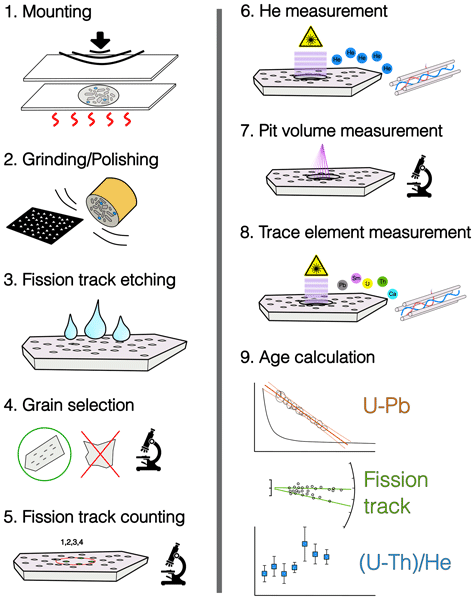
I think what would be useful for this manuscript is a figure comprised of a series of schematic panels illustrating all the steps in the triple dating and also explicitly stating the order of the analysis steps in the abstract - mounting, etching, grain selection; FT counting, H measurement, volume estimation and then LA-ICP-MS analysis.
Response: We do agree with the reviewer and would add a figure illustrating the analytical steps and also give the order of steps in the abstract.
I could not download any of the scripts from the Zenodo repository – were they meant to be visible to the reviewers? It would have been useful if they were.
Response: We are sorry to hear that the download was not possible. We unfortunately didn’t check if the repository is accessible at the time of submission. Access is now open to the public.
My only reservation is the U-Pb age calculation. A zircon should not be used as the U-Pb age standard, and Durango is far too young for an accurate correction. McClure Mountain was analysed – it should be the primary. Why was it not used? You also cannot perform a drift correction on the 206Pb/238U ratio because the standards invariably contains variable common Pb – the common Pb correction must be undertaken first, and then you drift correct the common Pb-corrected 206Pb/238U ratio. See Chew et al., 2014 Chemical Geology which discusses all this in detail. Minor edits are listed below.
Response: Thanks for the comment on the U-Pb calculation. We do agree that the applied analytics could be better for this part. We have not sued a zircon, this was still in the manuscript from an earlier version. We will delete it in the revised version. Although we are now routinely doing, we have not measured McClure Mountain apatite. We therefore have only Durango apatite as reference age standard, which we agree is not ideal. We have followed the right order of data reduction, we first applied the common Pb correction for the used age standard, in our case Durango using the 207Pb correction method. Afterwards we corrected the the samples for drift. We will change the text accordingly to clarify the order of steps in the U-Pb calculation.
Best wishes
David Chew
Minor comments
L46 ‘and expanded’ – Will be changed accordingly.
L51-52 Recent progress in in-situ (U–Th)/He thermochronometry has demonstrated its compatibility with other dating systems, such as U-Pb, Lu-Hf, and fission-track methods (e.g., Carrapa et al., 2009; Bedoya et al., 2024).
I do not get this sentence. Why does compatible mean in this context? Surely the point about in situ (U-Th)/He is that it works (i.e. it reproduces conventional single crystal analyses of age reference materials) and it gives you spatial control. – We wanted to point out that the in situ (U-Th)/He method is capable to be combined with other dating methods. We will adjust the sentence in a revised manuscript.
L61-63 A more recent innovation by Bedoya et al. (2024) involved a sequential analysis of Lu-Hf, U-Pb, and after polishing, the LA-ICP-MS-based fission track dating method was applied to single apatite grains embedded in epoxy mounts.
Emphasize the point here that it does not require extraction from the mount. Is the analysis order correct? It would seem to make sense to count for FT first before the grain is more or less destroyed by the big Lu-Hf spot. – We will emphasize that grain extraction is not necessary. In fact the exact order or analysis is unfortunately not given in Bedoya et al. (2024), but we will try to get this information by contacting the author and correct the text accordingly. OK, we got a response, they first did FT, followed by U-Pb on the same spot. The much larger Lu-Hf spot was placed next to it, in case grains were large enough. I will add this information in the revised manuscript.
L64 Since epoxy degasses under ultra-high vacuum conditions
Is this true of all epoxy resins? Has anyone tried Petropoxy under a ultra-high vacuum? – I am not aware of any testing on different types of expoxy. We would change the sentence and say that we are not aware of any epoxy that that performs similar to Teflon.
L105 1. Initial Setup: A clean glass slide was coated with a thin film of epoxy to fix grains in place during mounting.
Would double-sided tape work – presumably the epoxy will cure at room temperature leaving not much time for grain placement. What epoxy was used? – We have tested heat-resisting tape (Kapton), but it was shrinking at our embedding temperature of 295°C. We therefore used epoxy resin (Araldite 2020) keep grains in place.
L164 The zenodo link does not appear to work, and in any case it is not clear what of the following six numbered steps it is used for. – The Zendo repository contains a Python macro that is semi-automatically helping the user to do the mentioned steps, e.g. switching between objectives, taking images and saving images in a folder structure. We would add more information on this in a revised manuscript.
L199, L234,L272, L301 These zenodo links do not appear to be valid either in the DOI system. – This has been solved in the meantime.
L301-312 – see substantive comment.
L322-323 I do not like the term variable common lead composition referring to Durango. I think it is accepted its initial Pb isotopic composition is homogenous (see Paul et al. Chemical Geology 2021); what varies is the amount of common Pbn in each analysis – so refer to variable amounts of common Pb, not variable Pb composition. It is an important difference. – Thanks for pointing this out. We will change the text accordingly in a revised manuscript.
L418 The IM field is a bit broader that – it includes low ASI (non-peraluminous) granites. There is a pre-IOA rhyolite along with pre- and post IOA ignimbrite in Durango, and the the Durango-Mazatlán ignimbrites are true rhyolites in composition that follow a high-potassium calc-alkaline trend (McDowell et al., 2007). So they would likely plot in the IM field. – Thanks for clarification, we will add this information in a revised manuscript.
L449 I would present these data as a lower intercept age on TW concordia – it is very unusual to present 207Pb-corrected data on Wetherill concordia as it makes everything perfectly concordant. Same for sample 22BGE055T in Fig. 4. – We will adjust the figure and will add a lower intercept age on the TW concordia.
L630-631 What inverse thermal history modelling software was used – your own or HeFTy? Needs more detail. – Since HeFTy cannot yet handle in-situ data we have our own Matlab based inverse modelling approach that is using standard annealing model of Ketcham et al. (2007) and the adapted He model of Glotzbach and Ehlers (2024). We will add more details on it.
Citation: https://doi.org/10.5194/egusphere-2026-1552-AC1
-
AC1: 'Reply on RC1', Christoph Glotzbach, 12 Jun 2026
-
RC2: 'Comment on egusphere-2026-1552', Rebecca Flowers, 24 May 2026
This manuscript presents the methodology of the Tubingen lab for the acquisition of laser-ablation U-Pb, fission track, and (U-Th)/He data in phosphates. It presents results for the Durango apatite standard as well as for a sample of crystalline basement in western Germany. It also outlines a decision matrix to enhance the acquisition of high-quality laser-ablation (U-Th)/He data and presents thermal history modeling results for the western Germany basement sample.
Overall, this is a nice paper and I greatly appreciate the overview of the methods in this manuscript. Given that laser-ablation (U-Th)/He dating methods are still under development and there is no universally adopted approach, I agree that it should be a priority for labs to clearly explain their methods prior to publishing data for unknowns. Papers like this one are valuable for moving the method forward.
Our lab at CU is also deep in the development of our analytical methodology for laser-ablation (U-Th)/He geochronology so three of us (myself, Cullen Kortyna, and Jim Metcalf) discussed this manuscript. I summarize below the key points of our discussion and our suggestions to improve the contribution.
Methods
We appreciate the details provided in the methodology. However, it would be helpful to locally provide more information, explain the rationale for some decisions, and include pictures (rather than solely illustrations) of some of the method steps.
- It would be helpful to show pictures of the mount preparation process. We were unclear what was meant by the “heated press”. Does the Teflon mount remain on the glass slide or is it popped off for polishing? How do you successfully polish a Teflon disk this thin?
- It would be helpful to provide more explanation about how you determine pit volumes. We have learned that LA-(U-Th)/He results are very sensitive to the pit measurements and different systems work differently. How does your confocal laser system work to generate models of the pit? What is being used for the top surface interpolation?
- Uncertainties on pit volumes are not discussed. How did you determine these uncertainties and what is the typical uncertainty magnitude? The pit-volume uncertainties reported in Table 4 are extremely small.
- We were surprised that the U-Th spot was placed as a smaller spot in the He pit, rather than as a larger spot over the He pit. The latter would yield improved precision on the trace element data and better sample the parent isotopes that contributed to the measured He. Could you explain the reasoning for this decision?
- How was 204Pb corrected for 204Hg for plotting on the Wetherill diagram?
- We were unsure why 91500 zircon was mentioned as an age standard when apatite samples are being analyzed.
- We typically run a secondary U-Th reference like 610 to check for bias in our calibration curve and wondered if this was part of your standard protocol.
- We see that variable laser parameters (e.g., variable fluence) were used for some of the analyses and wondered if this affected your dates.
- There are sections on fission-track age calculation and U-Pb age calculation, but no section on (U-Th)/He age calculation. The latter should be added.
- In the section on (U-Th)/He age calculation, it would be helpful to include a section on uncertainties (including those for the pit volumes) and how these were propagated into the (U-Th)/He date. What was the density assumed in the age calculations?
- I would recommend switching the order of 2.10 and 2.11 so that they are in the same order that the results are presented.
Results
- We appreciate the modeling of mounting-induced annealing and diffusion. We agree that this analysis needed to be done and it is reassuring to see that the mounting protocol does not bias the analytical outcomes.
- There is no graphical depiction of the LA-(U-Th)/He dates in the manuscript. Please include results plots for the (U-Th)/He data. These could be data distributions or date-eU plots.
- Lines 513-522 – could these data define a date-eU relationship? Include this plot?
- Table 4. Please explain the numbers in last four columns – I understand that these likely refer to the decision matrix.
- We were not convinced by the interpretation of the U-Pb data for the sample from Germany. The data in Figure 4C on the Tera-Wasserburg diagram arguably define two different concordia lines, possibly due to two different common Pb compositions. Why not fit one or two concordia lines through these data and derive a preferred date?
- What type of 204Pb correction was applied to the German sample data on the Wetherill diagram?
- The large spread of data on the Wetherill diagram in Figure 4D suggests that the common Pb correction was not successful – this would indicate that taking the average 206Pb/238U age or the weighted concordia age is not the best approach to deriving an apatite U-Pb date for this sample. Instead, the intercept from the Tera-Wasserburg diagram would appear to be a better approach.
- The authors provide geological explanations for the discrepancy between the K-Ar date and the apatite U-Pb date. It strikes us as more reasonable to question the approach to the common Pb correction, and we are generally skeptical of the quality of K-Ar dates from the 1970s. It seems to us more appropriate to disregard the K-Ar data and then derive a U-Pb date from the Tera-Wasserburg diagram (and not worry about it being even older than the date currently derived from the Wetherill diagram).
Discussion – Decision matrix
- We feel that the decision matrix is a valuable contribution of this manuscript. However, we feel that there should be a richer discussion of the four different parameters in the context of the actual data. How do the dates reported in this manuscript correlate with these different criteria? It would be helpful to show plots of the data in the context of these criteria.
- Here again it would be helpful to include real images, such as of the laser pit shape.
- We like your statistical approach for radionuclide zoning, but could you please explain in the text why you decided on 20 as the MSWD cutoff?
- We were confused about the grain geometry criterion – if you put the pits on the grain geometry schematics, isn’t this criterion essentially the same as the pit-grain relationship criterion? As one moves from 1 to 5 in grain geometry, the grains become smaller, which means that the pit becomes closer to the grain edge, the same as in the pit-grain relationship criterion. Could you please add the pits to the grain geometry schematics and explain in the text why you distinguish the grain geometry criterion from the pit-grain relationship criterion?
Discussion – Tradeoffs
- We recommend adding a short section in the discussion that discusses the tradeoffs when collecting triple dates on apatite.
- For example, the fission-track data are of low quality because the authors restricted themselves to collecting those data on samples also dated by U-Pb and (U-Th)/He (at least, I think that’s what was done). Would it be better to acquire data for a larger suite of apatite, even if not on the same grains dated by the other methods? It would be worth discussing the pros and cons.
- A compromise must also have been made when deciding to collect the rare earth element data simultaneously with the U-Th data. Collecting all of these data will reduce the resolution on the U-Th zonation and increase the uncertainties on the U-Th.
- We fully appreciate that compromises are required when setting up analyses and deciding what data are most important to prioritize. A discussion recognizing these limitations and decision-making would be helpful.
Discussion - Thermal history reconstruction.
- We appreciate the thermal history modeling carried out by this paper and the efforts to derive thermal histories that simultaneously explain the triple dates. We have a few thoughts here.
- Table 5. Please explain the Dist2PrismX and Dist2PrismZ parameters. How to you know distance from polished surface to the grain bottom?
- Lines 652-654. Why use acceptable fits instead of good-fits?
- In Figure 7, could you please show a plot of all the LA-(U-Th)/He dates (not just the 7 modeled dates) along with the predictions of the best-fit path? This could be a date-eU plot, or some other plot. A plot comparing all observed dates with the predicted dates would be far more intuitive than the plot currently included, which shows the observed and predicted concentrations (which carries no geological or kinetic meaning).
Minor Comments
- There was a lot of space and two entire figures on the modeling of mounting-induced annealing and diffusion. You might consider moving some of that content into the supplement.
- Lines 28-29. I think too many significant figures are reported here?
- Lines 218-219 say 20-50 um spot size for He pits, but lines 269-270 say 30-50 um spots.
- Line 724. “Resolute” doesn’t seem like the right word choice here. “…better-resolved cooling histories…” would be an alternative.
Citation: https://doi.org/10.5194/egusphere-2026-1552-RC2 -
AC2: 'Reply on RC2', Christoph Glotzbach, 12 Jun 2026
RC2: Comment on egusphere-2026-1552 – Rebecca Flowers
This manuscript presents the methodology of the Tubingen lab for the acquisition of laser-ablation U-Pb, fission track, and (U-Th)/He data in phosphates. It presents results for the Durango apatite standard as well as for a sample of crystalline basement in western Germany. It also outlines a decision matrix to enhance the acquisition of high-quality laser-ablation (U-Th)/He data and presents thermal history modeling results for the western Germany basement sample.
Overall, this is a nice paper and I greatly appreciate the overview of the methods in this manuscript. Given that laser-ablation (U-Th)/He dating methods are still under development and there is no universally adopted approach, I agree that it should be a priority for labs to clearly explain their methods prior to publishing data for unknowns. Papers like this one are valuable for moving the method forward.
Our lab at CU is also deep in the development of our analytical methodology for laser-ablation (U-Th)/He geochronology so three of us (myself, Cullen Kortyna, and Jim Metcalf) discussed this manuscript. I summarize below the key points of our discussion and our suggestions to improve the contribution.
Methods
We appreciate the details provided in the methodology. However, it would be helpful to locally provide more information, explain the rationale for some decisions, and include pictures (rather than solely illustrations) of some of the method steps.
- It would be helpful to show pictures of the mount preparation process. We were unclear what was meant by the “heated press”. Does the Teflon mount remain on the glass slide or is it popped off for polishing? How do you successfully polish a Teflon disk this thin? – The details will be added to the revised manuscript. We do have a manual heat press like this https://de.kinteksolution.com/products/manual-heated-hydraulic-lab-press-with-integrated-hot-plates-hydraulic-press-machine. The Teflon will be removed from the glass slide and attached to a thicker mount with double-sided adhesive tape for grinding and polishing.
- It would be helpful to provide more explanation about how you determine pit volumes. We have learned that LA-(U-Th)/He results are very sensitive to the pit measurements and different systems work differently. How does your confocal laser system work to generate models of the pit? What is being used for the top surface interpolation? – That is a very good point and we are unfortunately missing standards that can be used to validate our measurements. Our system is scanning the pit at vertical resolution of 0.4 micrometer and builds the model based on where the laser is focused (highest intensity). The pre-ablation surface is linearly interpolated from numerous x,y,z points taken a few microns around the pit. In fact we draw a circle around and take the x,y,z points from that circle. We were also not sure how accurate our method is and for that reason we used step height standards from AppNano with heights of 5 and 10 μm. With our system we could measure the reference height within 1-2%, but that difference might be due to height variations of the reference material. Therefore we cannot really assign an uncertainty based on the comparison with the reference height standard. However, we are very confident that our system is accurately measure the steep walls of the laser pits, since we very accurately determine the vertical wall of the step height standards.
- Uncertainties on pit volumes are not discussed. How did you determine these uncertainties and what is the typical uncertainty magnitude? The pit-volume uncertainties reported in Table 4 are extremely small. – Initially we have repeated the pit volume calculation several times and calculate the mean and standard deviations from several measurements. In some cases results were very robust and did not change much, in other cases there was a bit of variation, mostly when for instance the grain surface was not perfectly smooth. Anyway, uncertainties were quite small and we therefore did not continue to do repeated pit volume measurements. We do think that a more detailed study is required to study uncertainties of the pit volume measurements.
- We were surprised that the U-Th spot was placed as a smaller spot in the He pit, rather than as a larger spot over the He pit. The latter would yield improved precision on the trace element data and better sample the parent isotopes that contributed to the measured He. Could you explain the reasoning for this decision? – We can add in the revised manuscript details on our decision. I do agree with the reviewer, but there are also advantages doing a nested approach that we describe. First, the pit shape and geometry will be more similar to those of the glass standard when starting with a flat surface with the larger He pit. Second, potential zoning might be easier to detect and used for age calculation since the ablated material can be transferred into depth information.
- How was 204Pb corrected for 204Hg for plotting on the Wetherill diagram? – We have used the 207Pb method to correct for common lead, which will be added in a revised version of the manuscript.
- We were unsure why 91500 zircon was mentioned as an age standard when apatite samples are being analyzed. – Ups, that got probably in the manuscript during an earlier phase of the manuscript. At that time I thought of putting also some zircon data into it. We will delete it.
- We typically run a secondary U-Th reference like 610 to check for bias in our calibration curve and wondered if this was part of your standard protocol. – That is a good point, so far we have not done. Since our Durango apatite yield correct ages, we did not thought to analyse another trace element standard. We agree, however, that it is low effort to measure in addition to the 610 standard. We will mention this in the revised manuscript and will also measure it from now on.
- We see that variable laser parameters (e.g., variable fluence) were used for some of the analyses and wondered if this affected your dates. – Based on our limited number of measurements with variable fluence (1.3 to 3 J/cm2) we do not see any impact on resulting He age (Table 4). We will add this information in the revised manuscript.
- There are sections on fission-track age calculation and U-Pb age calculation, but no section on (U-Th)/He age calculation. The latter should be added. – We will add a corresponding section.
- In the section on (U-Th)/He age calculation, it would be helpful to include a section on uncertainties (including those for the pit volumes) and how these were propagated into the (U-Th)/He date. What was the density assumed in the age calculations? – That is a good point, we will add information on how we did propagate uncertainties and give details on the density used.
- I would recommend switching the order of 2.10 and 2.11 so that they are in the same order that the results are presented. – Good point, we will do in the revised manuscript.
Results
- We appreciate the modeling of mounting-induced annealing and diffusion. We agree that this analysis needed to be done and it is reassuring to see that the mounting protocol does not bias the analytical outcomes. –
- There is no graphical depiction of the LA-(U-Th)/He dates in the manuscript. Please include results plots for the (U-Th)/He data. These could be data distributions or date-eU plots. - We will explore the data to make sure we do not miss any significant relationship, and will produce a plot to show the spread in ages as a function of eU, grain-size or any other variable.
- Lines 513-522 – could these data define a date-eU relationship? Include this plot? – We will explore it, but looking at the data, there is no clear relationship, e.g. the youngest and oldest grains do not correspond to the lowest/highest eU.
- Table 4. Please explain the numbers in last four columns – I understand that these likely refer to the decision matrix. – We will add a link to the decision matrix in the revised manuscript.
- We were not convinced by the interpretation of the U-Pb data for the sample from Germany. The data in Figure 4C on the Tera-Wasserburg diagram arguably define two different concordia lines, possibly due to two different common Pb compositions. Why not fit one or two concordia lines through these data and derive a preferred date? – We will explore this and will fit one/two discordia lines and will report the lower intercept ages.
- What type of 204Pb correction was applied to the German sample data on the Wetherill diagram? – We applied a 207Pb correction method, which we will mention in the revised version of the manuscript.
- The large spread of data on the Wetherill diagram in Figure 4D suggests that the common Pb correction was not successful – this would indicate that taking the average 206Pb/238U age or the weighted concordia age is not the best approach to deriving an apatite U-Pb date for this sample. Instead, the intercept from the Tera-Wasserburg diagram would appear to be a better approach. – Ones we have done the fitting of the data in the Tera-Wasserburg diagram, we will compare the resulting ages.
- The authors provide geological explanations for the discrepancy between the K-Ar date and the apatite U-Pb date. It strikes us as more reasonable to question the approach to the common Pb correction, and we are generally skeptical of the quality of K-Ar dates from the 1970s. It seems to us more appropriate to disregard the K-Ar data and then derive a U-Pb date from the Tera-Wasserburg diagram (and not worry about it being even older than the date currently derived from the Wetherill diagram). – We were a bit defensive in interpreting our results since the sample did not produce ideal results. Let’s see what the fitting of the data in the Tera-Wasserburg diagram gives and based on this we will adjust our interpretation.
Discussion – Decision matrix
- We feel that the decision matrix is a valuable contribution of this manuscript. However, we feel that there should be a richer discussion of the four different parameters in the context of the actual data. How do the dates reported in this manuscript correlate with these different criteria? It would be helpful to show plots of the data in the context of these criteria. – We can add a few examples (including figures, likely for the supplement) in which direction the criteria influence resulting ages, such as radionuclide zoning.
- Here again it would be helpful to include real images, such as of the laser pit shape. – We can add figures showing, good/bad laser pits or homogeneous/zoned radionuclide distributions.
- We like your statistical approach for radionuclide zoning, but could you please explain in the text why you decided on 20 as the MSWD cutoff? – There is no special statistical meaning of using 20 as cutoff; it is simply suggested since data with a MSWD of 20 does have quite large variation and would like produce an outlier age. The latter, however, would need to be explored in more detail (I would not like much to include it in this study).
- We were confused about the grain geometry criterion – if you put the pits on the grain geometry schematics, isn’t this criterion essentially the same as the pit-grain relationship criterion? As one moves from 1 to 5 in grain geometry, the grains become smaller, which means that the pit becomes closer to the grain edge, the same as in the pit-grain relationship criterion. Could you please add the pits to the grain geometry schematics and explain in the text why you distinguish the grain geometry criterion from the pit-grain relationship criterion? – Good point, we will add pictures of the pits on the grains shown in the ‘Grain geometry’ column in the decision matrix figure. Both criteria are different, while the ‘Grain geometry’ does not necessarily impact the resulting ages, it does have consequences for a potential thermal modelling, since the distances to the grain boundaries are partly unknown, preventing to set-up all required modelling parameters (e.g. grain radius, and distance to the prismatic surface). The ‘Pit-grain relationship’ does directly impact the resulting ages, however, thermal history modeling is still possible. We will add some extra text to the discussion section to explain the differences in more detail.
Discussion – Tradeoffs
- We recommend adding a short section in the discussion that discusses the tradeoffs when collecting triple dates on apatite. – That is a great idea, we will add a section on the tradeoffs that derive from making compromises.
- For example, the fission-track data are of low quality because the authors restricted themselves to collecting those data on samples also dated by U-Pb and (U-Th)/He (at least, I think that’s what was done). Would it be better to acquire data for a larger suite of apatite, even if not on the same grains dated by the other methods? It would be worth discussing the pros and cons. – We will add information on the grain selection and especially on the restriction of counting in a specific geometry, e.g. circle with 30 μm. We do have some suggestions on how this could be optimised, e.g. measuring/counting several spots in larger grains.
- A compromise must also have been made when deciding to collect the rare earth element data simultaneously with the U-Th data. Collecting all of these data will reduce the resolution on the U-Th zonation and increase the uncertainties on the U-Th. – Integration times of the REE are 0.001 sec/Mass and therefore all 14 REE measured do only take 0.014 sec, while we measured Pb isotopes with an integration time of 0.1 seconds, and the whole sampling period is roughly 1 sec. Therefore, the measuring time of REE is negligible and does not led to a reduced resolution of the U-Th-Pb measurements. We will add this information in the discussion.
- We fully appreciate that compromises are required when setting up analyses and deciding what data are most important to prioritize. A discussion recognizing these limitations and decision-making would be helpful. - We fully agree that this needs to be stated and we will add a short paragraph reporting our setup and potential compromises.
Discussion - Thermal history reconstruction.
- We appreciate the thermal history modeling carried out by this paper and the efforts to derive thermal histories that simultaneously explain the triple dates. We have a few thoughts here.
- Table 5. Please explain the Dist2PrismX and Dist2PrismZ parameters. How to you know distance from polished surface to the grain bottom? – Dist2PrismX and Dist2PrismZ are the measured distances of the centre of the laser pit towards the prism faces measured in the horizontal and vertical plane. The horizontal distance is easy to measure, the vertical is not trivial and also not very accurate. We simply focused on the bottom of the grain with transmitted light and corrected the distance with the refraction index of apatite. We will add this information in the revised manuscript.
- Lines 652-654. Why use acceptable fits instead of good-fits? – Ah, of course, we also take good paths, everything that yields a GOF >0.05. We will rephrase it.
- In Figure 7, could you please show a plot of all the LA-(U-Th)/He dates (not just the 7 modeled dates) along with the predictions of the best-fit path? This could be a date-eU plot, or some other plot. A plot comparing all observed dates with the predicted dates would be far more intuitive than the plot currently included, which shows the observed and predicted concentrations (which carries no geological or kinetic meaning). - We will generate this plot, and either add it to Fig. 7 as a new sub-figure or replacing 7A with the new plot.
Minor Comments
- There was a lot of space and two entire figures on the modeling of mounting-induced annealing and diffusion. You might consider moving some of that content into the supplement. – We do agree, and accordingly will condense the section on the ‘Mount induced annealing and diffusion’ and move the figures into the supplement.
- Lines 28-29. I think too many significant figures are reported here? – I unfortunately do not understand your comment here.
- Lines 218-219 say 20-50 um spot size for He pits, but lines 269-270 say 30-50 um spots. – Ah, 30-50 μm is correct and will be corrected in line 218-219.
- Line 724. “Resolute” doesn’t seem like the right word choice here. “…better-resolved cooling histories…” would be an alternative. - Thanks for the suggestion, we will correct this sentence in the revised manuscript.
Citation: https://doi.org/10.5194/egusphere-2026-1552-AC2
Peer review completion


Interactive discussion
Status: closed
-
RC1: 'Comment on egusphere-2026-1552', David M. Chew, 20 Apr 2026
This is a great paper, showing a really nice integrated methodology for in situ U-Th/He, FT and U-Pb dating of apatite in Teflon mounts. It is going to be a valuable contribution to the field.
I think what would be useful for this manuscript is a figure comprised of a series of schematic panels illustrating all the steps in the triple dating and also explicitly stating the order of the analysis steps in the abstract - mounting, etching, grain selection; FT counting, H measurement, volume estimation and then LA-ICP-MS analysis.
I could not download any of the scripts from the Zenodo repository – were they meant to be visible to the reviewers? It would have been useful if they were.
My only reservation is the U-Pb age calculation. A zircon should not be used as the U-Pb age standard, and Durango is far too young for an accurate correction. McClure Mountain was analysed – it should be the primary. Why was it not used? You also cannot perform a drift correction on the 206Pb/238U ratio because the standards invariably contains variable common Pb – the common Pb correction must be undertaken first, and then you drift correct the common Pb-corrected 206Pb/238U ratio. See Chew et al., 2014 Chemical Geology which discusses all this in detail. Minor edits are listed below.
Best wishes
David Chew
Miinor comments
L46 ‘and expanded’
L51-52 Recent progress in in-situ (U–Th)/He thermochronometry has demonstrated its compatibility with other dating systems, such as U-Pb, Lu-Hf, and fission-track methods (e.g., Carrapa et al., 2009; Bedoya et al., 2024).
I do not get this sentence. Why does compatible mean in this context? Surely the point about in situ (U-Th)/He is that it works (i.e. it reproduces conventional single crystal analyses of age reference materials) and it gives you spatial control.
L61-63 A more recent innovation by Bedoya et al. (2024) involved a sequential analysis of Lu-Hf, U-Pb, and after polishing, the LA-ICP-MS-based fission track dating method was applied to single apatite grains embedded in epoxy mounts.
Emphasize the point here that it does not require extraction from the mount. Is the analysis order correct? It would seem to make sense to count for FT first before the grain is more or less destroyed by the big Lu-Hf spot.
L64 Since epoxy degasses under ultra-high vacuum conditions
Is this true of all epoxy resins? Has anyone tried Petropoxy under a ultra-high vacuum?
L105 1. Initial Setup: A clean glass slide was coated with a thin film of epoxy to fix grains in place during mounting.
Would double-sided tape work – presumably the epoxy will cure at room temperature leaving not much time for grain placement. What epoxy was used?
L164 The zenodo link does not appear to work, and in any case it is not clear what of the following six numbered steps it is used for.
L199, L234,L272, L301 These zenodo links do not appear to be valid either in the DOI system.
L301-312 – see substantive comment.
L322-323 I do not like the term variable common lead composition referring to Durango. I think it is accepted its initial Pb isotopic composition is homogenous (see Paul et al. Chemical Geology 2021); what varies is the amount of common Pbn in each analysis – so refer to variable amounts of common Pb, not variable Pb composition. It is an important difference.
L418 The IM field is a bit broader that – it includes low ASI (non-peraluminous) granites. There is a pre-IOA rhyolite along with pre- and post IOA ignimbrite in Durango, and the the Durango-Mazatlán ignimbrites are true rhyolites in composition that follow a high-potassium calc-alkaline trend (McDowell et al., 2007). So they would likely plot in the IM field.
L449 I would present these data as a lower intercept age on TW concordia – it is very unusual to present 207Pb-corrected data on Wetherill concordia as it makes everything perfectly concordant. Same for sample 22BGE055T in Fig. 4.
L630-631 What inverse thermal history modelling software was used – your own or HeFTy? Needs more detail.
Citation: https://doi.org/10.5194/egusphere-2026-1552-RC1 -
AC1: 'Reply on RC1', Christoph Glotzbach, 12 Jun 2026
RC1: Comment on egusphere-2026-1552 – David Chew
This is a great paper, showing a really nice integrated methodology for in situ U-Th/He, FT and U-Pb dating of apatite in Teflon mounts. It is going to be a valuable contribution to the field.
I think what would be useful for this manuscript is a figure comprised of a series of schematic panels illustrating all the steps in the triple dating and also explicitly stating the order of the analysis steps in the abstract - mounting, etching, grain selection; FT counting, H measurement, volume estimation and then LA-ICP-MS analysis.
Response: We do agree with the reviewer and would add a figure illustrating the analytical steps and also give the order of steps in the abstract.
I could not download any of the scripts from the Zenodo repository – were they meant to be visible to the reviewers? It would have been useful if they were.
Response: We are sorry to hear that the download was not possible. We unfortunately didn’t check if the repository is accessible at the time of submission. Access is now open to the public.
My only reservation is the U-Pb age calculation. A zircon should not be used as the U-Pb age standard, and Durango is far too young for an accurate correction. McClure Mountain was analysed – it should be the primary. Why was it not used? You also cannot perform a drift correction on the 206Pb/238U ratio because the standards invariably contains variable common Pb – the common Pb correction must be undertaken first, and then you drift correct the common Pb-corrected 206Pb/238U ratio. See Chew et al., 2014 Chemical Geology which discusses all this in detail. Minor edits are listed below.
Response: Thanks for the comment on the U-Pb calculation. We do agree that the applied analytics could be better for this part. We have not sued a zircon, this was still in the manuscript from an earlier version. We will delete it in the revised version. Although we are now routinely doing, we have not measured McClure Mountain apatite. We therefore have only Durango apatite as reference age standard, which we agree is not ideal. We have followed the right order of data reduction, we first applied the common Pb correction for the used age standard, in our case Durango using the 207Pb correction method. Afterwards we corrected the the samples for drift. We will change the text accordingly to clarify the order of steps in the U-Pb calculation.
Best wishes
David Chew
Minor comments
L46 ‘and expanded’ – Will be changed accordingly.
L51-52 Recent progress in in-situ (U–Th)/He thermochronometry has demonstrated its compatibility with other dating systems, such as U-Pb, Lu-Hf, and fission-track methods (e.g., Carrapa et al., 2009; Bedoya et al., 2024).
I do not get this sentence. Why does compatible mean in this context? Surely the point about in situ (U-Th)/He is that it works (i.e. it reproduces conventional single crystal analyses of age reference materials) and it gives you spatial control. – We wanted to point out that the in situ (U-Th)/He method is capable to be combined with other dating methods. We will adjust the sentence in a revised manuscript.
L61-63 A more recent innovation by Bedoya et al. (2024) involved a sequential analysis of Lu-Hf, U-Pb, and after polishing, the LA-ICP-MS-based fission track dating method was applied to single apatite grains embedded in epoxy mounts.
Emphasize the point here that it does not require extraction from the mount. Is the analysis order correct? It would seem to make sense to count for FT first before the grain is more or less destroyed by the big Lu-Hf spot. – We will emphasize that grain extraction is not necessary. In fact the exact order or analysis is unfortunately not given in Bedoya et al. (2024), but we will try to get this information by contacting the author and correct the text accordingly. OK, we got a response, they first did FT, followed by U-Pb on the same spot. The much larger Lu-Hf spot was placed next to it, in case grains were large enough. I will add this information in the revised manuscript.
L64 Since epoxy degasses under ultra-high vacuum conditions
Is this true of all epoxy resins? Has anyone tried Petropoxy under a ultra-high vacuum? – I am not aware of any testing on different types of expoxy. We would change the sentence and say that we are not aware of any epoxy that that performs similar to Teflon.
L105 1. Initial Setup: A clean glass slide was coated with a thin film of epoxy to fix grains in place during mounting.
Would double-sided tape work – presumably the epoxy will cure at room temperature leaving not much time for grain placement. What epoxy was used? – We have tested heat-resisting tape (Kapton), but it was shrinking at our embedding temperature of 295°C. We therefore used epoxy resin (Araldite 2020) keep grains in place.
L164 The zenodo link does not appear to work, and in any case it is not clear what of the following six numbered steps it is used for. – The Zendo repository contains a Python macro that is semi-automatically helping the user to do the mentioned steps, e.g. switching between objectives, taking images and saving images in a folder structure. We would add more information on this in a revised manuscript.
L199, L234,L272, L301 These zenodo links do not appear to be valid either in the DOI system. – This has been solved in the meantime.
L301-312 – see substantive comment.
L322-323 I do not like the term variable common lead composition referring to Durango. I think it is accepted its initial Pb isotopic composition is homogenous (see Paul et al. Chemical Geology 2021); what varies is the amount of common Pbn in each analysis – so refer to variable amounts of common Pb, not variable Pb composition. It is an important difference. – Thanks for pointing this out. We will change the text accordingly in a revised manuscript.
L418 The IM field is a bit broader that – it includes low ASI (non-peraluminous) granites. There is a pre-IOA rhyolite along with pre- and post IOA ignimbrite in Durango, and the the Durango-Mazatlán ignimbrites are true rhyolites in composition that follow a high-potassium calc-alkaline trend (McDowell et al., 2007). So they would likely plot in the IM field. – Thanks for clarification, we will add this information in a revised manuscript.
L449 I would present these data as a lower intercept age on TW concordia – it is very unusual to present 207Pb-corrected data on Wetherill concordia as it makes everything perfectly concordant. Same for sample 22BGE055T in Fig. 4. – We will adjust the figure and will add a lower intercept age on the TW concordia.
L630-631 What inverse thermal history modelling software was used – your own or HeFTy? Needs more detail. – Since HeFTy cannot yet handle in-situ data we have our own Matlab based inverse modelling approach that is using standard annealing model of Ketcham et al. (2007) and the adapted He model of Glotzbach and Ehlers (2024). We will add more details on it.
Citation: https://doi.org/10.5194/egusphere-2026-1552-AC1
-
AC1: 'Reply on RC1', Christoph Glotzbach, 12 Jun 2026
-
RC2: 'Comment on egusphere-2026-1552', Rebecca Flowers, 24 May 2026
This manuscript presents the methodology of the Tubingen lab for the acquisition of laser-ablation U-Pb, fission track, and (U-Th)/He data in phosphates. It presents results for the Durango apatite standard as well as for a sample of crystalline basement in western Germany. It also outlines a decision matrix to enhance the acquisition of high-quality laser-ablation (U-Th)/He data and presents thermal history modeling results for the western Germany basement sample.
Overall, this is a nice paper and I greatly appreciate the overview of the methods in this manuscript. Given that laser-ablation (U-Th)/He dating methods are still under development and there is no universally adopted approach, I agree that it should be a priority for labs to clearly explain their methods prior to publishing data for unknowns. Papers like this one are valuable for moving the method forward.
Our lab at CU is also deep in the development of our analytical methodology for laser-ablation (U-Th)/He geochronology so three of us (myself, Cullen Kortyna, and Jim Metcalf) discussed this manuscript. I summarize below the key points of our discussion and our suggestions to improve the contribution.
Methods
We appreciate the details provided in the methodology. However, it would be helpful to locally provide more information, explain the rationale for some decisions, and include pictures (rather than solely illustrations) of some of the method steps.
- It would be helpful to show pictures of the mount preparation process. We were unclear what was meant by the “heated press”. Does the Teflon mount remain on the glass slide or is it popped off for polishing? How do you successfully polish a Teflon disk this thin?
- It would be helpful to provide more explanation about how you determine pit volumes. We have learned that LA-(U-Th)/He results are very sensitive to the pit measurements and different systems work differently. How does your confocal laser system work to generate models of the pit? What is being used for the top surface interpolation?
- Uncertainties on pit volumes are not discussed. How did you determine these uncertainties and what is the typical uncertainty magnitude? The pit-volume uncertainties reported in Table 4 are extremely small.
- We were surprised that the U-Th spot was placed as a smaller spot in the He pit, rather than as a larger spot over the He pit. The latter would yield improved precision on the trace element data and better sample the parent isotopes that contributed to the measured He. Could you explain the reasoning for this decision?
- How was 204Pb corrected for 204Hg for plotting on the Wetherill diagram?
- We were unsure why 91500 zircon was mentioned as an age standard when apatite samples are being analyzed.
- We typically run a secondary U-Th reference like 610 to check for bias in our calibration curve and wondered if this was part of your standard protocol.
- We see that variable laser parameters (e.g., variable fluence) were used for some of the analyses and wondered if this affected your dates.
- There are sections on fission-track age calculation and U-Pb age calculation, but no section on (U-Th)/He age calculation. The latter should be added.
- In the section on (U-Th)/He age calculation, it would be helpful to include a section on uncertainties (including those for the pit volumes) and how these were propagated into the (U-Th)/He date. What was the density assumed in the age calculations?
- I would recommend switching the order of 2.10 and 2.11 so that they are in the same order that the results are presented.
Results
- We appreciate the modeling of mounting-induced annealing and diffusion. We agree that this analysis needed to be done and it is reassuring to see that the mounting protocol does not bias the analytical outcomes.
- There is no graphical depiction of the LA-(U-Th)/He dates in the manuscript. Please include results plots for the (U-Th)/He data. These could be data distributions or date-eU plots.
- Lines 513-522 – could these data define a date-eU relationship? Include this plot?
- Table 4. Please explain the numbers in last four columns – I understand that these likely refer to the decision matrix.
- We were not convinced by the interpretation of the U-Pb data for the sample from Germany. The data in Figure 4C on the Tera-Wasserburg diagram arguably define two different concordia lines, possibly due to two different common Pb compositions. Why not fit one or two concordia lines through these data and derive a preferred date?
- What type of 204Pb correction was applied to the German sample data on the Wetherill diagram?
- The large spread of data on the Wetherill diagram in Figure 4D suggests that the common Pb correction was not successful – this would indicate that taking the average 206Pb/238U age or the weighted concordia age is not the best approach to deriving an apatite U-Pb date for this sample. Instead, the intercept from the Tera-Wasserburg diagram would appear to be a better approach.
- The authors provide geological explanations for the discrepancy between the K-Ar date and the apatite U-Pb date. It strikes us as more reasonable to question the approach to the common Pb correction, and we are generally skeptical of the quality of K-Ar dates from the 1970s. It seems to us more appropriate to disregard the K-Ar data and then derive a U-Pb date from the Tera-Wasserburg diagram (and not worry about it being even older than the date currently derived from the Wetherill diagram).
Discussion – Decision matrix
- We feel that the decision matrix is a valuable contribution of this manuscript. However, we feel that there should be a richer discussion of the four different parameters in the context of the actual data. How do the dates reported in this manuscript correlate with these different criteria? It would be helpful to show plots of the data in the context of these criteria.
- Here again it would be helpful to include real images, such as of the laser pit shape.
- We like your statistical approach for radionuclide zoning, but could you please explain in the text why you decided on 20 as the MSWD cutoff?
- We were confused about the grain geometry criterion – if you put the pits on the grain geometry schematics, isn’t this criterion essentially the same as the pit-grain relationship criterion? As one moves from 1 to 5 in grain geometry, the grains become smaller, which means that the pit becomes closer to the grain edge, the same as in the pit-grain relationship criterion. Could you please add the pits to the grain geometry schematics and explain in the text why you distinguish the grain geometry criterion from the pit-grain relationship criterion?
Discussion – Tradeoffs
- We recommend adding a short section in the discussion that discusses the tradeoffs when collecting triple dates on apatite.
- For example, the fission-track data are of low quality because the authors restricted themselves to collecting those data on samples also dated by U-Pb and (U-Th)/He (at least, I think that’s what was done). Would it be better to acquire data for a larger suite of apatite, even if not on the same grains dated by the other methods? It would be worth discussing the pros and cons.
- A compromise must also have been made when deciding to collect the rare earth element data simultaneously with the U-Th data. Collecting all of these data will reduce the resolution on the U-Th zonation and increase the uncertainties on the U-Th.
- We fully appreciate that compromises are required when setting up analyses and deciding what data are most important to prioritize. A discussion recognizing these limitations and decision-making would be helpful.
Discussion - Thermal history reconstruction.
- We appreciate the thermal history modeling carried out by this paper and the efforts to derive thermal histories that simultaneously explain the triple dates. We have a few thoughts here.
- Table 5. Please explain the Dist2PrismX and Dist2PrismZ parameters. How to you know distance from polished surface to the grain bottom?
- Lines 652-654. Why use acceptable fits instead of good-fits?
- In Figure 7, could you please show a plot of all the LA-(U-Th)/He dates (not just the 7 modeled dates) along with the predictions of the best-fit path? This could be a date-eU plot, or some other plot. A plot comparing all observed dates with the predicted dates would be far more intuitive than the plot currently included, which shows the observed and predicted concentrations (which carries no geological or kinetic meaning).
Minor Comments
- There was a lot of space and two entire figures on the modeling of mounting-induced annealing and diffusion. You might consider moving some of that content into the supplement.
- Lines 28-29. I think too many significant figures are reported here?
- Lines 218-219 say 20-50 um spot size for He pits, but lines 269-270 say 30-50 um spots.
- Line 724. “Resolute” doesn’t seem like the right word choice here. “…better-resolved cooling histories…” would be an alternative.
Citation: https://doi.org/10.5194/egusphere-2026-1552-RC2 -
AC2: 'Reply on RC2', Christoph Glotzbach, 12 Jun 2026
RC2: Comment on egusphere-2026-1552 – Rebecca Flowers
This manuscript presents the methodology of the Tubingen lab for the acquisition of laser-ablation U-Pb, fission track, and (U-Th)/He data in phosphates. It presents results for the Durango apatite standard as well as for a sample of crystalline basement in western Germany. It also outlines a decision matrix to enhance the acquisition of high-quality laser-ablation (U-Th)/He data and presents thermal history modeling results for the western Germany basement sample.
Overall, this is a nice paper and I greatly appreciate the overview of the methods in this manuscript. Given that laser-ablation (U-Th)/He dating methods are still under development and there is no universally adopted approach, I agree that it should be a priority for labs to clearly explain their methods prior to publishing data for unknowns. Papers like this one are valuable for moving the method forward.
Our lab at CU is also deep in the development of our analytical methodology for laser-ablation (U-Th)/He geochronology so three of us (myself, Cullen Kortyna, and Jim Metcalf) discussed this manuscript. I summarize below the key points of our discussion and our suggestions to improve the contribution.
Methods
We appreciate the details provided in the methodology. However, it would be helpful to locally provide more information, explain the rationale for some decisions, and include pictures (rather than solely illustrations) of some of the method steps.
- It would be helpful to show pictures of the mount preparation process. We were unclear what was meant by the “heated press”. Does the Teflon mount remain on the glass slide or is it popped off for polishing? How do you successfully polish a Teflon disk this thin? – The details will be added to the revised manuscript. We do have a manual heat press like this https://de.kinteksolution.com/products/manual-heated-hydraulic-lab-press-with-integrated-hot-plates-hydraulic-press-machine. The Teflon will be removed from the glass slide and attached to a thicker mount with double-sided adhesive tape for grinding and polishing.
- It would be helpful to provide more explanation about how you determine pit volumes. We have learned that LA-(U-Th)/He results are very sensitive to the pit measurements and different systems work differently. How does your confocal laser system work to generate models of the pit? What is being used for the top surface interpolation? – That is a very good point and we are unfortunately missing standards that can be used to validate our measurements. Our system is scanning the pit at vertical resolution of 0.4 micrometer and builds the model based on where the laser is focused (highest intensity). The pre-ablation surface is linearly interpolated from numerous x,y,z points taken a few microns around the pit. In fact we draw a circle around and take the x,y,z points from that circle. We were also not sure how accurate our method is and for that reason we used step height standards from AppNano with heights of 5 and 10 μm. With our system we could measure the reference height within 1-2%, but that difference might be due to height variations of the reference material. Therefore we cannot really assign an uncertainty based on the comparison with the reference height standard. However, we are very confident that our system is accurately measure the steep walls of the laser pits, since we very accurately determine the vertical wall of the step height standards.
- Uncertainties on pit volumes are not discussed. How did you determine these uncertainties and what is the typical uncertainty magnitude? The pit-volume uncertainties reported in Table 4 are extremely small. – Initially we have repeated the pit volume calculation several times and calculate the mean and standard deviations from several measurements. In some cases results were very robust and did not change much, in other cases there was a bit of variation, mostly when for instance the grain surface was not perfectly smooth. Anyway, uncertainties were quite small and we therefore did not continue to do repeated pit volume measurements. We do think that a more detailed study is required to study uncertainties of the pit volume measurements.
- We were surprised that the U-Th spot was placed as a smaller spot in the He pit, rather than as a larger spot over the He pit. The latter would yield improved precision on the trace element data and better sample the parent isotopes that contributed to the measured He. Could you explain the reasoning for this decision? – We can add in the revised manuscript details on our decision. I do agree with the reviewer, but there are also advantages doing a nested approach that we describe. First, the pit shape and geometry will be more similar to those of the glass standard when starting with a flat surface with the larger He pit. Second, potential zoning might be easier to detect and used for age calculation since the ablated material can be transferred into depth information.
- How was 204Pb corrected for 204Hg for plotting on the Wetherill diagram? – We have used the 207Pb method to correct for common lead, which will be added in a revised version of the manuscript.
- We were unsure why 91500 zircon was mentioned as an age standard when apatite samples are being analyzed. – Ups, that got probably in the manuscript during an earlier phase of the manuscript. At that time I thought of putting also some zircon data into it. We will delete it.
- We typically run a secondary U-Th reference like 610 to check for bias in our calibration curve and wondered if this was part of your standard protocol. – That is a good point, so far we have not done. Since our Durango apatite yield correct ages, we did not thought to analyse another trace element standard. We agree, however, that it is low effort to measure in addition to the 610 standard. We will mention this in the revised manuscript and will also measure it from now on.
- We see that variable laser parameters (e.g., variable fluence) were used for some of the analyses and wondered if this affected your dates. – Based on our limited number of measurements with variable fluence (1.3 to 3 J/cm2) we do not see any impact on resulting He age (Table 4). We will add this information in the revised manuscript.
- There are sections on fission-track age calculation and U-Pb age calculation, but no section on (U-Th)/He age calculation. The latter should be added. – We will add a corresponding section.
- In the section on (U-Th)/He age calculation, it would be helpful to include a section on uncertainties (including those for the pit volumes) and how these were propagated into the (U-Th)/He date. What was the density assumed in the age calculations? – That is a good point, we will add information on how we did propagate uncertainties and give details on the density used.
- I would recommend switching the order of 2.10 and 2.11 so that they are in the same order that the results are presented. – Good point, we will do in the revised manuscript.
Results
- We appreciate the modeling of mounting-induced annealing and diffusion. We agree that this analysis needed to be done and it is reassuring to see that the mounting protocol does not bias the analytical outcomes. –
- There is no graphical depiction of the LA-(U-Th)/He dates in the manuscript. Please include results plots for the (U-Th)/He data. These could be data distributions or date-eU plots. - We will explore the data to make sure we do not miss any significant relationship, and will produce a plot to show the spread in ages as a function of eU, grain-size or any other variable.
- Lines 513-522 – could these data define a date-eU relationship? Include this plot? – We will explore it, but looking at the data, there is no clear relationship, e.g. the youngest and oldest grains do not correspond to the lowest/highest eU.
- Table 4. Please explain the numbers in last four columns – I understand that these likely refer to the decision matrix. – We will add a link to the decision matrix in the revised manuscript.
- We were not convinced by the interpretation of the U-Pb data for the sample from Germany. The data in Figure 4C on the Tera-Wasserburg diagram arguably define two different concordia lines, possibly due to two different common Pb compositions. Why not fit one or two concordia lines through these data and derive a preferred date? – We will explore this and will fit one/two discordia lines and will report the lower intercept ages.
- What type of 204Pb correction was applied to the German sample data on the Wetherill diagram? – We applied a 207Pb correction method, which we will mention in the revised version of the manuscript.
- The large spread of data on the Wetherill diagram in Figure 4D suggests that the common Pb correction was not successful – this would indicate that taking the average 206Pb/238U age or the weighted concordia age is not the best approach to deriving an apatite U-Pb date for this sample. Instead, the intercept from the Tera-Wasserburg diagram would appear to be a better approach. – Ones we have done the fitting of the data in the Tera-Wasserburg diagram, we will compare the resulting ages.
- The authors provide geological explanations for the discrepancy between the K-Ar date and the apatite U-Pb date. It strikes us as more reasonable to question the approach to the common Pb correction, and we are generally skeptical of the quality of K-Ar dates from the 1970s. It seems to us more appropriate to disregard the K-Ar data and then derive a U-Pb date from the Tera-Wasserburg diagram (and not worry about it being even older than the date currently derived from the Wetherill diagram). – We were a bit defensive in interpreting our results since the sample did not produce ideal results. Let’s see what the fitting of the data in the Tera-Wasserburg diagram gives and based on this we will adjust our interpretation.
Discussion – Decision matrix
- We feel that the decision matrix is a valuable contribution of this manuscript. However, we feel that there should be a richer discussion of the four different parameters in the context of the actual data. How do the dates reported in this manuscript correlate with these different criteria? It would be helpful to show plots of the data in the context of these criteria. – We can add a few examples (including figures, likely for the supplement) in which direction the criteria influence resulting ages, such as radionuclide zoning.
- Here again it would be helpful to include real images, such as of the laser pit shape. – We can add figures showing, good/bad laser pits or homogeneous/zoned radionuclide distributions.
- We like your statistical approach for radionuclide zoning, but could you please explain in the text why you decided on 20 as the MSWD cutoff? – There is no special statistical meaning of using 20 as cutoff; it is simply suggested since data with a MSWD of 20 does have quite large variation and would like produce an outlier age. The latter, however, would need to be explored in more detail (I would not like much to include it in this study).
- We were confused about the grain geometry criterion – if you put the pits on the grain geometry schematics, isn’t this criterion essentially the same as the pit-grain relationship criterion? As one moves from 1 to 5 in grain geometry, the grains become smaller, which means that the pit becomes closer to the grain edge, the same as in the pit-grain relationship criterion. Could you please add the pits to the grain geometry schematics and explain in the text why you distinguish the grain geometry criterion from the pit-grain relationship criterion? – Good point, we will add pictures of the pits on the grains shown in the ‘Grain geometry’ column in the decision matrix figure. Both criteria are different, while the ‘Grain geometry’ does not necessarily impact the resulting ages, it does have consequences for a potential thermal modelling, since the distances to the grain boundaries are partly unknown, preventing to set-up all required modelling parameters (e.g. grain radius, and distance to the prismatic surface). The ‘Pit-grain relationship’ does directly impact the resulting ages, however, thermal history modeling is still possible. We will add some extra text to the discussion section to explain the differences in more detail.
Discussion – Tradeoffs
- We recommend adding a short section in the discussion that discusses the tradeoffs when collecting triple dates on apatite. – That is a great idea, we will add a section on the tradeoffs that derive from making compromises.
- For example, the fission-track data are of low quality because the authors restricted themselves to collecting those data on samples also dated by U-Pb and (U-Th)/He (at least, I think that’s what was done). Would it be better to acquire data for a larger suite of apatite, even if not on the same grains dated by the other methods? It would be worth discussing the pros and cons. – We will add information on the grain selection and especially on the restriction of counting in a specific geometry, e.g. circle with 30 μm. We do have some suggestions on how this could be optimised, e.g. measuring/counting several spots in larger grains.
- A compromise must also have been made when deciding to collect the rare earth element data simultaneously with the U-Th data. Collecting all of these data will reduce the resolution on the U-Th zonation and increase the uncertainties on the U-Th. – Integration times of the REE are 0.001 sec/Mass and therefore all 14 REE measured do only take 0.014 sec, while we measured Pb isotopes with an integration time of 0.1 seconds, and the whole sampling period is roughly 1 sec. Therefore, the measuring time of REE is negligible and does not led to a reduced resolution of the U-Th-Pb measurements. We will add this information in the discussion.
- We fully appreciate that compromises are required when setting up analyses and deciding what data are most important to prioritize. A discussion recognizing these limitations and decision-making would be helpful. - We fully agree that this needs to be stated and we will add a short paragraph reporting our setup and potential compromises.
Discussion - Thermal history reconstruction.
- We appreciate the thermal history modeling carried out by this paper and the efforts to derive thermal histories that simultaneously explain the triple dates. We have a few thoughts here.
- Table 5. Please explain the Dist2PrismX and Dist2PrismZ parameters. How to you know distance from polished surface to the grain bottom? – Dist2PrismX and Dist2PrismZ are the measured distances of the centre of the laser pit towards the prism faces measured in the horizontal and vertical plane. The horizontal distance is easy to measure, the vertical is not trivial and also not very accurate. We simply focused on the bottom of the grain with transmitted light and corrected the distance with the refraction index of apatite. We will add this information in the revised manuscript.
- Lines 652-654. Why use acceptable fits instead of good-fits? – Ah, of course, we also take good paths, everything that yields a GOF >0.05. We will rephrase it.
- In Figure 7, could you please show a plot of all the LA-(U-Th)/He dates (not just the 7 modeled dates) along with the predictions of the best-fit path? This could be a date-eU plot, or some other plot. A plot comparing all observed dates with the predicted dates would be far more intuitive than the plot currently included, which shows the observed and predicted concentrations (which carries no geological or kinetic meaning). - We will generate this plot, and either add it to Fig. 7 as a new sub-figure or replacing 7A with the new plot.
Minor Comments
- There was a lot of space and two entire figures on the modeling of mounting-induced annealing and diffusion. You might consider moving some of that content into the supplement. – We do agree, and accordingly will condense the section on the ‘Mount induced annealing and diffusion’ and move the figures into the supplement.
- Lines 28-29. I think too many significant figures are reported here? – I unfortunately do not understand your comment here.
- Lines 218-219 say 20-50 um spot size for He pits, but lines 269-270 say 30-50 um spots. – Ah, 30-50 μm is correct and will be corrected in line 218-219.
- Line 724. “Resolute” doesn’t seem like the right word choice here. “…better-resolved cooling histories…” would be an alternative. - Thanks for the suggestion, we will correct this sentence in the revised manuscript.
Citation: https://doi.org/10.5194/egusphere-2026-1552-AC2
Peer review completion
Journal article(s) based on this preprint
Viewed
| HTML | XML | Total | BibTeX | EndNote | |
|---|---|---|---|---|---|
| 424 | 245 | 42 | 711 | 48 | 38 |
- HTML: 424
- PDF: 245
- XML: 42
- Total: 711
- BibTeX: 48
- EndNote: 38
Viewed (geographical distribution)
| Country | # | Views | % |
|---|
| Total: | 0 |
| HTML: | 0 |
| PDF: | 0 |
| XML: | 0 |
- 1
Christoph Glotzbach

Alexander Neely
Todd Ehlers
The requested preprint has a corresponding peer-reviewed final revised paper. You are encouraged to refer to the final revised version.
- Preprint
(3207 KB) - Metadata XML
This is a great paper, showing a really nice integrated methodology for in situ U-Th/He, FT and U-Pb dating of apatite in Teflon mounts. It is going to be a valuable contribution to the field.
I think what would be useful for this manuscript is a figure comprised of a series of schematic panels illustrating all the steps in the triple dating and also explicitly stating the order of the analysis steps in the abstract - mounting, etching, grain selection; FT counting, H measurement, volume estimation and then LA-ICP-MS analysis.
I could not download any of the scripts from the Zenodo repository – were they meant to be visible to the reviewers? It would have been useful if they were.
My only reservation is the U-Pb age calculation. A zircon should not be used as the U-Pb age standard, and Durango is far too young for an accurate correction. McClure Mountain was analysed – it should be the primary. Why was it not used? You also cannot perform a drift correction on the 206Pb/238U ratio because the standards invariably contains variable common Pb – the common Pb correction must be undertaken first, and then you drift correct the common Pb-corrected 206Pb/238U ratio. See Chew et al., 2014 Chemical Geology which discusses all this in detail. Minor edits are listed below.
Best wishes
David Chew
Miinor comments
L46 ‘and expanded’
L51-52 Recent progress in in-situ (U–Th)/He thermochronometry has demonstrated its compatibility with other dating systems, such as U-Pb, Lu-Hf, and fission-track methods (e.g., Carrapa et al., 2009; Bedoya et al., 2024).
I do not get this sentence. Why does compatible mean in this context? Surely the point about in situ (U-Th)/He is that it works (i.e. it reproduces conventional single crystal analyses of age reference materials) and it gives you spatial control.
L61-63 A more recent innovation by Bedoya et al. (2024) involved a sequential analysis of Lu-Hf, U-Pb, and after polishing, the LA-ICP-MS-based fission track dating method was applied to single apatite grains embedded in epoxy mounts.
Emphasize the point here that it does not require extraction from the mount. Is the analysis order correct? It would seem to make sense to count for FT first before the grain is more or less destroyed by the big Lu-Hf spot.
L64 Since epoxy degasses under ultra-high vacuum conditions
Is this true of all epoxy resins? Has anyone tried Petropoxy under a ultra-high vacuum?
L105 1. Initial Setup: A clean glass slide was coated with a thin film of epoxy to fix grains in place during mounting.
Would double-sided tape work – presumably the epoxy will cure at room temperature leaving not much time for grain placement. What epoxy was used?
L164 The zenodo link does not appear to work, and in any case it is not clear what of the following six numbered steps it is used for.
L199, L234,L272, L301 These zenodo links do not appear to be valid either in the DOI system.
L301-312 – see substantive comment.
L322-323 I do not like the term variable common lead composition referring to Durango. I think it is accepted its initial Pb isotopic composition is homogenous (see Paul et al. Chemical Geology 2021); what varies is the amount of common Pbn in each analysis – so refer to variable amounts of common Pb, not variable Pb composition. It is an important difference.
L418 The IM field is a bit broader that – it includes low ASI (non-peraluminous) granites. There is a pre-IOA rhyolite along with pre- and post IOA ignimbrite in Durango, and the the Durango-Mazatlán ignimbrites are true rhyolites in composition that follow a high-potassium calc-alkaline trend (McDowell et al., 2007). So they would likely plot in the IM field.
L449 I would present these data as a lower intercept age on TW concordia – it is very unusual to present 207Pb-corrected data on Wetherill concordia as it makes everything perfectly concordant. Same for sample 22BGE055T in Fig. 4.
L630-631 What inverse thermal history modelling software was used – your own or HeFTy? Needs more detail.