
the Creative Commons Attribution 4.0 License.
the Creative Commons Attribution 4.0 License.
 | 31 Mar 2026
Global characterisation of the vertical temperature anomaly structure of heat extremes over land in ERA5
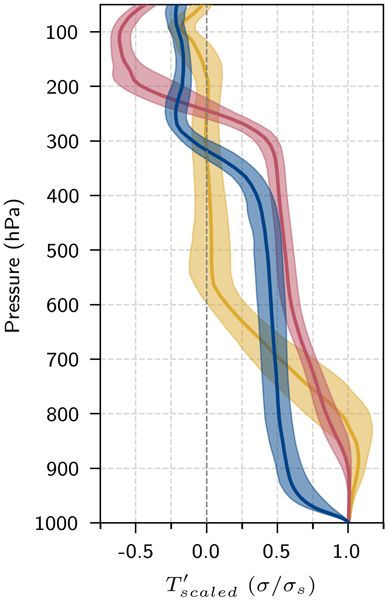
Abstract. The formation of surface heat extremes is usually described in terms of surface processes and upper-level dynamics. However, their full vertical temperature profile contains additional essential information about the involved processes. So far, it is an open question whether heat extremes are associated with characteristic vertical temperature anomaly profiles and, if they exist, how they vary across the globe. In this study, we globally and systematically classify vertical temperature anomaly profiles during annual maximum 2-m temperature events (TXx) using a k-means clustering approach. After normalising and scaling the anomaly profiles, we find three clusters whose global distribution closely follows the polar, mid-latitude, and tropical climate zones. The three clusters capture key structural differences of heat extremes. Within the tropical cluster, positive temperature anomalies during TXx events are vertically confined to the (often deep) boundary layer and intensify progressively in the days leading up to the event, while the upper troposphere is not deviating from its climatological mean. The mid-latitude cluster also exhibits bottom-heavy temperature anomalies, which, however, extend throughout the full troposphere, showing a strong vertical coupling during TXx events. In the polar cluster, the events are characterised by deep tropospheric warm anomalies, accompanied by the erosion of the near-surface inversion layer, resulting in a shallow layer of particularly strong temperature anomalies near the ground. These results show that while multiple physical mechanisms can generate a heat extreme, at first order, the normalised and scaled temperature anomaly profiles during heat extremes are very similar to each other within a given climate zone. Deviations from the cluster median during individual TXx events mainly come from the variability between TXx events rather than the variability between the median profiles of different grid points. Finally, the normalised and scaled temperature anomaly profiles of the most extreme TXx events are particularly well represented by the grid point's median profile for all TXx events, suggesting a typical dynamics of the most extreme heat events.
Competing interests: At least one of the (co-)authors is a member of the editorial board of Weather and Climate Dynamics.
Publisher's note: Copernicus Publications remains neutral with regard to jurisdictional claims made in the text, published maps, institutional affiliations, or any other geographical representation in this paper. While Copernicus Publications makes every effort to include appropriate place names, the final responsibility lies with the authors. Views expressed in the text are those of the authors and do not necessarily reflect the views of the publisher.-
Notice on discussion status
The requested preprint has a corresponding peer-reviewed final revised paper. You are encouraged to refer to the final revised version.
-
Preprint
(8756 KB)
-
Supplement
(4393 KB)
-
The requested preprint has a corresponding peer-reviewed final revised paper. You are encouraged to refer to the final revised version.
- Preprint
(8756 KB) - Metadata XML
-
Supplement
(4393 KB) - BibTeX
- EndNote
- Final revised paper


Journal article(s) based on this preprint
Interactive discussion
Status: closed
- AC1: 'Comment on egusphere-2026-1522', Belinda Hotz, 27 Apr 2026
-
RC1: 'Comment on egusphere-2026-1522', Anonymous Referee #1, 04 May 2026
Review of “Global characterization of the vertical temperature anomaly structure of heat extremes over land in ERA5” by Hotz et al.
Summary:
The authors examine vertical temperature profiles in the ERA5 reanalysis occurring during (and just before, and just after) annual maximum 2-m temperature events (“TXx”). After suitable normalization, a clustering algorithm is used to better understand the main categories of temperature profiles. Their clustering procedure identifies three distinct clusters, that approximately correspond to the tropics, midlatitudes and high latitudes.
Major comments:
This is an interesting study. The paper is written very well. I thought that the insight, presented towards the end of the paper, that especially extreme heat waves have a more “typical” structure, in line with large deviation theory, was especially interesting. The manuscript appears suitable for publication after some minor revisions.
I have one main critique of the study. There is a good deal of discussion on the physical mechanisms underlying the cluster distributions, but the discussion is also mainly qualitative and a bit vague. There is a level of subjectivity inherent to any clustering analysis. Some clearer physical insight would help the reader understand whether or not the clustering algorithm is identifying something physically meaningful or not. For example, the fact that parts of Uruguay and southern Brazil are in the polar cluster (Fig. 2a, discussed on lines 297-304) could be potentially very interesting if there is some deeper physical meaning to that classification; alternatively, it might just be a boring artifact of the classification (given this result disappears on using six clusters, rather than three, I suspect the latter). If clearer physical explanations can’t be provided (which may well be a challenging task beyond the scope of this manuscript) then it would be good to see a little more reflection on this limitation in the manuscript itself.
Specific comments:
Line 60: clarify the term “moisture availability”, as this can have several different meanings. What specific water flux or storage is being referred to here?
Line 107: I think it’s reasonable to use the ERA5 reanalysis in this study, but there needs to be more discussion of its limitations here. Yes, much of the vertical structure is probably fine, but the boundary layer and near-surface vertical structure is probably rather poor, and those aspects of the profile are arguably most relevant because that is where people live.
Line 122: typo, “1’533” should be “1,533”
Line 130: While this normalization procedure all sounds reasonable enough, it would be good to more clearly motivate some of the more arbitrary choices made here. For example, why not calculate \sigma(i,j,k) in a manner analogous to the calculation of T_clim, using a moving window?
Section 2.3: this is very clearly explained. Well done.
Figure 2: caption has typos, “26’325” should be “26,325” and same problem for other numbers reported in the caption. Please check for and fix this issue throughout the manuscript.
Line 245: some discussion of the literature on the “weak temperature gradient” approximation would be appropriate here.
Section 3.2 and Figure 3 is very nicely done.
Citation: https://doi.org/10.5194/egusphere-2026-1522-RC1 -
RC2: 'Comment on egusphere-2026-1522', Aaron Donohoe, 11 Jun 2026
Review of Hotz et al. “Global characteristic of the vertical temperature anomaly structure of heat extremes over land in ERA5”
This manuscript presents global analyses of the vertical structure of the warmest days of the global land masses and argues that; i. the characteristic vertical structure of warm extremes fall into three general clusters organized by climatic zone; ii. Variability of the vertical structure of warm events primarilt reflects inter-event variability at each grid point as opposed to departure of the local median profile from the cluster median and iii. the most extreme events are well (if not better than the moderate event) represented by the cluster median profile. I really enjoyed reading this paper. The questions asked are novel as are the analysis techniques used and I think the analysis generally (though not completely) supports the conclusion and interpretation. I have a bunch of comments but think this paper is nearly publishable as is without changing the analyses but clarifying why the methodological choices were made and how to interpret them. However, there are certain methodological decisions that, if I have understood the techniques correctly, I think could be altered to better support the physical questions being asked. The length of my review mostly reflects the novelty of the analysis techniques bringing up questions of how to interpret thing and not the quality of the manuscript.
Major comments:
Normalization by vertically resolved standard deviation and the implication for interpretation of extreme warm events in physical units. If I understand the order of operations correctly, the temperature at each grid point is first normalized by the vertically resolved standard deviation and then scaled by the surface standardized anomaly. As such, the TXx events should not be interpreted as the vertical profile of events in temperature units but in units of vertical resolved standard deviations. For example, if all TXx events were vertically homogenous (heating the whole column uniformly) the TXx vertical profile would not be homogenous if the temperature variance had a vertical structure (would likely be amplified aloft assuming temperature variance is highest at the surface). Perhaps I’ve misunderstood or thought through this wrong and perhaps this was choice was intentional – I think many parts of the text are consistent with this definition (especially the text centered on line 165). However, there are times (including the abstract and discussion of the profiles in lines centered by 250) where the profiles are referred to as “bottom heavy” and “amplified” etc. implying that the vertical profiles reflect the magnitude of the temperature anomalies during warm events in temperature units and not vertically resolved standardized anomalies.
My personal preference would be to convert the profiles back to temperature units by multiplying by the vertically resolved standard deviation (to be interpreted as the temperature anomaly per standard deviation surface event). Alternatively, if the Author’s wish to retain dimensionless profiles, they could multiply by the ratio of the vertically resolved standard deviation to the surface standard deviation. I think these choices would be more consistent with the physical questions being asked and that, as written, most readers will interpret the profiles as the relative temperature anomalies at each level during a warm event.
Impact of seasonality and diurnal cycle on the vertical structure of TXx events. The first step of the analysis is to normalize the temperature anomaly by a seasonally (but not interannually) varying standard deviation. This is logical for certain purposes but has some important impacts (I think, but may have misunderstood): i. TXx events at a given gridpoint represent a blend events from different seasons, with different climatological mean state atmospheric thermal structures; ii. extreme events from different seasons may be labeled as a TXx event, even if events in the same year have larger absolute magnitudes. I would have thought these factors have important implications in the Arctic particularly: i. a winter TXx event which erodes the climatological inversion is likely more surface amplified than a summer event and ii. a summer TXx event may be very small absolute magnitude, especially in the marginal ice zone where the standard deviation is very small since temperature is locked to the freezing temperature of ice. I would have thought that seasonality is contributing substantially to the inter TXx variability of the vertical structure and, if grouped by seasonality, the vertical structure is less varied across events than stated in the manuscript.
The Authors state (line 140) that TXx events primarily occur in the summer which, if true (I believe the Authors) can only occur if the summer T2m distribution is positively skewed (since the data is normalized by a seasonally varying standard deviation, unless I missed something). This in itself is interesting, but I wonder if it is universally true, or if some of the spatial inhomegeneity reflects the underlying skewness projecting onto whether summer or winter events are identified. I don’t think the Author’s need to redo the analysis to address these points but should simply mention some of the drawbacks of generalizing the analyses across seasons.
Similarly, my understanding is that the same considerations above apply the diurnal cycle, since the normalization is done by dividing by the standard deviation at each 3 hourly time step independently. If I understand this correctly, some TXx events are warm nights and potentially are less anomalous in the absolute sense than daytime highs if the nighttime temperature variance is smaller than the daytime temperature variance (I believe this to be the case in most locations). Perhaps the temporal evolution in Figure 3 already addresses this point though its unclear if those results are daily average or instantaneous only at the 3-hour instant of the TXx event. A sanity check on the impact of diurnally varying normalization would be to plot the Tnorm temporal evolution of the median event a 3 hourly resolution to see how jumpy the structure is. I’ve seen some preliminary analysis suggesting that daily max and daily min temperature are poorly correlated and this gives me pause. I think in general, the discussion in the manuscript is framed in terms of daytime warm events controlled by surface heating and if the TXx profiles are evening events, this might have to be rethought. I don’t know enough about the skewness of daytime versus evening temperature to speculate on whether TXx events are primarily daytime (I would guess daytime temperature is more positively skewed and, thus, TXx events are during the day). Again, I don’t think any analysis needs to be redone but perhaps some discussion could guide the reader.
I’m not convinced that the analysis presented supports the idea that the most extreme events have vertical structures that are more similar to the median structure than moderate events. Though I anecdotally believe this is true, I’m not sure the two figures (6 and 7) in this section demonstrate that point. If I understood what was plotted correctly, the analysis in Fig. 6 suggests that the vertical structure of extreme events are more similar to eachother (not to the median) as compared to the similarity of moderate events to eachother. Additionally, I think normalization by a bigger surface Tnorm in the most extreme events inherhently mutes the variability in the 10 most extreme events. Stated otherwise, if the two samples (extreme versus moderate) had identical absolute temperature variability in the free troposphere, the extreme sample would have reduced Tscaled due to dividing by a greater Tnorm_surface. Perhaps this is just a matter of how the question being asked is framed. It seems that Figure 7 suffers from the same problem. If you started from a null hypothesis that there is similar noise (comparable absolute temperature variability) unrelated to the surface event in the upper atmosphere, one would expect the vertically averaged variance to scale as one over the square root of the normalized temperature anomaly – which seems to be a good fit to the distribution in Fig 7A. Again, I might have missed something here. It seems like the right test is to take some measure of the error between (the vertically resolved) Tscaled in the extreme events compared to the median profile and then compare to the same analysis in the moderate event case.
The role of EOF truncation in the spatial homogeneity of the clusters. This is a pretty technical point related to applying PCA to global Tscaled and then retaining 8 PC/EOF pairs for the analysis. Wouldn’t this inherently produce more spatially homogeneity of the vertical profiles of TXx events than is in the raw data? If a gridpoint or small region has a vertical structure of TXx that isn’t seen elsewhere, it will not be retained by the 8 PC/EOFs moving forward. This isn’t a problem if the analysis after the clustering references the raw Tscaled data (I couldn’t tell if it did, or used the truncuated data). I’m not really worried about this point since 95% of the variance is retained. But again, this is likely worth mentioning.
Minor comments
Line 55. Might be worth mentioning that this mechanism assumes weak temperature gradients aloft.
Line 60. What about the role of surface solar variability? Or is the assumption that hot days are clear and thus downwelling solar at the surface is set by clear sky atmospheric transmissivity? Even if the later is true, the magnitude of downwelling solar anomalies at the surface during the hot days depends on the climatological cloudiness. Lucas Vargas Zeppetello has some nice arguments about this in “The climatology of extremely high warm season temperatures….”
Line 252. “highly amplified” relative to what? I would call the surface warming in the mid-latitude band moderately amplified relative to the warming in the free troposphere.
Lines 290. I wonder how defining events in the hybrid coordinate over high topography influences which cluster the location belongs to. If I have undertstood correctly, you are comparing the behaivor of the Greenland surface pressure to that at near sea level pressure in the analysis.
Line 370. Is there a role of the climatological stability in distinguishing between these regimes?
Line 380. I wonder (speculate) if the distinction between clusters 2 and 3 is that atmospheric heat transport variability tends to be concentrated higher in the atmosphere towards the pole – I’m not sure this result is in the literature. The papers by Chris Cardinale and Brian Rose might show this.
Citation: https://doi.org/10.5194/egusphere-2026-1522-RC2 - AC2: 'Comment on egusphere-2026-1522', Belinda Hotz, 08 Jul 2026
Peer review completion


Interactive discussion
Status: closed
-
AC1: 'Comment on egusphere-2026-1522', Belinda Hotz, 27 Apr 2026
It seems that the axis labels in Appendix Figure B1 are corrupted in the preprint version of the manuscript. We apologise for the confusion that this might have caused and provide the correct version of Figure B1 with the proper axis labels attached here.
-
RC1: 'Comment on egusphere-2026-1522', Anonymous Referee #1, 04 May 2026
Review of “Global characterization of the vertical temperature anomaly structure of heat extremes over land in ERA5” by Hotz et al.
Summary:
The authors examine vertical temperature profiles in the ERA5 reanalysis occurring during (and just before, and just after) annual maximum 2-m temperature events (“TXx”). After suitable normalization, a clustering algorithm is used to better understand the main categories of temperature profiles. Their clustering procedure identifies three distinct clusters, that approximately correspond to the tropics, midlatitudes and high latitudes.
Major comments:
This is an interesting study. The paper is written very well. I thought that the insight, presented towards the end of the paper, that especially extreme heat waves have a more “typical” structure, in line with large deviation theory, was especially interesting. The manuscript appears suitable for publication after some minor revisions.
I have one main critique of the study. There is a good deal of discussion on the physical mechanisms underlying the cluster distributions, but the discussion is also mainly qualitative and a bit vague. There is a level of subjectivity inherent to any clustering analysis. Some clearer physical insight would help the reader understand whether or not the clustering algorithm is identifying something physically meaningful or not. For example, the fact that parts of Uruguay and southern Brazil are in the polar cluster (Fig. 2a, discussed on lines 297-304) could be potentially very interesting if there is some deeper physical meaning to that classification; alternatively, it might just be a boring artifact of the classification (given this result disappears on using six clusters, rather than three, I suspect the latter). If clearer physical explanations can’t be provided (which may well be a challenging task beyond the scope of this manuscript) then it would be good to see a little more reflection on this limitation in the manuscript itself.
Specific comments:
Line 60: clarify the term “moisture availability”, as this can have several different meanings. What specific water flux or storage is being referred to here?
Line 107: I think it’s reasonable to use the ERA5 reanalysis in this study, but there needs to be more discussion of its limitations here. Yes, much of the vertical structure is probably fine, but the boundary layer and near-surface vertical structure is probably rather poor, and those aspects of the profile are arguably most relevant because that is where people live.
Line 122: typo, “1’533” should be “1,533”
Line 130: While this normalization procedure all sounds reasonable enough, it would be good to more clearly motivate some of the more arbitrary choices made here. For example, why not calculate \sigma(i,j,k) in a manner analogous to the calculation of T_clim, using a moving window?
Section 2.3: this is very clearly explained. Well done.
Figure 2: caption has typos, “26’325” should be “26,325” and same problem for other numbers reported in the caption. Please check for and fix this issue throughout the manuscript.
Line 245: some discussion of the literature on the “weak temperature gradient” approximation would be appropriate here.
Section 3.2 and Figure 3 is very nicely done.
Citation: https://doi.org/10.5194/egusphere-2026-1522-RC1 -
RC2: 'Comment on egusphere-2026-1522', Aaron Donohoe, 11 Jun 2026
Review of Hotz et al. “Global characteristic of the vertical temperature anomaly structure of heat extremes over land in ERA5”
This manuscript presents global analyses of the vertical structure of the warmest days of the global land masses and argues that; i. the characteristic vertical structure of warm extremes fall into three general clusters organized by climatic zone; ii. Variability of the vertical structure of warm events primarilt reflects inter-event variability at each grid point as opposed to departure of the local median profile from the cluster median and iii. the most extreme events are well (if not better than the moderate event) represented by the cluster median profile. I really enjoyed reading this paper. The questions asked are novel as are the analysis techniques used and I think the analysis generally (though not completely) supports the conclusion and interpretation. I have a bunch of comments but think this paper is nearly publishable as is without changing the analyses but clarifying why the methodological choices were made and how to interpret them. However, there are certain methodological decisions that, if I have understood the techniques correctly, I think could be altered to better support the physical questions being asked. The length of my review mostly reflects the novelty of the analysis techniques bringing up questions of how to interpret thing and not the quality of the manuscript.
Major comments:
Normalization by vertically resolved standard deviation and the implication for interpretation of extreme warm events in physical units. If I understand the order of operations correctly, the temperature at each grid point is first normalized by the vertically resolved standard deviation and then scaled by the surface standardized anomaly. As such, the TXx events should not be interpreted as the vertical profile of events in temperature units but in units of vertical resolved standard deviations. For example, if all TXx events were vertically homogenous (heating the whole column uniformly) the TXx vertical profile would not be homogenous if the temperature variance had a vertical structure (would likely be amplified aloft assuming temperature variance is highest at the surface). Perhaps I’ve misunderstood or thought through this wrong and perhaps this was choice was intentional – I think many parts of the text are consistent with this definition (especially the text centered on line 165). However, there are times (including the abstract and discussion of the profiles in lines centered by 250) where the profiles are referred to as “bottom heavy” and “amplified” etc. implying that the vertical profiles reflect the magnitude of the temperature anomalies during warm events in temperature units and not vertically resolved standardized anomalies.
My personal preference would be to convert the profiles back to temperature units by multiplying by the vertically resolved standard deviation (to be interpreted as the temperature anomaly per standard deviation surface event). Alternatively, if the Author’s wish to retain dimensionless profiles, they could multiply by the ratio of the vertically resolved standard deviation to the surface standard deviation. I think these choices would be more consistent with the physical questions being asked and that, as written, most readers will interpret the profiles as the relative temperature anomalies at each level during a warm event.
Impact of seasonality and diurnal cycle on the vertical structure of TXx events. The first step of the analysis is to normalize the temperature anomaly by a seasonally (but not interannually) varying standard deviation. This is logical for certain purposes but has some important impacts (I think, but may have misunderstood): i. TXx events at a given gridpoint represent a blend events from different seasons, with different climatological mean state atmospheric thermal structures; ii. extreme events from different seasons may be labeled as a TXx event, even if events in the same year have larger absolute magnitudes. I would have thought these factors have important implications in the Arctic particularly: i. a winter TXx event which erodes the climatological inversion is likely more surface amplified than a summer event and ii. a summer TXx event may be very small absolute magnitude, especially in the marginal ice zone where the standard deviation is very small since temperature is locked to the freezing temperature of ice. I would have thought that seasonality is contributing substantially to the inter TXx variability of the vertical structure and, if grouped by seasonality, the vertical structure is less varied across events than stated in the manuscript.
The Authors state (line 140) that TXx events primarily occur in the summer which, if true (I believe the Authors) can only occur if the summer T2m distribution is positively skewed (since the data is normalized by a seasonally varying standard deviation, unless I missed something). This in itself is interesting, but I wonder if it is universally true, or if some of the spatial inhomegeneity reflects the underlying skewness projecting onto whether summer or winter events are identified. I don’t think the Author’s need to redo the analysis to address these points but should simply mention some of the drawbacks of generalizing the analyses across seasons.
Similarly, my understanding is that the same considerations above apply the diurnal cycle, since the normalization is done by dividing by the standard deviation at each 3 hourly time step independently. If I understand this correctly, some TXx events are warm nights and potentially are less anomalous in the absolute sense than daytime highs if the nighttime temperature variance is smaller than the daytime temperature variance (I believe this to be the case in most locations). Perhaps the temporal evolution in Figure 3 already addresses this point though its unclear if those results are daily average or instantaneous only at the 3-hour instant of the TXx event. A sanity check on the impact of diurnally varying normalization would be to plot the Tnorm temporal evolution of the median event a 3 hourly resolution to see how jumpy the structure is. I’ve seen some preliminary analysis suggesting that daily max and daily min temperature are poorly correlated and this gives me pause. I think in general, the discussion in the manuscript is framed in terms of daytime warm events controlled by surface heating and if the TXx profiles are evening events, this might have to be rethought. I don’t know enough about the skewness of daytime versus evening temperature to speculate on whether TXx events are primarily daytime (I would guess daytime temperature is more positively skewed and, thus, TXx events are during the day). Again, I don’t think any analysis needs to be redone but perhaps some discussion could guide the reader.
I’m not convinced that the analysis presented supports the idea that the most extreme events have vertical structures that are more similar to the median structure than moderate events. Though I anecdotally believe this is true, I’m not sure the two figures (6 and 7) in this section demonstrate that point. If I understood what was plotted correctly, the analysis in Fig. 6 suggests that the vertical structure of extreme events are more similar to eachother (not to the median) as compared to the similarity of moderate events to eachother. Additionally, I think normalization by a bigger surface Tnorm in the most extreme events inherhently mutes the variability in the 10 most extreme events. Stated otherwise, if the two samples (extreme versus moderate) had identical absolute temperature variability in the free troposphere, the extreme sample would have reduced Tscaled due to dividing by a greater Tnorm_surface. Perhaps this is just a matter of how the question being asked is framed. It seems that Figure 7 suffers from the same problem. If you started from a null hypothesis that there is similar noise (comparable absolute temperature variability) unrelated to the surface event in the upper atmosphere, one would expect the vertically averaged variance to scale as one over the square root of the normalized temperature anomaly – which seems to be a good fit to the distribution in Fig 7A. Again, I might have missed something here. It seems like the right test is to take some measure of the error between (the vertically resolved) Tscaled in the extreme events compared to the median profile and then compare to the same analysis in the moderate event case.
The role of EOF truncation in the spatial homogeneity of the clusters. This is a pretty technical point related to applying PCA to global Tscaled and then retaining 8 PC/EOF pairs for the analysis. Wouldn’t this inherently produce more spatially homogeneity of the vertical profiles of TXx events than is in the raw data? If a gridpoint or small region has a vertical structure of TXx that isn’t seen elsewhere, it will not be retained by the 8 PC/EOFs moving forward. This isn’t a problem if the analysis after the clustering references the raw Tscaled data (I couldn’t tell if it did, or used the truncuated data). I’m not really worried about this point since 95% of the variance is retained. But again, this is likely worth mentioning.
Minor comments
Line 55. Might be worth mentioning that this mechanism assumes weak temperature gradients aloft.
Line 60. What about the role of surface solar variability? Or is the assumption that hot days are clear and thus downwelling solar at the surface is set by clear sky atmospheric transmissivity? Even if the later is true, the magnitude of downwelling solar anomalies at the surface during the hot days depends on the climatological cloudiness. Lucas Vargas Zeppetello has some nice arguments about this in “The climatology of extremely high warm season temperatures….”
Line 252. “highly amplified” relative to what? I would call the surface warming in the mid-latitude band moderately amplified relative to the warming in the free troposphere.
Lines 290. I wonder how defining events in the hybrid coordinate over high topography influences which cluster the location belongs to. If I have undertstood correctly, you are comparing the behaivor of the Greenland surface pressure to that at near sea level pressure in the analysis.
Line 370. Is there a role of the climatological stability in distinguishing between these regimes?
Line 380. I wonder (speculate) if the distinction between clusters 2 and 3 is that atmospheric heat transport variability tends to be concentrated higher in the atmosphere towards the pole – I’m not sure this result is in the literature. The papers by Chris Cardinale and Brian Rose might show this.
Citation: https://doi.org/10.5194/egusphere-2026-1522-RC2 - AC2: 'Comment on egusphere-2026-1522', Belinda Hotz, 08 Jul 2026
Peer review completion
Journal article(s) based on this preprint
Viewed
| HTML | XML | Total | Supplement | BibTeX | EndNote | |
|---|---|---|---|---|---|---|
| 681 | 464 | 57 | 1,202 | 86 | 45 | 56 |
- HTML: 681
- PDF: 464
- XML: 57
- Total: 1,202
- Supplement: 86
- BibTeX: 45
- EndNote: 56
Viewed (geographical distribution)
| Country | # | Views | % |
|---|
| Total: | 0 |
| HTML: | 0 |
| PDF: | 0 |
| XML: | 0 |
- 1

Heini Wernli
Matthias Röthlisberger
Robin Noyelle
The requested preprint has a corresponding peer-reviewed final revised paper. You are encouraged to refer to the final revised version.
- Preprint
(8756 KB) - Metadata XML
-
Supplement
(4393 KB) - BibTeX
- EndNote
- Final revised paper
It seems that the axis labels in Appendix Figure B1 are corrupted in the preprint version of the manuscript. We apologise for the confusion that this might have caused and provide the correct version of Figure B1 with the proper axis labels attached here.