
the Creative Commons Attribution 4.0 License.
the Creative Commons Attribution 4.0 License.
 | 31 Mar 2026
Online xylem water isotope monitoring and soil water content profiling reveal spatial root water uptake dynamics in sunflower
Abstract. Knowledge about plant water stress regulation mechanisms (e.g., plant stem capacitance) from in-situ observation is crucial for the study and modeling of plant root water uptake (RWU). We present a proof of concept and a first application of a simple method for online, minimally invasive monitoring of the water stable isotopic composition of sap xylem water of Helianthus annuus (sunflower) by inserting a sampling tube connected to a laser spectrometer in the plant stem. After careful calibration of our method, we applied it successfully to individual sunflower plants grown in soil columns. We followed the dynamics in stem water isotopic composition in response to changing light intensity and to depth-specific, isotopically labeled water pulses. We further establish that these isotopic dynamics matched changes in RWU profiles monitored simultaneously, independently, and non-destructively by the Soil Water Profiler. We finally highlight from modeling exercises the significance of the role of plant stem capacitance: water exchanges between xylem and stem non-conducting tissues were estimated to amount to about one sixth of RWU of Helianthus annuus, showing that the stem itself can be expected to be a quickly accessible reservoir of water for transpiration, very similar to what is found in trees.
-
Notice on discussion status
The requested preprint has a corresponding peer-reviewed final revised paper. You are encouraged to refer to the final revised version.
-
Preprint
(1451 KB)
-
The requested preprint has a corresponding peer-reviewed final revised paper. You are encouraged to refer to the final revised version.
- Preprint
(1451 KB) - Metadata XML
- BibTeX
- EndNote
- Final revised paper


Journal article(s) based on this preprint
Interactive discussion
Status: closed
-
RC1: 'Comment on egusphere-2026-1518', Anonymous Referee #1, 26 May 2026
-
AC1: 'Reply on RC1', Youri Rothfuss, 17 Jun 2026
Dear reviewer, thank you! We greatly appreciate your comments. Please find below our answers and what we intend to revise / add / remove in our upcoming revised manuscript version.
Answer to point 1:
Indeed, this is a very important point and for this experiment we took several precautions to make sure that soil water redistribution between layers did not occur during the time window of the experiment. Before the experiment, we waited for the sunflowers to dry out the soil sufficiently such that a) an injection would lead to a considerable change of the local soil water content (SWC) and b) that the injection of limited size would not be constrained too much by the soil being too dry, or inversely, too wet such that the pulse would diffuse over too much of a region. Based on experience and simulations using Hydrus-1D this would require that the prior SWC is above 0.05 and below 0.12 cm3 cm-3 such that we can be assured that the upper and lower depths of pulse expansion are met. As the plant takes up the added water relatively quickly, this also reduces the risk of the injected water diffusing too far from the point of origin, something that cannot be replicated in a column without a plant. The second step we performed to assure that no water would cross between layers was to adjust the extend of the layer in such a way that we could not observe an increase of SWC at the boundary of two layers by observing the SWC profiles as they were measured by the SWaP (information is contained within the data series). Here, we also changed the boundary position of the layers by a cm up and down and found no significant changes, indicating that water did not exchange between layers. This can also be seen in supplemental Figure A1 where the boundary between the layers is indicated and where one can observe that the water of the pulses do not cross these boundaries over time. The lower boundary at about 35 cm depth is not strictly necessary for our analysis but ensures that the effect of the deeper pulse is not diluted by the water at the bottom of the column. The water in the lowest layer does redistribute within that layer as can be observed from Hydrus simulations, without the added pulses. For SWC below 0.12 cm3 cm-3 redistributive flows are very slow and local and do not cross the second, lower boundary within the timeframe of the experiment. It should be noted too, that the matric potential gradients are in fact quite low, in the order of 10 hPa cm-1 so redistributive flows are well contained.
--> We propose to add a Hydrus-1D simulation in an Appendix in our revised manuscript to support the present answer.
Anwer to point 2:
The reviewer addresses a valid issue, but the sunflower cultivar we used here is a very small (<50cm) growing cultivar, the “Dwarf yellow spray”, and under our conditions was no higher than 30 to 40 cm. Whereas for this experiment we do not have the leaf area, the typical leaf area of these sunflowers at this growth stage is in the order of 500 to 1000 cm2.
--> We propose adding 1) the cultivar name in the text – this was indeed missing ! – and a picture of the plants of about a week before the experiments in a new Appendix, in which this small sunflower size can be observed. The calculation of the reviewer is perfectly in line with our measurements, which is also expected from the published performance of the SWaP.
Answer to point 3:
First concern:
As the reviewer points out, Eq. (4) is basically a simple volume-weighed mixing model to calculate δsoil at time step (t) in one layer from the value at time step (t-1), namely δant and that of the added, labelled water (δadd). As the latter is known, Eq. (4) only needs to be initialized, which we explain in lines 203-208 of the original manuscript:
“Finally, values for the initial soil water isotopic composition, i.e., prior to the first addition of isotopically enriched water in the upper soil layer on DoE 1 16:00-17:00, was determined – since it was not measured in situ during the experiment – and was assumed to be the same for both soil columns (plant #1 and plant #2). More precisely, it was computed to fall onto an evaporation line with a slope of 4‰ /‰ (Rothfuss et al., 2015) and passing through the isotopic composition value of local tap water (δ2H=–50.4‰ and δ18O=–7.4‰) in a dual isotope (δ2H vs. δ18O) plot.”
The obtained soil water δ2H (δ18O) initial values in the top, middle, and bottom layers of both soil columns (in which plant #1 and #2 are grown) were -47.7, -50.4, and -50.4 ‰ (-6.7, -7.4, and -7.4 ‰) and are reported in Appendix E.--> In our revised manuscript version, we will significantly expand the explanations of our calculations and provide these numbers in the text.
Second concern:
Yes, that is correct, δsoil is affected by water addition only, that is, remains constant within each layer until the next water addition. We acknowledged in our manuscript that this is a simplification (see line 403-404), yet we believe it to be valid at the layer scale, since we made sure that there was 1) no (convective) water transport across the defined layers (please refer to our answer to your previous comment) and 2) no or negligible diffusion of the labeling pulse across layers during the time window of the experiments. We also believe that there was no significant evaporation and therefore changes in δsoil in the top layer during the experiments.
Taking destructive measurements for determination of δsoil in such conditions (small size of the column) would have been very challenging without affecting the plants themselves. The best option would be to monitor non-destructively the changes in δsoil (e.g., following the method of, e.g., Rothfuss et al. 2013). This would require to significantly modify the setup. We hope to perform such a follow-up experiment soon.
--> We agree that this needs further justification and propose to incorporate the present answer to our discussion (section 4.2).
Refs:
Rothfuss, Y., Vereecken, H., and Brüggemann, N.: Monitoring water stable isotopic composition in soils using gas-permeable tubing and infrared laser absorption spectroscopy. Water Resour. Res., 49(6), 3747-3755, https://www.doi.org/10.1002/wrcr.20311, 2013.
Citation: https://doi.org/10.5194/egusphere-2026-1518-AC1
-
AC1: 'Reply on RC1', Youri Rothfuss, 17 Jun 2026
-
RC2: 'Comment on egusphere-2026-1518', Anonymous Referee #2, 27 May 2026
General comments
The authors present a novel and highly relevant methodological approach for ecohydrology and plant physiology. The authors successfully demonstrate minimally invasive monitoring of stem water isotopic composition in an herbaceous plant (sunflower) using a laser spectrometer coupled with a sampling tube. The manuscript is generally well structured and the figures are clear.
Despite these limitations, the work represents a promising step towards real‑time isotope monitoring in herbaceous plants, but the current level of replication, calibration verification, and modelling detail is insufficient for full acceptance. A revision that addresses the above points would substantially improve the manuscript.
Specific comments
- The case study relies on only two sunflower plants (plant #1 and plant #2). The observed differences between the two plants are interpreted in terms of experimental timing, but without statistical replication it is impossible to know whether these differences reflect genuine biological variability or are simply artefacts of the low n.
- The calibration was performed in hydroponic solution, yet the case study uses soil‑grown plants. The authors acknowledge that the calibration might need to be re‑determined for soil conditions, but they do not test whether the hydroponic‑derived calibration functions are valid under the soil condition.
- The method is described as “minimally invasive”, but the authors provide no comparison with other non‑destructive alternatives. The extent to which the drilling perturbs the plant is not quantified.
- The assumption that the stem water reservoir is well mixed and that the exchange fraction is constant during the day is a gross simplification. The authors can present a sensitivity analysis.
- The statement that the method “failed” when the tubing was inserted too deeply or too high above the soil is important. The authors should provide quantitative thresholds (e.g., maximum insertion depth, minimum stem diameter) that would allow other researchers to avoid these failures.
- “assuming no transport of water occurred across soil layers” (L199) this assumption is not justified. The authors can give former references or explanations on why lateral or vertical redistribution can be neglected
Technical Corrections
The reference list contains several formatting inconsistencies (e.g., missing journal names, incomplete page ranges). Check the journal guidelines for references.
Citation: https://doi.org/10.5194/egusphere-2026-1518-RC2 -
AC2: 'Reply on RC2', Youri Rothfuss, 17 Jun 2026
Dear Reviewer, thank you very much for your comments! Please find below our answers and details on how we propose to address your comments in the revised version of our manuscript.
Answer to point 1:
Thank you for this very important point! Our intention was not to draw definitive conclusions on the physiology and water transit time of sunflower plants, rather to present a proof of concept and a first application of the simple isotope monitoring method. We do not think that our estimate of capacitance should be representative of the tested cultivar: we just highlight the importance of its capacitance. There is naturally no wish to overinterpret the differences between the two plants investigated - there are indeed more possibilities, including biology.
--> We propose to explicitly mention the low n in the discussion section (4.3).
Answer to point 2:
The calibration functions obtained in hydroponic solutions would not be transferable to the case of a soil-grown plant only if a sunflower behaves differently from an isotope standpoint, i.e., discriminates differently against heavier stable isotopes during uptake from a soil than from pure liquid water. We however do not think it is case.
--> We will therefore modify that section (currently L385-388) and formulate it in a positive manner, that is: we are confident that the calibration functions are species-specific, rather than influenced by the environment in which the plant is grown, therefore are transferable to a soil-grown plant.
On a side note, calibrating in soils poses other challenges, e.g., prevention from soil evaporation to conserve the δsoil value while growing the plant in aerobic conditions.
Answer to point 3:
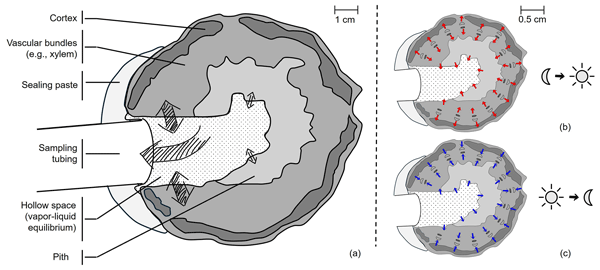
There are currently no non-destructive alternatives to our method. This can only be done by sampling the stem destructively and by extracting its water in the laboratory using one of the available techniques, e.g., the cryogenic vacuum distillation, centrifugation, direct vapor equilibration (Ceperley et al., 2024). Also, the extent to which the drilling affected the plant was observed with MRI pictures and discussed in the text (please see Figure 5 and text L454-L457, Appendix Fa and b).
Answer to point 4:
Thank you. It is not entirely clear which section this comment refers to. In case it refers to Eq. (5) (replacement model), it is correct that we cannot proof our assumption, but this is not the purpose for providing this equation. It serves only as a rough estimate of how large the fraction of water is that exchanges with the stationary water within the stem. It serves as an indicator of order of magnitude only.
Also we do think that we tested the sensitivity of the replacement model to the exchange fraction parameter in L424-429 (section 4.3)
“If fex=1 is set in the simple replacement model (Eq. 5), that is, all water flowing in the xylem is isotopically exchanging with water from the (non-conducting) stem tissues, stem water would reach a constant δstem in roughly 2 h. On the other hand, if fex=1/6, it would take 10 h for stem water to be replaced nearly fully with the xylem water, which would be roughly in line with our observation for plant #1.”
Answer to point 5:
Thank you for this important point! Our method did not “fail”, rather:
“[f]ailure to [insert the tubing (i) only a couple of millimeters inside the stem and (ii) close to the root crown] resulted in invalid data during the experiments”.
The installation of the tubing inside the stem always worked and always yielded an isotope response. It could be observed quite fast (<1 min) from the raw readings if the tubing was inserted correctly (water vapor mixing ratio values equal to the saturated values at the temperature of the stem).
--> As for Point 2 (please see our answer above), we will phrase this positively in our revised manuscript to avoid any misunderstandings about the replicability of our method.
Answer to point 6:
This statement in L199 should be seen more like a standard, conservative phrasing, because we did verify that this is substantially correct. As commented to Reviewer 1, the layers were carefully selected. In fact, we tried several boundary positions over a range of a few cm from within the SWaP data. Up to 1 cm up or down showed no significant changes in our results, giving more than sufficient confidence that no relevant cross layer exchange occurred between the upper and middle soil layers.
--> We will rephrase and replace “assuming” with “after verifying” in our revised manuscript. In addition, we will add a Hydrus-1D simulation in an Appendix to support the present answer.
Technical corrections:
References are reported in accordance with the journal guidelines (https://www.hydrology-and-earth-system-sciences.net/submission.html#references). We did find two articles (Ceperley et al., 2024; Fabiani et al., 2022) which were missing their article numbers (no page ranges). Thank you. This will be amended in the revised version of the manuscript.
Refs:
Ceperley, N., Gimeno, T. E., Jacobs, S. R., Beyer, M., Dubbert, M., Fischer, B., Geris, J., Holko, L., Kuebert, A., Le Gall, S., Lehmann, M. M., Llorens, P., Millar, C., Penna, D., Prieto, I., Radolinski, J., Scandellari, F., Stockinger, M., Stumpp, C., Tetzlaff, D., van Meerveld, I., Werner, C., Yildiz, O., Zuecco, G., Barbeta, A., Orlowski, N., and Rothfuss, Y.: Toward a common methodological framework for the sampling, extraction, and isotopic analysis of water in the Critical Zone to study vegetation water use, Wiley Interdisciplinary Reviews-Water, 11(4), e1727, https://www.doi.org/10.1002/wat2.1727, 2024.
Fabiani, G., Penna, D., Barbeta, A., and Klaus, J.: Sapwood and heartwood are not isolated compartments: Consequences for isotope ecohydrology, Ecohydrology, 15(8), e2478, https://www.doi.org/10.1002/eco.2478, 2022.
Citation: https://doi.org/10.5194/egusphere-2026-1518-AC2
Peer review completion


Interactive discussion
Status: closed
-
RC1: 'Comment on egusphere-2026-1518', Anonymous Referee #1, 26 May 2026
This manuscript presents a proof-of-concept study for online monitoring of stem/xylem water isotopic composition in Helianthus annuus using stem vapor in-situ sampling coupled to laser spectroscopy, combined with non-destructive soil water content profiling (SWaP) to infer root water uptake (RWU) dynamics. The manuscript addresses an important topic because stable isotope methods for inferring RWU are increasingly used, while assumptions of instantaneous mixing and negligible internal water storage are often difficult to validate. Extending online isotope monitoring approaches from trees to herbaceous plants is also potentially valuable from a technical point of view.
I have several comments mainly related to uncertainties that could potentially arise from assumptions made during the soil layer-specific estimation of RWU and soil water isotopic composition (δsoil). As detailed below, these uncertainties could potentially have been better constrained by including, for example, a plant-free soil column (blank control) to quantify background soil water dynamics and/or by incorporating direct measurements of soil water isotope composition at different depths and time points throughout the experiment. The lack of such controls or direct measurements makes it difficult to evaluate the robustness of some of the key inferred quantities used in the subsequent analyses.
1. I am concerned about the authors’ use of SWaP-derived changes in soil water content to infer layer-specific RWU dynamics. It seems to me that changes in soil water content within a given layer may not necessarily reflect RWU alone, for example, in a soil column without plants, soil water content may still vary over time due to a number of factors including surface evaporation, redistribution/infiltration of water from upper to lower layers following isotope-labeling pulses added to a specific layer, etc.. Such changes could potentially be interpreted as RWU if not explicitly accounted for. In this sense a plant-free control column subjected to the same water additions and environmental conditions (which is lacking in the present study) would be helpful in constraining the uncertainty in SWaP-derived RWU profiles. I suggest that the authors either provide additional evidence that soil water redistribution and evaporation were negligible under their experimental conditions, or explicitly acknowledge this limitation. Ideally, future applications of this approach should benefit from including a blank soil column control to quantify background SWC dynamics unrelated to plant water uptake.
2. Related to the above concern, I also feel that the reported whole-column RWU rates shown in Fig. 2b appear relatively low compared with what might be expected for a sunflower plant at the flowering stage. For example, Fig. 2b suggests a peak whole-plant uptake rate (blue line) of only approximately 1.5–1.75 ml per 10 min under high light intensity (~1200 μmol m⁻² s⁻¹). Assuming a representative leaf-level transpiration rate of approximately 3 mmol H₂O m⁻² s⁻¹ for sunflower (which could potentially be even higher under such conditions, given that sunflower is a highly transpirational species), this uptake rate would correspond to only around 500 cm² total transpiring leaf area. This seems relatively small for a flowering sunflower plant, although actual leaf area was not reported.
3. Lines 199-209 describe how delta_soil water for each soil layer was estimated. According to this description, layer-specific detla_soil was calculated as a volume-weighted mixture of added labeled water and antecedent soil water. I have two concerns regarding this procedure: 1) without direct isotope measurement of soil water, how was delta_ant determined for each individual layer? Was a pre-established, depth-dependent isotope distribution model used to estimate delta_ant? or was delta_ant assumed identical among different layers (e.g., equivalent to the irrigation water isotopic composition)? 2) Eq. 4 also gives the impression that, once isotopically labeled water was added, the calculated delta_soil for each layer remained effectively constant thereafter. This means that temporal variation in delta_soil was neglected. This may need further justification. More generally I think that at least some attempts to make measurements of soil water isotope compositions at spatiotemporal scales would be beneficial than to just rely entirely on estimated values based on ideal assumptions.
Citation: https://doi.org/10.5194/egusphere-2026-1518-RC1 -
AC1: 'Reply on RC1', Youri Rothfuss, 17 Jun 2026
Dear reviewer, thank you! We greatly appreciate your comments. Please find below our answers and what we intend to revise / add / remove in our upcoming revised manuscript version.
Answer to point 1:
Indeed, this is a very important point and for this experiment we took several precautions to make sure that soil water redistribution between layers did not occur during the time window of the experiment. Before the experiment, we waited for the sunflowers to dry out the soil sufficiently such that a) an injection would lead to a considerable change of the local soil water content (SWC) and b) that the injection of limited size would not be constrained too much by the soil being too dry, or inversely, too wet such that the pulse would diffuse over too much of a region. Based on experience and simulations using Hydrus-1D this would require that the prior SWC is above 0.05 and below 0.12 cm3 cm-3 such that we can be assured that the upper and lower depths of pulse expansion are met. As the plant takes up the added water relatively quickly, this also reduces the risk of the injected water diffusing too far from the point of origin, something that cannot be replicated in a column without a plant. The second step we performed to assure that no water would cross between layers was to adjust the extend of the layer in such a way that we could not observe an increase of SWC at the boundary of two layers by observing the SWC profiles as they were measured by the SWaP (information is contained within the data series). Here, we also changed the boundary position of the layers by a cm up and down and found no significant changes, indicating that water did not exchange between layers. This can also be seen in supplemental Figure A1 where the boundary between the layers is indicated and where one can observe that the water of the pulses do not cross these boundaries over time. The lower boundary at about 35 cm depth is not strictly necessary for our analysis but ensures that the effect of the deeper pulse is not diluted by the water at the bottom of the column. The water in the lowest layer does redistribute within that layer as can be observed from Hydrus simulations, without the added pulses. For SWC below 0.12 cm3 cm-3 redistributive flows are very slow and local and do not cross the second, lower boundary within the timeframe of the experiment. It should be noted too, that the matric potential gradients are in fact quite low, in the order of 10 hPa cm-1 so redistributive flows are well contained.
--> We propose to add a Hydrus-1D simulation in an Appendix in our revised manuscript to support the present answer.
Anwer to point 2:
The reviewer addresses a valid issue, but the sunflower cultivar we used here is a very small (<50cm) growing cultivar, the “Dwarf yellow spray”, and under our conditions was no higher than 30 to 40 cm. Whereas for this experiment we do not have the leaf area, the typical leaf area of these sunflowers at this growth stage is in the order of 500 to 1000 cm2.
--> We propose adding 1) the cultivar name in the text – this was indeed missing ! – and a picture of the plants of about a week before the experiments in a new Appendix, in which this small sunflower size can be observed. The calculation of the reviewer is perfectly in line with our measurements, which is also expected from the published performance of the SWaP.
Answer to point 3:
First concern:
As the reviewer points out, Eq. (4) is basically a simple volume-weighed mixing model to calculate δsoil at time step (t) in one layer from the value at time step (t-1), namely δant and that of the added, labelled water (δadd). As the latter is known, Eq. (4) only needs to be initialized, which we explain in lines 203-208 of the original manuscript:
“Finally, values for the initial soil water isotopic composition, i.e., prior to the first addition of isotopically enriched water in the upper soil layer on DoE 1 16:00-17:00, was determined – since it was not measured in situ during the experiment – and was assumed to be the same for both soil columns (plant #1 and plant #2). More precisely, it was computed to fall onto an evaporation line with a slope of 4‰ /‰ (Rothfuss et al., 2015) and passing through the isotopic composition value of local tap water (δ2H=–50.4‰ and δ18O=–7.4‰) in a dual isotope (δ2H vs. δ18O) plot.”
The obtained soil water δ2H (δ18O) initial values in the top, middle, and bottom layers of both soil columns (in which plant #1 and #2 are grown) were -47.7, -50.4, and -50.4 ‰ (-6.7, -7.4, and -7.4 ‰) and are reported in Appendix E.--> In our revised manuscript version, we will significantly expand the explanations of our calculations and provide these numbers in the text.
Second concern:
Yes, that is correct, δsoil is affected by water addition only, that is, remains constant within each layer until the next water addition. We acknowledged in our manuscript that this is a simplification (see line 403-404), yet we believe it to be valid at the layer scale, since we made sure that there was 1) no (convective) water transport across the defined layers (please refer to our answer to your previous comment) and 2) no or negligible diffusion of the labeling pulse across layers during the time window of the experiments. We also believe that there was no significant evaporation and therefore changes in δsoil in the top layer during the experiments.
Taking destructive measurements for determination of δsoil in such conditions (small size of the column) would have been very challenging without affecting the plants themselves. The best option would be to monitor non-destructively the changes in δsoil (e.g., following the method of, e.g., Rothfuss et al. 2013). This would require to significantly modify the setup. We hope to perform such a follow-up experiment soon.
--> We agree that this needs further justification and propose to incorporate the present answer to our discussion (section 4.2).
Refs:
Rothfuss, Y., Vereecken, H., and Brüggemann, N.: Monitoring water stable isotopic composition in soils using gas-permeable tubing and infrared laser absorption spectroscopy. Water Resour. Res., 49(6), 3747-3755, https://www.doi.org/10.1002/wrcr.20311, 2013.
Citation: https://doi.org/10.5194/egusphere-2026-1518-AC1
-
AC1: 'Reply on RC1', Youri Rothfuss, 17 Jun 2026
-
RC2: 'Comment on egusphere-2026-1518', Anonymous Referee #2, 27 May 2026
General comments
The authors present a novel and highly relevant methodological approach for ecohydrology and plant physiology. The authors successfully demonstrate minimally invasive monitoring of stem water isotopic composition in an herbaceous plant (sunflower) using a laser spectrometer coupled with a sampling tube. The manuscript is generally well structured and the figures are clear.
Despite these limitations, the work represents a promising step towards real‑time isotope monitoring in herbaceous plants, but the current level of replication, calibration verification, and modelling detail is insufficient for full acceptance. A revision that addresses the above points would substantially improve the manuscript.
Specific comments
- The case study relies on only two sunflower plants (plant #1 and plant #2). The observed differences between the two plants are interpreted in terms of experimental timing, but without statistical replication it is impossible to know whether these differences reflect genuine biological variability or are simply artefacts of the low n.
- The calibration was performed in hydroponic solution, yet the case study uses soil‑grown plants. The authors acknowledge that the calibration might need to be re‑determined for soil conditions, but they do not test whether the hydroponic‑derived calibration functions are valid under the soil condition.
- The method is described as “minimally invasive”, but the authors provide no comparison with other non‑destructive alternatives. The extent to which the drilling perturbs the plant is not quantified.
- The assumption that the stem water reservoir is well mixed and that the exchange fraction is constant during the day is a gross simplification. The authors can present a sensitivity analysis.
- The statement that the method “failed” when the tubing was inserted too deeply or too high above the soil is important. The authors should provide quantitative thresholds (e.g., maximum insertion depth, minimum stem diameter) that would allow other researchers to avoid these failures.
- “assuming no transport of water occurred across soil layers” (L199) this assumption is not justified. The authors can give former references or explanations on why lateral or vertical redistribution can be neglected
Technical Corrections
The reference list contains several formatting inconsistencies (e.g., missing journal names, incomplete page ranges). Check the journal guidelines for references.
Citation: https://doi.org/10.5194/egusphere-2026-1518-RC2 -
AC2: 'Reply on RC2', Youri Rothfuss, 17 Jun 2026
Dear Reviewer, thank you very much for your comments! Please find below our answers and details on how we propose to address your comments in the revised version of our manuscript.
Answer to point 1:
Thank you for this very important point! Our intention was not to draw definitive conclusions on the physiology and water transit time of sunflower plants, rather to present a proof of concept and a first application of the simple isotope monitoring method. We do not think that our estimate of capacitance should be representative of the tested cultivar: we just highlight the importance of its capacitance. There is naturally no wish to overinterpret the differences between the two plants investigated - there are indeed more possibilities, including biology.
--> We propose to explicitly mention the low n in the discussion section (4.3).
Answer to point 2:
The calibration functions obtained in hydroponic solutions would not be transferable to the case of a soil-grown plant only if a sunflower behaves differently from an isotope standpoint, i.e., discriminates differently against heavier stable isotopes during uptake from a soil than from pure liquid water. We however do not think it is case.
--> We will therefore modify that section (currently L385-388) and formulate it in a positive manner, that is: we are confident that the calibration functions are species-specific, rather than influenced by the environment in which the plant is grown, therefore are transferable to a soil-grown plant.
On a side note, calibrating in soils poses other challenges, e.g., prevention from soil evaporation to conserve the δsoil value while growing the plant in aerobic conditions.
Answer to point 3:
There are currently no non-destructive alternatives to our method. This can only be done by sampling the stem destructively and by extracting its water in the laboratory using one of the available techniques, e.g., the cryogenic vacuum distillation, centrifugation, direct vapor equilibration (Ceperley et al., 2024). Also, the extent to which the drilling affected the plant was observed with MRI pictures and discussed in the text (please see Figure 5 and text L454-L457, Appendix Fa and b).
Answer to point 4:
Thank you. It is not entirely clear which section this comment refers to. In case it refers to Eq. (5) (replacement model), it is correct that we cannot proof our assumption, but this is not the purpose for providing this equation. It serves only as a rough estimate of how large the fraction of water is that exchanges with the stationary water within the stem. It serves as an indicator of order of magnitude only.
Also we do think that we tested the sensitivity of the replacement model to the exchange fraction parameter in L424-429 (section 4.3)
“If fex=1 is set in the simple replacement model (Eq. 5), that is, all water flowing in the xylem is isotopically exchanging with water from the (non-conducting) stem tissues, stem water would reach a constant δstem in roughly 2 h. On the other hand, if fex=1/6, it would take 10 h for stem water to be replaced nearly fully with the xylem water, which would be roughly in line with our observation for plant #1.”
Answer to point 5:
Thank you for this important point! Our method did not “fail”, rather:
“[f]ailure to [insert the tubing (i) only a couple of millimeters inside the stem and (ii) close to the root crown] resulted in invalid data during the experiments”.
The installation of the tubing inside the stem always worked and always yielded an isotope response. It could be observed quite fast (<1 min) from the raw readings if the tubing was inserted correctly (water vapor mixing ratio values equal to the saturated values at the temperature of the stem).
--> As for Point 2 (please see our answer above), we will phrase this positively in our revised manuscript to avoid any misunderstandings about the replicability of our method.
Answer to point 6:
This statement in L199 should be seen more like a standard, conservative phrasing, because we did verify that this is substantially correct. As commented to Reviewer 1, the layers were carefully selected. In fact, we tried several boundary positions over a range of a few cm from within the SWaP data. Up to 1 cm up or down showed no significant changes in our results, giving more than sufficient confidence that no relevant cross layer exchange occurred between the upper and middle soil layers.
--> We will rephrase and replace “assuming” with “after verifying” in our revised manuscript. In addition, we will add a Hydrus-1D simulation in an Appendix to support the present answer.
Technical corrections:
References are reported in accordance with the journal guidelines (https://www.hydrology-and-earth-system-sciences.net/submission.html#references). We did find two articles (Ceperley et al., 2024; Fabiani et al., 2022) which were missing their article numbers (no page ranges). Thank you. This will be amended in the revised version of the manuscript.
Refs:
Ceperley, N., Gimeno, T. E., Jacobs, S. R., Beyer, M., Dubbert, M., Fischer, B., Geris, J., Holko, L., Kuebert, A., Le Gall, S., Lehmann, M. M., Llorens, P., Millar, C., Penna, D., Prieto, I., Radolinski, J., Scandellari, F., Stockinger, M., Stumpp, C., Tetzlaff, D., van Meerveld, I., Werner, C., Yildiz, O., Zuecco, G., Barbeta, A., Orlowski, N., and Rothfuss, Y.: Toward a common methodological framework for the sampling, extraction, and isotopic analysis of water in the Critical Zone to study vegetation water use, Wiley Interdisciplinary Reviews-Water, 11(4), e1727, https://www.doi.org/10.1002/wat2.1727, 2024.
Fabiani, G., Penna, D., Barbeta, A., and Klaus, J.: Sapwood and heartwood are not isolated compartments: Consequences for isotope ecohydrology, Ecohydrology, 15(8), e2478, https://www.doi.org/10.1002/eco.2478, 2022.
Citation: https://doi.org/10.5194/egusphere-2026-1518-AC2
Peer review completion
Journal article(s) based on this preprint
Viewed
| HTML | XML | Total | BibTeX | EndNote | |
|---|---|---|---|---|---|
| 436 | 190 | 54 | 680 | 48 | 54 |
- HTML: 436
- PDF: 190
- XML: 54
- Total: 680
- BibTeX: 48
- EndNote: 54
Viewed (geographical distribution)
| Country | # | Views | % |
|---|
| Total: | 0 |
| HTML: | 0 |
| PDF: | 0 |
| XML: | 0 |
- 1

Samuel Le Gall
Nicolas Brüggemann
Sharmin Jahan
Mathieu Javaux
Julian Klaus
Harry Vereecken
Dagmar van Dusschoten
The requested preprint has a corresponding peer-reviewed final revised paper. You are encouraged to refer to the final revised version.
- Preprint
(1451 KB) - Metadata XML
This manuscript presents a proof-of-concept study for online monitoring of stem/xylem water isotopic composition in Helianthus annuus using stem vapor in-situ sampling coupled to laser spectroscopy, combined with non-destructive soil water content profiling (SWaP) to infer root water uptake (RWU) dynamics. The manuscript addresses an important topic because stable isotope methods for inferring RWU are increasingly used, while assumptions of instantaneous mixing and negligible internal water storage are often difficult to validate. Extending online isotope monitoring approaches from trees to herbaceous plants is also potentially valuable from a technical point of view.
I have several comments mainly related to uncertainties that could potentially arise from assumptions made during the soil layer-specific estimation of RWU and soil water isotopic composition (δsoil). As detailed below, these uncertainties could potentially have been better constrained by including, for example, a plant-free soil column (blank control) to quantify background soil water dynamics and/or by incorporating direct measurements of soil water isotope composition at different depths and time points throughout the experiment. The lack of such controls or direct measurements makes it difficult to evaluate the robustness of some of the key inferred quantities used in the subsequent analyses.
1. I am concerned about the authors’ use of SWaP-derived changes in soil water content to infer layer-specific RWU dynamics. It seems to me that changes in soil water content within a given layer may not necessarily reflect RWU alone, for example, in a soil column without plants, soil water content may still vary over time due to a number of factors including surface evaporation, redistribution/infiltration of water from upper to lower layers following isotope-labeling pulses added to a specific layer, etc.. Such changes could potentially be interpreted as RWU if not explicitly accounted for. In this sense a plant-free control column subjected to the same water additions and environmental conditions (which is lacking in the present study) would be helpful in constraining the uncertainty in SWaP-derived RWU profiles. I suggest that the authors either provide additional evidence that soil water redistribution and evaporation were negligible under their experimental conditions, or explicitly acknowledge this limitation. Ideally, future applications of this approach should benefit from including a blank soil column control to quantify background SWC dynamics unrelated to plant water uptake.
2. Related to the above concern, I also feel that the reported whole-column RWU rates shown in Fig. 2b appear relatively low compared with what might be expected for a sunflower plant at the flowering stage. For example, Fig. 2b suggests a peak whole-plant uptake rate (blue line) of only approximately 1.5–1.75 ml per 10 min under high light intensity (~1200 μmol m⁻² s⁻¹). Assuming a representative leaf-level transpiration rate of approximately 3 mmol H₂O m⁻² s⁻¹ for sunflower (which could potentially be even higher under such conditions, given that sunflower is a highly transpirational species), this uptake rate would correspond to only around 500 cm² total transpiring leaf area. This seems relatively small for a flowering sunflower plant, although actual leaf area was not reported.
3. Lines 199-209 describe how delta_soil water for each soil layer was estimated. According to this description, layer-specific detla_soil was calculated as a volume-weighted mixture of added labeled water and antecedent soil water. I have two concerns regarding this procedure: 1) without direct isotope measurement of soil water, how was delta_ant determined for each individual layer? Was a pre-established, depth-dependent isotope distribution model used to estimate delta_ant? or was delta_ant assumed identical among different layers (e.g., equivalent to the irrigation water isotopic composition)? 2) Eq. 4 also gives the impression that, once isotopically labeled water was added, the calculated delta_soil for each layer remained effectively constant thereafter. This means that temporal variation in delta_soil was neglected. This may need further justification. More generally I think that at least some attempts to make measurements of soil water isotope compositions at spatiotemporal scales would be beneficial than to just rely entirely on estimated values based on ideal assumptions.