
the Creative Commons Attribution 4.0 License.
the Creative Commons Attribution 4.0 License.
 | 29 Apr 2026
New Insights into Traffic Emissions: The Role of Hydrocarbons and Oxygenated Organic Species in Traffic-Derived Aerosol
Abstract. A substantial fraction of submicron particles originates from vehicle emissions in urban environments. This study investigated the chemical characteristics and sources of submicron organic aerosol (OA) at a traffic site in Helsinki, Finland, using four datasets collected in 2018–2024. Measurements were conducted using an Aerodyne Aerosol Mass Spectrometer, and source apportionment was performed using Positive Matrix Factorization.
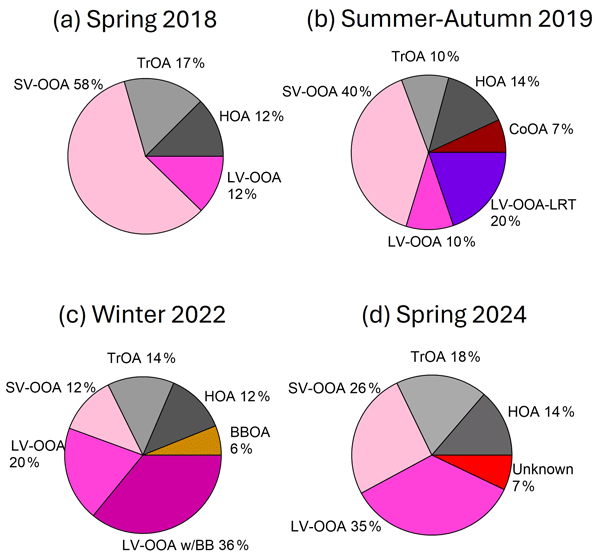
The results showed that vehicular traffic contributed to several types of OA. Hydrocarbon-like OA (HOA) typically peaked during morning traffic, whereas more oxygenated OA, referred to here as traffic-related OA (TrOA), also peaked in the morning but remained elevated for a longer duration. The mass spectra of TrOA resembled those of HOA and biomass burning OA, however, TrOA had distinct fractions of C2H4O2+ (at m/z 60), C2H5O2+ (at m/z 61) and C3H5O2+ (at m/z 73) in OA. The exact origin of TrOA remains uncertain, however, delayed morning peaks suggest that TrOA is processed in the atmosphere or emitted from modern vehicles, which typically operate later than heavy-duty vehicles. Semi-volatile OOA also appeared to be partially traffic-related, although due to its secondary nature, it was not directly linked to daily traffic patterns.
This study highlights that traffic-associated OA encompasses both hydrocarbons and oxygenated POA and SOA. Relying solely on HOA to estimate traffic POA can result in a 50 % underestimation, as HOA and TrOA often have similar magnitudes. The characteristics of OA linked to vehicular emissions are likely to evolve in future as the vehicle fleet changes.
-
Notice on discussion status
The requested preprint has a corresponding peer-reviewed final revised paper. You are encouraged to refer to the final revised version.
-
Preprint
(1703 KB)
-
Supplement
(2580 KB)
-
The requested preprint has a corresponding peer-reviewed final revised paper. You are encouraged to refer to the final revised version.
- Preprint
(1703 KB) - Metadata XML
-
Supplement
(2580 KB) - BibTeX
- EndNote
- Final revised paper


Journal article(s) based on this preprint
Interactive discussion
Status: closed
-
RC1: 'Comment on egusphere-2026-1511', Anonymous Referee #2, 27 May 2026
-
AC1: 'Reply on RC1', Sanna Saarikoski, 03 Jul 2026
The comment was uploaded in the form of a supplement: https://egusphere.copernicus.org/preprints/2026/egusphere-2026-1511/egusphere-2026-1511-AC1-supplement.pdf
-
AC1: 'Reply on RC1', Sanna Saarikoski, 03 Jul 2026
-
RC2: 'Comment on egusphere-2026-1511', Anonymous Referee #1, 27 May 2026
This paper compares PMF factors from four SP-AMS campaigns in Helsinki, two of which have been previously analyzed and published. The authors identify a traffic-related, slightly oxygenated factor, TrOA, that is apparently unique to Helsinki. They conclude that OA from traffic may be underestimated if only HOA is considered. This paper is a useful addition to the literature on organic aerosol at sites heavily influenced by urban traffic. However, I would like the authors to address the following points before publication.
My main concern with the paper is that some of the conclusions seem overstated or based on a single outlying point. For example, the discussion of Figure 6 on lines 366-375 is a little misleading. It is only the Winter 2022 TrOA that looks different. The other three TrOA factors fall in line with HOA, SV-OOA and most of the LV-OOA factors, though with slightly higher f values. Yet, in the conclusions, they call out a pronounced signal at m/z 61 for TrOA (line 410 and again at lines 433-434). They need to rephrase the conclusions so that they reflect the actual data on TrOA from all four campaigns.
The discussion of size distributions on lines 331-337 seems to argue that there is mixing between the TrOA and BBOA-influenced factors. Yet, in the conclusions, the TrOA is assumed to be entirely traffic-related. Again, they should rephrase the conclusions to reflect the data in the paper.
Also, in the conclusions (line 430), please add a brief summary of why SV-OOA is considered to be traffic-related since the rest of the paragraph is about how different it is from traffic indicators. Since SV-OOA has multiple sources, the statement that OA from traffic reaches 62% seems overstated. Maybe reframe this paragraph as OA from traffic might still be underestimated, even including HOA and TrOA, if some SV-OOA is traffic-related.
Lines 148-149: The authors state that both the tungsten and laser vaporizers were in use. Were they switching the laser on and off? If so, how often? If the laser was on continuously, they should state that explicitly.
Why are no results presented for the black carbon measurement with the SP-AMS? Did the authors include the Cx signals in PMF? I wonder if that might help explain some of the separation into HOA and TrOA. Maybe one is black carbon-rich and one is black carbon-poor.
Minor comments:
Line 37: Sea salt is listed as an anthropogenic source of OA. I don’t understand the connection. Either delete it from the list of anthropogenic sources or include an explanation.
Line 69: “80% less aged OA (POA + SOA)” is confusing. Should that be “80% less aged OA (aged POA + SOA)”?
Line 176 (and elsewhere): The figures in the SI need to be re-ordered (and re-numbered) in the order they are mentioned in the text.
Line 194-195 (and elsewhere): This list of m/z’s is in order of highest to lowest signal but I think it would be less confusing to read if the m/z’s were listed in numerical order.
Figure 2: I would add the H:C and O:C to each panel for easier comparison among the campaigns.
Figure 3. I would move the TrOA label in the figure to beside the light grey oval. It is a little lost above BBOA and CoOA.
Line 266: I am not sure what the phrase “but all oxygenated ions tend to be pronounced in the SOA mass spectra” means in this context. I think the point of the last two sentences is that although C2H5O2+ has not been observed in primary emissions it has been observed in SOA formed from those emissions. Maybe say that more directly.
Lines 280-282: This statement isn’t necessarily true unless the authors tell us what number size distribution the SCA factor has and how that compares to the size cutoff in the SP-AMS. I would also insert “mass-based” between “SP-AMS” and “measurements.”
Line 301: Insert “(at m/z 43)” after C2H3O+ since this is the first time this ion is mentioned. In fact, it might be helpful if the authors included the m/z every time an ion is mentioned.
Figure 5. Panels a and c show a clear difference between 60 vs 73 and 61 vs 73, but I’m not sure panels b and d (in terms of f values) add to the discussion. They show the same trends but are much noisier. In addition, the f values for the PMF factors are displayed in a much better way in Figure 6. I would skip panels b and d in Figure 5 and the associated discussion.
Line 370: I am not sure what the authors mean by the CoOA factor “can be mixed” with TrOA. The time series and mass spectra are distinctly different. Maybe the authors mean “mistaken for?” Or maybe rephrase this sentence to point out the similarity in f space without drawing a conclusion.
SI Table S3: What is “episode/episodes” referring to? There should be an asterisk on Summer-Autumn 2019.
SI Figures S8 to S11: The authors could consolidate these diurnals with the figures of the PMF factors. They are only mentioned once in the text and don’t need to take up so much space. What is the vertical blue line in Fig. S10a?
SI Figure S12: I think you could skip this figure. Everything discussed with respect to this figure is easily observable in the mass spectra in Figure 2.
SI Figure S17: I would add a point for a typical COA since that is commonly what is associated with higher fC4H7+ than fC4H9+.
Typos:
Line76: Should be “gas recirculation” not “gas circulation”
Line 101: Insert “wear” after “brake”
Line 118: Delete “of” before “six”
Line 124: Use “after the pandemic” rather than “after the COVID-19”
Line 214: Substitute “the pattern” for “that”
Line 281: Define DMPS
Throughout paper: Capitalize “Autumn” in “Summer-autumn”
SI, top of page 5: Insert “with” before “the highest”
SI, page 7: “Unknow” should be “unknown”
Insert “where” before “the eighth”
“eight” should be “eighth”
Fig. S6b does not show the 8th factor gaining mass. Delete the figure reference.
Fig. S3 does not show diurnals. Should be S6 instead.
“4-factor” should be “5-factor”
Citation: https://doi.org/10.5194/egusphere-2026-1511-RC2 -
AC2: 'Reply on RC2', Sanna Saarikoski, 03 Jul 2026
The comment was uploaded in the form of a supplement: https://egusphere.copernicus.org/preprints/2026/egusphere-2026-1511/egusphere-2026-1511-AC2-supplement.pdf
-
AC2: 'Reply on RC2', Sanna Saarikoski, 03 Jul 2026
Peer review completion


Interactive discussion
Status: closed
-
RC1: 'Comment on egusphere-2026-1511', Anonymous Referee #2, 27 May 2026
Saarikoski et al. present a conventional PMF paper using aerodyne SPAMS. The work is composed of results from four independent measurement campaigns conducted in different seasons, covering a variety of meteorological and weather conditions in a traffic-influenced urban environment in Helsinki. As expected, the PMF showed several common aerosol components across all campaigns, while also revealed different factors in different seasons. The study is particularly strengthened by the identification of organic traffic aerosol (TrOA) that differs from conventional HOA and exhibits characteristic oxygenated ions commonly associated with biomass burning. The manuscript further explores diagnostic ion ratios and hydrocarbon patterns to distinguish TrOA from HOA and BBOA. Overall, the manuscript is well written, and I do not have any major concerns.
line110, the statement “its sources were identified using PMF” is somehow misleading. PMF factors in AMS data are not always direct sources, but rather chemically or process-defined components that can sometimes be linked to sources after interpretation.
Fig. 2. The diurnal cycles are presented as normalized concentration. Please clarify which parameter was used for normalization.
line210-213, It is difficult to attribute the relatively flat HOA diurnal pattern in spring 2018 solely to airflow and temperature. Moreover, the cycle does not appear truly flat but instead shows a noticeable peak around midnight. Are the air masses in the Helsinki region primarily influenced by southerly or southwesterly winds during the warmer season (spring to autumn)? Considering that the 2018 and 2019 campaigns represent meteorologically similar periods in terms of temperature and air mass influence, one might expect comparable HOA diurnal patterns for these two seasons.
line213-214, it looks to me that HOA shows higher concentrations in the day than at night in the diurnal cycle (Fig. 2), contradictory to the statements here.
line288-289, can you reason BBOA from a dominant local source?
line295, laser vaporizer should enable the detection refractory organic species due to the presence of BC. How does this capability affect the PMF factors compared to results from conventional thermal vaporizer results? This aspect is not discussed in the manuscript and would benefit from clarification.
Citation: https://doi.org/10.5194/egusphere-2026-1511-RC1 -
AC1: 'Reply on RC1', Sanna Saarikoski, 03 Jul 2026
The comment was uploaded in the form of a supplement: https://egusphere.copernicus.org/preprints/2026/egusphere-2026-1511/egusphere-2026-1511-AC1-supplement.pdf
-
AC1: 'Reply on RC1', Sanna Saarikoski, 03 Jul 2026
-
RC2: 'Comment on egusphere-2026-1511', Anonymous Referee #1, 27 May 2026
This paper compares PMF factors from four SP-AMS campaigns in Helsinki, two of which have been previously analyzed and published. The authors identify a traffic-related, slightly oxygenated factor, TrOA, that is apparently unique to Helsinki. They conclude that OA from traffic may be underestimated if only HOA is considered. This paper is a useful addition to the literature on organic aerosol at sites heavily influenced by urban traffic. However, I would like the authors to address the following points before publication.
My main concern with the paper is that some of the conclusions seem overstated or based on a single outlying point. For example, the discussion of Figure 6 on lines 366-375 is a little misleading. It is only the Winter 2022 TrOA that looks different. The other three TrOA factors fall in line with HOA, SV-OOA and most of the LV-OOA factors, though with slightly higher f values. Yet, in the conclusions, they call out a pronounced signal at m/z 61 for TrOA (line 410 and again at lines 433-434). They need to rephrase the conclusions so that they reflect the actual data on TrOA from all four campaigns.
The discussion of size distributions on lines 331-337 seems to argue that there is mixing between the TrOA and BBOA-influenced factors. Yet, in the conclusions, the TrOA is assumed to be entirely traffic-related. Again, they should rephrase the conclusions to reflect the data in the paper.
Also, in the conclusions (line 430), please add a brief summary of why SV-OOA is considered to be traffic-related since the rest of the paragraph is about how different it is from traffic indicators. Since SV-OOA has multiple sources, the statement that OA from traffic reaches 62% seems overstated. Maybe reframe this paragraph as OA from traffic might still be underestimated, even including HOA and TrOA, if some SV-OOA is traffic-related.
Lines 148-149: The authors state that both the tungsten and laser vaporizers were in use. Were they switching the laser on and off? If so, how often? If the laser was on continuously, they should state that explicitly.
Why are no results presented for the black carbon measurement with the SP-AMS? Did the authors include the Cx signals in PMF? I wonder if that might help explain some of the separation into HOA and TrOA. Maybe one is black carbon-rich and one is black carbon-poor.
Minor comments:
Line 37: Sea salt is listed as an anthropogenic source of OA. I don’t understand the connection. Either delete it from the list of anthropogenic sources or include an explanation.
Line 69: “80% less aged OA (POA + SOA)” is confusing. Should that be “80% less aged OA (aged POA + SOA)”?
Line 176 (and elsewhere): The figures in the SI need to be re-ordered (and re-numbered) in the order they are mentioned in the text.
Line 194-195 (and elsewhere): This list of m/z’s is in order of highest to lowest signal but I think it would be less confusing to read if the m/z’s were listed in numerical order.
Figure 2: I would add the H:C and O:C to each panel for easier comparison among the campaigns.
Figure 3. I would move the TrOA label in the figure to beside the light grey oval. It is a little lost above BBOA and CoOA.
Line 266: I am not sure what the phrase “but all oxygenated ions tend to be pronounced in the SOA mass spectra” means in this context. I think the point of the last two sentences is that although C2H5O2+ has not been observed in primary emissions it has been observed in SOA formed from those emissions. Maybe say that more directly.
Lines 280-282: This statement isn’t necessarily true unless the authors tell us what number size distribution the SCA factor has and how that compares to the size cutoff in the SP-AMS. I would also insert “mass-based” between “SP-AMS” and “measurements.”
Line 301: Insert “(at m/z 43)” after C2H3O+ since this is the first time this ion is mentioned. In fact, it might be helpful if the authors included the m/z every time an ion is mentioned.
Figure 5. Panels a and c show a clear difference between 60 vs 73 and 61 vs 73, but I’m not sure panels b and d (in terms of f values) add to the discussion. They show the same trends but are much noisier. In addition, the f values for the PMF factors are displayed in a much better way in Figure 6. I would skip panels b and d in Figure 5 and the associated discussion.
Line 370: I am not sure what the authors mean by the CoOA factor “can be mixed” with TrOA. The time series and mass spectra are distinctly different. Maybe the authors mean “mistaken for?” Or maybe rephrase this sentence to point out the similarity in f space without drawing a conclusion.
SI Table S3: What is “episode/episodes” referring to? There should be an asterisk on Summer-Autumn 2019.
SI Figures S8 to S11: The authors could consolidate these diurnals with the figures of the PMF factors. They are only mentioned once in the text and don’t need to take up so much space. What is the vertical blue line in Fig. S10a?
SI Figure S12: I think you could skip this figure. Everything discussed with respect to this figure is easily observable in the mass spectra in Figure 2.
SI Figure S17: I would add a point for a typical COA since that is commonly what is associated with higher fC4H7+ than fC4H9+.
Typos:
Line76: Should be “gas recirculation” not “gas circulation”
Line 101: Insert “wear” after “brake”
Line 118: Delete “of” before “six”
Line 124: Use “after the pandemic” rather than “after the COVID-19”
Line 214: Substitute “the pattern” for “that”
Line 281: Define DMPS
Throughout paper: Capitalize “Autumn” in “Summer-autumn”
SI, top of page 5: Insert “with” before “the highest”
SI, page 7: “Unknow” should be “unknown”
Insert “where” before “the eighth”
“eight” should be “eighth”
Fig. S6b does not show the 8th factor gaining mass. Delete the figure reference.
Fig. S3 does not show diurnals. Should be S6 instead.
“4-factor” should be “5-factor”
Citation: https://doi.org/10.5194/egusphere-2026-1511-RC2 -
AC2: 'Reply on RC2', Sanna Saarikoski, 03 Jul 2026
The comment was uploaded in the form of a supplement: https://egusphere.copernicus.org/preprints/2026/egusphere-2026-1511/egusphere-2026-1511-AC2-supplement.pdf
-
AC2: 'Reply on RC2', Sanna Saarikoski, 03 Jul 2026
Peer review completion
Journal article(s) based on this preprint
Viewed
| HTML | XML | Total | Supplement | BibTeX | EndNote | |
|---|---|---|---|---|---|---|
| 361 | 107 | 39 | 507 | 47 | 56 | 49 |
- HTML: 361
- PDF: 107
- XML: 39
- Total: 507
- Supplement: 47
- BibTeX: 56
- EndNote: 49
Viewed (geographical distribution)
| Country | # | Views | % |
|---|
| Total: | 0 |
| HTML: | 0 |
| PDF: | 0 |
| XML: | 0 |
- 1
Sanna Saarikoski

Minna Aurela
Jarkko V. Niemi
Luis M. F. Barreira
Jussi Hoivala
Hanna Manninen
Topi Rönkkö
Hilkka Timonen
The requested preprint has a corresponding peer-reviewed final revised paper. You are encouraged to refer to the final revised version.
- Preprint
(1703 KB) - Metadata XML
-
Supplement
(2580 KB) - BibTeX
- EndNote
- Final revised paper
Saarikoski et al. present a conventional PMF paper using aerodyne SPAMS. The work is composed of results from four independent measurement campaigns conducted in different seasons, covering a variety of meteorological and weather conditions in a traffic-influenced urban environment in Helsinki. As expected, the PMF showed several common aerosol components across all campaigns, while also revealed different factors in different seasons. The study is particularly strengthened by the identification of organic traffic aerosol (TrOA) that differs from conventional HOA and exhibits characteristic oxygenated ions commonly associated with biomass burning. The manuscript further explores diagnostic ion ratios and hydrocarbon patterns to distinguish TrOA from HOA and BBOA. Overall, the manuscript is well written, and I do not have any major concerns.
line110, the statement “its sources were identified using PMF” is somehow misleading. PMF factors in AMS data are not always direct sources, but rather chemically or process-defined components that can sometimes be linked to sources after interpretation.
Fig. 2. The diurnal cycles are presented as normalized concentration. Please clarify which parameter was used for normalization.
line210-213, It is difficult to attribute the relatively flat HOA diurnal pattern in spring 2018 solely to airflow and temperature. Moreover, the cycle does not appear truly flat but instead shows a noticeable peak around midnight. Are the air masses in the Helsinki region primarily influenced by southerly or southwesterly winds during the warmer season (spring to autumn)? Considering that the 2018 and 2019 campaigns represent meteorologically similar periods in terms of temperature and air mass influence, one might expect comparable HOA diurnal patterns for these two seasons.
line213-214, it looks to me that HOA shows higher concentrations in the day than at night in the diurnal cycle (Fig. 2), contradictory to the statements here.
line288-289, can you reason BBOA from a dominant local source?
line295, laser vaporizer should enable the detection refractory organic species due to the presence of BC. How does this capability affect the PMF factors compared to results from conventional thermal vaporizer results? This aspect is not discussed in the manuscript and would benefit from clarification.