
the Creative Commons Attribution 4.0 License.
the Creative Commons Attribution 4.0 License.
 | 01 Apr 2026
Do GEMS geostationary satellite observations of tropospheric NO2 always improve NOx emission estimates and related air quality modelling?
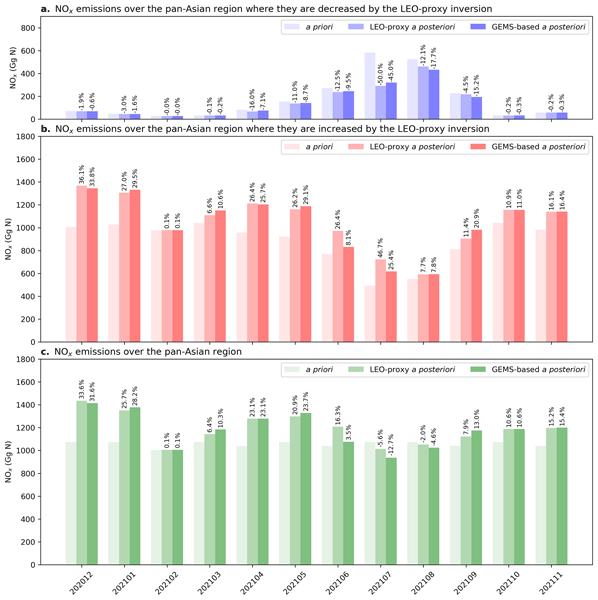
Abstract. Satellite observations of atmospheric composition from low Earth orbit (LEO) have significantly advanced our understanding of global tropospheric chemistry; however, their 12-hour overpass cadence limits the attribution of rapid compositional changes. The launch of the Korean Geostationary Environment Monitoring Spectrometer (GEMS) in 2020 heralded the beginning of continuous spaceborne monitoring of atmospheric composition during sunlit hours across Asia, allowing researchers to track atmospheric variability in real-time from a geostationary perspective. We assess the added value of GEMS observations of tropospheric NO2 to estimate monthly emissions of NOx across Asia compared with the information provided by the equivalent instrument in LEO. We use the adjoint of the GEOS-Chem atmospheric chemistry transport model to infer NOx emissions, comparing estimates using the full set of GEMS tropospheric NO2 data against a surrogate LEO dataset created by subsampling the GEMS data at 13:45 local time (Korea Standard Time, KST). We find that the benefits of assimilating high-frequency GEMS observations are most significant during non-summer months (September−May), when elevated NO2 concentrations and pronounced diurnal variability provide strong constraints on emission estimates. During this period, NOx emission estimates derived from the full GEMS record deviate substantially from LEO-proxy results, with differences of 0.2−52.6 GgN month−1, corresponding to 0.02−5.06 % of the a priori emissions. These differences further propagate into widespread adjustments in modelled ozone, hydroxyl radicals, and other secondary species, with evaluation against independent in situ measurements showing that GEMS-inferred emission estimates offer comparable or superior performance particularly in regions where the differences are most pronounced. In contrast, we find that during summer months (June−August), low NO2 levels likely introduce retrieval uncertainties that challenge the data assimilation framework in which only anthropogenic NOx sources are optimised, leading to negligible or even detrimental impacts on our ability to estimate NOx emissions.
-
Notice on discussion status
The requested preprint has a corresponding peer-reviewed final revised paper. You are encouraged to refer to the final revised version.
-
Preprint
(6010 KB)
-
Supplement
(3354 KB)
-
The requested preprint has a corresponding peer-reviewed final revised paper. You are encouraged to refer to the final revised version.
- Preprint
(6010 KB) - Metadata XML
-
Supplement
(3354 KB) - BibTeX
- EndNote
- Final revised paper


Journal article(s) based on this preprint
Interactive discussion
Status: closed
- RC1: 'Comment on egusphere-2026-1499', Anonymous Referee #1, 02 May 2026
-
RC2: 'Comment on egusphere-2026-1499', Anonymous Referee #2, 09 May 2026
Yao et al., compares between GEMS based and LEO based proxy emissions for the year 2021 and to investigate the utility of GEMS observations to constrains emissions.
The manuscript topic is very relevant and aims to answer very significant questions – however – there are concerns that will need to be reconciled before publication.
Major concerns:
- The primary objective of a GEO satellite is to derive hourly column and surface concentrations and emissions. However, this paper aims to compare between monthly emission estimates and identify if GEO is better or a LEO proxy is better.
This dilutes the use of GEO observations. However, if the objective is to compare between retrieval capabilities of the instruments, there are lot of other parameters that are needed to be compared/constrained. So, I suggest the author to re-think about the objectives of this comparison.
- Given the results, the authors have suggested to use GEO observations for non-summer months and LEO for summer months if the community is interested in the deriving surface emissions from GEO observations. The authors have mentioned that in a single line 314 that might be attributed to photochemical sinks. I think this requires a more detailed explanation, as to what must be causing it and how.
- The authors have used LEO-proxy to compare between LEO and GEO. There is little to nothing explanation on how the LEO-proxy inversions is designed. Line 200 says: this experiment utilizes a subset of GEMS retrievals restricted to 13:45 local time (KST). But how is it done? Its important for the readers to understand how the two inversions are different from each other in their design. I also suggest the authors should consider using actual including actual LEO observations (TROPOMI/OMI) – to have some evidence on how the actual differences might look like –
- One of the claims that the authors have listed in this manuscript is that they considered the use of independent observations to verify the columns and surface. But little explanation has been provided uncertainties and errors involved with Pandora and AERONET. I suggest the authors include a discussion on how and when Pandora and AERONET columns might be biased based on studies in the literature.
Minor concerns –
- The current discussion speaks solely about the results observed in this paper. However, I think – the authors need to include literature and prior studies relevant to GEO/LEO based inversions and show a comparison between how their work might have similar/different results and have explanations for them.
- Figure 6 currently shows just the simulated NO2 column and surface conc after the inversions are implemented. I suggest the use of observations (both column and surface) overlayed on these maps to show how well they match with the observations. I feel the authors chose to not include them in the same figure to avoid crowding, in that case they can include an overall annual mean or a few monthly mean figures to understand how the actual improved columns and surface compare against the observations (column and surface)
- The authors suggest having conducted inversions for the 12 months, but all the figures are for the representative month of April 2021. The have shown the GEMS based NO2 retrievals for 2021 for the 12 months in figure S11. I would suggest the authors to include a panel for inversion (a posteriori – a priori) for all 12 months. May be this will explain why they chose April as the representative month.
- Figure 7 shows and Figure S13 shows NO2 column and surface biases for North China Plain and Northern India. NCP shows positive biases for column and negative biases for the surface while we see negative biases for both column and surface for northern India. Is there an explanation for that?
- 2021 was one a COVID lockdown year in both India and China. There was a significant drop in anthropogenic NOx emissions from traffic, which is probably observed by the satellite and ground-based instruments, but not by the model. I think the authors need to include a paragraph explaining this phenomenon.
Citation: https://doi.org/10.5194/egusphere-2026-1499-RC2 -
RC3: 'Comment on egusphere-2026-1499', Anonymous Referee #2, 09 May 2026
Yao et al., compares between GEMS based and LEO based proxy emissions for the year 2021 and to investigate the utility of GEMS observations to constrains emissions.
The manuscript topic is very relevant and aims to answer very significant questions – however – there are concerns that will need to be reconciled before publication.
Major concerns:
- The primary objective of a GEO satellite is to derive hourly column and surface concentrations and emissions. However, this paper aims to compare between monthly emission estimates and identify if GEO is better or a LEO proxy is better. This dilutes the use of GEO observations. However, if the objective is to compare between retrieval capabilities of the instruments, there are lot of other parameters that are needed to be compared/constrained. So, I suggest the author to re-think about the objectives of this comparison.
- Given the results, the authors have suggested to use GEO observations for non-summer months and LEO for summer months if the community is interested in the deriving surface emissions from GEO observations. The authors have mentioned that in a single line 314 that might be attributed to photochemical sinks. I think this requires a more detailed explanation, as to what must be causing it and how.
- The authors have used LEO-proxy to compare between LEO and GEO. There is little to nothing explanation on how the LEO-proxy inversions is designed. Line 200 says: this experiment utilizes a subset of GEMS retrievals restricted to 13:45 local time (KST). But how is it done? Its important for the readers to understand how the two inversions are different from each other in their design. I also suggest the authors should consider using actual including actual LEO observations (TROPOMI/OMI) – to have some evidence on how the actual differences might look like –
- One of the claims that the authors have listed in this manuscript is that they considered the use of independent observations to verify the columns and surface. But little explanation has been provided uncertainties and errors involved with Pandora and AERONET. I suggest the authors include a discussion on how and when Pandora and AERONET columns might be biased based on studies in the literature.
Minor concerns –
- The current discussion speaks solely about the results observed in this paper. However, I think – the authors need to include literature and prior studies relevant to GEO/LEO based inversions and show a comparison between how their work might have similar/different results and have explanations for them.
- Figure 6 currently shows just the simulated NO2 column and surface conc after the inversions are implemented. I suggest the use of observations (both column and surface) overlayed on these maps to show how well they match with the observations. I feel the authors chose to not include them in the same figure to avoid crowding, in that case they can include an overall annual mean or a few monthly mean figures to understand how the actual improved columns and surface compare against the observations (column and surface)
- The authors suggest having conducted inversions for the 12 months, but all the figures are for the representative month of April 2021. The have shown the GEMS based NO2 retrievals for 2021 for the 12 months in figure S11. I would suggest the authors to include a panel for inversion (a posteriori – a priori) for all 12 months. May be this will explain why they chose April as the representative month.
- Figure 7 shows and Figure S13 shows NO2 column and surface biases for North China Plain and Northern India. NCP shows positive biases for column and negative biases for the surface while we see negative biases for both column and surface for northern India. Is there an explanation for that?
- 2021 was one a COVID lockdown year in both India and China. There was a significant drop in anthropogenic NOx emissions from traffic, which is probably observed by the satellite and ground-based instruments, but not by the model. I think the authors need to include a paragraph explaining this phenomenon.
Citation: https://doi.org/10.5194/egusphere-2026-1499-RC3 -
AC1: 'Comment on egusphere-2026-1499', Fei Yao, 05 Jul 2026
The comment was uploaded in the form of a supplement: https://egusphere.copernicus.org/preprints/2026/egusphere-2026-1499/egusphere-2026-1499-AC1-supplement.pdf
Peer review completion


Interactive discussion
Status: closed
-
RC1: 'Comment on egusphere-2026-1499', Anonymous Referee #1, 02 May 2026
Yao et al. present a comparison between a full-hourly GEMS-based inversion and a LEO-proxy inversion using the GEOS-Chem adjoint, aiming to quantify the added value of geostationary NO2 observations for constraining monthly NOₓ emissions.
The topic is timely, and the seasonal contrast between non-summer and summer is interesting. The degradation in optimizing anthropogenic emissions using NO2 column during summer potentially suggest a strong background influence in the observations. The authors also clearly acknowledge several limitations of their analysis.
However, I have several major concerns, which need to be addressed before the manuscript can be considered for publication.
Major comments:
- In the abstract, the authors claim that the added value of using GEMS instead of LEO-proxy observations is “substantial”, while the overall impact on monthly emission estimate is below 5.1%. While I do not deny that geostationary observations provide additional information to monthly inversions, I do not consider this level of change to be “substantial” (also shown in your Figures 2-3). Please consider rephrasing the Abstract and similar expressions throughout the manuscript.
- This work only optimizes anthropogenic NOx This is an important aspect of inversion setup, but is not clearly stated in the Abstract, Section 2.2 (method description), or the Conclusion. Please clarify this explicitly. In addition, it would be helpful to briefly explain in Section 2.2 why only anthropogenic emissions are optimized, while other sources (e.g., lightning and soil NOₓ), which are generally more uncertain, are not included.
- The use of AERONET columnar NO2 for evaluation raises some concerns, as AERONET is not primarily designed for trace gas retrievals. It would be helpful to discuss how the uncertainty and limitations of AERONET NO2 retrievals, and how they may affect the interpretation of model evaluation results.
- Figures 2-3 evaluate the two inversions across multiple temporal scales (afternoon, daytime average, and daily average). I do not see the motivation of analyzing multiple temporal scales, as the inversion only updates monthly emissions. Please consider simplifying the figures or clear justifying why these different temporal scales are necessary in this context.
- In Section 3.3, the GEMS-based inversion shows the same direction of correction as the LEO-proxy inversion over East Asia, but the opposite direction over North India. What drives this regional contrast? This behavior is interesting but not explained in the current manuscript. Please provide a clearer physical or observational explanation.
- In Section 3.4, the explanations for changes in related species are either missing or not sufficiently accurate. For example:
- HCHO generally reflects VOC oxidation, and is therefore more directly controlled by the oxidation capacity (O3 and OH).
- CO is primarily removed by OH, and is therefore more directly controlled by the OH.
- SO2 oxidation is largely driven by OH and O3, so it can show an inverse relationship with these oxidants.
- NH3 is strongly influenced by HNO3 availability, so increased NO2 can enhance HNO3 formation and thus shift NH3 partitioning and loss.
The current explanation that these responses reflect “complex nonlinear chemistry” is too general. A more physically grounded interpretation is needed.
- Lines 119-122. The variable ccomp in Eq. 1 represents a vertical column density, not a slant column density. Therefore, a priori information is inherently embedded in ccomp I do not understand what the authors mean by “this process does not explicitly incorporate a priori profiles”? In fact, the influence of a priori profiles on AMF can be significant. A relevant example is Oak et al. (2024), which the authors already cite. Please clarify this point and revise the discussion accordingly.
Citation: https://doi.org/10.5194/egusphere-2026-1499-RC1 -
RC2: 'Comment on egusphere-2026-1499', Anonymous Referee #2, 09 May 2026
Yao et al., compares between GEMS based and LEO based proxy emissions for the year 2021 and to investigate the utility of GEMS observations to constrains emissions.
The manuscript topic is very relevant and aims to answer very significant questions – however – there are concerns that will need to be reconciled before publication.
Major concerns:
- The primary objective of a GEO satellite is to derive hourly column and surface concentrations and emissions. However, this paper aims to compare between monthly emission estimates and identify if GEO is better or a LEO proxy is better.
This dilutes the use of GEO observations. However, if the objective is to compare between retrieval capabilities of the instruments, there are lot of other parameters that are needed to be compared/constrained. So, I suggest the author to re-think about the objectives of this comparison.
- Given the results, the authors have suggested to use GEO observations for non-summer months and LEO for summer months if the community is interested in the deriving surface emissions from GEO observations. The authors have mentioned that in a single line 314 that might be attributed to photochemical sinks. I think this requires a more detailed explanation, as to what must be causing it and how.
- The authors have used LEO-proxy to compare between LEO and GEO. There is little to nothing explanation on how the LEO-proxy inversions is designed. Line 200 says: this experiment utilizes a subset of GEMS retrievals restricted to 13:45 local time (KST). But how is it done? Its important for the readers to understand how the two inversions are different from each other in their design. I also suggest the authors should consider using actual including actual LEO observations (TROPOMI/OMI) – to have some evidence on how the actual differences might look like –
- One of the claims that the authors have listed in this manuscript is that they considered the use of independent observations to verify the columns and surface. But little explanation has been provided uncertainties and errors involved with Pandora and AERONET. I suggest the authors include a discussion on how and when Pandora and AERONET columns might be biased based on studies in the literature.
Minor concerns –
- The current discussion speaks solely about the results observed in this paper. However, I think – the authors need to include literature and prior studies relevant to GEO/LEO based inversions and show a comparison between how their work might have similar/different results and have explanations for them.
- Figure 6 currently shows just the simulated NO2 column and surface conc after the inversions are implemented. I suggest the use of observations (both column and surface) overlayed on these maps to show how well they match with the observations. I feel the authors chose to not include them in the same figure to avoid crowding, in that case they can include an overall annual mean or a few monthly mean figures to understand how the actual improved columns and surface compare against the observations (column and surface)
- The authors suggest having conducted inversions for the 12 months, but all the figures are for the representative month of April 2021. The have shown the GEMS based NO2 retrievals for 2021 for the 12 months in figure S11. I would suggest the authors to include a panel for inversion (a posteriori – a priori) for all 12 months. May be this will explain why they chose April as the representative month.
- Figure 7 shows and Figure S13 shows NO2 column and surface biases for North China Plain and Northern India. NCP shows positive biases for column and negative biases for the surface while we see negative biases for both column and surface for northern India. Is there an explanation for that?
- 2021 was one a COVID lockdown year in both India and China. There was a significant drop in anthropogenic NOx emissions from traffic, which is probably observed by the satellite and ground-based instruments, but not by the model. I think the authors need to include a paragraph explaining this phenomenon.
Citation: https://doi.org/10.5194/egusphere-2026-1499-RC2 -
RC3: 'Comment on egusphere-2026-1499', Anonymous Referee #2, 09 May 2026
Yao et al., compares between GEMS based and LEO based proxy emissions for the year 2021 and to investigate the utility of GEMS observations to constrains emissions.
The manuscript topic is very relevant and aims to answer very significant questions – however – there are concerns that will need to be reconciled before publication.
Major concerns:
- The primary objective of a GEO satellite is to derive hourly column and surface concentrations and emissions. However, this paper aims to compare between monthly emission estimates and identify if GEO is better or a LEO proxy is better. This dilutes the use of GEO observations. However, if the objective is to compare between retrieval capabilities of the instruments, there are lot of other parameters that are needed to be compared/constrained. So, I suggest the author to re-think about the objectives of this comparison.
- Given the results, the authors have suggested to use GEO observations for non-summer months and LEO for summer months if the community is interested in the deriving surface emissions from GEO observations. The authors have mentioned that in a single line 314 that might be attributed to photochemical sinks. I think this requires a more detailed explanation, as to what must be causing it and how.
- The authors have used LEO-proxy to compare between LEO and GEO. There is little to nothing explanation on how the LEO-proxy inversions is designed. Line 200 says: this experiment utilizes a subset of GEMS retrievals restricted to 13:45 local time (KST). But how is it done? Its important for the readers to understand how the two inversions are different from each other in their design. I also suggest the authors should consider using actual including actual LEO observations (TROPOMI/OMI) – to have some evidence on how the actual differences might look like –
- One of the claims that the authors have listed in this manuscript is that they considered the use of independent observations to verify the columns and surface. But little explanation has been provided uncertainties and errors involved with Pandora and AERONET. I suggest the authors include a discussion on how and when Pandora and AERONET columns might be biased based on studies in the literature.
Minor concerns –
- The current discussion speaks solely about the results observed in this paper. However, I think – the authors need to include literature and prior studies relevant to GEO/LEO based inversions and show a comparison between how their work might have similar/different results and have explanations for them.
- Figure 6 currently shows just the simulated NO2 column and surface conc after the inversions are implemented. I suggest the use of observations (both column and surface) overlayed on these maps to show how well they match with the observations. I feel the authors chose to not include them in the same figure to avoid crowding, in that case they can include an overall annual mean or a few monthly mean figures to understand how the actual improved columns and surface compare against the observations (column and surface)
- The authors suggest having conducted inversions for the 12 months, but all the figures are for the representative month of April 2021. The have shown the GEMS based NO2 retrievals for 2021 for the 12 months in figure S11. I would suggest the authors to include a panel for inversion (a posteriori – a priori) for all 12 months. May be this will explain why they chose April as the representative month.
- Figure 7 shows and Figure S13 shows NO2 column and surface biases for North China Plain and Northern India. NCP shows positive biases for column and negative biases for the surface while we see negative biases for both column and surface for northern India. Is there an explanation for that?
- 2021 was one a COVID lockdown year in both India and China. There was a significant drop in anthropogenic NOx emissions from traffic, which is probably observed by the satellite and ground-based instruments, but not by the model. I think the authors need to include a paragraph explaining this phenomenon.
Citation: https://doi.org/10.5194/egusphere-2026-1499-RC3 -
AC1: 'Comment on egusphere-2026-1499', Fei Yao, 05 Jul 2026
The comment was uploaded in the form of a supplement: https://egusphere.copernicus.org/preprints/2026/egusphere-2026-1499/egusphere-2026-1499-AC1-supplement.pdf
Peer review completion
Journal article(s) based on this preprint
Viewed
| HTML | XML | Total | Supplement | BibTeX | EndNote | |
|---|---|---|---|---|---|---|
| 590 | 240 | 51 | 881 | 122 | 62 | 67 |
- HTML: 590
- PDF: 240
- XML: 51
- Total: 881
- Supplement: 122
- BibTeX: 62
- EndNote: 67
Viewed (geographical distribution)
| Country | # | Views | % |
|---|
| Total: | 0 |
| HTML: | 0 |
| PDF: | 0 |
| XML: | 0 |
- 1

Xiaolin Wang
Yi Wang
Gitaek T. Lee
Haolin Wang
Liang Feng
Daven K. Henze
Rokjin J. Park
The requested preprint has a corresponding peer-reviewed final revised paper. You are encouraged to refer to the final revised version.
- Preprint
(6010 KB) - Metadata XML
-
Supplement
(3354 KB) - BibTeX
- EndNote
- Final revised paper
Yao et al. present a comparison between a full-hourly GEMS-based inversion and a LEO-proxy inversion using the GEOS-Chem adjoint, aiming to quantify the added value of geostationary NO2 observations for constraining monthly NOₓ emissions.
The topic is timely, and the seasonal contrast between non-summer and summer is interesting. The degradation in optimizing anthropogenic emissions using NO2 column during summer potentially suggest a strong background influence in the observations. The authors also clearly acknowledge several limitations of their analysis.
However, I have several major concerns, which need to be addressed before the manuscript can be considered for publication.
Major comments:
The current explanation that these responses reflect “complex nonlinear chemistry” is too general. A more physically grounded interpretation is needed.