
the Creative Commons Attribution 4.0 License.
the Creative Commons Attribution 4.0 License.
 | 20 Mar 2026
Seasonal variation in vegetation-climate interactions shape the CO2 exchange in a degraded raised bog
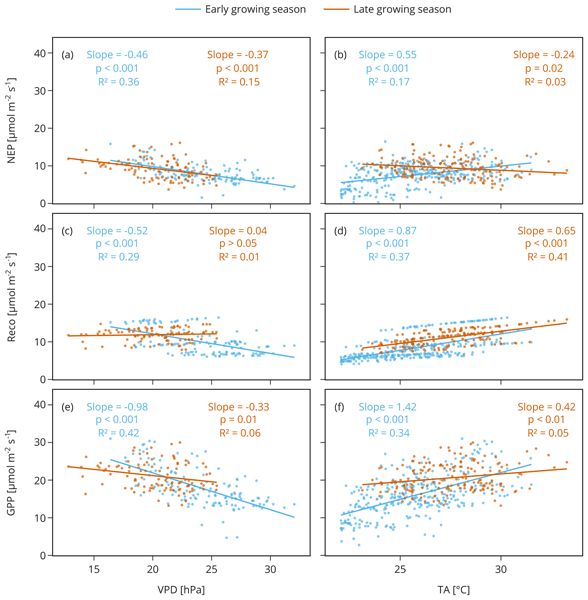
Abstract. Pristine peatlands act as natural carbon sinks, but disturbance — mostly anthropogenic drainage — turns them into CO2 sources, responsible for 2–5 % of annual greenhouse gas (GHG) emissions globally. Complex interactions between vegetation, soil, climate, and hydrology produce highly variable CO2 budgets on different types of peatlands and between years. Abandoned drained peatlands are considered low-hanging fruit for rewetting due to expected high GHG emissions and low resistance to repurposing yet remain underrepresented in research. To close this gap in literature we measured three years (2023–2025) of CO2 and CH4 fluxes alongside meteorological and hydrological conditions in a drained shrub-dominated ombrotrophic raised bog in NW Germany, investigating carbon flux budgets and the main seasonal drivers of fluxes. Methane fluxes were negligible throughout, likely due to consistently deep water tables (>15 cm). Annual CO2 budgets were highly variable: the site was a considerable source in 2023 and 2025 (131 and 86 gC m-2 a-1) but near-neutral in 2024. An anomalously warm spring in 2024 triggered earlier vegetation greening and substantially increased CO2 uptake capacity from April through June. In contrast, warming later in the growing season increased CO2 emissions due to a stronger reaction of respiration than of photosynthesis to warming — highlighting how the timing of climate anomalies matters. Partitioning the effects of high air temperature (TA) and vapor pressure deficit (VPD) revealed that high VPD suppressed carbon fluxes in the first half of the growing season but not the second, while extreme TA did not limit GPP or ecosystem respiration the way extreme VPD did. TA and solar radiation were the dominant daily flux drivers; water table depth did not govern daily or interannual carbon flux variability. Together, our results demonstrate that the timing of TA and VPD anomalies — mediated through vegetation responses — decisively shapes their impact on the carbon balance. These results will become increasingly relevant as climate extremes intensify with ongoing global warming.
-
Notice on discussion status
The requested preprint has a corresponding peer-reviewed final revised paper. You are encouraged to refer to the final revised version.
-
Preprint
(2084 KB)
-
Supplement
(437 KB)
-
The requested preprint has a corresponding peer-reviewed final revised paper. You are encouraged to refer to the final revised version.
- Preprint
(2084 KB) - Metadata XML
-
Supplement
(437 KB) - BibTeX
- EndNote
- Final revised paper


Journal article(s) based on this preprint
Interactive discussion
Status: closed
-
RC1: 'Comment on egusphere-2026-1496', Anonymous Referee #1, 17 Apr 2026
- AC1: 'Reply on RC1', Nicolas Behrens, 15 May 2026
-
RC2: 'Comment on egusphere-2026-1496', Anonymous Referee #2, 20 Apr 2026
This article presents an analysis of vegetation-climate interaction from measurements at an abandoned, degraded raised bog. I found the article interesting and the analyses were thorough, and I think the content would fit nicely within the scope of Biogeosciences. However, some revisions and clarifications are required.
The introduction is well written and provides the necessary background information on the topic. You could include the “low hanging fruit” of rewetting/mitigation potential message from your abstract in the introduction since that was missing. This message is important considering that across several countries there are abandoned drained fields that may be persistent sources of emissions.
In the first paragraph you can consider introducing natural peatlands as sources of methane, since in the second paragraph you talk generally about carbon emissions and not just CO2 emissions. Carbon balances can/should also encompass lateral losses. While in temperate peatlands this loss may be small, it can decide whether a site is a net C sink. I recommend to either adjust this, or be more specific that you are writing about CO2 fluxes only in this paragraph.
The methods were generally clear, but some more detail is required: see my line comments below.
The seasonality detection was nice and avoids subjectivity to define season stages.
For the driver analysis in section 2.6, is there a reason why SWC wasn’t included? It could have been an interesting addition for the driver/anomaly analysis and perhaps provided some insight into flux regulation that WTD doesn’t provide. But I could see that it may have had high collinearity with WTD.
Assuming you used the REddyProc implementation of the nighttime partitioning method and didn’t implement your own, Reco is fit on night NEE and TA using sliding 7 day windows in steps of 4 days to define the parameters. It is modelled for day and night, i.e. it doesn’t keep the observed night NEE in the timeseries. For the driver analysis, since Reco is fit using TA, it will of course be a dominant driver (as you show later) and therefore those results are unsurprising. Because of the fitting windows/steps, your daily flux anomalies are likely smoothed.
A complication that isn’t considered/discussed is effect of gapfilling and partitioning on the driver/anomaly analysis. Only the night-time conditions are considering during the fitting of Reco, but then you are examining daily anomalies of the fluxes and drivers. I think the effect of e.g. daily VPD may not truly be represented for Reco considering the way it is fit and the typical diurnal cycles of VPD, though there are likely memory effects. This has some carry over effects to GPP. There is also the effect of the gapfilling of NEE on the daily driver analysis, since some of the drivers were also used as predictors for the gapfilling. These issues are hard to avoid unless you stick to only analysis of the measured data – and generally for understanding drivers using the direct flux observations would be the best. Unfortunately then you would only get the effect of drivers on daytime and nighttime NEE and not the partitioned fluxes. The analysis is still interesting and you can derive insights from it, but you should mention these circular/confounding issues in the Discussion.
It was unclear sometimes in the results if you were using the nighttime partitioned data introduced earlier, or your own partitioning you introduced in section 2.7, e.g. the results in Section 3.7 and Figure 9 (clearly your own method was used for the monthly responses in Figure 8). Or even if the gapfilled NEE/NEP data was used in e.g. Figure 9 for the analyses.
CH4 budgets were included in a table but were not discussed or referred to in the text, though you noted the issues with gapfilling earlier. You could refer to them in Section 3.2 when you write that gapfilling performance was poor / uncertainties were too high (or exclude them entirely). See my line comments about the low number of data points.
The article was generally written well with good figures but there were some grammar issues, incomplete sentences, and incorrect units applied which need to be corrected. I pointed out some but probably didn’t catch all of them – please check carefully.
Units: See line items. Spaces between the units (e.g. g C m-2 a-1, not gC). Annual flux units should have a time unit a-1 or yr-1. CH4 flux you had units of mmol m-2 s-1, which I assume should be nmol m-2 s-1 since otherwise that is a huge flux and would exceed your detection limit. A couple of issues with radiation and VPD units.
Inconsistent uses of subscripts at times, e.g. Q10 and Q10, CO2 and CO2.
Check language around when discussing WTD, it can be confusing to know if you are talking about shallower or deeper water tables at times when it is “less” or “more” etc. Sticking to e.g. deep and shallow, raised or lower etc. is clearer.
The tense in the MS was not always consistent, check carefully.
Line comments
Abstract
L9: The first sentence does not flow that well, I would rephrase it. Carbon dioxide is also not defined yet if it needs to be.
L14: methane (CH4) if it needs to be defined
L15: northwest Germany
L16: Perhaps clarify the units that 15 cm is below ground and that WTD is in the notation of positive units -> deeper. Or just write water tables consistently deeper than 15 cm if you don’t have space here.
L17: gC m-2 a-1 -> g C m-2 a-1
L18: greening or growth?
Introduction
L31: carbon dioxide should be defined again if it needs to be
L34: “leading to carbon losses in form of CO2”: be more specific here, the aeration enables microbial peat oxidation and this is the largest C loss pathway. Carbon losses could also entail DOC/POC losses, but microbial peat oxidation enabled by drainage is normally the greatest.
L68: “when WTD is consistently high (> 20 cm)” do you mean consistently deep? Intuitively when one talks about high water tables you think of it being close to the surface.
Methods
L110: in this first paragraph I would write the former land use of the site, based on L115 it was for peat extraction so clarify this.
L120-125: consider adding the common names of the plants
Figure 1: include the footprint model that you used to calculate the climatology in the caption.
L135: in the meteo measurements, you have included the company names and locations for some of the instruments but not all. E.g. for Onset Hobo, you have included Bourne, MA, USA but for Hukseflux, Stevens Hydraprobe and others they are not included.
L146: german -> German
L154: “The first”: the MX2001?
L155: I assume what happened was the Thünen instate logger was corrected for linear offsets relative to the MX2001?
L158: R in R2 should be in italics
L160: LI7200RS -> LI-7200RS
L162: LI7700 -> LI-7700
L163: strictly the fluxes were not measured at 10 Hz, rather the 3D wind speeds and gas concentrations were. You calculated half-hourly fluxes.
L164: include the full EddyPro version number, most probably v7.0.9
L165: raw 10 Hz data was->were filtered
L166: the simple covariance maximisation technique is generally inappropriate for H2O with the LI-7200RS due to the dependence of lag time on relative humidity. Did you check if the lag windows were appropriate? The automatic timelag optimisation is a better approach for non-passive gases with closed path instruments in EddyPro. The impact on your results is probably not large since you didn’t make extensive use of LE outside of the EBC, but it is used in other corrections such as the WPL. See Sabbatini et al. DOI: 10.1515/intag-2017-0043.
L169-170: the correct reference for the high-pass filtering effects is Moncrieff et al. (2004), the year is wrong, see DOI: 10.1007/1-4020-2265-4_2
L170: I assume the spectroscopic correction was also applied for CH4 with the LI-7700, see McDermitt et al. 2011 DOI:10.1007/s00340-010-4307-0. Again, the LI-7700 measures gas concentrations (well molar densities actually) of CH4 and not fluxes.
L175: did you filter the LI-7700 using signal strength? If so what threshold?
L179: After the absolute limits removal, the remaining spikes…
L182: The RStudio version is not important, rather the version of R is if you want to include something.
L184: What was the determined threshold? How many quantiles were extracted in addition to the determined threshold, just 0.05 and 0.95? Or e.g. 40 quantiles spaced evenly as in OneFlux?
L203: I assume these other uncertainties were also added in quadrature? Was the uncertainty due to u* threshold computed as the variance of the different gapfilled totals for each u* quantile threshold?
L208: NEE introduced but not defined. Did you add the single point storage estimate to get NEE or is just the CO2 flux? I assume there was no profile since the tower was low at 2.77 m.
L211: convention is to use G as the soil/ground heat flux, as you did in Figure S3.
L231: all available observations – only observed and not gapfilled?
L250: Q10 was earlier with subscript 10 in L105
L253: All Reco is modelled using the temperature relationship determined from NEE night, not just Reco day if you used the REddyProc implementation. You can see that in your response functions in Figure 9
L261: Sentence starts lower case and missing ‘to’, should it be “To determine the light response of the ecosystem fluxes , …”?
L264: why is night time defined as < 10 W m-2 but daytime is > 50 W m-2?
L266: µMol -> µmol, fix here and other usage
Results
L290: be consistent with the number of digits for reporting R2. Instead of writing “it was” be more specific, e.g. the R2 was
L295: between 11.0 and 11.6ºC
L296: W m-2 instead of kW m-2
L297: total rainfall (Fig, 2b), respectively,
Figure 2: figure resolution needs to be increased
Figure 3: nice Figure. Daily P might look better as a barplot rather than line
L324: The year 2025 was by far the driest…
L330: What is the average closure of FLUXNET2015?
L336: "The ensemble neural networks filled the gaps with an average R2 across all u*-scenarios of 0.85±0.03, uncertainty in the R2 expressed as the 95% confidence interval across all models.”
This should be rephrased. You cannot know the R2 of the gaps since you don’t have the data (unless you are talking about artificial gaps, but I don’t recall you introducing them). Rather, is this the average score of the validation sets? Reporting the RMSE and bias would also be useful.
L339: this is a high proportion of data points filtered out for CH4. Was it because the data quality/signal strength was too low often? Note that if the fluxes are regularly below the detection limit you should not use the stationarity flag of CH4 (included in the Mauder and Foken test), rather you should apply the CO2 stationarity flag. See Nemitz et al. 2018: Filtering and gap-filling section on page 536. DOI: 10.1515/intag-2017-0042.
In any case, given the low fluxes the overall impact on your study will be low.
Interesting that you didn’t see regular CH4 fluxes given the water levels could be elevated at times with warmer temperatures, but also considering the presence of drainage ditches. Particularly the summer of 2023 there was a wetter period, but you did not have measurements then.
L340-341: mmol m-2 s-1 -> nmol m-2 s-1, otherwise those are large fluxes of CH4!
L349: “reducing all correlations controlled for to maximum remaining Pearson correlation coefficient of 0.13” please rephrase
L368-369: CO2, 2 should be in subscript
Table 1: how did you put CH4 into units of g CO2-C eq. m-2 yr-1? If a GWP value was used, state which and what timeframe in the figure caption. Be consistent with the number of decimal places for each value in the table. Your Reco and GPP totals add up to NEE for 2024 and 2025, but there is small difference for 2023.
Section 3.5: It’s interesting that the climate anomalies didn’t explain much of the flux in EGS, however there was clear diverging behaviour/conditions as shown by parameters in Figure 8 – particularly in 2024.
Fig 7: Z_WTD had positive effects on Reco and GPP but a mixed response on NEE, why? (Okay, I see a reason in discussion later).
L411: Interesting that lower WTs enhanced Reco but VPD decreased it. Which growing season for the VPD impact, both EGS and LGS (seems that only EGS from the figure)?
L419: missing full stop at end of sentence.
Fig 7: black orders -> borders.
Figure 9: VPD units should be in hPa? Add regression goodness of fit the plots as well? Would be good to use consistent y-ranges for the plots and extend Reco and GPP to 0. Ranges may be consistent but the Reco right side plot is missing the 5 tick.
Discussion
L461: include the uncertainty interval of these totals, units should be g C m-2 a-1
L474:476: be more specific about the budgets of the other studies, do you mean GPP and Reco are both similarly within that range?
L490: Neither of those studies included Molina caerulea, though they did write about the effect of pressurised flow systems of vascular plants and CH4 emissions. You could also add a citation that showed the effect of M. caerulea, e.g. Leroy et al. 2017 DOI:10.1016/j.soilbio.2017.01.005
L475: Is the higher nutrient availability, as indicted by your elevated N and lower CN, also a reason for the higher productivity compared to the semi-natural sites and enabled the dense shrub cover?
L490: do you know anything about the water / peat chemistry? Could there be other terminal electron acceptors that suppress CH4 emissions here?
L496: this should be self-evident since Reco is defined by the relationship with TA
L501: I’m not sure I agree with your phrasing about the contrasting role. WTD does or should control emissions across sites since it limits the oxygen intrusion into peat and as a result limits decomposition, and it forms a nice relationship at the seasonal/annual scale with net emissions typically. I think to find a short-term effect it will be tricky with NEE if you don’t examine day/night separately – as you note with the effect of Reco/GPP and WTD cancelling out. And hence why you find a better relationship in the NGS.
L573: To the best of our knowledge, there…
Supplement
Figure S2: ET isn’t in the figure?
Figure S3: fix the date range(2023–202)
Figure S4: no (a) and (b) labels in figure
Citation: https://doi.org/10.5194/egusphere-2026-1496-RC2 - AC2: 'Reply on RC2', Nicolas Behrens, 15 May 2026
-
RC3: 'Comment on egusphere-2026-1496', Anonymous Referee #3, 20 Apr 2026
This paper is well-written, methodologically strong, and engaging. Although it presents only three years of eddy covariance data from a drained, shrub-dominated raised bog, the authors maximize the value of this dataset. This type of abandoned, unmanaged peatland is both climatically relevant and significantly underrepresented in the literature. The analytical framework is thorough for a single-site study: the combination of anomaly regression, ecophysiological response curves, and the sequential filtering approach to separate TA and VPD effects demonstrates strong methodological ambition and careful attention to confounding factors. The central message, that the timing of a warm spring matters as much as its intensity for the annual carbon balance, is clearly conveyed and well supported by the data. The figures are effective, the writing is precise, and the authors are transparent about the limitations of a three-year dataset. The comments below primarily clarify and suggest ways to tighten the framing, none of which undermine the core findings.
General Comments
G1. Length of the measurement record
The eddy covariance record spans only three years, which limits the ability to draw robust conclusions about long-term drivers or to place the observed interannual variability in a broader climatic context. The authors are aware of this and acknowledge it in the conclusions, which is appreciated; this is a classic, project-related constraint. That said, the three years captured do include substantial climatic contrasts (wet/warm 2024 vs. dry 2025/2023), which partially offset one another. No additional action required, but explicitly framing this as a limitation when discussing generalisability, particularly for the spring warming and VPD findings, would strengthen the paper.
—
G2. Absence of remote sensing or greenness indicators for phenology
Given that vegetation phenology is a central element of the study, it is somewhat surprising that no remote sensing datasets or optical greenness indicators (e.g., NDVI, PhenoCam, or near-surface RGB camera indices) were used to independently corroborate the GPP-derived phenological transition dates. Such datasets are now widely available at high temporal resolution and would provide an empirical cross-check on the SOS/POS/EOS dates derived from the double-sigmoid fit. The authors should, at a minimum, discuss whether such data exist for the site and, if not, why they were not used, or acknowledge this as a gap.
-
G3. Scale mismatch in the WTD discussion
The manuscript argues (Section 4.2.1) that the minor role of WTD anomalies on daily NEE contrasts with “its widely accepted role as the primary driver of CO₂ emissions across sites.” However, the cited cross-site studies (Evans et al., 2021; Ma et al., 2022; Tiemeyer et al., 2020) establish WTD–CO₂ relationships at the interannual or cross-site scale, not at the ±3-day anomaly scale used here. These are fundamentally different analytical contexts. A lack of daily covariation in anomalies does not contradict WTD as the dominant structural control on absolute emission levels. The framing should be revised accordingly.
-
Line Comments
l. 130 - Site heterogeneity
The site is described as moderately heterogeneous, with varying cover of Calluna, Molinia, Erica, graminoids, and individual Betula trees. Nothing wrong with that for an EC study, but it is somewhat surprising that spatial heterogeneity does not appear to be addressed further, for instance, through footprint-weighted vegetation composition or a comparison of flux behavior across dominant footprint sectors. This may be out of scope for this paper, but a brief sentence acknowledging it as a caveat would be appropriate.
-
l. 140 Disappearance of SWC and TS as covariates
Soil water content (SWC) and soil temperature (TS) are measured at the site (two profiles at 5 cm depth) and reported here, but they do not appear as predictor variables in the gap-filling or driver analysis frameworks. Given that SWC and TS are direct controls on microbial decomposition and that Reco is included in the analysis, their absence warrants explanation. Was spatial heterogeneity too large for these point measurements to be representative of the footprint? Or were they excluded because of data gaps? Please clarify.
-
l. 191 - No hydrological predictor in gap-filling
Water table depth is not included among the gap-filling predictors (TA, VPD, SWIN, hour, month). For a deeply drained site where WTD fluctuates substantially (Fig. 3e), this is surprising, even if WTD is ultimately found not to be a dominant daily flux driver (Section 3.5), excluding it from the gap-filling model means the model cannot learn any WTD signal that may exist, which could become circular when the driver analysis subsequently finds no WTD effect. At a minimum, the rationale for excluding WTD from the gap-filling predictors should be explicitly stated, even if it is not standard for non-peat-related sites.
-
l. 192 - Test data split for gap-filling evaluation
“20% of the data was set aside as test data to evaluate the model's performance.”
Please clarify whether this 20% was drawn by random sampling or a temporal block holdout. Random sampling of half-hourly data yields optimistically biased R² due to autocorrelation between adjacent time steps. A block holdout would better reflect real gap-filling skill, especially for the long equipment-failure gaps (19 and 29 days). Again, all depends on the gapfilling objective; it is very legit for small gaps.
-
l. 195 - Neural network architecture
Two hidden layers with 50 nodes each represent considerable model capacity for a single-site problem with 5–6 input predictors. The ensemble approach and Laplace uncertainty quantification partially address the risk of overfitting, but it would help to be more explicit about what this model is being asked to do in practice. Outside the two major equipment failures, gaps are presumably short (hours to a few days), for which a simpler model would likely perform equally well. Does the reported R² = 0.85 ± 0.03 reflect performance on short gaps, long gaps, or both combined? Clarifying the distribution of gap lengths and model performance by gap-length category would help readers assess whether the architecture is justified.
—
l. 222–224 - Description of L1 and L2 in Eq. (2)
“L1 and L2 are the times of the early summer and later summer plateauing of GPP.”
This is incorrect. In Eq. (2), L1 and L2 are the asymptotic amplitude parameters (same units as GPP, not time). The timing parameters are t0 and t1. Please correct.
-
l. 305 - Figure 2: no long-term SWIN reference
Long-term climatological context is provided for TA and P from the nearby DWD station, but not for SWIN (Fig. 2c). Is this because SWIN is not available from the meteo station over a comparable period, or is it because the data are not comparable? If so, this should be stated - without a long-term reference, it is harder to assess whether some of the radiation conditions in 2023–2025 were anomalous.
-
l. 315 - Figure 3: 2024 WTD
The 2024 WTD time series (Fig. 3e) looks markedly different from 2023 and 2025, with a not-so-deep summer drop. A good reason to investigate this effect for the 2024 carbon balance, which looks very different from the others.
-
Fig. 4 (l. 353–360) - Double-sigmoid fit: envelope, bias, and phenological metric
The double-sigmoid fits capture the overall seasonal envelope of GPP well across all three years. However, the fitted curves tend to run slightly above the bulk of the observed daily values (blue dots), suggesting a modest but systematic overestimation of GPP around peak season, visible in all three panels. Since SOS, POS, and EOS are derived from the third derivative of this fit, a consistent upward bias in the envelope need not affect transition timing per se, but it may influence the partitioning of flux budgets between EGS and LGS if the peak date shifts accordingly. The authors should comment on whether this affects the seasonal budgets in Table 1, and ideally report confidence intervals for SOS, POS, and EOS.
Additionally, the phenological transitions are expressed in day-of-year. Given that the spring onset in this study is strongly linked to accumulated warmth (the warm spring of 2024 being the key example), it would be worth discussing whether expressing the phenological axis in accumulated degree days - standard in crop phenology - would provide a more mechanistically interpretable picture of the growing season dynamics.
-
l. 375–378 - Table 1: season date ranges
Given that SOS/EOS dates differ substantially across years (SOS ranges from DOY 80 to 103), it would help readers to include the actual DOY ranges for NGS, EGS, and LGS for each year directly in the table as additional rows, rather than requiring a cross-reference to Sect. 2.4.
-
l. 420 - Reco–VPD relationship: confounding with SWC/WTD
Caution is warranted when interpreting the relationship between Reco anomalies and VPD, as VPD and SWC/WTD are typically correlated during dry periods, making it difficult to isolate a direct VPD effect on Reco from an indirect moisture-limitation effect. The authors acknowledge the negative SWC–flux correlation in the filtered data (Fig. S4, l. 544–545), but this concern applies equally to the Reco–VPD relationship highlighted here. The reader would benefit from a clearer statement that the VPD effect on Reco cannot be fully decoupled from concurrent soil moisture conditions, which is also the context eventually provided at l. 540.
-
l. 475 - High GPP and footprint heterogeneity
The attribution of high GPP to the dense shrub canopy is plausible, but a footprint-based analysis - comparing flux signatures under wind directions dominated by the denser shrub patches versus the Betula patches or Molinia areas - could provide more direct empirical support. The authors may well be working on this as a separate study, and if so, a brief note to that effect would be appropriate. If not, the claim should be framed as a suggestion rather than a conclusion.Citation: https://doi.org/10.5194/egusphere-2026-1496-RC3 - AC3: 'Reply on RC3', Nicolas Behrens, 15 May 2026
Peer review completion


Interactive discussion
Status: closed
-
RC1: 'Comment on egusphere-2026-1496', Anonymous Referee #1, 17 Apr 2026
This manuscript focuses on understanding the magnitude, seasonal dynamics, and main drivers of carbon fluxes from an abandoned drained peatland. Carbon fluxes were measured using an eddy covariance tower installed at the site, and net ecosystem exchange was further partitioned into gross primary production and ecosystem respiration. The authors then applied a range of statistical analyses to disentangle the effects of key climatic drivers, with particular attention to separating the influences of air temperature, vapor pressure deficit, and radiation. Overall, the manuscript is clear and well written, methods are rigorous, robust and described in a way that allows for replication. The figures are clear and show relevant information, and the analyses performed are adequate for the objectives presented in the paper. I think this manuscript would be a very nice contribution to Biogeosciences as it fits into its scope and would also be interesting to the readers of the journal as it looks at an underrepresented site in the literature. However, there are some points that need to be clarified before publication.
- While the authors note that data availability is insufficient to robustly estimate seasonal CH4 fluxes and the drivers, it is a bit unclear why there was not a lot of data available (was it precipitation? Bad quality? Below detection limits for the most part?), and which periods were considered for the CH4 budgets presented. Where the gaps evenly distributed across time-seasons? Or where there periods of bigger gaps like the one you mentioned due to rodent damage and lightning? A time series in the supplement would help to see this a bit better.
- Figure 4 shows normalized daily mean GPP, but there is no mention in the methods section of how the normalization was done.
- Flux results are split into monthly aggregates, or seasonal values (non-growing season, growing season) but there are also mentions of early and late growing season stages. While each perspective is individually informative, the combined presentation leads to some redundancy and makes it harder to identify the core results. It would be good to merge or summarise the results a bit better to avoid redundant information both in the text and in the figures, as they all convey similar information (Table 1, Figure 5 and Figure 6). A more selective presentation that highlights only the most informative figures in the main text and relegating secondary results to the supplement would improve readability and focus.
- The filtering and anomaly‑based analysis substantially reduces confounding by seasonality, radiation, and the strong covariation between TA and VPD, and represents a thoughtful attempt to isolate short‑term driver effects. However, despite these efforts, relationships involving Reco (and to a lesser extent GPP) are still partly conditioned by the partitioning approach, as the nighttime NEE partitioning explicitly assumes a temperature dependence of respiration. As a result, the derived sensitivities should be interpreted as method‑conditional rather than as independent estimates of ecosystem process controls. I think this limitation should be more explicitly discussed, or at least acknowledged, in the Discussion, with clearer bounds on the mechanistic interpretation of these results.
Minor comments:
- L 90 -95: I understand the meaning of this sentence: “To understand what drives carbon fluxes from abandoned drained bogs and to delineate the mitigation potential of restoration measures under a warming climate demands both precise flux measurements and a rigorous analysis of their drivers.” It is a bit confusing and perhaps missing a comma or two. I think it needs rewording. Here is my suggestion: "To understand what drives carbon fluxes from abandoned drained bogs and to delineate the mitigation potential of restoration measures under a warming climate, both precise flux measurements and a rigorous analysis of their drivers are required."
- Please check the manuscript for ‘CO2’ use rather than CO2
- Could you provide coordinates for the location of the site?
- Figure 2 looks great, a minor improvement would be to align the x-axis of figure 2d and 2b. I think that would allow the reader to see the variations on WTD due to precipitation a bit better.
Citation: https://doi.org/10.5194/egusphere-2026-1496-RC1 - AC1: 'Reply on RC1', Nicolas Behrens, 15 May 2026
-
RC2: 'Comment on egusphere-2026-1496', Anonymous Referee #2, 20 Apr 2026
This article presents an analysis of vegetation-climate interaction from measurements at an abandoned, degraded raised bog. I found the article interesting and the analyses were thorough, and I think the content would fit nicely within the scope of Biogeosciences. However, some revisions and clarifications are required.
The introduction is well written and provides the necessary background information on the topic. You could include the “low hanging fruit” of rewetting/mitigation potential message from your abstract in the introduction since that was missing. This message is important considering that across several countries there are abandoned drained fields that may be persistent sources of emissions.
In the first paragraph you can consider introducing natural peatlands as sources of methane, since in the second paragraph you talk generally about carbon emissions and not just CO2 emissions. Carbon balances can/should also encompass lateral losses. While in temperate peatlands this loss may be small, it can decide whether a site is a net C sink. I recommend to either adjust this, or be more specific that you are writing about CO2 fluxes only in this paragraph.
The methods were generally clear, but some more detail is required: see my line comments below.
The seasonality detection was nice and avoids subjectivity to define season stages.
For the driver analysis in section 2.6, is there a reason why SWC wasn’t included? It could have been an interesting addition for the driver/anomaly analysis and perhaps provided some insight into flux regulation that WTD doesn’t provide. But I could see that it may have had high collinearity with WTD.
Assuming you used the REddyProc implementation of the nighttime partitioning method and didn’t implement your own, Reco is fit on night NEE and TA using sliding 7 day windows in steps of 4 days to define the parameters. It is modelled for day and night, i.e. it doesn’t keep the observed night NEE in the timeseries. For the driver analysis, since Reco is fit using TA, it will of course be a dominant driver (as you show later) and therefore those results are unsurprising. Because of the fitting windows/steps, your daily flux anomalies are likely smoothed.
A complication that isn’t considered/discussed is effect of gapfilling and partitioning on the driver/anomaly analysis. Only the night-time conditions are considering during the fitting of Reco, but then you are examining daily anomalies of the fluxes and drivers. I think the effect of e.g. daily VPD may not truly be represented for Reco considering the way it is fit and the typical diurnal cycles of VPD, though there are likely memory effects. This has some carry over effects to GPP. There is also the effect of the gapfilling of NEE on the daily driver analysis, since some of the drivers were also used as predictors for the gapfilling. These issues are hard to avoid unless you stick to only analysis of the measured data – and generally for understanding drivers using the direct flux observations would be the best. Unfortunately then you would only get the effect of drivers on daytime and nighttime NEE and not the partitioned fluxes. The analysis is still interesting and you can derive insights from it, but you should mention these circular/confounding issues in the Discussion.
It was unclear sometimes in the results if you were using the nighttime partitioned data introduced earlier, or your own partitioning you introduced in section 2.7, e.g. the results in Section 3.7 and Figure 9 (clearly your own method was used for the monthly responses in Figure 8). Or even if the gapfilled NEE/NEP data was used in e.g. Figure 9 for the analyses.
CH4 budgets were included in a table but were not discussed or referred to in the text, though you noted the issues with gapfilling earlier. You could refer to them in Section 3.2 when you write that gapfilling performance was poor / uncertainties were too high (or exclude them entirely). See my line comments about the low number of data points.
The article was generally written well with good figures but there were some grammar issues, incomplete sentences, and incorrect units applied which need to be corrected. I pointed out some but probably didn’t catch all of them – please check carefully.
Units: See line items. Spaces between the units (e.g. g C m-2 a-1, not gC). Annual flux units should have a time unit a-1 or yr-1. CH4 flux you had units of mmol m-2 s-1, which I assume should be nmol m-2 s-1 since otherwise that is a huge flux and would exceed your detection limit. A couple of issues with radiation and VPD units.
Inconsistent uses of subscripts at times, e.g. Q10 and Q10, CO2 and CO2.
Check language around when discussing WTD, it can be confusing to know if you are talking about shallower or deeper water tables at times when it is “less” or “more” etc. Sticking to e.g. deep and shallow, raised or lower etc. is clearer.
The tense in the MS was not always consistent, check carefully.
Line comments
Abstract
L9: The first sentence does not flow that well, I would rephrase it. Carbon dioxide is also not defined yet if it needs to be.
L14: methane (CH4) if it needs to be defined
L15: northwest Germany
L16: Perhaps clarify the units that 15 cm is below ground and that WTD is in the notation of positive units -> deeper. Or just write water tables consistently deeper than 15 cm if you don’t have space here.
L17: gC m-2 a-1 -> g C m-2 a-1
L18: greening or growth?
Introduction
L31: carbon dioxide should be defined again if it needs to be
L34: “leading to carbon losses in form of CO2”: be more specific here, the aeration enables microbial peat oxidation and this is the largest C loss pathway. Carbon losses could also entail DOC/POC losses, but microbial peat oxidation enabled by drainage is normally the greatest.
L68: “when WTD is consistently high (> 20 cm)” do you mean consistently deep? Intuitively when one talks about high water tables you think of it being close to the surface.
Methods
L110: in this first paragraph I would write the former land use of the site, based on L115 it was for peat extraction so clarify this.
L120-125: consider adding the common names of the plants
Figure 1: include the footprint model that you used to calculate the climatology in the caption.
L135: in the meteo measurements, you have included the company names and locations for some of the instruments but not all. E.g. for Onset Hobo, you have included Bourne, MA, USA but for Hukseflux, Stevens Hydraprobe and others they are not included.
L146: german -> German
L154: “The first”: the MX2001?
L155: I assume what happened was the Thünen instate logger was corrected for linear offsets relative to the MX2001?
L158: R in R2 should be in italics
L160: LI7200RS -> LI-7200RS
L162: LI7700 -> LI-7700
L163: strictly the fluxes were not measured at 10 Hz, rather the 3D wind speeds and gas concentrations were. You calculated half-hourly fluxes.
L164: include the full EddyPro version number, most probably v7.0.9
L165: raw 10 Hz data was->were filtered
L166: the simple covariance maximisation technique is generally inappropriate for H2O with the LI-7200RS due to the dependence of lag time on relative humidity. Did you check if the lag windows were appropriate? The automatic timelag optimisation is a better approach for non-passive gases with closed path instruments in EddyPro. The impact on your results is probably not large since you didn’t make extensive use of LE outside of the EBC, but it is used in other corrections such as the WPL. See Sabbatini et al. DOI: 10.1515/intag-2017-0043.
L169-170: the correct reference for the high-pass filtering effects is Moncrieff et al. (2004), the year is wrong, see DOI: 10.1007/1-4020-2265-4_2
L170: I assume the spectroscopic correction was also applied for CH4 with the LI-7700, see McDermitt et al. 2011 DOI:10.1007/s00340-010-4307-0. Again, the LI-7700 measures gas concentrations (well molar densities actually) of CH4 and not fluxes.
L175: did you filter the LI-7700 using signal strength? If so what threshold?
L179: After the absolute limits removal, the remaining spikes…
L182: The RStudio version is not important, rather the version of R is if you want to include something.
L184: What was the determined threshold? How many quantiles were extracted in addition to the determined threshold, just 0.05 and 0.95? Or e.g. 40 quantiles spaced evenly as in OneFlux?
L203: I assume these other uncertainties were also added in quadrature? Was the uncertainty due to u* threshold computed as the variance of the different gapfilled totals for each u* quantile threshold?
L208: NEE introduced but not defined. Did you add the single point storage estimate to get NEE or is just the CO2 flux? I assume there was no profile since the tower was low at 2.77 m.
L211: convention is to use G as the soil/ground heat flux, as you did in Figure S3.
L231: all available observations – only observed and not gapfilled?
L250: Q10 was earlier with subscript 10 in L105
L253: All Reco is modelled using the temperature relationship determined from NEE night, not just Reco day if you used the REddyProc implementation. You can see that in your response functions in Figure 9
L261: Sentence starts lower case and missing ‘to’, should it be “To determine the light response of the ecosystem fluxes , …”?
L264: why is night time defined as < 10 W m-2 but daytime is > 50 W m-2?
L266: µMol -> µmol, fix here and other usage
Results
L290: be consistent with the number of digits for reporting R2. Instead of writing “it was” be more specific, e.g. the R2 was
L295: between 11.0 and 11.6ºC
L296: W m-2 instead of kW m-2
L297: total rainfall (Fig, 2b), respectively,
Figure 2: figure resolution needs to be increased
Figure 3: nice Figure. Daily P might look better as a barplot rather than line
L324: The year 2025 was by far the driest…
L330: What is the average closure of FLUXNET2015?
L336: "The ensemble neural networks filled the gaps with an average R2 across all u*-scenarios of 0.85±0.03, uncertainty in the R2 expressed as the 95% confidence interval across all models.”
This should be rephrased. You cannot know the R2 of the gaps since you don’t have the data (unless you are talking about artificial gaps, but I don’t recall you introducing them). Rather, is this the average score of the validation sets? Reporting the RMSE and bias would also be useful.
L339: this is a high proportion of data points filtered out for CH4. Was it because the data quality/signal strength was too low often? Note that if the fluxes are regularly below the detection limit you should not use the stationarity flag of CH4 (included in the Mauder and Foken test), rather you should apply the CO2 stationarity flag. See Nemitz et al. 2018: Filtering and gap-filling section on page 536. DOI: 10.1515/intag-2017-0042.
In any case, given the low fluxes the overall impact on your study will be low.
Interesting that you didn’t see regular CH4 fluxes given the water levels could be elevated at times with warmer temperatures, but also considering the presence of drainage ditches. Particularly the summer of 2023 there was a wetter period, but you did not have measurements then.
L340-341: mmol m-2 s-1 -> nmol m-2 s-1, otherwise those are large fluxes of CH4!
L349: “reducing all correlations controlled for to maximum remaining Pearson correlation coefficient of 0.13” please rephrase
L368-369: CO2, 2 should be in subscript
Table 1: how did you put CH4 into units of g CO2-C eq. m-2 yr-1? If a GWP value was used, state which and what timeframe in the figure caption. Be consistent with the number of decimal places for each value in the table. Your Reco and GPP totals add up to NEE for 2024 and 2025, but there is small difference for 2023.
Section 3.5: It’s interesting that the climate anomalies didn’t explain much of the flux in EGS, however there was clear diverging behaviour/conditions as shown by parameters in Figure 8 – particularly in 2024.
Fig 7: Z_WTD had positive effects on Reco and GPP but a mixed response on NEE, why? (Okay, I see a reason in discussion later).
L411: Interesting that lower WTs enhanced Reco but VPD decreased it. Which growing season for the VPD impact, both EGS and LGS (seems that only EGS from the figure)?
L419: missing full stop at end of sentence.
Fig 7: black orders -> borders.
Figure 9: VPD units should be in hPa? Add regression goodness of fit the plots as well? Would be good to use consistent y-ranges for the plots and extend Reco and GPP to 0. Ranges may be consistent but the Reco right side plot is missing the 5 tick.
Discussion
L461: include the uncertainty interval of these totals, units should be g C m-2 a-1
L474:476: be more specific about the budgets of the other studies, do you mean GPP and Reco are both similarly within that range?
L490: Neither of those studies included Molina caerulea, though they did write about the effect of pressurised flow systems of vascular plants and CH4 emissions. You could also add a citation that showed the effect of M. caerulea, e.g. Leroy et al. 2017 DOI:10.1016/j.soilbio.2017.01.005
L475: Is the higher nutrient availability, as indicted by your elevated N and lower CN, also a reason for the higher productivity compared to the semi-natural sites and enabled the dense shrub cover?
L490: do you know anything about the water / peat chemistry? Could there be other terminal electron acceptors that suppress CH4 emissions here?
L496: this should be self-evident since Reco is defined by the relationship with TA
L501: I’m not sure I agree with your phrasing about the contrasting role. WTD does or should control emissions across sites since it limits the oxygen intrusion into peat and as a result limits decomposition, and it forms a nice relationship at the seasonal/annual scale with net emissions typically. I think to find a short-term effect it will be tricky with NEE if you don’t examine day/night separately – as you note with the effect of Reco/GPP and WTD cancelling out. And hence why you find a better relationship in the NGS.
L573: To the best of our knowledge, there…
Supplement
Figure S2: ET isn’t in the figure?
Figure S3: fix the date range(2023–202)
Figure S4: no (a) and (b) labels in figure
Citation: https://doi.org/10.5194/egusphere-2026-1496-RC2 - AC2: 'Reply on RC2', Nicolas Behrens, 15 May 2026
-
RC3: 'Comment on egusphere-2026-1496', Anonymous Referee #3, 20 Apr 2026
This paper is well-written, methodologically strong, and engaging. Although it presents only three years of eddy covariance data from a drained, shrub-dominated raised bog, the authors maximize the value of this dataset. This type of abandoned, unmanaged peatland is both climatically relevant and significantly underrepresented in the literature. The analytical framework is thorough for a single-site study: the combination of anomaly regression, ecophysiological response curves, and the sequential filtering approach to separate TA and VPD effects demonstrates strong methodological ambition and careful attention to confounding factors. The central message, that the timing of a warm spring matters as much as its intensity for the annual carbon balance, is clearly conveyed and well supported by the data. The figures are effective, the writing is precise, and the authors are transparent about the limitations of a three-year dataset. The comments below primarily clarify and suggest ways to tighten the framing, none of which undermine the core findings.
General Comments
G1. Length of the measurement record
The eddy covariance record spans only three years, which limits the ability to draw robust conclusions about long-term drivers or to place the observed interannual variability in a broader climatic context. The authors are aware of this and acknowledge it in the conclusions, which is appreciated; this is a classic, project-related constraint. That said, the three years captured do include substantial climatic contrasts (wet/warm 2024 vs. dry 2025/2023), which partially offset one another. No additional action required, but explicitly framing this as a limitation when discussing generalisability, particularly for the spring warming and VPD findings, would strengthen the paper.
—
G2. Absence of remote sensing or greenness indicators for phenology
Given that vegetation phenology is a central element of the study, it is somewhat surprising that no remote sensing datasets or optical greenness indicators (e.g., NDVI, PhenoCam, or near-surface RGB camera indices) were used to independently corroborate the GPP-derived phenological transition dates. Such datasets are now widely available at high temporal resolution and would provide an empirical cross-check on the SOS/POS/EOS dates derived from the double-sigmoid fit. The authors should, at a minimum, discuss whether such data exist for the site and, if not, why they were not used, or acknowledge this as a gap.
-
G3. Scale mismatch in the WTD discussion
The manuscript argues (Section 4.2.1) that the minor role of WTD anomalies on daily NEE contrasts with “its widely accepted role as the primary driver of CO₂ emissions across sites.” However, the cited cross-site studies (Evans et al., 2021; Ma et al., 2022; Tiemeyer et al., 2020) establish WTD–CO₂ relationships at the interannual or cross-site scale, not at the ±3-day anomaly scale used here. These are fundamentally different analytical contexts. A lack of daily covariation in anomalies does not contradict WTD as the dominant structural control on absolute emission levels. The framing should be revised accordingly.
-
Line Comments
l. 130 - Site heterogeneity
The site is described as moderately heterogeneous, with varying cover of Calluna, Molinia, Erica, graminoids, and individual Betula trees. Nothing wrong with that for an EC study, but it is somewhat surprising that spatial heterogeneity does not appear to be addressed further, for instance, through footprint-weighted vegetation composition or a comparison of flux behavior across dominant footprint sectors. This may be out of scope for this paper, but a brief sentence acknowledging it as a caveat would be appropriate.
-
l. 140 Disappearance of SWC and TS as covariates
Soil water content (SWC) and soil temperature (TS) are measured at the site (two profiles at 5 cm depth) and reported here, but they do not appear as predictor variables in the gap-filling or driver analysis frameworks. Given that SWC and TS are direct controls on microbial decomposition and that Reco is included in the analysis, their absence warrants explanation. Was spatial heterogeneity too large for these point measurements to be representative of the footprint? Or were they excluded because of data gaps? Please clarify.
-
l. 191 - No hydrological predictor in gap-filling
Water table depth is not included among the gap-filling predictors (TA, VPD, SWIN, hour, month). For a deeply drained site where WTD fluctuates substantially (Fig. 3e), this is surprising, even if WTD is ultimately found not to be a dominant daily flux driver (Section 3.5), excluding it from the gap-filling model means the model cannot learn any WTD signal that may exist, which could become circular when the driver analysis subsequently finds no WTD effect. At a minimum, the rationale for excluding WTD from the gap-filling predictors should be explicitly stated, even if it is not standard for non-peat-related sites.
-
l. 192 - Test data split for gap-filling evaluation
“20% of the data was set aside as test data to evaluate the model's performance.”
Please clarify whether this 20% was drawn by random sampling or a temporal block holdout. Random sampling of half-hourly data yields optimistically biased R² due to autocorrelation between adjacent time steps. A block holdout would better reflect real gap-filling skill, especially for the long equipment-failure gaps (19 and 29 days). Again, all depends on the gapfilling objective; it is very legit for small gaps.
-
l. 195 - Neural network architecture
Two hidden layers with 50 nodes each represent considerable model capacity for a single-site problem with 5–6 input predictors. The ensemble approach and Laplace uncertainty quantification partially address the risk of overfitting, but it would help to be more explicit about what this model is being asked to do in practice. Outside the two major equipment failures, gaps are presumably short (hours to a few days), for which a simpler model would likely perform equally well. Does the reported R² = 0.85 ± 0.03 reflect performance on short gaps, long gaps, or both combined? Clarifying the distribution of gap lengths and model performance by gap-length category would help readers assess whether the architecture is justified.
—
l. 222–224 - Description of L1 and L2 in Eq. (2)
“L1 and L2 are the times of the early summer and later summer plateauing of GPP.”
This is incorrect. In Eq. (2), L1 and L2 are the asymptotic amplitude parameters (same units as GPP, not time). The timing parameters are t0 and t1. Please correct.
-
l. 305 - Figure 2: no long-term SWIN reference
Long-term climatological context is provided for TA and P from the nearby DWD station, but not for SWIN (Fig. 2c). Is this because SWIN is not available from the meteo station over a comparable period, or is it because the data are not comparable? If so, this should be stated - without a long-term reference, it is harder to assess whether some of the radiation conditions in 2023–2025 were anomalous.
-
l. 315 - Figure 3: 2024 WTD
The 2024 WTD time series (Fig. 3e) looks markedly different from 2023 and 2025, with a not-so-deep summer drop. A good reason to investigate this effect for the 2024 carbon balance, which looks very different from the others.
-
Fig. 4 (l. 353–360) - Double-sigmoid fit: envelope, bias, and phenological metric
The double-sigmoid fits capture the overall seasonal envelope of GPP well across all three years. However, the fitted curves tend to run slightly above the bulk of the observed daily values (blue dots), suggesting a modest but systematic overestimation of GPP around peak season, visible in all three panels. Since SOS, POS, and EOS are derived from the third derivative of this fit, a consistent upward bias in the envelope need not affect transition timing per se, but it may influence the partitioning of flux budgets between EGS and LGS if the peak date shifts accordingly. The authors should comment on whether this affects the seasonal budgets in Table 1, and ideally report confidence intervals for SOS, POS, and EOS.
Additionally, the phenological transitions are expressed in day-of-year. Given that the spring onset in this study is strongly linked to accumulated warmth (the warm spring of 2024 being the key example), it would be worth discussing whether expressing the phenological axis in accumulated degree days - standard in crop phenology - would provide a more mechanistically interpretable picture of the growing season dynamics.
-
l. 375–378 - Table 1: season date ranges
Given that SOS/EOS dates differ substantially across years (SOS ranges from DOY 80 to 103), it would help readers to include the actual DOY ranges for NGS, EGS, and LGS for each year directly in the table as additional rows, rather than requiring a cross-reference to Sect. 2.4.
-
l. 420 - Reco–VPD relationship: confounding with SWC/WTD
Caution is warranted when interpreting the relationship between Reco anomalies and VPD, as VPD and SWC/WTD are typically correlated during dry periods, making it difficult to isolate a direct VPD effect on Reco from an indirect moisture-limitation effect. The authors acknowledge the negative SWC–flux correlation in the filtered data (Fig. S4, l. 544–545), but this concern applies equally to the Reco–VPD relationship highlighted here. The reader would benefit from a clearer statement that the VPD effect on Reco cannot be fully decoupled from concurrent soil moisture conditions, which is also the context eventually provided at l. 540.
-
l. 475 - High GPP and footprint heterogeneity
The attribution of high GPP to the dense shrub canopy is plausible, but a footprint-based analysis - comparing flux signatures under wind directions dominated by the denser shrub patches versus the Betula patches or Molinia areas - could provide more direct empirical support. The authors may well be working on this as a separate study, and if so, a brief note to that effect would be appropriate. If not, the claim should be framed as a suggestion rather than a conclusion.Citation: https://doi.org/10.5194/egusphere-2026-1496-RC3 - AC3: 'Reply on RC3', Nicolas Behrens, 15 May 2026
Peer review completion
Journal article(s) based on this preprint
Viewed
| HTML | XML | Total | Supplement | BibTeX | EndNote | |
|---|---|---|---|---|---|---|
| 584 | 221 | 66 | 871 | 127 | 39 | 56 |
- HTML: 584
- PDF: 221
- XML: 66
- Total: 871
- Supplement: 127
- BibTeX: 39
- EndNote: 56
Viewed (geographical distribution)
| Country | # | Views | % |
|---|
| Total: | 0 |
| HTML: | 0 |
| PDF: | 0 |
| XML: | 0 |
- 1
Nicolas Behrens
Klaus-Holger Knorr
Christoph Rückriem
Mana Gharun
The requested preprint has a corresponding peer-reviewed final revised paper. You are encouraged to refer to the final revised version.
- Preprint
(2084 KB) - Metadata XML
-
Supplement
(437 KB) - BibTeX
- EndNote
- Final revised paper
This manuscript focuses on understanding the magnitude, seasonal dynamics, and main drivers of carbon fluxes from an abandoned drained peatland. Carbon fluxes were measured using an eddy covariance tower installed at the site, and net ecosystem exchange was further partitioned into gross primary production and ecosystem respiration. The authors then applied a range of statistical analyses to disentangle the effects of key climatic drivers, with particular attention to separating the influences of air temperature, vapor pressure deficit, and radiation. Overall, the manuscript is clear and well written, methods are rigorous, robust and described in a way that allows for replication. The figures are clear and show relevant information, and the analyses performed are adequate for the objectives presented in the paper. I think this manuscript would be a very nice contribution to Biogeosciences as it fits into its scope and would also be interesting to the readers of the journal as it looks at an underrepresented site in the literature. However, there are some points that need to be clarified before publication.
Minor comments: