
the Creative Commons Attribution 4.0 License.
the Creative Commons Attribution 4.0 License.
 | 10 Apr 2026
The 2020 abrupt drainage of Jinwuco triggered lake- to land- terminus transition and lagged slowdown of Jinwu Glacier, southeastern Tibet
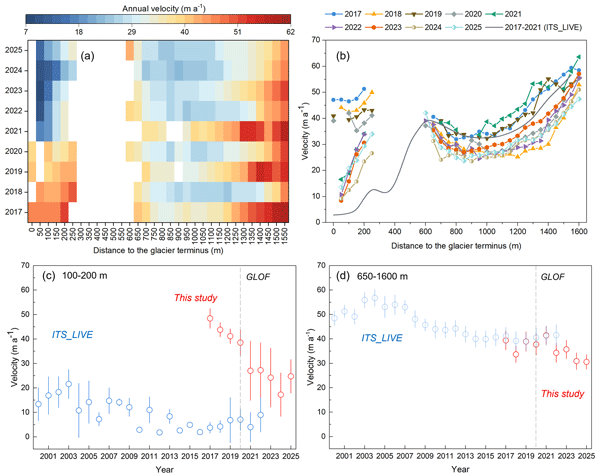
Abstract. Glacier–proglacial lake interactions can accelerate terminus retreat and dynamic thinning of lake-terminating glaciers. However, glacier responses to abrupt lake disconnection following glacial lake outburst floods (GLOFs) remain poorly quantified. Here, we investigate changes in surface velocity (2017–2025) and elevation (2002–2025) of Jinwu Glacier (southeast Tibet, China), whose proglacial lake (Jinwuco) drained during a GLOF on 26 June 2020, shifting the glacier from lake- to land-terminating conditions. Rapid lake drainage triggered a pronounced but lagged dynamic response. Ice-flow velocities within 0–200 m of the terminus decreased by ~49 %, from ~40 m a⁻¹ (2017–2020) to ~20 m a⁻¹ (2022–2025). In contrast, velocity reductions in the upstream reach (600–1550 m) were smaller (~14 %). Surface elevation thinning in the terminal 0–550 m section intensified from −2.90 m a⁻¹ during 2002–2014 to −3.71 m a⁻¹ during 2014–2025, whereas surface lowering in the 600–1550 m section slowed from −1.17 to −0.87 m a⁻¹, with a slight surface elevation increase in the topographic transition zone (500–750 m). Following the GLOF, the glacier terminus underwent slight advance and localized ice calving. These patterns suggest a short-lived longitudinal extension at the glacier terminus, followed by a shift toward a more compressive regime in the 500–750 m zone as downstream ice-flux demand weakened. This study provides the first quantitative evidence of glacier dynamic adjustment following a GLOF driven transition from lake- to land-terminating conditions.
-
Notice on discussion status
The requested preprint has a corresponding peer-reviewed final revised paper. You are encouraged to refer to the final revised version.
-
Preprint
(1408 KB)
-
Supplement
(1171 KB)
-
The requested preprint has a corresponding peer-reviewed final revised paper. You are encouraged to refer to the final revised version.
- Preprint
(1408 KB) - Metadata XML
-
Supplement
(1171 KB) - BibTeX
- EndNote
- Final revised paper


Journal article(s) based on this preprint
Interactive discussion
Status: closed
-
RC1: 'Comment on egusphere-2026-1492', Anonymous Referee #1, 12 May 2026
- AC1: 'Reply on RC1', Yunyi Luo, 27 Jun 2026
-
RC2: 'Comment on egusphere-2026-1492', Anonymous Referee #2, 31 May 2026
This work by Luo et al. investigates the changes in Jinwu Glacier following the outburst flood from its proglacial lake, Jinwuco, in June 2020. The authors use the Landsat imagery and ten PlanetScope images to map the lake area and derive glacier velocity. Elevation data from ASTER and other previous studies are also analyzed for potential relationship to the outburst flood. Based on the results, the authors argue that the drainage of Jinwuco has slowed the Jinwu Glacier and altered the ice thinning rate in the ablation zone.
The topic of this study is intriguing, and I think Jinwe Glacier indeed has the potential to showcase the dynamic transition of glacier flow when the flow no longer ends in water. Most of the methods used in this study are classic, which ensures the basic quality of the results. My concerns for this study, however, primarily fall on the interpretation of the results. I think the data presented by the authors cannot adequately support their main argument on the relationship between the Jinwuco drainage and the potential slowdown. Below are the details of my reasoning, along with comments on organization, writing, and other aspects of the manuscript. I have also included some suggested analyses that the authors may consider adding in future revisions or resubmission.
Major comments
- Equation 3 is incorrect. It should be ice speed (m/yr) = displacement (m) * A (days/yr) / N (days). All ice speed measurements in this study need to be revised. Also, please specify the value of A. Is it fixed at 365.25?
- Is there really a slowdown?
- (1) Figure 4(a) shows a very noisy velocity signal at 0-200m from the terminus. The ice speed can vary by >40 m/yr over a 50 m distance along the flowline. I have checked the velocity maps provided in the Zenodo submission (Thank you for doing this! I appreciate it, as I think this enables efficient communication between us), and they also show a spatially inconsistent pattern in the 0-200m zone. This speed variation is too large to be physically plausible. Since it exceeds the NAMD of bedrock velocity by more than 10-fold, this variation is very likely due to incorrect matches by the feature-tracking algorithm (Zheng et al., 2023). With the presence of incorrect matches, any trends at the 0-200m zone are unconvincing to me. The validation described in Section 5.2 does not address this issue either, because, according to Figure S6, only 12 points are arbitrarily chosen in the 0-200m zone for comparison, which likely excludes any mismatched pixels, as suggested by the low RMSE relative to the speed variation described above.
- To investigate and reduce the effects of incorrect matches, I suggest using a small step size (e.g., 1x1 or 2x2 pixels) so that incorrect matches can be identified as pixel clusters, which can then be masked during post-processing. For velocity maps that show serious spatial incoherence (e.g., 2020, 2021, 2022, 2023, and 2024), a possible source of incorrect matches is the drastic change in the terminus area (i.e., decorrelation of the glacier-free surface) due to the continuous decrease in the proglacial lake level. It might be helpful to experiment with different tracking parameters, such as a smaller correlation window (e.g., 30x30 pixels) and a narrower search range (e.g., 20x20 pixels), to reduce the chance of incorrect matches.
- (2) For the 600-1550 m section, the velocity pattern is more spatially coherent than the 0-200 section, but there seems to be no clear deceleration after the outburst event. Based on Figure 4(a), the temporal pattern at this section appears to be more of a biannual fluctuation for unknown reasons, unrelated to the lake outburst. Besides, the authors state, “the mean velocity also decreased from 38.25 ± 9.12 m a⁻¹ during 2017–2021 to 32.87 ± 8.37 m a⁻¹ during 2022–2025, representing a 14% reduction,” but the pair at the nominal year 2021 has the acquisition period between September 2020 and September 2021 (Table S2), which is entirely after the flood event. What if we compare the average for 2017–2020 (before the flood) with that for 2021–2025 (after the flood)? Will the speed change be significant?
- If there is a slowdown, is it really related to the outburst flood?
- (1) Based on the ITS_LIVE data and the PlanetScope velocity maps shown in Figure 4(d), the glacier speed at the 600-1550m section has been constantly decreasing since 2005. This trend seems independent of the 2020 outburst flood event and is consistent with previous findings that glaciers in High Mountain Asia are slowing due to ice thinning (Dehecq et al., 2019). The results presented in the manuscript do not provide sufficient evidence to support proglacial lake drainage as a factor (sole factor or one of many factors) influencing glacier speed, since there is no clear temporal relationship.
- (2) Figure 4(c) also shows a decreasing trend of glacier speed at the 0-200m section based on the ITS_LIVE data, although there is a huge discrepancy between ITS_LIVE and PlanetScope-derived velocity maps. This discrepancy should be further discussed. If ITS_LIVE data can be trusted, then the slowdown can be interpreted the same way above, which is independent of lake drainage. If ITS_LIVE cannot be trusted, what makes the PlanetScope-derived data more reliable? After all, some of the measurements are biased by incorrect matches.
- What caused the lag?
- The supporting evidence for a slowdown after 2021/2022 is weak. In fact, Figure 4(a) and Figure S6 (tie point #6) indicate that a slowdown could take place in 2020 if we only consider the 0-200 m section. A recent paper by Baldacchino et al. (2025) suggests that the frontal dynamic signal can be blocked by an icefall, so there is a reason for not seeing any velocity changes in 2020 at the 600-1550m section. A slowdown with no time lag is physically more convincing than a lagged slowdown since the effective pressure changes immediately when water drains.
- If the authors still prefer a lagged slowdown model, then they should really explain why a lagged slowdown is necessary. After all, a slowdown can be due to many factors, such as glacier thinning, ice temperatures, and changes to subglacial hydrological conditions. It can be irrelevant to lake drainage, and if so, it can take place gradually or abruptly at any time, depending on the driving mechanism.
- Elevation change is not necessarily related to the flood. The authors use three DEMs for the differencing analysis (Section 4.3), but none of them represent the elevation near the time of the outburst event. The 2014-2025 DEM differencing results can include surface mass balance and dynamic signals from both before and after the flood. This has made it difficult to explain anything. With a NAMD of 6.46 m (0.59 m/yr; conventionally in the sense of 1-sigma uncertainty) for the 2014-2025 ASTER DEM differencing (Section 3.3), it is hard to justify the elevation change signals for the zone with neutral changes at 600m, which is interpreted by the authors as an ice bulge due to glacier slowdown.
Are there more elevation data available? If data scarcity is an issue, I would suggest a more conservative argument that the elevation change analysis cannot determine whether the outburst flood affected the ice dynamics. - L214-217 and Figure S4: Questionable arguments. (1) Minowa et al. (2023) do not address anything about Jinwu Glacier. (2) I have no idea what this talks about regarding proglacial lake depth. According to my understanding, Figure S4(a) plots the bathymetry of Jinwuco with terminus positions Jinwu Glacier between 2003 and 2012. As a result, the data plotted in Figure S4(b) must be the velocity data from 2003 to 2012, which cannot be derived from the PlanetScope velocity maps used in this study. Hence, I think this argument, “ice-flow velocity (600-1550m) was significantly positively correlated with lake depth,” is falsified. (3) For Figure S4, I am not sure how a paper published in 2019 (Zhang et al., 2019) contains the data measured after the 2020 GLOF.
The issues above affect the credibility of this study. The authors need to carefully examine the data, citations, and corresponding arguments throughout the paper.
Other specific comments- L31: Can be more specific: “expansion of proglacial lakes.”
- L46-47: This sentence is a bit hard to read. A “retreating glacier” already indicates the retreat is continuous. Consider rewrite.
- L54: How does lake expansion (rather than lake shrinkage) lead to the detachment from the glacier?
- L57: A short-lived perturbation? But the case in Jinwuco shows a persistent detachment, isn’t it?
- L58-60 and L228-230: More details about this previous study are needed in order to make a better context. Is this the only study about the glacier response to the proglacial lake changes? How similar is it to Jinwuco? Was Longbasaba also detached from water during the drainage? Do we expect to see the same behaviors at Jinwuco?
- L80-83: SRTM and RGI data need to be cited. Also, (1) “an elevation range of ~3666 m” does not make sense. (2) “Basin topography is high in the west and low in the east.” (3) Why does a high topographical relief favor the existence of glacial lakes? Or do you just mean “high elevation?”
- L125-127: “In autumn and winter, terrain shadows often obscure large parts of the lower glacier…” and “We therefore mainly selected scenes from September and October to minimize shadow effects” are conflicting ideas and do not make sense.
- L138: NMAD of stable-terrain velocities? I can see how the authors define the stable terrains, but it would be better if they could provide the actual locations where the velocities are used for NMAD. Is Figure S2 something we are looking for?
- L141 and Equation 2: Please avoid using Vx and Vy for displacement components. They should be reserved for velocity components.
- Section 4.1: I do not see a clear relationship between this section and the other parts of the paper. How does the change of lake area over time relate to glacier speed? Besides, some data appear to be identical from Zheng et al. (2021), but there is no corresponding citation in this section. What’s new? Finally, this study focuses on glacier dynamics rather than lake evolution, so why not map changes in terminus position instead of lake area?
- Figure 2: Specify the Landsat mission whenever possible.
- Figure 3: The outburst flood took place in June 2020, but the lake area changed drastically between 2019 and 2020, according to this figure. Please check.
- L188: What do you mean by “ice-cliff morphology progressively degraded?” How much is the terminus advance? (See my comment for Section 4.1)
- L192: “magnitude of deceleration” does not make sense here. Maybe just “ice speed”?
- Figure 4: How do you derive the data (including ice speed and its uncertainty) to be plotted in panels (c) and (d) from panel (a)? This needs to be explained in the methods section. For ITS_LIVE data, it is necessary to indicate what data set you use (annual mosaics or image-pair velocities).
- Figure 5: What is the red dashed line? (Also, see my comment for Section 4.1)
- L201: Should be moved to the Methods section.
- L221-223: The reduction of hydrostatic pressure is immediate when the lake level drops, so it makes no sense for a temporarily maintained extensional flow afterward.
- L227: Since you used “ice calving,” it is necessary to clarify whether the terminus is still connected to any water bodies in 2021. Did this calving affect the terminus position? Is it related to the slight terminus advance in 2021 (Figure 5)?
- L230-235: The topic jumps abruptly from velocity analysis to elevation data within the paragraph without transition. Consider rearranging.
- L247-248: The changes at Jinwu Glacier may always be controlled by the climate forcing, isn’t it? (cf. Fig 4(d) and L230-235). Before making this argument, the authors need to clearly show the velocity/elevation changes caused by the outburst flood with convincing evidence. See my major comments for details.
- L254: GLOFs from moraine-dammed glacial lakes, not moraine-dammed GLOFs.
- L278-281: How is the pairwise RMSE defined? The mean standard deviation of what? What agreement is substantially improved? I can get a rough sense of these quantities, but I think these should be explicitly defined, along with what they are used to assess.
- L293: The thinning near the terminus is robust, but how is it (not) related to the lake drainage? The latter is the main focus of the study, but is skipped here. (See my major comment on the elevation analysis as well.)
- The term “ice-flux demand” repeatedly appears in the manuscript, but what actually is it? It should be defined or explicitly explained.
- L325-327: What is the availability for the PlanetScope images used in this study? Are they open to the public?
ReferencesBaldacchino, F., Zheng, W., Wu, K., Kapitsa, V., Yegorov, A., & Bolch, T. (2025). Investigating seasonal velocity variations of selected glaciers in high mountain asia. Science of Remote Sensing, 12, 100266. https://doi.org/10.1016/j.srs.2025.100266
Dehecq, A., Gourmelen, N., Gardner, A.S. et al. Twenty-first century glacier slowdown driven by mass loss in High Mountain Asia. Nature Geosci 12, 22–27 (2019). https://doi.org/10.1038/s41561-018-0271-9
Zheng, G., Mergili, M., Emmer, A., Allen, S., Bao, A., Guo, H., and Stoffel, M. (2021). The 2020 glacial lake outburst flood at Jinwuco, Tibet: causes, impacts, and implications for hazard and risk assessment, The Cryosphere, 15, 3159–3180, https://doi.org/10.5194/tc-15-3159-2021
Zheng, W., Bhushan, S., VanWyk De Vries, M., Kochtitzky, W., Shean, D., Copland, L., Dow, C., Jones-Ivey, R., & Pérez, F. (2023). GLAcier Feature Tracking testkit (GLAFT): a statistically and physically based framework for evaluating glacier velocity products derived from optical satellite image feature tracking. The Cryosphere, 17(9), 4063–4078. https://doi.org/10.5194/tc-17-4063-2023
Citation: https://doi.org/10.5194/egusphere-2026-1492-RC2 - AC2: 'Reply on RC2', Yunyi Luo, 27 Jun 2026
- Equation 3 is incorrect. It should be ice speed (m/yr) = displacement (m) * A (days/yr) / N (days). All ice speed measurements in this study need to be revised. Also, please specify the value of A. Is it fixed at 365.25?
Peer review completion


Interactive discussion
Status: closed
-
RC1: 'Comment on egusphere-2026-1492', Anonymous Referee #1, 12 May 2026
My referee comment is provided in the attached pdf document.
- AC1: 'Reply on RC1', Yunyi Luo, 27 Jun 2026
-
RC2: 'Comment on egusphere-2026-1492', Anonymous Referee #2, 31 May 2026
This work by Luo et al. investigates the changes in Jinwu Glacier following the outburst flood from its proglacial lake, Jinwuco, in June 2020. The authors use the Landsat imagery and ten PlanetScope images to map the lake area and derive glacier velocity. Elevation data from ASTER and other previous studies are also analyzed for potential relationship to the outburst flood. Based on the results, the authors argue that the drainage of Jinwuco has slowed the Jinwu Glacier and altered the ice thinning rate in the ablation zone.
The topic of this study is intriguing, and I think Jinwe Glacier indeed has the potential to showcase the dynamic transition of glacier flow when the flow no longer ends in water. Most of the methods used in this study are classic, which ensures the basic quality of the results. My concerns for this study, however, primarily fall on the interpretation of the results. I think the data presented by the authors cannot adequately support their main argument on the relationship between the Jinwuco drainage and the potential slowdown. Below are the details of my reasoning, along with comments on organization, writing, and other aspects of the manuscript. I have also included some suggested analyses that the authors may consider adding in future revisions or resubmission.
Major comments
- Equation 3 is incorrect. It should be ice speed (m/yr) = displacement (m) * A (days/yr) / N (days). All ice speed measurements in this study need to be revised. Also, please specify the value of A. Is it fixed at 365.25?
- Is there really a slowdown?
- (1) Figure 4(a) shows a very noisy velocity signal at 0-200m from the terminus. The ice speed can vary by >40 m/yr over a 50 m distance along the flowline. I have checked the velocity maps provided in the Zenodo submission (Thank you for doing this! I appreciate it, as I think this enables efficient communication between us), and they also show a spatially inconsistent pattern in the 0-200m zone. This speed variation is too large to be physically plausible. Since it exceeds the NAMD of bedrock velocity by more than 10-fold, this variation is very likely due to incorrect matches by the feature-tracking algorithm (Zheng et al., 2023). With the presence of incorrect matches, any trends at the 0-200m zone are unconvincing to me. The validation described in Section 5.2 does not address this issue either, because, according to Figure S6, only 12 points are arbitrarily chosen in the 0-200m zone for comparison, which likely excludes any mismatched pixels, as suggested by the low RMSE relative to the speed variation described above.
- To investigate and reduce the effects of incorrect matches, I suggest using a small step size (e.g., 1x1 or 2x2 pixels) so that incorrect matches can be identified as pixel clusters, which can then be masked during post-processing. For velocity maps that show serious spatial incoherence (e.g., 2020, 2021, 2022, 2023, and 2024), a possible source of incorrect matches is the drastic change in the terminus area (i.e., decorrelation of the glacier-free surface) due to the continuous decrease in the proglacial lake level. It might be helpful to experiment with different tracking parameters, such as a smaller correlation window (e.g., 30x30 pixels) and a narrower search range (e.g., 20x20 pixels), to reduce the chance of incorrect matches.
- (2) For the 600-1550 m section, the velocity pattern is more spatially coherent than the 0-200 section, but there seems to be no clear deceleration after the outburst event. Based on Figure 4(a), the temporal pattern at this section appears to be more of a biannual fluctuation for unknown reasons, unrelated to the lake outburst. Besides, the authors state, “the mean velocity also decreased from 38.25 ± 9.12 m a⁻¹ during 2017–2021 to 32.87 ± 8.37 m a⁻¹ during 2022–2025, representing a 14% reduction,” but the pair at the nominal year 2021 has the acquisition period between September 2020 and September 2021 (Table S2), which is entirely after the flood event. What if we compare the average for 2017–2020 (before the flood) with that for 2021–2025 (after the flood)? Will the speed change be significant?
- If there is a slowdown, is it really related to the outburst flood?
- (1) Based on the ITS_LIVE data and the PlanetScope velocity maps shown in Figure 4(d), the glacier speed at the 600-1550m section has been constantly decreasing since 2005. This trend seems independent of the 2020 outburst flood event and is consistent with previous findings that glaciers in High Mountain Asia are slowing due to ice thinning (Dehecq et al., 2019). The results presented in the manuscript do not provide sufficient evidence to support proglacial lake drainage as a factor (sole factor or one of many factors) influencing glacier speed, since there is no clear temporal relationship.
- (2) Figure 4(c) also shows a decreasing trend of glacier speed at the 0-200m section based on the ITS_LIVE data, although there is a huge discrepancy between ITS_LIVE and PlanetScope-derived velocity maps. This discrepancy should be further discussed. If ITS_LIVE data can be trusted, then the slowdown can be interpreted the same way above, which is independent of lake drainage. If ITS_LIVE cannot be trusted, what makes the PlanetScope-derived data more reliable? After all, some of the measurements are biased by incorrect matches.
- What caused the lag?
- The supporting evidence for a slowdown after 2021/2022 is weak. In fact, Figure 4(a) and Figure S6 (tie point #6) indicate that a slowdown could take place in 2020 if we only consider the 0-200 m section. A recent paper by Baldacchino et al. (2025) suggests that the frontal dynamic signal can be blocked by an icefall, so there is a reason for not seeing any velocity changes in 2020 at the 600-1550m section. A slowdown with no time lag is physically more convincing than a lagged slowdown since the effective pressure changes immediately when water drains.
- If the authors still prefer a lagged slowdown model, then they should really explain why a lagged slowdown is necessary. After all, a slowdown can be due to many factors, such as glacier thinning, ice temperatures, and changes to subglacial hydrological conditions. It can be irrelevant to lake drainage, and if so, it can take place gradually or abruptly at any time, depending on the driving mechanism.
- Elevation change is not necessarily related to the flood. The authors use three DEMs for the differencing analysis (Section 4.3), but none of them represent the elevation near the time of the outburst event. The 2014-2025 DEM differencing results can include surface mass balance and dynamic signals from both before and after the flood. This has made it difficult to explain anything. With a NAMD of 6.46 m (0.59 m/yr; conventionally in the sense of 1-sigma uncertainty) for the 2014-2025 ASTER DEM differencing (Section 3.3), it is hard to justify the elevation change signals for the zone with neutral changes at 600m, which is interpreted by the authors as an ice bulge due to glacier slowdown.
Are there more elevation data available? If data scarcity is an issue, I would suggest a more conservative argument that the elevation change analysis cannot determine whether the outburst flood affected the ice dynamics. - L214-217 and Figure S4: Questionable arguments. (1) Minowa et al. (2023) do not address anything about Jinwu Glacier. (2) I have no idea what this talks about regarding proglacial lake depth. According to my understanding, Figure S4(a) plots the bathymetry of Jinwuco with terminus positions Jinwu Glacier between 2003 and 2012. As a result, the data plotted in Figure S4(b) must be the velocity data from 2003 to 2012, which cannot be derived from the PlanetScope velocity maps used in this study. Hence, I think this argument, “ice-flow velocity (600-1550m) was significantly positively correlated with lake depth,” is falsified. (3) For Figure S4, I am not sure how a paper published in 2019 (Zhang et al., 2019) contains the data measured after the 2020 GLOF.
The issues above affect the credibility of this study. The authors need to carefully examine the data, citations, and corresponding arguments throughout the paper.
Other specific comments- L31: Can be more specific: “expansion of proglacial lakes.”
- L46-47: This sentence is a bit hard to read. A “retreating glacier” already indicates the retreat is continuous. Consider rewrite.
- L54: How does lake expansion (rather than lake shrinkage) lead to the detachment from the glacier?
- L57: A short-lived perturbation? But the case in Jinwuco shows a persistent detachment, isn’t it?
- L58-60 and L228-230: More details about this previous study are needed in order to make a better context. Is this the only study about the glacier response to the proglacial lake changes? How similar is it to Jinwuco? Was Longbasaba also detached from water during the drainage? Do we expect to see the same behaviors at Jinwuco?
- L80-83: SRTM and RGI data need to be cited. Also, (1) “an elevation range of ~3666 m” does not make sense. (2) “Basin topography is high in the west and low in the east.” (3) Why does a high topographical relief favor the existence of glacial lakes? Or do you just mean “high elevation?”
- L125-127: “In autumn and winter, terrain shadows often obscure large parts of the lower glacier…” and “We therefore mainly selected scenes from September and October to minimize shadow effects” are conflicting ideas and do not make sense.
- L138: NMAD of stable-terrain velocities? I can see how the authors define the stable terrains, but it would be better if they could provide the actual locations where the velocities are used for NMAD. Is Figure S2 something we are looking for?
- L141 and Equation 2: Please avoid using Vx and Vy for displacement components. They should be reserved for velocity components.
- Section 4.1: I do not see a clear relationship between this section and the other parts of the paper. How does the change of lake area over time relate to glacier speed? Besides, some data appear to be identical from Zheng et al. (2021), but there is no corresponding citation in this section. What’s new? Finally, this study focuses on glacier dynamics rather than lake evolution, so why not map changes in terminus position instead of lake area?
- Figure 2: Specify the Landsat mission whenever possible.
- Figure 3: The outburst flood took place in June 2020, but the lake area changed drastically between 2019 and 2020, according to this figure. Please check.
- L188: What do you mean by “ice-cliff morphology progressively degraded?” How much is the terminus advance? (See my comment for Section 4.1)
- L192: “magnitude of deceleration” does not make sense here. Maybe just “ice speed”?
- Figure 4: How do you derive the data (including ice speed and its uncertainty) to be plotted in panels (c) and (d) from panel (a)? This needs to be explained in the methods section. For ITS_LIVE data, it is necessary to indicate what data set you use (annual mosaics or image-pair velocities).
- Figure 5: What is the red dashed line? (Also, see my comment for Section 4.1)
- L201: Should be moved to the Methods section.
- L221-223: The reduction of hydrostatic pressure is immediate when the lake level drops, so it makes no sense for a temporarily maintained extensional flow afterward.
- L227: Since you used “ice calving,” it is necessary to clarify whether the terminus is still connected to any water bodies in 2021. Did this calving affect the terminus position? Is it related to the slight terminus advance in 2021 (Figure 5)?
- L230-235: The topic jumps abruptly from velocity analysis to elevation data within the paragraph without transition. Consider rearranging.
- L247-248: The changes at Jinwu Glacier may always be controlled by the climate forcing, isn’t it? (cf. Fig 4(d) and L230-235). Before making this argument, the authors need to clearly show the velocity/elevation changes caused by the outburst flood with convincing evidence. See my major comments for details.
- L254: GLOFs from moraine-dammed glacial lakes, not moraine-dammed GLOFs.
- L278-281: How is the pairwise RMSE defined? The mean standard deviation of what? What agreement is substantially improved? I can get a rough sense of these quantities, but I think these should be explicitly defined, along with what they are used to assess.
- L293: The thinning near the terminus is robust, but how is it (not) related to the lake drainage? The latter is the main focus of the study, but is skipped here. (See my major comment on the elevation analysis as well.)
- The term “ice-flux demand” repeatedly appears in the manuscript, but what actually is it? It should be defined or explicitly explained.
- L325-327: What is the availability for the PlanetScope images used in this study? Are they open to the public?
ReferencesBaldacchino, F., Zheng, W., Wu, K., Kapitsa, V., Yegorov, A., & Bolch, T. (2025). Investigating seasonal velocity variations of selected glaciers in high mountain asia. Science of Remote Sensing, 12, 100266. https://doi.org/10.1016/j.srs.2025.100266
Dehecq, A., Gourmelen, N., Gardner, A.S. et al. Twenty-first century glacier slowdown driven by mass loss in High Mountain Asia. Nature Geosci 12, 22–27 (2019). https://doi.org/10.1038/s41561-018-0271-9
Zheng, G., Mergili, M., Emmer, A., Allen, S., Bao, A., Guo, H., and Stoffel, M. (2021). The 2020 glacial lake outburst flood at Jinwuco, Tibet: causes, impacts, and implications for hazard and risk assessment, The Cryosphere, 15, 3159–3180, https://doi.org/10.5194/tc-15-3159-2021
Zheng, W., Bhushan, S., VanWyk De Vries, M., Kochtitzky, W., Shean, D., Copland, L., Dow, C., Jones-Ivey, R., & Pérez, F. (2023). GLAcier Feature Tracking testkit (GLAFT): a statistically and physically based framework for evaluating glacier velocity products derived from optical satellite image feature tracking. The Cryosphere, 17(9), 4063–4078. https://doi.org/10.5194/tc-17-4063-2023
Citation: https://doi.org/10.5194/egusphere-2026-1492-RC2 - AC2: 'Reply on RC2', Yunyi Luo, 27 Jun 2026
- Equation 3 is incorrect. It should be ice speed (m/yr) = displacement (m) * A (days/yr) / N (days). All ice speed measurements in this study need to be revised. Also, please specify the value of A. Is it fixed at 365.25?
Peer review completion
Journal article(s) based on this preprint
Viewed
| HTML | XML | Total | Supplement | BibTeX | EndNote | |
|---|---|---|---|---|---|---|
| 407 | 140 | 50 | 597 | 85 | 39 | 38 |
- HTML: 407
- PDF: 140
- XML: 50
- Total: 597
- Supplement: 85
- BibTeX: 39
- EndNote: 38
Viewed (geographical distribution)
| Country | # | Views | % |
|---|
| Total: | 0 |
| HTML: | 0 |
| PDF: | 0 |
| XML: | 0 |
- 1
Yunyi Luo

Yin Fu
Xueyuan Lu
Yongsheng Yin
Jiawei Yang
Guoxiong Zheng
Xuyang Lu
The requested preprint has a corresponding peer-reviewed final revised paper. You are encouraged to refer to the final revised version.
- Preprint
(1408 KB) - Metadata XML
-
Supplement
(1171 KB) - BibTeX
- EndNote
- Final revised paper
My referee comment is provided in the attached pdf document.