
the Creative Commons Attribution 4.0 License.
the Creative Commons Attribution 4.0 License.
 | 26 Mar 2026
Validation of EarthCARE/ATLID aerosol profiling products with ground-based PollyNET lidars – case studies
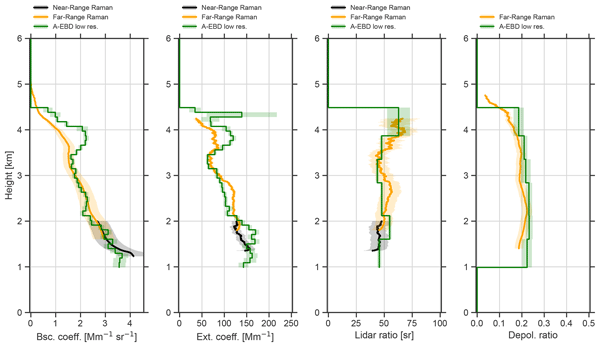
Abstract. The satellite mission EarthCARE (Earth Cloud, Aerosol, and Radiation Explorer) of the European Space Agency (ESA) and the Japan Aerospace Exploration Agency (JAXA) was successfully launched in May 2024. The satellite has four instruments on board, namely a high-spectral-resolution lidar called ATLID, a Cloud Profiling Doppler Radar (CPR), a Multi-Spectral Imager (MSI), and a Broad-Band Radiometer (BBR). ATLID provides for the first time directly measured profiles of the extinction and backscatter coefficient (and thus lidar ratio) together with the depolarization ratio at 355 nm from space. Since the start of the measurements, several updates in the ESA’s processing chain have been made resulting in different base-lines of the products. A first homogenized data set for the entire mission duration processed with one algorithm version, namely Baseline BA, was accomplished in September 2025. We used ground-based multiwavelength-Raman-polarization lidars of PollyNET operating in the framework of the Aerosol, Clouds and Trace gases Research Infrastructure (ACTRIS) to discuss the quality of ATLID profiling products based on golden case studies. The PollyNET lidars measure the same geophysical parameter as EarthCARE, namely profiles of the particle backscatter coefficient, the particle extinction coefficient, and the particle linear depolarization ratio at 355 nm. Seven dedicated cases, for which EarthCARE and the ground-based reference system observed the same atmospheric scene, were selected, spanning several atmospheric conditions (ice clouds, high aerosol load, pristine conditions) and geographic locations (Tropical Atlantic, Europe, Central Asia, and the pristine Southern Hemisphere). Our investigations revealed that ATLID has remarkable profiling capabilities with good signal strength and high vertical resolution. The ATLID profiling product of ESA’s processing chain, A-EBD, could resolve the vertical structure of the targeted atmospheric features very well so that the A-EBD backscatter and extinction profiles (at low resolution) matched qualitatively (and mostly quantitatively) with the ground-based reference observations for most investigated atmospheric conditions. The intensive particle quantity lidar ratio is retrieved layer-wise and thus not in the same resolution as the backscatter and extinction products. It matches in many cases with the ground-based reference, but we also detected occasions when the lidar ratio in certain atmospheric regions was significantly deviating from the reference, which also then affects either the extinction or backscatter coefficient values. Especially edge effects at the transition of particle layers to clean air seem to be problematic. Concerning ATLID’s depolarization ratio, fair agreement was found for strongly scattering and depolarizing features, like ice clouds – especially during nighttime. For the aerosol regime, however, we confirm significant deviations from the ground reference and consider the depolarization ratio in Baselines BA and BB as quantitatively not reliable, especially during daytime. Thus, ATLID’s depolarization ratio of Baselines B can be used to discriminate but not to type atmospheric features.
In conclusion, we can state that ATLID’s optical profiles of Baselines B are ready for scientific exploitation keeping in mind the reported drawbacks (e.g., depolarization ratio offsets, edge effects, occasional retrieval errors, non-complete quality flags). EarthCARE data should therefore be intensively quality checked before using for scientific studies. As EarthCARE’s lifetime was recently foreseen to last for more than 10 years and algorithm development continues, such validation efforts stay important and complement other respective validation approaches.
Competing interests: At least one of the (co-)authors is a member of the editorial board of Atmospheric Measurement Techniques.
Publisher's note: Copernicus Publications remains neutral with regard to jurisdictional claims made in the text, published maps, institutional affiliations, or any other geographical representation in this paper. While Copernicus Publications makes every effort to include appropriate place names, the final responsibility lies with the authors. Views expressed in the text are those of the authors and do not necessarily reflect the views of the publisher.-
Notice on discussion status
The requested preprint has a corresponding peer-reviewed final revised paper. You are encouraged to refer to the final revised version.
-
Preprint
(14643 KB)
-
The requested preprint has a corresponding peer-reviewed final revised paper. You are encouraged to refer to the final revised version.
- Preprint
(14643 KB) - Metadata XML
- BibTeX
- EndNote
- Final revised paper


Journal article(s) based on this preprint
Interactive discussion
Status: closed
-
RC1: 'Comment on egusphere-2026-1490', Anonymous Referee #1, 27 Apr 2026
-
AC1: 'Reply on RC1', Holger Baars, 14 May 2026
We sincerely thank both reviewers for their time and effort to review the current manuscript and for their helpful comments! Please find below a detailed answer to your comments. The reviewers’ comments are highlighted in italic, while our response is in normal font. For a detailed response, please see the attached pdf.
-
AC1: 'Reply on RC1', Holger Baars, 14 May 2026
-
RC2: 'Comment on egusphere-2026-1490', Anonymous Referee #2, 30 Apr 2026
This paper provides a detailed discussion of the results of ground-based/ship-borne validation of the ESA aerosol product derived from EarthCARE satellite-borne lidar data. The validation process demonstrates meticulous and sophisticated planning, including the selection of datasets that account for the horizontal heterogeneity of the target aerosols and the incorporation of various aerosol scenarios. Furthermore, the paper not only demonstrates the validity of the product but also discusses remaining challenges, providing valuable information and insights for aerosol science using EarthCARE data. The writing is extremely thorough and clear, the figures and tables are appropriate, and it is a well-written paper. For the reasons stated above, this reviewer recommends the publication of this paper in AMT. While no major revisions are required, I would like the authors to revise the paper taking into account the points listed below.
- Although the text is written in a clear manner, I feel that the key points of this paper—such as its findings—become less clear as I read on. This paper selects seven aerosol cases. For each case, it describes the atmospheric and aerosol conditions, the differences in optical properties between satellite and ground-based data, findings, suggestions, and conclusion. The underlying issue may be not only the large number of cases—seven in total—but also the substantial amount of information provided for each one (and the writing may be somewhat redundant). Furthermore, it may be difficult to recall the details of a previous case while reading about a new one. Therefore, it would be very helpful to have a table summarizing the key points (observation area and period, what type of aerosol case it is, whether the optical properties between satellite and ground observations are consistent, what findings were identified—e.g., edge effects) corresponding to Section 3 for the seven cases.
- Conclusion: It would be very helpful if you could emphasize the description of the findings. For example, you could elaborate on the findings, stating something like, “The findings of this paper are as follows.”
- While many descriptions of the differences in optical properties between satellites and ground-based measurements tend to “overestimate” or “underestimate” these differences, it would be helpful if the actual magnitude of the difference (relative or absolute error) were specified in specific instances.
- P6 L163: AM-COL (Haarig et al., 2023), ACM-CAP (Mason et al., 2023) : A brief explanation of the synergy with which sensor (MSI?, CPR?, both?) would aid the reader's understanding.
- P10 L279: 100 km vertical smoothing => 100km horizontal smoothing?
- P13 Fig5: No description on NR
- P23 L443: Above the aerosol layers, ice clouds were observed at around 7.5 and 11.5 km: Is the 11.5 km layer a cloud? It appears to have a very high lider ratio (~80sr ?). Could it be an aerosol in some areas?
- P33 L565: hardly revealing the horizontally heterogeneous atmospheric state.: At this point, I think a bit more explanation is needed as to why this is stated in this way. Some persons may suggest that while high-resolution products (right figure) are indeed noisier than low-resolution products (left figure), their horizontal structure appears to be similar to that of low-resolution products.
Citation: https://doi.org/10.5194/egusphere-2026-1490-RC2 -
AC2: 'Reply on RC2', Holger Baars, 14 May 2026
We sincerely thank both reviewers for their time and effort to review the current manuscript and for their helpful comments! Please find below a detailed answer to your comments. The reviewers’ comments are highlighted in italic, while our response is in normal font. For a detailed response, please see the attached pdf.
Peer review completion


Interactive discussion
Status: closed
-
RC1: 'Comment on egusphere-2026-1490', Anonymous Referee #1, 27 Apr 2026
(general comments)
This paper is the first well-organized study on the validation of ATLID using ground-based lidar, and it serves as an extremely valuable report for both ATLID users and algorithm developers. It evaluates ATLID products using reliable ground-based lidar systems at locations scattered around the world for various types of aerosols. The text is clear and easy to read, and the figures are of high quality. While I believe this paper is nearly ready for publication, some technical corrections and few additional explanations are needed, so I consider minor revisions to be necessary.
(specific comments)
- Please clarify whether, for all selected cases, the profile closest to the ground site was used, or whether, in some cases, the profiles were averaged. For example, line 89 states “all but one within 20 km,” which I interpreted to mean that all profiles within 20 km were used; however, as noted in line 357, Fig. 9 states that the closest product was used.
- Regarding lines 416–417, it states, “Dedicated investigations have shown...”; if there is a reference, please include it.
(technical corrections)
- Line 254: It says 14.4 N, but based on Fig. 3, isn’t 14.1 N correct?
- Line 278: Regarding “100 km vertical smoothing,” isn’t this a typo for “horizontal”?
- Line 399: Since “ore” is a proper noun, it should be written as “Ore.”
- Line 573: “)” is missing in “(see Fig. 19”.
Citation: https://doi.org/10.5194/egusphere-2026-1490-RC1 -
AC1: 'Reply on RC1', Holger Baars, 14 May 2026
We sincerely thank both reviewers for their time and effort to review the current manuscript and for their helpful comments! Please find below a detailed answer to your comments. The reviewers’ comments are highlighted in italic, while our response is in normal font. For a detailed response, please see the attached pdf.
-
RC2: 'Comment on egusphere-2026-1490', Anonymous Referee #2, 30 Apr 2026
This paper provides a detailed discussion of the results of ground-based/ship-borne validation of the ESA aerosol product derived from EarthCARE satellite-borne lidar data. The validation process demonstrates meticulous and sophisticated planning, including the selection of datasets that account for the horizontal heterogeneity of the target aerosols and the incorporation of various aerosol scenarios. Furthermore, the paper not only demonstrates the validity of the product but also discusses remaining challenges, providing valuable information and insights for aerosol science using EarthCARE data. The writing is extremely thorough and clear, the figures and tables are appropriate, and it is a well-written paper. For the reasons stated above, this reviewer recommends the publication of this paper in AMT. While no major revisions are required, I would like the authors to revise the paper taking into account the points listed below.
- Although the text is written in a clear manner, I feel that the key points of this paper—such as its findings—become less clear as I read on. This paper selects seven aerosol cases. For each case, it describes the atmospheric and aerosol conditions, the differences in optical properties between satellite and ground-based data, findings, suggestions, and conclusion. The underlying issue may be not only the large number of cases—seven in total—but also the substantial amount of information provided for each one (and the writing may be somewhat redundant). Furthermore, it may be difficult to recall the details of a previous case while reading about a new one. Therefore, it would be very helpful to have a table summarizing the key points (observation area and period, what type of aerosol case it is, whether the optical properties between satellite and ground observations are consistent, what findings were identified—e.g., edge effects) corresponding to Section 3 for the seven cases.
- Conclusion: It would be very helpful if you could emphasize the description of the findings. For example, you could elaborate on the findings, stating something like, “The findings of this paper are as follows.”
- While many descriptions of the differences in optical properties between satellites and ground-based measurements tend to “overestimate” or “underestimate” these differences, it would be helpful if the actual magnitude of the difference (relative or absolute error) were specified in specific instances.
- P6 L163: AM-COL (Haarig et al., 2023), ACM-CAP (Mason et al., 2023) : A brief explanation of the synergy with which sensor (MSI?, CPR?, both?) would aid the reader's understanding.
- P10 L279: 100 km vertical smoothing => 100km horizontal smoothing?
- P13 Fig5: No description on NR
- P23 L443: Above the aerosol layers, ice clouds were observed at around 7.5 and 11.5 km: Is the 11.5 km layer a cloud? It appears to have a very high lider ratio (~80sr ?). Could it be an aerosol in some areas?
- P33 L565: hardly revealing the horizontally heterogeneous atmospheric state.: At this point, I think a bit more explanation is needed as to why this is stated in this way. Some persons may suggest that while high-resolution products (right figure) are indeed noisier than low-resolution products (left figure), their horizontal structure appears to be similar to that of low-resolution products.
Citation: https://doi.org/10.5194/egusphere-2026-1490-RC2 -
AC2: 'Reply on RC2', Holger Baars, 14 May 2026
We sincerely thank both reviewers for their time and effort to review the current manuscript and for their helpful comments! Please find below a detailed answer to your comments. The reviewers’ comments are highlighted in italic, while our response is in normal font. For a detailed response, please see the attached pdf.
Peer review completion
Journal article(s) based on this preprint
Viewed
| HTML | XML | Total | BibTeX | EndNote | |
|---|---|---|---|---|---|
| 873 | 522 | 65 | 1,460 | 65 | 70 |
- HTML: 873
- PDF: 522
- XML: 65
- Total: 1,460
- BibTeX: 65
- EndNote: 70
Viewed (geographical distribution)
| Country | # | Views | % |
|---|
| Total: | 0 |
| HTML: | 0 |
| PDF: | 0 |
| XML: | 0 |
- 1
Cited



Moritz Haarig
Leonard König
Athena A. Floutsi
Elizaveta Basharova
Julian Hofer
Henriette Gebauer
Ronny Engelmann
Dietrich Althausen
Annett Skupin
Benedikt Gast
Felix Fritzsch
Kevin Ohneiser
Cristofer Jimenez
Tom Gaudek
Martin Radenz
Håvard Buholdt
Birgit Heese
Andi Klamt
Patric Seifert
David P. Donovan
Gerd-Jan van Zadelhoff
Sabur F. Abdullaev
Shohina K. Khalifaeva
Dilovar F. Nozirov
Ulla Wandinger
The requested preprint has a corresponding peer-reviewed final revised paper. You are encouraged to refer to the final revised version.
- Preprint
(14643 KB) - Metadata XML
(general comments)
This paper is the first well-organized study on the validation of ATLID using ground-based lidar, and it serves as an extremely valuable report for both ATLID users and algorithm developers. It evaluates ATLID products using reliable ground-based lidar systems at locations scattered around the world for various types of aerosols. The text is clear and easy to read, and the figures are of high quality. While I believe this paper is nearly ready for publication, some technical corrections and few additional explanations are needed, so I consider minor revisions to be necessary.
(specific comments)
(technical corrections)