
the Creative Commons Attribution 4.0 License.
the Creative Commons Attribution 4.0 License.
 | 27 Apr 2026
Improving the Confidence in Retrievals of Vertical Distributions of Cloud Condensation Nuclei Number Concentration from ARM Supported by Aircraft In Situ Observations
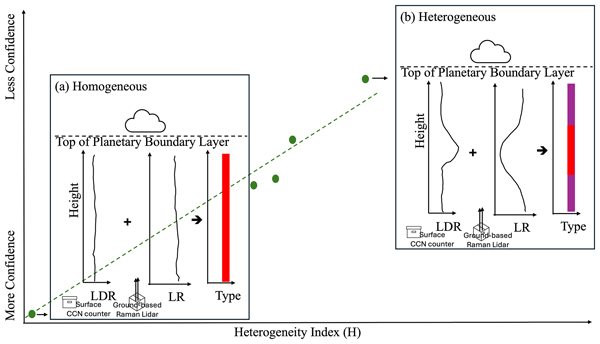
Abstract. Accurate quantification of the vertical distribution of cloud condensation nuclei (CCN) number concentrations is critical for improving our understanding of aerosol–cloud interactions. Ground-based Raman lidars operated by the Atmospheric Radiation Measurement (ARM) program, together with surface CCN measurements, are used to retrieve vertically resolved CCN number concentrations (Retrieved Number concentration of CCN, RNCCN). These retrievals rely on several assumptions, including that aerosol composition is vertically homogeneous. To assess this assumption, we developed and tested a framework to infer the dominant aerosol classes/types at different altitudes. This was done by applying a k-Nearest-Neighbors (kNN) algorithm to lidar ratio and linear depolarization ratio measurements from Raman lidar. We evaluated the framework using aircraft aerosol and CCN measurements from the ARM Holistic Interactions of Shallow Clouds, Aerosols, and Land Ecosystems (HI-SCALE) field campaign. The results show that RNCCN performance degrades as vertical aerosol complexity increases, i.e., RNCCN agrees with the aircraft CCN in vertically homogeneous conditions, but closure decreases in layered aerosol structures. To generalize beyond individual examples, we introduce a metric (heterogeneity index) that quantifies the vertical complexity by assessing the variation of inferred aerosol classes/types. Case-level statistics show a tendency for RNCCN and aircraft differences to increase with this metric. By detecting retrievals that are likely compromised by aerosol vertical heterogeneity, the proposed framework improves the interpretability and effective use of RNCCN used for long-term evaluation of models and aerosol–cloud interactions.
-
Notice on discussion status
The requested preprint has a corresponding peer-reviewed final revised paper. You are encouraged to refer to the final revised version.
-
Preprint
(2201 KB)
-
The requested preprint has a corresponding peer-reviewed final revised paper. You are encouraged to refer to the final revised version.
- Preprint
(2201 KB) - Metadata XML
- BibTeX
- EndNote
- Final revised paper


Journal article(s) based on this preprint
Interactive discussion
Status: closed
-
RC1: 'Comment on egusphere-2026-1432', Anonymous Referee #1, 21 May 2026
-
AC1: 'Reply on RC1', Jingjing Tian, 30 Jun 2026
We sincerely thank the reviewer for their thoughtful comments, constructive suggestions, and the time and effort invested in reviewing our manuscript. We have carefully considered all of the comments and provided our detailed point-by-point responses in the attached PDF.
-
AC1: 'Reply on RC1', Jingjing Tian, 30 Jun 2026
-
RC2: 'Comment on egusphere-2026-1432', Anonymous Referee #2, 29 May 2026
My comments are located in the attached document.
-
AC2: 'Reply on RC2', Jingjing Tian, 30 Jun 2026
We sincerely thank the reviewer for their thoughtful comments, constructive suggestions, and the time and effort invested in reviewing our manuscript. We have carefully considered all of the comments and provided our detailed point-by-point responses in the attached PDF.
-
AC2: 'Reply on RC2', Jingjing Tian, 30 Jun 2026
Peer review completion


Interactive discussion
Status: closed
-
RC1: 'Comment on egusphere-2026-1432', Anonymous Referee #1, 21 May 2026
The paper presents an interesting attempt to estimate CCN concentrations from lidar observations with the support of ground-based in situ CCN observations.
I have only a few point. Minor revisions are needed.
Detailed comments:
P7, l218: kNN is not explained in the main text body, only in the abstract. Thus, please explain the abbreviation here, i.e., mention: k-Nearest Neighbors classifier
P5, Data section
In this section, one should present a simple sketch that provide an overview of the entire data analysis concept. This sketch should include the near-surface in-situ CCN observation (station), a lidar backscatter profile (from the ground up to a cloud base…), a horizontal line indicating the top of the aerosol layer (boundary layer) and a tiny cumulus cloud with cloud base height close to or at the boundary layer top (and the lidar profile ends at cloud base), and maybe even another (varying) vertical line indicating homogeneous aerosol type conditions or slightly varying aerosol-type conditions with height …… In this way the reader would be able to easily understand the entire retrieval concept.
P18, l491: The method is exclusively applicable to PBL clouds? What about CCN estimates in the free troposphere. Should be discussed.
Citation: https://doi.org/10.5194/egusphere-2026-1432-RC1 -
AC1: 'Reply on RC1', Jingjing Tian, 30 Jun 2026
We sincerely thank the reviewer for their thoughtful comments, constructive suggestions, and the time and effort invested in reviewing our manuscript. We have carefully considered all of the comments and provided our detailed point-by-point responses in the attached PDF.
-
AC1: 'Reply on RC1', Jingjing Tian, 30 Jun 2026
-
RC2: 'Comment on egusphere-2026-1432', Anonymous Referee #2, 29 May 2026
My comments are located in the attached document.
-
AC2: 'Reply on RC2', Jingjing Tian, 30 Jun 2026
We sincerely thank the reviewer for their thoughtful comments, constructive suggestions, and the time and effort invested in reviewing our manuscript. We have carefully considered all of the comments and provided our detailed point-by-point responses in the attached PDF.
-
AC2: 'Reply on RC2', Jingjing Tian, 30 Jun 2026
Peer review completion
Journal article(s) based on this preprint
Data sets
RNCCNPROF1KULKARNI value-added product (VAP) G. Kulkarni https://doi.org/10.5439/1813858
DeliAn data A. A. Floutsi et al. https://doi.org/10.5281/zenodo.7751752
Viewed
| HTML | XML | Total | BibTeX | EndNote | |
|---|---|---|---|---|---|
| 359 | 102 | 51 | 512 | 57 | 52 |
- HTML: 359
- PDF: 102
- XML: 51
- Total: 512
- BibTeX: 57
- EndNote: 52
Viewed (geographical distribution)
| Country | # | Views | % |
|---|
| Total: | 0 |
| HTML: | 0 |
| PDF: | 0 |
| XML: | 0 |
- 1
Jingjing Tian

Gourihar Kulkarni
Jennifer M. Comstock
John E. Shilling
Damao Zhang
The requested preprint has a corresponding peer-reviewed final revised paper. You are encouraged to refer to the final revised version.
- Preprint
(2201 KB) - Metadata XML
The paper presents an interesting attempt to estimate CCN concentrations from lidar observations with the support of ground-based in situ CCN observations.
I have only a few point. Minor revisions are needed.
Detailed comments:
P7, l218: kNN is not explained in the main text body, only in the abstract. Thus, please explain the abbreviation here, i.e., mention: k-Nearest Neighbors classifier
P5, Data section
In this section, one should present a simple sketch that provide an overview of the entire data analysis concept. This sketch should include the near-surface in-situ CCN observation (station), a lidar backscatter profile (from the ground up to a cloud base…), a horizontal line indicating the top of the aerosol layer (boundary layer) and a tiny cumulus cloud with cloud base height close to or at the boundary layer top (and the lidar profile ends at cloud base), and maybe even another (varying) vertical line indicating homogeneous aerosol type conditions or slightly varying aerosol-type conditions with height …… In this way the reader would be able to easily understand the entire retrieval concept.
P18, l491: The method is exclusively applicable to PBL clouds? What about CCN estimates in the free troposphere. Should be discussed.