
the Creative Commons Attribution 4.0 License.
the Creative Commons Attribution 4.0 License.
 | 01 Jun 2026
Paleoclimate data assimilation with adaptive observation error inflation and adaptive localization
Abstract. Paleoclimate data assimilation methods significantly enhance the accuracy, spatiotemporal continuity, and global relevance of climate reconstructions by integrating Earth system models with proxy records. In this study, we further improve the algorithm by implementing two adaptive strategies—adaptive observation error inflation and adaptive localization—and systematically evaluate their performance in reconstructing temperature data over equatorial regions. For the adaptive observation error inflation experiments, two distinct methods were employed: the Adaptive observation error inflation (AOEI) method, which yields significant extreme improvements in specific regions but introduces notable local biases, and Huber Robust Estimation (HAOEI) method, which provides more robust and spatially consistent enhancement overall. In the adaptive localization experiments, observational density and correlation data were utilized to adjust the localization radius and weight matrix at each grid point. This approach effectively leverages sparse observational information, reduces spurious teleconnections, accurately reproduces the spatial structure of dominant climate variability modes, and optimizes the overall stability of the analyzed field.
Competing interests: At least one of the (co-)authors is a member of the editorial board of Geoscientific Model Development.
Publisher's note: Copernicus Publications remains neutral with regard to jurisdictional claims made in the text, published maps, institutional affiliations, or any other geographical representation in this paper. While Copernicus Publications makes every effort to include appropriate place names, the final responsibility lies with the authors. Views expressed in the text are those of the authors and do not necessarily reflect the views of the publisher.-
Notice on discussion status
The requested preprint has a corresponding peer-reviewed final revised paper. You are encouraged to refer to the final revised version.
-
Preprint
(3609 KB)
-
The requested preprint has a corresponding peer-reviewed final revised paper. You are encouraged to refer to the final revised version.
- Preprint
(3609 KB) - Metadata XML
- BibTeX
- EndNote
- Final revised paper


Journal article(s) based on this preprint
Interactive discussion
Status: closed
-
RC1: 'Comment on egusphere-2026-1424', Anonymous Referee #1, 08 Jun 2026
- AC1: 'Reply on RC1', Yuefei Zeng, 13 Jul 2026
-
RC2: 'Comment on egusphere-2026-1424', Anonymous Referee #2, 11 Jun 2026
This short study presents two potential improvements in paleoclimate data assimilation: adaptive observation error inflation and adaptive localization. The reasoning to propose those improvements is sound and the description of the methods and results is clear, except in some place as detailed below.
I still have one major concern. While the analyses and figures present relevant quantitative information, the discussion on the interest of the method is mainly qualitative and appears to overstate the impact of the proposed modifications. This should be changed in a revised version. For instance, the abstract and conclusion give no number. My understanding is that the proposed modifications only bring relatively modest improvements, reducing the errors of the order of a few percent only compared to the standard methodology for the majority of the diagnostics proposed. This is a key information for potential users to determine if implementing new methods for localization and error inflation worth the effort compared to other developments. Consequently, I consider that this quantitative information on the magnitude of improvements compared to the standard method should be discussed in more details, comparing the diagnostics to identify where this improvement is small or negligible and quantifying where it is considered more substantial. Some examples are given also below but this is general comments that is applicable for all the sections.
Specific points.
1/ Lines 6-7. As mentioned in the general comment, a qualitative sentence like ‘which yields significant extreme improvements in specific regions but introduces notable local biases, and Huber Robust Estimation (HAOEI) method, which provides more robust and spatially consistent enhancement overall ‘, should be supported by numbers to quantify the improvement. ‘Extremes’ is also too strong seeing the results of the experiments.
2/ Line 30. EnKF has also limitations that could be mentioned briefly
3/ In the method section, I was a bit confused with the usage of the variable x. I guess xf in equation 1 is the state vector (forecast) but it is not mentioned. Then xi is the position in equation 6 and xi,t in equation 10 the value of a variable at position i at time t but there I was lost and do not know the value of which variable.
4/ For section 2.3, maybe add a sketch to illustrate more clearly the method ?
5/ Line 122. It is not clear the standard deviation of what variable.
6/ At the end of page 6, explain what is the cfr framework.
7/ Line 203 ‘superior performance’ is mentioned but, if I see well, the improvement is very small (that would be useful to give percentages for instance). This should be mentioned.
8/ Line 213-214. Again, the differences are small and should be quantified and discussed in the text.
9/ Line 235. Please quantify ‘considerably lower’. Considerably seems too strong from my understanding of the figures.
10/ Line 251. Please quantify ‘robust performance’.
Citation: https://doi.org/10.5194/egusphere-2026-1424-RC2 - AC2: 'Reply on RC2', Yuefei Zeng, 13 Jul 2026
-
RC3: 'Comment on egusphere-2026-1424', Anonymous Referee #3, 01 Jul 2026
The authors developed and applied two adaptive strategies within a paleoclimate data assimilation (PDA) framework. In particular, these two strategies relate to the observation error and to localization. The latter determines the extent to which local records influence remote regions. I found the manuscript interesting, as it proposes adaptive strategies to improve climate reconstructions using PDA. However, in its current form, the manuscript mainly presents these two strategies without drawing clear conclusions regarding their application to PDA frameworks. The evaluation is too limited to clearly quantify the benefits of the two approaches. In addition, by introducing new parameters to be estimated, and therefore increasing the number of degrees of freedom, these strategies also raise the potential issue of overfitting. This issue should be clearly stated, along with possible ways to assess and mitigate it.
In general, the authors should moderate some of their statements regarding the improvement over the standard framework. First, the improvement appears to be modest. Second, part of the improvement may result from overfitting. A more detailed evaluation (for instance focusing on other variables than sea surface temperature) as well as the evaluation of the potential overfitting occurrence are therefore required before robustly claiming that these strategies represent a clear improvement and provide substantial added value.
Specific comments:
The observation error needs to be described more clearly. Some would argue that the observation error cannot be considered as a tune parameter because it relates the uncertainties related to the observations. In a DA framework, I would argue that this error is not only related to the observational uncertainty itself, but also arises from the model-data comparison, as the model does not resolve all the processes that contribute to the proxy signal (in addition to the fact that most of PDA studies might underestimate the observational error in their system).
The chosen values for the threshold parameter δ should be justified.
The introduction of the correlation coefficient at line 133 adds another layer of complexity and uncertainty. In particular, the relationship between two remote regions may vary substantially over time.
It is unclear to me whether the PDA strategies used by the authors are time-dependent. Since the number of proxies varies strongly over time, using a time-dependent strategy would make sense. However, this could also increase the risk of overfitting, as mentioned above.
Citation: https://doi.org/10.5194/egusphere-2026-1424-RC3 - AC3: 'Reply on RC3', Yuefei Zeng, 13 Jul 2026
Peer review completion


Interactive discussion
Status: closed
-
RC1: 'Comment on egusphere-2026-1424', Anonymous Referee #1, 08 Jun 2026
Paleoclimate data assimilation with adaptive observation error inflation and adaptive localization
Luo et al.
This manuscript proposes an adaptive observation error inflation and an adaptive localization for paleoclimate data assimilation. Since paleoclimate has large uncertainties for prior estimates and proxies, it is important to constrain the state by using the proxy information as much as possbile. Thus, covariance inflation and localization are essential components for paleoclimate data assimilation. The manuscript is well written. Please see my specific comments as below.
1. I think a flavor of EnKF is used for proxy data assimilation. Please give a brief introduction of the assimilation method, and how inflation and localization are applied within the assimilation framework.
2. Sections 2.1 and 2.2, compared to AOEI, HAOEI introduces a new parameter delta to scale the inflation, to avoid too aggressive inflation. However, HAOEI needs an empirically determined parameter delta, which adds additional uncertainties.
3. Although I personally can see the purpose of HAOEI, the foundation for HAOEI, or advantages of HAOEI over AOEI, needs more interpretation.
4. Section 2.3, for both localization radius L based on KDE and correlation estimated from time series of variables and proxies, it is unclear why these two techniques are proposed, and why they are superior to GC and other existing adaptive localization methods.
5. Moreover, as in my previous comment, there are empirical parameters introduced here too, as the bandwidth h, Lmin. Then more uncertainties are introduced, and it is hard to generalize the usage of such an adaptive method.
6. Section 3.2.1, the choice of the parameter delta and associated impacts on the assimilation results needs be discussed here.
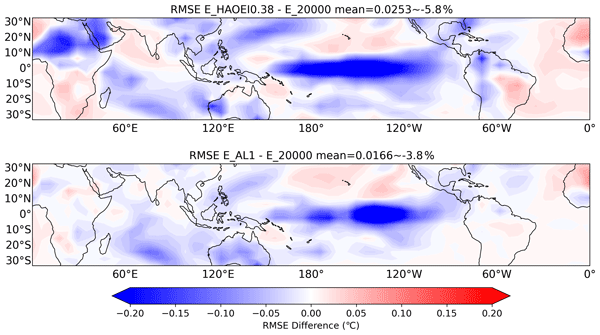
Why the adaptive observation error inflation has impact on the region with large RMSEs around (20N 30E)?
7. Lines 213-216, do you use online or offline ensemble-based data assimilation? If it is offline, how does the imbalance occur?
8. Furthermore, paleoclimate data assimilation is quite different from the convective-scale DA, due to sparse proxies and large uncertainties. Please explain why a small localization lengthscale expected?
Citation: https://doi.org/10.5194/egusphere-2026-1424-RC1 - AC1: 'Reply on RC1', Yuefei Zeng, 13 Jul 2026
-
RC2: 'Comment on egusphere-2026-1424', Anonymous Referee #2, 11 Jun 2026
This short study presents two potential improvements in paleoclimate data assimilation: adaptive observation error inflation and adaptive localization. The reasoning to propose those improvements is sound and the description of the methods and results is clear, except in some place as detailed below.
I still have one major concern. While the analyses and figures present relevant quantitative information, the discussion on the interest of the method is mainly qualitative and appears to overstate the impact of the proposed modifications. This should be changed in a revised version. For instance, the abstract and conclusion give no number. My understanding is that the proposed modifications only bring relatively modest improvements, reducing the errors of the order of a few percent only compared to the standard methodology for the majority of the diagnostics proposed. This is a key information for potential users to determine if implementing new methods for localization and error inflation worth the effort compared to other developments. Consequently, I consider that this quantitative information on the magnitude of improvements compared to the standard method should be discussed in more details, comparing the diagnostics to identify where this improvement is small or negligible and quantifying where it is considered more substantial. Some examples are given also below but this is general comments that is applicable for all the sections.
Specific points.
1/ Lines 6-7. As mentioned in the general comment, a qualitative sentence like ‘which yields significant extreme improvements in specific regions but introduces notable local biases, and Huber Robust Estimation (HAOEI) method, which provides more robust and spatially consistent enhancement overall ‘, should be supported by numbers to quantify the improvement. ‘Extremes’ is also too strong seeing the results of the experiments.
2/ Line 30. EnKF has also limitations that could be mentioned briefly
3/ In the method section, I was a bit confused with the usage of the variable x. I guess xf in equation 1 is the state vector (forecast) but it is not mentioned. Then xi is the position in equation 6 and xi,t in equation 10 the value of a variable at position i at time t but there I was lost and do not know the value of which variable.
4/ For section 2.3, maybe add a sketch to illustrate more clearly the method ?
5/ Line 122. It is not clear the standard deviation of what variable.
6/ At the end of page 6, explain what is the cfr framework.
7/ Line 203 ‘superior performance’ is mentioned but, if I see well, the improvement is very small (that would be useful to give percentages for instance). This should be mentioned.
8/ Line 213-214. Again, the differences are small and should be quantified and discussed in the text.
9/ Line 235. Please quantify ‘considerably lower’. Considerably seems too strong from my understanding of the figures.
10/ Line 251. Please quantify ‘robust performance’.
Citation: https://doi.org/10.5194/egusphere-2026-1424-RC2 - AC2: 'Reply on RC2', Yuefei Zeng, 13 Jul 2026
-
RC3: 'Comment on egusphere-2026-1424', Anonymous Referee #3, 01 Jul 2026
The authors developed and applied two adaptive strategies within a paleoclimate data assimilation (PDA) framework. In particular, these two strategies relate to the observation error and to localization. The latter determines the extent to which local records influence remote regions. I found the manuscript interesting, as it proposes adaptive strategies to improve climate reconstructions using PDA. However, in its current form, the manuscript mainly presents these two strategies without drawing clear conclusions regarding their application to PDA frameworks. The evaluation is too limited to clearly quantify the benefits of the two approaches. In addition, by introducing new parameters to be estimated, and therefore increasing the number of degrees of freedom, these strategies also raise the potential issue of overfitting. This issue should be clearly stated, along with possible ways to assess and mitigate it.
In general, the authors should moderate some of their statements regarding the improvement over the standard framework. First, the improvement appears to be modest. Second, part of the improvement may result from overfitting. A more detailed evaluation (for instance focusing on other variables than sea surface temperature) as well as the evaluation of the potential overfitting occurrence are therefore required before robustly claiming that these strategies represent a clear improvement and provide substantial added value.
Specific comments:
The observation error needs to be described more clearly. Some would argue that the observation error cannot be considered as a tune parameter because it relates the uncertainties related to the observations. In a DA framework, I would argue that this error is not only related to the observational uncertainty itself, but also arises from the model-data comparison, as the model does not resolve all the processes that contribute to the proxy signal (in addition to the fact that most of PDA studies might underestimate the observational error in their system).
The chosen values for the threshold parameter δ should be justified.
The introduction of the correlation coefficient at line 133 adds another layer of complexity and uncertainty. In particular, the relationship between two remote regions may vary substantially over time.
It is unclear to me whether the PDA strategies used by the authors are time-dependent. Since the number of proxies varies strongly over time, using a time-dependent strategy would make sense. However, this could also increase the risk of overfitting, as mentioned above.
Citation: https://doi.org/10.5194/egusphere-2026-1424-RC3 - AC3: 'Reply on RC3', Yuefei Zeng, 13 Jul 2026
Peer review completion
Journal article(s) based on this preprint
Viewed
| HTML | XML | Total | BibTeX | EndNote | |
|---|---|---|---|---|---|
| 249 | 77 | 30 | 356 | 23 | 19 |
- HTML: 249
- PDF: 77
- XML: 30
- Total: 356
- BibTeX: 23
- EndNote: 19
Viewed (geographical distribution)
| Country | # | Views | % |
|---|
| Total: | 0 |
| HTML: | 0 |
| PDF: | 0 |
| XML: | 0 |
- 1
Ge Luo

Jiuwei Zhao
The requested preprint has a corresponding peer-reviewed final revised paper. You are encouraged to refer to the final revised version.
- Preprint
(3609 KB) - Metadata XML
Paleoclimate data assimilation with adaptive observation error inflation and adaptive localization
Luo et al.
This manuscript proposes an adaptive observation error inflation and an adaptive localization for paleoclimate data assimilation. Since paleoclimate has large uncertainties for prior estimates and proxies, it is important to constrain the state by using the proxy information as much as possbile. Thus, covariance inflation and localization are essential components for paleoclimate data assimilation. The manuscript is well written. Please see my specific comments as below.
1. I think a flavor of EnKF is used for proxy data assimilation. Please give a brief introduction of the assimilation method, and how inflation and localization are applied within the assimilation framework.
2. Sections 2.1 and 2.2, compared to AOEI, HAOEI introduces a new parameter delta to scale the inflation, to avoid too aggressive inflation. However, HAOEI needs an empirically determined parameter delta, which adds additional uncertainties.
3. Although I personally can see the purpose of HAOEI, the foundation for HAOEI, or advantages of HAOEI over AOEI, needs more interpretation.
4. Section 2.3, for both localization radius L based on KDE and correlation estimated from time series of variables and proxies, it is unclear why these two techniques are proposed, and why they are superior to GC and other existing adaptive localization methods.
5. Moreover, as in my previous comment, there are empirical parameters introduced here too, as the bandwidth h, Lmin. Then more uncertainties are introduced, and it is hard to generalize the usage of such an adaptive method.
6. Section 3.2.1, the choice of the parameter delta and associated impacts on the assimilation results needs be discussed here.
Why the adaptive observation error inflation has impact on the region with large RMSEs around (20N 30E)?
7. Lines 213-216, do you use online or offline ensemble-based data assimilation? If it is offline, how does the imbalance occur?
8. Furthermore, paleoclimate data assimilation is quite different from the convective-scale DA, due to sparse proxies and large uncertainties. Please explain why a small localization lengthscale expected?