
the Creative Commons Attribution 4.0 License.
the Creative Commons Attribution 4.0 License.
 | 24 Mar 2026
Advancing the Capabilities for Efficient Hurricane-Centric Simulations with the Atmospheric Model ICON
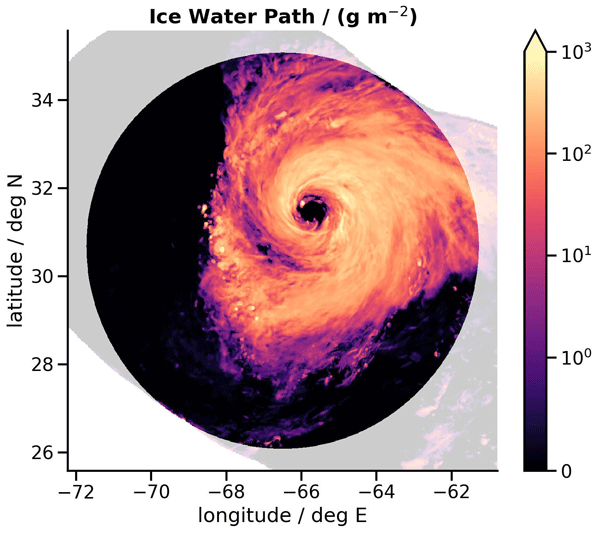
Abstract. Global storm-resolving simulations with kilometer resolution are increasingly replacing traditional climate modeling approaches and show particular potential for resolving the dynamics and effects of deep moist convection. These modern modeling methods are moving toward sub-km scales, leading to extremely high energy and resource requirements. This makes iterations, parameter optimizations, and sensitivity studies no longer easily feasible. For the class of propagating, large-scale weather phenomena such as hurricanes, high-resolution limited-area approaches in combination with Lagrangian methods are therefore of interest, in which refined grids are shifted along the path of the phenomenon under consideration. To create this capacity for the ICON atmospheric model, this study develops a flexible workflow toolkit to enable efficient simulations of tropical cyclones on a sub-km scale. Our approach leverages the flexibility that ICON offers through the ability to create custom grids. The concept divides hurricane tracks into overlapping temporal windows of 12–24 hours and generates customized grid segments that follow the hurricane's movement. The technical implementation automates key components of the workflow, including hurricane tracking, flexible grid generation, and preparation and merging of initial conditions across successive segments. The application of the workflow is demonstrated using Hurricane Paulette (2020) as an example, for which high-resolution simulations with grid spacings down to 300 m were performed using different segment configurations. The results show that the hurricane track remains consistent with the base run and depends mainly on the across-track width of the chosen configuration, while intensity metrics such as minimum pressure and maximum wind speed show significant sensitivities to resolution in our multi-nested setups. The efficiency gains are significant compared to traditional approaches with fixed limited-area domains: The hurricane-centric method reduces resource requirements by factors of 13–175, depending on the area configuration. Analysis of spin-up effects shows systematic but manageable impacts during segment transitions. Nevertheless, the efficiency gains achieved by our method are so substantial that they justify the acceptance of the spin-up effects. Our segment-based approach in the hurricane-centric reference system now allows for more flexible regional hurricane simulations with the ICON model and more efficient investigation of new research questions regarding the sensitivity of hurricane cloud systems at very high resolutions.
-
Notice on discussion status
The requested preprint has a corresponding peer-reviewed final revised paper. You are encouraged to refer to the final revised version.
-
Preprint
(5308 KB)
-
The requested preprint has a corresponding peer-reviewed final revised paper. You are encouraged to refer to the final revised version.
- Preprint
(5308 KB) - Metadata XML
- BibTeX
- EndNote
- Final revised paper


Journal article(s) based on this preprint
Interactive discussion
Status: closed
-
RC1: 'Comment on egusphere-2026-1412', Nadja Omanovic, 31 Mar 2026
The comment was uploaded in the form of a supplement: https://egusphere.copernicus.org/preprints/2026/egusphere-2026-1412/egusphere-2026-1412-RC1-supplement.pdfCitation: https://doi.org/
10.5194/egusphere-2026-1412-RC1 -
AC1: 'Reply on RC1', Fabian Senf, 03 Jul 2026
Dear Reviewer,Thank you for the thorough and constructive evaluation of our manuscript. We have carefully considered each of your comments and have revised the manuscript accordingly.In order to facilitate the review of the changes, we attached the following supplemental documents (appended into one single PDF file):- Point‑by‑point response letter – a detailed reply to every comment raised, indicating how the manuscript has been modified or providing justification when no change was made.- a PDF that highlights only the newly added material (e.g., new sections, tables, or figures) introduced during this revision.- a PDF in which all textual and figure modifications relative to the original submission are highlighted.We trust that these documents will make it straightforward to assess the extent of the revisions and to verify that each of your concerns has been addressed. Should any further clarification be required, we stand ready to provide additional information.Thank you again for your valuable feedback, which has substantially improved the quality of our work. We look forward to your continued assessment.Sincerely,Fabian Senf
-
AC1: 'Reply on RC1', Fabian Senf, 03 Jul 2026
-
RC2: 'Comment on egusphere-2026-1412', Anonymous Referee #2, 27 Apr 2026
The comment was uploaded in the form of a supplement: https://egusphere.copernicus.org/preprints/2026/egusphere-2026-1412/egusphere-2026-1412-RC2-supplement.pdf
-
AC2: 'Reply on RC2', Fabian Senf, 03 Jul 2026
Dear Reviewer,Thank you for the thorough and constructive evaluation of our manuscript. We have carefully considered each of your comments and have revised the manuscript accordingly.In order to facilitate the review of the changes, we attached the following supplemental documents (appended into one single PDF file):- Point‑by‑point response letter – a detailed reply to every comment raised, indicating how the manuscript has been modified or providing justification when no change was made.- a PDF that highlights only the newly added material (e.g., new sections, tables, or figures) introduced during this revision.- a PDF in which all textual and figure modifications relative to the original submission are highlighted.We trust that these documents will make it straightforward to assess the extent of the revisions and to verify that each of your concerns has been addressed. Should any further clarification be required, we stand ready to provide additional information.Thank you again for your valuable feedback, which has substantially improved the quality of our work. We look forward to your continued assessment.Sincerely,Fabian Senf
-
AC2: 'Reply on RC2', Fabian Senf, 03 Jul 2026
-
RC3: 'Comment on egusphere-2026-1412', Anonymous Referee #3, 01 May 2026
Dear authors, please find my comments in the attached PDF.
-
AC3: 'Reply on RC3', Fabian Senf, 03 Jul 2026
Dear Reviewer,Thank you for the thorough and constructive evaluation of our manuscript. We have carefully considered each of your comments and have revised the manuscript accordingly.In order to facilitate the review of the changes, we attached the following supplemental documents (appended into one single PDF file):- Point‑by‑point response letter – a detailed reply to every comment raised, indicating how the manuscript has been modified or providing justification when no change was made.- a PDF that highlights only the newly added material (e.g., new sections, tables, or figures) introduced during this revision.- a PDF in which all textual and figure modifications relative to the original submission are highlighted.We trust that these documents will make it straightforward to assess the extent of the revisions and to verify that each of your concerns has been addressed. Should any further clarification be required, we stand ready to provide additional information.Thank you again for your valuable feedback, which has substantially improved the quality of our work. We look forward to your continued assessment.Sincerely,Fabian Senf
-
AC3: 'Reply on RC3', Fabian Senf, 03 Jul 2026
Peer review completion


Interactive discussion
Status: closed
-
RC1: 'Comment on egusphere-2026-1412', Nadja Omanovic, 31 Mar 2026
The comment was uploaded in the form of a supplement: https://egusphere.copernicus.org/preprints/2026/egusphere-2026-1412/egusphere-2026-1412-RC1-supplement.pdf
-
AC1: 'Reply on RC1', Fabian Senf, 03 Jul 2026
Dear Reviewer,Thank you for the thorough and constructive evaluation of our manuscript. We have carefully considered each of your comments and have revised the manuscript accordingly.In order to facilitate the review of the changes, we attached the following supplemental documents (appended into one single PDF file):- Point‑by‑point response letter – a detailed reply to every comment raised, indicating how the manuscript has been modified or providing justification when no change was made.- a PDF that highlights only the newly added material (e.g., new sections, tables, or figures) introduced during this revision.- a PDF in which all textual and figure modifications relative to the original submission are highlighted.We trust that these documents will make it straightforward to assess the extent of the revisions and to verify that each of your concerns has been addressed. Should any further clarification be required, we stand ready to provide additional information.Thank you again for your valuable feedback, which has substantially improved the quality of our work. We look forward to your continued assessment.Sincerely,Fabian Senf
-
AC1: 'Reply on RC1', Fabian Senf, 03 Jul 2026
-
RC2: 'Comment on egusphere-2026-1412', Anonymous Referee #2, 27 Apr 2026
The comment was uploaded in the form of a supplement: https://egusphere.copernicus.org/preprints/2026/egusphere-2026-1412/egusphere-2026-1412-RC2-supplement.pdf
-
AC2: 'Reply on RC2', Fabian Senf, 03 Jul 2026
Dear Reviewer,Thank you for the thorough and constructive evaluation of our manuscript. We have carefully considered each of your comments and have revised the manuscript accordingly.In order to facilitate the review of the changes, we attached the following supplemental documents (appended into one single PDF file):- Point‑by‑point response letter – a detailed reply to every comment raised, indicating how the manuscript has been modified or providing justification when no change was made.- a PDF that highlights only the newly added material (e.g., new sections, tables, or figures) introduced during this revision.- a PDF in which all textual and figure modifications relative to the original submission are highlighted.We trust that these documents will make it straightforward to assess the extent of the revisions and to verify that each of your concerns has been addressed. Should any further clarification be required, we stand ready to provide additional information.Thank you again for your valuable feedback, which has substantially improved the quality of our work. We look forward to your continued assessment.Sincerely,Fabian Senf
-
AC2: 'Reply on RC2', Fabian Senf, 03 Jul 2026
-
RC3: 'Comment on egusphere-2026-1412', Anonymous Referee #3, 01 May 2026
Dear authors, please find my comments in the attached PDF.
-
AC3: 'Reply on RC3', Fabian Senf, 03 Jul 2026
Dear Reviewer,Thank you for the thorough and constructive evaluation of our manuscript. We have carefully considered each of your comments and have revised the manuscript accordingly.In order to facilitate the review of the changes, we attached the following supplemental documents (appended into one single PDF file):- Point‑by‑point response letter – a detailed reply to every comment raised, indicating how the manuscript has been modified or providing justification when no change was made.- a PDF that highlights only the newly added material (e.g., new sections, tables, or figures) introduced during this revision.- a PDF in which all textual and figure modifications relative to the original submission are highlighted.We trust that these documents will make it straightforward to assess the extent of the revisions and to verify that each of your concerns has been addressed. Should any further clarification be required, we stand ready to provide additional information.Thank you again for your valuable feedback, which has substantially improved the quality of our work. We look forward to your continued assessment.Sincerely,Fabian Senf
-
AC3: 'Reply on RC3', Fabian Senf, 03 Jul 2026
Peer review completion
Journal article(s) based on this preprint
Viewed
| HTML | XML | Total | BibTeX | EndNote | |
|---|---|---|---|---|---|
| 729 | 312 | 65 | 1,106 | 61 | 69 |
- HTML: 729
- PDF: 312
- XML: 65
- Total: 1,106
- BibTeX: 61
- EndNote: 69
Viewed (geographical distribution)
| Country | # | Views | % |
|---|
| Total: | 0 |
| HTML: | 0 |
| PDF: | 0 |
| XML: | 0 |
- 1

Roxana Cremer
The requested preprint has a corresponding peer-reviewed final revised paper. You are encouraged to refer to the final revised version.
- Preprint
(5308 KB) - Metadata XML