
the Creative Commons Attribution 4.0 License.
the Creative Commons Attribution 4.0 License.
 | 18 Mar 2026
Millennial-Scale Carbon Accumulation in Mediterranean Rhodolith Deposits
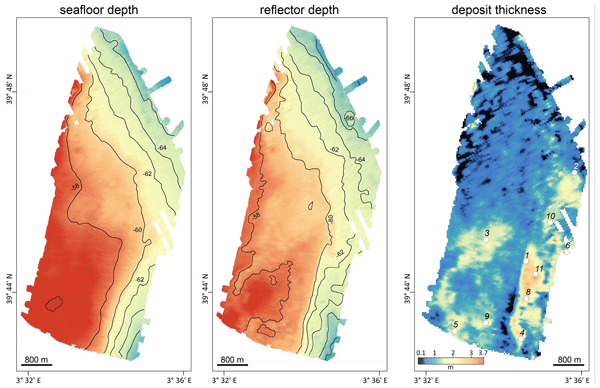
Abstract. Rhodolith and maërl beds are globally relevant biogenic habitats whose long-term carbon storage capacity remains poorly quantified, particularly in the Mediterranean. To fill this gap, we investigated the formation, structure, and carbon content of a sediment deposit underlying a rhodolith bed in the Menorca Channel (Western Mediterranean). High-resolution seismo-acoustic profiling revealed a highly heterogeneous biogenic sedimentary deposit at ~60 m depth, with thickness ranging from a few centimeters to 3.7 m (mean = 0.95 m). Seven vibrocores extracted from the thickest sediment deposits were analyzed for grain size, carbonate content, bioclast composition, organic carbon, and radiocarbon age. Radiocarbon dating indicates that sediment accumulation began during the early Holocene (11,700–9,000 yr BP), when post-glacial sea-level rise transitioned the area from subaerial exposure to shallow-marine conditions. Early deposits were dominated by bivalves and dispersed coralline fragments. The establishment of modern sea level around 7,000–6,500 yr BP led to the development of dense rhodolith–maërl facies that persist today. Sediment accretion rates are low (median = 8.54 cm kyr⁻¹), reflecting very low external sediment supply, and slow growth of coralline algae. Organic carbon content in the upper 50 cm, representing the most dynamic and recently deposited carbon pool, averaged 0.57 % (± 0.22), with an estimated organic carbon stock of 32.04 (± 4.18) Mg C ha⁻¹. These results show that Mediterranean rhodolith beds act as long-term organic carbon stores, forming spatially complex Holocene deposits whose contribution to carbon storage has been largely overlooked.
-
Notice on discussion status
The requested preprint has a corresponding peer-reviewed final revised paper. You are encouraged to refer to the final revised version.
-
Preprint
(1083 KB)
-
Supplement
(2464 KB)
-
The requested preprint has a corresponding peer-reviewed final revised paper. You are encouraged to refer to the final revised version.
- Preprint
(1083 KB) - Metadata XML
-
Supplement
(2464 KB) - BibTeX
- EndNote
- Final revised paper


Journal article(s) based on this preprint
Interactive discussion
Status: closed
-
RC1: 'Comment on egusphere-2026-1394', Anonymous Referee #1, 07 Apr 2026
-
AC1: 'Reply on RC1', Silvia de Juan, 30 Apr 2026
General Reviewer comment –response
We thank the reviewer for this constructive and insightful assessment of our manuscript. We appreciate the recognition of the novelty and potential of the dataset, as well as the detailed comments regarding conceptual framing, scaling of interpretations, and treatment of uncertainty.
In response, we have substantially revised the manuscript to address the main concerns raised. First, we have reworked key sections of the Introduction to more clearly frame rhodolith and maërl beds in relation to classical blue carbon ecosystems. In particular, we now explicitly emphasize their role as particle-trapping systems that facilitate the accumulation of sedimentary organic carbon, rather than presenting them as direct analogues to vegetated blue carbon habitats. The unresolved balance between organic carbon storage and calcification-related CO₂ release is now clearly introduced early in the manuscript.
Second, we have revised the interpretation of our results to better align with the scale and limitations of the data. Statements regarding long-term carbon storage and reservoir function have been moderated, and we now more explicitly distinguish between measured sedimentary organic carbon stocks (upper 50 cm) and broader spatial and temporal. We have also incorporated additional discussion of uncertainty and representativeness, particularly highlighting that stock estimates are based on cores collected from thicker sediment deposits and therefore may not capture the full spatial variability of the system.
Third, we have strengthened the discussion of spatial heterogeneity and sampling limitations, and included explicit recommendations for future work to better constrain variability in sediment thickness, carbon content, and deeper sediment layers (>50 cm), as well as across different rhodolith densities and morphologies.
Regarding the use of the term “millennial-scale,” we have revised the wording throughout the manuscript to adopt a more cautious tone. However, we note that the upper 50 cm of sediment analysed in this study spans several thousand years of accumulation (up to ~6,000 years based on radiocarbon constraints), and therefore still reflects processes operating over millennial timescales. We believe that data, despite the limitation of measuring the first 50 cm along cores, reveal millennial ages (see table 2). However, to be more precise we propose an alternative title: Carbon Accumulation in Mediterranean Rhodolith Beds during the Holocene.
We believe these revisions have significantly improved the clarity, balance, and robustness of the manuscript, and we thank the reviewer again for their valuable input.
Reviewer comment: Claims exceed direct evidence
We fully agree on the need to more clearly distinguish between direct observations, inferred processes, and broader interpretations. In the revised manuscript, we have carefully reframed the main findings to align more closely with the scale and scope of the data and to more clearly acknowledge remaining uncertainties, particularly regarding long-term carbon preservation and spatial variability (e.g., lines 598-607; 613-15; 673-74).
Reviewer comment: Blue-carbon framing is conceptually incomplete
We agree that the distinction between organic carbon storage and net ecosystem carbon balance is fundamental, particularly in calcifying systems such as rhodolith and maërl beds, and that this needed to be made clearer from the outset. In response, we have substantially restructured and rewritten the Introduction to address this issue explicitly and early in the manuscript. The revised version now clearly distinguishes between (i) coastal blue carbon ecosystems dominated by organic carbon burial, and (ii) calcifying carbonate-producing habitats, where organic carbon sequestration co-occurs with calcium carbonate precipitation and associated CO₂ release.
Importantly, we now state explicitly in the Introduction that the study focuses on sedimentary organic carbon stocks and their depositional history, and that it does not aim to resolve net ecosystem carbon balance.
Please, see document with track changes (e.g., lines 68-79).
Reviewer comment: Representativeness and extrapolation need stronger caution
We agree that the sampling design and its implications for representativeness and extrapolation required clearer and more explicit discussion. We would also like to highlight the effort and cost involved in extracting core samples at a depth of 60 metres in a harsh environment, a task that requires the use of virbocorers and the prior acquisition of a geophysical map. At present, this is not an activity that can be easily repeated, as it requires a significant investment of research funds. For this reason, we consider that the data obtained, although limited within an ideal theoretical framework, are valuable in practical terms, concerning a system about which we had no prior information.
In any case, we have strengthened the manuscript by explicitly acknowledging the sampling strategy and its potential bias toward thicker sediment deposits (e.g., lines 395-96; 55-56).
Reviewer comment: Chronostratigraphic interpretation is plausible but needs more restraint
Thank you for the suggestion. We rephrased the text in different sections (abstract, lines 613-15) to be more conservative and stressing the limitation (in terms of spatial extent and amount of dated material) of our dataset, which however we believe to be valuable.
Reviewer comment: The manuscript needs major language revision
The text has been proofread by the two co-authors, who are native English speakers; we hope the reviewer will find it easier to read.
SPECIFIC COMMENTS
Abstract / lines 24–27
The abstract currently presents the results as showing that Mediterranean rhodolith beds “act as long-term organic carbon stores.” This should be toned - Addressed (lines 27)
Introduction / line 52
References included as suggested (line 63)
Introduction / lines 60–67
The introduction has undergone substantial changes to address this issue (please, see document with track changes)
Introduction / lines 93–98
Text modified as suggested (line 297)
Methods / lines 136–139
Uncertainty on resolution added as suggested (line 385)
Methods / lines 141–146
An explanation has been included (line 395)
Methods / lines 165–169
There is no reversal, as the dating results, although limited, do not reverse; they are sequential with respect to depth. There are no older data at shallower depths
Methods / lines 178–196
More detail has been included in this section (lines 443-47)
Results / lines 222–230
This has been addressed in different sections of the manuscript (e.g., line 555, 700)
Results / lines 253–254
This figure has been improved
Results / lines 259–277
This has been addressed in the text and in the table 2
Results / lines 288–293
This section includes a more detailed explanation (lines 553-60)
Results / lines 306–315
This has been addressed and model results are interpreted more cautiously (lines 677)
Discussion / lines 337–338
The sentence has been rewritten
Discussion / lines 362–369
We have emphasised that this is an interpretation (lines 679-80)
Discussion / lines 377–384
These differences are now stated clearly (lines 611-13)
Discussion / lines 398–401
This has now been addressed earlier in the document.
Conclusions / lines 403–413
The suggestion has been included and the inferences about a millennial deposit treated more carefully
Citation: https://doi.org/10.5194/egusphere-2026-1394-AC1 -
AC2: 'Reply on RC1', Silvia de Juan, 30 Apr 2026
Further to my previous message, I would like to inform you that I have prepared a revised version of the manuscript addressing all the comments received. The co-authors and I consider that the manuscript has improved substantially, with a clearer and more focused scope.
As noted in my responses, these revisions are reflected in the updated version. However, as submission of a revised manuscript requires an invitation from the Editor, I am currently unable to share it.
Citation: https://doi.org/10.5194/egusphere-2026-1394-AC2
-
AC1: 'Reply on RC1', Silvia de Juan, 30 Apr 2026
-
RC2: 'Comment on egusphere-2026-1394', Anonymous Referee #2, 14 May 2026
This is an interesting paper on the role of rhodolith beds as short-term carbon storage in the Menorca channel. Authors combine different methodological approaches to present robust results. Furthermore, the results strengthen the general view that rhodolith beds are vulnerable ecosystems that should be protected due to their relevance as ecological services, biodiversification centers, and because they contribute to regulate global climate due to carbon storage.
Despite the results and conclusions are robust, the paper could be benefited by broadening the discussion section. Several parts of the discussion are actually repetitions of the results (i.e., lines: 320-326; 331-338; 354-359;370-376). I think that the discussion could be enlarged, including and discussing the information provided by other authors. In particular, regarding the carbon storage, which is the main aim of the paper, authors only consider the paper by Mao et al. (2020). They should also take into consideration the papers by van der Heijden and Kamenos, 2015; Macreadie et al., 2019; Mao et al., 2024 [Biol. Lett. 20: 20230598 (doi: 10.1098/rsbl.2023.059]; James et al., 2024 [Glob. Chang. Biol., 30, e17261 (doi: 10.1111/gcb.17261]; Schubert et al., 2024) and references therein. In addition, authors can check Bosence and Wilson (2003; Aquat. Conserv., 13, S21-S31) and Ehrhold et al. (2021; Palaeo3, 577, 110525, doi: 10.1016/j.palaeo.2021.110525) for further comparison of thick buried rhodolith beds.
Apart from this issue, there are a few minor suggestions/comments:
Line 26. I suggest to delete “Mediterranean”
Line 49. The reference Aguirre et al. should be 2017.
Line 52. I think that it is not appropriate to refer to a paper under review. Delete the reference to Cabrito et al.
Line 54. In addition to Basso et al., consider adding also Aguirre et al. (2012, 2017).
Line 182. “24-48 hours”? Indicate this.
Line 209. What is AR(1)?
Line 212. What is AICc?
Line 341. Consider adding Aguirre et al., 2017 to the references.
Line 405. Delete one “with”.
Figures. Letters, numbers and symbols in Figs. 2 and 3 are very small. I suggest to increase them.
Symbols in Fig. 4 can be depicted with different colors to highlight them.
Citation: https://doi.org/10.5194/egusphere-2026-1394-RC2 -
AC3: 'Reply on RC2', Silvia de Juan, 15 May 2026
We thank the reviewer for the positive assessment of the robustness of our results and conclusions. We agree that the Discussion section could benefit from a broader integration of previous literature, particularly in relation to carbon storage in rhodolith beds and carbonate sediments. Following the reviewer’s suggestion, we have revised the Discussion to reduce repetition of the Results section and to incorporate additional comparisons and context from the relevant studies suggested. We also included comparisons with studies addressing thick buried rhodolith deposits and carbonate platform dynamics (e.g. Bosence and Wilson, 2003; Ehrhold et al., 2021).
We appreciate the reviewer’s recommendation to expand the comparative framework beyond Mao et al. (2020), as this helped us better contextualize the Menorca rhodolith deposit within the broader literature on carbon storage and long-term preservation in carbonate systems. Minor comments and corrections raised by the reviewer have also been carefully addressed throughout the revised manuscript.
We now have a revised version of the manuscript that incorporates the constructive comments from both reviewers. Should the Editor consider it appropriate, we would be pleased to submit the revised manuscript for further consideration.
Citation: https://doi.org/10.5194/egusphere-2026-1394-AC3
-
AC3: 'Reply on RC2', Silvia de Juan, 15 May 2026
Peer review completion


Interactive discussion
Status: closed
-
RC1: 'Comment on egusphere-2026-1394', Anonymous Referee #1, 07 Apr 2026
This manuscript addresses an important topic and presents a potentially valuable dataset combining seismo-acoustic mapping, vibrocores, radiocarbon dating, sediment characterization, and organic carbon measurements from a Mediterranean rhodolith deposit in the Menorca Channel. The study has clear potential, particularly because millennial-scale sedimentary development of rhodolith systems remains poorly constrained, and because carbon storage in such calcifying habitats is still under-documented. However, in its present form, the manuscript overstates several conclusions relative to the data presented. The central problem is a mismatch between the scale of the claims and the scale of the measurements. The paper repeatedly frames the system as a millennial-scale organic carbon reservoir, yet organic carbon was only measured in the upper 50 cm of sediment, while chronology is available for only four of seven cores and includes reworked material in at least some basal horizons. As a result, several conclusions about long-term preservation, sequestration, and carbon-reservoir function are currently more interpretive than demonstrative. A second major issue is conceptual framing. The manuscript uses blue-carbon language for a calcifying system, but only later acknowledges the unresolved balance between sedimentary organic carbon storage and calcification-related CO₂ release. That caveat is fundamental, not secondary, and needs to be built into the framing from the introduction onward. At present, the manuscript reads as more certain about climate-mitigation significance than the evidence supports. In addition, the manuscript would benefit from more rigorous treatment of representativeness, uncertainty, and inference. The geophysical mapping demonstrates strong spatial heterogeneity in deposit thickness, yet the stock estimates are based on a small number of targeted cores collected from thicker deposits. That does not invalidate the study, but it does mean that statements about the broader Menorca Channel rhodolith bed need to be more tightly bounded.
For these reasons, I think the manuscript has merit, but it requires substantial revision before it is ready for publication.
Main comments
Claims exceed direct evidence
The manuscript’s strongest direct results are: highly heterogeneous Holocene biogenic deposits, plausible onset of persistent dense rhodolith–maërl facies after sea-level stabilization, and measured organic carbon stocks in the upper 50 cm. Those are worthwhile findings. But several broader claims—especially around millennial-scale carbon preservation and long-term reservoir function—go beyond what was directly measured. The authors need to distinguish much more carefully between what is measured, what is inferred, and what remains hypothetical.Blue-carbon framing is conceptually incomplete
The introduction foregrounds organic carbon burial in coastal ecosystems, then extends that framing to rhodolith beds, but the manuscript does not adequately distinguish carbon storage from net carbon sequestration in a calcifying carbonate-producing habitat. This issue is acknowledged only near the end of the discussion. That is too late. The manuscript should explicitly state early on that the study quantifies sedimentary organic carbon stocks and depositional history, but does not resolve net ecosystem carbon balance.Representativeness and extrapolation need stronger caution
Seven cores were retained from twelve collected, and core sites were selected on the basis of maximum sediment thickness. This is a sensible strategy for reconstructing deposit history, but it also biases the dataset toward thicker accumulations. That sampling design needs to be discussed explicitly when presenting carbon stock estimates and any implication for the wider bed.Chronostratigraphic interpretation is plausible but needs more restraint
The manuscript uses reworked basal dates to interpret pre-Holocene material and then infers onset and consolidation of rhodolith-rich facies during the early to mid-Holocene. This is reasonable, but the text sometimes presents the sequence rather too smoothly, given the limited number of dated horizons and evidence of reworking. The depositional history should be framed as a best-supported reconstruction rather than as a tightly resolved chronology.The manuscript needs major language revision
There are several grammatical, syntactic, and stylistic problems that they materially affect readability and precision. Several sentences are difficult to understand or ungrammatical, and some interpretive passages become less convincing because of this. The paper would benefit from careful editing by a fluent English speaker before resubmission.Specific comments
Abstract / lines 24–27
The abstract currently presents the results as showing that Mediterranean rhodolith beds “act as long-term organic carbon stores.” This should be toned down. The study demonstrates organic carbon stocks in the upper 50 cm within a Holocene depositional framework; it does not directly measure long-term preservation throughout the full deposit.Introduction / line 52
There are so many papers that give definitions of rhodoliths, so no need to use this in-review citation (Cabrito et al under review) from one of the co-authors. Check articles by Basso, Bosence, etc.Introduction / lines 60–67
This paragraph needs a clearer conceptual distinction between organic carbon storage in sediment and net climate mitigation in calcifying systems. Without that distinction, the framing is incomplete. For organic carbon, it is also important to refer to floridean starch commonly produced by many coralline algae, which might play an important role in the blue carbon realm (see Pyko et al 2025 in Aquatic Conservation: Marine and Freshwater Ecosystems, doi:10.1002/aqc.70045)Introduction / lines 93–98
The sentence ending “reconstruct the depositional history through in relation with the last glacio-eustatic oscillation” is ungrammatical and should be rewritten. More importantly, this section should state explicitly that the OC measurements are limited to the upper 50 cm.Methods / lines 136–139
The manuscript should report uncertainty or resolution limits for the thickness estimates derived from the acoustic interpretation. This is especially important because the manuscript emphasizes fine-scale patchiness.Methods / lines 141–146
Why were 5 of the 12 collected cores excluded? This should be stated clearly. At present, the omission is insufficiently explained.Methods / lines 165–169
Please clarify whether age reversals or other stratigraphic inconsistencies were evaluated formally, particularly given the presence of reworked older material.Methods / lines 178–196
The OC methods need more detail. For highly carbonate-rich sediments, the acidification protocol, mass correction, and QA/QC steps matter. The present description is too brief for full reproducibility.Results / lines 222–230
The mapping result is important, but the manuscript should explicitly connect this heterogeneity to the limits of stock extrapolation. The current text highlights heterogeneity descriptively but does not fully integrate its implications.Results / lines 253–254
The figure is extremely difficult to read.Results / lines 259–277
The age interpretation would be clearer if the authors separated reworked/pre-Holocene ages from depositional ages more explicitly in both the text and Table 2.Results / lines 288–293
The derivation of annual carbon accumulation from the 50 cm stock and median accretion rate needs to be shown more transparently. At present, this estimate appears precise, but the underlying assumptions are not fully explained.Results / lines 306–315
The mixed-effects model is potentially useful, but the interpretation is stronger than warranted by the limited sample size. With seven cores and upper 50 cm subsamples only, the modelling results should be presented more cautiously.Discussion / lines 337–338
“when sea-level lowered down its rise almost reaching its actual level” should be rewritten entirely.Discussion / lines 362–369
The interpretation of no depth trend as evidence for mixing, burial, and textural control is plausible, but still speculative. The authors should label it as such.Discussion / lines 377–384
The comparison to Scottish rhodolith beds is potentially useful, but it needs more caveats. Differences in depth interval, age structure, hydrodynamics, sediment composition, and analytical design make direct comparison difficult.Discussion / lines 398–401
This is the conceptual caveat the manuscript most needs, yet it appears only near the end. It should be moved earlier into the framing and discussion.Conclusions / lines 403–413
The conclusions are currently overstated. “Actively storing carbon over millennia” and broader references to global stability are too expansive relative to the evidence presented here. The authors should conclude more narrowly: this deposit preserves measurable organic carbon in the upper sediment and sits within a dated Holocene depositional framework consistent with long-term accumulation.Citation: https://doi.org/10.5194/egusphere-2026-1394-RC1 -
AC1: 'Reply on RC1', Silvia de Juan, 30 Apr 2026
General Reviewer comment –response
We thank the reviewer for this constructive and insightful assessment of our manuscript. We appreciate the recognition of the novelty and potential of the dataset, as well as the detailed comments regarding conceptual framing, scaling of interpretations, and treatment of uncertainty.
In response, we have substantially revised the manuscript to address the main concerns raised. First, we have reworked key sections of the Introduction to more clearly frame rhodolith and maërl beds in relation to classical blue carbon ecosystems. In particular, we now explicitly emphasize their role as particle-trapping systems that facilitate the accumulation of sedimentary organic carbon, rather than presenting them as direct analogues to vegetated blue carbon habitats. The unresolved balance between organic carbon storage and calcification-related CO₂ release is now clearly introduced early in the manuscript.
Second, we have revised the interpretation of our results to better align with the scale and limitations of the data. Statements regarding long-term carbon storage and reservoir function have been moderated, and we now more explicitly distinguish between measured sedimentary organic carbon stocks (upper 50 cm) and broader spatial and temporal. We have also incorporated additional discussion of uncertainty and representativeness, particularly highlighting that stock estimates are based on cores collected from thicker sediment deposits and therefore may not capture the full spatial variability of the system.
Third, we have strengthened the discussion of spatial heterogeneity and sampling limitations, and included explicit recommendations for future work to better constrain variability in sediment thickness, carbon content, and deeper sediment layers (>50 cm), as well as across different rhodolith densities and morphologies.
Regarding the use of the term “millennial-scale,” we have revised the wording throughout the manuscript to adopt a more cautious tone. However, we note that the upper 50 cm of sediment analysed in this study spans several thousand years of accumulation (up to ~6,000 years based on radiocarbon constraints), and therefore still reflects processes operating over millennial timescales. We believe that data, despite the limitation of measuring the first 50 cm along cores, reveal millennial ages (see table 2). However, to be more precise we propose an alternative title: Carbon Accumulation in Mediterranean Rhodolith Beds during the Holocene.
We believe these revisions have significantly improved the clarity, balance, and robustness of the manuscript, and we thank the reviewer again for their valuable input.
Reviewer comment: Claims exceed direct evidence
We fully agree on the need to more clearly distinguish between direct observations, inferred processes, and broader interpretations. In the revised manuscript, we have carefully reframed the main findings to align more closely with the scale and scope of the data and to more clearly acknowledge remaining uncertainties, particularly regarding long-term carbon preservation and spatial variability (e.g., lines 598-607; 613-15; 673-74).
Reviewer comment: Blue-carbon framing is conceptually incomplete
We agree that the distinction between organic carbon storage and net ecosystem carbon balance is fundamental, particularly in calcifying systems such as rhodolith and maërl beds, and that this needed to be made clearer from the outset. In response, we have substantially restructured and rewritten the Introduction to address this issue explicitly and early in the manuscript. The revised version now clearly distinguishes between (i) coastal blue carbon ecosystems dominated by organic carbon burial, and (ii) calcifying carbonate-producing habitats, where organic carbon sequestration co-occurs with calcium carbonate precipitation and associated CO₂ release.
Importantly, we now state explicitly in the Introduction that the study focuses on sedimentary organic carbon stocks and their depositional history, and that it does not aim to resolve net ecosystem carbon balance.
Please, see document with track changes (e.g., lines 68-79).
Reviewer comment: Representativeness and extrapolation need stronger caution
We agree that the sampling design and its implications for representativeness and extrapolation required clearer and more explicit discussion. We would also like to highlight the effort and cost involved in extracting core samples at a depth of 60 metres in a harsh environment, a task that requires the use of virbocorers and the prior acquisition of a geophysical map. At present, this is not an activity that can be easily repeated, as it requires a significant investment of research funds. For this reason, we consider that the data obtained, although limited within an ideal theoretical framework, are valuable in practical terms, concerning a system about which we had no prior information.
In any case, we have strengthened the manuscript by explicitly acknowledging the sampling strategy and its potential bias toward thicker sediment deposits (e.g., lines 395-96; 55-56).
Reviewer comment: Chronostratigraphic interpretation is plausible but needs more restraint
Thank you for the suggestion. We rephrased the text in different sections (abstract, lines 613-15) to be more conservative and stressing the limitation (in terms of spatial extent and amount of dated material) of our dataset, which however we believe to be valuable.
Reviewer comment: The manuscript needs major language revision
The text has been proofread by the two co-authors, who are native English speakers; we hope the reviewer will find it easier to read.
SPECIFIC COMMENTS
Abstract / lines 24–27
The abstract currently presents the results as showing that Mediterranean rhodolith beds “act as long-term organic carbon stores.” This should be toned - Addressed (lines 27)
Introduction / line 52
References included as suggested (line 63)
Introduction / lines 60–67
The introduction has undergone substantial changes to address this issue (please, see document with track changes)
Introduction / lines 93–98
Text modified as suggested (line 297)
Methods / lines 136–139
Uncertainty on resolution added as suggested (line 385)
Methods / lines 141–146
An explanation has been included (line 395)
Methods / lines 165–169
There is no reversal, as the dating results, although limited, do not reverse; they are sequential with respect to depth. There are no older data at shallower depths
Methods / lines 178–196
More detail has been included in this section (lines 443-47)
Results / lines 222–230
This has been addressed in different sections of the manuscript (e.g., line 555, 700)
Results / lines 253–254
This figure has been improved
Results / lines 259–277
This has been addressed in the text and in the table 2
Results / lines 288–293
This section includes a more detailed explanation (lines 553-60)
Results / lines 306–315
This has been addressed and model results are interpreted more cautiously (lines 677)
Discussion / lines 337–338
The sentence has been rewritten
Discussion / lines 362–369
We have emphasised that this is an interpretation (lines 679-80)
Discussion / lines 377–384
These differences are now stated clearly (lines 611-13)
Discussion / lines 398–401
This has now been addressed earlier in the document.
Conclusions / lines 403–413
The suggestion has been included and the inferences about a millennial deposit treated more carefully
Citation: https://doi.org/10.5194/egusphere-2026-1394-AC1 -
AC2: 'Reply on RC1', Silvia de Juan, 30 Apr 2026
Further to my previous message, I would like to inform you that I have prepared a revised version of the manuscript addressing all the comments received. The co-authors and I consider that the manuscript has improved substantially, with a clearer and more focused scope.
As noted in my responses, these revisions are reflected in the updated version. However, as submission of a revised manuscript requires an invitation from the Editor, I am currently unable to share it.
Citation: https://doi.org/10.5194/egusphere-2026-1394-AC2
-
AC1: 'Reply on RC1', Silvia de Juan, 30 Apr 2026
-
RC2: 'Comment on egusphere-2026-1394', Anonymous Referee #2, 14 May 2026
This is an interesting paper on the role of rhodolith beds as short-term carbon storage in the Menorca channel. Authors combine different methodological approaches to present robust results. Furthermore, the results strengthen the general view that rhodolith beds are vulnerable ecosystems that should be protected due to their relevance as ecological services, biodiversification centers, and because they contribute to regulate global climate due to carbon storage.
Despite the results and conclusions are robust, the paper could be benefited by broadening the discussion section. Several parts of the discussion are actually repetitions of the results (i.e., lines: 320-326; 331-338; 354-359;370-376). I think that the discussion could be enlarged, including and discussing the information provided by other authors. In particular, regarding the carbon storage, which is the main aim of the paper, authors only consider the paper by Mao et al. (2020). They should also take into consideration the papers by van der Heijden and Kamenos, 2015; Macreadie et al., 2019; Mao et al., 2024 [Biol. Lett. 20: 20230598 (doi: 10.1098/rsbl.2023.059]; James et al., 2024 [Glob. Chang. Biol., 30, e17261 (doi: 10.1111/gcb.17261]; Schubert et al., 2024) and references therein. In addition, authors can check Bosence and Wilson (2003; Aquat. Conserv., 13, S21-S31) and Ehrhold et al. (2021; Palaeo3, 577, 110525, doi: 10.1016/j.palaeo.2021.110525) for further comparison of thick buried rhodolith beds.
Apart from this issue, there are a few minor suggestions/comments:
Line 26. I suggest to delete “Mediterranean”
Line 49. The reference Aguirre et al. should be 2017.
Line 52. I think that it is not appropriate to refer to a paper under review. Delete the reference to Cabrito et al.
Line 54. In addition to Basso et al., consider adding also Aguirre et al. (2012, 2017).
Line 182. “24-48 hours”? Indicate this.
Line 209. What is AR(1)?
Line 212. What is AICc?
Line 341. Consider adding Aguirre et al., 2017 to the references.
Line 405. Delete one “with”.
Figures. Letters, numbers and symbols in Figs. 2 and 3 are very small. I suggest to increase them.
Symbols in Fig. 4 can be depicted with different colors to highlight them.
Citation: https://doi.org/10.5194/egusphere-2026-1394-RC2 -
AC3: 'Reply on RC2', Silvia de Juan, 15 May 2026
We thank the reviewer for the positive assessment of the robustness of our results and conclusions. We agree that the Discussion section could benefit from a broader integration of previous literature, particularly in relation to carbon storage in rhodolith beds and carbonate sediments. Following the reviewer’s suggestion, we have revised the Discussion to reduce repetition of the Results section and to incorporate additional comparisons and context from the relevant studies suggested. We also included comparisons with studies addressing thick buried rhodolith deposits and carbonate platform dynamics (e.g. Bosence and Wilson, 2003; Ehrhold et al., 2021).
We appreciate the reviewer’s recommendation to expand the comparative framework beyond Mao et al. (2020), as this helped us better contextualize the Menorca rhodolith deposit within the broader literature on carbon storage and long-term preservation in carbonate systems. Minor comments and corrections raised by the reviewer have also been carefully addressed throughout the revised manuscript.
We now have a revised version of the manuscript that incorporates the constructive comments from both reviewers. Should the Editor consider it appropriate, we would be pleased to submit the revised manuscript for further consideration.
Citation: https://doi.org/10.5194/egusphere-2026-1394-AC3
-
AC3: 'Reply on RC2', Silvia de Juan, 15 May 2026
Peer review completion
Journal article(s) based on this preprint
Viewed
| HTML | XML | Total | Supplement | BibTeX | EndNote | |
|---|---|---|---|---|---|---|
| 814 | 205 | 85 | 1,104 | 136 | 58 | 89 |
- HTML: 814
- PDF: 205
- XML: 85
- Total: 1,104
- Supplement: 136
- BibTeX: 58
- EndNote: 89
Viewed (geographical distribution)
| Country | # | Views | % |
|---|
| Total: | 0 |
| HTML: | 0 |
| PDF: | 0 |
| XML: | 0 |
- 1

Ryan Smazal
Claudio Lo Iacono
Maria del Mar Gil
Andrea Cabrito
Andres Ospina-Alvarez
Jorge Guillén
Grace M. Cott
Laia Illa-López
Hilmar Hinz
Francesc Maynou
The requested preprint has a corresponding peer-reviewed final revised paper. You are encouraged to refer to the final revised version.
- Preprint
(1083 KB) - Metadata XML
-
Supplement
(2464 KB) - BibTeX
- EndNote
- Final revised paper
This manuscript addresses an important topic and presents a potentially valuable dataset combining seismo-acoustic mapping, vibrocores, radiocarbon dating, sediment characterization, and organic carbon measurements from a Mediterranean rhodolith deposit in the Menorca Channel. The study has clear potential, particularly because millennial-scale sedimentary development of rhodolith systems remains poorly constrained, and because carbon storage in such calcifying habitats is still under-documented. However, in its present form, the manuscript overstates several conclusions relative to the data presented. The central problem is a mismatch between the scale of the claims and the scale of the measurements. The paper repeatedly frames the system as a millennial-scale organic carbon reservoir, yet organic carbon was only measured in the upper 50 cm of sediment, while chronology is available for only four of seven cores and includes reworked material in at least some basal horizons. As a result, several conclusions about long-term preservation, sequestration, and carbon-reservoir function are currently more interpretive than demonstrative. A second major issue is conceptual framing. The manuscript uses blue-carbon language for a calcifying system, but only later acknowledges the unresolved balance between sedimentary organic carbon storage and calcification-related CO₂ release. That caveat is fundamental, not secondary, and needs to be built into the framing from the introduction onward. At present, the manuscript reads as more certain about climate-mitigation significance than the evidence supports. In addition, the manuscript would benefit from more rigorous treatment of representativeness, uncertainty, and inference. The geophysical mapping demonstrates strong spatial heterogeneity in deposit thickness, yet the stock estimates are based on a small number of targeted cores collected from thicker deposits. That does not invalidate the study, but it does mean that statements about the broader Menorca Channel rhodolith bed need to be more tightly bounded.
For these reasons, I think the manuscript has merit, but it requires substantial revision before it is ready for publication.
Main comments
Claims exceed direct evidence
The manuscript’s strongest direct results are: highly heterogeneous Holocene biogenic deposits, plausible onset of persistent dense rhodolith–maërl facies after sea-level stabilization, and measured organic carbon stocks in the upper 50 cm. Those are worthwhile findings. But several broader claims—especially around millennial-scale carbon preservation and long-term reservoir function—go beyond what was directly measured. The authors need to distinguish much more carefully between what is measured, what is inferred, and what remains hypothetical.
Blue-carbon framing is conceptually incomplete
The introduction foregrounds organic carbon burial in coastal ecosystems, then extends that framing to rhodolith beds, but the manuscript does not adequately distinguish carbon storage from net carbon sequestration in a calcifying carbonate-producing habitat. This issue is acknowledged only near the end of the discussion. That is too late. The manuscript should explicitly state early on that the study quantifies sedimentary organic carbon stocks and depositional history, but does not resolve net ecosystem carbon balance.
Representativeness and extrapolation need stronger caution
Seven cores were retained from twelve collected, and core sites were selected on the basis of maximum sediment thickness. This is a sensible strategy for reconstructing deposit history, but it also biases the dataset toward thicker accumulations. That sampling design needs to be discussed explicitly when presenting carbon stock estimates and any implication for the wider bed.
Chronostratigraphic interpretation is plausible but needs more restraint
The manuscript uses reworked basal dates to interpret pre-Holocene material and then infers onset and consolidation of rhodolith-rich facies during the early to mid-Holocene. This is reasonable, but the text sometimes presents the sequence rather too smoothly, given the limited number of dated horizons and evidence of reworking. The depositional history should be framed as a best-supported reconstruction rather than as a tightly resolved chronology.
The manuscript needs major language revision
There are several grammatical, syntactic, and stylistic problems that they materially affect readability and precision. Several sentences are difficult to understand or ungrammatical, and some interpretive passages become less convincing because of this. The paper would benefit from careful editing by a fluent English speaker before resubmission.
Specific comments
Abstract / lines 24–27
The abstract currently presents the results as showing that Mediterranean rhodolith beds “act as long-term organic carbon stores.” This should be toned down. The study demonstrates organic carbon stocks in the upper 50 cm within a Holocene depositional framework; it does not directly measure long-term preservation throughout the full deposit.
Introduction / line 52
There are so many papers that give definitions of rhodoliths, so no need to use this in-review citation (Cabrito et al under review) from one of the co-authors. Check articles by Basso, Bosence, etc.
Introduction / lines 60–67
This paragraph needs a clearer conceptual distinction between organic carbon storage in sediment and net climate mitigation in calcifying systems. Without that distinction, the framing is incomplete. For organic carbon, it is also important to refer to floridean starch commonly produced by many coralline algae, which might play an important role in the blue carbon realm (see Pyko et al 2025 in Aquatic Conservation: Marine and Freshwater Ecosystems, doi:10.1002/aqc.70045)
Introduction / lines 93–98
The sentence ending “reconstruct the depositional history through in relation with the last glacio-eustatic oscillation” is ungrammatical and should be rewritten. More importantly, this section should state explicitly that the OC measurements are limited to the upper 50 cm.
Methods / lines 136–139
The manuscript should report uncertainty or resolution limits for the thickness estimates derived from the acoustic interpretation. This is especially important because the manuscript emphasizes fine-scale patchiness.
Methods / lines 141–146
Why were 5 of the 12 collected cores excluded? This should be stated clearly. At present, the omission is insufficiently explained.
Methods / lines 165–169
Please clarify whether age reversals or other stratigraphic inconsistencies were evaluated formally, particularly given the presence of reworked older material.
Methods / lines 178–196
The OC methods need more detail. For highly carbonate-rich sediments, the acidification protocol, mass correction, and QA/QC steps matter. The present description is too brief for full reproducibility.
Results / lines 222–230
The mapping result is important, but the manuscript should explicitly connect this heterogeneity to the limits of stock extrapolation. The current text highlights heterogeneity descriptively but does not fully integrate its implications.
Results / lines 253–254
The figure is extremely difficult to read.
Results / lines 259–277
The age interpretation would be clearer if the authors separated reworked/pre-Holocene ages from depositional ages more explicitly in both the text and Table 2.
Results / lines 288–293
The derivation of annual carbon accumulation from the 50 cm stock and median accretion rate needs to be shown more transparently. At present, this estimate appears precise, but the underlying assumptions are not fully explained.
Results / lines 306–315
The mixed-effects model is potentially useful, but the interpretation is stronger than warranted by the limited sample size. With seven cores and upper 50 cm subsamples only, the modelling results should be presented more cautiously.
Discussion / lines 337–338
“when sea-level lowered down its rise almost reaching its actual level” should be rewritten entirely.
Discussion / lines 362–369
The interpretation of no depth trend as evidence for mixing, burial, and textural control is plausible, but still speculative. The authors should label it as such.
Discussion / lines 377–384
The comparison to Scottish rhodolith beds is potentially useful, but it needs more caveats. Differences in depth interval, age structure, hydrodynamics, sediment composition, and analytical design make direct comparison difficult.
Discussion / lines 398–401
This is the conceptual caveat the manuscript most needs, yet it appears only near the end. It should be moved earlier into the framing and discussion.
Conclusions / lines 403–413
The conclusions are currently overstated. “Actively storing carbon over millennia” and broader references to global stability are too expansive relative to the evidence presented here. The authors should conclude more narrowly: this deposit preserves measurable organic carbon in the upper sediment and sits within a dated Holocene depositional framework consistent with long-term accumulation.