
the Creative Commons Attribution 4.0 License.
the Creative Commons Attribution 4.0 License.
 | 24 Mar 2026
Shifts in riverine POC sources reduce terrestrial OC burial in the subaqueous Changjiang Delta
Abstract. Global riverine particulate organic carbon (POC) fluxes have declined worldwide due to dam-induced reductions in sediment load. However, how the composition of riverine POC has evolved in response to declining sediment supply, and how such shifts influence OC burial in subaqueous deltaic systems remain unclear. Here, we collected suspended particulate matter (SPM) from the Changjiang Estuary during the summer and winter of 2025 to analyze N/C ratios and δ13C values. These data were integrated with a four-decade (1980–2021) dataset comprising POC proxies (N/C, δ13C, and Δ14C) for SPM in the estuary and surface sediments from the subaqueous Changjiang Delta. Our results reveal a temporal increase in N/C ratios and a decrease in δ13C values in riverine SPM. Based on a Bayesian end-member mixing model, we attribute these trends to an increasing proportion of POC derived from freshwater algae and a decreasing proportion of POC originating from soil/bedrock erosion. This temporal increment in river-delivered labile algae POC drove a 1.5-fold decrease in OC preservation efficiency in subaqueous Changjiang Delta from 15.1 % (before 2003) to 10.7 % (after 2003), resulting in a more pronounced reduction in deltaic OC burial. Consequently, the amount of OC retained in sediments decreased by approximately 50 %, from 0.68 × 10⁵ t/month in 2001 to an average of 0.34 × 10⁵ t/month during the flood seasons of 2011–2020. Our findings emphasize that the shifts in riverine OC sources, not merely the decline in total OC flux, may exert great effects on OC burial in deltaic systems globally.
-
Notice on discussion status
The requested preprint has a corresponding peer-reviewed final revised paper. You are encouraged to refer to the final revised version.
-
Preprint
(1549 KB)
-
Supplement
(1045 KB)
-
The requested preprint has a corresponding peer-reviewed final revised paper. You are encouraged to refer to the final revised version.
- Preprint
(1549 KB) - Metadata XML
-
Supplement
(1045 KB) - BibTeX
- EndNote
- Final revised paper


Journal article(s) based on this preprint
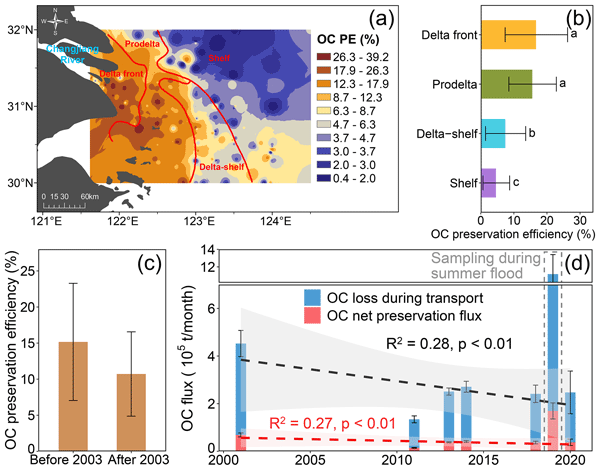
Dam construction has altered riverine organic carbon (OC) composition, but its impact on deltaic OC burial remains unclear. Analysis of a four-decadal dataset of suspended and surface sediments in the Changjiang subaqueous delta reveals a temporal increase in freshwater algal OC and a decrease in petrogenic OC input to the East China Sea. This shift toward more labile OC reduced OC preservation efficiency from 15.1% to 10.7%, resulting in an approximately 50% loss of net OC preservation.
Interactive discussion
Status: closed
-
RC1: 'Comment on egusphere-2026-1392', Bin Zhao, 20 Apr 2026
-
AC1: 'Reply on RC1', Jiyuan Jin, 25 Apr 2026
Thank you very much for reviewing our manuscript and for providing insightful and constructive comments, which have undoubtedly helped improve the quality of our work.
We are carefully considering your comments and will submit a revised version of the manuscript, together with a detailed point-by-point response to each of your suggestions, in due course.
We sincerely appreciate your valuable comments, as well as the time and effort you have devoted to reviewing our manuscript.
Kind regards,
Jiyuan Jin
on behalf of all co-authorsCitation: https://doi.org/10.5194/egusphere-2026-1392-AC1 -
AC2: 'Reply on RC1', Jiyuan Jin, 18 May 2026
Dear Prof. Zhong,
We sincerely thank you for the time and effort you devoted to reviewing our manuscript and for providing constructive comments and suggestions. We have carefully considered all of your comments and revised the manuscript accordingly. Detailed point-by-point responses to your comments are provided in the attached response letter. We believe that the revisions made in response to your suggestions have substantially improved the clarity, rigor, and overall quality of our manuscript.
Sincerely,
Jiyuan Jin (on behalf of all authors)
-
AC3: 'Reply on RC1', Jiyuan Jin, 18 May 2026
Dear Prof. Zhao,
We sincerely thank you for the time and effort you devoted to reviewing our manuscript and for providing constructive comments and suggestions. We have carefully considered all of your comments and revised the manuscript accordingly. Detailed point-by-point responses to your comments are provided in the attached response letter. We believe that the revisions made in response to your suggestions have substantially improved the clarity, rigor, and overall quality of our manuscript.
Sincerely,
Jiyuan Jin (on behalf of all authors)
-
AC1: 'Reply on RC1', Jiyuan Jin, 25 Apr 2026
-
RC2: 'Comment on egusphere-2026-1392', Aislinn Fox, 06 May 2026
Deltas are important areas for organic carbon burial. Hydropower dams have significant impacts on riverine sediment delivery, which in turn can impact in-river primary production dynamics and organic carbon delivery to the ocean and delta environments. Comprehensive studies on how river impoundment can impact organic carbon dynamics, particularly within deltaic environment where burial occurs, is of great interest. This study presents robust work to investigate how OC sources and deltaic OC burial are changing in the discharge of the largest East Asian river with a significant damming project. Some language and concept clarification, as well as data availability, require some improvement before publication. My specific comments on the manuscript are as follows:
Abstract:
Line 19-21: “temporal increment” is unclear, perhaps should be “temporal increase.” “1.5-fold decrease” is also unclear, and perhaps should instead be phrased as: “…drove a decrease in OC preservation efficiency in the subaqueous Changjiang Delta from 15.1% (before 2003) to 10.7% (after 2003), resulting in a pronounced reduction in deltaic OC burial.”
Line 21-22: No need for scientific notation to my eye here, just write out the amount in tons or kilotons.
Introduction:
Line 33: Incomplete and unclear sentence.
Line 42: “as the clearly temporal decline of sediment loads in the river (Dang et al., 2010).” The purpose of this remark is unclear. Did river OC loads decline alongside sediment loads?
Line 43: “exhibit distinct degrees of lability” I wouldn’t say there are distinct degrees of lability, it is a spectrum or continuum of lability.
Line 51: “transported” rather than “conveyed over”
Methods:
Line 100: How many samples?
Line 149: By “content of terrestrial OC”, is “content” referring to the concentration, mass, or OC%? Please clarify and perhaps replace both instances with a more specific word. I am not totally sure how OC preservation efficiency differs considerably from burial efficiency. What exactly does it mean, mechanistically, to not account for the surface area? Perhaps this could be discussed within the discussion section.
Results:
Line 167-168: The remark about anthropogenic activities impacting SPM grain size is interpretation and should be mentioned in the discussion, rather than the results.
Line 173 and throughout: I would perhaps use the language “sedimentary environments” rather than “sedimentary units” throughout, as sedimentary unit implies, to me, a lithified rock unit. If this language is commonly used in sedimentary studies (which I am not experienced in), however, then ignore this suggestion.
Line 180,186-187: I would just quote the increase or change, rather than describing with “2.5-fold”, etc. For example, “…with the value increasing from 0.07 in 1980 to 0.17 in 2025.” Describing decreases in particular with this language is unclear, so I would avoid it if possible.
Line 198: change to “values of δ13C and C/N in surface sediment increased and decreased from 1980 to 2025, respectively.” Perhaps include a figure reference for this for this if there is one. Instinctually I wanted to look at figure 2, as this figure seems to show that, but it does not seem to specifically be for the Delta front environment.
Discussion:
Line 258: Is the citation for the reduced sediment loads in these rivers the same as the next sentence?
Line 260: Is “water-sediment regulation” referring to the decrease in sediment loads due to the existence of the Xiaolangdi Reservoir? If so, perhaps better phrased as “sediment impacts due to Xiaolangdi Reservoir” or something similar. Or, if water-sediment regulation is a frequently used term, please define it earlier.
Line 271: At the end of this paragraph I’m left wondering which one it is, however, the next paragraph shifts to something different. While you may not have the data to be able to determine which of the two hypotheses is correct, could lead on with a sentence about what kind of future work/measurements could be done to better investigate this problem, or leading towards a future later section in the manuscript that discusses this.
Line 383-384: It seems odd to me that younger OC would be composed of eroded bedrock, while aged OC is composed of (presumably more modern) plant debris. Which Fig. 3 subplot shows this the best? It is also difficult to interpret this statement with figure 5, as younger OC (higher D14C) was more well correlated with low OC/SA, the opposite of what is said in the text. Perhaps there is an error in the text.
Figure notes:
Figure 1: For 1B-1E, do the bars represent the mean values of each variable for that sedimentary environment, with the error of the mean? Perhaps this will be better shown as quartile/box plots, rather than a barplot. Please clarify in figure caption if they are displaying the mean as well, as “characteristics” is vague. For 1G, is the R2 and p-value describing an exponential fit line or a linear fit line? Please describe in the caption, and if it is a linear fit equation please have it displayed as a linear relationship on the graph.
Figure 3: I would suggest for clarity (particularly for colour-blind individuals) that the datapoints be kept in one colour (e.g. just black) and do variations in shape, filled and solid, particularly for the sediment before/after 2003 points.
Optional figure note: I would suggest changing some figure colour palettes to ones that are more colour-blind and black and white printing friendly, for example those from the Viridis package. Figure 1 A-E (and any related figures referencing sedimentary environment with those colours) would be a good candidate. However, if difficult, it is not necessary.
Supplement notes:
Is there a data table with all the 13C and C/N values measured in this study? In the supplement, I see Table S3 appears to be the compilation of previous data. Is this the same data used in, for example, figure 3? There appear to be many more datapoints than are in Table S3. I suggest a table compilation of the values measured in this study.
Within Table S3, 14C values are not included, although those discussed in the study appear to come from this compilation of previous data. Please either include these, or have some other data table with 14C values used in this study included.
Overall, I had confusion throughout on which datasets were used for what. For example, the recent samples that were collected and are being presented in this study, and the older, compiled data. More complete tables with all of the data would do well to provide clarity on this.
Citation: https://doi.org/10.5194/egusphere-2026-1392-RC2 -
AC4: 'Reply on RC2', Jiyuan Jin, 18 May 2026
Dear Prof. Fox,
We sincerely thank you for the time and effort you devoted to reviewing our manuscript and for providing constructive comments and suggestions. We have carefully considered all of your comments and revised the manuscript accordingly. Detailed point-by-point responses to your comments are provided in the attached response letter. We believe that the revisions made in response to your suggestions have substantially improved the clarity, rigor, and overall quality of our manuscript.
Sincerely,
Jiyuan Jin (on behalf of all authors)
-
AC4: 'Reply on RC2', Jiyuan Jin, 18 May 2026


Interactive discussion
Status: closed
-
RC1: 'Comment on egusphere-2026-1392', Bin Zhao, 20 Apr 2026
Jin et al. used a four-decade (1980–2021) dataset to analyze shifts in POC sources and their influence on OC burial in the Changjiang subaqueous delta before and after dam construction. It is commendable that this study employs multi-year data to examine OC burial in a highly human-impacted estuary. The study addresses a topic of interest and presents robust analytical work. However, the classification basis of different sedimentary units and the assumptions underlying the method require further clarification before publication. My specific comments are as follows:
(1) It is suggested that coastal currents be introduced in text and/or labeled in Figure 1.
(2) Line 88-89. It is suggested that the authors briefly clarify the classification basis of these four sedimentary units, as well as their differences in sedimentary environments, including hydrodynamic conditions, sediment sources, sedimentation rates, and other relevant aspects.
(3) Line 141. Since estuarine SPM may also contain marine-derived OC, the OC loadingSPM here should represent terrestrial OC/SSA in SPM. Alternatively, I recommend that the authors clarify that the marine OC content in estuarine SPM is relatively low and can be neglected. It should be noted that neglecting marine OC may lead to an underestimation of OC burial efficiency.
(4) Section 3.1 overlaps somewhat with Sections 3.2 and 3.3. It is suggested that the authors consider merging the content of Section 3.1 into Sections 3.2 and 3.3 to improve the conciseness and logical flow of the manuscript.
(5) “In Delta front, the values of δ 13C and C/N in surface sediment were increased and decreased over time, respectively”. Please remove “were“ from this sentence.
(6) Line 317-318. Here OC preservation efficiency is estimated based on OC content ratios, which are strongly influenced by sediment grain size. Therefore, the lower OC preservation efficiency after 2003 may be attributed not only to shifts in OC sources but also to changes in sediment grain size. I recommend that the authors consider grain-size variations when interpreting these results.
(7) Line 377-378. Based on the data presented in this study, it is difficult to determine whether a substantial proportion of OC in SPM occurs in a mineral-unprotected form.
Citation: https://doi.org/10.5194/egusphere-2026-1392-RC1 -
AC1: 'Reply on RC1', Jiyuan Jin, 25 Apr 2026
Thank you very much for reviewing our manuscript and for providing insightful and constructive comments, which have undoubtedly helped improve the quality of our work.
We are carefully considering your comments and will submit a revised version of the manuscript, together with a detailed point-by-point response to each of your suggestions, in due course.
We sincerely appreciate your valuable comments, as well as the time and effort you have devoted to reviewing our manuscript.
Kind regards,
Jiyuan Jin
on behalf of all co-authorsCitation: https://doi.org/10.5194/egusphere-2026-1392-AC1 -
AC2: 'Reply on RC1', Jiyuan Jin, 18 May 2026
Dear Prof. Zhong,
We sincerely thank you for the time and effort you devoted to reviewing our manuscript and for providing constructive comments and suggestions. We have carefully considered all of your comments and revised the manuscript accordingly. Detailed point-by-point responses to your comments are provided in the attached response letter. We believe that the revisions made in response to your suggestions have substantially improved the clarity, rigor, and overall quality of our manuscript.
Sincerely,
Jiyuan Jin (on behalf of all authors)
-
AC3: 'Reply on RC1', Jiyuan Jin, 18 May 2026
Dear Prof. Zhao,
We sincerely thank you for the time and effort you devoted to reviewing our manuscript and for providing constructive comments and suggestions. We have carefully considered all of your comments and revised the manuscript accordingly. Detailed point-by-point responses to your comments are provided in the attached response letter. We believe that the revisions made in response to your suggestions have substantially improved the clarity, rigor, and overall quality of our manuscript.
Sincerely,
Jiyuan Jin (on behalf of all authors)
-
AC1: 'Reply on RC1', Jiyuan Jin, 25 Apr 2026
-
RC2: 'Comment on egusphere-2026-1392', Aislinn Fox, 06 May 2026
Deltas are important areas for organic carbon burial. Hydropower dams have significant impacts on riverine sediment delivery, which in turn can impact in-river primary production dynamics and organic carbon delivery to the ocean and delta environments. Comprehensive studies on how river impoundment can impact organic carbon dynamics, particularly within deltaic environment where burial occurs, is of great interest. This study presents robust work to investigate how OC sources and deltaic OC burial are changing in the discharge of the largest East Asian river with a significant damming project. Some language and concept clarification, as well as data availability, require some improvement before publication. My specific comments on the manuscript are as follows:
Abstract:
Line 19-21: “temporal increment” is unclear, perhaps should be “temporal increase.” “1.5-fold decrease” is also unclear, and perhaps should instead be phrased as: “…drove a decrease in OC preservation efficiency in the subaqueous Changjiang Delta from 15.1% (before 2003) to 10.7% (after 2003), resulting in a pronounced reduction in deltaic OC burial.”
Line 21-22: No need for scientific notation to my eye here, just write out the amount in tons or kilotons.
Introduction:
Line 33: Incomplete and unclear sentence.
Line 42: “as the clearly temporal decline of sediment loads in the river (Dang et al., 2010).” The purpose of this remark is unclear. Did river OC loads decline alongside sediment loads?
Line 43: “exhibit distinct degrees of lability” I wouldn’t say there are distinct degrees of lability, it is a spectrum or continuum of lability.
Line 51: “transported” rather than “conveyed over”
Methods:
Line 100: How many samples?
Line 149: By “content of terrestrial OC”, is “content” referring to the concentration, mass, or OC%? Please clarify and perhaps replace both instances with a more specific word. I am not totally sure how OC preservation efficiency differs considerably from burial efficiency. What exactly does it mean, mechanistically, to not account for the surface area? Perhaps this could be discussed within the discussion section.
Results:
Line 167-168: The remark about anthropogenic activities impacting SPM grain size is interpretation and should be mentioned in the discussion, rather than the results.
Line 173 and throughout: I would perhaps use the language “sedimentary environments” rather than “sedimentary units” throughout, as sedimentary unit implies, to me, a lithified rock unit. If this language is commonly used in sedimentary studies (which I am not experienced in), however, then ignore this suggestion.
Line 180,186-187: I would just quote the increase or change, rather than describing with “2.5-fold”, etc. For example, “…with the value increasing from 0.07 in 1980 to 0.17 in 2025.” Describing decreases in particular with this language is unclear, so I would avoid it if possible.
Line 198: change to “values of δ13C and C/N in surface sediment increased and decreased from 1980 to 2025, respectively.” Perhaps include a figure reference for this for this if there is one. Instinctually I wanted to look at figure 2, as this figure seems to show that, but it does not seem to specifically be for the Delta front environment.
Discussion:
Line 258: Is the citation for the reduced sediment loads in these rivers the same as the next sentence?
Line 260: Is “water-sediment regulation” referring to the decrease in sediment loads due to the existence of the Xiaolangdi Reservoir? If so, perhaps better phrased as “sediment impacts due to Xiaolangdi Reservoir” or something similar. Or, if water-sediment regulation is a frequently used term, please define it earlier.
Line 271: At the end of this paragraph I’m left wondering which one it is, however, the next paragraph shifts to something different. While you may not have the data to be able to determine which of the two hypotheses is correct, could lead on with a sentence about what kind of future work/measurements could be done to better investigate this problem, or leading towards a future later section in the manuscript that discusses this.
Line 383-384: It seems odd to me that younger OC would be composed of eroded bedrock, while aged OC is composed of (presumably more modern) plant debris. Which Fig. 3 subplot shows this the best? It is also difficult to interpret this statement with figure 5, as younger OC (higher D14C) was more well correlated with low OC/SA, the opposite of what is said in the text. Perhaps there is an error in the text.
Figure notes:
Figure 1: For 1B-1E, do the bars represent the mean values of each variable for that sedimentary environment, with the error of the mean? Perhaps this will be better shown as quartile/box plots, rather than a barplot. Please clarify in figure caption if they are displaying the mean as well, as “characteristics” is vague. For 1G, is the R2 and p-value describing an exponential fit line or a linear fit line? Please describe in the caption, and if it is a linear fit equation please have it displayed as a linear relationship on the graph.
Figure 3: I would suggest for clarity (particularly for colour-blind individuals) that the datapoints be kept in one colour (e.g. just black) and do variations in shape, filled and solid, particularly for the sediment before/after 2003 points.
Optional figure note: I would suggest changing some figure colour palettes to ones that are more colour-blind and black and white printing friendly, for example those from the Viridis package. Figure 1 A-E (and any related figures referencing sedimentary environment with those colours) would be a good candidate. However, if difficult, it is not necessary.
Supplement notes:
Is there a data table with all the 13C and C/N values measured in this study? In the supplement, I see Table S3 appears to be the compilation of previous data. Is this the same data used in, for example, figure 3? There appear to be many more datapoints than are in Table S3. I suggest a table compilation of the values measured in this study.
Within Table S3, 14C values are not included, although those discussed in the study appear to come from this compilation of previous data. Please either include these, or have some other data table with 14C values used in this study included.
Overall, I had confusion throughout on which datasets were used for what. For example, the recent samples that were collected and are being presented in this study, and the older, compiled data. More complete tables with all of the data would do well to provide clarity on this.
Citation: https://doi.org/10.5194/egusphere-2026-1392-RC2 -
AC4: 'Reply on RC2', Jiyuan Jin, 18 May 2026
Dear Prof. Fox,
We sincerely thank you for the time and effort you devoted to reviewing our manuscript and for providing constructive comments and suggestions. We have carefully considered all of your comments and revised the manuscript accordingly. Detailed point-by-point responses to your comments are provided in the attached response letter. We believe that the revisions made in response to your suggestions have substantially improved the clarity, rigor, and overall quality of our manuscript.
Sincerely,
Jiyuan Jin (on behalf of all authors)
-
AC4: 'Reply on RC2', Jiyuan Jin, 18 May 2026
Peer review completion


Journal article(s) based on this preprint
Dam construction has altered riverine organic carbon (OC) composition, but its impact on deltaic OC burial remains unclear. Analysis of a four-decadal dataset of suspended and surface sediments in the Changjiang subaqueous delta reveals a temporal increase in freshwater algal OC and a decrease in petrogenic OC input to the East China Sea. This shift toward more labile OC reduced OC preservation efficiency from 15.1% to 10.7%, resulting in an approximately 50% loss of net OC preservation.
Viewed
| HTML | XML | Total | Supplement | BibTeX | EndNote | |
|---|---|---|---|---|---|---|
| 588 | 187 | 62 | 837 | 97 | 45 | 49 |
- HTML: 588
- PDF: 187
- XML: 62
- Total: 837
- Supplement: 97
- BibTeX: 45
- EndNote: 49
Viewed (geographical distribution)
| Country | # | Views | % |
|---|
| Total: | 0 |
| HTML: | 0 |
| PDF: | 0 |
| XML: | 0 |
- 1
Jiyuan Jin
Yaping Wang
Hui Sheng
Bixuan Tang
Wei Feng
Lanyue Liu
Rui Liu
The requested preprint has a corresponding peer-reviewed final revised paper. You are encouraged to refer to the final revised version.
- Preprint
(1549 KB) - Metadata XML
-
Supplement
(1045 KB) - BibTeX
- EndNote
- Final revised paper
Jin et al. used a four-decade (1980–2021) dataset to analyze shifts in POC sources and their influence on OC burial in the Changjiang subaqueous delta before and after dam construction. It is commendable that this study employs multi-year data to examine OC burial in a highly human-impacted estuary. The study addresses a topic of interest and presents robust analytical work. However, the classification basis of different sedimentary units and the assumptions underlying the method require further clarification before publication. My specific comments are as follows:
(1) It is suggested that coastal currents be introduced in text and/or labeled in Figure 1.
(2) Line 88-89. It is suggested that the authors briefly clarify the classification basis of these four sedimentary units, as well as their differences in sedimentary environments, including hydrodynamic conditions, sediment sources, sedimentation rates, and other relevant aspects.
(3) Line 141. Since estuarine SPM may also contain marine-derived OC, the OC loadingSPM here should represent terrestrial OC/SSA in SPM. Alternatively, I recommend that the authors clarify that the marine OC content in estuarine SPM is relatively low and can be neglected. It should be noted that neglecting marine OC may lead to an underestimation of OC burial efficiency.
(4) Section 3.1 overlaps somewhat with Sections 3.2 and 3.3. It is suggested that the authors consider merging the content of Section 3.1 into Sections 3.2 and 3.3 to improve the conciseness and logical flow of the manuscript.
(5) “In Delta front, the values of δ 13C and C/N in surface sediment were increased and decreased over time, respectively”. Please remove “were“ from this sentence.
(6) Line 317-318. Here OC preservation efficiency is estimated based on OC content ratios, which are strongly influenced by sediment grain size. Therefore, the lower OC preservation efficiency after 2003 may be attributed not only to shifts in OC sources but also to changes in sediment grain size. I recommend that the authors consider grain-size variations when interpreting these results.
(7) Line 377-378. Based on the data presented in this study, it is difficult to determine whether a substantial proportion of OC in SPM occurs in a mineral-unprotected form.