
the Creative Commons Attribution 4.0 License.
the Creative Commons Attribution 4.0 License.
 | 20 Mar 2026
A high-resolution perspective on climate drivers of lake stratification and phototrophic community dynamics in Late Glacial Central Europe
Abstract. Predicting the trajectory of aquatic deoxygenation under global warming requires a mechanistic understanding of lacustrine responses to rapid climate shifts. We investigated how climate-driven changes in catchment vegetation and local iron-rich lithology regulated lake stratification and ecosystem resilience in the maar lake Holzmaar (Central Europe). We focused on the Late Glacial, specifically on transitions during Dansgaard-Oeschger Event 1 (DOE-1; ca. 14,690–11,700 cal yr BP), a period of rapid natural warming and cooling that serves as an analogue for future high amplitude climate variation and for modern Arctic lakes undergoing rapid climate-driven transitions. Combining non-destructive hyperspectral imaging (HSI) of sedimentary pigments with high-resolution XRF geochemistry, we resolved parts of the ecosystem trajectory during DOE-1.
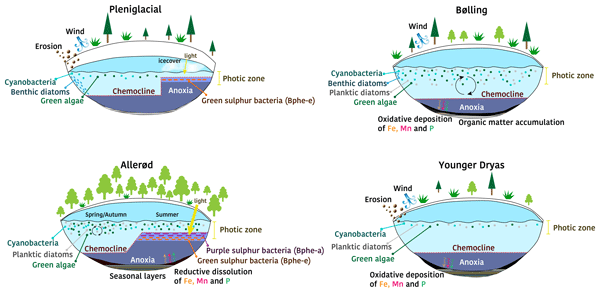
Ecological succession progress from a pioneer community of cyanobacteria to a stable anoxic late-successional community characterized by planktonic diatom Stephanodiscus minutulus and anoxygenic purple sulphur bacteria (PSB) in the photic zone. While regional warming (mean summer temperature increased ~2.8 °C) provided the physical potential for lake stratification, our data suggest that intense anoxia was primarily triggered by the expansion of Betula in the watershed. This afforestation stabilized the water column through wind shielding. The termination of the anoxic phase coincided with the onset of the Younger Dryas cooling and increased aridity, which effectively destabilized the existing stratification. While the shift from Betula to Pinus forest may have caused a change in the terrestrial-aquatic linkage, the primary driver of the transition was the physical forcing (lake mixing) of the climatic shift (cooling).
Geochemically, the lake exhibited remarkable resilience. Unlike carbonate-dominated systems prone to internal phosphorus loading, Holzmaar efficiently sequesters nutrients via a dual mechanism of reactive iron binding (authigenic vivianite) and stable mineral burial. The phosphorous trap prevents nutrient release by permanently sequestering P in the sediment, allowing rapid ecosystem recovery without delay once the specific climate and vegetation drivers shift. Our findings demonstrate that in volcanic maar lakes, catchment vegetation characteristics and local lithology can modulate, and even override, the direct effects of climate warming on aquatic anoxia.
-
Notice on discussion status
The requested preprint has a corresponding peer-reviewed final revised paper. You are encouraged to refer to the final revised version.
-
Preprint
(6110 KB)
-
The requested preprint has a corresponding peer-reviewed final revised paper. You are encouraged to refer to the final revised version.
- Preprint
(6110 KB) - Metadata XML
- BibTeX
- EndNote
- Final revised paper


Journal article(s) based on this preprint
Interactive discussion
Status: closed
-
CC1: 'Presentation of GDGT data', Paul Zander, 30 Mar 2026
-
AC3: 'Reply on CC1', Petra Zahajská, 10 Jun 2026
Dear Dr. Zander,
Thank you very much for your kind words and for taking the time to review our manuscript. We deeply appreciate your insightful comments, which have allowed us to refine the integration of the regional GDGT-based temperature reconstruction and strengthen our paleolimnological interpretations.
Please find our detailed responses to your points below:
Comment: Suggestion to remove the 3 youngest data points from Auel Maar (ages 13128, 13340, and 13875 b2k) which were excluded from the final reconstruction in Zander et al. (2024).
Response: We thank you for pointing this out. We have completely removed these three data points from both our figures and our statistical analysis. To ensure complete transparency, we have explicitly noted this quality control filtering step in the Methods section under Section 2.8 ("Predictor variable selection and quality control").
Comment: Note in the figure that GDGTs represent Temperatures of Months Above Freezing (TMAF).
Response: We have updated the text accordingly. Due to the insertion of a new site/bathymetric map early in the manuscript, the multi-proxy summary diagram is now Figure 7 in the revised version. We have corrected the y-axis label to explicitly state TGDGT (TMAF, °C) and updated the figure caption to ensure maximum clarity for the reader regarding the nature of the temperature proxy.
Comment: Incorporating high %GDGT-0 (methanogenesis) and the presence of brGDGT-IIIa'' to confirm deep-water anoxia as early as 14.2 ka BP.
Response: This is an excellent addition to our framework, and we are grateful for the suggestion. We have integrated these specific molecular indicators into our discussion in Section 4.2. Mentioning the presence of brGDGT-IIIa'' provides robust, independent geochemical support for our sedimentary pigment evidence (such as the early green sulphur bacteria marker.
Thank you once again for your constructive guidance, which has significantly upgraded the geochemical accuracy of our paper.
Sincerely,
Zahajská et al.
Citation: https://doi.org/10.5194/egusphere-2026-1390-AC3
-
AC3: 'Reply on CC1', Petra Zahajská, 10 Jun 2026
-
CC2: 'Comment on egusphere-2026-1390', Brian F. Cumming, 01 May 2026
Publisher’s note: this comment is a copy of RC2 and its content was therefore removed on 21 May 2026.
Citation: https://doi.org/10.5194/egusphere-2026-1390-CC2 -
CC3: 'Reply on CC2', Brian F. Cumming, 01 May 2026
Publisher’s note: this comment is a copy of RC2 and its content was therefore removed on 21 May 2026.
Citation: https://doi.org/10.5194/egusphere-2026-1390-CC3
-
CC3: 'Reply on CC2', Brian F. Cumming, 01 May 2026
-
RC1: 'Comment on egusphere-2026-1390', Wojciech Tylmann, 06 May 2026
Review of A high-resolution perspective on climate drivers of lake stratification and phototrophic community dynamics in Late Glacial Central Europe
General comments:
The manuscript by Zahajska et al. presents highly interesting results from maar lake Holzmaar, a well-established paleolimnological site in Central Europe. The study investigates climate-driven changes in lake stratification and associated oxygen conditions, fitting well within the scope of Biogeosciences. The topic is timely and of broad interest, as it relates to vegetation dynamics, biogeochemical processes in the water column, and lake ecosystem resilience.
A robust chronological framework, together with extensive prior research on the lake, enables thorough and well-supported interpretations of the new data. Overall, the study provides a substantial contribution of novel insights and is likely to be of wide interest to the scientific community.
I particularly appreciate very interesting scientific hypotheses, the solid multi-proxy approach, and the application of robust statistical analyses. The manuscript is clearly written, with well-defined objectives and methods, clearly presented results, and critical discussion. In my opinion, this is a high-quality scientific contribution with only minor issues (see detailed comments below). The manuscript meets the standards required for publication, and I therefore recommend acceptance after minor revisions.
Detailed comments:
Lines 40–41: This statement may be misleading, as winter mixing is often inhibited by ice cover. Furthermore, autumn is not strictly a stratified period but rather a transitional season during which mixing begins to intensify. I suggest rephrasing to: “…is disrupted when surface cooling and wind stress induce deep convective mixing in late autumn/winter or spring.”
Lines 83–91: Although the lake is well known, a more detailed description, possibly accompanied by a schematic map, would improve clarity for a broader readership.
Lines 93–99: Not sure if this information may be more appropriately placed in the Introduction section?
Line 148: Consider revising to “0.5 to 1.5 g.”
Line 185: The “modified evaporation tray method” requires either a reference or a brief description of the modification.
Line 245: Replace “three” with “III.”
Lines 251–252: I have concerns regarding the interpretation of PC2, in fact I do not understand why you think it “…represents the division between minerogenic (negative) vs organic matter and redox sensitive (positive) elements in the sediment record”. Please carefully verify the loadings, as the current interpretation appears inconsistent with Fig. A4. See also my comment on the figure caption below.
Fig. A4 caption: The caption appears inconsistent with the figure. It does not seem that Mn, S, Cu, and Zn have positive loadings on PC2. Instead, the figure indicates that Mn, Cu, and Zn exhibit strong negative loadings, while S shows only a minor positive loading.
Citation: https://doi.org/10.5194/egusphere-2026-1390-RC1 -
AC1: 'Reply on RC1', Petra Zahajská, 10 Jun 2026
We sincerely thank the reviewer for the highly positive assessment of our manuscript and for recognising the value of our multi-proxy approach and statistical analyses. We appreciate the careful reading of our work and the constructive suggestions provided, which have helped us improve the clarity and accuracy of the final manuscript.
Detailed comments:
Lines 40–41: This statement may be misleading, as winter mixing is often inhibited by ice cover. Furthermore, autumn is not strictly a stratified period but rather a transitional season during which mixing begins to intensify. I suggest rephrasing to: “…is disrupted when surface cooling and wind stress induce deep convective mixing in late autumn/winter or spring.”
Response: We thank the reviewer for this precise limnological clarification. We completely agree that winter mixing is often inhibited by ice and that autumn is transitional. We have adopted your suggested phrasing to ensure our description of the mixing dynamics is accurate.
Lines 83–91: Although the lake is well known, a more detailed description, possibly accompanied by a schematic map, would improve clarity for a broader readership.
Response: We appreciate this suggestion. To make the manuscript more accessible to a broader readership, we have expanded the site description and added both a regional map and a detailed bathymetric map of Holzmaar as Figure 1.
Lines 93–99: Not sure if this information may be more appropriately placed in the Introduction section?
Response: We agree with the reviewer that this overview of the established Late Glacial trajectory of Holzmaar serves a much stronger thematic purpose in the Introduction rather than the Methods section. We have removed this text block from the site/methods section and successfully integrated it into the final paragraph of the Introduction (Section 1). By weaving these details into our summary of previous works (Zolitschka, 1998; García et al., 2022), the manuscript now clearly outlines the known broad-scale vegetation and trophy shifts before explicitly targeting the unresolved high-resolution biogeochemical gaps that our study addresses. We feel this has greatly improved the text’s structural flow and readability.
Line 148: Consider revising to “0.5 to 1.5 g.”
Response: We have corrected this to read "0.5 to 1.5 g" as suggested.
Line 185: The “modified evaporation tray method” requires either a reference or a brief description of the modification.
Response: We apologise for the omission. We have now added the appropriate reference (Battarbee, 1986) to clarify the modified evaporation tray method used. Battarbee, R.W., 1986. Diatom analysis. In: Berglund, B.E. (Ed.), Handb. Holocene Palaeoecol. Palaeohydrol. J Wiley & Sons Ltd., New York, pp. 527- 570.
Line 245: Replace “three” with “III.”
Response: We have replaced the word "three" with the Roman numeral "III" to maintain consistency with our cluster naming convention.
Lines 251–252: I have concerns regarding the interpretation of PC2, in fact I do not understand why you think it “…represents the division between minerogenic (negative) vs organic matter and redox sensitive (positive) elements in the sediment record”. Please carefully verify the loadings, as the current interpretation appears inconsistent with Fig. A4. See also my comment on the figure caption below.
Response: We are very grateful to the reviewer for catching this discrepancy. The description of the PC2 axis was indeed swapped in the text compared to the figure A4, as well as in the figure caption of Fig. A4. We corrected the text according to the figures; everything should be correct now.
Fig. A4 caption: The caption appears inconsistent with the figure. It does not seem that Mn, S, Cu, and Zn have positive loadings on PC2. Instead, the figure indicates that Mn, Cu, and Zn exhibit strong negative loadings, while S shows only a minor positive loading.
Response: Similar to our response above, the PC2 axis description in the caption was mistakenly swapped. We have revised the caption for Figure A4 to accurately reflect the directional loadings (i.e., Mn, Cu, and Zn exhibit strong negative loadings, and S shows a minor positive loading).
Citation: https://doi.org/10.5194/egusphere-2026-1390-AC1
-
AC1: 'Reply on RC1', Petra Zahajská, 10 Jun 2026
-
RC2: 'Comment on egusphere-2026-1390', Brian Cumming, 21 May 2026
Review of a high-resolution perspective on climate drivers of lake stratification and phototrophic community dynamics in Late Glacial Central EuropeThis is an interesting and well-written paper that addresses an important question related to changes in lakes and rapid changes in climate. The issue of increasing anoxia in lakes due to changes in climate is an important issue, and studying past changes helps inform us of potential risks. The study lake is unique in terms of its size, but the findings are interesting and relevant, albeit not applicable to larger lakes where anoxia can be a problem to cold-water fish.I would categorize the study as of very high quality, in terms of the questions asked, the quality of the core over the time-frame of interest (both warming and cooling, defined by pollen assemblages), and the types and quality of the analyses (hyperspectral imaging, pigments, XRF, and diatoms). The paper is interesting and relevant.General comment – I don’t particularly like the framing of assemblages as pioneering to late-successional. This concept assumes stationarity of limnological conditions and time to reach equilibrium. Paleolimnology informs us that patterns of succession can occur, but that there can be rapid reversals of algal assemblages due to changes in climate that can change lake conditions. This should not be referred to as succession.Comments by line, some of which reinforce the general comments above.Line 18 – typo - change ‘phosphorous’ to ‘phosphorus’.Line 74-78 – Questions asked – not sure you are answering these questions in your paper. The first questions I would keep as how phototrophic communities change over periods of rapid climate change over the D-O Event 1 from 14,690 to 11,700 cal BP, involving both warming and cooling events. You are inferring stratification, which is not the question.Question 2 is more of a discussion point and not a central question.Question 3 – not sure you can assess hysteresis and this isn’t discuss much in the paper. Hysteresis is not adequately defined in the paper.Line 79 – ‘identify’ and ‘hypothesize’ are two similar but different concepts. I would not use ‘identify’.Line 86 – change to 5.8 ha (simpler)Line 87 – your site description needs to be better. You state that Holzmaar is predisposed to meromixis, but you never state that is or is not meromictic. This is important. More information is needed on this lake. Is it permanently meromictic. How does the mixolimnion mix (Lewis classification). The thermocline and the chemocline are two separate things, and normally don’t co-occur. Do they in Holzmaar? This leads to great uncertainty later in your discussion.Line 101 – don’t know what is meant by ‘parallel’ – Sediment cores taken within ‘x’ meters in the same location?Line 146 – not sure you need ‘absolute’ before pigment ..Maybe be more explicit on why hyperspectral and HPLC – to allow for inexpensive higher resolution analysis.Line 185 – ‘neutral pH’ – distilled water is not neutral (pH of ~5.6).Line 185 – reference for your modified evaporation methods. What evaporation method (Battarbee?) and how modified. If you have concentrations of diatoms, I would prefer this over the relative abundances presented so that you can relate to your Si from XRF.Line 190 – subscript for HNO3Line 220 – Only a selection of variables…. was used for further RDA… - please describe how you selected the variables you used.Line 230 – state the ‘common’ resolution?Line 236 -237 – I agree completely with the reduction of dimensionality, but how did you do this (see above). Did you adjust your permutation test for multiply comparisons? Fig. 4 seems to have a lot of forward selected variables. Did you assess the VIFs.3.2 Primary producer communities – see earlier – I would not characterize these as Pioneers, secondary colonizers and diatoms + PS. This has been done in the literature in Arctic systems, but high abundances the benthic diatoms you list in Fig. 3 in any lake dependent on the depth sampled. These taxa are likely ‘low’ light specialists (see Kingsbury et al. 2012, doi:10.1111/j.1365-2427.2012.02781.x; Gushalak et al. 2020, https://doi.org/10.1007/s10933-020-00146-w)Line 257 – Agree that you have a pattern in Fig. 2, but all pigments inferring very low production and high erosion.Fig. 2 – if you keep it, needs to be better labelled. I would much prefer seeing a plot of your pigments in terms of concentrations.Line 263 – silicifiers is not a commonly used term – do you mean diatoms and chrysophytes or just diatoms. What do you mean by red-blooming algae – dinoflagellates or Rhodophyta). Likely best to specify the pigment as not to confuse the reader.Line 264 – I didn’t read Vossel et al. (2015), but you should explain how they concluded that P. ocellata ‘thrives in oligotrophic waters with low phosphorus concentrations and a stratified water column. Vossel et al. from the title seems like a taxonomic paper and not an ecological paper. In your Fig. 3, P. ocellata has similar %abundances during the B-A when S. minutulus and Chl a are high, so in your core, your interpretation is contradictory.Line 268-269 – Likely the lake level likely increased, so this is not succession.Line 277 – agree that production was low in the Pleniglacial. Please state why you believe that nitrogen was limiting.Line 278 – if the driver is an increase in lake level, why would you refer to these taxa as late-successional. The environment is changing, succession needs stability.Line 302 – would like a little more discussion on vivianite. Biogeochemists that I have discussed vivianite in the past believe that vivianite is post-depositional, requires anoxia and ferrous iron. Wouldn’t sequestering of phosphorus occur simply by the formation of meromixis.Fig. 3 – you state ‘selected sedimentary pigments’. Why were these ones selected (higher concentrations?); do you have concentrations of diatoms – do the concentrations correspond to your spikes in Si from Fig. 1. At least in North America, P. ocellata is a planktonic taxa. I would not agree that it is benthic. It is a round rapheless centric.DiscussionLine 324 – you represent your pollen as relative abundances. Pine can be transported a very long distance, so don’t over interpret high AP values.Line 326 – totally disagree – this is not like ecological succession.Line 332 – yes you have small amounts of many taxa including benthic diatoms. To me this infers low light and an unstable landscape. What is a generalist cyanobacteria??Line 342 – agree with your rising lake levels and expansion of macrophytes and a more diverse benthic flora in the early Bolling, and then even higher water levels. In your HPLC data could you look at the ratio of chlorophyll a/pheophytin a as a proxy; I would hypothesize that if the lake got deeper this ratio would be lower and stable (more photodegradation on the way to the sediments), and when shallow and turbid the ratio would be high and potentially variable do to quick burial. Just a thought if you have this data.Line 346 – the trend towards thermal stratification cannot be inferred by okenone. Okenone is normally associated with meromixis. Thermal stratification likely occur in the upper water layer (mixolimnion) that could be categorized based on the Lewis Lake classification system (i.e. with respect to mixing patterns).Line 354 – I would not use the term successionLine 361 – I don’t see a paradox. Anaerobic bacteria and the S. minutulus occupy different regions of the lake and could easily vary seasonally, even if the lake was chemically stratified. You do not need to imply ecological plasticity. Do you have any data on seasonality. Does this lake also thermally stratify in the mixolimnion?Line 369 – Sounds like you have some data on seasonality and distribution of diatoms. Please describe the data collected. However, upon examination of the references, any evidence is sparce. If you have any evidence that S. minutulus exists above the bacterial plate please let the reader know. This appears to be highly speculative but is written definitely. Your statement “….S. minutulus to thrive in the lower epilimnion immediately above the bacterial plate…” makes no sense. The epilimnion would be up in the mixolimnion, and the bacterial plate by the chemocline. The deep chlorophyll maximum normally occurs on the metalimnion in the mixolimnion, the chemocline is normally deeper in the lake. Spanbauer’s statement is correct, but she is referring to the lower epilimnion, were diatoms get stuck due to thermal density changes. If you have directly knowledge of cooccurrence of diatoms and anoxic bacteria. This whole section is not written well. Coming in at the end of the paragraph with new data on seasonal separation should have come earlier.Line 392-394 – I would insert that the expansion of birch may have acted as a reinforcing factor.Line 403 – yes, DOC may be important but without data is you are getting complex without a lot a support.Line 412-415 – yes, may be a factor, but the cooling/aridity is likely the most likely factor. Did regional conditions show drops in lake levels? The drop in production is huge. When you say stable lake stratification, do you mean the breakdown of meromixis? or both. On Fig. 3, were diatoms simply not present but analyses attempted. Did lakes freeze over permanently? Do other records show such large changes?Line 469 – internal phosphorus loading and hysteresis are not the same. Needs clarification.Citation: https://doi.org/
10.5194/egusphere-2026-1390-RC2 -
AC2: 'Reply on RC2', Petra Zahajská, 10 Jun 2026
We thank the reviewer for this insightful comment. We completely agree that a rigid "successional" framework may imply an autogenic progression toward equilibrium that does not capture the highly dynamic, climate-forced nature of this system. Accordingly, we have thoroughly revised the manuscript to replace this framework with environment- and climate-driven designations.
In Section 3.2, the groups are now explicitly defined as:
- The Pleniglacial assemblage
- The transitional Bølling assemblage
- The stratified Allerød assemblage
We have also updated the heading of Section 4.2 to "The climate-driven primary producer community shifts" and reframed the text to focus on allogenic responses to temperature, wind shielding, and mixing regimes rather than ecological succession.
Comments by line, some of which reinforce the general comments above.
Line 18 – typo - change ‘phosphorous’ to ‘phosphorus’.
Response: We have corrected this typographical error throughout the manuscript.
Line 74-78 – Questions asked – not sure you are answering these questions in your paper. The first questions I would keep as how phototrophic communities change over periods of rapid climate change over the D-O Event 1 from 14,690 to 11,700 cal BP, involving both warming and cooling events. You are inferring stratification, which is not the question.
Question 2 is more of a discussion point and not a central question.
Question 3 – not sure you can assess hysteresis and this isn’t discuss much in the paper. Hysteresis is not adequately defined in the paper.
Response: We appreciate this constructive critique. We have streamlined and restructured our central research questions in the Introduction to align tightly with our datasets and final interpretations. We removed the overemphasis on stratification in the first question, omitted the separate discussion point, and addressed the conflation regarding "hysteresis". The text now presents two focused questions:
- How do phototrophic communities change in response to periods of rapid climate shifts (both warming and cooling) during Dansgaard-Oeschger Event 1 (14,690–11,700 yr cal BP)?
- How do internal biogeochemical mechanisms (such as iron-mediated nutrient retention) and catchment vegetation modulate the resilience of the lake and ecosystem reversibility when these climatic drivers shift?
Line 79 – ‘identify’ and ‘hypothesize’ are two similar but different concepts. I would not use ‘identify’.
Response: We agree with this distinction. The text has been modified to: "...we hypothesize the specific roles of catchment vegetation and iron availability in regulating lake resilience."
Line 86 – change to 5.8 ha (simpler)
Response: To balance maximum data interoperability with reader scannability, we have included both units in the site description: "...with a small surface area of 58,000m2 (5.8 ha) relative to its maximum depth of 20 m.."
Line 87 – your site description needs to be better. You state that Holzmaar is predisposed to meromixis, but you never state that is or is not meromictic. This is important. More information is needed on this lake. Is it permanently meromictic. How does the mixolimnion mix (Lewis classification). The thermocline and the chemocline are two separate things, and normally don’t co-occur. Do they in Holzmaar? This leads to great uncertainty later in your discussion.
Response: We thank the reviewer for pointing out these ambiguities. We will expand the site description to provide a clearer limnological context. Specifically, we will clarify that Holzmaar is currently dimictic rather than meromictic. We will also explicitly note that in this specific system, the thermocline and chemocline are often located in close proximity to one another at approximately 6 m of water depth.
Line 101 – don’t know what is meant by ‘parallel’ – Sediment cores taken within ‘x’ meters in the same location?
Response: We agree that this wording was unclear and have replaced "parallel" with "adjacent" to better describe the coring locations. We also added a map with the locations of the coring as figure 1.
Line 146 – not sure you need ‘absolute’ before pigment ..Maybe be more explicit on why hyperspectral and HPLC – to allow for inexpensive higher resolution analysis.
Response: We have removed the word "absolute" as suggested. Furthermore, we have explicitly clarified our methodological rationale, noting that combining hyperspectral imaging with HPLC enables highly detailed, continuous-resolution analysis in a more time- and cost-effective manner.
Line 185 – ‘neutral pH’ – distilled water is not neutral (pH of ~5.6).
Response: We appreciate the reviewer catching this detail. The text will be adjusted to: “An aliquot of each sample was oxidised with 30% H2O2 and heated in a water bath at approximately 80°C for 2-5 minutes to eliminate organic matter, following standard methods (Batterbee 1986). Permanent slides were mounted using Naphrax mounting medium.”
Line 185 – reference for your modified evaporation methods. What evaporation method (Battarbee?) and how modified. If you have concentrations of diatoms, I would prefer this over the relative abundances presented so that you can relate to your Si from XRF.
Response: We have added the proper reference for the evaporation method used: Battarbee, R.W., 1986. Diatom analysis. In: Berglund, B.E. (Ed.), Handb. Holocene Palaeoecol. Palaeohydrol. J Wiley & Sons Ltd., New York, pp. 527-570. We also add the diatom concentrations to Figure 1 (now Fig. 2) under the Si/Ti ratio, but we keep the Si/Ti ratio for further analysis, as its resolution is much higher than that of the diatom concentrations.
Line 190 – subscript for HNO3
Response: We have corrected the formatting.
Line 220 – Only a selection of variables…. was used for further RDA… - please describe how you selected the variables you used.
Response: We have expanded Section 2.8 ("Predictor variable selection and quality control") to explicitly describe our selection workflow. We performed a formal Variance Inflation Factor (VIF) assessment with a strict exclusion threshold of VIF > 10 to clear out collinear variables (which removed 8 redundant parameters, including annual/seasonal insolation curves and several pollen lines), leaving a robust subset of 10 non-redundant environmental drivers for the final Redundancy Analysis (RDA).
Line 230 – state the ‘common’ resolution?
Response: We have added the specific information regarding the common resolution. The XRF-HSI data were aligned at a 1 mm resolution, while the lower-resolution variables and external datasets were aligned at a 100-year resolution.
Line 236 -237 – I agree completely with the reduction of dimensionality, but how did you do this (see above). Did you adjust your permutation test for multiply comparisons? Fig. 4 seems to have a lot of forward selected variables. Did you assess the VIFs.
Response: As described in our updated Section 2.8, we shifted to a strict VIF-based filtering protocol to resolve collinearity prior to running the ordination model, removing 8 highly multicollinear variables. For quality control in our permutation testing, we now explicitly state that significance was evaluated using 999 unrestricted permutations across the entire model and individual axes, with p-value thresholds systematically adjusted using a conservative Bonferroni correction (α) to avoid Type I error inflation. The final RDA biplot has been updated accordingly and is now presented as Figure 5.
3.2 Primary producer communities – see earlier – I would not characterize these as Pioneers, secondary colonizers and diatoms + PS. This has been done in the literature in Arctic systems, but high abundances the benthic diatoms you list in Fig. 3 in any lake dependent on the depth sampled. These taxa are likely ‘low’ light specialists (see Kingsbury et al. 2012, doi:10.1111/j.1365-2427.2012.02781.x; Gushalak et al. 2020, https://doi.org/10.1007/s10933-020-00146-w)
Response: We are very grateful for this recommendation and the provided literature. We agree that describing these shifts as a classic autogenic succession was flawed. In Section 4.2, we have reinterpreted the Pleniglacial community through the lens of light limitation and landscape instability. Guided by Kingsbury et al. (2012) and Gushulak and Cumming (2020), we now discuss these small fragilarioid diatoms and cryptophytes (alloxanthin) as specialised low-light and turbidity-tolerant assemblages that held a clear competitive edge during a harsh, well-mixed phase with prolonged ice cover, matching the ecological traits highlighted by the reviewer.
Line 257 – Agree that you have a pattern in Fig. 2, but all pigments inferring very low production and high erosion.
Response: We have clarified this interpretation in Section 4.2. The Pleniglacial pigment profile is now explicitly contextualised as a low-biomass assemblage operating under severe nutritional and climatic strain, strictly co-occurring with high detrital input (Ti) driven by intense regional wind activity and an open, unstable landscape.
Fig. 2 – if you keep it, needs to be better labelled. I would much prefer seeing a plot of your pigments in terms of concentrations.
Response: We opted for a heatmap because centring and scaling the data effectively removes the sediment composition effect, allowing us to better visualise the relative shifts between communities. We hope the reviewer agrees that this is valuable for interpretation. However, we understand the desire to see absolute values, so we have now added a supplementary figure presenting the absolute pigment concentrations.
Line 263 – silicifiers is not a commonly used term – do you mean diatoms and chrysophytes or just diatoms. What do you mean by red-blooming algae – dinoflagellates or Rhodophyta). Likely best to specify the pigment as not to confuse the reader.
Response: We have eliminated these vague categories to prevent confusion. The text has been modified to specify the precise biomarker names alongside their concrete producer classifications based on modern chemotaxonomic literature (e.g., reclassifying "red-blooming algae" to astaxanthin-producing chlorophytes or dinoflagellates). These details have also been carefully cross-checked and updated in the summary reference table (Table A1).
Line 264 – I didn’t read Vossel et al. (2015), but you should explain how they concluded that P. ocellata thrives in oligotrophic waters with low phosphorus concentrations and a stratified water column. Vossel et al. from the title seems like a taxonomic paper and not an ecological paper. In your Fig. 3, P. ocellata has similar %abundances during the B-A when S. minutulus and Chl a are high, so in your core, your interpretation is contradictory.
Response: The reviewer is entirely correct; our original interpretation of Pantocsekiella ocellata was too restrictive and created a clear contradiction with our productivity proxies (S. minutulus and high chlorophyll a) during the Bølling-Allerød. We have completely revised this section. While Vossel et al. (2015) is primarily a taxonomic paper, they note that open-water morphotypes of the P. ocellata complex exhibit wide nutrient tolerances and are prevalent in deep, open water column settings. Because cyclotelloids have a clear morphological advantage for staying suspended, their co-occurrence with heavy S. minutulus diatoms and photic-zone euxinia markers (okenone) provides key evidence for a structured meromictic mixing regime. This indicates that active seasonal mixing occurred within an open upper mixolimnion, while a stagnant deep monimolimnion preserved the anoxic bacterial plate.
Line 268-269 – Likely the lake level likely increased, so this is not succession.
Response: We agree. This text has been completely rewritten to frame the structural transition in terms of expanding pelagic niches, rising water levels, and changing lake morphometry, rather than autogenic ecological succession.
Line 277 – agree that production was low in the Pleniglacial. Please state why you believe that nitrogen was limiting.
Response: We have added our explicit biogeochemical reasoning to Section 4.2: the inference of nitrogen limitation is supported by the high relative abundance of generalist cyanobacteria (highly efficient in nitrogen-poor waters or capable of nitrogen fixation) occurring alongside the terrestrial expansion of Juniperus in the catchment, which is a prominent pioneer taxon known to target young, nitrogen-deficient soils.
Line 278 – if the driver is an increase in lake level, why would you refer to these taxa as late-successional. The environment is changing, succession needs stability.
Response: We agree completely. The term "late-successional" has been deleted and replaced with a process-based descriptor: "the stratified Allerød assemblage" (Section 3.2 & 4.2).
Line 302 – would like a little more discussion on vivianite. Biogeochemists that I have discussed vivianite in the past believe that vivianite is post-depositional, requires anoxia and ferrous iron. Wouldn’t sequestering of phosphorus occur simply by the formation of meromixis.
Response: This is an excellent point. Vivianite is indeed a post-depositional mineral requiring anoxia and ferrous iron, and this is precisely the mechanism by which phosphorus was trapped in Holzmaar. While P is initially sequestered due to meromixis, we must emphasise that it remains permanently sequestered in the sediment due to its reaction with iron. In systems where iron is not readily available, P can be released back into the water column under anoxic conditions via reductive dissolution of the Fe-(oxy)hydroxides it adsorbs onto. We have expanded our discussion to clarify these distinct processes.
Fig. 3 – you state ‘selected sedimentary pigments’. Why were these ones selected (higher concentrations?); do you have concentrations of diatoms – do the concentrations correspond to your spikes in Si from Fig. 1. At least in North America, P. ocellata is a planktonic taxa. I would not agree that it is benthic. It is a round rapheless centric.
Response: We have updated this figure (now Figure 4) and its caption to explicitly state that the pigments selected serve as diagnostic biomarkers representing the major primary producer groups and major structural shifts. We have added absolute diatom concentration profiles to Fig 1 (now Fig 2), which show excellent stratigraphic agreement with our high-resolution ratio. Finally, we thank the reviewer for pointing out the ecological misclassification of P. ocellata, we have corrected its classification from benthic to planktonic and updated its color coding in the figures.
Discussion
Line 324 – you represent your pollen as relative abundances. Pine can be transported a very long distance, so don’t over interpret high AP values.
Response: We thank the reviewer for this important caveat regarding pine pollen transport. We are mindful of this and have ensured that our interpretations of the AP values remain conservative.
Line 326 – totally disagree – this is not like ecological succession.
Response: We agree and have removed the succession analogy entirely, replacing it with an interpretation driven by physical mixing and landscape thresholds.
Line 332 – yes you have small amounts of many taxa including benthic diatoms. To me this infers low light and an unstable landscape. What is a generalist cyanobacteria??
Response: We have rewritten this section to centre on a low-light, highly turbid environment and an unstable, eroding landscape. We also clarified that "generalist cyanobacteria" refers to our bulk echinenone pigment signal, which indicates the presence of general cyanobacteria prior to the development of specialised nitrogen-fixing communities. But we have rephrased this part for clarity.
Line 342 – agree with your rising lake levels and expansion of macrophytes and a more diverse benthic flora in the early Bolling, and then even higher water levels. In your HPLC data could you look at the ratio of chlorophyll a/pheophytin a as a proxy; I would hypothesize that if the lake got deeper this ratio would be lower and stable (more photodegradation on the way to the sediments), and when shallow and turbid the ratio would be high and potentially variable do to quick burial. Just a thought if you have this data.
Response: This is an excellent methodological suggestion. We calculated the chlorophyll a / pheophytin a ratio and included it in our supplementary material. However, we have added a note of caution in our text: because these pigments are highly sensitive to post-coring oxidation and light exposure during core handling and extraction, the downcore ratio can easily incorporate modern degradation artefacts. Thus, while it aligns conceptually with our water-depth interpretations, we choose to treat it with appropriate analytical caution.
Line 346 – the trend towards thermal stratification cannot be inferred by okenone. Okenone is normally associated with meromixis. Thermal stratification likely occur in the upper water layer (mixolimnion) that could be categorized based on the Lewis Lake classification system (i.e. with respect to mixing patterns).
Response: We agree completely with this critical limnological distinction. We have adjusted our phrasing in Section 4.2 to specify stable chemical stratification and meromixis rather than thermal stratification, noting that okenone strictly marks the position of the chemocline reaching the photic zone. We do note, however, that in modern Holzmaar, the thermocline and chemocline often coincide at a depth of 6-8 m.
Line 354 – I would not use the term succession
Response: The term has been removed here and throughout the manuscript.
Line 361 – I don’t see a paradox. Anaerobic bacteria and the S. minutulus occupy different regions of the lake and could easily vary seasonally, even if the lake was chemically stratified. You do not need to imply ecological plasticity. Do you have any data on seasonality. Does this lake also thermally stratify in the mixolimnion?
Response: We appreciate this comment, which helped clear up an over-complicated argument. We have removed all mention of an ecological paradox or specialized plasticity. The text has been heavily rewritten to describe this co-occurrence as a direct consequence of a structured, compartmentalized water column (seasonal or spatial separation) within a meromictic lake.
Line 369 – Sounds like you have some data on seasonality and distribution of diatoms. Please describe the data collected. However, upon examination of the references, any evidence is sparce. If you have any evidence that S. minutulus exists above the bacterial plate please let the reader know. This appears to be highly speculative but is written definitely. Your statement “…. S. minutulus to thrive in the lower epilimnion immediately above the bacterial plate…” makes no sense. The epilimnion would be up in the mixolimnion, and the bacterial plate by the chemocline. The deep chlorophyll maximum normally occurs on the metalimnion in the mixolimnion, the chemocline is normally deeper in the lake. Spanbauer’s statement is correct, but she is referring to the lower epilimnion, were diatoms get stuck due to thermal density changes. If you have directly knowledge of cooccurrence of diatoms and anoxic bacteria. This whole section is not written well. Coming in at the end of the paragraph with new data on seasonal separation should have come earlier.
Response: We apologise for the flawed limnological terminology in our previous draft, which we have carefully corrected in Section 4.2. Our direct evidence for seasonal vs spatial coexistence comes from our high-resolution hyperspectral core scans (Figure 6, formerly Figure 5). The micro-stratigraphy of the varves shows a dual control: distinct, unmixed seasonal laminae (strict spring diatom blooms interbedded with summer bacterial plates) occur alongside micro-layers showing simultaneous deposition. We have restructured the paragraph to clarify that during summer stratification of the upper mixolimnion, S. minutulus successfully occupied a shaded, light-limited niche, forming a Deep Chlorophyll Maximum (DCM) within the metalimnion, positioned vertically distinct from and immediately above the dense, self-shading purple sulphur bacterial plate at the deeper chemocline.
Line 392-394 – I would insert that the expansion of birch may have acted as a reinforcing factor.
Response: We agree and have adjusted Section 4.3 to state that the expansion of Betula acted as a reinforcing factor: "...the stabilisation of catchment soils by Betula and the associated export of organic matter acted as a reinforcing factor for lake stratification." (Lines 463–464).
Line 403 – yes, DOC may be important but without data is you are getting complex without a lot a support.
Response: We agree that without direct proxy data for DOC, this becomes overly speculative. We have removed this hypothesis from the discussion.
Line 412-415 – yes, may be a factor, but the cooling/aridity is likely the most likely factor. Did regional conditions show drops in lake levels? The drop in production is huge. When you say stable lake stratification, do you mean the breakdown of meromixis? or both. On Fig. 3, were diatoms simply not present but analyses attempted. Did lakes freeze over permanently? Do other records show such large changes?
Response: We agree completely with the reviewer that regional cooling and increased aridity were the decisive drivers behind this major transition. We have adjusted the discussion in Sections 4.2 and 4.3 to explicitly focus on these climatic drivers, and we will to address the specific points as follows:
- Lake-level changes: To our knowledge, there are no documented or conclusive indications of distinct Late Glacial lake-level fluctuations from the Eifel region. Therefore, we avoid attributing the productivity drop to changes in water depth and focus primarily on thermal and density-driven mechanisms.
- Permanent ice cover vs. permafrost runoff: Given Holzmaar's latitudinal position (~50°N), a permanent, perennial ice cover is highly unlikely and is physically argued against by the continuous deposition of sediments preserved throughout both the Pleniglacial and the Younger Dryas. An extended seasonal or severe winter ice cover certainly could have occurred.
- Stratification vs. meromixis breakdown: When discussing the termination of this stable state, we are specifically referring to the complete collapse of the stable meromictic density gradient (and its associated monimolimnetic anoxia) back into a holomictic mixing regime. The drop in temperatures and enhanced wind-driven wave action increased surface water density, triggering deep convective mixing that completely re-oxygenated the deep basin and dismantled the metalimnetic chemocline. This clear structural shift and the subsequent ecological reversal are discussed in Section 4.2 and visually traced by the multivariate trajectory returning to the pioneer-community space in Figure A5.
- Further diatom data: Diatom analysis was not conducted in the YD because of a sedimentary hiatus, and the diatom analysis resolution was 4cm. Indeed, a higher-resolution diatom analysis at the end of anoxia would be useful, though we don't have these data. We can add a note from the Holocene diatom stratigraphy from García et al. 2022 to refer to the community after the hiatus.
Line 469 – internal phosphorus loading and hysteresis are not the same. Needs clarification.
Response: We appreciate this correction. We have uncoupled these terms in our Conclusions (Section 5). We now clearly define internal phosphorus loading as the specific biogeochemical feedback loop that recycles sediment nutrients, whereas hysteresis is properly described as the resulting macro-level ecosystem state (i.e., a delayed recovery after the primary climate driver is removed).
Citation: https://doi.org/10.5194/egusphere-2026-1390-AC2
-
AC2: 'Reply on RC2', Petra Zahajská, 10 Jun 2026
Peer review completion


Post-review adjustments


Interactive discussion
Status: closed
-
CC1: 'Presentation of GDGT data', Paul Zander, 30 Mar 2026
Dear Dr. Zahajská et al.,
Congratulations on this nice study - I found it very interesting to read about the changes in lake ecology during this period of rapid climate changes.
My comments pertain to the use of GDGT data from Holzmaar and nearby Auel Maar published in Zander et al., 2024 (Climate of the Past). As author of that study, I want to suggest a couple small changes to how you present the temperature reconstruction based on GDGTs.
1) I suggest to remove data points in the temperature reconstruction that were not included the final temperature reconstruction. These are the 3 youngest data points from Auel Maar, which were measured as a check on the overlap with Holzmaar, but were excluded due to the poor chronology of Auel Maar in this section and because there may have some influence of soil GDGTs as Auel Maar was very shallow transitioning to a floodplain during this time. The data points to exclude have ages
13128 b2k
13340 b2k
13875 b2kIn the PANGAEA data file, these are marked with a comment as not included in the final temperature reconstruction, but I can understand how this could easily be missed, and I plan to resubmit the dataset with these temperature estimates removed.
2) Please note in Figure 6 either on the axis label or in the caption that the GDGTs represent Temperatures of Months Above Freezing (TMAF).
3) It might be interesting to mention that the very high %GDGT-0 indicates a lot of methanogenic activity in Holzmaar, including the late glacial, and the presence brGDGT-IIIa'' also confirms anoxic conditions in the hypolimnion even in the oldest sample I analyzed at 14.2 ka BP.
Sincerely,
Paul ZanderCitation: https://doi.org/10.5194/egusphere-2026-1390-CC1 -
AC3: 'Reply on CC1', Petra Zahajská, 10 Jun 2026
Dear Dr. Zander,
Thank you very much for your kind words and for taking the time to review our manuscript. We deeply appreciate your insightful comments, which have allowed us to refine the integration of the regional GDGT-based temperature reconstruction and strengthen our paleolimnological interpretations.
Please find our detailed responses to your points below:
Comment: Suggestion to remove the 3 youngest data points from Auel Maar (ages 13128, 13340, and 13875 b2k) which were excluded from the final reconstruction in Zander et al. (2024).
Response: We thank you for pointing this out. We have completely removed these three data points from both our figures and our statistical analysis. To ensure complete transparency, we have explicitly noted this quality control filtering step in the Methods section under Section 2.8 ("Predictor variable selection and quality control").
Comment: Note in the figure that GDGTs represent Temperatures of Months Above Freezing (TMAF).
Response: We have updated the text accordingly. Due to the insertion of a new site/bathymetric map early in the manuscript, the multi-proxy summary diagram is now Figure 7 in the revised version. We have corrected the y-axis label to explicitly state TGDGT (TMAF, °C) and updated the figure caption to ensure maximum clarity for the reader regarding the nature of the temperature proxy.
Comment: Incorporating high %GDGT-0 (methanogenesis) and the presence of brGDGT-IIIa'' to confirm deep-water anoxia as early as 14.2 ka BP.
Response: This is an excellent addition to our framework, and we are grateful for the suggestion. We have integrated these specific molecular indicators into our discussion in Section 4.2. Mentioning the presence of brGDGT-IIIa'' provides robust, independent geochemical support for our sedimentary pigment evidence (such as the early green sulphur bacteria marker.
Thank you once again for your constructive guidance, which has significantly upgraded the geochemical accuracy of our paper.
Sincerely,
Zahajská et al.
Citation: https://doi.org/10.5194/egusphere-2026-1390-AC3
-
AC3: 'Reply on CC1', Petra Zahajská, 10 Jun 2026
-
CC2: 'Comment on egusphere-2026-1390', Brian F. Cumming, 01 May 2026
Publisher’s note: this comment is a copy of RC2 and its content was therefore removed on 21 May 2026.
Citation: https://doi.org/10.5194/egusphere-2026-1390-CC2 -
CC3: 'Reply on CC2', Brian F. Cumming, 01 May 2026
Publisher’s note: this comment is a copy of RC2 and its content was therefore removed on 21 May 2026.
Citation: https://doi.org/10.5194/egusphere-2026-1390-CC3
-
CC3: 'Reply on CC2', Brian F. Cumming, 01 May 2026
-
RC1: 'Comment on egusphere-2026-1390', Wojciech Tylmann, 06 May 2026
Review of A high-resolution perspective on climate drivers of lake stratification and phototrophic community dynamics in Late Glacial Central Europe
General comments:
The manuscript by Zahajska et al. presents highly interesting results from maar lake Holzmaar, a well-established paleolimnological site in Central Europe. The study investigates climate-driven changes in lake stratification and associated oxygen conditions, fitting well within the scope of Biogeosciences. The topic is timely and of broad interest, as it relates to vegetation dynamics, biogeochemical processes in the water column, and lake ecosystem resilience.
A robust chronological framework, together with extensive prior research on the lake, enables thorough and well-supported interpretations of the new data. Overall, the study provides a substantial contribution of novel insights and is likely to be of wide interest to the scientific community.
I particularly appreciate very interesting scientific hypotheses, the solid multi-proxy approach, and the application of robust statistical analyses. The manuscript is clearly written, with well-defined objectives and methods, clearly presented results, and critical discussion. In my opinion, this is a high-quality scientific contribution with only minor issues (see detailed comments below). The manuscript meets the standards required for publication, and I therefore recommend acceptance after minor revisions.
Detailed comments:
Lines 40–41: This statement may be misleading, as winter mixing is often inhibited by ice cover. Furthermore, autumn is not strictly a stratified period but rather a transitional season during which mixing begins to intensify. I suggest rephrasing to: “…is disrupted when surface cooling and wind stress induce deep convective mixing in late autumn/winter or spring.”
Lines 83–91: Although the lake is well known, a more detailed description, possibly accompanied by a schematic map, would improve clarity for a broader readership.
Lines 93–99: Not sure if this information may be more appropriately placed in the Introduction section?
Line 148: Consider revising to “0.5 to 1.5 g.”
Line 185: The “modified evaporation tray method” requires either a reference or a brief description of the modification.
Line 245: Replace “three” with “III.”
Lines 251–252: I have concerns regarding the interpretation of PC2, in fact I do not understand why you think it “…represents the division between minerogenic (negative) vs organic matter and redox sensitive (positive) elements in the sediment record”. Please carefully verify the loadings, as the current interpretation appears inconsistent with Fig. A4. See also my comment on the figure caption below.
Fig. A4 caption: The caption appears inconsistent with the figure. It does not seem that Mn, S, Cu, and Zn have positive loadings on PC2. Instead, the figure indicates that Mn, Cu, and Zn exhibit strong negative loadings, while S shows only a minor positive loading.
Citation: https://doi.org/10.5194/egusphere-2026-1390-RC1 -
AC1: 'Reply on RC1', Petra Zahajská, 10 Jun 2026
We sincerely thank the reviewer for the highly positive assessment of our manuscript and for recognising the value of our multi-proxy approach and statistical analyses. We appreciate the careful reading of our work and the constructive suggestions provided, which have helped us improve the clarity and accuracy of the final manuscript.
Detailed comments:
Lines 40–41: This statement may be misleading, as winter mixing is often inhibited by ice cover. Furthermore, autumn is not strictly a stratified period but rather a transitional season during which mixing begins to intensify. I suggest rephrasing to: “…is disrupted when surface cooling and wind stress induce deep convective mixing in late autumn/winter or spring.”
Response: We thank the reviewer for this precise limnological clarification. We completely agree that winter mixing is often inhibited by ice and that autumn is transitional. We have adopted your suggested phrasing to ensure our description of the mixing dynamics is accurate.
Lines 83–91: Although the lake is well known, a more detailed description, possibly accompanied by a schematic map, would improve clarity for a broader readership.
Response: We appreciate this suggestion. To make the manuscript more accessible to a broader readership, we have expanded the site description and added both a regional map and a detailed bathymetric map of Holzmaar as Figure 1.
Lines 93–99: Not sure if this information may be more appropriately placed in the Introduction section?
Response: We agree with the reviewer that this overview of the established Late Glacial trajectory of Holzmaar serves a much stronger thematic purpose in the Introduction rather than the Methods section. We have removed this text block from the site/methods section and successfully integrated it into the final paragraph of the Introduction (Section 1). By weaving these details into our summary of previous works (Zolitschka, 1998; García et al., 2022), the manuscript now clearly outlines the known broad-scale vegetation and trophy shifts before explicitly targeting the unresolved high-resolution biogeochemical gaps that our study addresses. We feel this has greatly improved the text’s structural flow and readability.
Line 148: Consider revising to “0.5 to 1.5 g.”
Response: We have corrected this to read "0.5 to 1.5 g" as suggested.
Line 185: The “modified evaporation tray method” requires either a reference or a brief description of the modification.
Response: We apologise for the omission. We have now added the appropriate reference (Battarbee, 1986) to clarify the modified evaporation tray method used. Battarbee, R.W., 1986. Diatom analysis. In: Berglund, B.E. (Ed.), Handb. Holocene Palaeoecol. Palaeohydrol. J Wiley & Sons Ltd., New York, pp. 527- 570.
Line 245: Replace “three” with “III.”
Response: We have replaced the word "three" with the Roman numeral "III" to maintain consistency with our cluster naming convention.
Lines 251–252: I have concerns regarding the interpretation of PC2, in fact I do not understand why you think it “…represents the division between minerogenic (negative) vs organic matter and redox sensitive (positive) elements in the sediment record”. Please carefully verify the loadings, as the current interpretation appears inconsistent with Fig. A4. See also my comment on the figure caption below.
Response: We are very grateful to the reviewer for catching this discrepancy. The description of the PC2 axis was indeed swapped in the text compared to the figure A4, as well as in the figure caption of Fig. A4. We corrected the text according to the figures; everything should be correct now.
Fig. A4 caption: The caption appears inconsistent with the figure. It does not seem that Mn, S, Cu, and Zn have positive loadings on PC2. Instead, the figure indicates that Mn, Cu, and Zn exhibit strong negative loadings, while S shows only a minor positive loading.
Response: Similar to our response above, the PC2 axis description in the caption was mistakenly swapped. We have revised the caption for Figure A4 to accurately reflect the directional loadings (i.e., Mn, Cu, and Zn exhibit strong negative loadings, and S shows a minor positive loading).
Citation: https://doi.org/10.5194/egusphere-2026-1390-AC1
-
AC1: 'Reply on RC1', Petra Zahajská, 10 Jun 2026
-
RC2: 'Comment on egusphere-2026-1390', Brian Cumming, 21 May 2026
Review of a high-resolution perspective on climate drivers of lake stratification and phototrophic community dynamics in Late Glacial Central EuropeThis is an interesting and well-written paper that addresses an important question related to changes in lakes and rapid changes in climate. The issue of increasing anoxia in lakes due to changes in climate is an important issue, and studying past changes helps inform us of potential risks. The study lake is unique in terms of its size, but the findings are interesting and relevant, albeit not applicable to larger lakes where anoxia can be a problem to cold-water fish.I would categorize the study as of very high quality, in terms of the questions asked, the quality of the core over the time-frame of interest (both warming and cooling, defined by pollen assemblages), and the types and quality of the analyses (hyperspectral imaging, pigments, XRF, and diatoms). The paper is interesting and relevant.General comment – I don’t particularly like the framing of assemblages as pioneering to late-successional. This concept assumes stationarity of limnological conditions and time to reach equilibrium. Paleolimnology informs us that patterns of succession can occur, but that there can be rapid reversals of algal assemblages due to changes in climate that can change lake conditions. This should not be referred to as succession.Comments by line, some of which reinforce the general comments above.Line 18 – typo - change ‘phosphorous’ to ‘phosphorus’.Line 74-78 – Questions asked – not sure you are answering these questions in your paper. The first questions I would keep as how phototrophic communities change over periods of rapid climate change over the D-O Event 1 from 14,690 to 11,700 cal BP, involving both warming and cooling events. You are inferring stratification, which is not the question.Question 2 is more of a discussion point and not a central question.Question 3 – not sure you can assess hysteresis and this isn’t discuss much in the paper. Hysteresis is not adequately defined in the paper.Line 79 – ‘identify’ and ‘hypothesize’ are two similar but different concepts. I would not use ‘identify’.Line 86 – change to 5.8 ha (simpler)Line 87 – your site description needs to be better. You state that Holzmaar is predisposed to meromixis, but you never state that is or is not meromictic. This is important. More information is needed on this lake. Is it permanently meromictic. How does the mixolimnion mix (Lewis classification). The thermocline and the chemocline are two separate things, and normally don’t co-occur. Do they in Holzmaar? This leads to great uncertainty later in your discussion.Line 101 – don’t know what is meant by ‘parallel’ – Sediment cores taken within ‘x’ meters in the same location?Line 146 – not sure you need ‘absolute’ before pigment ..Maybe be more explicit on why hyperspectral and HPLC – to allow for inexpensive higher resolution analysis.Line 185 – ‘neutral pH’ – distilled water is not neutral (pH of ~5.6).Line 185 – reference for your modified evaporation methods. What evaporation method (Battarbee?) and how modified. If you have concentrations of diatoms, I would prefer this over the relative abundances presented so that you can relate to your Si from XRF.Line 190 – subscript for HNO3Line 220 – Only a selection of variables…. was used for further RDA… - please describe how you selected the variables you used.Line 230 – state the ‘common’ resolution?Line 236 -237 – I agree completely with the reduction of dimensionality, but how did you do this (see above). Did you adjust your permutation test for multiply comparisons? Fig. 4 seems to have a lot of forward selected variables. Did you assess the VIFs.3.2 Primary producer communities – see earlier – I would not characterize these as Pioneers, secondary colonizers and diatoms + PS. This has been done in the literature in Arctic systems, but high abundances the benthic diatoms you list in Fig. 3 in any lake dependent on the depth sampled. These taxa are likely ‘low’ light specialists (see Kingsbury et al. 2012, doi:10.1111/j.1365-2427.2012.02781.x; Gushalak et al. 2020, https://doi.org/10.1007/s10933-020-00146-w)Line 257 – Agree that you have a pattern in Fig. 2, but all pigments inferring very low production and high erosion.Fig. 2 – if you keep it, needs to be better labelled. I would much prefer seeing a plot of your pigments in terms of concentrations.Line 263 – silicifiers is not a commonly used term – do you mean diatoms and chrysophytes or just diatoms. What do you mean by red-blooming algae – dinoflagellates or Rhodophyta). Likely best to specify the pigment as not to confuse the reader.Line 264 – I didn’t read Vossel et al. (2015), but you should explain how they concluded that P. ocellata ‘thrives in oligotrophic waters with low phosphorus concentrations and a stratified water column. Vossel et al. from the title seems like a taxonomic paper and not an ecological paper. In your Fig. 3, P. ocellata has similar %abundances during the B-A when S. minutulus and Chl a are high, so in your core, your interpretation is contradictory.Line 268-269 – Likely the lake level likely increased, so this is not succession.Line 277 – agree that production was low in the Pleniglacial. Please state why you believe that nitrogen was limiting.Line 278 – if the driver is an increase in lake level, why would you refer to these taxa as late-successional. The environment is changing, succession needs stability.Line 302 – would like a little more discussion on vivianite. Biogeochemists that I have discussed vivianite in the past believe that vivianite is post-depositional, requires anoxia and ferrous iron. Wouldn’t sequestering of phosphorus occur simply by the formation of meromixis.Fig. 3 – you state ‘selected sedimentary pigments’. Why were these ones selected (higher concentrations?); do you have concentrations of diatoms – do the concentrations correspond to your spikes in Si from Fig. 1. At least in North America, P. ocellata is a planktonic taxa. I would not agree that it is benthic. It is a round rapheless centric.DiscussionLine 324 – you represent your pollen as relative abundances. Pine can be transported a very long distance, so don’t over interpret high AP values.Line 326 – totally disagree – this is not like ecological succession.Line 332 – yes you have small amounts of many taxa including benthic diatoms. To me this infers low light and an unstable landscape. What is a generalist cyanobacteria??Line 342 – agree with your rising lake levels and expansion of macrophytes and a more diverse benthic flora in the early Bolling, and then even higher water levels. In your HPLC data could you look at the ratio of chlorophyll a/pheophytin a as a proxy; I would hypothesize that if the lake got deeper this ratio would be lower and stable (more photodegradation on the way to the sediments), and when shallow and turbid the ratio would be high and potentially variable do to quick burial. Just a thought if you have this data.Line 346 – the trend towards thermal stratification cannot be inferred by okenone. Okenone is normally associated with meromixis. Thermal stratification likely occur in the upper water layer (mixolimnion) that could be categorized based on the Lewis Lake classification system (i.e. with respect to mixing patterns).Line 354 – I would not use the term successionLine 361 – I don’t see a paradox. Anaerobic bacteria and the S. minutulus occupy different regions of the lake and could easily vary seasonally, even if the lake was chemically stratified. You do not need to imply ecological plasticity. Do you have any data on seasonality. Does this lake also thermally stratify in the mixolimnion?Line 369 – Sounds like you have some data on seasonality and distribution of diatoms. Please describe the data collected. However, upon examination of the references, any evidence is sparce. If you have any evidence that S. minutulus exists above the bacterial plate please let the reader know. This appears to be highly speculative but is written definitely. Your statement “….S. minutulus to thrive in the lower epilimnion immediately above the bacterial plate…” makes no sense. The epilimnion would be up in the mixolimnion, and the bacterial plate by the chemocline. The deep chlorophyll maximum normally occurs on the metalimnion in the mixolimnion, the chemocline is normally deeper in the lake. Spanbauer’s statement is correct, but she is referring to the lower epilimnion, were diatoms get stuck due to thermal density changes. If you have directly knowledge of cooccurrence of diatoms and anoxic bacteria. This whole section is not written well. Coming in at the end of the paragraph with new data on seasonal separation should have come earlier.Line 392-394 – I would insert that the expansion of birch may have acted as a reinforcing factor.Line 403 – yes, DOC may be important but without data is you are getting complex without a lot a support.Line 412-415 – yes, may be a factor, but the cooling/aridity is likely the most likely factor. Did regional conditions show drops in lake levels? The drop in production is huge. When you say stable lake stratification, do you mean the breakdown of meromixis? or both. On Fig. 3, were diatoms simply not present but analyses attempted. Did lakes freeze over permanently? Do other records show such large changes?Line 469 – internal phosphorus loading and hysteresis are not the same. Needs clarification.Citation: https://doi.org/
10.5194/egusphere-2026-1390-RC2 -
AC2: 'Reply on RC2', Petra Zahajská, 10 Jun 2026
We thank the reviewer for this insightful comment. We completely agree that a rigid "successional" framework may imply an autogenic progression toward equilibrium that does not capture the highly dynamic, climate-forced nature of this system. Accordingly, we have thoroughly revised the manuscript to replace this framework with environment- and climate-driven designations.
In Section 3.2, the groups are now explicitly defined as:
- The Pleniglacial assemblage
- The transitional Bølling assemblage
- The stratified Allerød assemblage
We have also updated the heading of Section 4.2 to "The climate-driven primary producer community shifts" and reframed the text to focus on allogenic responses to temperature, wind shielding, and mixing regimes rather than ecological succession.
Comments by line, some of which reinforce the general comments above.
Line 18 – typo - change ‘phosphorous’ to ‘phosphorus’.
Response: We have corrected this typographical error throughout the manuscript.
Line 74-78 – Questions asked – not sure you are answering these questions in your paper. The first questions I would keep as how phototrophic communities change over periods of rapid climate change over the D-O Event 1 from 14,690 to 11,700 cal BP, involving both warming and cooling events. You are inferring stratification, which is not the question.
Question 2 is more of a discussion point and not a central question.
Question 3 – not sure you can assess hysteresis and this isn’t discuss much in the paper. Hysteresis is not adequately defined in the paper.
Response: We appreciate this constructive critique. We have streamlined and restructured our central research questions in the Introduction to align tightly with our datasets and final interpretations. We removed the overemphasis on stratification in the first question, omitted the separate discussion point, and addressed the conflation regarding "hysteresis". The text now presents two focused questions:
- How do phototrophic communities change in response to periods of rapid climate shifts (both warming and cooling) during Dansgaard-Oeschger Event 1 (14,690–11,700 yr cal BP)?
- How do internal biogeochemical mechanisms (such as iron-mediated nutrient retention) and catchment vegetation modulate the resilience of the lake and ecosystem reversibility when these climatic drivers shift?
Line 79 – ‘identify’ and ‘hypothesize’ are two similar but different concepts. I would not use ‘identify’.
Response: We agree with this distinction. The text has been modified to: "...we hypothesize the specific roles of catchment vegetation and iron availability in regulating lake resilience."
Line 86 – change to 5.8 ha (simpler)
Response: To balance maximum data interoperability with reader scannability, we have included both units in the site description: "...with a small surface area of 58,000m2 (5.8 ha) relative to its maximum depth of 20 m.."
Line 87 – your site description needs to be better. You state that Holzmaar is predisposed to meromixis, but you never state that is or is not meromictic. This is important. More information is needed on this lake. Is it permanently meromictic. How does the mixolimnion mix (Lewis classification). The thermocline and the chemocline are two separate things, and normally don’t co-occur. Do they in Holzmaar? This leads to great uncertainty later in your discussion.
Response: We thank the reviewer for pointing out these ambiguities. We will expand the site description to provide a clearer limnological context. Specifically, we will clarify that Holzmaar is currently dimictic rather than meromictic. We will also explicitly note that in this specific system, the thermocline and chemocline are often located in close proximity to one another at approximately 6 m of water depth.
Line 101 – don’t know what is meant by ‘parallel’ – Sediment cores taken within ‘x’ meters in the same location?
Response: We agree that this wording was unclear and have replaced "parallel" with "adjacent" to better describe the coring locations. We also added a map with the locations of the coring as figure 1.
Line 146 – not sure you need ‘absolute’ before pigment ..Maybe be more explicit on why hyperspectral and HPLC – to allow for inexpensive higher resolution analysis.
Response: We have removed the word "absolute" as suggested. Furthermore, we have explicitly clarified our methodological rationale, noting that combining hyperspectral imaging with HPLC enables highly detailed, continuous-resolution analysis in a more time- and cost-effective manner.
Line 185 – ‘neutral pH’ – distilled water is not neutral (pH of ~5.6).
Response: We appreciate the reviewer catching this detail. The text will be adjusted to: “An aliquot of each sample was oxidised with 30% H2O2 and heated in a water bath at approximately 80°C for 2-5 minutes to eliminate organic matter, following standard methods (Batterbee 1986). Permanent slides were mounted using Naphrax mounting medium.”
Line 185 – reference for your modified evaporation methods. What evaporation method (Battarbee?) and how modified. If you have concentrations of diatoms, I would prefer this over the relative abundances presented so that you can relate to your Si from XRF.
Response: We have added the proper reference for the evaporation method used: Battarbee, R.W., 1986. Diatom analysis. In: Berglund, B.E. (Ed.), Handb. Holocene Palaeoecol. Palaeohydrol. J Wiley & Sons Ltd., New York, pp. 527-570. We also add the diatom concentrations to Figure 1 (now Fig. 2) under the Si/Ti ratio, but we keep the Si/Ti ratio for further analysis, as its resolution is much higher than that of the diatom concentrations.
Line 190 – subscript for HNO3
Response: We have corrected the formatting.
Line 220 – Only a selection of variables…. was used for further RDA… - please describe how you selected the variables you used.
Response: We have expanded Section 2.8 ("Predictor variable selection and quality control") to explicitly describe our selection workflow. We performed a formal Variance Inflation Factor (VIF) assessment with a strict exclusion threshold of VIF > 10 to clear out collinear variables (which removed 8 redundant parameters, including annual/seasonal insolation curves and several pollen lines), leaving a robust subset of 10 non-redundant environmental drivers for the final Redundancy Analysis (RDA).
Line 230 – state the ‘common’ resolution?
Response: We have added the specific information regarding the common resolution. The XRF-HSI data were aligned at a 1 mm resolution, while the lower-resolution variables and external datasets were aligned at a 100-year resolution.
Line 236 -237 – I agree completely with the reduction of dimensionality, but how did you do this (see above). Did you adjust your permutation test for multiply comparisons? Fig. 4 seems to have a lot of forward selected variables. Did you assess the VIFs.
Response: As described in our updated Section 2.8, we shifted to a strict VIF-based filtering protocol to resolve collinearity prior to running the ordination model, removing 8 highly multicollinear variables. For quality control in our permutation testing, we now explicitly state that significance was evaluated using 999 unrestricted permutations across the entire model and individual axes, with p-value thresholds systematically adjusted using a conservative Bonferroni correction (α) to avoid Type I error inflation. The final RDA biplot has been updated accordingly and is now presented as Figure 5.
3.2 Primary producer communities – see earlier – I would not characterize these as Pioneers, secondary colonizers and diatoms + PS. This has been done in the literature in Arctic systems, but high abundances the benthic diatoms you list in Fig. 3 in any lake dependent on the depth sampled. These taxa are likely ‘low’ light specialists (see Kingsbury et al. 2012, doi:10.1111/j.1365-2427.2012.02781.x; Gushalak et al. 2020, https://doi.org/10.1007/s10933-020-00146-w)
Response: We are very grateful for this recommendation and the provided literature. We agree that describing these shifts as a classic autogenic succession was flawed. In Section 4.2, we have reinterpreted the Pleniglacial community through the lens of light limitation and landscape instability. Guided by Kingsbury et al. (2012) and Gushulak and Cumming (2020), we now discuss these small fragilarioid diatoms and cryptophytes (alloxanthin) as specialised low-light and turbidity-tolerant assemblages that held a clear competitive edge during a harsh, well-mixed phase with prolonged ice cover, matching the ecological traits highlighted by the reviewer.
Line 257 – Agree that you have a pattern in Fig. 2, but all pigments inferring very low production and high erosion.
Response: We have clarified this interpretation in Section 4.2. The Pleniglacial pigment profile is now explicitly contextualised as a low-biomass assemblage operating under severe nutritional and climatic strain, strictly co-occurring with high detrital input (Ti) driven by intense regional wind activity and an open, unstable landscape.
Fig. 2 – if you keep it, needs to be better labelled. I would much prefer seeing a plot of your pigments in terms of concentrations.
Response: We opted for a heatmap because centring and scaling the data effectively removes the sediment composition effect, allowing us to better visualise the relative shifts between communities. We hope the reviewer agrees that this is valuable for interpretation. However, we understand the desire to see absolute values, so we have now added a supplementary figure presenting the absolute pigment concentrations.
Line 263 – silicifiers is not a commonly used term – do you mean diatoms and chrysophytes or just diatoms. What do you mean by red-blooming algae – dinoflagellates or Rhodophyta). Likely best to specify the pigment as not to confuse the reader.
Response: We have eliminated these vague categories to prevent confusion. The text has been modified to specify the precise biomarker names alongside their concrete producer classifications based on modern chemotaxonomic literature (e.g., reclassifying "red-blooming algae" to astaxanthin-producing chlorophytes or dinoflagellates). These details have also been carefully cross-checked and updated in the summary reference table (Table A1).
Line 264 – I didn’t read Vossel et al. (2015), but you should explain how they concluded that P. ocellata thrives in oligotrophic waters with low phosphorus concentrations and a stratified water column. Vossel et al. from the title seems like a taxonomic paper and not an ecological paper. In your Fig. 3, P. ocellata has similar %abundances during the B-A when S. minutulus and Chl a are high, so in your core, your interpretation is contradictory.
Response: The reviewer is entirely correct; our original interpretation of Pantocsekiella ocellata was too restrictive and created a clear contradiction with our productivity proxies (S. minutulus and high chlorophyll a) during the Bølling-Allerød. We have completely revised this section. While Vossel et al. (2015) is primarily a taxonomic paper, they note that open-water morphotypes of the P. ocellata complex exhibit wide nutrient tolerances and are prevalent in deep, open water column settings. Because cyclotelloids have a clear morphological advantage for staying suspended, their co-occurrence with heavy S. minutulus diatoms and photic-zone euxinia markers (okenone) provides key evidence for a structured meromictic mixing regime. This indicates that active seasonal mixing occurred within an open upper mixolimnion, while a stagnant deep monimolimnion preserved the anoxic bacterial plate.
Line 268-269 – Likely the lake level likely increased, so this is not succession.
Response: We agree. This text has been completely rewritten to frame the structural transition in terms of expanding pelagic niches, rising water levels, and changing lake morphometry, rather than autogenic ecological succession.
Line 277 – agree that production was low in the Pleniglacial. Please state why you believe that nitrogen was limiting.
Response: We have added our explicit biogeochemical reasoning to Section 4.2: the inference of nitrogen limitation is supported by the high relative abundance of generalist cyanobacteria (highly efficient in nitrogen-poor waters or capable of nitrogen fixation) occurring alongside the terrestrial expansion of Juniperus in the catchment, which is a prominent pioneer taxon known to target young, nitrogen-deficient soils.
Line 278 – if the driver is an increase in lake level, why would you refer to these taxa as late-successional. The environment is changing, succession needs stability.
Response: We agree completely. The term "late-successional" has been deleted and replaced with a process-based descriptor: "the stratified Allerød assemblage" (Section 3.2 & 4.2).
Line 302 – would like a little more discussion on vivianite. Biogeochemists that I have discussed vivianite in the past believe that vivianite is post-depositional, requires anoxia and ferrous iron. Wouldn’t sequestering of phosphorus occur simply by the formation of meromixis.
Response: This is an excellent point. Vivianite is indeed a post-depositional mineral requiring anoxia and ferrous iron, and this is precisely the mechanism by which phosphorus was trapped in Holzmaar. While P is initially sequestered due to meromixis, we must emphasise that it remains permanently sequestered in the sediment due to its reaction with iron. In systems where iron is not readily available, P can be released back into the water column under anoxic conditions via reductive dissolution of the Fe-(oxy)hydroxides it adsorbs onto. We have expanded our discussion to clarify these distinct processes.
Fig. 3 – you state ‘selected sedimentary pigments’. Why were these ones selected (higher concentrations?); do you have concentrations of diatoms – do the concentrations correspond to your spikes in Si from Fig. 1. At least in North America, P. ocellata is a planktonic taxa. I would not agree that it is benthic. It is a round rapheless centric.
Response: We have updated this figure (now Figure 4) and its caption to explicitly state that the pigments selected serve as diagnostic biomarkers representing the major primary producer groups and major structural shifts. We have added absolute diatom concentration profiles to Fig 1 (now Fig 2), which show excellent stratigraphic agreement with our high-resolution ratio. Finally, we thank the reviewer for pointing out the ecological misclassification of P. ocellata, we have corrected its classification from benthic to planktonic and updated its color coding in the figures.
Discussion
Line 324 – you represent your pollen as relative abundances. Pine can be transported a very long distance, so don’t over interpret high AP values.
Response: We thank the reviewer for this important caveat regarding pine pollen transport. We are mindful of this and have ensured that our interpretations of the AP values remain conservative.
Line 326 – totally disagree – this is not like ecological succession.
Response: We agree and have removed the succession analogy entirely, replacing it with an interpretation driven by physical mixing and landscape thresholds.
Line 332 – yes you have small amounts of many taxa including benthic diatoms. To me this infers low light and an unstable landscape. What is a generalist cyanobacteria??
Response: We have rewritten this section to centre on a low-light, highly turbid environment and an unstable, eroding landscape. We also clarified that "generalist cyanobacteria" refers to our bulk echinenone pigment signal, which indicates the presence of general cyanobacteria prior to the development of specialised nitrogen-fixing communities. But we have rephrased this part for clarity.
Line 342 – agree with your rising lake levels and expansion of macrophytes and a more diverse benthic flora in the early Bolling, and then even higher water levels. In your HPLC data could you look at the ratio of chlorophyll a/pheophytin a as a proxy; I would hypothesize that if the lake got deeper this ratio would be lower and stable (more photodegradation on the way to the sediments), and when shallow and turbid the ratio would be high and potentially variable do to quick burial. Just a thought if you have this data.
Response: This is an excellent methodological suggestion. We calculated the chlorophyll a / pheophytin a ratio and included it in our supplementary material. However, we have added a note of caution in our text: because these pigments are highly sensitive to post-coring oxidation and light exposure during core handling and extraction, the downcore ratio can easily incorporate modern degradation artefacts. Thus, while it aligns conceptually with our water-depth interpretations, we choose to treat it with appropriate analytical caution.
Line 346 – the trend towards thermal stratification cannot be inferred by okenone. Okenone is normally associated with meromixis. Thermal stratification likely occur in the upper water layer (mixolimnion) that could be categorized based on the Lewis Lake classification system (i.e. with respect to mixing patterns).
Response: We agree completely with this critical limnological distinction. We have adjusted our phrasing in Section 4.2 to specify stable chemical stratification and meromixis rather than thermal stratification, noting that okenone strictly marks the position of the chemocline reaching the photic zone. We do note, however, that in modern Holzmaar, the thermocline and chemocline often coincide at a depth of 6-8 m.
Line 354 – I would not use the term succession
Response: The term has been removed here and throughout the manuscript.
Line 361 – I don’t see a paradox. Anaerobic bacteria and the S. minutulus occupy different regions of the lake and could easily vary seasonally, even if the lake was chemically stratified. You do not need to imply ecological plasticity. Do you have any data on seasonality. Does this lake also thermally stratify in the mixolimnion?
Response: We appreciate this comment, which helped clear up an over-complicated argument. We have removed all mention of an ecological paradox or specialized plasticity. The text has been heavily rewritten to describe this co-occurrence as a direct consequence of a structured, compartmentalized water column (seasonal or spatial separation) within a meromictic lake.
Line 369 – Sounds like you have some data on seasonality and distribution of diatoms. Please describe the data collected. However, upon examination of the references, any evidence is sparce. If you have any evidence that S. minutulus exists above the bacterial plate please let the reader know. This appears to be highly speculative but is written definitely. Your statement “…. S. minutulus to thrive in the lower epilimnion immediately above the bacterial plate…” makes no sense. The epilimnion would be up in the mixolimnion, and the bacterial plate by the chemocline. The deep chlorophyll maximum normally occurs on the metalimnion in the mixolimnion, the chemocline is normally deeper in the lake. Spanbauer’s statement is correct, but she is referring to the lower epilimnion, were diatoms get stuck due to thermal density changes. If you have directly knowledge of cooccurrence of diatoms and anoxic bacteria. This whole section is not written well. Coming in at the end of the paragraph with new data on seasonal separation should have come earlier.
Response: We apologise for the flawed limnological terminology in our previous draft, which we have carefully corrected in Section 4.2. Our direct evidence for seasonal vs spatial coexistence comes from our high-resolution hyperspectral core scans (Figure 6, formerly Figure 5). The micro-stratigraphy of the varves shows a dual control: distinct, unmixed seasonal laminae (strict spring diatom blooms interbedded with summer bacterial plates) occur alongside micro-layers showing simultaneous deposition. We have restructured the paragraph to clarify that during summer stratification of the upper mixolimnion, S. minutulus successfully occupied a shaded, light-limited niche, forming a Deep Chlorophyll Maximum (DCM) within the metalimnion, positioned vertically distinct from and immediately above the dense, self-shading purple sulphur bacterial plate at the deeper chemocline.
Line 392-394 – I would insert that the expansion of birch may have acted as a reinforcing factor.
Response: We agree and have adjusted Section 4.3 to state that the expansion of Betula acted as a reinforcing factor: "...the stabilisation of catchment soils by Betula and the associated export of organic matter acted as a reinforcing factor for lake stratification." (Lines 463–464).
Line 403 – yes, DOC may be important but without data is you are getting complex without a lot a support.
Response: We agree that without direct proxy data for DOC, this becomes overly speculative. We have removed this hypothesis from the discussion.
Line 412-415 – yes, may be a factor, but the cooling/aridity is likely the most likely factor. Did regional conditions show drops in lake levels? The drop in production is huge. When you say stable lake stratification, do you mean the breakdown of meromixis? or both. On Fig. 3, were diatoms simply not present but analyses attempted. Did lakes freeze over permanently? Do other records show such large changes?
Response: We agree completely with the reviewer that regional cooling and increased aridity were the decisive drivers behind this major transition. We have adjusted the discussion in Sections 4.2 and 4.3 to explicitly focus on these climatic drivers, and we will to address the specific points as follows:
- Lake-level changes: To our knowledge, there are no documented or conclusive indications of distinct Late Glacial lake-level fluctuations from the Eifel region. Therefore, we avoid attributing the productivity drop to changes in water depth and focus primarily on thermal and density-driven mechanisms.
- Permanent ice cover vs. permafrost runoff: Given Holzmaar's latitudinal position (~50°N), a permanent, perennial ice cover is highly unlikely and is physically argued against by the continuous deposition of sediments preserved throughout both the Pleniglacial and the Younger Dryas. An extended seasonal or severe winter ice cover certainly could have occurred.
- Stratification vs. meromixis breakdown: When discussing the termination of this stable state, we are specifically referring to the complete collapse of the stable meromictic density gradient (and its associated monimolimnetic anoxia) back into a holomictic mixing regime. The drop in temperatures and enhanced wind-driven wave action increased surface water density, triggering deep convective mixing that completely re-oxygenated the deep basin and dismantled the metalimnetic chemocline. This clear structural shift and the subsequent ecological reversal are discussed in Section 4.2 and visually traced by the multivariate trajectory returning to the pioneer-community space in Figure A5.
- Further diatom data: Diatom analysis was not conducted in the YD because of a sedimentary hiatus, and the diatom analysis resolution was 4cm. Indeed, a higher-resolution diatom analysis at the end of anoxia would be useful, though we don't have these data. We can add a note from the Holocene diatom stratigraphy from García et al. 2022 to refer to the community after the hiatus.
Line 469 – internal phosphorus loading and hysteresis are not the same. Needs clarification.
Response: We appreciate this correction. We have uncoupled these terms in our Conclusions (Section 5). We now clearly define internal phosphorus loading as the specific biogeochemical feedback loop that recycles sediment nutrients, whereas hysteresis is properly described as the resulting macro-level ecosystem state (i.e., a delayed recovery after the primary climate driver is removed).
Citation: https://doi.org/10.5194/egusphere-2026-1390-AC2
-
AC2: 'Reply on RC2', Petra Zahajská, 10 Jun 2026
Peer review completion
Post-review adjustments
Journal article(s) based on this preprint
Viewed
| HTML | XML | Total | BibTeX | EndNote | |
|---|---|---|---|---|---|
| 852 | 418 | 96 | 1,366 | 54 | 76 |
- HTML: 852
- PDF: 418
- XML: 96
- Total: 1,366
- BibTeX: 54
- EndNote: 76
Viewed (geographical distribution)
| Country | # | Views | % |
|---|
| Total: | 0 |
| HTML: | 0 |
| PDF: | 0 |
| XML: | 0 |
- 1

María Luján García
Stella Birlo
Andrea Lami
Martina Stebich
Stan Johan Schouten
Noé R. M. M. Schmidhauser
Bernd Zolitschka
Hendrik Vogel
Martin Grosjean
The requested preprint has a corresponding peer-reviewed final revised paper. You are encouraged to refer to the final revised version.
- Preprint
(6110 KB) - Metadata XML
Dear Dr. Zahajská et al.,
Congratulations on this nice study - I found it very interesting to read about the changes in lake ecology during this period of rapid climate changes.
My comments pertain to the use of GDGT data from Holzmaar and nearby Auel Maar published in Zander et al., 2024 (Climate of the Past). As author of that study, I want to suggest a couple small changes to how you present the temperature reconstruction based on GDGTs.
1) I suggest to remove data points in the temperature reconstruction that were not included the final temperature reconstruction. These are the 3 youngest data points from Auel Maar, which were measured as a check on the overlap with Holzmaar, but were excluded due to the poor chronology of Auel Maar in this section and because there may have some influence of soil GDGTs as Auel Maar was very shallow transitioning to a floodplain during this time. The data points to exclude have ages
13128 b2k
13340 b2k
13875 b2k
In the PANGAEA data file, these are marked with a comment as not included in the final temperature reconstruction, but I can understand how this could easily be missed, and I plan to resubmit the dataset with these temperature estimates removed.
2) Please note in Figure 6 either on the axis label or in the caption that the GDGTs represent Temperatures of Months Above Freezing (TMAF).
3) It might be interesting to mention that the very high %GDGT-0 indicates a lot of methanogenic activity in Holzmaar, including the late glacial, and the presence brGDGT-IIIa'' also confirms anoxic conditions in the hypolimnion even in the oldest sample I analyzed at 14.2 ka BP.
Sincerely,
Paul Zander