
the Creative Commons Attribution 4.0 License.
the Creative Commons Attribution 4.0 License.
 | 24 Mar 2026
Feasibility of Measuring Volcanic Gas Composition Using Sky-scattered Sunlight and FTIR Spectroscopy
Abstract. Monitoring volcanic emissions is essential for understanding volcanic processes and predicting eruption dynamics. Remote sensing is the only method that allows safe measurements right before, during, and after eruptions. Current monitoring is mostly limited to the ultraviolet and visible (UV-VIS) spectral ranges due to the high sky brightness in that region, restricting observations largely to SO2.
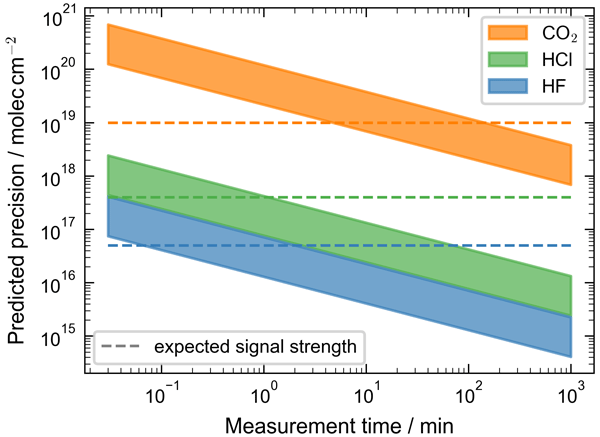
Here, we assess the feasibility of constraining volcanic emissions using passive Fourier transform infrared (FTIR) spectroscopy of sky-scattered sunlight in the near-infrared (NIR), where absorption features of a broader range of gases of interest are available. Using an instrument model for spectral signal-to-noise ratio (SNR) combined with an information-content analysis, we estimate detection limits for individual trace gas columns under realistic conditions. To address systematic uncertainties always present in atmospheric total column measurements, we developed an innovative approach of incorporating actual measurements into our estimations. The instrument model accurately reproduced laboratory validation experiments. To assess applicability of the method, this study focuses on Mount Etna as a representative high-emission volcano. Our results indicate that CO2 column measurements remain challenging. Even under bright sky conditions, measurement times of 30 minutes are necessary to reach detection limits on the scale of the expected total column enhancement. This renders flux estimations via plume transects not feasible, while plume-composition measurements might be possible. In contrast, strongly emitted halogen species such as HCl and HF are detectable within tens of seconds under bright skies and up to approximately 10 minutes for dark conditions, owing to their low atmospheric background concentrations. The limitations identified for CO2 are largely independent of the specific spectroscopic implementation, since they arise fundamentally from the low amount of available light. Finally, the SNR and detection-limit analysis using actual measurements is broadly applicable to other instruments, spectral regions, and target species.
Competing interests: At least one of the (co-)authors is a member of the editorial board of Atmospheric Measurement Techniques.
Publisher's note: Copernicus Publications remains neutral with regard to jurisdictional claims made in the text, published maps, institutional affiliations, or any other geographical representation in this paper. While Copernicus Publications makes every effort to include appropriate place names, the final responsibility lies with the authors. Views expressed in the text are those of the authors and do not necessarily reflect the views of the publisher.-
Notice on discussion status
The requested preprint has a corresponding peer-reviewed final revised paper. You are encouraged to refer to the final revised version.
-
Preprint
(1792 KB)
-
The requested preprint has a corresponding peer-reviewed final revised paper. You are encouraged to refer to the final revised version.
- Preprint
(1792 KB) - Metadata XML
- BibTeX
- EndNote
- Final revised paper


Journal article(s) based on this preprint
Interactive discussion
Status: closed
-
RC1: 'Comment on egusphere-2026-1387', Anonymous Referee #1, 24 Apr 2026
- AC1: 'Reply on RC1', Tobias D. Schmitt, 07 Aug 2026
-
RC2: 'Comment on egusphere-2026-1387', Anonymous Referee #2, 08 Jun 2026
Comment on “Feasibility of Measuring Volcanic Gas Composition Using Sky-Scattered Sunlight and FTIR Spectroscopy” by Tobias Schmidt et al.
General:
This manuscript investigates the feasibility of measuring volcanic gas slant columns, particularly CO₂, using sky-scattered sunlight in the near-infrared spectral region. The concept is scientifically interesting because the use of scattered sunlight would enable measurement geometries that are not accessible with traditional direct-sun observations and could therefore open new possibilities for volcanic gas monitoring.
The authors conclude that the proposed approach is not feasible for CO₂ under the investigated conditions. Although this is a negative result, it is nevertheless an important and scientifically valid outcome. The study addresses a novel measurement concept and provides information that is highly relevant for the atmospheric remote-sensing community. I therefore believe that the manuscript fits within the scope of the journal and should be published after minor to moderate revisions.
In my view, this work represents one of the first systematic investigations of near-infrared retrievals from sky-scattered sunlight for volcanic applications. Even if the approach proves unsuitable for CO₂, the results are valuable because they initiate a broader discussion about the applicability of such techniques to other trace gases and emission sources. While volcanic plumes are relatively weak emitters of CO₂ compared to the atmospheric background, similar methodologies may eventually find applications for large anthropogenic super-emitters such as power plants, industrial facilities, or methane sources. The study is therefore relevant beyond volcanology.
My main concern is that the manuscript does not show in detail measured and simulated spectra demonstrating the retrieval performance. Such examples are essential for evaluating the feasibility of the approach. Discussed microwindows for al 3 Retrievals including measured and simulated spectra, sensitivity studies, and examples of the selected microwindows would greatly strengthen the manuscript and help readers understand the limitations identified by the authors, even if the precision do not allow to find anomalies the simulation of H2O at 5600cm-1 (HCl overtone), CO2 at 6300cm-1 and O2 at (8000 cm-1 HF overtone) should be shown.
A fundamental challenge of using sky-scattered sunlight is that the radiative transfer problem differs substantially from that of direct-solar FTIR observations. In direct-solar measurements, the retrieval can often be interpreted as counting absorption along a relatively well-defined optical path. In contrast, each scattered photon follows a different trajectory through the atmosphere, making the measurement highly sensitive to the vertical distribution of absorbers, atmospheric scattering processes, and particularly aerosols as I imagine. This issue is well known from satellite retrievals, for example in the REMOTEC methane retrieval algorithm used for TROPOMI, where aerosol-related path-length uncertainties are a major source of error.
In the present application, scattering is simultaneously beneficial and problematic: more scattering increases the signal available for observation, but it also complicates the separation of photons scattered before and after traversing the volcanic plume. This effect will differ substantially between spectral regions, for example for HCl overtone bands near 5600 cm⁻¹, CO₂ absorption near 6300 cm⁻¹, and HF overtone bands near 8000 cm⁻¹.
For this reason, I would like to see representative measured and simulated spectra for the retrieval windows used by REMOTEC. If volcanic absorptions are not detectable in the available datasets, examples showing H₂O near 5600 cm⁻¹, background CO₂ near 6300 cm⁻¹, and O₂ near 8000 cm⁻¹ would still be very informative. Such examples would allow the reader to assess the spectral information content and the quality of the radiative transfer modelling.
Overall, I find the study novel, relevant, and worthy of publication. Maybe the manuscript would benefit a little from a more detailed discussion of the underlying radiative transfer problem, additional retrieval diagnostics, and a clearer presentation of measured and simulated spectra and quantity, also I would like to expand the discussion of the instrument design apart from the detector responsivity and noise reduction, to improve of the increase of the “étendue” of the set up.
I hope my following comments make sense and could improve the manuscript, but feel free to ignore them, if they do not make sense to you.
Major Comments1. measured and simulated spectra of individual microwindows
My main concern is that the manuscript does not show any measured or simulated spectra demonstrating the retrieval performance. Since the study concludes that the proposed approach is not feasible for CO₂, it is essential to provide the evidence supporting this conclusion.
I strongly recommend including examples of:
- Measured spectra;
- Simulated spectra;
- Fit residuals;
- Signal-to-noise estimates how they are calculated in detail
- Retrieval diagnostics for the selected microwindows. (slant column Airmassfactore, scattering weights or something similar.)
Even if volcanic absorptions are not visible in the available measurements, examples of retrievals for H₂O (~5600 cm⁻¹), CO₂ (~6300 cm⁻¹), and O₂ (~8000 cm⁻¹) would help the reader understand the information content of the observations and the limitations of the method.
2. More detailed discussion of radiative transfer
The manuscript would benefit from a more detailed description of the radiative transfer problem solved by REMOTEC and how it differs from the radiative transfer assumptions used in direct-sun FTIR retrieval codes such as PROFFAST, PROFFIT, SFIT, or GFIT.
In direct-solar observations, the optical path is relatively well defined. In contrast, for sky-scattered sunlight, each photon follows a different path through the atmosphere. Consequently, the retrieval becomes highly sensitive to:
- aerosol loading;
- aerosol vertical distribution;
- gas vertical profiles;
- scattering geometry.
A more detailed discussion of these effects would help readers understand why the retrieval problem is fundamentally more challenging than conventional direct-sun observations.
3. Role of aerosols and scattering-induced dilution
The manuscript should discuss in greater detail how aerosols influence the retrieval.
Scattering simultaneously increases the available signal and introduces uncertainty in the effective light path. The retrieval ultimately depends on distinguishing photons scattered before entering the plume from photons scattered after leaving the plume.
This effect is expected to vary significantly between the HCl, CO₂, and HF retrieval windows because of their different wavelengths and scattering properties.
A sensitivity study investigating aerosol optical depth and aerosol vertical distribution would considerably strengthen the conclusions.
4. Validation of retrieved air-mass factors
The retrievals provide slant columns that are linked to vertical columns through an air-mass factor.
For the Heidelberg region measurements, reasonably accurate estimates of the atmospheric CO₂ and O₂ columns are already available from COCCON and TCCON observations. Therefore, it should be possible to compare the retrieved vertical columns with independent measurements and report the corresponding air-mass factors.
Such a comparison would provide valuable insight into:
- the realism of the retrieval;
- the dependence of air-mass factors on solar zenith angle;
- the relative importance of atmospheric variability, aerosols, and geometry.
This information would also help interpret the variability shown in Figure 4.
5. Instrument optimization and alternative observing strategies
The manuscript focuses primarily on detector SNR limitations. However, other approaches to improve the measurement sensitivity should at least be discussed.
For example:
- Increasing the field of view of the detector
- Relaxing requirements on instrumental line shape
- Operating at lower spectral resolution
- Investigating cloud-scattered sunlight as done by Love et al. (1998);
- Direct observations of the sky (plume) without tracker or fiber coupling to a pointing system;
- Alternative optical configurations optimized for signal throughput rather than high-accuracy column retrievals.
Even if such approaches are beyond the scope of the present work, a discussion of their potential benefits and limitations would help justify the negative conclusion.
And then the minor comments:
Specific commentsIntroduction
Page 2, line 45
The sentence
"There were a few attempts to take advantage of IR emission spectroscopy using the thermal emissions of the volcanic gas itself (Love et al., 1998; Goff et al., 2001), but these remained isolated case studies."
could be reformulated in a more balanced way.
For example:
"There were several successful attempts to exploit infrared emission spectroscopy using thermal emission from volcanic gases as well as cloud-scattered sunlight (Love et al., 1998; Goff et al., 2001)."
This wording better acknowledges the pioneering contributions of these studies.
Definition of geometry
Line 67
The terms "on-axis" and "off-axis" are not clearly defined.
Consider replacing them with:
- "on-plume" and "off-plume";
or explicitly defining the axis as the observer–plume viewing direction.
Discussion of Love et al. (1998)
The manuscript briefly cites Love et al. (1998), but the discussion could be expanded.
Although the study relied largely on thermal emission, it also exploited cloud-scattered sunlight. This sounds at least similar as the sky-scattered sunlight approach investigated here.
The comparison may help clarify why the present approach is particularly challenging.
Distance to the scattering layer
For volcanic applications, the effective distance and altitude of the scattering layer are important parameters.
This issue has previously been discussed in the context of SO₂ camera measurements (e.g. Campion et al., 2015; Schiavo et al., 2020) and may deserve to be mentioned in the manuscript.
Retrieval examples from Heidelberg
Since retrievals were successfully performed on the roof in Heidelberg, I encourage the authors to include examples showing:
- measured spectra;
- simulated spectra;
- slant columns;
- vertical columns;
- air-mass factors;
- scattering-weight profiles.
These examples would greatly improve transparency and reproducibility.
Precisión estimates
The manuscript would benefit from a comparison between:
- analytically predicted retrieval uncertainties;
- empirical precision estimated from consecutive measurements.
Agreement between both estimates would increase confidence in the uncertainty analysis.
Instrument description
The discussion of the modified EM27/SUN could be expanded.
Compared with the original EM27 (OPAG 22), the EM27/SUN includes several modifications, including changes to detector, beamsplitter, focal length, field stop, and aperture configuration. These changes improve the instrumental line shape, accuracy, and potentially precision, but they all lower the SNR.
The authors may wish to discuss whether a different aperture configuration could improve signal throughput in the proposed application. I imagin that you will get a different curve in
Etna measurements
If spectra from the Etna campaign are available, I strongly encourage the authors to show them, even if no successful volcanic retrievals were obtained.
Negative examples are scientifically valuable and would help readers understand the practical limitations encountered during the experiment.
Some technical suggestions:
- Show the measured and fitted spectra of the Microwindows
- Explain the radiative transfer and the algorithm using equation.
- Quantify aerosol/scattering effects for the Heidelberg measurements; Validate or at least comment on the air-mass factors some how.
- Discuss whether the instrument and observing strategy were fully optimized before concluding that the method is not feasible.
I did not get fully understand the instrumental model and how Table A1 is linked, if it would be possible, It would have liked to have maybe two pairwise instrument configurations orientated on the EM27/sun and the EM27 from Bruker: just add two columns in table A1 and put the numbers and discuss the possibility to improve “étendue”:
focal length 10cm-> 3.5 cm-1 (factor 3), aperture (actual maybe 2 cm ) -> double (4cm) (factor 4), with pointing optic and without pointing optic, with default detector and with suggested narrow band detector (well described).
And as the authors state the apodization function is somehow a degradation of the spectral resolution, and it is not independent, if you change the field of view of the detector to obtain more Photons you get self apodization, not so important in the mid infrared.
FOV=half of internal field of view=detector_aperture_radius/focal length
Delta v = 0.5*v (FOV/2)^2
Delta v = 0.5*v (1mm/35mm/2)^2= 0.6 cm-1 > resolution EM27/sun
(but not too far away)
Why not using more from the beam diameter /aperture in figure, probably you will also have to use a stronger apodization function.
And why not reduce the spectral resolution, is there a optimal spectral resolution for the geometry?
The settings optimized for direct sun observations might be newly optimized for the new application.
6.What happens if the light goes through a fiber? It would be nice to see it by measurements, if you have an almost homogen atmosphere on the roof of Heidelberg and nothing special to point to (because you have no direct sun and not a plume), this would be ideal to measure with and without pointing optics.
I should note that I used ChatGPT to help improve the wording of my comments. Unfortunately, this may have resulted in a tone that sounds somewhat more direct or impolite than I intended. I sincerely apologize if any part of the review came across that way.
Citation: https://doi.org/10.5194/egusphere-2026-1387-RC2 - AC2: 'Reply on RC2', Tobias D. Schmitt, 07 Aug 2026
Peer review completion


Interactive discussion
Status: closed
-
RC1: 'Comment on egusphere-2026-1387', Anonymous Referee #1, 24 Apr 2026
General Comments:
In this manuscript, the authors describe a data-informed numerical evaluation and instrument model for volcanic gas analysis using scattered near-infrared light. They provide an approach to estimating signal-to-noise ratio under varied conditions and thereby measurement precision for target gas species. While the text is clear in its derivation of SNR and concise in the outcome for three gas species (CO2, HCl, and HF), the overall presentation would benefit from a stronger emphasis on the novelty of the work and impact on future directions for atmospheric measurements.
Specific Comments:
For example, the authors state they “developed an innovative approach of incorporating actual measurements into our estimations” to address systematic uncertainties. However, the text presents a data-informed model and analysis which did not read as new – while the pre-existing dataset itself may be unique or rare. The model was presented, and data (or previously determined correlation factors) was supplemented. Additional detail describing the unique aspects of the “information-content analysis” would strengthen the narrative.
Further, the manuscript would benefit from additional discussion around the implications or impact of the findings. It’s clear that the work effort informed the authors’ decision to not proceed with building a new instrument. There is a missed opportunity to emphasize why the reader should be motivated to use the results going forward. For example, a quick comparison of findings with the current measurement approaches – going beyond feasibility/utility and motivating where this technique may best be pursued (particularly for HF and HCl, where responsivity was deemed reasonable) – would help orient and motivate the reader.
Citation: https://doi.org/10.5194/egusphere-2026-1387-RC1 - AC1: 'Reply on RC1', Tobias D. Schmitt, 07 Aug 2026
-
RC2: 'Comment on egusphere-2026-1387', Anonymous Referee #2, 08 Jun 2026
Comment on “Feasibility of Measuring Volcanic Gas Composition Using Sky-Scattered Sunlight and FTIR Spectroscopy” by Tobias Schmidt et al.
General:
This manuscript investigates the feasibility of measuring volcanic gas slant columns, particularly CO₂, using sky-scattered sunlight in the near-infrared spectral region. The concept is scientifically interesting because the use of scattered sunlight would enable measurement geometries that are not accessible with traditional direct-sun observations and could therefore open new possibilities for volcanic gas monitoring.
The authors conclude that the proposed approach is not feasible for CO₂ under the investigated conditions. Although this is a negative result, it is nevertheless an important and scientifically valid outcome. The study addresses a novel measurement concept and provides information that is highly relevant for the atmospheric remote-sensing community. I therefore believe that the manuscript fits within the scope of the journal and should be published after minor to moderate revisions.
In my view, this work represents one of the first systematic investigations of near-infrared retrievals from sky-scattered sunlight for volcanic applications. Even if the approach proves unsuitable for CO₂, the results are valuable because they initiate a broader discussion about the applicability of such techniques to other trace gases and emission sources. While volcanic plumes are relatively weak emitters of CO₂ compared to the atmospheric background, similar methodologies may eventually find applications for large anthropogenic super-emitters such as power plants, industrial facilities, or methane sources. The study is therefore relevant beyond volcanology.
My main concern is that the manuscript does not show in detail measured and simulated spectra demonstrating the retrieval performance. Such examples are essential for evaluating the feasibility of the approach. Discussed microwindows for al 3 Retrievals including measured and simulated spectra, sensitivity studies, and examples of the selected microwindows would greatly strengthen the manuscript and help readers understand the limitations identified by the authors, even if the precision do not allow to find anomalies the simulation of H2O at 5600cm-1 (HCl overtone), CO2 at 6300cm-1 and O2 at (8000 cm-1 HF overtone) should be shown.
A fundamental challenge of using sky-scattered sunlight is that the radiative transfer problem differs substantially from that of direct-solar FTIR observations. In direct-solar measurements, the retrieval can often be interpreted as counting absorption along a relatively well-defined optical path. In contrast, each scattered photon follows a different trajectory through the atmosphere, making the measurement highly sensitive to the vertical distribution of absorbers, atmospheric scattering processes, and particularly aerosols as I imagine. This issue is well known from satellite retrievals, for example in the REMOTEC methane retrieval algorithm used for TROPOMI, where aerosol-related path-length uncertainties are a major source of error.
In the present application, scattering is simultaneously beneficial and problematic: more scattering increases the signal available for observation, but it also complicates the separation of photons scattered before and after traversing the volcanic plume. This effect will differ substantially between spectral regions, for example for HCl overtone bands near 5600 cm⁻¹, CO₂ absorption near 6300 cm⁻¹, and HF overtone bands near 8000 cm⁻¹.
For this reason, I would like to see representative measured and simulated spectra for the retrieval windows used by REMOTEC. If volcanic absorptions are not detectable in the available datasets, examples showing H₂O near 5600 cm⁻¹, background CO₂ near 6300 cm⁻¹, and O₂ near 8000 cm⁻¹ would still be very informative. Such examples would allow the reader to assess the spectral information content and the quality of the radiative transfer modelling.
Overall, I find the study novel, relevant, and worthy of publication. Maybe the manuscript would benefit a little from a more detailed discussion of the underlying radiative transfer problem, additional retrieval diagnostics, and a clearer presentation of measured and simulated spectra and quantity, also I would like to expand the discussion of the instrument design apart from the detector responsivity and noise reduction, to improve of the increase of the “étendue” of the set up.
I hope my following comments make sense and could improve the manuscript, but feel free to ignore them, if they do not make sense to you.
Major Comments1. measured and simulated spectra of individual microwindows
My main concern is that the manuscript does not show any measured or simulated spectra demonstrating the retrieval performance. Since the study concludes that the proposed approach is not feasible for CO₂, it is essential to provide the evidence supporting this conclusion.
I strongly recommend including examples of:
- Measured spectra;
- Simulated spectra;
- Fit residuals;
- Signal-to-noise estimates how they are calculated in detail
- Retrieval diagnostics for the selected microwindows. (slant column Airmassfactore, scattering weights or something similar.)
Even if volcanic absorptions are not visible in the available measurements, examples of retrievals for H₂O (~5600 cm⁻¹), CO₂ (~6300 cm⁻¹), and O₂ (~8000 cm⁻¹) would help the reader understand the information content of the observations and the limitations of the method.
2. More detailed discussion of radiative transfer
The manuscript would benefit from a more detailed description of the radiative transfer problem solved by REMOTEC and how it differs from the radiative transfer assumptions used in direct-sun FTIR retrieval codes such as PROFFAST, PROFFIT, SFIT, or GFIT.
In direct-solar observations, the optical path is relatively well defined. In contrast, for sky-scattered sunlight, each photon follows a different path through the atmosphere. Consequently, the retrieval becomes highly sensitive to:
- aerosol loading;
- aerosol vertical distribution;
- gas vertical profiles;
- scattering geometry.
A more detailed discussion of these effects would help readers understand why the retrieval problem is fundamentally more challenging than conventional direct-sun observations.
3. Role of aerosols and scattering-induced dilution
The manuscript should discuss in greater detail how aerosols influence the retrieval.
Scattering simultaneously increases the available signal and introduces uncertainty in the effective light path. The retrieval ultimately depends on distinguishing photons scattered before entering the plume from photons scattered after leaving the plume.
This effect is expected to vary significantly between the HCl, CO₂, and HF retrieval windows because of their different wavelengths and scattering properties.
A sensitivity study investigating aerosol optical depth and aerosol vertical distribution would considerably strengthen the conclusions.
4. Validation of retrieved air-mass factors
The retrievals provide slant columns that are linked to vertical columns through an air-mass factor.
For the Heidelberg region measurements, reasonably accurate estimates of the atmospheric CO₂ and O₂ columns are already available from COCCON and TCCON observations. Therefore, it should be possible to compare the retrieved vertical columns with independent measurements and report the corresponding air-mass factors.
Such a comparison would provide valuable insight into:
- the realism of the retrieval;
- the dependence of air-mass factors on solar zenith angle;
- the relative importance of atmospheric variability, aerosols, and geometry.
This information would also help interpret the variability shown in Figure 4.
5. Instrument optimization and alternative observing strategies
The manuscript focuses primarily on detector SNR limitations. However, other approaches to improve the measurement sensitivity should at least be discussed.
For example:
- Increasing the field of view of the detector
- Relaxing requirements on instrumental line shape
- Operating at lower spectral resolution
- Investigating cloud-scattered sunlight as done by Love et al. (1998);
- Direct observations of the sky (plume) without tracker or fiber coupling to a pointing system;
- Alternative optical configurations optimized for signal throughput rather than high-accuracy column retrievals.
Even if such approaches are beyond the scope of the present work, a discussion of their potential benefits and limitations would help justify the negative conclusion.
And then the minor comments:
Specific commentsIntroduction
Page 2, line 45
The sentence
"There were a few attempts to take advantage of IR emission spectroscopy using the thermal emissions of the volcanic gas itself (Love et al., 1998; Goff et al., 2001), but these remained isolated case studies."
could be reformulated in a more balanced way.
For example:
"There were several successful attempts to exploit infrared emission spectroscopy using thermal emission from volcanic gases as well as cloud-scattered sunlight (Love et al., 1998; Goff et al., 2001)."
This wording better acknowledges the pioneering contributions of these studies.
Definition of geometry
Line 67
The terms "on-axis" and "off-axis" are not clearly defined.
Consider replacing them with:
- "on-plume" and "off-plume";
or explicitly defining the axis as the observer–plume viewing direction.
Discussion of Love et al. (1998)
The manuscript briefly cites Love et al. (1998), but the discussion could be expanded.
Although the study relied largely on thermal emission, it also exploited cloud-scattered sunlight. This sounds at least similar as the sky-scattered sunlight approach investigated here.
The comparison may help clarify why the present approach is particularly challenging.
Distance to the scattering layer
For volcanic applications, the effective distance and altitude of the scattering layer are important parameters.
This issue has previously been discussed in the context of SO₂ camera measurements (e.g. Campion et al., 2015; Schiavo et al., 2020) and may deserve to be mentioned in the manuscript.
Retrieval examples from Heidelberg
Since retrievals were successfully performed on the roof in Heidelberg, I encourage the authors to include examples showing:
- measured spectra;
- simulated spectra;
- slant columns;
- vertical columns;
- air-mass factors;
- scattering-weight profiles.
These examples would greatly improve transparency and reproducibility.
Precisión estimates
The manuscript would benefit from a comparison between:
- analytically predicted retrieval uncertainties;
- empirical precision estimated from consecutive measurements.
Agreement between both estimates would increase confidence in the uncertainty analysis.
Instrument description
The discussion of the modified EM27/SUN could be expanded.
Compared with the original EM27 (OPAG 22), the EM27/SUN includes several modifications, including changes to detector, beamsplitter, focal length, field stop, and aperture configuration. These changes improve the instrumental line shape, accuracy, and potentially precision, but they all lower the SNR.
The authors may wish to discuss whether a different aperture configuration could improve signal throughput in the proposed application. I imagin that you will get a different curve in
Etna measurements
If spectra from the Etna campaign are available, I strongly encourage the authors to show them, even if no successful volcanic retrievals were obtained.
Negative examples are scientifically valuable and would help readers understand the practical limitations encountered during the experiment.
Some technical suggestions:
- Show the measured and fitted spectra of the Microwindows
- Explain the radiative transfer and the algorithm using equation.
- Quantify aerosol/scattering effects for the Heidelberg measurements; Validate or at least comment on the air-mass factors some how.
- Discuss whether the instrument and observing strategy were fully optimized before concluding that the method is not feasible.
I did not get fully understand the instrumental model and how Table A1 is linked, if it would be possible, It would have liked to have maybe two pairwise instrument configurations orientated on the EM27/sun and the EM27 from Bruker: just add two columns in table A1 and put the numbers and discuss the possibility to improve “étendue”:
focal length 10cm-> 3.5 cm-1 (factor 3), aperture (actual maybe 2 cm ) -> double (4cm) (factor 4), with pointing optic and without pointing optic, with default detector and with suggested narrow band detector (well described).
And as the authors state the apodization function is somehow a degradation of the spectral resolution, and it is not independent, if you change the field of view of the detector to obtain more Photons you get self apodization, not so important in the mid infrared.
FOV=half of internal field of view=detector_aperture_radius/focal length
Delta v = 0.5*v (FOV/2)^2
Delta v = 0.5*v (1mm/35mm/2)^2= 0.6 cm-1 > resolution EM27/sun
(but not too far away)
Why not using more from the beam diameter /aperture in figure, probably you will also have to use a stronger apodization function.
And why not reduce the spectral resolution, is there a optimal spectral resolution for the geometry?
The settings optimized for direct sun observations might be newly optimized for the new application.
6.What happens if the light goes through a fiber? It would be nice to see it by measurements, if you have an almost homogen atmosphere on the roof of Heidelberg and nothing special to point to (because you have no direct sun and not a plume), this would be ideal to measure with and without pointing optics.
I should note that I used ChatGPT to help improve the wording of my comments. Unfortunately, this may have resulted in a tone that sounds somewhat more direct or impolite than I intended. I sincerely apologize if any part of the review came across that way.
Citation: https://doi.org/10.5194/egusphere-2026-1387-RC2 - AC2: 'Reply on RC2', Tobias D. Schmitt, 07 Aug 2026
Peer review completion
Journal article(s) based on this preprint
Viewed
| HTML | XML | Total | BibTeX | EndNote | |
|---|---|---|---|---|---|
| 704 | 325 | 64 | 1,093 | 51 | 63 |
- HTML: 704
- PDF: 325
- XML: 64
- Total: 1,093
- BibTeX: 51
- EndNote: 63
Viewed (geographical distribution)
| Country | # | Views | % |
|---|
| Total: | 0 |
| HTML: | 0 |
| PDF: | 0 |
| XML: | 0 |
- 1
Tobias Dieter Schmitt

Moritz Sindram
Benedikt Alexander Löw
Lukas Weis
Ralph Kleinschek
Nicole Bobrowski
The requested preprint has a corresponding peer-reviewed final revised paper. You are encouraged to refer to the final revised version.
- Preprint
(1792 KB) - Metadata XML
General Comments:
In this manuscript, the authors describe a data-informed numerical evaluation and instrument model for volcanic gas analysis using scattered near-infrared light. They provide an approach to estimating signal-to-noise ratio under varied conditions and thereby measurement precision for target gas species. While the text is clear in its derivation of SNR and concise in the outcome for three gas species (CO2, HCl, and HF), the overall presentation would benefit from a stronger emphasis on the novelty of the work and impact on future directions for atmospheric measurements.
Specific Comments:
For example, the authors state they “developed an innovative approach of incorporating actual measurements into our estimations” to address systematic uncertainties. However, the text presents a data-informed model and analysis which did not read as new – while the pre-existing dataset itself may be unique or rare. The model was presented, and data (or previously determined correlation factors) was supplemented. Additional detail describing the unique aspects of the “information-content analysis” would strengthen the narrative.
Further, the manuscript would benefit from additional discussion around the implications or impact of the findings. It’s clear that the work effort informed the authors’ decision to not proceed with building a new instrument. There is a missed opportunity to emphasize why the reader should be motivated to use the results going forward. For example, a quick comparison of findings with the current measurement approaches – going beyond feasibility/utility and motivating where this technique may best be pursued (particularly for HF and HCl, where responsivity was deemed reasonable) – would help orient and motivate the reader.