
the Creative Commons Attribution 4.0 License.
the Creative Commons Attribution 4.0 License.
 | 23 Apr 2026
Upward transport and segregation of ice-nucleating particles in deep convective clouds
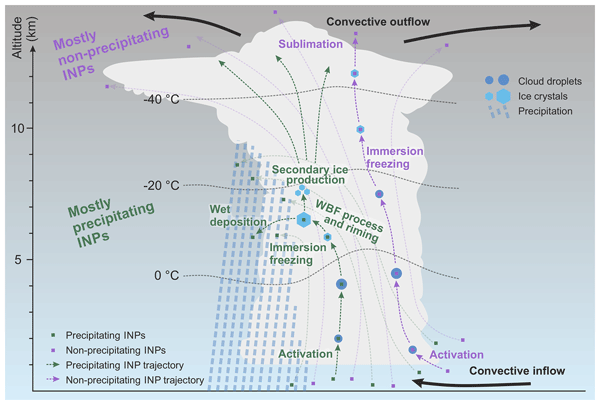
Abstract. Ice-nucleating particles (INPs) play a crucial role in Earth’s weather and climate by influencing cloud properties and precipitation. However, their abundance in the free troposphere, vertical distribution, and transport mechanisms are not well-characterized. This study presents immersion INP measurements from filter samples collected aboard the HALO research aircraft in the troposphere and the lower stratosphere (up to 14.5 km) over Europe during the CIRRUS-HL (Cirrus in High Latitudes) campaign in summer 2021. By sampling cloud particle residuals and aerosol particles in the inflow and outflow of deep convective clouds (DCCs) and performing offline INP analysis, we shed light on the vertical transport and segregation of INPs in DCCs.
While INP-temperature spectra of convective inflow included both INPs active at high (T > -15 °C) and low temperatures (T < -20 °C), the in-cloud and outflow spectra only featured INPs active at low temperatures. We explain the observed INP segregation in the updraft with precipitation scavenging of INPs active at high temperatures. In contrast, INPs active at lower temperatures (T < -20 °C) are efficiently transported upwards into the free troposphere with ambient temperatures below -40 °C, i.e., temperatures far below the temperatures at which these INPs initiate immersion freezing. In the DCC outflow, INP concentrations exceed the upper tropospheric background concentration by at least two orders of magnitude. These INPs are then available for ice formation in mid and upper tropospheric clouds.
-
Notice on discussion status
The requested preprint has a corresponding peer-reviewed final revised paper. You are encouraged to refer to the final revised version.
-
Preprint
(1275 KB)
-
Supplement
(2081 KB)
-
The requested preprint has a corresponding peer-reviewed final revised paper. You are encouraged to refer to the final revised version.
- Preprint
(1275 KB) - Metadata XML
-
Supplement
(2081 KB) - BibTeX
- EndNote
- Final revised paper


Journal article(s) based on this preprint
Interactive discussion
Status: closed
- RC1: 'Comment on egusphere-2026-1383', Anonymous Referee #1, 11 May 2026
- RC2: 'Comment on egusphere-2026-1383', Anonymous Referee #2, 03 Jun 2026
- AC1: 'Reply to RC1 and RC2', Jonas Schaefer, 16 Jul 2026
Peer review completion


Interactive discussion
Status: closed
-
RC1: 'Comment on egusphere-2026-1383', Anonymous Referee #1, 11 May 2026
Summary
This manuscript (“Upward transport and segregation of ice-nucleating particles in deep convective clouds”) by Schaefer et al. investigates the transport of particles in deep convective clouds, with a focus upon ice nucleating particles. They utilize the HALO research aircraft to collect measurements of particle number and composition above Europe. They sampled aerosol and cloud residual composition using a single particle mass spectrometer, and collected filters for offline analysis. They primarily present results from a case study sampling a deep convective system, where they sampled the inflow the convective system, in-cloud, and the outflow of the convective system. The convective inflow had high INP concentrations at very warm temperatures (>-15 °C), while the in-cloud had INPs at warm temperatures, but particularly from -14 to -17 °C, and the convective outflow had virtually no INPs at temperatures warmer than 17 °C. They observed that DCC outflow INPs were much higher than would have been expected from the background INP concentrations in the free troposphere/lower stratosphere, indicating that the INPs were transported from the BL. They also observed that the composition of free tropospheric air, in-cloud residuals, and convective outflow varied systematically, though this aspect of the paper is under-developed.
I like this study, think it is interesting, and that it warrants publication in ACP after some revisions. My suggestions are below.
General comments
First, this paper is primarily about a single case study, with a handful of supporting measurements from complementary flights. The authors make some strong statements about their results, from a single case study and I think that they need to temper them. For instance, in the summary and conclusions, they state that “deep convective clouds act as a major mechanism for lifting INPs from the boundary layer into the free troposphere.” I am not disputing that they DCC can transport INPs from the BL into the FT, but calling it a major mechanism is too strong, based upon the results from one research flight. I would also say that they did not find that INP outflow from DCC “can influence ice formation in cirrus clouds, and after sedimentation downstream, in mid-level mixed-phase clouds.” I agree that this may happen, but don’t think the authors demonstrated that happening in this study. Wording here and throughout the manuscript should be revised where appropriate.
Second, it appears to me that there is no significant difference between the activated fraction of warm INPs in the inflow vs in-cloud residuals (Fig. 5a). At the very warmest temperatures (-10 °C) the in-cloud sampling has higher INP concentrations than the inflow, and when the inflow is higher than the in-cloud, it appears to be within the measurement uncertainty.
Finally, the single particle composition aspect of this paper is under-developed. For instance, dust particles are observed in-cloud and also at the DCC outflow. Is the mixing state of the dust particles that make it to the outflow systematically different from those found in-cloud? It would be interesting to know whether the authors considered this in their analysis.
Specific comments
Line 51: HALO needs to be parenthesized.
Line 63: Cziczo et al. (2004) also measured composition of INPs in the free troposphere.
Line 81: I think it would be worthwhile to change the name of HASI to not include sub-micrometer. If it has been modified to also measure supermicron particles, it seems like a potential source of unnecessary confusion.
Line 124: The sentence starting “A lower size…” is awkwardly constructed, rewrite for clarity.
Line 133: Vali formula given in SI, worthwhile to reference this fact.
Line 163: What does S2 refer to? Is it figure or table?
Line 221: No closing parentheses.
Line 234: This whole paragraph has a number of missing parantheses. I am going to stop noting these, but please go through and carefully check the rest of the manuscript.
Line 248: I thought that the
Line 287: Figure 5d title is ‘outflow’ not ‘inflow’, and there is no red line. Do you mean 5c?
Line 387: I think that the authors showed that DCC can act as a lifting mechanism for INPs, but they did not find a clear indication that “they can influence ice formation in cirrus clouds, and after sedimentation downstream, in mid-level mixed-phase clouds.” I agree that the this is likely to happen, but don’t think the authors demonstrated that happening in this study. Would recommend rewording this point to clarify the distinction.
Figure 4: Panel (a) altitude is in hPa, could you add a scale showing it in m as well. There is also a blue line that looks like an isotherm in this panel, what is it?
Supplement: It would be more reader-friendly to add the list of abbreviations to the main text.
References
Cziczo, D. J., Murphy, D. M., Hudson, P. K., & Thomson, D. S. (2004). Single particle measurements of the chemical composition of cirrus ice residue during CRYSTAL-FACE. Journal of Geophysical Research, 109(D4), 1–13. https://doi.org/10.1029/2003JD004032
Citation: https://doi.org/10.5194/egusphere-2026-1383-RC1 - RC2: 'Comment on egusphere-2026-1383', Anonymous Referee #2, 03 Jun 2026
- AC1: 'Reply to RC1 and RC2', Jonas Schaefer, 16 Jul 2026
Peer review completion
Journal article(s) based on this preprint
Viewed
| HTML | XML | Total | Supplement | BibTeX | EndNote | |
|---|---|---|---|---|---|---|
| 411 | 278 | 79 | 768 | 80 | 61 | 63 |
- HTML: 411
- PDF: 278
- XML: 79
- Total: 768
- Supplement: 80
- BibTeX: 61
- EndNote: 63
Viewed (geographical distribution)
| Country | # | Views | % |
|---|
| Total: | 0 |
| HTML: | 0 |
| PDF: | 0 |
| XML: | 0 |
- 1

Sarah Grawe
Hans-Christian Clemen
Stephan Mertes
Johannes Schneider
Bruno Wetzel
Daniel Sauer
Jennifer Wolf
Laura Tomsche
Johanna Mayer
Roland Schrödner
Silvia Henning
Tina Jurkat-Witschas
Christiane Voigt
Helmut Ziereis
Theresa Harlaß
Mira Pöhlker
Frank Stratmann
The requested preprint has a corresponding peer-reviewed final revised paper. You are encouraged to refer to the final revised version.
- Preprint
(1275 KB) - Metadata XML
-
Supplement
(2081 KB) - BibTeX
- EndNote
- Final revised paper
Summary
This manuscript (“Upward transport and segregation of ice-nucleating particles in deep convective clouds”) by Schaefer et al. investigates the transport of particles in deep convective clouds, with a focus upon ice nucleating particles. They utilize the HALO research aircraft to collect measurements of particle number and composition above Europe. They sampled aerosol and cloud residual composition using a single particle mass spectrometer, and collected filters for offline analysis. They primarily present results from a case study sampling a deep convective system, where they sampled the inflow the convective system, in-cloud, and the outflow of the convective system. The convective inflow had high INP concentrations at very warm temperatures (>-15 °C), while the in-cloud had INPs at warm temperatures, but particularly from -14 to -17 °C, and the convective outflow had virtually no INPs at temperatures warmer than 17 °C. They observed that DCC outflow INPs were much higher than would have been expected from the background INP concentrations in the free troposphere/lower stratosphere, indicating that the INPs were transported from the BL. They also observed that the composition of free tropospheric air, in-cloud residuals, and convective outflow varied systematically, though this aspect of the paper is under-developed.
I like this study, think it is interesting, and that it warrants publication in ACP after some revisions. My suggestions are below.
General comments
First, this paper is primarily about a single case study, with a handful of supporting measurements from complementary flights. The authors make some strong statements about their results, from a single case study and I think that they need to temper them. For instance, in the summary and conclusions, they state that “deep convective clouds act as a major mechanism for lifting INPs from the boundary layer into the free troposphere.” I am not disputing that they DCC can transport INPs from the BL into the FT, but calling it a major mechanism is too strong, based upon the results from one research flight. I would also say that they did not find that INP outflow from DCC “can influence ice formation in cirrus clouds, and after sedimentation downstream, in mid-level mixed-phase clouds.” I agree that this may happen, but don’t think the authors demonstrated that happening in this study. Wording here and throughout the manuscript should be revised where appropriate.
Second, it appears to me that there is no significant difference between the activated fraction of warm INPs in the inflow vs in-cloud residuals (Fig. 5a). At the very warmest temperatures (-10 °C) the in-cloud sampling has higher INP concentrations than the inflow, and when the inflow is higher than the in-cloud, it appears to be within the measurement uncertainty.
Finally, the single particle composition aspect of this paper is under-developed. For instance, dust particles are observed in-cloud and also at the DCC outflow. Is the mixing state of the dust particles that make it to the outflow systematically different from those found in-cloud? It would be interesting to know whether the authors considered this in their analysis.
Specific comments
Line 51: HALO needs to be parenthesized.
Line 63: Cziczo et al. (2004) also measured composition of INPs in the free troposphere.
Line 81: I think it would be worthwhile to change the name of HASI to not include sub-micrometer. If it has been modified to also measure supermicron particles, it seems like a potential source of unnecessary confusion.
Line 124: The sentence starting “A lower size…” is awkwardly constructed, rewrite for clarity.
Line 133: Vali formula given in SI, worthwhile to reference this fact.
Line 163: What does S2 refer to? Is it figure or table?
Line 221: No closing parentheses.
Line 234: This whole paragraph has a number of missing parantheses. I am going to stop noting these, but please go through and carefully check the rest of the manuscript.
Line 248: I thought that the
Line 287: Figure 5d title is ‘outflow’ not ‘inflow’, and there is no red line. Do you mean 5c?
Line 387: I think that the authors showed that DCC can act as a lifting mechanism for INPs, but they did not find a clear indication that “they can influence ice formation in cirrus clouds, and after sedimentation downstream, in mid-level mixed-phase clouds.” I agree that the this is likely to happen, but don’t think the authors demonstrated that happening in this study. Would recommend rewording this point to clarify the distinction.
Figure 4: Panel (a) altitude is in hPa, could you add a scale showing it in m as well. There is also a blue line that looks like an isotherm in this panel, what is it?
Supplement: It would be more reader-friendly to add the list of abbreviations to the main text.
References
Cziczo, D. J., Murphy, D. M., Hudson, P. K., & Thomson, D. S. (2004). Single particle measurements of the chemical composition of cirrus ice residue during CRYSTAL-FACE. Journal of Geophysical Research, 109(D4), 1–13. https://doi.org/10.1029/2003JD004032