
the Creative Commons Attribution 4.0 License.
the Creative Commons Attribution 4.0 License.
 | 13 Mar 2026
The added value of new ground-based observations in improving China's methane emission quantification
Abstract. China is one of the largest anthropogenic methane emitters, yet its current space- and ground-based observational network remains insufficient for robust emission quantification, particularly in southern regions. To address this gap, we develop an integrated framework, employing Bayesian analytical inversion and simulated annealing algorithms, to design optimal ground-based methane monitoring networks. In Bayesian theory, the degrees of freedom for signal (DOFS) is usually used to quantify the independent information content provided by observations, with higher values indicating stronger constraint capability. Using GEOS-Chem at 50 km resolution, we estimate that current TROPOMI observations and existing surface measurements (13 in-situ sites and 4 ground column sites in East Asia) can provide a DOFS of 134 for methane emissons in China. We further assess the performance of networks comprising 5 to 100 new stations across daily, weekly and monthly sampling frequencies. Optimized designs consistently prioritize new sites in southwestern and eastern China, where satellite coverage is sparse and emissions are high. Adding 50 optimally placed stations with weekly sampling can approximately double the DOFS (from 134 to 259). These results highlight the significant potential of combining optimized ground-based networks with satellite data to improve methane emission quantification in China.
-
Notice on discussion status
The requested preprint has a corresponding peer-reviewed final revised paper. You are encouraged to refer to the final revised version.
-
Preprint
(9864 KB)
-
Supplement
(6554 KB)
-
The requested preprint has a corresponding peer-reviewed final revised paper. You are encouraged to refer to the final revised version.
- Preprint
(9864 KB) - Metadata XML
-
Supplement
(6554 KB) - BibTeX
- EndNote
- Final revised paper


Journal article(s) based on this preprint
Interactive discussion
Status: closed
-
RC1: 'Comment on egusphere-2026-1349', Anonymous Referee #1, 06 Apr 2026
The comment was uploaded in the form of a supplement: https://egusphere.copernicus.org/preprints/2026/egusphere-2026-1349/egusphere-2026-1349-RC1-supplement.pdf
-
AC1: 'Reply on RC1', Lu Shen, 19 May 2026
The comment was uploaded in the form of a supplement: https://egusphere.copernicus.org/preprints/2026/egusphere-2026-1349/egusphere-2026-1349-AC1-supplement.pdf
-
AC1: 'Reply on RC1', Lu Shen, 19 May 2026
-
RC2: 'Comment on egusphere-2026-1349', Anonymous Referee #2, 07 Apr 2026
I recommend publication following minor revisions.
This is a useful paper, and I think the main contribution is clear. The authors are trying to identify where new surface stations would provide the largest increase in sensitivity for methane emissions estimates over China, especially when combined with TROPOMI. The overall framework is interesting, and the results are potentially valuable for network design. My comments are mostly about clarification of the inversion assumptions, interpretation of DOFS, and treatment of errors. The manuscript’s core setup is a Bayesian analytical inversion with GEOS-Chem, TROPOMI, and existing ground stations, optimized with simulated annealing. Following are my comments.
1. Please clarify what the DOFS values in Table 1 represent.
In Table 1, I assume the listed DOFS values indicate how much each measurement type or station contributes to constraining emissions over China. If that is correct, please state this more explicitly in the text and/or caption, because as written it is easy to wonder whether these DOFS refer to concentration information, emissions information, or something else. Table 1 currently labels the column as “DOFS in China,” and the methods define DOFS as the total number of independent pieces of information provided by the observations, but the connection between those two uses should be stated more plainly.
2. The treatment of TROPOMI observations needs to be clearer.
In the TROPOMI section and in the discussion of sampling frequency, I was left unsure whether the inversion is using super observations or whether all valid TROPOMI observations are assimilated individually. This matters for how one interprets the observing system and the assumed error statistics. The paper states that after quality control and spatial regridding, approximately 3.8 × 10^6 valid XCH4 retrievals were obtained over China in 2022, and later discusses large sensitivity to daily, weekly, and monthly sampling frequencies for added surface sites. That raised a basic question for me: are the satellite data being assimilated as individual observations, or aggregated in some way? If the inversion is effectively treating all TROPOMI observations individually, that needs to be stated clearly in the inversion section. If super observations are used, then that also needs to be stated clearly, including how the corresponding observational errors are defined.
3. Please discuss the Gaussian and diagonal error assumptions more carefully.
The inversion framework assumes normal errors and diagonal prior and observational covariance matrices. That is a standard starting point, but for TROPOMI methane retrievals this assumption is not trivial. As Lu Shen knows well, previous GEOS-Chem and TROPOMI inversions often use super observations partly because retrieval and transport errors are not purely independent and normally distributed. I am not asking the authors to redo the inversion, but I do think the manuscript should acknowledge this limitation more directly and explain why the present assumptions are still adequate for the network design exercise.
4. The discussion of sampling frequency needs more explanation.
The statement that the maximum DOFS enhancement peaks at 2.1, 4.7, and 11.5 for monthly, weekly, and daily sampling caught my attention. Are the authors effectively assuming a daily inversion for those hypothetical new stations? If so, this needs to be spelled out much more clearly in the methods. More broadly, the paper should explain what “daily,” “weekly,” and “monthly” mean operationally in the inversion, and whether those scenarios assume one representative measurement per day, week, or month, or something more complex. This is important because the resulting gains in DOFS are central to the paper’s conclusions.
5. I think the framing around line 255 could be improved.
The paper is identifying optimal locations for new ground-based observation sites by maximizing DOFS, which is fine. But conceptually, adding a measurement will generally increase DOFS under the assumptions of the Bayesian framework used here. So I do not think the central question is whether the added measurement increases DOFS, because by construction it will. The more relevant issue is whether the added site is worth the cost, and whether it adds robust information once potential systematic errors are considered. I think the paper would benefit from a slightly more careful framing here: the optimization is really about maximizing the value of additional sites, not determining whether more measurements help in principle.
6. Please consider discussing information content in terms of posterior error reduction, not just DOFS.
Related to the previous point, I do not think DOFS alone fully captures the value of adding a measurement. What really matters is the reduction in posterior error, especially once systematic errors associated with a new site are considered. A stronger information metric would be the reduction in entropy, or in Rodgers (2000) language, the information gain in bits:
Delta H = 0.5 * log2( |Sa| / |Sx_tilde| ) = 0.5 * [ log2(|Sa|) - log2(|Sx_tilde|) ]
where Sx_tilde is the posterior error covariance including the relevant systematic errors. I do not think the authors need to replace the whole paper with this metric, but I do think some discussion is needed of the distinction between DOFS and actual reduction in posterior uncertainty, especially given the possible role of systematic and correlated errors.
7. The description of “error” around line 302 is confusing and should be tightened.
I was not always sure whether the paper is referring to observational error, model-observation mismatch, or simply differences between observations and the prior simulation. Those are not the same thing. If the quantity reflects mismatch between observed methane and prior concentrations, then part of that mismatch is signal, not error. On the other hand, if the authors are arguing that unresolved variability at model scale belongs in the observational error term, then that is reasonable, but it needs to be explained more carefully. Right now the wording risks conflating information with error. This matters because the manuscript defines observational error as the aggregate of forward model error, instrument error, and representation error, and then estimates it using a residual-error approach based on model-observation differences.
8. The relation between large “errors” and large DOFS deserves explanation.
At line 314 and in Table 1, I may be reading this incorrectly, but it looks like some sites with relatively large assumed errors also have relatively large DOFS. If that is right, it would help to explain this explicitly. My guess is that proximity to strong source regions and stronger Jacobian sensitivity can outweigh larger observational error, but the reader should not have to infer that. A short explanation would help. The paper already hints at this by noting that stations near emission sources provide greater constraints, so this should be easy to clarify.
9. Equation 7 should include an important caveat about source attribution.
For the sectoral attribution framework following Hancock et al. ACP 2025, I strongly recommend adding a sentence noting that this method assumes the relative contributions of each sector to the total emissions in a given grid cell are correct, which introduces an additional source of uncertainty in the sectoral attribution of inversion results. Although the high resolution of the inversion reduces the impact of this assumption relative to coarser approaches, the posterior attribution to sectors still depends on the spatial allocation in the prior inventories. I also recommend citing Cusworth et al. (2021), which presents a Bayesian framework for deriving sector-based methane emissions from top-down fluxes and explicitly discusses uncertainty structure in sector attribution.
Suggested citation text for this section:
“Following Hancock et al. (2025), this method assumes that the relative contributions of each sector to the total emissions in a given grid cell are correct, which introduces an additional source of uncertainty in the sectoral attribution of inversion results. Although the high resolution of our inversion reduces the impact of this assumption compared with coarser-resolution approaches, our ability to attribute posterior emissions to individual sectors remains dependent on the spatial allocation of emissions in the prior inventories.”
Relevant citation links:
Hancock et al. (2025): https://acp.copernicus.org/articles/25/797/2025/
Cusworth et al. (2021): https://www.nature.com/articles/s43247-021-00312-610. A couple of assumptions deserve a bit more discussion in the limitations.
The paper assumes diagonal observational and prior covariance matrices, and it also assigns a fixed observational error to hypothetical new stations based on the mean error from six urban sites. Both are reasonable practical choices, but both could affect the resulting optimization. I suggest briefly discussing how sensitive the site selection may be to these assumptions. Related to this, the CMA recent data are not publicly available, so the 2022 analysis applies error characteristics from earlier years. That is understandable, but it is still a limitation worth stating explicitly. The manuscript does mention some limitations in the Discussion, but these particular assumptions deserve to be more front-and-center because they directly affect the information metrics that drive the optimization.
11. The uncertainty-reduction metric could be brought more centrally into the discussion.
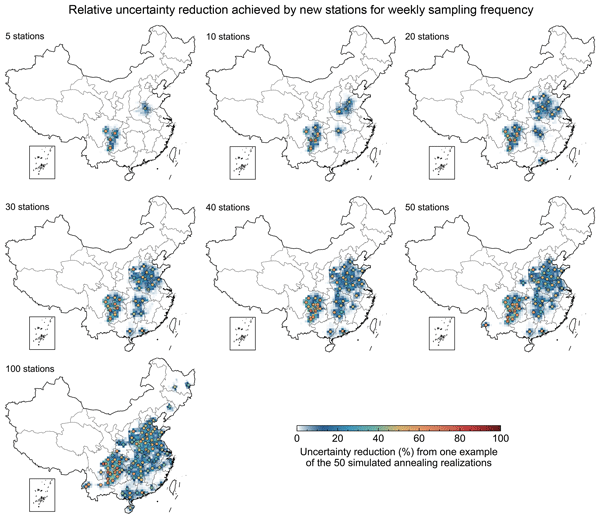
The manuscript includes relative uncertainty reduction in addition to DOFS, and I think that helps connect the optimization to what readers care about physically. Since DOFS is not the same thing as total information gain or practical reduction in posterior uncertainty, I would encourage the authors to emphasize the UR results a bit more in the interpretation. In my view, this would strengthen the paper. The manuscript already computes UR, maps it, and notes that local uncertainty reductions near newly added stations can exceed 90%, so this material is already there and just needs slightly more emphasis.
12. Please clarify exactly what level of emissions is being optimized and interpreted.
At different points the paper discusses national DOFS, regional DOFS, and sectoral averaging kernel sensitivities. Those are all useful, but the transitions between them are a bit quick. A short clarifying paragraph would help readers keep straight whether the optimization is targeting grid-scale emissions, national totals, or sectoral attribution, and how those relate. Right now the manuscript moves from a state vector of native grid cells, clusters, and boundary conditions, to national DOFS, then regional DOFS, then sectoral AK sensitivities. I think the science is fine, but the reader would benefit from a clearer roadmap.
Minor point
The statement that areas south of 33° N account for only 3.8 × 10^5 valid retrievals, about 11% of those in northern China, is useful and helps motivate the paper. I would keep it, but I think it would be even stronger if the authors tied this more directly to the network-design result, namely that the optimized new stations repeatedly cluster in southwestern and southern China because that is exactly where the observing gap is most consequential.
Citation: https://doi.org/10.5194/egusphere-2026-1349-RC2 -
AC2: 'Reply on RC2', Lu Shen, 19 May 2026
The comment was uploaded in the form of a supplement: https://egusphere.copernicus.org/preprints/2026/egusphere-2026-1349/egusphere-2026-1349-AC2-supplement.pdf
-
AC2: 'Reply on RC2', Lu Shen, 19 May 2026
Peer review completion


Interactive discussion
Status: closed
-
RC1: 'Comment on egusphere-2026-1349', Anonymous Referee #1, 06 Apr 2026
The comment was uploaded in the form of a supplement: https://egusphere.copernicus.org/preprints/2026/egusphere-2026-1349/egusphere-2026-1349-RC1-supplement.pdf
-
AC1: 'Reply on RC1', Lu Shen, 19 May 2026
The comment was uploaded in the form of a supplement: https://egusphere.copernicus.org/preprints/2026/egusphere-2026-1349/egusphere-2026-1349-AC1-supplement.pdf
-
AC1: 'Reply on RC1', Lu Shen, 19 May 2026
-
RC2: 'Comment on egusphere-2026-1349', Anonymous Referee #2, 07 Apr 2026
I recommend publication following minor revisions.
This is a useful paper, and I think the main contribution is clear. The authors are trying to identify where new surface stations would provide the largest increase in sensitivity for methane emissions estimates over China, especially when combined with TROPOMI. The overall framework is interesting, and the results are potentially valuable for network design. My comments are mostly about clarification of the inversion assumptions, interpretation of DOFS, and treatment of errors. The manuscript’s core setup is a Bayesian analytical inversion with GEOS-Chem, TROPOMI, and existing ground stations, optimized with simulated annealing. Following are my comments.
1. Please clarify what the DOFS values in Table 1 represent.
In Table 1, I assume the listed DOFS values indicate how much each measurement type or station contributes to constraining emissions over China. If that is correct, please state this more explicitly in the text and/or caption, because as written it is easy to wonder whether these DOFS refer to concentration information, emissions information, or something else. Table 1 currently labels the column as “DOFS in China,” and the methods define DOFS as the total number of independent pieces of information provided by the observations, but the connection between those two uses should be stated more plainly.
2. The treatment of TROPOMI observations needs to be clearer.
In the TROPOMI section and in the discussion of sampling frequency, I was left unsure whether the inversion is using super observations or whether all valid TROPOMI observations are assimilated individually. This matters for how one interprets the observing system and the assumed error statistics. The paper states that after quality control and spatial regridding, approximately 3.8 × 10^6 valid XCH4 retrievals were obtained over China in 2022, and later discusses large sensitivity to daily, weekly, and monthly sampling frequencies for added surface sites. That raised a basic question for me: are the satellite data being assimilated as individual observations, or aggregated in some way? If the inversion is effectively treating all TROPOMI observations individually, that needs to be stated clearly in the inversion section. If super observations are used, then that also needs to be stated clearly, including how the corresponding observational errors are defined.
3. Please discuss the Gaussian and diagonal error assumptions more carefully.
The inversion framework assumes normal errors and diagonal prior and observational covariance matrices. That is a standard starting point, but for TROPOMI methane retrievals this assumption is not trivial. As Lu Shen knows well, previous GEOS-Chem and TROPOMI inversions often use super observations partly because retrieval and transport errors are not purely independent and normally distributed. I am not asking the authors to redo the inversion, but I do think the manuscript should acknowledge this limitation more directly and explain why the present assumptions are still adequate for the network design exercise.
4. The discussion of sampling frequency needs more explanation.
The statement that the maximum DOFS enhancement peaks at 2.1, 4.7, and 11.5 for monthly, weekly, and daily sampling caught my attention. Are the authors effectively assuming a daily inversion for those hypothetical new stations? If so, this needs to be spelled out much more clearly in the methods. More broadly, the paper should explain what “daily,” “weekly,” and “monthly” mean operationally in the inversion, and whether those scenarios assume one representative measurement per day, week, or month, or something more complex. This is important because the resulting gains in DOFS are central to the paper’s conclusions.
5. I think the framing around line 255 could be improved.
The paper is identifying optimal locations for new ground-based observation sites by maximizing DOFS, which is fine. But conceptually, adding a measurement will generally increase DOFS under the assumptions of the Bayesian framework used here. So I do not think the central question is whether the added measurement increases DOFS, because by construction it will. The more relevant issue is whether the added site is worth the cost, and whether it adds robust information once potential systematic errors are considered. I think the paper would benefit from a slightly more careful framing here: the optimization is really about maximizing the value of additional sites, not determining whether more measurements help in principle.
6. Please consider discussing information content in terms of posterior error reduction, not just DOFS.
Related to the previous point, I do not think DOFS alone fully captures the value of adding a measurement. What really matters is the reduction in posterior error, especially once systematic errors associated with a new site are considered. A stronger information metric would be the reduction in entropy, or in Rodgers (2000) language, the information gain in bits:
Delta H = 0.5 * log2( |Sa| / |Sx_tilde| ) = 0.5 * [ log2(|Sa|) - log2(|Sx_tilde|) ]
where Sx_tilde is the posterior error covariance including the relevant systematic errors. I do not think the authors need to replace the whole paper with this metric, but I do think some discussion is needed of the distinction between DOFS and actual reduction in posterior uncertainty, especially given the possible role of systematic and correlated errors.
7. The description of “error” around line 302 is confusing and should be tightened.
I was not always sure whether the paper is referring to observational error, model-observation mismatch, or simply differences between observations and the prior simulation. Those are not the same thing. If the quantity reflects mismatch between observed methane and prior concentrations, then part of that mismatch is signal, not error. On the other hand, if the authors are arguing that unresolved variability at model scale belongs in the observational error term, then that is reasonable, but it needs to be explained more carefully. Right now the wording risks conflating information with error. This matters because the manuscript defines observational error as the aggregate of forward model error, instrument error, and representation error, and then estimates it using a residual-error approach based on model-observation differences.
8. The relation between large “errors” and large DOFS deserves explanation.
At line 314 and in Table 1, I may be reading this incorrectly, but it looks like some sites with relatively large assumed errors also have relatively large DOFS. If that is right, it would help to explain this explicitly. My guess is that proximity to strong source regions and stronger Jacobian sensitivity can outweigh larger observational error, but the reader should not have to infer that. A short explanation would help. The paper already hints at this by noting that stations near emission sources provide greater constraints, so this should be easy to clarify.
9. Equation 7 should include an important caveat about source attribution.
For the sectoral attribution framework following Hancock et al. ACP 2025, I strongly recommend adding a sentence noting that this method assumes the relative contributions of each sector to the total emissions in a given grid cell are correct, which introduces an additional source of uncertainty in the sectoral attribution of inversion results. Although the high resolution of the inversion reduces the impact of this assumption relative to coarser approaches, the posterior attribution to sectors still depends on the spatial allocation in the prior inventories. I also recommend citing Cusworth et al. (2021), which presents a Bayesian framework for deriving sector-based methane emissions from top-down fluxes and explicitly discusses uncertainty structure in sector attribution.
Suggested citation text for this section:
“Following Hancock et al. (2025), this method assumes that the relative contributions of each sector to the total emissions in a given grid cell are correct, which introduces an additional source of uncertainty in the sectoral attribution of inversion results. Although the high resolution of our inversion reduces the impact of this assumption compared with coarser-resolution approaches, our ability to attribute posterior emissions to individual sectors remains dependent on the spatial allocation of emissions in the prior inventories.”
Relevant citation links:
Hancock et al. (2025): https://acp.copernicus.org/articles/25/797/2025/
Cusworth et al. (2021): https://www.nature.com/articles/s43247-021-00312-610. A couple of assumptions deserve a bit more discussion in the limitations.
The paper assumes diagonal observational and prior covariance matrices, and it also assigns a fixed observational error to hypothetical new stations based on the mean error from six urban sites. Both are reasonable practical choices, but both could affect the resulting optimization. I suggest briefly discussing how sensitive the site selection may be to these assumptions. Related to this, the CMA recent data are not publicly available, so the 2022 analysis applies error characteristics from earlier years. That is understandable, but it is still a limitation worth stating explicitly. The manuscript does mention some limitations in the Discussion, but these particular assumptions deserve to be more front-and-center because they directly affect the information metrics that drive the optimization.
11. The uncertainty-reduction metric could be brought more centrally into the discussion.
The manuscript includes relative uncertainty reduction in addition to DOFS, and I think that helps connect the optimization to what readers care about physically. Since DOFS is not the same thing as total information gain or practical reduction in posterior uncertainty, I would encourage the authors to emphasize the UR results a bit more in the interpretation. In my view, this would strengthen the paper. The manuscript already computes UR, maps it, and notes that local uncertainty reductions near newly added stations can exceed 90%, so this material is already there and just needs slightly more emphasis.
12. Please clarify exactly what level of emissions is being optimized and interpreted.
At different points the paper discusses national DOFS, regional DOFS, and sectoral averaging kernel sensitivities. Those are all useful, but the transitions between them are a bit quick. A short clarifying paragraph would help readers keep straight whether the optimization is targeting grid-scale emissions, national totals, or sectoral attribution, and how those relate. Right now the manuscript moves from a state vector of native grid cells, clusters, and boundary conditions, to national DOFS, then regional DOFS, then sectoral AK sensitivities. I think the science is fine, but the reader would benefit from a clearer roadmap.
Minor point
The statement that areas south of 33° N account for only 3.8 × 10^5 valid retrievals, about 11% of those in northern China, is useful and helps motivate the paper. I would keep it, but I think it would be even stronger if the authors tied this more directly to the network-design result, namely that the optimized new stations repeatedly cluster in southwestern and southern China because that is exactly where the observing gap is most consequential.
Citation: https://doi.org/10.5194/egusphere-2026-1349-RC2 -
AC2: 'Reply on RC2', Lu Shen, 19 May 2026
The comment was uploaded in the form of a supplement: https://egusphere.copernicus.org/preprints/2026/egusphere-2026-1349/egusphere-2026-1349-AC2-supplement.pdf
-
AC2: 'Reply on RC2', Lu Shen, 19 May 2026
Peer review completion
Journal article(s) based on this preprint
Data sets
Datasets for the added value of new ground-based observations in improving China’s methane emission quantification H. Zhong et al. https://doi.org/10.18170/DVN/ONXDSR
Viewed
| HTML | XML | Total | Supplement | BibTeX | EndNote | |
|---|---|---|---|---|---|---|
| 927 | 666 | 98 | 1,691 | 227 | 77 | 100 |
- HTML: 927
- PDF: 666
- XML: 98
- Total: 1,691
- Supplement: 227
- BibTeX: 77
- EndNote: 100
Viewed (geographical distribution)
| Country | # | Views | % |
|---|
| Total: | 0 |
| HTML: | 0 |
| PDF: | 0 |
| XML: | 0 |
- 1
Huiru Zhong
Lu Shen

Fengwei Wan
The requested preprint has a corresponding peer-reviewed final revised paper. You are encouraged to refer to the final revised version.
- Preprint
(9864 KB) - Metadata XML
-
Supplement
(6554 KB) - BibTeX
- EndNote
- Final revised paper