
the Creative Commons Attribution 4.0 License.
the Creative Commons Attribution 4.0 License.
 | 13 Apr 2026
Drivers of Atmospheric Volatile Methylated Sulfur Variability Across the Southern Ocean and Antarctic Coast
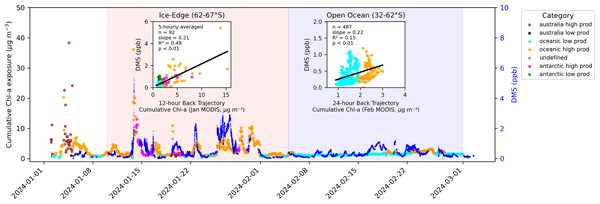
Abstract. Biogenic volatile methylated sulfur (VMS) gases, dimethyl sulfide (DMS) and methanethiol (MeSH), are major precursors of climate-cooling sulfate aerosol, yet their sources, co-emission and fate remain poorly constrained over the Southern Ocean and Antarctica. In this study, we combine atmospheric VMS measurements with biogeochemical and meteorological observations from an austral summer Southern Ocean voyage to examine the drivers of atmospheric VMS concentrations across contrasting ocean-atmosphere regimes. At the Antarctic Ice Edge (62–67° S), DMS dominated the VMS burden (up to 5.7 ppb) with episodic coastal polynya and shelf biological hotspots demonstrating very low MeSH:DMS (0.3–4 %). In this regime, DMS variability was strongly related to recent air mass exposure to high surface chlorophyll-a (R2 = 0.49), whereas MeSH showed little dependence (R2 < 0.14), consistent with stronger heterotrophic control on MeSH production. Over the open ocean (32–62° S), DMS and MeSH were tightly coupled (R2 = 0.80) with higher MeSH (up to 250 ppt) and MeSH:DMS (~15 %), but chlorophyll-a explained little of the variability (R2 = 0.15); instead, physical ocean structure and boundary-layer conditions influenced VMS variability. DMS and DMSO co-varied at the Antarctic Ice-Edge (R2 = 0.69), indicating rapid oxidation via addition reactions with hydroxyl and bromine monoxide radicals at the surface. Overall, our results support developing coupled VMS-biogeochemical parameterisations to better capture aerosol-cloud representation in Southern Ocean climate models, and revising DMS-based parameterisations of MeSH at the Antarctic Ice-Edge, which currently appear to overestimate MeSH contributions to the VMS burden under these conditions.
-
Notice on discussion status
The requested preprint has a corresponding peer-reviewed final revised paper. You are encouraged to refer to the final revised version.
-
Preprint
(3555 KB)
-
Supplement
(14615 KB)
-
The requested preprint has a corresponding peer-reviewed final revised paper. You are encouraged to refer to the final revised version.
- Preprint
(3555 KB) - Metadata XML
-
Supplement
(14615 KB) - BibTeX
- EndNote
- Final revised paper


Journal article(s) based on this preprint
Interactive discussion
Status: closed
- RC1: 'Comment on egusphere-2026-1346', Charel Wohl, 05 Jun 2026
-
RC2: 'Comment on egusphere-2026-1346', Anonymous Referee #2, 16 Jun 2026
This paper presents measurements of gas-phase DMS, MeSH and DMSO during a research cruise near Antarctica and in the Southern Ocean with extensive analysis of air mass backtrajectories and local biogeochemical measurements. The discussion of the case studies is interesting as is the discussion of DMSO. This paper is an important addition to the still fairly sparse body of measurements in this remote and climactically important region. It should be published after consideration of the following comments.
Major comments:
- I think the paper could benefit from some restructuring and possibly removing some material that doesn’t tell a clear story. In particular, I find all the different ways the data is sliced up to be confusing and wonder if they are all necessary. For example, Figure 3 has the data divided in two by ship location and then divided in four by air mass source/productivity. Do the violin plots for ship location explain anything? They are not discussed in Section 3.2. The ratio of MeSH:DMS is discussed in Section 3.4 but in the context of a figure in a previous paper. The violin plots in Figure 3 do not make the same point. Instead, the violin plots look remarkably similar between low and high productivity (except oceanic DMSO). I don’t think they demonstrate the point that high productivity regions had higher VMS concentrations. I encourage you to rethink whether violin plots are a good representation of the data. It might be better to plot MeSH vs DMS and DMSO vs DMS and color by the four air mass sources. If that does not show a clear separation between high and low productivity air masses, then maybe remove Section 3.2 and Figure 3 and move on to the next section which makes a more convincing case for correlating concentrations with air mass source.
- Later in the paper, there is a further division into three case studies. The times of the case studies are not indicated on any of the time series plots making it difficult to understand how they relate to the rest of the campaign. In Figure 2 (and Figure S13), I would suggest using vertical lines to mark the start/end of each case study. Also mark the various regions on Fig. S11 which has a different time axis.
- I don’t think the mesocosm experiment adds much to this paper and it adds text/figures to the SI. I would remove it from this paper since the authors mention that a more extensive paper on the mesocosm experiments is in progress.
- You should state more clearly that the DMS and MeSH measurements in this paper have been published previously, either in the introduction or in the campaign overview section.
Minor comments:
Figure 1. This is a very nice summary of the various processes. I would suggest a few changes that might make it easier to interpret. On the right-hand side, I would flip what is above and below the red dashed line. This would put the higher temperature reactions above the lower temperature reactions and also put the more volatile species above the less volatile species. I think these changes to the layout would enhance interpretation by having the physical layout represent the properties. Can you make the pink and the red boxes more different in color? They are difficult to tell apart. It would be helpful to have a legend for the colors.
Section 2.4. Did you calibrate the TOF-ACSM for MSA and did you see any indication that some of the SO4 measured might have been MSA?
Figure 2. In panel e), the axis is labeled MeSH:VMS but the text says MeSH: DMS. Are the ppb units ppbv? Is there a reason to use different units (molecules/cm3) for DMSO and MSA? In general, the traces are very hard to tell apart. Maybe consider using more contrasting colors in each panel.
Figures 2, 4, S11, S13. Why are the tick marks on the time axis not evenly spaced? Most are 7 days apart but there’s a gap of 10 days between Jan 22 and Feb 1. This makes it hard to find specific dates mentioned in the text.
Figure 3. Why is the sum of the air mass points (1195) 40% higher than the sum of the ship location points (852)? Figure 2 shows the air mass analysis extending longer in time than the ship location but not 40% longer.
Lines 282-3: MeSH is not what you are plotting in Fig. 5a. However, if you mark the Subtropical Front on Fig.2, then you can refer to that.
Line 325: Please explain briefly what the nocturnal accumulation method is.
Lines 349 and 356: Please mark the locations of your three case studies on the map in Fig. S4. What is a process station?
Lines 357-367: This description of high DMS/MeSH being associated with shallow water is at odds with the depth profile in Fig S9 which shows the highest DMS at the point where the water became much deeper. Do you have an explanation?
Line 388: There are only a few measurements of dissolved DMSO in the MPA region and they are not higher than the other measurements. Please explain why you consider these high concentrations.
Line 497: I would not call an R2 of 0.04 “signficantly correlated.” Plus, you call it decoupled in line 557. Please rephrase.
Figure 6. Can you use red and blue regions to indicate ice edge and open ocean? Using red and blue bars for the polar front and subtropical front makes it look like you are defining open ocean differently in this graph than in the other ones.
Lines 534-536: Since you have seawater and air DMSO, can you estimate a flux from a two-layer model?
Supplementary Information:
Line 13: 11-12% uncertainty seems low for PTR measurements, especially for the compounds that you are not directly calibrating during the campaign. Does this take into consideration the error in fitting two peaks close to each other, as in the examples in Fig. S1, when the target peak is small?
Equation 1: It is confusing that all the subscripts are x. Shouldn’t two of them be DMS?
Lines 20-21: Why is the sensitivity of DMS 6 times higher at KCG than during MISO?
Lines 23-27: Do you have enough compounds in your calibration cylinder to do sensitivity vs kPTR? Can you show the data and where MeSH and DMSO fall relative to the compounds in your cal cylinder? I’m surprised DMSO is off by a factor of 4.5.
Section S2: This is a confusing description of OSSCAR since it starts with a lot of detail about the detector. What is in front of the detector? A GC? With a trap? Are you looking at the headspace of a sample? Or bubbling through a sample?
Section S4: Since you have both air and seawater measurements for DMS, can you calculate fluxes with a two-layer model? How do they agree with the nighttime accumulation method?
Lines 104-105: What are the UV transmission characteristics of the PMMA lid and Tedlar film?
Figure S9: Is there a reason to plot versus latitude instead of as a time-series? It makes it hard to visually compare averages as you do in the text. It would be useful to add the locations of the CTD casts to this figure.
Figure S10: Please include an axis in units of depth.
Figure S12: It is very difficult to tell the different orange lines apart. Can you use more distinct colors and/or different symbols? Do any of these correspond to the Subtropical Front case? Can you put a label with the region at the top of each column?
Figure S15: Please highlight the region that is the Subtropical Front case in the time-series panels.
Typos/corrections:
Line 276: You have not yet defined MPA.
Lines 426-429: This sentence is repetitive and refers to the wrong figure in the SI (CDOM is Fig. S10 not S12).
Line 474: I think you mean Subtropical Front, rather than Open Ocean, for the third case study.
Line 558: R2 is 0.04 in Fig. 6.
Supplementary Information:
Make sure the figures are in the order mentioned in the text.
Line 10: Reference missing.
Figure S5: Can you use the same orange color for oceanic high productivity in the pie charts as on the map?
Figure S8: It is very hard to see the blue writing against the blue background.
Citation: https://doi.org/10.5194/egusphere-2026-1346-RC2 -
RC3: 'Comment on egusphere-2026-1346', Anonymous Referee #3, 02 Jul 2026
Review of: “Drivers of Atmospheric Volatile Methylated Sulfur Variability Across the Southern Ocean and Antarctic Coast” by Mynard et al.
The authors present a valuable contribution to our understanding of marine sulfur cycling by detailing the environmental drivers of DMS and MeSH across the Southern Ocean and Antarctic coastal region. A major strength of this study is its robust integration of atmospheric and biogeochemical data from an austral summer voyage, which combinedly demonstrates that volatile methylated sulfur (VMS) drivers are highly region-specific. By detailing distinct regional mechanisms alongside observations of rapid oxidation processes near the ice edge, the manuscript provides crucial, high-resolution empirical data that will significantly refine how future climate models parameterize climate-cooling sulfate aerosol precursors in these remote marine environments. This timely manuscript is valuable to the community in addressing the knowledge gap for this climatically important region and should be published after the following comments are addressed.
Major Comments:
- To avoid ambiguity regarding overlapping datasets, please explicitly detail the novelty of this work especially in term of dataset presented by mentioning that in the earlier section like introduction or at the beginning of methodology in contrast with your recently published work Mynard, C., et al. (2025).
- While Figure 1 provides an excellent and highly useful conceptual framework for VMS oxidation, it is currently missing arrows for heterogeneous loss of HPMTF. I would recommend adding that to provide a more realistic picture of VMS chemistry. Additionally, the scheme currently links methanesulfonic acid (MSA) solely to particle growth. It would be valuable to indicate that MSA can also play a direct role in nucleation.
- In Figure 4, the authors use a 5-hourly average with a 12-hour back trajectory for the Ice-Edge regression but seemingly use 1-hourly data for the Open Ocean regression with a 24-hour back trajectory. While you justified the choice of time for back trajectory analysis and unless I missed to catch this up, it would be nice to add a justification in the main text for treating the temporal averaging of the data points for two regimes differently (5-hour vs 1-hour).
Minor Comments:
Line 282-283: How did you isolate MeSH since you plotted VMS in Figure 5a?
Fig S1: The figure would benefit from increasing all font sizes and repositioning the legend inside the figure.
Fig S13: Have the authors investigated any potential correlations between VMS concentrations and the hourly rainfall data presented in Figure S13? The author could consider adding a figure in the supplementary.
Fig S14: Consider increasing the size of the symbols in the legend for clarity.
Citation: https://doi.org/10.5194/egusphere-2026-1346-RC3 - AC1: 'Comment on egusphere-2026-1346', Caleb Mynard, 22 Jul 2026
Peer review completion


Interactive discussion
Status: closed
-
RC1: 'Comment on egusphere-2026-1346', Charel Wohl, 05 Jun 2026
Review of: “Drivers of Atmospheric Volatile Methylated Sulfur Variability Across the Southern Ocean and Antarctic Coast” by Mynard et al.
The authors present a whole suite of measurements centred around MeSH and DMS concentrations via PTR-ToF in air. The authors include oceanic measurements which are relevant to the production of these compounds in seawater and measurements of the oxidative products of MeSH and DMS in air. The methodologies employed are well described and robust. The authors present a very detailed and complete discussion of the data. The claims made in this discussion are well backed up by the available data and are well embedded in the existing knowledge around these compounds. The dataset and discussion are very valuable to the community and I highly recommend this manuscript for publication following a few minor comments around the methodology.
As part of the peer review process and for posterity, it might be worth detailing here how this manuscript differs from “Mynard, C., Franklin, E. B., Alroe, J., Somerville, N., Patti, A., Siems, S. T., et al. (2025). Constraining atmospheric methanethiol estimates over the Southern Ocean. Geophysical Research Letters, 52, e2025GL116470. https://doi.org/10.1029/2025GL116470”. The manuscript presented here clearly contains more detailed information on the MISO voyage and it is richer in data from different instruments (air and water).
L20: These are CLAW-hypothesis specific references. Suggest changing to a different reference which look at the impact of DMS (and MeSH) specifically, rather than this feedback mechanism.
L28: “… limited anthropogenic and terrestrial influence”
Figure 1: The figure is potentially missing some arrows indicating HPMTF losses and how they reduce the yield of SO2 from DMS. Potentially beyond the scope of the manuscript but feels like a detail worth adding to the figure. Also, MSA is potentially playing a role in nucleation, again, not sure if this is important for this manuscript. https://pubs.acs.org/doi/10.1021/acsearthspacechem.3c00017
L95: The PTR was calibrated every 5 days. Can the authors provide a figure that shows that the analytical system was very stable and not more frequent calibrations were necessary?
L100: Why did the authors decide to relate MeSH, DMSO sensitivities to DMS sensitivity using a ratio rather than a regression? After all, there could be an intercept in this relationship.
L163: Did the authors use day and night-time data for this? During the day, the fluorometer measurements could be influenced by photochemical quenching. The authors could consider adding the HPLC measurements to Fig2 c).
L188: Please add here that you compared underway and CTD Fluo to check for measurement consistency/contamination.
Section 3.3: This section is very complete. Have the authors observed any correlations with hourly precipitation Figure S13? We might expect that DMS and MeSH and DMSO are “scavenged” by rain. Have the authors observed any correlations with PAR and the amplitude of a potential diurnal cycle in DMS and MeSH? More PAR – more OH – larger diurnal. Overall there is a lack of discussion of diurnal variability in DMS and MeSH. All MeSH air measurements up to now have found a diurnal change in the mean. Might be worth adding a figure in the supplement and brief discussion e.g. in Sect.3.1.
Supplement
L4: How frequent were the backgrounds?
L13: The uncertainty of the Apel-Riemer Cal gas concentration is +- 5 %. Has this been considered?
L21: Why was the sensitivity at KCG 6 times larger than during MISO?
L26: Did the authors also compare cylinder-derived MeSH sensitivity and MeSH sensitivity from the measured ion counts of protonated species and the collision rate constant for the proton transfer reaction? What was the transmission used for MeSH and how was this derived?
L114: Indicate location of NO3-CIMS? How straight was this inlet?
Figure S1: The authors could include brief (1-2 days) timeseries of m/z 49, 63 and 79 and all peaks they fitted at these nominal masses. This is just to show that the authors have fitted “the right” number of peaks – if there is such a thing. The motivation behind this is very well illustrated in the supplement of this paper: https://www.pnas.org/doi/10.1073/pnas.2218127120#supplementary-materials
Citation: https://doi.org/10.5194/egusphere-2026-1346-RC1 -
RC2: 'Comment on egusphere-2026-1346', Anonymous Referee #2, 16 Jun 2026
This paper presents measurements of gas-phase DMS, MeSH and DMSO during a research cruise near Antarctica and in the Southern Ocean with extensive analysis of air mass backtrajectories and local biogeochemical measurements. The discussion of the case studies is interesting as is the discussion of DMSO. This paper is an important addition to the still fairly sparse body of measurements in this remote and climactically important region. It should be published after consideration of the following comments.
Major comments:
- I think the paper could benefit from some restructuring and possibly removing some material that doesn’t tell a clear story. In particular, I find all the different ways the data is sliced up to be confusing and wonder if they are all necessary. For example, Figure 3 has the data divided in two by ship location and then divided in four by air mass source/productivity. Do the violin plots for ship location explain anything? They are not discussed in Section 3.2. The ratio of MeSH:DMS is discussed in Section 3.4 but in the context of a figure in a previous paper. The violin plots in Figure 3 do not make the same point. Instead, the violin plots look remarkably similar between low and high productivity (except oceanic DMSO). I don’t think they demonstrate the point that high productivity regions had higher VMS concentrations. I encourage you to rethink whether violin plots are a good representation of the data. It might be better to plot MeSH vs DMS and DMSO vs DMS and color by the four air mass sources. If that does not show a clear separation between high and low productivity air masses, then maybe remove Section 3.2 and Figure 3 and move on to the next section which makes a more convincing case for correlating concentrations with air mass source.
- Later in the paper, there is a further division into three case studies. The times of the case studies are not indicated on any of the time series plots making it difficult to understand how they relate to the rest of the campaign. In Figure 2 (and Figure S13), I would suggest using vertical lines to mark the start/end of each case study. Also mark the various regions on Fig. S11 which has a different time axis.
- I don’t think the mesocosm experiment adds much to this paper and it adds text/figures to the SI. I would remove it from this paper since the authors mention that a more extensive paper on the mesocosm experiments is in progress.
- You should state more clearly that the DMS and MeSH measurements in this paper have been published previously, either in the introduction or in the campaign overview section.
Minor comments:
Figure 1. This is a very nice summary of the various processes. I would suggest a few changes that might make it easier to interpret. On the right-hand side, I would flip what is above and below the red dashed line. This would put the higher temperature reactions above the lower temperature reactions and also put the more volatile species above the less volatile species. I think these changes to the layout would enhance interpretation by having the physical layout represent the properties. Can you make the pink and the red boxes more different in color? They are difficult to tell apart. It would be helpful to have a legend for the colors.
Section 2.4. Did you calibrate the TOF-ACSM for MSA and did you see any indication that some of the SO4 measured might have been MSA?
Figure 2. In panel e), the axis is labeled MeSH:VMS but the text says MeSH: DMS. Are the ppb units ppbv? Is there a reason to use different units (molecules/cm3) for DMSO and MSA? In general, the traces are very hard to tell apart. Maybe consider using more contrasting colors in each panel.
Figures 2, 4, S11, S13. Why are the tick marks on the time axis not evenly spaced? Most are 7 days apart but there’s a gap of 10 days between Jan 22 and Feb 1. This makes it hard to find specific dates mentioned in the text.
Figure 3. Why is the sum of the air mass points (1195) 40% higher than the sum of the ship location points (852)? Figure 2 shows the air mass analysis extending longer in time than the ship location but not 40% longer.
Lines 282-3: MeSH is not what you are plotting in Fig. 5a. However, if you mark the Subtropical Front on Fig.2, then you can refer to that.
Line 325: Please explain briefly what the nocturnal accumulation method is.
Lines 349 and 356: Please mark the locations of your three case studies on the map in Fig. S4. What is a process station?
Lines 357-367: This description of high DMS/MeSH being associated with shallow water is at odds with the depth profile in Fig S9 which shows the highest DMS at the point where the water became much deeper. Do you have an explanation?
Line 388: There are only a few measurements of dissolved DMSO in the MPA region and they are not higher than the other measurements. Please explain why you consider these high concentrations.
Line 497: I would not call an R2 of 0.04 “signficantly correlated.” Plus, you call it decoupled in line 557. Please rephrase.
Figure 6. Can you use red and blue regions to indicate ice edge and open ocean? Using red and blue bars for the polar front and subtropical front makes it look like you are defining open ocean differently in this graph than in the other ones.
Lines 534-536: Since you have seawater and air DMSO, can you estimate a flux from a two-layer model?
Supplementary Information:
Line 13: 11-12% uncertainty seems low for PTR measurements, especially for the compounds that you are not directly calibrating during the campaign. Does this take into consideration the error in fitting two peaks close to each other, as in the examples in Fig. S1, when the target peak is small?
Equation 1: It is confusing that all the subscripts are x. Shouldn’t two of them be DMS?
Lines 20-21: Why is the sensitivity of DMS 6 times higher at KCG than during MISO?
Lines 23-27: Do you have enough compounds in your calibration cylinder to do sensitivity vs kPTR? Can you show the data and where MeSH and DMSO fall relative to the compounds in your cal cylinder? I’m surprised DMSO is off by a factor of 4.5.
Section S2: This is a confusing description of OSSCAR since it starts with a lot of detail about the detector. What is in front of the detector? A GC? With a trap? Are you looking at the headspace of a sample? Or bubbling through a sample?
Section S4: Since you have both air and seawater measurements for DMS, can you calculate fluxes with a two-layer model? How do they agree with the nighttime accumulation method?
Lines 104-105: What are the UV transmission characteristics of the PMMA lid and Tedlar film?
Figure S9: Is there a reason to plot versus latitude instead of as a time-series? It makes it hard to visually compare averages as you do in the text. It would be useful to add the locations of the CTD casts to this figure.
Figure S10: Please include an axis in units of depth.
Figure S12: It is very difficult to tell the different orange lines apart. Can you use more distinct colors and/or different symbols? Do any of these correspond to the Subtropical Front case? Can you put a label with the region at the top of each column?
Figure S15: Please highlight the region that is the Subtropical Front case in the time-series panels.
Typos/corrections:
Line 276: You have not yet defined MPA.
Lines 426-429: This sentence is repetitive and refers to the wrong figure in the SI (CDOM is Fig. S10 not S12).
Line 474: I think you mean Subtropical Front, rather than Open Ocean, for the third case study.
Line 558: R2 is 0.04 in Fig. 6.
Supplementary Information:
Make sure the figures are in the order mentioned in the text.
Line 10: Reference missing.
Figure S5: Can you use the same orange color for oceanic high productivity in the pie charts as on the map?
Figure S8: It is very hard to see the blue writing against the blue background.
Citation: https://doi.org/10.5194/egusphere-2026-1346-RC2 -
RC3: 'Comment on egusphere-2026-1346', Anonymous Referee #3, 02 Jul 2026
Review of: “Drivers of Atmospheric Volatile Methylated Sulfur Variability Across the Southern Ocean and Antarctic Coast” by Mynard et al.
The authors present a valuable contribution to our understanding of marine sulfur cycling by detailing the environmental drivers of DMS and MeSH across the Southern Ocean and Antarctic coastal region. A major strength of this study is its robust integration of atmospheric and biogeochemical data from an austral summer voyage, which combinedly demonstrates that volatile methylated sulfur (VMS) drivers are highly region-specific. By detailing distinct regional mechanisms alongside observations of rapid oxidation processes near the ice edge, the manuscript provides crucial, high-resolution empirical data that will significantly refine how future climate models parameterize climate-cooling sulfate aerosol precursors in these remote marine environments. This timely manuscript is valuable to the community in addressing the knowledge gap for this climatically important region and should be published after the following comments are addressed.
Major Comments:
- To avoid ambiguity regarding overlapping datasets, please explicitly detail the novelty of this work especially in term of dataset presented by mentioning that in the earlier section like introduction or at the beginning of methodology in contrast with your recently published work Mynard, C., et al. (2025).
- While Figure 1 provides an excellent and highly useful conceptual framework for VMS oxidation, it is currently missing arrows for heterogeneous loss of HPMTF. I would recommend adding that to provide a more realistic picture of VMS chemistry. Additionally, the scheme currently links methanesulfonic acid (MSA) solely to particle growth. It would be valuable to indicate that MSA can also play a direct role in nucleation.
- In Figure 4, the authors use a 5-hourly average with a 12-hour back trajectory for the Ice-Edge regression but seemingly use 1-hourly data for the Open Ocean regression with a 24-hour back trajectory. While you justified the choice of time for back trajectory analysis and unless I missed to catch this up, it would be nice to add a justification in the main text for treating the temporal averaging of the data points for two regimes differently (5-hour vs 1-hour).
Minor Comments:
Line 282-283: How did you isolate MeSH since you plotted VMS in Figure 5a?
Fig S1: The figure would benefit from increasing all font sizes and repositioning the legend inside the figure.
Fig S13: Have the authors investigated any potential correlations between VMS concentrations and the hourly rainfall data presented in Figure S13? The author could consider adding a figure in the supplementary.
Fig S14: Consider increasing the size of the symbols in the legend for clarity.
Citation: https://doi.org/10.5194/egusphere-2026-1346-RC3 - AC1: 'Comment on egusphere-2026-1346', Caleb Mynard, 22 Jul 2026
Peer review completion
Journal article(s) based on this preprint
Viewed
| HTML | XML | Total | Supplement | BibTeX | EndNote | |
|---|---|---|---|---|---|---|
| 429 | 190 | 48 | 667 | 287 | 58 | 44 |
- HTML: 429
- PDF: 190
- XML: 48
- Total: 667
- Supplement: 287
- BibTeX: 58
- EndNote: 44
Viewed (geographical distribution)
| Country | # | Views | % |
|---|
| Total: | 0 |
| HTML: | 0 |
| PDF: | 0 |
| XML: | 0 |
- 1

Emily B. Franklin
Joel Alroe
Karen Westwood
Brandon J. McNabb
Robert Strzepek
Philippe D. Tortell
Steven T. Siems
Antonio Patti
Suzie Molloy
Alan Griffiths
Branka Miljevic
Marc D. Mallet
Ruhi Humphries
Erin Dunne
The requested preprint has a corresponding peer-reviewed final revised paper. You are encouraged to refer to the final revised version.
- Preprint
(3555 KB) - Metadata XML
-
Supplement
(14615 KB) - BibTeX
- EndNote
- Final revised paper
Review of: “Drivers of Atmospheric Volatile Methylated Sulfur Variability Across the Southern Ocean and Antarctic Coast” by Mynard et al.
The authors present a whole suite of measurements centred around MeSH and DMS concentrations via PTR-ToF in air. The authors include oceanic measurements which are relevant to the production of these compounds in seawater and measurements of the oxidative products of MeSH and DMS in air. The methodologies employed are well described and robust. The authors present a very detailed and complete discussion of the data. The claims made in this discussion are well backed up by the available data and are well embedded in the existing knowledge around these compounds. The dataset and discussion are very valuable to the community and I highly recommend this manuscript for publication following a few minor comments around the methodology.
As part of the peer review process and for posterity, it might be worth detailing here how this manuscript differs from “Mynard, C., Franklin, E. B., Alroe, J., Somerville, N., Patti, A., Siems, S. T., et al. (2025). Constraining atmospheric methanethiol estimates over the Southern Ocean. Geophysical Research Letters, 52, e2025GL116470. https://doi.org/10.1029/2025GL116470”. The manuscript presented here clearly contains more detailed information on the MISO voyage and it is richer in data from different instruments (air and water).
L20: These are CLAW-hypothesis specific references. Suggest changing to a different reference which look at the impact of DMS (and MeSH) specifically, rather than this feedback mechanism.
L28: “… limited anthropogenic and terrestrial influence”
Figure 1: The figure is potentially missing some arrows indicating HPMTF losses and how they reduce the yield of SO2 from DMS. Potentially beyond the scope of the manuscript but feels like a detail worth adding to the figure. Also, MSA is potentially playing a role in nucleation, again, not sure if this is important for this manuscript. https://pubs.acs.org/doi/10.1021/acsearthspacechem.3c00017
L95: The PTR was calibrated every 5 days. Can the authors provide a figure that shows that the analytical system was very stable and not more frequent calibrations were necessary?
L100: Why did the authors decide to relate MeSH, DMSO sensitivities to DMS sensitivity using a ratio rather than a regression? After all, there could be an intercept in this relationship.
L163: Did the authors use day and night-time data for this? During the day, the fluorometer measurements could be influenced by photochemical quenching. The authors could consider adding the HPLC measurements to Fig2 c).
L188: Please add here that you compared underway and CTD Fluo to check for measurement consistency/contamination.
Section 3.3: This section is very complete. Have the authors observed any correlations with hourly precipitation Figure S13? We might expect that DMS and MeSH and DMSO are “scavenged” by rain. Have the authors observed any correlations with PAR and the amplitude of a potential diurnal cycle in DMS and MeSH? More PAR – more OH – larger diurnal. Overall there is a lack of discussion of diurnal variability in DMS and MeSH. All MeSH air measurements up to now have found a diurnal change in the mean. Might be worth adding a figure in the supplement and brief discussion e.g. in Sect.3.1.
Supplement
L4: How frequent were the backgrounds?
L13: The uncertainty of the Apel-Riemer Cal gas concentration is +- 5 %. Has this been considered?
L21: Why was the sensitivity at KCG 6 times larger than during MISO?
L26: Did the authors also compare cylinder-derived MeSH sensitivity and MeSH sensitivity from the measured ion counts of protonated species and the collision rate constant for the proton transfer reaction? What was the transmission used for MeSH and how was this derived?
L114: Indicate location of NO3-CIMS? How straight was this inlet?
Figure S1: The authors could include brief (1-2 days) timeseries of m/z 49, 63 and 79 and all peaks they fitted at these nominal masses. This is just to show that the authors have fitted “the right” number of peaks – if there is such a thing. The motivation behind this is very well illustrated in the supplement of this paper: https://www.pnas.org/doi/10.1073/pnas.2218127120#supplementary-materials