
the Creative Commons Attribution 4.0 License.
the Creative Commons Attribution 4.0 License.
 | 18 Mar 2026
Integrating Ozone–vegetation Damage Schemes into SSiB4/TRIFFID: Evaluation of Six Parameterizations and Refinement of Ozone Decay Process Across Plant Functional Types
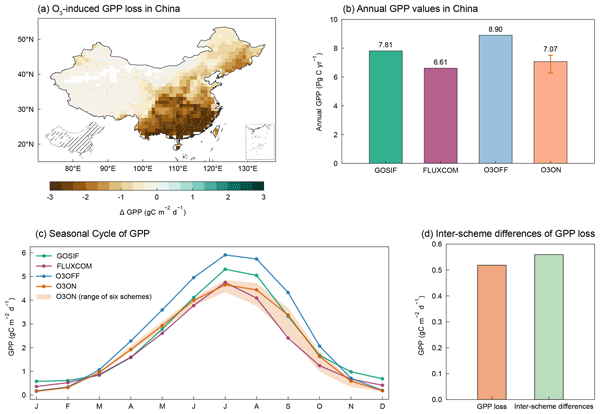
Abstract. Tropospheric ozone (O3) is a major air pollutant that threatens vegetation productivity and terrestrial ecosystems. Quantifying O3-induced impacts on photosynthesis and stomatal conductance is crucial for understanding biosphere-atmosphere interactions at regional and global scales. In recent decades, several parameterization schemes have been developed to describe the photosynthetic and stomatal responses to O3 exposure. However, substantial discrepancies remain when applying different schemes in various model frameworks. In this study, we integrated six flux-based O3-vegetation damage parameterizations into SSiB4/TRIFFID, a well-established dynamic global vegetation model, to assess the impacts of O3 pollution on vegetation photosynthesis in China during the 2010s. Our results indicate that O3 pollution led to approximately a 20 % reduction in GPP during the 2010s, with discrepancies ranging from 15 % to 31 % across different schemes. Comparison of the O3 damage schemes revealed substantial differences in plant O3 sensitivity across schemes and plant functional types (PFTs). When evaluated against observations, the newly developed L2024 parameterization—which features non‑linear response formulations—and the trait‑informed approaches based on leaf mass per area (LMA) both reproduce observed O3 sensitivity more closely, as reflected in their consistently smaller biases. This improved performance can be attributed to the inclusion of a broader range of observational and experimental data, as well as key physiological parameters (e.g., LMA) to better capture O3 sensitivity. Furthermore, we found that the L2024 scheme exhibited strong inhibition of photosynthesis in the late growing season due to cumulative O3 exposure. By refining the "decay" process of O3 accumulation using leaf lifespan parameters and applying the "decay" and "healing" processes across all PFTs, we improved the spatial and temporal distribution of gross primary productivity (GPP) simulations. This study highlights the importance of observations and physiological insights in developing O3-vegetation damage parameterizations. Future efforts should focus on expanding observational and experimental data on O3 responses in China’s natural ecosystems to enhance O3 damage assessment and model development.
-
Notice on discussion status
The requested preprint has a corresponding peer-reviewed final revised paper. You are encouraged to refer to the final revised version.
-
Preprint
(1918 KB)
-
Supplement
(1687 KB)
-
The requested preprint has a corresponding peer-reviewed final revised paper. You are encouraged to refer to the final revised version.
- Preprint
(1918 KB) - Metadata XML
-
Supplement
(1687 KB) - BibTeX
- EndNote
- Final revised paper


Journal article(s) based on this preprint
Interactive discussion
Status: closed
-
RC1: 'Comment on egusphere-2026-1335', Anonymous Referee #1, 24 Apr 2026
-
AC1: 'Reply on RC1', Lingfeng Li, 09 Jun 2026
We sincerely thank Referee #1 for the careful and constructive review. The comments were very helpful for improving the clarity, consistency, and presentation of the manuscript.
In response, we have substantially revised the Methods section to better distinguish the six O3–vegetation damage parameterizations, including their ozone dose metrics, photosynthesis–stomatal treatments, and parameter settings. We have added a new summary table to provide a side-by-side comparison of the schemes. We have also clarified the distinction between instantaneous stomatal O3 flux, PODy, and CUO, and revised the description of schemes to more clearly distinguish formulation refinements from parameter updates.
In addition, we have revised the figures and captions to clarify the spatial and temporal information, sources of observational benchmarks, and meaning of plotted data points. Formatting issues, notation inconsistencies, figure labels, and technical errors have also been checked and corrected throughout the manuscript and supplementary materials.
A detailed point-by-point response to all general and specific comments is provided in the response PDF attached as a supplementary file. In the response PDF, the referee’s comments are shown in black, while our responses and the corresponding manuscript revisions are shown in blue. All changes are also shown in the revised manuscript using track changes.
-
AC1: 'Reply on RC1', Lingfeng Li, 09 Jun 2026
-
RC2: 'Comment on egusphere-2026-1335', Anonymous Referee #2, 16 May 2026
This manuscript, entitled “Integrating Ozone–vegetation Damage Schemes into SSiB4/TRIFFID: Evaluation of Six Parameterizations and Refinement of Ozone Decay Process Across Plant Functional Types”, presents an intercomparison of six ozone damage parameterizations implemented in the SSiB4/TRIFFID dynamic global vegetation model, and applies them to quantify ozone impacts on vegetation photosynthesis in China during the 2010s. According to the manuscript, the Li2024 scheme generally performs best against observations, but also produces overly strong inhibition of photosynthesis during the late growing season due to cumulative ozone exposure. To reduce this bias, the authors further refine Li2024 by introducing ozone decay and healing processes for all plant functional types (PFTs). Tropospheric ozone damage remains an important source of uncertainty in land surface and Earth system modelling, and a systematic comparison of ozone–vegetation damage schemes within the same modelling framework is potentially useful. The manuscript is also within the scope of Geoscientific Model Development. The study may be useful for improving the representation of vegetation physiological responses to ozone stress in SSiB4/TRIFFID. However, I have concerns regarding the process justification and presentation of the refined decay/healing formulation. I therefore recommend revision before the manuscript can be considered for publication.
Major comment
Process basis of the refined decay/healing treatment requires clearer justification. My main concern relates to the treatment of the decay and healing processes in the refined Li2024 scheme. Li2024 includes a decay of accumulated POD for all PFTs, intended to represent the effects of leaf turnover and the emergence of new leaves. This is physically understandable in the sense that newly emerged leaves would have near-zero accumulated ozone damage, which would reduce canopy-mean POD. In the revised formulation presented here, the authors appear to extend or reformulate this treatment using a leaf-age-based decay approach for deciduous vegetation as well. The key issue is that the manuscript does not yet provide a sufficiently clear mechanistic basis for this formulation. What exact biological or physiological process is represented by the decay term for deciduous plants? Why is a leaf-age-based treatment appropriate for all PFTs, especially deciduous vegetation? Is there observational or experimental evidence supporting the proposed equations and parameter values?
At present, the refinement appears to be introduced primarily because the original Li2024 configuration produces too strong a late-season suppression of photosynthesis and GPP under cumulative ozone exposure. If this interpretation is correct, then the revised treatment is, at least in part, an empirical adjustment introduced to improve the seasonal cycle. In this case, the manuscript should present it more cautiously. Specifically, this component should not be framed as a robust process-based improvement unless stronger justification is provided. Instead, it would be more appropriate to describe it as a tentative or exploratory refinement, and to move from the Results section to Discussion, with suitably moderated language.
Given the aims of GMD, it is particularly important to distinguish clearly between: a process-based model development supported by theory or observations, and a pragmatic tuning-type modification introduced to reduce a simulation bias. The current manuscript does not yet make this distinction sufficiently clear.
Minor comments
(1) Please change L2024 to Li2024 throughout the manuscript. As noted by the authors, L2015 and Li2024 refer to schemes proposed by different authors, and the current notation is potentially confusing.
(2) Please check the model version name. CTSM2.2 should be CTSM5.2.
(3) In Fig. 3c, the colours of the different lines are difficult to distinguish. Please revise the colour palette and/or line styles to improve readability.
(4) In Fig. 5, it is not clear what the dots represent. Please specify explicitly in the caption whether these correspond to simulations or observations.
(5) In Fig. 8c, please clarify what is meant by OBS. Does this refer to GOSIF, FLUXCOM, or the mean of the two products? If possible, I suggest showing both products separately, or at least including their spread, in order to better reflect observational uncertainty and to provide a more objective benchmark for evaluating model performance.
Citation: https://doi.org/10.5194/egusphere-2026-1335-RC2 -
AC2: 'Reply on RC2', Lingfeng Li, 09 Jun 2026
We sincerely thank Referee #2 for the thoughtful and constructive review. The comments were particularly helpful for improving the explanation of the refined decay/healing treatment and for clarifying the scope of our modification to the Li2024 framework.
In the revised manuscript, we have clarified the interpretation of the decay and healing terms as complementary attenuation processes for accumulated O3 stress. The LAI-related healing term represents the rapid dilution of CUO during canopy expansion, whereas the leaf-longevity-based decay term provides a gradual attenuation pathway when LAI is stable or declining. We have also moderated the wording to present this treatment as a trait-constrained refinement within the existing CUO framework, rather than as process-based representation of O3 injury and recovery.
To support this interpretation, we added further discussion of the physiological basis, the role of leaf longevity, and added additional observational evidence from in the response supplementary figures from O3 fumigation experiments. We also revised the Methods, Results, Discussion, and relevant figure captions to make the motivation, implementation, and implications of the refinement clearer. The notation has also been updated from “L2024” to “Li2024” throughout the manuscript to avoid confusion with L2015.
A detailed point-by-point response, including supplementary response figures, is provided in the response PDF attached as a supplementary file. In the response PDF, the referee’s comments are shown in black, while our responses and the corresponding manuscript revisions are shown in blue. All changes are also shown in the revised manuscript using track changes.
-
AC2: 'Reply on RC2', Lingfeng Li, 09 Jun 2026
Peer review completion


Interactive discussion
Status: closed
-
RC1: 'Comment on egusphere-2026-1335', Anonymous Referee #1, 24 Apr 2026
Li et al. “Integrating Ozone-vegetation Damage Schemes into SSiB4/TRIFFID: Evaluation of Six Parameterizations and Refinement of Ozone Decay Process Across Plant Functional Types”
This study incorporates six ozone–vegetation damage parameterizations into the SSiB4/TRIFFID model and systematically evaluates ozone-induced reductions in GPP across China. Estimated GPP losses range from 15% to 31% across schemes. Benchmarking against observational ozone sensitivity indicates that the L2024 and LMA-based schemes perform relatively better. Moreover, refining the L2024 scheme to better represent the decay of cumulative ozone damage across plant functional types improves the spatiotemporal fidelity of GPP simulations. The topic of this study is helpful for the development of ozone vegetation damage scheme. However, some issues need to be addressed before the study can be considered for publication in GMD.
GENERAL
First, the key characteristics and differences among the six ozone damage schemes are not clearly presented. The authors introduce L2015, L2024, S2007, CS2007, LMAgrid, and LMApft separately in the methods, but a side-by-side comparison is missing. For example, which metric (CUO, PODy, or instantaneous ozone uptake) does each scheme rely on? Are the effects on photosynthesis and stomatal conductance treated in a coupled or decoupled manner? Is CS2007 simply a recalibrated version of S2007 with lower ozone damage sensitivity coefficients and a simplified treatment for three PFTs? The distinction between LMAgrid and LMApft is also unclear. Including a summary table in the methods that highlights the essential features and differences of all six schemes would greatly improve clarity.
Second, the conceptual framework regarding ozone dose metrics is confusing, and the distinction between mechanistic use and analytical use is not properly addressed. The authors employ three concepts – PODy (Phytotoxic Ozone Dose over a threshold of y), CUO (Cumulative Uptake of Ozone), and instantaneous ozone uptake -- without clearly defining or differentiating them. The description confuses PODy with CUO, and the relationship between PODy and instantaneous uptake is not explained. In the results, the authors introduce a dose-response analysis between GPP and ozone, in which the simulated annual cumulative stomatal ozone uptake is directly defined as PODy. The authors should clarify the physical meaning of each metric and specify how each is used in the research.
Third, the description of the original L2024 scheme is misleading, and the true contribution of the authors’ proposed improvement remains unclear. Section 2.2 describes L2024 as a PODy-dependent scheme, but Section 2.3.2 introduces CUO when discussing the modification of the ozone decay process, creating an inconsistency. Moreover, the claim that extending the decay process to all PFTs is an improvement is problematic: in the original L2024 (Eq. 5 in Li et al., 2024), the decay process already applies to all PFTs (leaf longevity for evergreens, LAI change for deciduous plants). Thus, this is not an innovation of the present study. Similar issues appear in the description of the Ma et al. (2023) schemes (see specific comments). The authors should clearly distinguish between parameter updates and structural improvements, and accurately restate their own contribution.
SPECIFIC
Throughout the abstract, main text, captions, and supplementary materials, there are multiple formatting errors: inconsistent terms for ‘O3’ or ‘ozone’, and/or missing subscripts. Please check each instance carefully. In addition, please standardize the format of dashes ‘-’ throughout the manuscript.
Line 47: NOx subscript.
Lines 83-86: Reference format errors. Are the re-calibrated S2007 and LMA schemes from the same paper? The sentence is unclear.
Line 121: H2O (m s-1) font error. Please check similar issues throughout this section.
Line 122: Missing period ‘.’
Line 127: FO3_A and FO3_g do not match the formulas.
Line 146: Typo: ‘O3-modification‘.
Line 157: Could be more explicit: ‘stomatal flux-based O3 damage framework‘.
Line 164: Ambiguous wording. The sentence ‘Following Feng et al. (2018), we set x = 0.019 based on the observations’ is from the scheme setting of Ma et al. (2023). The distinction between LMAgrid and LMApft is unclear; they differ in LMA format and α.
Line 170: Abbreviation not used (many such errors throughout; please check).
Line 172: Missing subscript (many such errors throughout).
Table 2: The L2024modify scheme could also be included.
Line 262: The sentence ‘Figure 1 shows... are shown in the supplementary materials (Fig. S4)’ is unclear. Please rephrase.
Figure 2: Why was GOSIF chosen for spatial validation but not FLUXCOM? Are panels (a), (b), (c) for the whole year or growing season? Experiment names in figures should match the main text (e.g., ‘O3OFF’ vs ‘O3 OFF’, ‘O3ON’ vs ‘O3 ON’). Please check all figures.
Figure 3: Why the inter-scheme difference have just one value instead of six?
Figure 4: Why does L2024 show the strongest GPP damage in Fig. 4 but not the strongest LAI damage in Fig. S7? Similarly, why does LMApft show the strongest GPP damage in southeastern China (f) but no corresponding LAI damage? Is this related to how GPP and LAI are calculated in the model? Could absolute and relative damage values be marked on the figures? Figure caption is separated from the figure.
Figure 5: Are these results for China or globally? Growing season or annual? Please clarify in each caption. The x-axis has errors.
Figure 5 clearly shows the relationship between RGPP and PODy. Figures 6 and 7 discuss ‘ozone sensitivity’ based on this relationship. However, the captions of Figures 6 and 7 do not explicitly state that sensitivity refers to the slope in Figure 5. Please clarify to avoid confusion.
Lines 319-326: Could the mismatch between stomatal ozone uptake and GPP damage across schemes be further explained? For example, L2015 decouples these two calculations.
Line 328: The explanation of RGPP has already been given above.
Line 418: Does the observational ozone sensitivity for each PFT attributed to Li et al. (2024) in Figure 6 correspond to the slopes calculated in Figure S3? This could be clarified.
Lines 425-426: The criticism of S2007 in the discussion is not accurate, as S2007 may have biases in sensitivity parameters instead of problems in the physical mechanisms.
Citation: https://doi.org/10.5194/egusphere-2026-1335-RC1 -
AC1: 'Reply on RC1', Lingfeng Li, 09 Jun 2026
We sincerely thank Referee #1 for the careful and constructive review. The comments were very helpful for improving the clarity, consistency, and presentation of the manuscript.
In response, we have substantially revised the Methods section to better distinguish the six O3–vegetation damage parameterizations, including their ozone dose metrics, photosynthesis–stomatal treatments, and parameter settings. We have added a new summary table to provide a side-by-side comparison of the schemes. We have also clarified the distinction between instantaneous stomatal O3 flux, PODy, and CUO, and revised the description of schemes to more clearly distinguish formulation refinements from parameter updates.
In addition, we have revised the figures and captions to clarify the spatial and temporal information, sources of observational benchmarks, and meaning of plotted data points. Formatting issues, notation inconsistencies, figure labels, and technical errors have also been checked and corrected throughout the manuscript and supplementary materials.
A detailed point-by-point response to all general and specific comments is provided in the response PDF attached as a supplementary file. In the response PDF, the referee’s comments are shown in black, while our responses and the corresponding manuscript revisions are shown in blue. All changes are also shown in the revised manuscript using track changes.
-
AC1: 'Reply on RC1', Lingfeng Li, 09 Jun 2026
-
RC2: 'Comment on egusphere-2026-1335', Anonymous Referee #2, 16 May 2026
This manuscript, entitled “Integrating Ozone–vegetation Damage Schemes into SSiB4/TRIFFID: Evaluation of Six Parameterizations and Refinement of Ozone Decay Process Across Plant Functional Types”, presents an intercomparison of six ozone damage parameterizations implemented in the SSiB4/TRIFFID dynamic global vegetation model, and applies them to quantify ozone impacts on vegetation photosynthesis in China during the 2010s. According to the manuscript, the Li2024 scheme generally performs best against observations, but also produces overly strong inhibition of photosynthesis during the late growing season due to cumulative ozone exposure. To reduce this bias, the authors further refine Li2024 by introducing ozone decay and healing processes for all plant functional types (PFTs). Tropospheric ozone damage remains an important source of uncertainty in land surface and Earth system modelling, and a systematic comparison of ozone–vegetation damage schemes within the same modelling framework is potentially useful. The manuscript is also within the scope of Geoscientific Model Development. The study may be useful for improving the representation of vegetation physiological responses to ozone stress in SSiB4/TRIFFID. However, I have concerns regarding the process justification and presentation of the refined decay/healing formulation. I therefore recommend revision before the manuscript can be considered for publication.
Major comment
Process basis of the refined decay/healing treatment requires clearer justification. My main concern relates to the treatment of the decay and healing processes in the refined Li2024 scheme. Li2024 includes a decay of accumulated POD for all PFTs, intended to represent the effects of leaf turnover and the emergence of new leaves. This is physically understandable in the sense that newly emerged leaves would have near-zero accumulated ozone damage, which would reduce canopy-mean POD. In the revised formulation presented here, the authors appear to extend or reformulate this treatment using a leaf-age-based decay approach for deciduous vegetation as well. The key issue is that the manuscript does not yet provide a sufficiently clear mechanistic basis for this formulation. What exact biological or physiological process is represented by the decay term for deciduous plants? Why is a leaf-age-based treatment appropriate for all PFTs, especially deciduous vegetation? Is there observational or experimental evidence supporting the proposed equations and parameter values?
At present, the refinement appears to be introduced primarily because the original Li2024 configuration produces too strong a late-season suppression of photosynthesis and GPP under cumulative ozone exposure. If this interpretation is correct, then the revised treatment is, at least in part, an empirical adjustment introduced to improve the seasonal cycle. In this case, the manuscript should present it more cautiously. Specifically, this component should not be framed as a robust process-based improvement unless stronger justification is provided. Instead, it would be more appropriate to describe it as a tentative or exploratory refinement, and to move from the Results section to Discussion, with suitably moderated language.
Given the aims of GMD, it is particularly important to distinguish clearly between: a process-based model development supported by theory or observations, and a pragmatic tuning-type modification introduced to reduce a simulation bias. The current manuscript does not yet make this distinction sufficiently clear.
Minor comments
(1) Please change L2024 to Li2024 throughout the manuscript. As noted by the authors, L2015 and Li2024 refer to schemes proposed by different authors, and the current notation is potentially confusing.
(2) Please check the model version name. CTSM2.2 should be CTSM5.2.
(3) In Fig. 3c, the colours of the different lines are difficult to distinguish. Please revise the colour palette and/or line styles to improve readability.
(4) In Fig. 5, it is not clear what the dots represent. Please specify explicitly in the caption whether these correspond to simulations or observations.
(5) In Fig. 8c, please clarify what is meant by OBS. Does this refer to GOSIF, FLUXCOM, or the mean of the two products? If possible, I suggest showing both products separately, or at least including their spread, in order to better reflect observational uncertainty and to provide a more objective benchmark for evaluating model performance.
Citation: https://doi.org/10.5194/egusphere-2026-1335-RC2 -
AC2: 'Reply on RC2', Lingfeng Li, 09 Jun 2026
We sincerely thank Referee #2 for the thoughtful and constructive review. The comments were particularly helpful for improving the explanation of the refined decay/healing treatment and for clarifying the scope of our modification to the Li2024 framework.
In the revised manuscript, we have clarified the interpretation of the decay and healing terms as complementary attenuation processes for accumulated O3 stress. The LAI-related healing term represents the rapid dilution of CUO during canopy expansion, whereas the leaf-longevity-based decay term provides a gradual attenuation pathway when LAI is stable or declining. We have also moderated the wording to present this treatment as a trait-constrained refinement within the existing CUO framework, rather than as process-based representation of O3 injury and recovery.
To support this interpretation, we added further discussion of the physiological basis, the role of leaf longevity, and added additional observational evidence from in the response supplementary figures from O3 fumigation experiments. We also revised the Methods, Results, Discussion, and relevant figure captions to make the motivation, implementation, and implications of the refinement clearer. The notation has also been updated from “L2024” to “Li2024” throughout the manuscript to avoid confusion with L2015.
A detailed point-by-point response, including supplementary response figures, is provided in the response PDF attached as a supplementary file. In the response PDF, the referee’s comments are shown in black, while our responses and the corresponding manuscript revisions are shown in blue. All changes are also shown in the revised manuscript using track changes.
-
AC2: 'Reply on RC2', Lingfeng Li, 09 Jun 2026
Peer review completion
Journal article(s) based on this preprint
Viewed
| HTML | XML | Total | Supplement | BibTeX | EndNote | |
|---|---|---|---|---|---|---|
| 830 | 271 | 87 | 1,188 | 150 | 76 | 77 |
- HTML: 830
- PDF: 271
- XML: 87
- Total: 1,188
- Supplement: 150
- BibTeX: 76
- EndNote: 77
Viewed (geographical distribution)
| Country | # | Views | % |
|---|
| Total: | 0 |
| HTML: | 0 |
| PDF: | 0 |
| XML: | 0 |
- 1
Lingfeng Li
Bo Qiu

Siwen Zhao
Chaorong Chen
Jiuyi Chen
Yueyang Ni
Xin Huang
Haishan Chen
Weidong Guo
The requested preprint has a corresponding peer-reviewed final revised paper. You are encouraged to refer to the final revised version.
- Preprint
(1918 KB) - Metadata XML
-
Supplement
(1687 KB) - BibTeX
- EndNote
- Final revised paper
Li et al. “Integrating Ozone-vegetation Damage Schemes into SSiB4/TRIFFID: Evaluation of Six Parameterizations and Refinement of Ozone Decay Process Across Plant Functional Types”
This study incorporates six ozone–vegetation damage parameterizations into the SSiB4/TRIFFID model and systematically evaluates ozone-induced reductions in GPP across China. Estimated GPP losses range from 15% to 31% across schemes. Benchmarking against observational ozone sensitivity indicates that the L2024 and LMA-based schemes perform relatively better. Moreover, refining the L2024 scheme to better represent the decay of cumulative ozone damage across plant functional types improves the spatiotemporal fidelity of GPP simulations. The topic of this study is helpful for the development of ozone vegetation damage scheme. However, some issues need to be addressed before the study can be considered for publication in GMD.
GENERAL
First, the key characteristics and differences among the six ozone damage schemes are not clearly presented. The authors introduce L2015, L2024, S2007, CS2007, LMAgrid, and LMApft separately in the methods, but a side-by-side comparison is missing. For example, which metric (CUO, PODy, or instantaneous ozone uptake) does each scheme rely on? Are the effects on photosynthesis and stomatal conductance treated in a coupled or decoupled manner? Is CS2007 simply a recalibrated version of S2007 with lower ozone damage sensitivity coefficients and a simplified treatment for three PFTs? The distinction between LMAgrid and LMApft is also unclear. Including a summary table in the methods that highlights the essential features and differences of all six schemes would greatly improve clarity.
Second, the conceptual framework regarding ozone dose metrics is confusing, and the distinction between mechanistic use and analytical use is not properly addressed. The authors employ three concepts – PODy (Phytotoxic Ozone Dose over a threshold of y), CUO (Cumulative Uptake of Ozone), and instantaneous ozone uptake -- without clearly defining or differentiating them. The description confuses PODy with CUO, and the relationship between PODy and instantaneous uptake is not explained. In the results, the authors introduce a dose-response analysis between GPP and ozone, in which the simulated annual cumulative stomatal ozone uptake is directly defined as PODy. The authors should clarify the physical meaning of each metric and specify how each is used in the research.
Third, the description of the original L2024 scheme is misleading, and the true contribution of the authors’ proposed improvement remains unclear. Section 2.2 describes L2024 as a PODy-dependent scheme, but Section 2.3.2 introduces CUO when discussing the modification of the ozone decay process, creating an inconsistency. Moreover, the claim that extending the decay process to all PFTs is an improvement is problematic: in the original L2024 (Eq. 5 in Li et al., 2024), the decay process already applies to all PFTs (leaf longevity for evergreens, LAI change for deciduous plants). Thus, this is not an innovation of the present study. Similar issues appear in the description of the Ma et al. (2023) schemes (see specific comments). The authors should clearly distinguish between parameter updates and structural improvements, and accurately restate their own contribution.
SPECIFIC
Throughout the abstract, main text, captions, and supplementary materials, there are multiple formatting errors: inconsistent terms for ‘O3’ or ‘ozone’, and/or missing subscripts. Please check each instance carefully. In addition, please standardize the format of dashes ‘-’ throughout the manuscript.
Line 47: NOx subscript.
Lines 83-86: Reference format errors. Are the re-calibrated S2007 and LMA schemes from the same paper? The sentence is unclear.
Line 121: H2O (m s-1) font error. Please check similar issues throughout this section.
Line 122: Missing period ‘.’
Line 127: FO3_A and FO3_g do not match the formulas.
Line 146: Typo: ‘O3-modification‘.
Line 157: Could be more explicit: ‘stomatal flux-based O3 damage framework‘.
Line 164: Ambiguous wording. The sentence ‘Following Feng et al. (2018), we set x = 0.019 based on the observations’ is from the scheme setting of Ma et al. (2023). The distinction between LMAgrid and LMApft is unclear; they differ in LMA format and α.
Line 170: Abbreviation not used (many such errors throughout; please check).
Line 172: Missing subscript (many such errors throughout).
Table 2: The L2024modify scheme could also be included.
Line 262: The sentence ‘Figure 1 shows... are shown in the supplementary materials (Fig. S4)’ is unclear. Please rephrase.
Figure 2: Why was GOSIF chosen for spatial validation but not FLUXCOM? Are panels (a), (b), (c) for the whole year or growing season? Experiment names in figures should match the main text (e.g., ‘O3OFF’ vs ‘O3 OFF’, ‘O3ON’ vs ‘O3 ON’). Please check all figures.
Figure 3: Why the inter-scheme difference have just one value instead of six?
Figure 4: Why does L2024 show the strongest GPP damage in Fig. 4 but not the strongest LAI damage in Fig. S7? Similarly, why does LMApft show the strongest GPP damage in southeastern China (f) but no corresponding LAI damage? Is this related to how GPP and LAI are calculated in the model? Could absolute and relative damage values be marked on the figures? Figure caption is separated from the figure.
Figure 5: Are these results for China or globally? Growing season or annual? Please clarify in each caption. The x-axis has errors.
Figure 5 clearly shows the relationship between RGPP and PODy. Figures 6 and 7 discuss ‘ozone sensitivity’ based on this relationship. However, the captions of Figures 6 and 7 do not explicitly state that sensitivity refers to the slope in Figure 5. Please clarify to avoid confusion.
Lines 319-326: Could the mismatch between stomatal ozone uptake and GPP damage across schemes be further explained? For example, L2015 decouples these two calculations.
Line 328: The explanation of RGPP has already been given above.
Line 418: Does the observational ozone sensitivity for each PFT attributed to Li et al. (2024) in Figure 6 correspond to the slopes calculated in Figure S3? This could be clarified.
Lines 425-426: The criticism of S2007 in the discussion is not accurate, as S2007 may have biases in sensitivity parameters instead of problems in the physical mechanisms.