
the Creative Commons Attribution 4.0 License.
the Creative Commons Attribution 4.0 License.
 | 27 Mar 2026
Invited Perspectives: Science for Comprehensive Disaster and Climate Risk Management
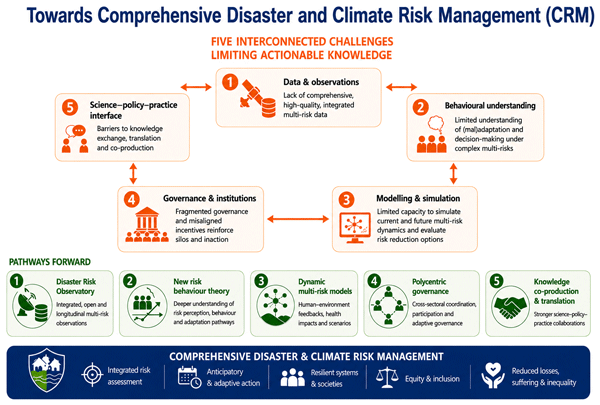
Abstract. In this paper, we explore five core challenges that need to be addressed in order to move towards the Comprehensive Disaster and Climate Risk Management approach, which has been proposed within the newly emerging paradigm of a more holistic approach to managing the risks associated with climatic and/or non-climatic hazards and non-climatic risk drivers across varied time scales and levels. These five challenges relate to the following points. First, we have a lack of comprehensive and high quality data for observing how society is impacted by, prepares for, and responds to multi-risks. Second, as a result we have a limited understanding of why individuals, communities, and other decision-makers (fail to) prepare for complex multi-risks in the way they do, and how that affects their responses. Third, our capacity to simulate how current and future risk could be effectively reduced is hampered by the aforementioned lack and fragmentation of observations and understanding of multi-risk dynamics. Fourth, current governance structures often reinforce data and knowledge silos. Fifth, the high complexity and wicked nature of the multi-risk problem results in barriers in knowledge exchange at the science, policy and practice interface. In this paper, we elaborate on each of these challenges, discuss why they matter for comprehensive disaster risk management, and provide ideas of how to overcome these challenges. We end the paper with a brief outlook.
Competing interests: At least one of the (co-)authors is a member of the editorial board of Natural Hazards and Earth System Sciences.
Publisher's note: Copernicus Publications remains neutral with regard to jurisdictional claims made in the text, published maps, institutional affiliations, or any other geographical representation in this paper. While Copernicus Publications makes every effort to include appropriate place names, the final responsibility lies with the authors. Views expressed in the text are those of the authors and do not necessarily reflect the views of the publisher.-
Notice on discussion status
The requested preprint has a corresponding peer-reviewed final revised paper. You are encouraged to refer to the final revised version.
-
Preprint
(621 KB)
-
The requested preprint has a corresponding peer-reviewed final revised paper. You are encouraged to refer to the final revised version.
- Preprint
(621 KB) - Metadata XML
- BibTeX
- EndNote
- Final revised paper


Journal article(s) based on this preprint
Interactive discussion
Status: closed
-
RC1: 'Comment on egusphere-2026-1331', Anonymous Referee #1, 11 May 2026
Dear Authors,
I found the article original and, in my opinion, the paper addresses relevant scientific and/or technical questions within the scope of NHESS. I believe that the introduction provides a broad and comprehensive overview of the current state of knowledge, with appropriate references to the relevant literature.
Some suggestions, offered with humility:
- First of all, I would recommend that the authors include some figures or graphics in the text, in order to break up the long written sections. A flowchart could be considered.
- Furthermore, to improve clarity and ease of understanding, it would be more appropriate to adopt the conventional structure with Introduction, Materials and Methods, Results, Discussion, and Conclusions.
- Lines 35–36: in the introduction (why is the first paragraph written in italics?) the example of Haiti is well explained, and when referring to the August 2021 earthquake, it would be useful to mention the number of fatalities, injuries, and missing persons (since it is extremely high and conveys the scale of the tragedy). Moreover, the risk associated with the concurrent COVID-19 pandemic has been overlooked: was this a deliberate choice? Is there a specific reason? Did the Government of Haiti also have to cope with this issue?
- Lines 72–73: regarding rapid-onset hazards, our research group has discussed the experience following the 2016–2017 earthquakes in central Italy (when people were forced to relocate far from the epicentral areas) in several papers “Farabollini, P., Bendia, F., & Lugeri, F. R. (2023). Revitalizing the Wounded Territory: The “Geo-Hiking’s” Potential. In Disaster Resilience and Human Settlements: Emerging Perspectives in the Anthropocene (pp. 259-281). Singapore: Springer Nature Singapore” and also here “Farabollini, P., Aringoli, D., Bendia, F., Bufalini, M., Cingolani, R., Fuffa, E., ... & Prati, S. (2022). Geomore srl (2022)- The geo-itinerary of “Anello della Sibilla” between sciences, history and myth: a vehicle for the renaissance of the territories affected by the earthquake using GIS technologies. Rend. Online Soc. Geol. It, 58, 28-33”.
- Line 81: If the authors consider it appropriate, I would like to point out some papers that discuss the increase in the use of substances and drugs during and after disasters:
North, C. S., Kawasaki, A., Spitznagel, E. L., & Hong, B. A. (2004). The course of PTSD, major depression, substance abuse, and somatization after a natural disaster. The Journal of nervous and mental disease, 192(12), 823-829;
Beaglehole, B., Bell, C., Frampton, C., Hamilton, G., & McKean, A. (2015a). The impact of the Canterbury earthquakes on prescribing for mental health. Australian & New Zealand Journal of Psychiatry, 49(8), 742-750;
Beaglehole, B., Bell, C., Beveridge, J., & Frampton, C. (2015b). Psychiatric admissions fall following the Christchurch earthquakes: An audit of inpatient data. Australian & New Zealand Journal of Psychiatry, 49(4), 346-350;
Kanehara, A., Ando, S., Araki, T., Usami, S., Kuwabara, H., Kano, Y., & Kasai, K. (2016). Trends in psychological distress and alcoholism after The Great East Japan Earthquake of 2011. SSM-Population Health, 2, 807-812;
Koyama, S., Tabuchi, T., Aida, J., Osaka, K., & Miyashiro, I. (2021). Determinants of increased tobacco consumption following a major disaster. Disaster Medicine and Public Health Preparedness, 15(1), 20-24;
Lavery, A. M. (2018). Notes from the field: pharmacy needs after a natural disaster—Puerto Rico, September–October 2017. MMWR. Morbidity and mortality weekly report, 67;
Amiri, H., Riyahifar, S., Nakhaee, N., & Nekoei-Moghadam, M. (2022). The long-term impact of the earthquake on substance use. International journal of emergency medicine, 15(1), 44.
- Finally, it could be interesting to include one or two case studies or simulations in which the priorities identified in the paper are applied in a concrete way.
Citation: https://doi.org/10.5194/egusphere-2026-1331-RC1 -
AC1: 'Reply on RC1', Philip Ward, 01 Jul 2026
Dear reviewer,
Many thanks for the generous words and for acknowledging the scientific value for the scope of NHESS. We thank the reviewer for the suggestions, which we hope to be able to use to improve the manuscript. In the attachment, we list our proposed changes to each comment (of both reviewers) point-by-point.
Kind regards
Philip Ward
-
RC2: 'Comment on egusphere-2026-1331', Rodrigo Calderon, 26 May 2026
Dear Authors,
I found the manuscript to be a valuable and timely contribution to the discussion of current challenges in comprehensive climate risk management, particularly within the context of increasingly interconnected and multi-risk societies. The paper addresses relevant conceptual and methodological issues and highlights several important directions for future research and practice. In my opinion, the manuscript represents a meaningful contribution to the broader understanding of risk governance and multi-risk dynamics, especially through its integrative perspective across disciplines and hazard contexts.
Overall, the manuscript is generally well written, and most arguments are supported by relevant literature. The scientific discussion is clear and balanced in most sections, and the topic itself is highly relevant for the natural hazards and disaster risk reduction community. I also appreciated the effort to connect climate risk management with broader systemic and societal dimensions.
However, I believe the manuscript could be further strengthened in terms of methodological clarity and conceptual organization. In particular, the main limitation is the lack of a clearer explanation regarding how the identified topics were selected and categorized as key challenges. It would be useful for the authors to clarify whether these themes emerged from a systematic review, expert consensus, conceptual synthesis, or another methodological approach. The inclusion of a conceptual figure or integrative diagram showing the relationships and interconnections among the identified challenges could significantly improve the presentation and readability of the manuscript.
In addition, while the manuscript successfully highlights several relevant challenges, some complementary perspectives from social sciences, risk perception research, participatory governance, and community resilience studies could be incorporated more explicitly to broaden the discussion and reinforce several of the paper’s arguments.
Overall, I consider the manuscript to have strong scientific significance and a good overall scientific and presentation quality. With some additional clarification and expansion in specific areas, I believe the paper could become an even stronger contribution to the field.
Specific comments
Line 181:
Are these crises addressed through anticipatory approaches, including the use of counterfactual analyses or scenario-based studies?
Line 240:
The discussion would benefit from references to risk perception studies examining adaptive responses at the individual level. Relevant examples include Siegrist and Arvai (2020), Slovic (1987), and Wachinger et al. (2013).
Line 257:
This is an interesting point regarding risk perception. What insights do existing risk perception studies provide in this context? Additional references would help strengthen the argument.
Line 270:
It may be useful to briefly define longitudinal data here as reinforcement of this important concept, beyond its earlier mention in Section 2.1.
Line 275:
The manuscript recognizes the growing need for greater integration of social sciences within climate risk management studies. Could the authors provide examples of current initiatives or interdisciplinary efforts addressing this gap?
Line 284:
The section title appears somewhat unclear or possibly incorrect. Perhaps “Risk simulation” or a similar term would better reflect the content of the section.
Line 294:
What characteristics are necessary for an effective multi-risk simulation framework? Is the inclusion of multiple hazards and longitudinal data sufficient, or should these simulations also incorporate dimensions such as physical vulnerability, health vulnerability, social vulnerability, and resilience?
Line 307:
It may be helpful to define what is meant by “dynamic vulnerability” in this context. Does this refer to temporal changes in social indicators and vulnerabilities resulting from cascading or multiple hazards?
Line 324:
It may be worth reinforcing the importance of local validation by acknowledging that disasters are inherently local processes, particularly from a disaster risk management perspective, and that locally grounded approaches are fundamental for strengthening community resilience. See, for example, Davies and Davies (2018).
Line 351:
The objective of establishing an empirical foundation is highly relevant. However, how do the authors envision incorporating empirical methodologies that also integrate socio-psychological dimensions and data?
Line 363:
What about experiences involving advisory groups, participatory governance, and community-engaged risk management approaches? Relevant examples could include Barton et al. (2020).
Line 446:
What types of data derived from underrepresented voices would be most relevant to include as a fundamental basis for risk assessment and management? In particular, how should the balance between the relevance, representativeness, and accuracy of risk-related information be addressed and evaluated?
Examples of references
Davies, T. R. H. and Davies, A. J.: Increasing communities’ resilience to disasters: An impact-based approach, Int. J. Disaster Risk Reduct., 31, 742–749, https://doi.org/10.1016/j.ijdrr.2018.07.026, 2018.
Barton, T. M., Beaven, S. J., Cradock-Henry, N. A., and Wilson, T. M.: Knowledge sharing in interdisciplinary disaster risk management initiatives: Co-creation insights and experience from New Zealand, Ecol. Soc., 25(4), 1–18, https://doi.org/10.5751/ES-11928-250425, 2020.
Siegrist, M. and Arvai, J.: Risk perception: Reflections on 40 years of research, Risk Analysis, 40, 2191–2206, https://doi.org/10.1111/risa.13599, 2020.
Slovic, P.: Perception of risk, Science, 236, 280–285, https://doi.org/10.1126/science.3563507, 1987.
Wachinger, G., Renn, O., Begg, C., and Kuhlicke, C.: The risk perception paradox: Implications for governance and communication of natural hazards, Risk Analysis, 33(6), 1049–1065, https://doi.org/10.1111/j.1539-6924.2012.01942.x, 2013.
Citation: https://doi.org/10.5194/egusphere-2026-1331-RC2 -
AC2: 'Reply on RC2', Philip Ward, 01 Jul 2026
Dear reviewer,
Many thanks for the generous words and for acknowledging the scientific value for the scope of NHESS. We thank the reviewer for the suggestions, which we hope to be able to use to improve the manuscript. In the attachment, we list our proposed changes to each comment (of both reviewers) point-by-point.
Kind regards
Philip Ward
-
AC2: 'Reply on RC2', Philip Ward, 01 Jul 2026
Peer review completion


Interactive discussion
Status: closed
-
RC1: 'Comment on egusphere-2026-1331', Anonymous Referee #1, 11 May 2026
Dear Authors,
I found the article original and, in my opinion, the paper addresses relevant scientific and/or technical questions within the scope of NHESS. I believe that the introduction provides a broad and comprehensive overview of the current state of knowledge, with appropriate references to the relevant literature.
Some suggestions, offered with humility:
- First of all, I would recommend that the authors include some figures or graphics in the text, in order to break up the long written sections. A flowchart could be considered.
- Furthermore, to improve clarity and ease of understanding, it would be more appropriate to adopt the conventional structure with Introduction, Materials and Methods, Results, Discussion, and Conclusions.
- Lines 35–36: in the introduction (why is the first paragraph written in italics?) the example of Haiti is well explained, and when referring to the August 2021 earthquake, it would be useful to mention the number of fatalities, injuries, and missing persons (since it is extremely high and conveys the scale of the tragedy). Moreover, the risk associated with the concurrent COVID-19 pandemic has been overlooked: was this a deliberate choice? Is there a specific reason? Did the Government of Haiti also have to cope with this issue?
- Lines 72–73: regarding rapid-onset hazards, our research group has discussed the experience following the 2016–2017 earthquakes in central Italy (when people were forced to relocate far from the epicentral areas) in several papers “Farabollini, P., Bendia, F., & Lugeri, F. R. (2023). Revitalizing the Wounded Territory: The “Geo-Hiking’s” Potential. In Disaster Resilience and Human Settlements: Emerging Perspectives in the Anthropocene (pp. 259-281). Singapore: Springer Nature Singapore” and also here “Farabollini, P., Aringoli, D., Bendia, F., Bufalini, M., Cingolani, R., Fuffa, E., ... & Prati, S. (2022). Geomore srl (2022)- The geo-itinerary of “Anello della Sibilla” between sciences, history and myth: a vehicle for the renaissance of the territories affected by the earthquake using GIS technologies. Rend. Online Soc. Geol. It, 58, 28-33”.
- Line 81: If the authors consider it appropriate, I would like to point out some papers that discuss the increase in the use of substances and drugs during and after disasters:
North, C. S., Kawasaki, A., Spitznagel, E. L., & Hong, B. A. (2004). The course of PTSD, major depression, substance abuse, and somatization after a natural disaster. The Journal of nervous and mental disease, 192(12), 823-829;
Beaglehole, B., Bell, C., Frampton, C., Hamilton, G., & McKean, A. (2015a). The impact of the Canterbury earthquakes on prescribing for mental health. Australian & New Zealand Journal of Psychiatry, 49(8), 742-750;
Beaglehole, B., Bell, C., Beveridge, J., & Frampton, C. (2015b). Psychiatric admissions fall following the Christchurch earthquakes: An audit of inpatient data. Australian & New Zealand Journal of Psychiatry, 49(4), 346-350;
Kanehara, A., Ando, S., Araki, T., Usami, S., Kuwabara, H., Kano, Y., & Kasai, K. (2016). Trends in psychological distress and alcoholism after The Great East Japan Earthquake of 2011. SSM-Population Health, 2, 807-812;
Koyama, S., Tabuchi, T., Aida, J., Osaka, K., & Miyashiro, I. (2021). Determinants of increased tobacco consumption following a major disaster. Disaster Medicine and Public Health Preparedness, 15(1), 20-24;
Lavery, A. M. (2018). Notes from the field: pharmacy needs after a natural disaster—Puerto Rico, September–October 2017. MMWR. Morbidity and mortality weekly report, 67;
Amiri, H., Riyahifar, S., Nakhaee, N., & Nekoei-Moghadam, M. (2022). The long-term impact of the earthquake on substance use. International journal of emergency medicine, 15(1), 44.
- Finally, it could be interesting to include one or two case studies or simulations in which the priorities identified in the paper are applied in a concrete way.
Citation: https://doi.org/10.5194/egusphere-2026-1331-RC1 -
AC1: 'Reply on RC1', Philip Ward, 01 Jul 2026
Dear reviewer,
Many thanks for the generous words and for acknowledging the scientific value for the scope of NHESS. We thank the reviewer for the suggestions, which we hope to be able to use to improve the manuscript. In the attachment, we list our proposed changes to each comment (of both reviewers) point-by-point.
Kind regards
Philip Ward
-
RC2: 'Comment on egusphere-2026-1331', Rodrigo Calderon, 26 May 2026
Dear Authors,
I found the manuscript to be a valuable and timely contribution to the discussion of current challenges in comprehensive climate risk management, particularly within the context of increasingly interconnected and multi-risk societies. The paper addresses relevant conceptual and methodological issues and highlights several important directions for future research and practice. In my opinion, the manuscript represents a meaningful contribution to the broader understanding of risk governance and multi-risk dynamics, especially through its integrative perspective across disciplines and hazard contexts.
Overall, the manuscript is generally well written, and most arguments are supported by relevant literature. The scientific discussion is clear and balanced in most sections, and the topic itself is highly relevant for the natural hazards and disaster risk reduction community. I also appreciated the effort to connect climate risk management with broader systemic and societal dimensions.
However, I believe the manuscript could be further strengthened in terms of methodological clarity and conceptual organization. In particular, the main limitation is the lack of a clearer explanation regarding how the identified topics were selected and categorized as key challenges. It would be useful for the authors to clarify whether these themes emerged from a systematic review, expert consensus, conceptual synthesis, or another methodological approach. The inclusion of a conceptual figure or integrative diagram showing the relationships and interconnections among the identified challenges could significantly improve the presentation and readability of the manuscript.
In addition, while the manuscript successfully highlights several relevant challenges, some complementary perspectives from social sciences, risk perception research, participatory governance, and community resilience studies could be incorporated more explicitly to broaden the discussion and reinforce several of the paper’s arguments.
Overall, I consider the manuscript to have strong scientific significance and a good overall scientific and presentation quality. With some additional clarification and expansion in specific areas, I believe the paper could become an even stronger contribution to the field.
Specific comments
Line 181:
Are these crises addressed through anticipatory approaches, including the use of counterfactual analyses or scenario-based studies?
Line 240:
The discussion would benefit from references to risk perception studies examining adaptive responses at the individual level. Relevant examples include Siegrist and Arvai (2020), Slovic (1987), and Wachinger et al. (2013).
Line 257:
This is an interesting point regarding risk perception. What insights do existing risk perception studies provide in this context? Additional references would help strengthen the argument.
Line 270:
It may be useful to briefly define longitudinal data here as reinforcement of this important concept, beyond its earlier mention in Section 2.1.
Line 275:
The manuscript recognizes the growing need for greater integration of social sciences within climate risk management studies. Could the authors provide examples of current initiatives or interdisciplinary efforts addressing this gap?
Line 284:
The section title appears somewhat unclear or possibly incorrect. Perhaps “Risk simulation” or a similar term would better reflect the content of the section.
Line 294:
What characteristics are necessary for an effective multi-risk simulation framework? Is the inclusion of multiple hazards and longitudinal data sufficient, or should these simulations also incorporate dimensions such as physical vulnerability, health vulnerability, social vulnerability, and resilience?
Line 307:
It may be helpful to define what is meant by “dynamic vulnerability” in this context. Does this refer to temporal changes in social indicators and vulnerabilities resulting from cascading or multiple hazards?
Line 324:
It may be worth reinforcing the importance of local validation by acknowledging that disasters are inherently local processes, particularly from a disaster risk management perspective, and that locally grounded approaches are fundamental for strengthening community resilience. See, for example, Davies and Davies (2018).
Line 351:
The objective of establishing an empirical foundation is highly relevant. However, how do the authors envision incorporating empirical methodologies that also integrate socio-psychological dimensions and data?
Line 363:
What about experiences involving advisory groups, participatory governance, and community-engaged risk management approaches? Relevant examples could include Barton et al. (2020).
Line 446:
What types of data derived from underrepresented voices would be most relevant to include as a fundamental basis for risk assessment and management? In particular, how should the balance between the relevance, representativeness, and accuracy of risk-related information be addressed and evaluated?
Examples of references
Davies, T. R. H. and Davies, A. J.: Increasing communities’ resilience to disasters: An impact-based approach, Int. J. Disaster Risk Reduct., 31, 742–749, https://doi.org/10.1016/j.ijdrr.2018.07.026, 2018.
Barton, T. M., Beaven, S. J., Cradock-Henry, N. A., and Wilson, T. M.: Knowledge sharing in interdisciplinary disaster risk management initiatives: Co-creation insights and experience from New Zealand, Ecol. Soc., 25(4), 1–18, https://doi.org/10.5751/ES-11928-250425, 2020.
Siegrist, M. and Arvai, J.: Risk perception: Reflections on 40 years of research, Risk Analysis, 40, 2191–2206, https://doi.org/10.1111/risa.13599, 2020.
Slovic, P.: Perception of risk, Science, 236, 280–285, https://doi.org/10.1126/science.3563507, 1987.
Wachinger, G., Renn, O., Begg, C., and Kuhlicke, C.: The risk perception paradox: Implications for governance and communication of natural hazards, Risk Analysis, 33(6), 1049–1065, https://doi.org/10.1111/j.1539-6924.2012.01942.x, 2013.
Citation: https://doi.org/10.5194/egusphere-2026-1331-RC2 -
AC2: 'Reply on RC2', Philip Ward, 01 Jul 2026
Dear reviewer,
Many thanks for the generous words and for acknowledging the scientific value for the scope of NHESS. We thank the reviewer for the suggestions, which we hope to be able to use to improve the manuscript. In the attachment, we list our proposed changes to each comment (of both reviewers) point-by-point.
Kind regards
Philip Ward
-
AC2: 'Reply on RC2', Philip Ward, 01 Jul 2026
Peer review completion
Journal article(s) based on this preprint
Viewed
| HTML | XML | Total | BibTeX | EndNote | |
|---|---|---|---|---|---|
| 980 | 314 | 86 | 1,380 | 89 | 94 |
- HTML: 980
- PDF: 314
- XML: 86
- Total: 1,380
- BibTeX: 89
- EndNote: 94
Viewed (geographical distribution)
| Country | # | Views | % |
|---|
| Total: | 0 |
| HTML: | 0 |
| PDF: | 0 |
| XML: | 0 |
- 1
Philip J. Ward

Marleen C. de Ruiter
Kees Boersma
Tomris Cesuroglu
Nathan Clark
Tina Comes
Ashok Dahal
Sonja Fransen
Jasper Verschuur
Carmen Anthonj
Srijith Balakrishnan
Jens de Bruijn
Eefje Hendriks
Rodrigo Mena Fluhmann
Goda Perlaviciute
Linda Steg
Marc van den Homberg
Cees van Westen
Funda Atun
Anja Schreijer
Nicole van Maanen
The requested preprint has a corresponding peer-reviewed final revised paper. You are encouraged to refer to the final revised version.
- Preprint
(621 KB) - Metadata XML