
the Creative Commons Attribution 4.0 License.
the Creative Commons Attribution 4.0 License.
 | 07 Apr 2026
Simulating the impacts of utility-scale photovoltaic installations with a physically based coupled WRF-PV model
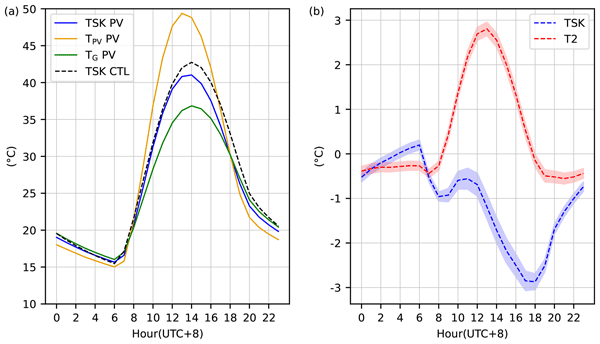
Abstract. Utility-scale photovoltaic (PV) installations are expanding so significantly that they may alter the surface energy balance and affect the local climate. Yet, simplified or non-coupled PV schemes in regional climate models limit the understanding of the PV climatic impacts. In this study, we developed a physically based, fully coupled WRF-PV model based on the Weather Research and Forecasting (WRF) model. WRF-PV maintains surface energy balance closure between the PV panels and the ground and enables the PV-induced radiative and thermal effects to feed back to the atmosphere dynamically. We used this model to perform two regional simulations, WRF_PV (with PV panels) and WRF_CTL (without PV panels), in northwestern China, a major PV deployment region. Our results indicated that WRF_PV captured observed spatial and diurnal climate features, and improved the simulation of skin temperature relative to WRF_CTL. PV installations reduced daytime skin temperature by 0.9 °C but warmed near-surface air by 1.8 °C in summer. Additionally, PV-induced enhanced sensible heating, weakened lower-atmospheric stability, and promoted low-level cloud formation, causing a reduction in downward shortwave radiation by about 1 %. Moreover, precipitation shifted toward extremes, accompanied by minor reductions in moderate rainfall. This study shows that modeling PV-land surface processes is needed for regional climate models to adequately assess the impacts of utility-scale PV installation.
-
Notice on discussion status
The requested preprint has a corresponding peer-reviewed final revised paper. You are encouraged to refer to the final revised version.
-
Preprint
(3662 KB)
-
The requested preprint has a corresponding peer-reviewed final revised paper. You are encouraged to refer to the final revised version.
- Preprint
(3662 KB) - Metadata XML
- BibTeX
- EndNote
- Final revised paper


Journal article(s) based on this preprint
Interactive discussion
Status: closed
-
RC1: 'Review of “Simulating the impacts of utility-scale photovoltaic installations with a physically based coupled WRF-PV model” by Chen et al. submitted to Geoscientific Model Development', Anonymous Referee #1, 04 May 2026
-
AC1: 'Reply on RC1', Yiran Chen, 10 Jul 2026
Dear Reviewer,
We sincerely thank you for your careful evaluation of our manuscript. We greatly appreciate your valuable feedback and constructive suggestions.
We have revised the manuscript accordingly and provided a detailed point-by-point response in the attached document. The original reviewer comments are shown in blue italics, followed by our corresponding responses and the revised text.
We hope that the revisions adequately address your concerns and suggestions. Please let us know if there are any additional changes you would like us to implement.
Thank you again for your time and valuable comments.
Yours sincerely,
Yiran Chen, Jiming Jin, and Yimin Liu
on behalf of all authors
-
AC1: 'Reply on RC1', Yiran Chen, 10 Jul 2026
-
RC2: 'Comment on egusphere-2026-1311', Anonymous Referee #2, 09 May 2026
The study develops a fully coupled PV–climate model that captures energy balance and atmospheric feedbacks. Applied to northwestern China, it improves skin-temperature simulation and shows that PV cools the surface but warms the near-surface air in summer. PV increases sensible heating, reduces stability, enhances low clouds, lowers shortwave radiation, and shifts precipitation toward more extremes. The authors highlight the need for coupled PV–land–atmosphere modeling to assess climate impacts. The manuscript is well-written, but I have some concerns:
Line 155: A major concern is the consistency and potential bias introduced by merging multiple PV datasets with different temporal coverages (2013–2023 vs. 2019–2022 vs. 2024) and classification methodologies. The manuscript does not clearly explain how discrepancies among these sources (e.g., spatial overlap, differing detection accuracies, or temporal mismatches) were reconciled into a unified PV distribution. In addition, filtering out installations smaller than 1 km² to match MODIS resolution may systematically exclude a large fraction of PV capacity, potentially biasing the spatial representation and subsequent analysis. The authors may clarify the data harmonization process and assess how these choices affect the robustness of their results.
Line 180: While WRF_PV includes the “annual evolution” of PV distribution, it is still unclear whether WRF_CTL uses time-invariant land-use and how interannual variability is separated from PV-induced signals. Without a clear description of how PV changes are synchronized with the meteorological forcing and how differences are aggregated across years, the attribution of climate responses specifically to PV installations may be confounded. I suggest clarifying whether both experiments use identical atmospheric boundary conditions for each year, how PV expansion is implemented year by year, and whether sensitivity tests were performed to isolate PV effects from natural variability.
Line 265: The authors attribute the large increase in net radiation primarily to reduced SWup and LWup, yet it is unclear whether these magnitudes are consistent with realistic PV albedo, emissivity, and panel orientation assumptions. In particular, the role of specular reflection and its parameterization in the model is not sufficiently described, raising questions about whether the shortwave radiative behavior of PV panels is accurately represented. It would be helpful if the authors provided a clearer description and validation of the radiative parameterization (including albedo, emissivity, and angular dependence) and demonstrated that surface energy balance closure is maintained under these large flux changes.
Line 355: The discussion is not rigorously demonstrated. Other factors, such as differences in model configuration, domain size, resolution, boundary conditions, or background climate regimes, can also contribute to the discrepancy with previous studies. Without controlled sensitivity experiments (e.g., toggling only albedo treatment while keeping other processes identical), it is difficult to isolate which mechanisms drive the reduced magnitude of impacts, right? Some sensitivity tests should be considered. While the WRF-PV model is described as more physically realistic, the claim that it produces results “closer to observations” is not sufficiently justified, particularly for land-atmosphere interactions. Given that the study highlights differences in cloud fraction and precipitation characteristics (including extremes), more rigorous validation against observational or reanalysis datasets is needed. This is especially important because precipitation redistribution (rather than total change) is a central conclusion.
Line 370: The statement is valid, but it is currently too brief and underdeveloped, given its importance. The authors should expand this discussion to more clearly articulate why a fully coupled land–atmosphere–ecosystem modeling framework is necessary for future work. In particular, PV installations can alter not only surface energy balance but also vegetation dynamics, soil moisture, and carbon fluxes. These processes may introduce additional feedbacks that are not captured in the current WRF-PV framework and could influence both local climate and longer-term ecosystem responses. The authors are encouraged to elaborate on (1) which key ecosystem processes are currently missing, (2) how their omission may affect the interpretation of the present results, and (3) how incorporating such processes in future model development could improve the robustness of PV–climate impact assessments. This would strengthen the discussion and better position the study within the broader context of land–climate interactions.
There are a few minor comments:
Line 25: The introduction would benefit from a clearer articulation of the importance of PV system design in shaping climate impacts. At present, the discussion treats PV installations somewhat generically, but key design parameters, such as panel tilt angle, row spacing, orientation, tracking systems, and mounting height, strongly influence surface albedo, shading patterns, aerodynamic roughness, and heat exchange processes. These factors can modulate the magnitude and even the direction of PV-induced radiative and thermal effects.
The references appear to be not enough. Please update the literature cited to better position the work.
Line 32: Barron-Gafford et al. "Agrivoltaics provide mutual benefits across the food–energy–water nexus in drylands." Nature Sustainability 2.9 (2019): 848-855.
Line 370: Jia et al. "Climate-driven divergence in biophysical and economic impacts of agrivoltaics.Proceedings of the National Academy of Sciences 123.10 (2026): e2514380123.
Ruth et al. "Enhancing climate-smart crop performance in arid agrivoltaics systems: effects of photovoltaic shading and soil amendments on tepary bean growth, yield, and associated soil microbiome." Plant and Soil (2026): 1-25.
Citation: https://doi.org/10.5194/egusphere-2026-1311-RC2 -
AC2: 'Reply on RC2', Yiran Chen, 10 Jul 2026
Dear Reviewer,
We sincerely thank you for your careful evaluation of our manuscript. We greatly appreciate your valuable feedback and constructive suggestions.
We have revised the manuscript accordingly and provided a detailed point-by-point response in the attached document. The original reviewer comments are shown in blue italics, followed by our corresponding responses and the revised text.
We hope that the revisions adequately address your concerns and suggestions. Please let us know if there are any additional changes you would like us to implement.
Thank you again for your time and valuable comments.
Yours sincerely,
Yiran Chen, Jiming Jin, and Yimin Liu
on behalf of all authors
-
AC2: 'Reply on RC2', Yiran Chen, 10 Jul 2026
Peer review completion


Interactive discussion
Status: closed
-
RC1: 'Review of “Simulating the impacts of utility-scale photovoltaic installations with a physically based coupled WRF-PV model” by Chen et al. submitted to Geoscientific Model Development', Anonymous Referee #1, 04 May 2026
This study couples a physically based PV-panel energy-balance model (an adaptation of Heusinger et al., 2020) into the Noah land-surface module in the WRF model, deriving a combined PV-ground energy-balance equation that ensures closure between panels, ground, and atmosphere. Coupled model simulations with and without PV modules are done over a major utility-scale PV deployment region in northwestern China for the summers of 2018-2024 and compared against available observations. The authors report a daytime cooling of skin temperature, a daytime warming of 2 m air temperature, enhanced sensible heat flux, weakened lower-tropospheric stability, increased low-level cloud, and a redistribution of summer precipitation toward extremes.
The manuscript addresses physically consistent representation of utility-scale PV installations in regional climate models, a topic of clear relevance to GMD readers. The energy-closed coupling formulation is a reasonable contribution to the modeling side of PV modules’ climate effect. I have a few general concerns on incomplete implementation details described in the methodology section, significance of the model validation results, and how it differentiates from the previous modeling studies. Overall, I would recommend a major revision before publication.
Please find my detailed comments in the attached PDF.
-
AC1: 'Reply on RC1', Yiran Chen, 10 Jul 2026
Dear Reviewer,
We sincerely thank you for your careful evaluation of our manuscript. We greatly appreciate your valuable feedback and constructive suggestions.
We have revised the manuscript accordingly and provided a detailed point-by-point response in the attached document. The original reviewer comments are shown in blue italics, followed by our corresponding responses and the revised text.
We hope that the revisions adequately address your concerns and suggestions. Please let us know if there are any additional changes you would like us to implement.
Thank you again for your time and valuable comments.
Yours sincerely,
Yiran Chen, Jiming Jin, and Yimin Liu
on behalf of all authors
-
AC1: 'Reply on RC1', Yiran Chen, 10 Jul 2026
-
RC2: 'Comment on egusphere-2026-1311', Anonymous Referee #2, 09 May 2026
The study develops a fully coupled PV–climate model that captures energy balance and atmospheric feedbacks. Applied to northwestern China, it improves skin-temperature simulation and shows that PV cools the surface but warms the near-surface air in summer. PV increases sensible heating, reduces stability, enhances low clouds, lowers shortwave radiation, and shifts precipitation toward more extremes. The authors highlight the need for coupled PV–land–atmosphere modeling to assess climate impacts. The manuscript is well-written, but I have some concerns:
Line 155: A major concern is the consistency and potential bias introduced by merging multiple PV datasets with different temporal coverages (2013–2023 vs. 2019–2022 vs. 2024) and classification methodologies. The manuscript does not clearly explain how discrepancies among these sources (e.g., spatial overlap, differing detection accuracies, or temporal mismatches) were reconciled into a unified PV distribution. In addition, filtering out installations smaller than 1 km² to match MODIS resolution may systematically exclude a large fraction of PV capacity, potentially biasing the spatial representation and subsequent analysis. The authors may clarify the data harmonization process and assess how these choices affect the robustness of their results.
Line 180: While WRF_PV includes the “annual evolution” of PV distribution, it is still unclear whether WRF_CTL uses time-invariant land-use and how interannual variability is separated from PV-induced signals. Without a clear description of how PV changes are synchronized with the meteorological forcing and how differences are aggregated across years, the attribution of climate responses specifically to PV installations may be confounded. I suggest clarifying whether both experiments use identical atmospheric boundary conditions for each year, how PV expansion is implemented year by year, and whether sensitivity tests were performed to isolate PV effects from natural variability.
Line 265: The authors attribute the large increase in net radiation primarily to reduced SWup and LWup, yet it is unclear whether these magnitudes are consistent with realistic PV albedo, emissivity, and panel orientation assumptions. In particular, the role of specular reflection and its parameterization in the model is not sufficiently described, raising questions about whether the shortwave radiative behavior of PV panels is accurately represented. It would be helpful if the authors provided a clearer description and validation of the radiative parameterization (including albedo, emissivity, and angular dependence) and demonstrated that surface energy balance closure is maintained under these large flux changes.
Line 355: The discussion is not rigorously demonstrated. Other factors, such as differences in model configuration, domain size, resolution, boundary conditions, or background climate regimes, can also contribute to the discrepancy with previous studies. Without controlled sensitivity experiments (e.g., toggling only albedo treatment while keeping other processes identical), it is difficult to isolate which mechanisms drive the reduced magnitude of impacts, right? Some sensitivity tests should be considered. While the WRF-PV model is described as more physically realistic, the claim that it produces results “closer to observations” is not sufficiently justified, particularly for land-atmosphere interactions. Given that the study highlights differences in cloud fraction and precipitation characteristics (including extremes), more rigorous validation against observational or reanalysis datasets is needed. This is especially important because precipitation redistribution (rather than total change) is a central conclusion.
Line 370: The statement is valid, but it is currently too brief and underdeveloped, given its importance. The authors should expand this discussion to more clearly articulate why a fully coupled land–atmosphere–ecosystem modeling framework is necessary for future work. In particular, PV installations can alter not only surface energy balance but also vegetation dynamics, soil moisture, and carbon fluxes. These processes may introduce additional feedbacks that are not captured in the current WRF-PV framework and could influence both local climate and longer-term ecosystem responses. The authors are encouraged to elaborate on (1) which key ecosystem processes are currently missing, (2) how their omission may affect the interpretation of the present results, and (3) how incorporating such processes in future model development could improve the robustness of PV–climate impact assessments. This would strengthen the discussion and better position the study within the broader context of land–climate interactions.
There are a few minor comments:
Line 25: The introduction would benefit from a clearer articulation of the importance of PV system design in shaping climate impacts. At present, the discussion treats PV installations somewhat generically, but key design parameters, such as panel tilt angle, row spacing, orientation, tracking systems, and mounting height, strongly influence surface albedo, shading patterns, aerodynamic roughness, and heat exchange processes. These factors can modulate the magnitude and even the direction of PV-induced radiative and thermal effects.
The references appear to be not enough. Please update the literature cited to better position the work.
Line 32: Barron-Gafford et al. "Agrivoltaics provide mutual benefits across the food–energy–water nexus in drylands." Nature Sustainability 2.9 (2019): 848-855.
Line 370: Jia et al. "Climate-driven divergence in biophysical and economic impacts of agrivoltaics.Proceedings of the National Academy of Sciences 123.10 (2026): e2514380123.
Ruth et al. "Enhancing climate-smart crop performance in arid agrivoltaics systems: effects of photovoltaic shading and soil amendments on tepary bean growth, yield, and associated soil microbiome." Plant and Soil (2026): 1-25.
Citation: https://doi.org/10.5194/egusphere-2026-1311-RC2 -
AC2: 'Reply on RC2', Yiran Chen, 10 Jul 2026
Dear Reviewer,
We sincerely thank you for your careful evaluation of our manuscript. We greatly appreciate your valuable feedback and constructive suggestions.
We have revised the manuscript accordingly and provided a detailed point-by-point response in the attached document. The original reviewer comments are shown in blue italics, followed by our corresponding responses and the revised text.
We hope that the revisions adequately address your concerns and suggestions. Please let us know if there are any additional changes you would like us to implement.
Thank you again for your time and valuable comments.
Yours sincerely,
Yiran Chen, Jiming Jin, and Yimin Liu
on behalf of all authors
-
AC2: 'Reply on RC2', Yiran Chen, 10 Jul 2026
Peer review completion
Journal article(s) based on this preprint
Viewed
| HTML | XML | Total | BibTeX | EndNote | |
|---|---|---|---|---|---|
| 512 | 264 | 46 | 822 | 42 | 45 |
- HTML: 512
- PDF: 264
- XML: 46
- Total: 822
- BibTeX: 42
- EndNote: 45
Viewed (geographical distribution)
| Country | # | Views | % |
|---|
| Total: | 0 |
| HTML: | 0 |
| PDF: | 0 |
| XML: | 0 |
- 1
Yiran Chen
Jiming Jin

Yimin Liu
Jannik Heusinger
Jesús Carrera
Zeyu Zhou
The requested preprint has a corresponding peer-reviewed final revised paper. You are encouraged to refer to the final revised version.
- Preprint
(3662 KB) - Metadata XML
This study couples a physically based PV-panel energy-balance model (an adaptation of Heusinger et al., 2020) into the Noah land-surface module in the WRF model, deriving a combined PV-ground energy-balance equation that ensures closure between panels, ground, and atmosphere. Coupled model simulations with and without PV modules are done over a major utility-scale PV deployment region in northwestern China for the summers of 2018-2024 and compared against available observations. The authors report a daytime cooling of skin temperature, a daytime warming of 2 m air temperature, enhanced sensible heat flux, weakened lower-tropospheric stability, increased low-level cloud, and a redistribution of summer precipitation toward extremes.
The manuscript addresses physically consistent representation of utility-scale PV installations in regional climate models, a topic of clear relevance to GMD readers. The energy-closed coupling formulation is a reasonable contribution to the modeling side of PV modules’ climate effect. I have a few general concerns on incomplete implementation details described in the methodology section, significance of the model validation results, and how it differentiates from the previous modeling studies. Overall, I would recommend a major revision before publication.
Please find my detailed comments in the attached PDF.