
the Creative Commons Attribution 4.0 License.
the Creative Commons Attribution 4.0 License.
 | 19 Jan 2026
Uncertainty estimation of aerosol properties from a Vaisala CT25k ceilometer based on in situ aerosol measurements
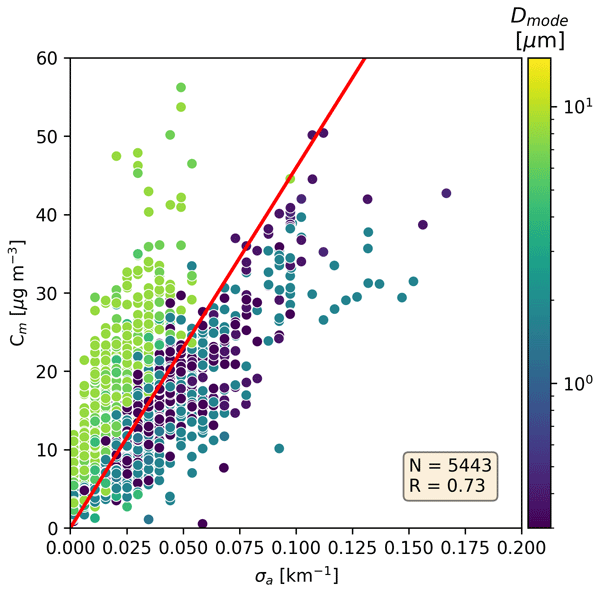
Abstract. In recent years, the use of automatic lidars and ceilometers (ALC) for atmospheric research has increased. Originally, these instruments were developed to measure cloud base height automatically, utilising the LIDAR principle. However, multiple studies have shown their usability for aerosol remote sensing and planetary boundary layer height detection. It is not only possible to calibrate a ceilometer and derive the attenuated backscatter signal, but also to retrieve aerosol extinction coefficients and aerosol mass concentrations by means of estimated extinction to mass coefficients (EMC). The ACTRIS national facility JOYCE (Jülich Observatory for Cloud Evolution) offers a multiyear dataset of cloud remote sensing measurements and ceilometer observations. So far, a method for measuring aerosol properties has been missing to use this dataset to quantify aerosol-cloud interaction. The goal of this study is to evaluate the applicability of a ceilometer aerosol retrieval to prove the value of this dataset for aerosol remote sensing. We present the workflow, starting with the raw ceilometer data, followed by a calibration of the backscatter coefficient profiles and a retrieval of aerosol properties. To evaluate the result of this workflow for the JOYCE ceilometer (Vaisala CT25k), in situ aerosol measurements at the Jülich meteorological tower were performed, where an optical particle sizer (OPS) was installed at 120 m above ground. Aerosol extinction coefficients σa were retrieved from the ceilometer attenuated backscatter signal with σa correlated with the in situ total aerosol mass concentration with R = 0.73. For our measurement set-up, aerosol mass concentrations can be derived from the retrieved σa with a mean absolute percentage error of 39 %. However, the extinction to mass conversion factor EMC = (2.2 ± 0.9) m2g-1 derived from the measurements for a wavelength of 906 nm was found to be greater by a factor of about 1.8 compared to literature and to EMC calculated from Mie simulations based on the in situ aerosol size distributions. The mismatch is tentatively attributed to the limited aerosol size range of the OPS.
-
Notice on discussion status
The requested preprint has a corresponding peer-reviewed final revised paper. You are encouraged to refer to the final revised version.
-
Preprint
(4153 KB)
-
The requested preprint has a corresponding peer-reviewed final revised paper. You are encouraged to refer to the final revised version.
- Preprint
(4153 KB) - Metadata XML
- BibTeX
- EndNote
- Final revised paper


Journal article(s) based on this preprint
Interactive discussion
Status: closed
-
RC1: 'Comment on egusphere-2026-131', Anonymous Referee #1, 24 Feb 2026
- AC1: 'Reply on RC1', Marcus Müller, 24 Apr 2026
-
RC2: 'Comment on egusphere-2026-131', Anonymous Referee #2, 25 Mar 2026
General impression: The authors studied the performance of a Vaisala ceilometer and compared the derived particle mass concentration with in situ observations of the mass concentration at 100 m height level above the ceilometer station. The paper contains interesting material and mainly deals with the effort to characterize uncertainties in the ceilometer products and to identify sources of uncertainties in the aerosol mass retrieval (ceilometer approach). The manuscript is worthwhile to be published in AMT.
Minor revisions are necessary.
Detailed comments:
All abbreviations need to be explained (when introduced) in the abstract, but again, in the full text body…..
Line 27: What about the role of aerosol particles in ice nucleation processes?
Line 30: Explain PM.
Line 37: Explain EARLINET.
Line 38: Explain ACTRIS.
Line 52: To my opinion an automized trustworthy lidar data analysis at 906 nm is only possible in combination with AERONET sun photometer observations (AODs at 870 and 1020 nm). Is that the case, at least for Juelich? Any comment on that is appreciated.
Figure 1 is confusing: JOYCE instruments seem to be on top of a container with a vertical extension of 20m. Please indicate a building in the sketch, a building with windows, for example…
Line 100-101: The overlap profile correction is a severe error source in your attempt to compare the ceilometer profile data with the in situ measurements, just 100 m above the ceilometer. And it doesn’t matter whether the lidar is a monoaxial or biaxial system. In the case of the CHM15, the overlap is almost complete at 350 m height above the lidar, that makes sense. Then it is difficult to compare these data with the in situ observation at 100 m height above the ceilometer because the actual overlap is not well known and continuously varies a bit with temperature in the ceilometer system. The overlap function typically shows a diurnal cycle. That means the correction remains problematic and introduces uncertainties. And all these overlap problems are overcome in the case of the Vaisala ceilometer? You can even make use of the lowest range gate (i.e., the first signal bin)? The overlap profile is super constant during the day, over days, weeks, and months?
After many decades of lidar experience in the field, I must say: This is impossible! A slightly varying overlap profile must be considered for every system. And for overlap values less than 0.7 (with 1 for complete overlap), the correction is almost useless, the errors can become extremely large. Thus, we need clear statements about the uncertainty in the overlap correction in the case of the Vaisala ceilometer. At what height is the overlap complete, at what height is an overlap of 0.7 reached? These numbers should be mentioned.
Line 114: What is the cutoff signature of the optical particle counter? Probably even particles with diameters of 2-5 µm will not be counted correctly when 10 µm particles are not counted at all.
Are the particles dried before the optical measurement? In the apparatus, the temperatures are probably significantly higher than outside (in the atmosphere) so that the particles lose water before the optical measurement is conducted. Please expand the discussion on this point.
Line 165: Did you check the quality of the determination of the calibration constant by comparing the height-integrated extinction profiles with respective AERONET photometer observations (at 870 and 1020 nm)?
Just an idea, in cases of good agreement (on clear sky days with well-mixed boundary layer and an almost aerosol-free free troposphere, no cirrus) one could use the AERONET size distribution to check the in situ measured size distribution (Is there an aerosol drying effect or not?) and one could even fill the in-situ-measured size distribution for sizes below 300 nm with values from AERONET…. Just for the comparisons later on (simulations versus observations).
Lines 174-189: If you use the Klett method or the mentioned forward method, the impact of uncertainties in the overlap correction is always large (in the near range). At the end you should compare the ceilometer-derived AOD with respective AERONET observations, for many cases, to check the quality of the ceilometer extinction profiles.
Line 226: If the conditions were ideal for the comparison with in situ observations, they were ideal for AERONET comparisons as well (I hope). Then, you can make use also of the size distribution derived from the AERONET observations… Please expand discussion on this.
Line 279, Eq.(15): The extinction-to-mass conversion factor is 460 km µg m-3. If I compare this conversion factor with the respective extinction-to-volume conversion factor for 910 nm (continental aerosol pollution) in the recently published discussion paper of
Ansmann, A., Hofer, J., Mamouri, R.-E., Haarig, M., Baars, H., and Wandinger, U.: Aerosol microphysical properties and CCN/INP information from lidar and ceilometer profiles: POLIPHON update, EGUsphere [preprint], https://doi.org/10.5194/egusphere-2026-648, 2026.
I end up with an extinction-to-mass conversion factor of about 675 km µg m-3 when assuming a density of 1.5 g cm-3 (and my computations do not have a bug). Please check by yourself. One should consider these numbers 675 vs 460 in the discussion later on.
Line 291: … and measured OPS size distributions. Did you assume ambient conditions? Did you consider drying of aerosol particles in the OPS?
In all subsequent simulations one may try to fill the size distribution (for sizes smaller than 300 nm) by means of AERONET size distribution products or, if available. You may alsomake use of standard in situ observation at Juelich, covering the size distribution down to 10-20 nm.
Lines 325-336: Again, where the particle dried or not? Was it possible to really measure ambient aerosol optical properties and thus the size distributions of aerosols at ambient conditions. This is what the lidar measures. Please expand the discussion on this topic.
Citation: https://doi.org/10.5194/egusphere-2026-131-RC2 - AC2: 'Reply on RC2', Marcus Müller, 24 Apr 2026
Peer review completion


Interactive discussion
Status: closed
-
RC1: 'Comment on egusphere-2026-131', Anonymous Referee #1, 24 Feb 2026
Müller et al. describe an approach to obtain aerosol optical properties and aerosol mass concentration from a Vaisala ceilometer. They also quantify the uncertainties by using data from an optical particle sizer. This overall very good work is relevant for publication in AMT. Methodology is described clearly, and results are discussed critically and comprehensively. I recommend this study for publication with minor corrections outlined in the attached pdf.
- AC1: 'Reply on RC1', Marcus Müller, 24 Apr 2026
-
RC2: 'Comment on egusphere-2026-131', Anonymous Referee #2, 25 Mar 2026
General impression: The authors studied the performance of a Vaisala ceilometer and compared the derived particle mass concentration with in situ observations of the mass concentration at 100 m height level above the ceilometer station. The paper contains interesting material and mainly deals with the effort to characterize uncertainties in the ceilometer products and to identify sources of uncertainties in the aerosol mass retrieval (ceilometer approach). The manuscript is worthwhile to be published in AMT.
Minor revisions are necessary.
Detailed comments:
All abbreviations need to be explained (when introduced) in the abstract, but again, in the full text body…..
Line 27: What about the role of aerosol particles in ice nucleation processes?
Line 30: Explain PM.
Line 37: Explain EARLINET.
Line 38: Explain ACTRIS.
Line 52: To my opinion an automized trustworthy lidar data analysis at 906 nm is only possible in combination with AERONET sun photometer observations (AODs at 870 and 1020 nm). Is that the case, at least for Juelich? Any comment on that is appreciated.
Figure 1 is confusing: JOYCE instruments seem to be on top of a container with a vertical extension of 20m. Please indicate a building in the sketch, a building with windows, for example…
Line 100-101: The overlap profile correction is a severe error source in your attempt to compare the ceilometer profile data with the in situ measurements, just 100 m above the ceilometer. And it doesn’t matter whether the lidar is a monoaxial or biaxial system. In the case of the CHM15, the overlap is almost complete at 350 m height above the lidar, that makes sense. Then it is difficult to compare these data with the in situ observation at 100 m height above the ceilometer because the actual overlap is not well known and continuously varies a bit with temperature in the ceilometer system. The overlap function typically shows a diurnal cycle. That means the correction remains problematic and introduces uncertainties. And all these overlap problems are overcome in the case of the Vaisala ceilometer? You can even make use of the lowest range gate (i.e., the first signal bin)? The overlap profile is super constant during the day, over days, weeks, and months?
After many decades of lidar experience in the field, I must say: This is impossible! A slightly varying overlap profile must be considered for every system. And for overlap values less than 0.7 (with 1 for complete overlap), the correction is almost useless, the errors can become extremely large. Thus, we need clear statements about the uncertainty in the overlap correction in the case of the Vaisala ceilometer. At what height is the overlap complete, at what height is an overlap of 0.7 reached? These numbers should be mentioned.
Line 114: What is the cutoff signature of the optical particle counter? Probably even particles with diameters of 2-5 µm will not be counted correctly when 10 µm particles are not counted at all.
Are the particles dried before the optical measurement? In the apparatus, the temperatures are probably significantly higher than outside (in the atmosphere) so that the particles lose water before the optical measurement is conducted. Please expand the discussion on this point.
Line 165: Did you check the quality of the determination of the calibration constant by comparing the height-integrated extinction profiles with respective AERONET photometer observations (at 870 and 1020 nm)?
Just an idea, in cases of good agreement (on clear sky days with well-mixed boundary layer and an almost aerosol-free free troposphere, no cirrus) one could use the AERONET size distribution to check the in situ measured size distribution (Is there an aerosol drying effect or not?) and one could even fill the in-situ-measured size distribution for sizes below 300 nm with values from AERONET…. Just for the comparisons later on (simulations versus observations).
Lines 174-189: If you use the Klett method or the mentioned forward method, the impact of uncertainties in the overlap correction is always large (in the near range). At the end you should compare the ceilometer-derived AOD with respective AERONET observations, for many cases, to check the quality of the ceilometer extinction profiles.
Line 226: If the conditions were ideal for the comparison with in situ observations, they were ideal for AERONET comparisons as well (I hope). Then, you can make use also of the size distribution derived from the AERONET observations… Please expand discussion on this.
Line 279, Eq.(15): The extinction-to-mass conversion factor is 460 km µg m-3. If I compare this conversion factor with the respective extinction-to-volume conversion factor for 910 nm (continental aerosol pollution) in the recently published discussion paper of
Ansmann, A., Hofer, J., Mamouri, R.-E., Haarig, M., Baars, H., and Wandinger, U.: Aerosol microphysical properties and CCN/INP information from lidar and ceilometer profiles: POLIPHON update, EGUsphere [preprint], https://doi.org/10.5194/egusphere-2026-648, 2026.
I end up with an extinction-to-mass conversion factor of about 675 km µg m-3 when assuming a density of 1.5 g cm-3 (and my computations do not have a bug). Please check by yourself. One should consider these numbers 675 vs 460 in the discussion later on.
Line 291: … and measured OPS size distributions. Did you assume ambient conditions? Did you consider drying of aerosol particles in the OPS?
In all subsequent simulations one may try to fill the size distribution (for sizes smaller than 300 nm) by means of AERONET size distribution products or, if available. You may alsomake use of standard in situ observation at Juelich, covering the size distribution down to 10-20 nm.
Lines 325-336: Again, where the particle dried or not? Was it possible to really measure ambient aerosol optical properties and thus the size distributions of aerosols at ambient conditions. This is what the lidar measures. Please expand the discussion on this topic.
Citation: https://doi.org/10.5194/egusphere-2026-131-RC2 - AC2: 'Reply on RC2', Marcus Müller, 24 Apr 2026
Peer review completion
Journal article(s) based on this preprint
Viewed
| HTML | XML | Total | BibTeX | EndNote | |
|---|---|---|---|---|---|
| 1,123 | 590 | 134 | 1,847 | 97 | 228 |
- HTML: 1,123
- PDF: 590
- XML: 134
- Total: 1,847
- BibTeX: 97
- EndNote: 228
Viewed (geographical distribution)
| Country | # | Views | % |
|---|
| Total: | 0 |
| HTML: | 0 |
| PDF: | 0 |
| XML: | 0 |
- 1
Marcus G. Müller

Birger Bohn
Ulrich Löhnert
The requested preprint has a corresponding peer-reviewed final revised paper. You are encouraged to refer to the final revised version.
- Preprint
(4153 KB) - Metadata XML
Müller et al. describe an approach to obtain aerosol optical properties and aerosol mass concentration from a Vaisala ceilometer. They also quantify the uncertainties by using data from an optical particle sizer. This overall very good work is relevant for publication in AMT. Methodology is described clearly, and results are discussed critically and comprehensively. I recommend this study for publication with minor corrections outlined in the attached pdf.