
the Creative Commons Attribution 4.0 License.
the Creative Commons Attribution 4.0 License.
 | 12 Mar 2026
Ocean alkalinity enhancement reduces silica ballasting during export due to amplified dissolution
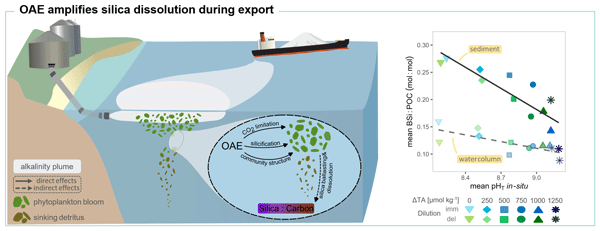
Abstract. Ocean alkalinity enhancement (OAE) is a carbon dioxide removal technology (CDR) proposed to store carbon dioxide (CO2) in the ocean on human-relevant time scales. However, depending on OAE intensity, resulting shifts in seawater carbonate chemistry speciation could alter community-driven biomass build-up, particulate stoichiometry, and transformation during particle export. Using mesocosms in the eutrophic North Sea (Helgoland, Germany), we established six alkalinity levels under two dilution scenarios (localized vs. uniform OAE additions) for 39 days. Total alkalinity (TA) was increased stepwise to ΔTAmax = 1250 µmol kg-1 (250 µmol TA kg-1 increments) using NaOH with CaCl2 to simulate cation release during calcium-based mineral dissolution, causing strong carbonate chemistry perturbations (e.g., pH > 9.25). Because response patterns were consistent across dilution scenarios, they were treated as replicates and assessed across the common pHT gradient. Average phytoplankton bloom magnitude (chlorophyll a and particulate organic carbon in the water column, POCWC) remained unchanged under unequilibrated OAE. In contrast, silica ballasting ratios declined with increasing pHT: suspended biogenic silica to particulate organic carbon ratios (BSiWC:POCWC, where WC = water column) decreased by up to 50 %, while exported BSiSed:POCSed (where Sed = sediment) decreased by 60 %, indicating intensification during sinking. As OAE delayed spring bloom timing, these effects were only apparent within mesocosm-specific bloom and export events. The stronger decline in sinking compared to suspended BSi:POC is consistent with pH-enhanced BSi dissolution during export. Porosity of sinking particles increased with pHT and co-varied with BSiSed:POCSed, suggesting particle-quality traits can modulate dissolution during transit. Remineralization metrics showed no treatment response, and particle sinking velocities did not scale with suspended or sinking silica ballasting ratios. Unequilibrated OAE may reduce silica ballasting, shoal carbon remineralization, and thus shorten sequestration timescales, potentially weakening net CO2 removal, regardless of dilution scenario. Quantifying how pH-driven BSi dissolution interacts with bloom and export dynamics will be critical for evaluating OAE efficacy and ecological safety.
-
Notice on discussion status
The requested preprint has a corresponding peer-reviewed final revised paper. You are encouraged to refer to the final revised version.
-
Preprint
(1354 KB)
-
Supplement
(2327 KB)
-
The requested preprint has a corresponding peer-reviewed final revised paper. You are encouraged to refer to the final revised version.
- Preprint
(1354 KB) - Metadata XML
-
Supplement
(2327 KB) - BibTeX
- EndNote
- Final revised paper


Journal article(s) based on this preprint
Interactive discussion
Status: closed
-
RC1: 'Comment on egusphere-2026-1300', Anonymous Referee #1, 24 Apr 2026
Suessle et al. provide a comprehensive study on a very timely and relevant matter, that is, the impact of ocean alkalinity enhancement (OAE) on silica ballasting and subsequent export efficiency. I did enjoy reading this manuscript and complement the authors trying to tackle this (as stated) under constrained, yet, very important aspect of OAE research. Particularly, the combination of both water column and sedimentary measurements presents the key strength of this manuscript and let the authors to draw conclusions made. As this study presents a novel and most foremost significant contribution to the field, I recommend publication after handling some (certainly rather minor) comments. While the manuscript is well-written and well structured, it could benefit from a cleaner presentation and tightening in places (especially statistical section). As this study tackles such an intricate aspect of OAE research with informative value for the field, I suggest the authors highlight further their study in a more broader context. While the limitations of this study are well discussed, I believe the authors should not cut short on highlighting the positive aspects further and discuss these more.
Main comments:
(1) It would be good if the authors include some additional context situating their study in a more global context of OAE applicability/efficiency and the implications of decreased silica ballasting (e.g. see Zhou et al., 2024). Although the authors point out (introduction lines 79-94) the importance of diatoms in coastal regions, what about high-latitude environments, or environments where other functional groups dominate, i.e. coccolithophores? This can then be looped back to in section 5 (Implications and Outlook).
Zhou, M., Tyka, M. D., Ho, D. T., Yankovsky, E., Bachman, S., Nicholas, T., ... & Long, M. C. (2025). Mapping the global variation in the efficiency of ocean alkalinity enhancement for carbon dioxide removal. Nature Climate Change, 15(1), 59-65.
(2) In the methodology section, the authors describe the determination of POPSed using persulfate oxidation (Oxisolv) via pressure cooking. While this is a standard method for total digestion, it converts all phosphorus—both organic and inorganic—into orthophosphate for measurement.
Unlike the carbon analysis, where the authors correctly distinguished between POC and PIC by removing carbonates with HCl, there is no mention of a similar step to account for particulate inorganic phosphorus (PIP). In coastal mesocosm environments, the inorganic fraction (e.g., iron-bound P or mineral apatite) can constitute a significant portion of the total particulate phosphorus pool. Similarly, for nitrogen, the use of untreated samples (TPN) likely includes inorganic fractions such as adsorbed ammonium.
Therefore, labelling these results as 'POPSed' and 'PONSed' is potentially misleading and likely results in an overestimation of the actual organic nutrient fluxes. Although this may be tangential to the primary focus of the study, the authors should revise the terminology (e.g., to TPPSed/TPNSed) or justify the assumption that inorganic fractions were negligible.
(3) For analytical analyses, the authors should give analytical merits of quality (precision/accuracy/limit of detection).
(4) The statistical assumptions, choices, and data handling would benefit from a tightened explanation and clarification. Currently it is somewhat confounding and hard to follow, specifically for an audience not too familiar with these techniques. Specifically the choices and subsequent modes of analyses should be presented clearer.
Minor comments:
Lines 67-69: This statement could benefit from an example as to why/how such export pathways might be modulated.Lines 90-94: Consider including Hashim et al., 2025, a study constraining mineral precipitation under more natural conditions than laboratory settings.
Hashim, M. S., Marx, L., Klein, F., Dean, C. L., Burdige, E., Hayden, M., ... & Subhas, A. V. (2025). Mineral formation during shipboard ocean alkalinity enhancement experiments in the North Atlantic. Biogeosciences, 22(22), 7149-7165.
Line 104: For completeness, add volume of mesocosms here.
Lines 107-109: Personally, I would refrain from labelling a study ‘first-of-its-kind’ and rather state the novelty by clearly identifying the key gap addressed and why it is important to investigate this. Consider rephrasing.
Line 114 and others: Throughout the manuscript there are inconsistencies in using in situ, in-situ, in-situ. Please revise accordingly.
Lines 133-134: This statement reads a bit odd. The authors treat biological response as an isolated variable, but biological export is sensitive to the initial perturbation, which can have indirect impacts on export. The authors cannot measure ‘governing efficiency’ if the application method itself suppresses the biological pump.
Lines 137-139: Why is the day of filling labelled as the start of the experiment when alkalinity manipulations were applied on day 4? Was is acclimation? Please clarify.
Line 139: How were the sets of six mesocosms chosen? Randomly assigned?
Lines 137-144: Why would ship-based delivery cause immediate and homogeneous delivery across the water column? Ship-based delivery aims to disperse into the mixed layer but arguably mostly at the surface. What is this argumentation based on? Requires further explanation.Lines 160-163: This sentence is somewhat contradictory. There is growing consensus that low to moderate alkalinity additions are unlikely to have adverse impacts on the biology and functioning. But the authors application of up to ΔTA 1250 μmol kg-1 evidently raises pH substantially with the aim to maximize biological response. Then the use of NaOH with a ‘comparatively low environmental footprint’. Please revise and clarify.
Line 171: Technically correct would be dissolved oxygen. Please revise accordingly throughout.
Line 206: Would be good to introduce (here, or in introduction) the focus on Fucoxanthin as diatom-specific pigment.
Line 209: Include details on extraction time and temperature. What was the analytical precision of pigment determination?
Line 265: Why was only the prokaryotic abundance determined if the study focuses on diatoms? Needs clarification.
Line 275: What was the volume of TA and DIC samples?
Line 520: CCMs not defined.
Citation: https://doi.org/10.5194/egusphere-2026-1300-RC1 -
AC1: 'Reply on RC1', Philipp Suessle, 14 May 2026
Reviewer 1:
Suessle et al. provide a comprehensive study on a very timely and relevant matter, that is, the impact of ocean alkalinity enhancement (OAE) on silica ballasting and subsequent export efficiency. I did enjoy reading this manuscript and complement the authors trying to tackle this (as stated) under constrained, yet, very important aspect of OAE research. Particularly, the combination of both water column and sedimentary measurements presents the key strength of this manuscript and let the authors to draw conclusions made. As this study presents a novel and most foremost significant contribution to the field, I recommend publication after handling some (certainly rather minor) comments. While the manuscript is well-written and well structured, it could benefit from a cleaner presentation and tightening in places (especially statistical section). As this study tackles such an intricate aspect of OAE research with informative value for the field, I suggest the authors highlight further their study in a more broader context. While the limitations of this study are well discussed, I believe the authors should not cut short on highlighting the positive aspects further and discuss these more.
Thank you for your insightful and constructive feedback on our manuscript. We appreciate the time and effort invested in evaluating the study and agree that the manuscript benefits from a clearer presentation of the statistical workflow and a stronger placement of our findings in the broader OAE context. We have revised and tightened respective sections. Please note, that we also have revised the abstract for clarity concerning the chosen bloom and sediment-deposition event analysis. In the following, we address the comments in the order in the order of appearanceRevised abstract:
Ocean alkalinity enhancement (OAE) is a carbon dioxide removal technology (CDR) proposed to store carbon dioxide (CO2) in the ocean on human-relevant time scales. However, depending on OAE intensity, resulting shifts in seawater carbonate chemistry speciation could alter community-driven biomass build-up, particulate stoichiometry, and transformation during particle export. Using mesocosms in the eutrophic North Sea (Helgoland, Germany), we established six alkalinity levels under two dilution scenarios (localized vs. uniform OAE additions) for 39 days. Total alkalinity (TA) was increased to ΔTAmax = 1250 µmol kg-1 (250 µmol TA kg-1 increments) using NaOH with CaCl2 to simulate cation release during calcium-based mineral dissolution, causing strong carbonate chemistry perturbations (e.g., pHmax > 9.25). To compare community-mediated carbon export across equivalent bloom phases, measurements were assessed within mesocosm-specific bloom and export events rather than on fixed sampling days, thereby accounting for OAE-induced shifts in spring bloom timing. During blooms, average phytoplankton biomass (as chlorophyll a and particulate organic carbon in the water column, POCWC) remained unchanged under unequilibrated OAE. In contrast, silica ballasting ratios declined with increasing pHT: suspended biogenic silica to particulate organic carbon ratios (BSiWC:POCWC, where WC = water column) decreased by up to 50%, while exported BSiSed:POCSed (where Sed = sediment) decreased by 60%, indicating intensification during sinking. The stronger decline in sinking compared to suspended BSi:POC is consistent with pH-enhanced BSi dissolution during export. Porosity of sinking particles increased with pHT and co-varied with BSiSed:POCSed, suggesting particle-quality traits can modulate dissolution during transit. Organic matter remineralization metrics showed no response to alkalinity addition, and particle sinking velocities did not scale with suspended or sinking silica ballasting ratios. Across dilution scenarios, unequilibrated OAE may reduce silica ballasting, potentially shoaling carbon remineralization, shortening sequestration timescales, and weakening net CO2 removal, while effects of dissolved silica regeneration on diatom productivity remain unresolved. Quantifying how pH-driven BSi dissolution interacts with bloom and export dynamics will be critical for evaluating OAE efficacy and ecological safety.Main comments:
Comment (1): It would be good if the authors include some additional context situating their study in a more global context of OAE applicability/efficiency and the implications of decreased silica ballasting (e.g. see Zhou et al., 2024). Although the authors point out (introduction lines 79-94) the importance of diatoms in coastal regions, what about high-latitude environments, or environments where other functional groups dominate, i.e. coccolithophores? This can then be looped back to in section 5 (Implications and Outlook).
Zhou, M., Tyka, M. D., Ho, D. T., Yankovsky, E., Bachman, S., Nicholas, T., ... & Long, M. C. (2025). Mapping the global variation in the efficiency of ocean alkalinity enhancement for carbon dioxide removal. Nature Climate Change, 15(1), 59-65.
Response 1: Thank you for this very constructive suggestion. We agree that the broader relevance of our findings for OAE applicability and efficiency could elevate the manuscript. We have therefore expanded the Discussion to place our results in a wider context. Specifically, we now discuss that the proposed mechanism may extend beyond coastal systems if the observed BSi loss is primarily governed by pH-enhanced dissolution and connect this to Zhou et al. (2025), who identified favourable OAE regions to be around ~50°N and ~50°S where surface retention of added alkalinity supports efficient air–sea CO2 equilibration. However, these regions also overlap with globally important diatom export systems. Below please find the paragraph added to the discussion.
Now lines 509 - 522: Although our experiment was conducted in a coastal system, the mechanism proposed here may extend beyond such regions if the observed BSi loss is primarily governed by pH-enhanced dissolution. This is particularly relevant given recent global OAE-efficiency estimates: Zhou et al. (2025) showed that OAE efficiency varies strongly with latitude and season, identifying high latitudes around ~50°N and ~50°S, including parts of the North Pacific and Southern Ocean, as favourable deployment locations due to enhanced surface retention of added alkalinity and efficient air–sea CO2 equilibration. Yet, these regions are also among the most relevant globally for seasonal diatom-driven carbon export (Le Moigne et al., 2012, Ragueneau et al., 2006). Taucher et al. (2022) further identified these regions as highly sensitive to pH-driven silica preservation under ocean acidification, suggesting they may also be particularly susceptible to silica dissolution under OAE. Importantly, Zhou et al. (2025) estimated OAE efficiency primarily from physical–chemical controls while assuming negligible biogeochemical feedbacks from carbonate-chemistry changes. Such maps therefore provide an essential baseline, but not necessarily a complete estimate of retained net CO2 sequestration under OAE. Our findings suggest this distinction matters in highly productive, diatom-dominated systems, where OAE-driven BSi dissolution could weaken silica ballasting and potentially alter biological-pump efficiency. However, whether this translates into a net reduction in CO₂ sequestration will depend on how dissolution-derived DSi is redistributed within the water column and on its role in regulating diatom growth.
Comment (2): In the methodology section, the authors describe the determination of POPSed using persulfate oxidation (Oxisolv) via pressure cooking. While this is a standard method for total digestion, it converts all phosphorus—both organic and inorganic—into orthophosphate for measurement.Unlike the carbon analysis, where the authors correctly distinguished between POC and PIC by removing carbonates with HCl, there is no mention of a similar step to account for particulate inorganic phosphorus (PIP). In coastal mesocosm environments, the inorganic fraction (e.g., iron-bound P or mineral apatite) can constitute a significant portion of the total particulate phosphorus pool. Similarly, for nitrogen, the use of untreated samples (TPN) likely includes inorganic fractions such as adsorbed ammonium.Therefore, labelling these results as 'POPSed' and 'PONSed' is potentially misleading and likely results in an overestimation of the actual organic nutrient fluxes. Although this may be tangential to the primary focus of the study, the authors should revise the terminology (e.g., to TPPSed/TPNSed) or justify the assumption that inorganic fractions were negligible.
Response (2): We agree that the particulate nitrogen and phosphorus pools were not adequately separated into organic and inorganic fractions. Thanks for pointing this out. We revised text and figures according to this more conservative terminology.
Comment (3): For analytical analyses, the authors should give analytical merits of quality (precision/accuracy/limit of detection).
Response (3): Thank you for this comment. We agree that analytical quality information should be reported more clearly. We have therefore revised the Methods to specify which quality-control information was available for each parameter group. For carbonate chemistry, we now report the analytical precision of TA and DIC and clarify that certified reference materials were used to assess accuracy. For nutrients, we clarify that accu-racy was monitored using certified reference material, precision was estimated from duplicate measurements, and limits of detection (LOD) were calculated from repeated blank measure-ments as the blank mean plus three standard deviations. For sediment-trap TPC, TPN, POC, and BSi, precision was likewise calculated from duplicate measurements. In addition, acetanilide standards were used to monitor the accuracy of TPC, TPN, and POC measurements from the CN analyzer. However, repeated blank measurements were not available for these measurements, so LODs could not be calculated. For water-column particulate C/N and BSi, routine duplicate sample measurements were not available; therefore, duplicate-based sample precision could not be estimated. However, for water-column particulate C/N, accuracy was likewise monitored us-ing acetanilide standards measured between samples and for water-column BSi, an LOD was estimated from repeated blank measurements. In addition, a rolling median absolute deviation approach was used as a data-consistency check to identify potential outliers within the time se-ries, followed by re-measurement where deemed necessary. This procedure is now described as an additional quality-control step rather than as an estimate of analytical precision. For further information on this outlier detection procedure see: “Leys, C., Ley, C., Klein, O., Bernard, P., & Licata, L. (2013). Detecting outliers: Do not use standard deviation around the mean, use abso-lute deviation around the median. Journal of experimental social psychology, 49(4), 764-766.” For HPLC pigments, routine duplicate measurements were not conducted. Blank filters showed no detectable Chl a or fucoxanthin signal, indicating negligible blank contamination, but pre-venting calculation of blank-based LOD. We now clarify that pigment quantification was based on HPLC calibration against pigment standards. We acknowledge that the available analytical quality information differs among parameter groups, and we have revised the text to avoid implying equivalent precision estimates where the underlying replicate, blank, or standard data were not available.
Now lines 208 – 212: Duplicate measurements were conducted with a CN analyzer (Euro EA-CN, HEKAtech GmbH, Germany) following the protocol of Sharp (1974). Accuracy was monitored by measuring acetanilide standards of known C and N content between samples. Precision was estimated from the average standard deviation between duplicate measurements over the course of the experiment and amounted to ±0.03 µmol TPC L-1 d-1, ±0.01 µmol TPN L-1 d-1, and ±0.04 µmol POC L-1 d-1, respectively.
Now lines 216 – 218: The precision of BSiSed measurements was similarly estimated from the average standard deviation between duplicate measurements over the course of the experiment and amounted to ±0.01 µmol BSi L-1 d-1.
Lines 224 – 229: There, carbon and nitrogen contents were quantified using a CN analyzer (Euro EA-CN, HEKAtech) following the procedure described for the sediment trap samples, and accuracy was likewise monitored by measuring acetanilide standards of known C and N content between samples. Routine duplicate measurements were not conducted for water-column particulate C/N, but suspect values were re-measured where possible and if re-measurements confirmed the original value, both measurements were averaged, if the original value was not reproduced, it was replaced by the new measurement.
Now lines 233 – 239: Pigment extraction was achieved using 100% acetone (HPLC-grade, Merck) and a cell mill (Precellys, France) with glass beads (0.5 mm) for 30 seconds to limit sample heating during homogenization. Samples were centrifuged at 10000 rpm (10 min, 4°C) and the supernatant filtered through a 0.2 µm PTFE syringe filter (13 mm, Lab Logistics Group). Concentrations of Chl a and Fucoxanthin within the supernatant were determined using High-Performance Liquid Chromatography (Thermo Scientific HPLC Ultimate 3000) according to Van Heukelem and Thomas (2001) and peaks were calibrated using a library of premeasured commercial standards. Where applicable, Chl a outliers were corrected using fluorometer measurements.
Now lines 243 – 246: Similar to TPC/NWC and POCWC measurements, potential outliers in water-column BSi measurements were re-measured where possible. If re-measurements confirmed the original value, both measurements were averaged, if the original value was not reproduced, it was replaced by the new measurement. Limits of detection were estimated from repeated blank measurements as the mean blank value plus three standard deviations, yielding of 0.13 µmol L-1.
Now lines 313 – 314: Both DIC and TA values were corrected against certified reference materials (batch no. 197; Dickson, 2010) to ensure accuracy and the precision of DIC and TA amounted to ±1.9 µmol kg-1 and ±2.0 µmol kg-1, respectively.Now lines 323 – 327: The accuracy of nutrient measurements was monitored using certified reference material and precision was estimated from the average standard deviation between duplicates over the course of the experiment (NO3-= ±0.1 µmol L-1, NO2- = ±0.003 µmol L-1, PO43- = ±0.005 µmol L-1, Si(OH)4 = ±0.04 µmol L-1). Limits of detection were likewise estimated from repeated blank measurements as the mean blank value plus three standard deviations, yielding 0.03 µmol L-1 for PO43-, 0.3 µmol L⁻¹ for Si(OH)4, and 0.5 µmol L-1 for NOx ((NO3- + NO2-).
Comment (4): The statistical assumptions, choices, and data handling would benefit from a tightened explanation and clarification. Currently it is somewhat confounding and hard to follow, specifically for an audience not too familiar with these techniques. Specifically the choices and subsequent modes of analyses should be presented clearer.
Response (4): Thank you for this comment. We agree, that the data handling and event-detection choices requires tightening. We have therefore shortened Sects. 2.4 and 2.5 accordingly. At the same time, we retained the key methodological details because we did not want to oversimplify the approach taken and these detection steps directly determine the biological windows used for subsequent comparisons and analysis of OAE effects. We therefore aimed to shorten the sections but tried to avoid removing information needed to assess the analytics applied here in detail. Below, please find the revised sections 2.4 and 2.5, highlighted in bold, where changes were implemented.
2.4 Bloom analysis
To align comparisons of mesocosms on a common biological clock (i.e., trophic state), we identified phytoplankton bloom start and duration separately for each mesocosm using Chl a dynamics. Although treatment-induced shifts in bloom timing are relevant to OAE environmental safety, a calendar-day fixed analysis would inadvertently mix bloom and non-bloom days across mesocosms and blur differences in OAE-mediated biomass build-up and stoichiometry. From sampled Chl a concentrations, short-term variability was reduced using a centered 3-sampling-day moving average (note: for the delayed treatment, top and bottom layers were averaged on days 5 – 6). A mesocosm-specific baseline (B) was defined as the median of smoothed Chl a values during days 1 – 6. Bloom detection started on day 7, after full treatment manipulation was achieved. Bloom start was defined as the first of two consecutive sampling days in which (i) smoothed Chl a exceeded a baseline-relative threshold on both days: Chl a ≥ (1+α)*B (with α = 0.35 and B = baseline), and (ii) day-to-day slopes of the smoothed Chl a series were positive on both days. Bloom end was determined only after the main Chl a peak and was defined as the first of two consecutive sampling days in which (i) smoothed Chl a fell back to Chl a ≤ (1+β)*B on both days (with β = 0.70, and again B = baseline), and (ii) at least one day had a negative slope. Separate start and end thresholds were used to provide hysteresis (with α < β). Among various tested combinations of α- and β-values the selected pair preserved sensible fit to the observed bloom-patterns of smoothed and raw Chl a within all treatments. To further evaluate how well the selected thresholds captured bloom development across mesocosms, we compared the threshold-defined bloom window with a reference bloom window around each mesocosm’s Chl a peak, which was bounded by the minima before and after the peak. For both windows, we calculated the area under the Chl a curve (termed AUC) and expressed the ratio of these areas (AUCα/β / AUCreference) as AUCm%. This metric was used to assess how completely the threshold-based method captured each mesocosms bloom. A detailed visualization of the analysis per mesocosm can be found in Fig. S4, providing raw and smoothed Chl a values, baselines and thresholds, defined start and end days per mesocosm, as well as AUCm% diagnostics. All analyses were conducted in R (R Core Team, 2021) using the `zoo` package (Zeileis and Grothendieck, 2005) for centred 3-day smoothing and windowed run tests (rollapply), and ggplot2 (Wickham, 2016) for visualization.2.5 Sediment deposition analysis
Sediment deposition events may not only occur at different points in time relative to the bloom start but could also exhibit different durations. Analysing sediment deposition on fixed calendar days would therefore distort estimates of export magnitude and stoichiometry. Similarly to water column blooms, we identified sediment deposition events per mesocosm to align comparisons on a common biological clock and accommodate variation in the coupling of production and export. Daily POC fluxes were used to quantify sediment deposition events. Cumulative export was calculated by summing daily fluxes to the end of the experiment, and short-term variability was reduced using a centred 3-sampling-day moving average. From there, we calculated the day-to-day slopes (m) of the smoothed cumulative curve, which served as a deposition intensity proxy. Event detection was restricted to a mesocosm-specific search window beginning at the day of water column bloom onset and ending at the day of bloom termination + w (an extension to the search window). To remove continuous background deposition before bloom-driven export, a baseline slope (mB) was defined as the median slope from days ≥ 5 and < bloom onset, and relative deposition intensity was defined as mrel = m − mB. For each mesocosm, event detection was centred around the day of maximum relative intensity (mmax), representing peak deposition. Deposition event start was defined as the first day within the search window where mrel ≥ α * mmax and the end of events as the day on which mrel ≤ (1 − α) * mmax (note, end detection was only allowed after mmax and water column bloom end). After testing several α and extended search windows (w) combinations, we chose α = 0.32 and w = 6 days. The combination yielded start and end days consistent with the observed phenology of cumulative POC flux and slope time series. To further evaluate the chosen α- and w-combination capturing the deposition events, we compared two metrics: a) the cumulative flux captured by the detected event window relative to total cumulative flux over the experiment, and b) flux density, defined as the captured cumulative flux divided by the event duration in days. Here, we note that mesocosms with secondary blooms and associated secondary deposition pulses had a lower proportion of total cumulative flux captured within the detected event, reflecting export distributed across multiple pulses rather than a failure of event detection; this did not affect our OAE analysis, as treatment comparisons were based on averages of the first bloom and associated deposition event. Detailed per-mesocosm visualization of the analysis can be found in Fig. S5, providing raw and smoothed cumulative POC flux values, slopes, detected start, end and peak deposition days, as well as proportion of total flux captured and flux density. Analyses were conducted in R (R Core Team, 2021) using the `zoo` package (Zeileis and Grothendieck, 2005) for centred 3-day smoothing and windowed run tests (rollapply), and ggplot2 (Wickham, 2016) for visualization.
Minor comments:Lines 67-69: This statement could benefit from an example as to why/how such export pathways might be modulated.
Response: We considered the original sentence to already have provided examples of export pathways by referring to zooplankton grazing and fecal-pellet repackaging, but we agree that the mechanistic link may not have been explicit enough. We have revised the sentence to clarify both why size structure may change under OAE and how such changes could affect export, meaning: by altering grazing capability (zooplankton) due to changed phytoplankton (particle) size, and thus egestion of fast sinking fecal pellets (beneficial for deep carbon sequestration).
Now lines 67 – 72: Under OAE, reduced CO2 availability could delay or dampen diatom blooms or increase reliance on carbon concentrating mechanisms (CCMs), with the potential to shift competitive balances among taxa and alter diatom community composition and associated size structure (Bach and Taucher, 2019; Hansen, 2002; Pierella Karlusich et al., 2021; Raven, 1993; Riebesell et al., 1993; Sommer et al., 2015). These shifts could in turn affect export pathways, as cell and particle size influence zooplankton grazing and thus the repackaging of organic matter into fast-sinking fecal pellets (Le Moigne et al., 2016; Stukel et al., 2011).
Lines 90-94: Consider including Hashim et al., 2025, a study constraining mineral precipitation under more natural conditions than laboratory settings.
Hashim, M. S., Marx, L., Klein, F., Dean, C. L., Burdige, E., Hayden, M., ... & Subhas, A. V. (2025). Mineral formation during shipboard ocean alkalinity enhancement experiments in the North Atlantic. Biogeosciences, 22(22), 7149-7165.Response: Thanks for pointing out, we included this citation.
Line 104: For completeness, add volume of mesocosms here.
Response: Thank you. Initial mesocosm volumes ranged from 5906 to 5912 L, and we therefore report the approximate initial volume of ~5.9 m3.
Lines 107-109: Personally, I would refrain from labelling a study ‘first-of-its-kind’ and rather state the novelty by clearly identifying the key gap addressed and why it is important to investigate this. Consider rephrasing.
Response: Thank you for this suggestion. We agree that the novelty is better framed by identifying the specific knowledge gap addressed rather than by labelling the study as first-of-its-kind. We have therefore removed this wording and revised the sentence to emphasize the OAE effects on silica ballasting.
Now lines 114 – 118: This study addresses a key gap in current OAE research by resolving how strong carbonate-chemistry perturbations affect diatom-mediated silica ballasting ratios across both suspended and sinking particulate pools in a productive coastal system. By separating water-column from exported material across a wide pHT gradient, our design provides mechanistic constraints on whether OAE alters biogenic silica preservation during export and thereby the efficiency of the biological pump.
Line 114 and others: Throughout the manuscript there are inconsistencies in using in situ, in-situ, in-situ. Please revise accordingly.
Response: Thanks for pointing this out, we revised throughout the text.
Lines 133-134: This statement reads a bit odd. The authors treat biological response as an isolated variable, but biological export is sensitive to the initial perturbation, which can have indirect impacts on export. The authors cannot measure ‘governing efficiency’ if the application method itself suppresses the biological pump.
Response: We agree that the original wording was unclear and could be read as treating biological export as isolated from the initial perturbation. Our intention was instead to distinguish between the carbonate-chemistry-based expectation of CO2 sequestration by OAE and the net CO2 sequestration outcome once biological export responding to the same perturbation are considered. We have revised the Methods text accordingly and avoid implying that we measure “governing efficiency”.
Now lines 142 – 144: Informing about environmental safety of varying application modes remains relevant, but equally important is the assessment of the net CO2 sequestration outcome of OAE when factoring in potential changes to the biological carbon pump.
Lines 137-139: Why is the day of filling labelled as the start of the experiment when alkalinity manipulations were applied on day 4? Was is acclimation? Please clarify.
Response: Thanks for pointing this out, we might not have been clear enough on this. Day 0 refers to the filling of the mesocosms and therefore to the start of the overall mesocosm experiment, whereas the alkalinity manipulation was applied only 4 days later (day 4) and marks the start of the OAE treatment period. The days before manipulation served as a pre-treatment period for baseline characterization relevant for e.g. community based analysis, to allow for settling of inorganic particles to the sediment trap introduced during the filling process, but also to establish sampling routines. Sediment samples from the first days are usually discarded, however, we retained the day numbering from filling onward to remain consistent with the broader mesocosm dataset and other related analyses. Below, we aim to clarify a bit more, that days after filling, prior to OAE manipulation can be considered baseline measurements.
Now lines 131 – 133: The days preceding the OAE manipulation (day 4) were used for baseline characterization of various water column parameters, while sediment-trap samples from these initial days were discarded due to filling-related particle disturbance.
Line 139: How were the sets of six mesocosms chosen? Randomly assigned?
Response: Thank you, the two sets of six mesocosms were strategically assigned to avoid creating an additional environmental gradient such as light availability on top of the alkalinity gradient. We have clarified this in the Methods section. Please note, that here, your following concern is already incorporated (see next comment).
Now lines 150 – 154: Therefore, the mesocosms were strategically assigned to two sets of six: one set received alkalinity throughout the enclosed water column (immediate dilution), representing an idealized rapid-dilution of alkalized waters and conceptually related to well-mixed upper-mixed-layer application modes, such as ship-wake release (Caserini et al., 2021), while the other set was initially alkalized only in the top layer (delayed dilution) and mixed after two days.
Lines 137-144: Why would ship-based delivery cause immediate and homogeneous delivery across the water column? Ship-based delivery aims to disperse into the mixed layer but arguably mostly at the surface. What is this argumentation based on? Requires further explanation.
Response: Thank you for pointing this out. We agree that the original wording could be read as implying that ship-based delivery would necessarily lead to immediate and homogeneous distribution across the entire water column, which was not our intention. Dilution and mixing during ship-based OAE application would depend on hydrodynamic, oceanographic, and deployment-specific conditions, including wake turbulence, ship speed, discharge rate, release depth, stratification, and mixed-layer depth. We have therefore revised the Introduction, Methods, and Figure 1 caption to describe the dilution treatments as idealized endmembers rather than realistic simulations of specific deployment methods. The immediate-dilution treatment is now defined as an idealized rapid-dilution of OAE perturbation within the water column and is only conceptually related to well-mixed application modes where alkalinity mixes fast within the mixed layer, such as ship-wake release. We hope that the revised wording avoids implying homogeneous mixed-layer or water-column distribution under real-world deployment conditions.
Now lines 150 – 154: Therefore, the mesocosms were strategically assigned to two sets of six: one set received alkalinity throughout the enclosed water column (immediate dilution), representing an idealized rapid-dilution of alkalized waters and conceptually related to well-mixed upper-mixed-layer application modes, such as ship-wake release (Caserini et al., 2021), while the other set was initially alkalized only in the top layer (delayed dilution) and mixed after two days.
Now lines 110 – 114: The experiment was originally designed to contrast idealized scenarios of point-source and dispersed OAE additions (e.g., ship-based, see Caserini et al., 2021), simulating varying degrees of dilution associated with discharge method and oceanographic state. Here, we prioritized analysis along the shared pHT gradient to isolate alkalinity-driven controls on bloom development and export (while retaining dilution-specific results for transparency).
And in caption of Fig. 1: (b) Setting and manipulation using 12 mesocosms subjected to two idealized dilution scenarios. Delayed dilution (del) represents a localized, surface-intensified perturbation, as may occur near point-source additions, whereas immediate dilution (imm) represents a more distributed upper-mixed-layer perturbation, conceptually relevant to well-mixed conditions following alkalinity release.
Lines 160-163: This sentence is somewhat contradictory. There is growing consensus that low to moderate alkalinity additions are unlikely to have adverse impacts on the biology and functioning. But the authors application of up to ΔTA 1250 μmol kg-1 evidently raises pH substantially with the aim to maximize biological response. Then the use of NaOH with a ‘comparatively low environmental footprint’. Please revise and clarify.
Response: We agree that the original wording conflated two different aspects. We have therefore removed the statement referring to the comparatively low environmental footprint of NaOH. The revised Methods text now focuses only on the chemical rationale for using NaOH. This avoids implying that the high-alkalinity treatments used here represent environmentally low-impact deployment conditions.
Now lines 176 – 178: Accordingly, TA targets were intentionally high to maximize detectability of biological responses across a wide pH range and the use of NaOH allowed for complete and rapid mixing, enabling controlled and precise TA additions (Iglesias-Rodríguez et al., 2023).
Line 171: Technically correct would be dissolved oxygen. Please revise accordingly throughout.
Response: Thanks for pointing this out, we revised accordingly.
Line 206: Would be good to introduce (here, or in introduction) the focus on Fucoxanthin as diatom-specific pigment.
Response: Thank you, yes we agree and have revised the Methods section to introduce fucoxanthin more clearly and explain why it was measured in addition to chlorophyll a. Specifically, we now clarify that chlorophyll a was used as a broad indicator of total phytoplankton biomass, whereas fucoxanthin is an accessory pigment associated mainly with diatoms and was therefore used here as a more specific proxy for diatom-associated biomass and diatom contribution to bloom development. Additionally, it was briefly re-introduced in the results section as suggested by reviewer 2:
Now lines 231 – 233: While Chl a was used as a broad indicator of total phytoplankton biomass, Fucoxanthin is an accessory pigment associated mainly with diatoms and was therefore used as a more specific proxy for diatom-associated biomass and diatom contribution to bloom development (Roy, 2011).
Now lines 421 – 423: Fucoxanthin, a diatom-associated accessory pigment used as a proxy for diatom biomass (see Sect. 2.3.2), tracked temporal Chl a dynamics (Fig. 2a, d), indicating diatom-driven bloom development, and was likewise not affected by pHT (Fig. S8, Table S1).
Line 209: Include details on extraction time and temperature. What was the analytical precision of pigment determination?
Response: Thank you for pointing this out. We have revised the Methods section to include the pigment extraction time in the cell mill, and mention, that due to short milling, the increase of sample temperature was limited. Regarding analytical precision, as mentioned earlier, duplicate pigment measurements were not routinely conducted, so we cannot report a robust replicate-based precision estimate for Chl a and fucoxanthin. Also, blank filters showed no detectable Chl a or fucoxanthin signal, indicating negligible blank contamination, but preventing calculation of blank-based LOD. However, we want to note, that the pigment concentrations in our experiment, were well above any plausible analytical uncertainty associated with HPLC pigment determination. Further, we clarified the available quality-control basis: pigment peaks were calibrated using premeasured commercial standards and suspicious Chl a values were corrected using fluorometer data
Now lines 233 – 239: Pigment extraction was achieved using 100% acetone (HPLC-grade, Merck) and a cell mill (Precellys, France) with glass beads (0.5 mm) for 30 seconds to limit sample heating during homogenization. Samples were centrifuged at 10000 rpm (10 min, 4°C) and the supernatant filtered through a 0.2 µm PTFE syringe filter (13 mm, Lab Logistics Group). Concentrations of Chl a and Fucoxanthin within the supernatant were determined using High-Performance Liquid Chromatography (Thermo Scientific HPLC Ultimate 3000) according to Van Heukelem and Thomas (2001) and peaks were calibrated using a library of premeasured commercial standards. Where applicable, Chl a outliers were corrected using fluorometer measurements.
Line 265: Why was only the prokaryotic abundance determined if the study focuses on diatoms? Needs clarification.
Response: Thank you for raising this point. Prokaryotic abundance was included as a supporting parameter to assess whether OAE affected the microbial background potentially involved in organic-matter processing and remineralization. Specifically, bacterial abundances were used to derive a biomass-normalised remineralization proxy (Bac:Chl a) for assessing whether OAE altered heterotrophic organic matter (carbon) degradation during particle export, an additional metric that could give insight into the observed BSiSed:POCSed signal that we evaluate. We have added a clarifying sentence to Section 2.3.5 to make this rationale explicit. Cell abundance and community-composition analyses, including diatom abundances, are outside the scope of this manuscript and will be addressed in forthcoming manuscripts from this experiment.
Now see lines 303 - 305: Bacterial abundances were determined to derive a biomass-normalised proxy for microbial remineralization activity (Bac:Chl a), used to assess whether OAE-driven changes in heterotrophic carbon degradation during particle transit could account for observed shifts in sediment trap BSi:POC ratios.
Line 275: What was the volume of TA and DIC samples?
Response: The bottle volume was 500 ml, we added at respective point in text (now line 302). Thanks for pointing out.
Line 520: CCMs not defined.
Response: Thanks, now already defined in the introduction (now line 69).
Citation: https://doi.org/10.5194/egusphere-2026-1300-AC1
-
AC1: 'Reply on RC1', Philipp Suessle, 14 May 2026
-
RC2: 'Comment on egusphere-2026-1300', Anonymous Referee #2, 01 May 2026
This manuscript investigates biogenic silica responses under two ocean alkalinity enhancement (OAE) dilution scenarios of multiple treatments using mesocosm experiments. The study addresses an important and timely question regarding how OAE-induced carbonate chemistry changes may influence particle dynamics and carbon sequestration. The experimental approach is interesting and has the potential to provide valuable insights.
However, the manuscript would benefit from improved clarity in the description of the experimental design and a more thorough discussion of key findings. Below are specific comments aimed at strengthening the manuscript.
Major comments:
- Line 137–145, Line 105: It is interesting that the authors added CaCl₂ solutions to simulate calcium-based OAE. However, this design is not very clearly explained in the Methods. Please add more details about the concentration and amount of CaCl₂ added in different mesocosms and how these were calculated.
- Line 26–28 and throughout the manuscript: If I understand correctly, the authors treated different dilution scenarios as replicates, which suggests that there were no treatment effects from localized versus uniform OAE additions. However, this observation is not sufficiently discussed in the Discussion section. Please add more explanation of why the dilution scenarios used here did not cause environmental impacts and how representative these results are of real-world conditions. Could this be partly due to limitations in the experimental design?
Minor comments:
- Line 26–28: This sentence is somewhat difficult to understand before seeing the results. Consider replacing “replicates” with “duplicates” for clarity.
- Line 35–38: “Remineralization metrics showed no treatment response…” Since multiple treatments were used in this study (e.g., dilution scenarios and alkalinity levels), please clarify what “treatment response” refers to here.
- Line 80–83: “To date, experiments in oligotrophic or subtropical settings only reported minor effects…” This statement is not entirely accurate. These experiments reported minor effects under specific chemical treatments (e.g., NaOH additions), but not across all experimental settings. For example, mineral additions in Guo et al. (2025) showed substantial impacts on plankton communities. Please revise this statement.
- Line 143–145: It is unclear how the authors set up the treatments and sampling protocol after stratification. It may be helpful to include a schematic or illustration to help readers better understand the experimental setup.
- Line 383: Please add more information about the difference between fucoxanthin and chlorophyll a to help readers understand why fucoxanthin was measured.
- Figures 2 and 3: I suggest using different symbols for the ΔTA 1250 treatment. The current symbols make it difficult to distinguish differences in the figures.
- Line 360–361: Carbonate precipitation was triggered in the two highest alkalinity mesocosms. Did this affect the statement that “other deposition-averaged fluxes (PON, POP, PIC) and cumulative fluxes were unaltered by OAE”? Please clarify and discuss any potential implications.
- Line 465: I did not fully follow how the 17% increase in export Si:N is consistent with the 56% decrease in dissolution per unit pH decline derived from ocean acidification scenarios. Please provide more explanation.
Citation: https://doi.org/10.5194/egusphere-2026-1300-RC2 -
AC2: 'Reply on RC2', Philipp Suessle, 14 May 2026
Reviewer 2:
This manuscript investigates biogenic silica responses under two ocean alkalinity enhancement (OAE) dilution scenarios of multiple treatments using mesocosm experiments. The study addresses an important and timely question regarding how OAE-induced carbonate chemistry changes may influence particle dynamics and carbon sequestration. The experimental approach is interesting and has the potential to provide valuable insights.
However, the manuscript would benefit from improved clarity in the description of the experimental design and a more thorough discussion of key findings. Below are specific comments aimed at strengthening the manuscript.We thank the reviewer for their helpful comments and suggestions. We agree that several aspects of the experimental design and interpretation required clearer explanation, particularly the distinction between alkalinity-gradient effects and dilution-mode. We have therefore expanded the Methods description of the treatment setup and added a supplementary schematic illustrating the implementation of the dilution scenarios. Also, we try to clarify why the export analyses focuses primarily on the shared pH gradient. In addition, we revised the abstract for clarity. Below, we address each comment in detail.
Revised abstract:
Ocean alkalinity enhancement (OAE) is a carbon dioxide removal technology (CDR) proposed to store carbon dioxide (CO2) in the ocean on human-relevant time scales. However, depending on OAE intensity, resulting shifts in seawater carbonate chemistry speciation could alter community-driven biomass build-up, particulate stoichiometry, and transformation during particle export. Using mesocosms in the eutrophic North Sea (Helgoland, Germany), we established six alkalinity levels under two dilution scenarios (localized vs. uniform OAE additions) for 39 days. Total alkalinity (TA) was increased to ΔTAmax = 1250 µmol kg-1 (250 µmol TA kg-1 increments) using NaOH with CaCl2 to simulate cation release during calcium-based mineral dissolution, causing strong carbonate chemistry perturbations (e.g., pHmax > 9.25). To compare community-mediated carbon export across equivalent bloom phases, measurements were assessed within mesocosm-specific bloom and export events rather than on fixed sampling days, thereby accounting for OAE-induced shifts in spring bloom timing. During blooms, average phytoplankton biomass (as chlorophyll a and particulate organic carbon in the water column, POCWC) remained unchanged under unequilibrated OAE. In contrast, silica ballasting ratios declined with increasing pHT: suspended biogenic silica to particulate organic carbon ratios (BSiWC:POCWC, where WC = water column) decreased by up to 50%, while exported BSiSed:POCSed (where Sed = sediment) decreased by 60%, indicating intensification during sinking. The stronger decline in sinking compared to suspended BSi:POC is consistent with pH-enhanced BSi dissolution during export. Porosity of sinking particles increased with pHT and co-varied with BSiSed:POCSed, suggesting particle-quality traits can modulate dissolution during transit. Organic matter remineralization metrics showed no response to alkalinity addition, and particle sinking velocities did not scale with suspended or sinking silica ballasting ratios. Across dilution scenarios, unequilibrated OAE may reduce silica ballasting, potentially shoaling carbon remineralization, shortening sequestration timescales, and weakening net CO2 removal, while effects of dissolved silica regeneration on diatom productivity remain unresolved. Quantifying how pH-driven BSi dissolution interacts with bloom and export dynamics will be critical for evaluating OAE efficacy and ecological safety.Major comments:
Line 137–145, Line 105: It is interesting that the authors added CaCl₂ solutions to simulate calcium-based OAE. However, this design is not very clearly explained in the Methods. Please add more details about the concentration and amount of CaCl₂ added in different mesocosms and how these were calculated.
Response: Thank you for pointing this out. We agree that the CaCl2 addition was not explained in sufficient detail. We have revised the Methods section to clarify that NaOH was used to increase alkalinity, while CaCl2 was added to simulate the Ca2+ input associated with calcium-based OAE without adding further alkalinity or DIC. The CaCl2 addition was calculated from the stoichiometry of Ca(OH)2 dissolution, where one mole of Ca2+ is associated with two equivalents of alkalinity. Thus, the target concentration of Ca2+ addition corresponded to half of the target ΔTA concentrations. We hope to have clarified this sufficiently in the following updated Methods section:
Now lines 158 – 160: Concentrations of CaCl2 solutions corresponded to half of the respective target alkalinity additions. This calculation assumes Ca(OH)2-based OAE, where dissolution of one mole of Ca(OH)2 releases one mole of Ca2+ and two equivalents of alkalinity.
Line 26–28 and throughout the manuscript: If I understand correctly, the authors treated different dilution scenarios as replicates, which suggests that there were no treatment effects from localized versus uniform OAE additions. However, this observation is not sufficiently discussed in the Discussion section. Please add more explanation of why the dilution scenarios used here did not cause environmental impacts and how representative these results are of real-world conditions. Could this be partly due to limitations in the experimental design?
Response: Thank you for this comment. We agree that the role of the dilution scenarios re-quired clearer framing, particularly to avoid implying that the export data can be used to draw broad conclusions about dilution-mode safety. The dilution scenarios were part of the original experimental design and were intended to rep-resent different initial alkalinity distributions associated with point-source versus more dis-persed OAE additions. They were implemented to assess short- to medium-term responses of e.g., phytoplankton physiology and community composition during the stratified phase, and whether such responses would be alleviated or reversed after dilution and mixing. We acknowledge that these aspects are relevant for OAE application (see Sect. 2.1, now in lines 142 - 147) and they will be addressed in forthcoming manuscripts from this experiment, where application-mode effects and water-column community responses are the primary focus. In the present manuscript, however, we clarify that such dilution-mode effects were not the primary focus of the export analysis (see the same section).
For the specific export-focused questions addressed in the present manuscript, dilution-specific interpretation is limited by the nature of the sediment-trap data. Sediment traps integrate sink-ing material from the full enclosed water column, and material collected in the traps cannot be assigned to a specific depth layer. As such, this is relevant for the delayed-dilution treatments, where particles originating from the initially alkalized surface layer travelled through the ini-tially unalkalized deeper layer before collection. We therefore considered the shared alkalini-ty/pH gradient between dilution scenarios the most appropriate primary axis of analysis for the export responses, not because dilution mode is environmentally irrelevant, but because the ex-port measurements do not allow robust attribution of sinking material to the initial dilution scenario. This interpretation was further supported by the main response of silica dissolution (estimated from BSiSed:POCSed) being directionally consistent across dilution scenarios (see Fig 3e).
We have revised Sect. 2.1 and Sect. 3.1 accordingly and removed wording that could imply that dilution scenarios were treated as replicates because they had no environmental effect. The re-vised text now clarifies that dilution-mode effects remain relevant for assessing application-specific environmental impacts, but that the export metrics presented here are not well suited to resolve them independently. A fuller treatment of application-mode effects, including communi-ty-level responses in the water column during the stratified phase, is reserved for forthcoming manuscripts from this experiment.Now lines 407 – 411, Sect. 3.1.: Because sediment traps integrated particle signals from both initially alkalized and initially unalkalized layers, and because main export responses were directionally consistent across dilution scenarios (Fig. 3e), the common pHT gradient was retained as the primary focus of the export analysis (see Sect. 2.1). Mesocosms with similar alkalinity levels were therefore treated as duplicates, while original treatment colors were retained for transparency.
Now lines 140 – 148, Sect. 2.1.: While the study-design encompassed varying dilution scenarios, to differentiate impacts of point-based versus more uniform alkalinity perturbations (Eisaman et al., 2023), here we will prioritize analysis of response signals over the common alkalinity/pH gradient. Informing about environmental safety of varying application modes remains relevant, but equally important is the assessment of the net CO2 sequestration outcome of OAE when factoring in potential changes to the biological carbon pump. This focus reflects both the broader relevance of alkalinity-driven bloom and export responses for evaluating net CO2 sequestration outcomes, and the inherent limitations of sediment-trap-based export metrics for resolving dilution-specific signals as integrated sinking material cannot be attributed to a specific depth layer of origin. For coherence with other publications coming from this experiment, the full treatment design is described below and the corresponding colour coding is retained in all figures.
Minor comments:Line 26–28: This sentence is somewhat difficult to understand before seeing the results. Consider replacing “replicates” with “duplicates” for clarity.
Response: Thank you for pointing this out. We have implemented the term “duplicates” throughout the manuscript for clarity. Please note, however, that the specific sentence previously in lines 26–28 has been removed during the revision of the abstract.
Line 35–38: “Remineralization metrics showed no treatment response…” Since multiple treatments were used in this study (e.g., dilution scenarios and alkalinity levels), please clarify what “treatment response” refers to here.
Response: Thank you for pointing this out. Here, “treatment response” referred specifically to responses along the alkalinity/pHT gradient, not to dilution-mode effects. We have revised the wording to avoid ambiguity.
Now lines 37 - 38: Organic matter remineralization metrics showed no response to alkalinity addition, and particle sinking velocities did not scale with suspended or sinking silica ballasting ratios.
Line 80–83: “To date, experiments in oligotrophic or subtropical settings only reported minor effects…” This statement is not entirely accurate. These experiments reported minor effects under specific chemical treatments (e.g., NaOH additions), but not across all experimental settings. For example, mineral additions in Guo et al. (2025) showed substantial impacts on plankton communities. Please revise this statement.
Response: Thanks a lot for pointing this out. We agree that the original statement was too broad. Our intention was to refer mainly to low or moderate dissolved alkalinity additions, particularly NaOH-based perturbations, rather than to all OAE approaches across all experimental settings. We have revised the sentence to make this distinction explicit and now acknowledge that feedstock type can influence biological responses, as shown by Guo et al. (2025).
Now lines 84 – 87: To date, experiments in oligotrophic or subtropical settings suggest that dissolved alkalinity additions (e.g., NaOH-based) have limited effects on community composition, microbial rates, and associated export, consistent with low nutrient availability and weak bloom/export signals (Marín-Samper et al., 2024a; Sánchez et al., 2024; Subhas et al., 2022; Suessle et al., 2025), with OAE feedstock-specific effects, such as nutrient or trace-metal release, remaining a relevant caveat (Guo et al. 2025).
Line 143–145: It is unclear how the authors set up the treatments and sampling protocol after stratification. It may be helpful to include a schematic or illustration to help readers better understand the experimental setup.
Response: Thank you for this suggestion. We agree that the treatment setup and sampling protocol after stratification might be difficult to follow from the Methods text alone. We have therefore added a supplementary scheme (Fig. S1) showing the immediate- and delayed-dilution treatments, the initial surface-confined alkalinity addition in the delayed treatments, the two-day stratified phase, mixing at the end of day 6, and the subsequent post-mixing sampling scheme. Accordingly, we mention Figure S1 in Sect. 2.1 (line 171) and all supplementary figures have been re-numbered throughout the text.
Line 383: Please add more information about the difference between fucoxanthin and chlorophyll a to help readers understand why fucoxanthin was measured.
Response: Thank you for this suggestion. This point was also raised by the other reviewer, so we have implemented the main clarification in Sect. 2.3.2, where fucoxanthin is first introduced. We now explain that fucoxanthin is a diatom-associated accessory pigment used here as a proxy for diatom biomass, whereas chlorophyll a was used as a broader indicator of total phytoplankton biomass. We also added a brief reminder in the Results section when first mentioning fucoxanthin dynamics, clarifying that fucoxanthin provides a more specific indication of diatom-associated biomass and the diatom-contribution to bloom development.
Now lines 421 – 423: Fucoxanthin, a diatom-associated accessory pigment used as a proxy for diatom biomass (see Sect. 2.3.2), tracked temporal Chl a dynamics (Fig. 2a, d), indicating diatom-driven bloom development, and was likewise not affected by pHT (Fig. S8, Table S1).
Now lines 231 – 233: While Chl a was used as a broad indicator of total phytoplankton biomass, Fucoxanthin is an accessory pigment associated mainly with diatoms and was therefore used as a more specific proxy for diatom-associated biomass and diatom contribution to bloom development (Roy, 2011).
Figures 2 and 3: I suggest using different symbols for the ΔTA 1250 treatment. The current symbols make it difficult to distinguish differences in the figures.
Response: We thank the reviewer for this suggestion, however, we would like to retain the current symbol and colour scheme because it is used consistently across this manuscript and other related forthcoming manuscripts from the same experiment. This consistency helps avoid implying that the ΔTA 1250 treatment represents a separate treatment category or analytical grouping, while maintaining comparability across the experimental publication set.
Line 360–361: Carbonate precipitation was triggered in the two highest alkalinity mesocosms. Did this affect the statement that “other deposition-averaged fluxes (PON, POP, PIC) and cumulative fluxes were unaltered by OAE”? Please clarify and discuss any potential implications.
Response: Thank you for pointing this out. The statement referred to the absence of a systematic/gradual response across the alkalinity/pHT gradient for the deposition-averaged fluxes considered here. However, PIC flux was affected differently because carbonate precipitation occurred in the two highest-alkalinity mesocosms, producing a threshold-type increase rather than a gradual response across the OAE gradient. We have therefore revised the text and shifted this clarification to Sect. 3.1, because the precipitation signal is primarily a carbonate-chemistry response to high OAE rather than a biological export response. However, we would like to refrain from expanding the discussion of carbonate precipitation here because its mechanisms and implications for OAE efficiency and biological carbon sequestration are already discussed in much detail in Suessle et al. (2025). Repeating this discussion would not add a new interpretation in the present manuscript and would dilute the focus on the novel finding of this study: the OAE-driven reduction in silica ballasting ratios during export.
Now lines 394 – 400, Sect 3.1.: Carbonate saturation states (ΩCa/Ar) remained high after mixing and carbonate precipitation was triggered in the two highest alkalinity mesocosms from mid-experiment onwards, decreasing TA and pHT (Fig. S2) and yielding high, threshold-like PIC fluxes in respective mesocosms. However, this did not confound results, as analyses were based on measured pHT (not target levels) and carbonate formation neither directly altered organic export magnitude, nor indirectly via increased particle sinking velocities (Fig. S6, Table S1). Additionally, blooms of comparable magnitude occurred regardless (Fig. 2a, c). This is consistent with prior observations, and we refer to Suessle et al. (2025) for a detailed discussion of OAE-driven carbonate precipitation and its effect on biological carbon sequestration.
Line 465: I did not fully follow how the 17% increase in export Si:N is consistent with the 56% decrease in dissolution per unit pH decline derived from ocean acidification scenarios. Please provide more explanation.
Response: We agree that the original wording did not make the scaling step sufficiently clear. We have revised the sentence to clarify that Taucher et al. (2022) reported a 17% increase in export Si:N under an approximate 0.3-unit pH decline in an end-of-century ocean-acidification scenario. Scaled to one full pH unit, this corresponds to an estimated 56% decrease in dissolution per unit pH decline. We now explicitly state this conversion before comparing it with our estimate of up to 60% increased apparent dissolution per unit pH increase, derived from BSi:POC. This clarifies that the comparison refers to pH-unit-normalized dissolution sensitivity rather than to the unscaled 17% Si:N response.
Now lines 501 – 507: Additionally, the global-scale pH sensitivity of BSi dissolution was estimated by Taucher et al. (2022), who reported a 17% increase in export Si:N under an approximate pH decline of 0.3 units (under end-of-century RCP 8.5 scenarios). Scaled to a full pH unit, this corresponds to an estimated 56% decrease in dissolution and, despite the opposite sign of the perturbation, falls within our estimate of up to 60% increase in dissolution per unit pH increase (measured from BSiSed:POCSed). The convergence of these independent estimates, derived from contrasting pH perturbations across different ecosystems and experimental approaches, further supports a view of chemically controlled, pH-sensitive BSi dissolution as a general and broadly applicable mechanism.
Peer review completion


Interactive discussion
Status: closed
-
RC1: 'Comment on egusphere-2026-1300', Anonymous Referee #1, 24 Apr 2026
Suessle et al. provide a comprehensive study on a very timely and relevant matter, that is, the impact of ocean alkalinity enhancement (OAE) on silica ballasting and subsequent export efficiency. I did enjoy reading this manuscript and complement the authors trying to tackle this (as stated) under constrained, yet, very important aspect of OAE research. Particularly, the combination of both water column and sedimentary measurements presents the key strength of this manuscript and let the authors to draw conclusions made. As this study presents a novel and most foremost significant contribution to the field, I recommend publication after handling some (certainly rather minor) comments. While the manuscript is well-written and well structured, it could benefit from a cleaner presentation and tightening in places (especially statistical section). As this study tackles such an intricate aspect of OAE research with informative value for the field, I suggest the authors highlight further their study in a more broader context. While the limitations of this study are well discussed, I believe the authors should not cut short on highlighting the positive aspects further and discuss these more.
Main comments:
(1) It would be good if the authors include some additional context situating their study in a more global context of OAE applicability/efficiency and the implications of decreased silica ballasting (e.g. see Zhou et al., 2024). Although the authors point out (introduction lines 79-94) the importance of diatoms in coastal regions, what about high-latitude environments, or environments where other functional groups dominate, i.e. coccolithophores? This can then be looped back to in section 5 (Implications and Outlook).
Zhou, M., Tyka, M. D., Ho, D. T., Yankovsky, E., Bachman, S., Nicholas, T., ... & Long, M. C. (2025). Mapping the global variation in the efficiency of ocean alkalinity enhancement for carbon dioxide removal. Nature Climate Change, 15(1), 59-65.
(2) In the methodology section, the authors describe the determination of POPSed using persulfate oxidation (Oxisolv) via pressure cooking. While this is a standard method for total digestion, it converts all phosphorus—both organic and inorganic—into orthophosphate for measurement.
Unlike the carbon analysis, where the authors correctly distinguished between POC and PIC by removing carbonates with HCl, there is no mention of a similar step to account for particulate inorganic phosphorus (PIP). In coastal mesocosm environments, the inorganic fraction (e.g., iron-bound P or mineral apatite) can constitute a significant portion of the total particulate phosphorus pool. Similarly, for nitrogen, the use of untreated samples (TPN) likely includes inorganic fractions such as adsorbed ammonium.
Therefore, labelling these results as 'POPSed' and 'PONSed' is potentially misleading and likely results in an overestimation of the actual organic nutrient fluxes. Although this may be tangential to the primary focus of the study, the authors should revise the terminology (e.g., to TPPSed/TPNSed) or justify the assumption that inorganic fractions were negligible.
(3) For analytical analyses, the authors should give analytical merits of quality (precision/accuracy/limit of detection).
(4) The statistical assumptions, choices, and data handling would benefit from a tightened explanation and clarification. Currently it is somewhat confounding and hard to follow, specifically for an audience not too familiar with these techniques. Specifically the choices and subsequent modes of analyses should be presented clearer.
Minor comments:
Lines 67-69: This statement could benefit from an example as to why/how such export pathways might be modulated.Lines 90-94: Consider including Hashim et al., 2025, a study constraining mineral precipitation under more natural conditions than laboratory settings.
Hashim, M. S., Marx, L., Klein, F., Dean, C. L., Burdige, E., Hayden, M., ... & Subhas, A. V. (2025). Mineral formation during shipboard ocean alkalinity enhancement experiments in the North Atlantic. Biogeosciences, 22(22), 7149-7165.
Line 104: For completeness, add volume of mesocosms here.
Lines 107-109: Personally, I would refrain from labelling a study ‘first-of-its-kind’ and rather state the novelty by clearly identifying the key gap addressed and why it is important to investigate this. Consider rephrasing.
Line 114 and others: Throughout the manuscript there are inconsistencies in using in situ, in-situ, in-situ. Please revise accordingly.
Lines 133-134: This statement reads a bit odd. The authors treat biological response as an isolated variable, but biological export is sensitive to the initial perturbation, which can have indirect impacts on export. The authors cannot measure ‘governing efficiency’ if the application method itself suppresses the biological pump.
Lines 137-139: Why is the day of filling labelled as the start of the experiment when alkalinity manipulations were applied on day 4? Was is acclimation? Please clarify.
Line 139: How were the sets of six mesocosms chosen? Randomly assigned?
Lines 137-144: Why would ship-based delivery cause immediate and homogeneous delivery across the water column? Ship-based delivery aims to disperse into the mixed layer but arguably mostly at the surface. What is this argumentation based on? Requires further explanation.Lines 160-163: This sentence is somewhat contradictory. There is growing consensus that low to moderate alkalinity additions are unlikely to have adverse impacts on the biology and functioning. But the authors application of up to ΔTA 1250 μmol kg-1 evidently raises pH substantially with the aim to maximize biological response. Then the use of NaOH with a ‘comparatively low environmental footprint’. Please revise and clarify.
Line 171: Technically correct would be dissolved oxygen. Please revise accordingly throughout.
Line 206: Would be good to introduce (here, or in introduction) the focus on Fucoxanthin as diatom-specific pigment.
Line 209: Include details on extraction time and temperature. What was the analytical precision of pigment determination?
Line 265: Why was only the prokaryotic abundance determined if the study focuses on diatoms? Needs clarification.
Line 275: What was the volume of TA and DIC samples?
Line 520: CCMs not defined.
Citation: https://doi.org/10.5194/egusphere-2026-1300-RC1 -
AC1: 'Reply on RC1', Philipp Suessle, 14 May 2026
Reviewer 1:
Suessle et al. provide a comprehensive study on a very timely and relevant matter, that is, the impact of ocean alkalinity enhancement (OAE) on silica ballasting and subsequent export efficiency. I did enjoy reading this manuscript and complement the authors trying to tackle this (as stated) under constrained, yet, very important aspect of OAE research. Particularly, the combination of both water column and sedimentary measurements presents the key strength of this manuscript and let the authors to draw conclusions made. As this study presents a novel and most foremost significant contribution to the field, I recommend publication after handling some (certainly rather minor) comments. While the manuscript is well-written and well structured, it could benefit from a cleaner presentation and tightening in places (especially statistical section). As this study tackles such an intricate aspect of OAE research with informative value for the field, I suggest the authors highlight further their study in a more broader context. While the limitations of this study are well discussed, I believe the authors should not cut short on highlighting the positive aspects further and discuss these more.
Thank you for your insightful and constructive feedback on our manuscript. We appreciate the time and effort invested in evaluating the study and agree that the manuscript benefits from a clearer presentation of the statistical workflow and a stronger placement of our findings in the broader OAE context. We have revised and tightened respective sections. Please note, that we also have revised the abstract for clarity concerning the chosen bloom and sediment-deposition event analysis. In the following, we address the comments in the order in the order of appearanceRevised abstract:
Ocean alkalinity enhancement (OAE) is a carbon dioxide removal technology (CDR) proposed to store carbon dioxide (CO2) in the ocean on human-relevant time scales. However, depending on OAE intensity, resulting shifts in seawater carbonate chemistry speciation could alter community-driven biomass build-up, particulate stoichiometry, and transformation during particle export. Using mesocosms in the eutrophic North Sea (Helgoland, Germany), we established six alkalinity levels under two dilution scenarios (localized vs. uniform OAE additions) for 39 days. Total alkalinity (TA) was increased to ΔTAmax = 1250 µmol kg-1 (250 µmol TA kg-1 increments) using NaOH with CaCl2 to simulate cation release during calcium-based mineral dissolution, causing strong carbonate chemistry perturbations (e.g., pHmax > 9.25). To compare community-mediated carbon export across equivalent bloom phases, measurements were assessed within mesocosm-specific bloom and export events rather than on fixed sampling days, thereby accounting for OAE-induced shifts in spring bloom timing. During blooms, average phytoplankton biomass (as chlorophyll a and particulate organic carbon in the water column, POCWC) remained unchanged under unequilibrated OAE. In contrast, silica ballasting ratios declined with increasing pHT: suspended biogenic silica to particulate organic carbon ratios (BSiWC:POCWC, where WC = water column) decreased by up to 50%, while exported BSiSed:POCSed (where Sed = sediment) decreased by 60%, indicating intensification during sinking. The stronger decline in sinking compared to suspended BSi:POC is consistent with pH-enhanced BSi dissolution during export. Porosity of sinking particles increased with pHT and co-varied with BSiSed:POCSed, suggesting particle-quality traits can modulate dissolution during transit. Organic matter remineralization metrics showed no response to alkalinity addition, and particle sinking velocities did not scale with suspended or sinking silica ballasting ratios. Across dilution scenarios, unequilibrated OAE may reduce silica ballasting, potentially shoaling carbon remineralization, shortening sequestration timescales, and weakening net CO2 removal, while effects of dissolved silica regeneration on diatom productivity remain unresolved. Quantifying how pH-driven BSi dissolution interacts with bloom and export dynamics will be critical for evaluating OAE efficacy and ecological safety.Main comments:
Comment (1): It would be good if the authors include some additional context situating their study in a more global context of OAE applicability/efficiency and the implications of decreased silica ballasting (e.g. see Zhou et al., 2024). Although the authors point out (introduction lines 79-94) the importance of diatoms in coastal regions, what about high-latitude environments, or environments where other functional groups dominate, i.e. coccolithophores? This can then be looped back to in section 5 (Implications and Outlook).
Zhou, M., Tyka, M. D., Ho, D. T., Yankovsky, E., Bachman, S., Nicholas, T., ... & Long, M. C. (2025). Mapping the global variation in the efficiency of ocean alkalinity enhancement for carbon dioxide removal. Nature Climate Change, 15(1), 59-65.
Response 1: Thank you for this very constructive suggestion. We agree that the broader relevance of our findings for OAE applicability and efficiency could elevate the manuscript. We have therefore expanded the Discussion to place our results in a wider context. Specifically, we now discuss that the proposed mechanism may extend beyond coastal systems if the observed BSi loss is primarily governed by pH-enhanced dissolution and connect this to Zhou et al. (2025), who identified favourable OAE regions to be around ~50°N and ~50°S where surface retention of added alkalinity supports efficient air–sea CO2 equilibration. However, these regions also overlap with globally important diatom export systems. Below please find the paragraph added to the discussion.
Now lines 509 - 522: Although our experiment was conducted in a coastal system, the mechanism proposed here may extend beyond such regions if the observed BSi loss is primarily governed by pH-enhanced dissolution. This is particularly relevant given recent global OAE-efficiency estimates: Zhou et al. (2025) showed that OAE efficiency varies strongly with latitude and season, identifying high latitudes around ~50°N and ~50°S, including parts of the North Pacific and Southern Ocean, as favourable deployment locations due to enhanced surface retention of added alkalinity and efficient air–sea CO2 equilibration. Yet, these regions are also among the most relevant globally for seasonal diatom-driven carbon export (Le Moigne et al., 2012, Ragueneau et al., 2006). Taucher et al. (2022) further identified these regions as highly sensitive to pH-driven silica preservation under ocean acidification, suggesting they may also be particularly susceptible to silica dissolution under OAE. Importantly, Zhou et al. (2025) estimated OAE efficiency primarily from physical–chemical controls while assuming negligible biogeochemical feedbacks from carbonate-chemistry changes. Such maps therefore provide an essential baseline, but not necessarily a complete estimate of retained net CO2 sequestration under OAE. Our findings suggest this distinction matters in highly productive, diatom-dominated systems, where OAE-driven BSi dissolution could weaken silica ballasting and potentially alter biological-pump efficiency. However, whether this translates into a net reduction in CO₂ sequestration will depend on how dissolution-derived DSi is redistributed within the water column and on its role in regulating diatom growth.
Comment (2): In the methodology section, the authors describe the determination of POPSed using persulfate oxidation (Oxisolv) via pressure cooking. While this is a standard method for total digestion, it converts all phosphorus—both organic and inorganic—into orthophosphate for measurement.Unlike the carbon analysis, where the authors correctly distinguished between POC and PIC by removing carbonates with HCl, there is no mention of a similar step to account for particulate inorganic phosphorus (PIP). In coastal mesocosm environments, the inorganic fraction (e.g., iron-bound P or mineral apatite) can constitute a significant portion of the total particulate phosphorus pool. Similarly, for nitrogen, the use of untreated samples (TPN) likely includes inorganic fractions such as adsorbed ammonium.Therefore, labelling these results as 'POPSed' and 'PONSed' is potentially misleading and likely results in an overestimation of the actual organic nutrient fluxes. Although this may be tangential to the primary focus of the study, the authors should revise the terminology (e.g., to TPPSed/TPNSed) or justify the assumption that inorganic fractions were negligible.
Response (2): We agree that the particulate nitrogen and phosphorus pools were not adequately separated into organic and inorganic fractions. Thanks for pointing this out. We revised text and figures according to this more conservative terminology.
Comment (3): For analytical analyses, the authors should give analytical merits of quality (precision/accuracy/limit of detection).
Response (3): Thank you for this comment. We agree that analytical quality information should be reported more clearly. We have therefore revised the Methods to specify which quality-control information was available for each parameter group. For carbonate chemistry, we now report the analytical precision of TA and DIC and clarify that certified reference materials were used to assess accuracy. For nutrients, we clarify that accu-racy was monitored using certified reference material, precision was estimated from duplicate measurements, and limits of detection (LOD) were calculated from repeated blank measure-ments as the blank mean plus three standard deviations. For sediment-trap TPC, TPN, POC, and BSi, precision was likewise calculated from duplicate measurements. In addition, acetanilide standards were used to monitor the accuracy of TPC, TPN, and POC measurements from the CN analyzer. However, repeated blank measurements were not available for these measurements, so LODs could not be calculated. For water-column particulate C/N and BSi, routine duplicate sample measurements were not available; therefore, duplicate-based sample precision could not be estimated. However, for water-column particulate C/N, accuracy was likewise monitored us-ing acetanilide standards measured between samples and for water-column BSi, an LOD was estimated from repeated blank measurements. In addition, a rolling median absolute deviation approach was used as a data-consistency check to identify potential outliers within the time se-ries, followed by re-measurement where deemed necessary. This procedure is now described as an additional quality-control step rather than as an estimate of analytical precision. For further information on this outlier detection procedure see: “Leys, C., Ley, C., Klein, O., Bernard, P., & Licata, L. (2013). Detecting outliers: Do not use standard deviation around the mean, use abso-lute deviation around the median. Journal of experimental social psychology, 49(4), 764-766.” For HPLC pigments, routine duplicate measurements were not conducted. Blank filters showed no detectable Chl a or fucoxanthin signal, indicating negligible blank contamination, but pre-venting calculation of blank-based LOD. We now clarify that pigment quantification was based on HPLC calibration against pigment standards. We acknowledge that the available analytical quality information differs among parameter groups, and we have revised the text to avoid implying equivalent precision estimates where the underlying replicate, blank, or standard data were not available.
Now lines 208 – 212: Duplicate measurements were conducted with a CN analyzer (Euro EA-CN, HEKAtech GmbH, Germany) following the protocol of Sharp (1974). Accuracy was monitored by measuring acetanilide standards of known C and N content between samples. Precision was estimated from the average standard deviation between duplicate measurements over the course of the experiment and amounted to ±0.03 µmol TPC L-1 d-1, ±0.01 µmol TPN L-1 d-1, and ±0.04 µmol POC L-1 d-1, respectively.
Now lines 216 – 218: The precision of BSiSed measurements was similarly estimated from the average standard deviation between duplicate measurements over the course of the experiment and amounted to ±0.01 µmol BSi L-1 d-1.
Lines 224 – 229: There, carbon and nitrogen contents were quantified using a CN analyzer (Euro EA-CN, HEKAtech) following the procedure described for the sediment trap samples, and accuracy was likewise monitored by measuring acetanilide standards of known C and N content between samples. Routine duplicate measurements were not conducted for water-column particulate C/N, but suspect values were re-measured where possible and if re-measurements confirmed the original value, both measurements were averaged, if the original value was not reproduced, it was replaced by the new measurement.
Now lines 233 – 239: Pigment extraction was achieved using 100% acetone (HPLC-grade, Merck) and a cell mill (Precellys, France) with glass beads (0.5 mm) for 30 seconds to limit sample heating during homogenization. Samples were centrifuged at 10000 rpm (10 min, 4°C) and the supernatant filtered through a 0.2 µm PTFE syringe filter (13 mm, Lab Logistics Group). Concentrations of Chl a and Fucoxanthin within the supernatant were determined using High-Performance Liquid Chromatography (Thermo Scientific HPLC Ultimate 3000) according to Van Heukelem and Thomas (2001) and peaks were calibrated using a library of premeasured commercial standards. Where applicable, Chl a outliers were corrected using fluorometer measurements.
Now lines 243 – 246: Similar to TPC/NWC and POCWC measurements, potential outliers in water-column BSi measurements were re-measured where possible. If re-measurements confirmed the original value, both measurements were averaged, if the original value was not reproduced, it was replaced by the new measurement. Limits of detection were estimated from repeated blank measurements as the mean blank value plus three standard deviations, yielding of 0.13 µmol L-1.
Now lines 313 – 314: Both DIC and TA values were corrected against certified reference materials (batch no. 197; Dickson, 2010) to ensure accuracy and the precision of DIC and TA amounted to ±1.9 µmol kg-1 and ±2.0 µmol kg-1, respectively.Now lines 323 – 327: The accuracy of nutrient measurements was monitored using certified reference material and precision was estimated from the average standard deviation between duplicates over the course of the experiment (NO3-= ±0.1 µmol L-1, NO2- = ±0.003 µmol L-1, PO43- = ±0.005 µmol L-1, Si(OH)4 = ±0.04 µmol L-1). Limits of detection were likewise estimated from repeated blank measurements as the mean blank value plus three standard deviations, yielding 0.03 µmol L-1 for PO43-, 0.3 µmol L⁻¹ for Si(OH)4, and 0.5 µmol L-1 for NOx ((NO3- + NO2-).
Comment (4): The statistical assumptions, choices, and data handling would benefit from a tightened explanation and clarification. Currently it is somewhat confounding and hard to follow, specifically for an audience not too familiar with these techniques. Specifically the choices and subsequent modes of analyses should be presented clearer.
Response (4): Thank you for this comment. We agree, that the data handling and event-detection choices requires tightening. We have therefore shortened Sects. 2.4 and 2.5 accordingly. At the same time, we retained the key methodological details because we did not want to oversimplify the approach taken and these detection steps directly determine the biological windows used for subsequent comparisons and analysis of OAE effects. We therefore aimed to shorten the sections but tried to avoid removing information needed to assess the analytics applied here in detail. Below, please find the revised sections 2.4 and 2.5, highlighted in bold, where changes were implemented.
2.4 Bloom analysis
To align comparisons of mesocosms on a common biological clock (i.e., trophic state), we identified phytoplankton bloom start and duration separately for each mesocosm using Chl a dynamics. Although treatment-induced shifts in bloom timing are relevant to OAE environmental safety, a calendar-day fixed analysis would inadvertently mix bloom and non-bloom days across mesocosms and blur differences in OAE-mediated biomass build-up and stoichiometry. From sampled Chl a concentrations, short-term variability was reduced using a centered 3-sampling-day moving average (note: for the delayed treatment, top and bottom layers were averaged on days 5 – 6). A mesocosm-specific baseline (B) was defined as the median of smoothed Chl a values during days 1 – 6. Bloom detection started on day 7, after full treatment manipulation was achieved. Bloom start was defined as the first of two consecutive sampling days in which (i) smoothed Chl a exceeded a baseline-relative threshold on both days: Chl a ≥ (1+α)*B (with α = 0.35 and B = baseline), and (ii) day-to-day slopes of the smoothed Chl a series were positive on both days. Bloom end was determined only after the main Chl a peak and was defined as the first of two consecutive sampling days in which (i) smoothed Chl a fell back to Chl a ≤ (1+β)*B on both days (with β = 0.70, and again B = baseline), and (ii) at least one day had a negative slope. Separate start and end thresholds were used to provide hysteresis (with α < β). Among various tested combinations of α- and β-values the selected pair preserved sensible fit to the observed bloom-patterns of smoothed and raw Chl a within all treatments. To further evaluate how well the selected thresholds captured bloom development across mesocosms, we compared the threshold-defined bloom window with a reference bloom window around each mesocosm’s Chl a peak, which was bounded by the minima before and after the peak. For both windows, we calculated the area under the Chl a curve (termed AUC) and expressed the ratio of these areas (AUCα/β / AUCreference) as AUCm%. This metric was used to assess how completely the threshold-based method captured each mesocosms bloom. A detailed visualization of the analysis per mesocosm can be found in Fig. S4, providing raw and smoothed Chl a values, baselines and thresholds, defined start and end days per mesocosm, as well as AUCm% diagnostics. All analyses were conducted in R (R Core Team, 2021) using the `zoo` package (Zeileis and Grothendieck, 2005) for centred 3-day smoothing and windowed run tests (rollapply), and ggplot2 (Wickham, 2016) for visualization.2.5 Sediment deposition analysis
Sediment deposition events may not only occur at different points in time relative to the bloom start but could also exhibit different durations. Analysing sediment deposition on fixed calendar days would therefore distort estimates of export magnitude and stoichiometry. Similarly to water column blooms, we identified sediment deposition events per mesocosm to align comparisons on a common biological clock and accommodate variation in the coupling of production and export. Daily POC fluxes were used to quantify sediment deposition events. Cumulative export was calculated by summing daily fluxes to the end of the experiment, and short-term variability was reduced using a centred 3-sampling-day moving average. From there, we calculated the day-to-day slopes (m) of the smoothed cumulative curve, which served as a deposition intensity proxy. Event detection was restricted to a mesocosm-specific search window beginning at the day of water column bloom onset and ending at the day of bloom termination + w (an extension to the search window). To remove continuous background deposition before bloom-driven export, a baseline slope (mB) was defined as the median slope from days ≥ 5 and < bloom onset, and relative deposition intensity was defined as mrel = m − mB. For each mesocosm, event detection was centred around the day of maximum relative intensity (mmax), representing peak deposition. Deposition event start was defined as the first day within the search window where mrel ≥ α * mmax and the end of events as the day on which mrel ≤ (1 − α) * mmax (note, end detection was only allowed after mmax and water column bloom end). After testing several α and extended search windows (w) combinations, we chose α = 0.32 and w = 6 days. The combination yielded start and end days consistent with the observed phenology of cumulative POC flux and slope time series. To further evaluate the chosen α- and w-combination capturing the deposition events, we compared two metrics: a) the cumulative flux captured by the detected event window relative to total cumulative flux over the experiment, and b) flux density, defined as the captured cumulative flux divided by the event duration in days. Here, we note that mesocosms with secondary blooms and associated secondary deposition pulses had a lower proportion of total cumulative flux captured within the detected event, reflecting export distributed across multiple pulses rather than a failure of event detection; this did not affect our OAE analysis, as treatment comparisons were based on averages of the first bloom and associated deposition event. Detailed per-mesocosm visualization of the analysis can be found in Fig. S5, providing raw and smoothed cumulative POC flux values, slopes, detected start, end and peak deposition days, as well as proportion of total flux captured and flux density. Analyses were conducted in R (R Core Team, 2021) using the `zoo` package (Zeileis and Grothendieck, 2005) for centred 3-day smoothing and windowed run tests (rollapply), and ggplot2 (Wickham, 2016) for visualization.
Minor comments:Lines 67-69: This statement could benefit from an example as to why/how such export pathways might be modulated.
Response: We considered the original sentence to already have provided examples of export pathways by referring to zooplankton grazing and fecal-pellet repackaging, but we agree that the mechanistic link may not have been explicit enough. We have revised the sentence to clarify both why size structure may change under OAE and how such changes could affect export, meaning: by altering grazing capability (zooplankton) due to changed phytoplankton (particle) size, and thus egestion of fast sinking fecal pellets (beneficial for deep carbon sequestration).
Now lines 67 – 72: Under OAE, reduced CO2 availability could delay or dampen diatom blooms or increase reliance on carbon concentrating mechanisms (CCMs), with the potential to shift competitive balances among taxa and alter diatom community composition and associated size structure (Bach and Taucher, 2019; Hansen, 2002; Pierella Karlusich et al., 2021; Raven, 1993; Riebesell et al., 1993; Sommer et al., 2015). These shifts could in turn affect export pathways, as cell and particle size influence zooplankton grazing and thus the repackaging of organic matter into fast-sinking fecal pellets (Le Moigne et al., 2016; Stukel et al., 2011).
Lines 90-94: Consider including Hashim et al., 2025, a study constraining mineral precipitation under more natural conditions than laboratory settings.
Hashim, M. S., Marx, L., Klein, F., Dean, C. L., Burdige, E., Hayden, M., ... & Subhas, A. V. (2025). Mineral formation during shipboard ocean alkalinity enhancement experiments in the North Atlantic. Biogeosciences, 22(22), 7149-7165.Response: Thanks for pointing out, we included this citation.
Line 104: For completeness, add volume of mesocosms here.
Response: Thank you. Initial mesocosm volumes ranged from 5906 to 5912 L, and we therefore report the approximate initial volume of ~5.9 m3.
Lines 107-109: Personally, I would refrain from labelling a study ‘first-of-its-kind’ and rather state the novelty by clearly identifying the key gap addressed and why it is important to investigate this. Consider rephrasing.
Response: Thank you for this suggestion. We agree that the novelty is better framed by identifying the specific knowledge gap addressed rather than by labelling the study as first-of-its-kind. We have therefore removed this wording and revised the sentence to emphasize the OAE effects on silica ballasting.
Now lines 114 – 118: This study addresses a key gap in current OAE research by resolving how strong carbonate-chemistry perturbations affect diatom-mediated silica ballasting ratios across both suspended and sinking particulate pools in a productive coastal system. By separating water-column from exported material across a wide pHT gradient, our design provides mechanistic constraints on whether OAE alters biogenic silica preservation during export and thereby the efficiency of the biological pump.
Line 114 and others: Throughout the manuscript there are inconsistencies in using in situ, in-situ, in-situ. Please revise accordingly.
Response: Thanks for pointing this out, we revised throughout the text.
Lines 133-134: This statement reads a bit odd. The authors treat biological response as an isolated variable, but biological export is sensitive to the initial perturbation, which can have indirect impacts on export. The authors cannot measure ‘governing efficiency’ if the application method itself suppresses the biological pump.
Response: We agree that the original wording was unclear and could be read as treating biological export as isolated from the initial perturbation. Our intention was instead to distinguish between the carbonate-chemistry-based expectation of CO2 sequestration by OAE and the net CO2 sequestration outcome once biological export responding to the same perturbation are considered. We have revised the Methods text accordingly and avoid implying that we measure “governing efficiency”.
Now lines 142 – 144: Informing about environmental safety of varying application modes remains relevant, but equally important is the assessment of the net CO2 sequestration outcome of OAE when factoring in potential changes to the biological carbon pump.
Lines 137-139: Why is the day of filling labelled as the start of the experiment when alkalinity manipulations were applied on day 4? Was is acclimation? Please clarify.
Response: Thanks for pointing this out, we might not have been clear enough on this. Day 0 refers to the filling of the mesocosms and therefore to the start of the overall mesocosm experiment, whereas the alkalinity manipulation was applied only 4 days later (day 4) and marks the start of the OAE treatment period. The days before manipulation served as a pre-treatment period for baseline characterization relevant for e.g. community based analysis, to allow for settling of inorganic particles to the sediment trap introduced during the filling process, but also to establish sampling routines. Sediment samples from the first days are usually discarded, however, we retained the day numbering from filling onward to remain consistent with the broader mesocosm dataset and other related analyses. Below, we aim to clarify a bit more, that days after filling, prior to OAE manipulation can be considered baseline measurements.
Now lines 131 – 133: The days preceding the OAE manipulation (day 4) were used for baseline characterization of various water column parameters, while sediment-trap samples from these initial days were discarded due to filling-related particle disturbance.
Line 139: How were the sets of six mesocosms chosen? Randomly assigned?
Response: Thank you, the two sets of six mesocosms were strategically assigned to avoid creating an additional environmental gradient such as light availability on top of the alkalinity gradient. We have clarified this in the Methods section. Please note, that here, your following concern is already incorporated (see next comment).
Now lines 150 – 154: Therefore, the mesocosms were strategically assigned to two sets of six: one set received alkalinity throughout the enclosed water column (immediate dilution), representing an idealized rapid-dilution of alkalized waters and conceptually related to well-mixed upper-mixed-layer application modes, such as ship-wake release (Caserini et al., 2021), while the other set was initially alkalized only in the top layer (delayed dilution) and mixed after two days.
Lines 137-144: Why would ship-based delivery cause immediate and homogeneous delivery across the water column? Ship-based delivery aims to disperse into the mixed layer but arguably mostly at the surface. What is this argumentation based on? Requires further explanation.
Response: Thank you for pointing this out. We agree that the original wording could be read as implying that ship-based delivery would necessarily lead to immediate and homogeneous distribution across the entire water column, which was not our intention. Dilution and mixing during ship-based OAE application would depend on hydrodynamic, oceanographic, and deployment-specific conditions, including wake turbulence, ship speed, discharge rate, release depth, stratification, and mixed-layer depth. We have therefore revised the Introduction, Methods, and Figure 1 caption to describe the dilution treatments as idealized endmembers rather than realistic simulations of specific deployment methods. The immediate-dilution treatment is now defined as an idealized rapid-dilution of OAE perturbation within the water column and is only conceptually related to well-mixed application modes where alkalinity mixes fast within the mixed layer, such as ship-wake release. We hope that the revised wording avoids implying homogeneous mixed-layer or water-column distribution under real-world deployment conditions.
Now lines 150 – 154: Therefore, the mesocosms were strategically assigned to two sets of six: one set received alkalinity throughout the enclosed water column (immediate dilution), representing an idealized rapid-dilution of alkalized waters and conceptually related to well-mixed upper-mixed-layer application modes, such as ship-wake release (Caserini et al., 2021), while the other set was initially alkalized only in the top layer (delayed dilution) and mixed after two days.
Now lines 110 – 114: The experiment was originally designed to contrast idealized scenarios of point-source and dispersed OAE additions (e.g., ship-based, see Caserini et al., 2021), simulating varying degrees of dilution associated with discharge method and oceanographic state. Here, we prioritized analysis along the shared pHT gradient to isolate alkalinity-driven controls on bloom development and export (while retaining dilution-specific results for transparency).
And in caption of Fig. 1: (b) Setting and manipulation using 12 mesocosms subjected to two idealized dilution scenarios. Delayed dilution (del) represents a localized, surface-intensified perturbation, as may occur near point-source additions, whereas immediate dilution (imm) represents a more distributed upper-mixed-layer perturbation, conceptually relevant to well-mixed conditions following alkalinity release.
Lines 160-163: This sentence is somewhat contradictory. There is growing consensus that low to moderate alkalinity additions are unlikely to have adverse impacts on the biology and functioning. But the authors application of up to ΔTA 1250 μmol kg-1 evidently raises pH substantially with the aim to maximize biological response. Then the use of NaOH with a ‘comparatively low environmental footprint’. Please revise and clarify.
Response: We agree that the original wording conflated two different aspects. We have therefore removed the statement referring to the comparatively low environmental footprint of NaOH. The revised Methods text now focuses only on the chemical rationale for using NaOH. This avoids implying that the high-alkalinity treatments used here represent environmentally low-impact deployment conditions.
Now lines 176 – 178: Accordingly, TA targets were intentionally high to maximize detectability of biological responses across a wide pH range and the use of NaOH allowed for complete and rapid mixing, enabling controlled and precise TA additions (Iglesias-Rodríguez et al., 2023).
Line 171: Technically correct would be dissolved oxygen. Please revise accordingly throughout.
Response: Thanks for pointing this out, we revised accordingly.
Line 206: Would be good to introduce (here, or in introduction) the focus on Fucoxanthin as diatom-specific pigment.
Response: Thank you, yes we agree and have revised the Methods section to introduce fucoxanthin more clearly and explain why it was measured in addition to chlorophyll a. Specifically, we now clarify that chlorophyll a was used as a broad indicator of total phytoplankton biomass, whereas fucoxanthin is an accessory pigment associated mainly with diatoms and was therefore used here as a more specific proxy for diatom-associated biomass and diatom contribution to bloom development. Additionally, it was briefly re-introduced in the results section as suggested by reviewer 2:
Now lines 231 – 233: While Chl a was used as a broad indicator of total phytoplankton biomass, Fucoxanthin is an accessory pigment associated mainly with diatoms and was therefore used as a more specific proxy for diatom-associated biomass and diatom contribution to bloom development (Roy, 2011).
Now lines 421 – 423: Fucoxanthin, a diatom-associated accessory pigment used as a proxy for diatom biomass (see Sect. 2.3.2), tracked temporal Chl a dynamics (Fig. 2a, d), indicating diatom-driven bloom development, and was likewise not affected by pHT (Fig. S8, Table S1).
Line 209: Include details on extraction time and temperature. What was the analytical precision of pigment determination?
Response: Thank you for pointing this out. We have revised the Methods section to include the pigment extraction time in the cell mill, and mention, that due to short milling, the increase of sample temperature was limited. Regarding analytical precision, as mentioned earlier, duplicate pigment measurements were not routinely conducted, so we cannot report a robust replicate-based precision estimate for Chl a and fucoxanthin. Also, blank filters showed no detectable Chl a or fucoxanthin signal, indicating negligible blank contamination, but preventing calculation of blank-based LOD. However, we want to note, that the pigment concentrations in our experiment, were well above any plausible analytical uncertainty associated with HPLC pigment determination. Further, we clarified the available quality-control basis: pigment peaks were calibrated using premeasured commercial standards and suspicious Chl a values were corrected using fluorometer data
Now lines 233 – 239: Pigment extraction was achieved using 100% acetone (HPLC-grade, Merck) and a cell mill (Precellys, France) with glass beads (0.5 mm) for 30 seconds to limit sample heating during homogenization. Samples were centrifuged at 10000 rpm (10 min, 4°C) and the supernatant filtered through a 0.2 µm PTFE syringe filter (13 mm, Lab Logistics Group). Concentrations of Chl a and Fucoxanthin within the supernatant were determined using High-Performance Liquid Chromatography (Thermo Scientific HPLC Ultimate 3000) according to Van Heukelem and Thomas (2001) and peaks were calibrated using a library of premeasured commercial standards. Where applicable, Chl a outliers were corrected using fluorometer measurements.
Line 265: Why was only the prokaryotic abundance determined if the study focuses on diatoms? Needs clarification.
Response: Thank you for raising this point. Prokaryotic abundance was included as a supporting parameter to assess whether OAE affected the microbial background potentially involved in organic-matter processing and remineralization. Specifically, bacterial abundances were used to derive a biomass-normalised remineralization proxy (Bac:Chl a) for assessing whether OAE altered heterotrophic organic matter (carbon) degradation during particle export, an additional metric that could give insight into the observed BSiSed:POCSed signal that we evaluate. We have added a clarifying sentence to Section 2.3.5 to make this rationale explicit. Cell abundance and community-composition analyses, including diatom abundances, are outside the scope of this manuscript and will be addressed in forthcoming manuscripts from this experiment.
Now see lines 303 - 305: Bacterial abundances were determined to derive a biomass-normalised proxy for microbial remineralization activity (Bac:Chl a), used to assess whether OAE-driven changes in heterotrophic carbon degradation during particle transit could account for observed shifts in sediment trap BSi:POC ratios.
Line 275: What was the volume of TA and DIC samples?
Response: The bottle volume was 500 ml, we added at respective point in text (now line 302). Thanks for pointing out.
Line 520: CCMs not defined.
Response: Thanks, now already defined in the introduction (now line 69).
Citation: https://doi.org/10.5194/egusphere-2026-1300-AC1
-
AC1: 'Reply on RC1', Philipp Suessle, 14 May 2026
-
RC2: 'Comment on egusphere-2026-1300', Anonymous Referee #2, 01 May 2026
This manuscript investigates biogenic silica responses under two ocean alkalinity enhancement (OAE) dilution scenarios of multiple treatments using mesocosm experiments. The study addresses an important and timely question regarding how OAE-induced carbonate chemistry changes may influence particle dynamics and carbon sequestration. The experimental approach is interesting and has the potential to provide valuable insights.
However, the manuscript would benefit from improved clarity in the description of the experimental design and a more thorough discussion of key findings. Below are specific comments aimed at strengthening the manuscript.
Major comments:
- Line 137–145, Line 105: It is interesting that the authors added CaCl₂ solutions to simulate calcium-based OAE. However, this design is not very clearly explained in the Methods. Please add more details about the concentration and amount of CaCl₂ added in different mesocosms and how these were calculated.
- Line 26–28 and throughout the manuscript: If I understand correctly, the authors treated different dilution scenarios as replicates, which suggests that there were no treatment effects from localized versus uniform OAE additions. However, this observation is not sufficiently discussed in the Discussion section. Please add more explanation of why the dilution scenarios used here did not cause environmental impacts and how representative these results are of real-world conditions. Could this be partly due to limitations in the experimental design?
Minor comments:
- Line 26–28: This sentence is somewhat difficult to understand before seeing the results. Consider replacing “replicates” with “duplicates” for clarity.
- Line 35–38: “Remineralization metrics showed no treatment response…” Since multiple treatments were used in this study (e.g., dilution scenarios and alkalinity levels), please clarify what “treatment response” refers to here.
- Line 80–83: “To date, experiments in oligotrophic or subtropical settings only reported minor effects…” This statement is not entirely accurate. These experiments reported minor effects under specific chemical treatments (e.g., NaOH additions), but not across all experimental settings. For example, mineral additions in Guo et al. (2025) showed substantial impacts on plankton communities. Please revise this statement.
- Line 143–145: It is unclear how the authors set up the treatments and sampling protocol after stratification. It may be helpful to include a schematic or illustration to help readers better understand the experimental setup.
- Line 383: Please add more information about the difference between fucoxanthin and chlorophyll a to help readers understand why fucoxanthin was measured.
- Figures 2 and 3: I suggest using different symbols for the ΔTA 1250 treatment. The current symbols make it difficult to distinguish differences in the figures.
- Line 360–361: Carbonate precipitation was triggered in the two highest alkalinity mesocosms. Did this affect the statement that “other deposition-averaged fluxes (PON, POP, PIC) and cumulative fluxes were unaltered by OAE”? Please clarify and discuss any potential implications.
- Line 465: I did not fully follow how the 17% increase in export Si:N is consistent with the 56% decrease in dissolution per unit pH decline derived from ocean acidification scenarios. Please provide more explanation.
Citation: https://doi.org/10.5194/egusphere-2026-1300-RC2 -
AC2: 'Reply on RC2', Philipp Suessle, 14 May 2026
Reviewer 2:
This manuscript investigates biogenic silica responses under two ocean alkalinity enhancement (OAE) dilution scenarios of multiple treatments using mesocosm experiments. The study addresses an important and timely question regarding how OAE-induced carbonate chemistry changes may influence particle dynamics and carbon sequestration. The experimental approach is interesting and has the potential to provide valuable insights.
However, the manuscript would benefit from improved clarity in the description of the experimental design and a more thorough discussion of key findings. Below are specific comments aimed at strengthening the manuscript.We thank the reviewer for their helpful comments and suggestions. We agree that several aspects of the experimental design and interpretation required clearer explanation, particularly the distinction between alkalinity-gradient effects and dilution-mode. We have therefore expanded the Methods description of the treatment setup and added a supplementary schematic illustrating the implementation of the dilution scenarios. Also, we try to clarify why the export analyses focuses primarily on the shared pH gradient. In addition, we revised the abstract for clarity. Below, we address each comment in detail.
Revised abstract:
Ocean alkalinity enhancement (OAE) is a carbon dioxide removal technology (CDR) proposed to store carbon dioxide (CO2) in the ocean on human-relevant time scales. However, depending on OAE intensity, resulting shifts in seawater carbonate chemistry speciation could alter community-driven biomass build-up, particulate stoichiometry, and transformation during particle export. Using mesocosms in the eutrophic North Sea (Helgoland, Germany), we established six alkalinity levels under two dilution scenarios (localized vs. uniform OAE additions) for 39 days. Total alkalinity (TA) was increased to ΔTAmax = 1250 µmol kg-1 (250 µmol TA kg-1 increments) using NaOH with CaCl2 to simulate cation release during calcium-based mineral dissolution, causing strong carbonate chemistry perturbations (e.g., pHmax > 9.25). To compare community-mediated carbon export across equivalent bloom phases, measurements were assessed within mesocosm-specific bloom and export events rather than on fixed sampling days, thereby accounting for OAE-induced shifts in spring bloom timing. During blooms, average phytoplankton biomass (as chlorophyll a and particulate organic carbon in the water column, POCWC) remained unchanged under unequilibrated OAE. In contrast, silica ballasting ratios declined with increasing pHT: suspended biogenic silica to particulate organic carbon ratios (BSiWC:POCWC, where WC = water column) decreased by up to 50%, while exported BSiSed:POCSed (where Sed = sediment) decreased by 60%, indicating intensification during sinking. The stronger decline in sinking compared to suspended BSi:POC is consistent with pH-enhanced BSi dissolution during export. Porosity of sinking particles increased with pHT and co-varied with BSiSed:POCSed, suggesting particle-quality traits can modulate dissolution during transit. Organic matter remineralization metrics showed no response to alkalinity addition, and particle sinking velocities did not scale with suspended or sinking silica ballasting ratios. Across dilution scenarios, unequilibrated OAE may reduce silica ballasting, potentially shoaling carbon remineralization, shortening sequestration timescales, and weakening net CO2 removal, while effects of dissolved silica regeneration on diatom productivity remain unresolved. Quantifying how pH-driven BSi dissolution interacts with bloom and export dynamics will be critical for evaluating OAE efficacy and ecological safety.Major comments:
Line 137–145, Line 105: It is interesting that the authors added CaCl₂ solutions to simulate calcium-based OAE. However, this design is not very clearly explained in the Methods. Please add more details about the concentration and amount of CaCl₂ added in different mesocosms and how these were calculated.
Response: Thank you for pointing this out. We agree that the CaCl2 addition was not explained in sufficient detail. We have revised the Methods section to clarify that NaOH was used to increase alkalinity, while CaCl2 was added to simulate the Ca2+ input associated with calcium-based OAE without adding further alkalinity or DIC. The CaCl2 addition was calculated from the stoichiometry of Ca(OH)2 dissolution, where one mole of Ca2+ is associated with two equivalents of alkalinity. Thus, the target concentration of Ca2+ addition corresponded to half of the target ΔTA concentrations. We hope to have clarified this sufficiently in the following updated Methods section:
Now lines 158 – 160: Concentrations of CaCl2 solutions corresponded to half of the respective target alkalinity additions. This calculation assumes Ca(OH)2-based OAE, where dissolution of one mole of Ca(OH)2 releases one mole of Ca2+ and two equivalents of alkalinity.
Line 26–28 and throughout the manuscript: If I understand correctly, the authors treated different dilution scenarios as replicates, which suggests that there were no treatment effects from localized versus uniform OAE additions. However, this observation is not sufficiently discussed in the Discussion section. Please add more explanation of why the dilution scenarios used here did not cause environmental impacts and how representative these results are of real-world conditions. Could this be partly due to limitations in the experimental design?
Response: Thank you for this comment. We agree that the role of the dilution scenarios re-quired clearer framing, particularly to avoid implying that the export data can be used to draw broad conclusions about dilution-mode safety. The dilution scenarios were part of the original experimental design and were intended to rep-resent different initial alkalinity distributions associated with point-source versus more dis-persed OAE additions. They were implemented to assess short- to medium-term responses of e.g., phytoplankton physiology and community composition during the stratified phase, and whether such responses would be alleviated or reversed after dilution and mixing. We acknowledge that these aspects are relevant for OAE application (see Sect. 2.1, now in lines 142 - 147) and they will be addressed in forthcoming manuscripts from this experiment, where application-mode effects and water-column community responses are the primary focus. In the present manuscript, however, we clarify that such dilution-mode effects were not the primary focus of the export analysis (see the same section).
For the specific export-focused questions addressed in the present manuscript, dilution-specific interpretation is limited by the nature of the sediment-trap data. Sediment traps integrate sink-ing material from the full enclosed water column, and material collected in the traps cannot be assigned to a specific depth layer. As such, this is relevant for the delayed-dilution treatments, where particles originating from the initially alkalized surface layer travelled through the ini-tially unalkalized deeper layer before collection. We therefore considered the shared alkalini-ty/pH gradient between dilution scenarios the most appropriate primary axis of analysis for the export responses, not because dilution mode is environmentally irrelevant, but because the ex-port measurements do not allow robust attribution of sinking material to the initial dilution scenario. This interpretation was further supported by the main response of silica dissolution (estimated from BSiSed:POCSed) being directionally consistent across dilution scenarios (see Fig 3e).
We have revised Sect. 2.1 and Sect. 3.1 accordingly and removed wording that could imply that dilution scenarios were treated as replicates because they had no environmental effect. The re-vised text now clarifies that dilution-mode effects remain relevant for assessing application-specific environmental impacts, but that the export metrics presented here are not well suited to resolve them independently. A fuller treatment of application-mode effects, including communi-ty-level responses in the water column during the stratified phase, is reserved for forthcoming manuscripts from this experiment.Now lines 407 – 411, Sect. 3.1.: Because sediment traps integrated particle signals from both initially alkalized and initially unalkalized layers, and because main export responses were directionally consistent across dilution scenarios (Fig. 3e), the common pHT gradient was retained as the primary focus of the export analysis (see Sect. 2.1). Mesocosms with similar alkalinity levels were therefore treated as duplicates, while original treatment colors were retained for transparency.
Now lines 140 – 148, Sect. 2.1.: While the study-design encompassed varying dilution scenarios, to differentiate impacts of point-based versus more uniform alkalinity perturbations (Eisaman et al., 2023), here we will prioritize analysis of response signals over the common alkalinity/pH gradient. Informing about environmental safety of varying application modes remains relevant, but equally important is the assessment of the net CO2 sequestration outcome of OAE when factoring in potential changes to the biological carbon pump. This focus reflects both the broader relevance of alkalinity-driven bloom and export responses for evaluating net CO2 sequestration outcomes, and the inherent limitations of sediment-trap-based export metrics for resolving dilution-specific signals as integrated sinking material cannot be attributed to a specific depth layer of origin. For coherence with other publications coming from this experiment, the full treatment design is described below and the corresponding colour coding is retained in all figures.
Minor comments:Line 26–28: This sentence is somewhat difficult to understand before seeing the results. Consider replacing “replicates” with “duplicates” for clarity.
Response: Thank you for pointing this out. We have implemented the term “duplicates” throughout the manuscript for clarity. Please note, however, that the specific sentence previously in lines 26–28 has been removed during the revision of the abstract.
Line 35–38: “Remineralization metrics showed no treatment response…” Since multiple treatments were used in this study (e.g., dilution scenarios and alkalinity levels), please clarify what “treatment response” refers to here.
Response: Thank you for pointing this out. Here, “treatment response” referred specifically to responses along the alkalinity/pHT gradient, not to dilution-mode effects. We have revised the wording to avoid ambiguity.
Now lines 37 - 38: Organic matter remineralization metrics showed no response to alkalinity addition, and particle sinking velocities did not scale with suspended or sinking silica ballasting ratios.
Line 80–83: “To date, experiments in oligotrophic or subtropical settings only reported minor effects…” This statement is not entirely accurate. These experiments reported minor effects under specific chemical treatments (e.g., NaOH additions), but not across all experimental settings. For example, mineral additions in Guo et al. (2025) showed substantial impacts on plankton communities. Please revise this statement.
Response: Thanks a lot for pointing this out. We agree that the original statement was too broad. Our intention was to refer mainly to low or moderate dissolved alkalinity additions, particularly NaOH-based perturbations, rather than to all OAE approaches across all experimental settings. We have revised the sentence to make this distinction explicit and now acknowledge that feedstock type can influence biological responses, as shown by Guo et al. (2025).
Now lines 84 – 87: To date, experiments in oligotrophic or subtropical settings suggest that dissolved alkalinity additions (e.g., NaOH-based) have limited effects on community composition, microbial rates, and associated export, consistent with low nutrient availability and weak bloom/export signals (Marín-Samper et al., 2024a; Sánchez et al., 2024; Subhas et al., 2022; Suessle et al., 2025), with OAE feedstock-specific effects, such as nutrient or trace-metal release, remaining a relevant caveat (Guo et al. 2025).
Line 143–145: It is unclear how the authors set up the treatments and sampling protocol after stratification. It may be helpful to include a schematic or illustration to help readers better understand the experimental setup.
Response: Thank you for this suggestion. We agree that the treatment setup and sampling protocol after stratification might be difficult to follow from the Methods text alone. We have therefore added a supplementary scheme (Fig. S1) showing the immediate- and delayed-dilution treatments, the initial surface-confined alkalinity addition in the delayed treatments, the two-day stratified phase, mixing at the end of day 6, and the subsequent post-mixing sampling scheme. Accordingly, we mention Figure S1 in Sect. 2.1 (line 171) and all supplementary figures have been re-numbered throughout the text.
Line 383: Please add more information about the difference between fucoxanthin and chlorophyll a to help readers understand why fucoxanthin was measured.
Response: Thank you for this suggestion. This point was also raised by the other reviewer, so we have implemented the main clarification in Sect. 2.3.2, where fucoxanthin is first introduced. We now explain that fucoxanthin is a diatom-associated accessory pigment used here as a proxy for diatom biomass, whereas chlorophyll a was used as a broader indicator of total phytoplankton biomass. We also added a brief reminder in the Results section when first mentioning fucoxanthin dynamics, clarifying that fucoxanthin provides a more specific indication of diatom-associated biomass and the diatom-contribution to bloom development.
Now lines 421 – 423: Fucoxanthin, a diatom-associated accessory pigment used as a proxy for diatom biomass (see Sect. 2.3.2), tracked temporal Chl a dynamics (Fig. 2a, d), indicating diatom-driven bloom development, and was likewise not affected by pHT (Fig. S8, Table S1).
Now lines 231 – 233: While Chl a was used as a broad indicator of total phytoplankton biomass, Fucoxanthin is an accessory pigment associated mainly with diatoms and was therefore used as a more specific proxy for diatom-associated biomass and diatom contribution to bloom development (Roy, 2011).
Figures 2 and 3: I suggest using different symbols for the ΔTA 1250 treatment. The current symbols make it difficult to distinguish differences in the figures.
Response: We thank the reviewer for this suggestion, however, we would like to retain the current symbol and colour scheme because it is used consistently across this manuscript and other related forthcoming manuscripts from the same experiment. This consistency helps avoid implying that the ΔTA 1250 treatment represents a separate treatment category or analytical grouping, while maintaining comparability across the experimental publication set.
Line 360–361: Carbonate precipitation was triggered in the two highest alkalinity mesocosms. Did this affect the statement that “other deposition-averaged fluxes (PON, POP, PIC) and cumulative fluxes were unaltered by OAE”? Please clarify and discuss any potential implications.
Response: Thank you for pointing this out. The statement referred to the absence of a systematic/gradual response across the alkalinity/pHT gradient for the deposition-averaged fluxes considered here. However, PIC flux was affected differently because carbonate precipitation occurred in the two highest-alkalinity mesocosms, producing a threshold-type increase rather than a gradual response across the OAE gradient. We have therefore revised the text and shifted this clarification to Sect. 3.1, because the precipitation signal is primarily a carbonate-chemistry response to high OAE rather than a biological export response. However, we would like to refrain from expanding the discussion of carbonate precipitation here because its mechanisms and implications for OAE efficiency and biological carbon sequestration are already discussed in much detail in Suessle et al. (2025). Repeating this discussion would not add a new interpretation in the present manuscript and would dilute the focus on the novel finding of this study: the OAE-driven reduction in silica ballasting ratios during export.
Now lines 394 – 400, Sect 3.1.: Carbonate saturation states (ΩCa/Ar) remained high after mixing and carbonate precipitation was triggered in the two highest alkalinity mesocosms from mid-experiment onwards, decreasing TA and pHT (Fig. S2) and yielding high, threshold-like PIC fluxes in respective mesocosms. However, this did not confound results, as analyses were based on measured pHT (not target levels) and carbonate formation neither directly altered organic export magnitude, nor indirectly via increased particle sinking velocities (Fig. S6, Table S1). Additionally, blooms of comparable magnitude occurred regardless (Fig. 2a, c). This is consistent with prior observations, and we refer to Suessle et al. (2025) for a detailed discussion of OAE-driven carbonate precipitation and its effect on biological carbon sequestration.
Line 465: I did not fully follow how the 17% increase in export Si:N is consistent with the 56% decrease in dissolution per unit pH decline derived from ocean acidification scenarios. Please provide more explanation.
Response: We agree that the original wording did not make the scaling step sufficiently clear. We have revised the sentence to clarify that Taucher et al. (2022) reported a 17% increase in export Si:N under an approximate 0.3-unit pH decline in an end-of-century ocean-acidification scenario. Scaled to one full pH unit, this corresponds to an estimated 56% decrease in dissolution per unit pH decline. We now explicitly state this conversion before comparing it with our estimate of up to 60% increased apparent dissolution per unit pH increase, derived from BSi:POC. This clarifies that the comparison refers to pH-unit-normalized dissolution sensitivity rather than to the unscaled 17% Si:N response.
Now lines 501 – 507: Additionally, the global-scale pH sensitivity of BSi dissolution was estimated by Taucher et al. (2022), who reported a 17% increase in export Si:N under an approximate pH decline of 0.3 units (under end-of-century RCP 8.5 scenarios). Scaled to a full pH unit, this corresponds to an estimated 56% decrease in dissolution and, despite the opposite sign of the perturbation, falls within our estimate of up to 60% increase in dissolution per unit pH increase (measured from BSiSed:POCSed). The convergence of these independent estimates, derived from contrasting pH perturbations across different ecosystems and experimental approaches, further supports a view of chemically controlled, pH-sensitive BSi dissolution as a general and broadly applicable mechanism.
Peer review completion
Journal article(s) based on this preprint
Viewed
| HTML | XML | Total | Supplement | BibTeX | EndNote | |
|---|---|---|---|---|---|---|
| 1,487 | 605 | 136 | 2,228 | 238 | 104 | 122 |
- HTML: 1,487
- PDF: 605
- XML: 136
- Total: 2,228
- Supplement: 238
- BibTeX: 104
- EndNote: 122
Viewed (geographical distribution)
| Country | # | Views | % |
|---|
| Total: | 0 |
| HTML: | 0 |
| PDF: | 0 |
| XML: | 0 |
- 1

Kai Georg Schulz
Joana Barcelos e Ramos
Nico Manuel Sievers
Julieta Schneider
Juliane Katharina Tammen
Leila Kittu
Laura Marín-Samper
Ulf Riebesell
The requested preprint has a corresponding peer-reviewed final revised paper. You are encouraged to refer to the final revised version.
- Preprint
(1354 KB) - Metadata XML
-
Supplement
(2327 KB) - BibTeX
- EndNote
- Final revised paper