
the Creative Commons Attribution 4.0 License.
the Creative Commons Attribution 4.0 License.
 | 13 Mar 2026
First Continuous Aerosol Measurements at Testa Grigia at 3480 m asl: Aerosol Populations and Transport Dynamics in the Southern European Alps
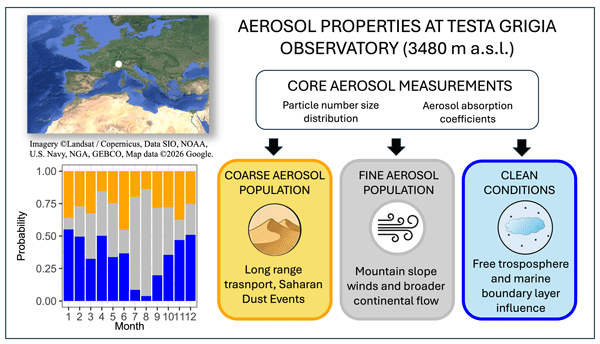
Abstract. High-elevation observatories are crucial for monitoring atmospheric aerosols, which play a key role in the climate system due to their effects on radiation, cloud, and snow albedo. We present the first measurements of aerosol size distribution and absorption coefficient at a 1-hour time resolution collected at the Testa Grigia Observatory (3,480 m asl) in the Italian Alps. This dataset spans from September 2021 to May 2023. We identified three distinct aerosol population types reaching the observatory, reflecting distinct transport pathways. The coarse particle population is indicative of long-range transport air masses from Sahara. Conversely, the fine particle population is linked to mesoscale circulations and boundary layer dynamics (from the Po Valley and local alpine valleys), and broader continental flows. Finally, periods of generally low particle number correspond to the influence of clean air from the free troposphere and the Mediterranean basin. The upper bound of the frequency of boundary layer influence is equal to 28 %. Conversely, Sahara Dust Events (SDE), identified as periods characterized by coarse aerosol population transported from the Sahara region, are observed for 6 % of the time. These events are predominantly recorded during spring and early summer and show strong correspondence with reanalysis data provided by CAMS (Copernicus Atmosphere Monitoring Service) ensemble model. The seasonal variability of PM10 concentration associated to SDE is explained by the variability to dust emission regions, dust mobilization over source region, and efficiency of dust transport mechanisms.
Competing interests: At least one of the (co-)authors is a member of the editorial board of Atmospheric Chemistry and Physics.
Publisher's note: Copernicus Publications remains neutral with regard to jurisdictional claims made in the text, published maps, institutional affiliations, or any other geographical representation in this paper. While Copernicus Publications makes every effort to include appropriate place names, the final responsibility lies with the authors. Views expressed in the text are those of the authors and do not necessarily reflect the views of the publisher.-
Notice on discussion status
The requested preprint has a corresponding peer-reviewed final revised paper. You are encouraged to refer to the final revised version.
-
Preprint
(1867 KB)
-
Supplement
(3493 KB)
-
The requested preprint has a corresponding peer-reviewed final revised paper. You are encouraged to refer to the final revised version.
- Preprint
(1867 KB) - Metadata XML
-
Supplement
(3493 KB) - BibTeX
- EndNote
- Final revised paper


Journal article(s) based on this preprint
Interactive discussion
Status: closed
- RC1: 'Comment on egusphere-2026-1299', Anonymous Referee #1, 23 Apr 2026
-
RC2: 'Comment on egusphere-2026-1299', Anonymous Referee #2, 23 Apr 2026
General comments:
The paper presents high-time-resolution measurements of aerosol size distribution and absorption at in Italian Alps, over the period September 2021–May 2023. The author applied a clustering method based on the aerosol volume size distribution shape to identify three main aerosol types. This, together with trajectory analysis and comparison with CAMS, has been shown to capture the influence of boundary layer dynamic, long range transport and Saharan dust event.
I found the manuscript to be well written and clearly structured. The methodology is presented in a clear way, and the figures are generally well designed. While the study does not introduce fundamentally new concepts, it provides a solid and well-supported analysis of aerosol transport mechanisms based on a robust dataset.
Technical comments:
Line 91: Typo in “measurements”.
Equation 2: It seems that a factor Dp^3 could be missing.
Lines 55–57: It is not entirely clear how this statement connects to the results presented later in the manuscript.
Lines 50–68: This part of the introduction would benefit from a clearer structure. It appears that the intention is to highlight the relevance of mountain sites for studying aerosol transport, but the cited conclusions seem somewhat disconnected from the rest of the paper. Can you clarifying the main message of this section to strengthen the introduction?
Line 99: For clarity, does this refer to the integrated frequency of winds exceeding 8 m/s, from North (90°) to East (0°)?
Line 175: It is not entirely clear how the additional pressure levels (10, 30, and 50 hPa below surface pressure) are used. Are these additional trajectory releases? If so, how are the resulting trajectories combined for interpretations, is it an integration of them all?
Line 220: Missing parenthesis.
Line 224: Duplicate citation of Nyeki et al. (inside and outside parentheses).
Line 225: The definition of “coarse particles” is repeated. Unless intentional for some reason, it would be sufficient to define it once.
Figure 5: I would recommend using a different colormap. The current one is not perceptually uniform and may introduce visual artifacts in the interpretation. A sequential colormap (e.g. viridis or plasma) may be more appropriate.
Line 467: The plots also suggest that, for Cluster 3, a larger fraction of air masses originates from higher altitudes compared to the other clusters.
Figure S2: A wind rose representation may be more appropriate for this type of data
Line 489: Typo in “Saharan dust”.
Line 498: The approach combining air mass history and aerosol size distribution to identify Saharan dust events is well established in the literature. The use of cluster analysis instead of fixed thresholds is a useful refinement, but it may be more appropriate to present it as an alternative implementation rather than a fully novel methodology.
Line 505: The comparison between observations and CAMS is interesting, but it relies on different definitions of dust, which may partly explain the discrepancies. For example, it is stated “In contrast, hourly data points classified as SDE in the observations but associated with lower PM10 were not correctly identified by CAMS (green markers in Fig. 6a)”, but you also used a threshold definition of those CAMS dust events which may also cause part of the mismatch.
Figure 7 (panels b and c): The colorbar values are difficult to read. It would be better to increase their size and also include units directly on the colorbar rather than only in the caption.
Figure S3: Why does the log10 of the frequency reach values up to 3?
Line 671: Typo (“This means…”).
Citation: https://doi.org/10.5194/egusphere-2026-1299-RC2 -
AC1: 'Comment on egusphere-2026-1299', Stefania Gilardoni, 13 May 2026
We would like to thank all the referees for their constructive suggestions and comments. We believe that the manuscript has improved thanks to their recommendations. We report in the attach pdf file a list of detailed answer to the referees' comments.
Peer review completion


Interactive discussion
Status: closed
-
RC1: 'Comment on egusphere-2026-1299', Anonymous Referee #1, 23 Apr 2026
The paper presents an interesting analysis of aerosol properties measured at a high elevation site in the Alps. The analysis is sound and interesting, and the aerosol data collected at the site can certainly add novel and unique information for the complex Alpine environment. The hope is that these aerosol measurements will continue and be augmented in the future. Overall, I think the paper can be published with rather minor revisions.
General comments
- Briefly describe the inlet and potential losses for the aethalometer
- I would guess that during the sampling, there might have been periods with low-level clouds. Did this affect the measurements? The authors screened the data by the RH, so I would think eventual cloudy periods were removed, but some mention would still be useful.
- The hypothesis of mixing between black carbon and dust particles is interesting. However, that begs the question of how the mixture was formed. Is it reasonable to believe that the mixture would form in the atmosphere through collision during transport or near the site, even if the particle concentration is low? Or are these mixtures forming closer to the source, like dust emitted very close to combustion sources (either human in nature or due to biomass burning)?
- This is not necessarily a request for changes, but the paper focuses a lot on dust, while the title does not mention dust. I wonder if a specific mention of dust in the title would make the link more immediate.
Specific comments
In the last sentence of the abstract: “The seasonal variability of PM10 concentration associated to SDE is explained by the variability to dust emission regions, dust mobilization over source region, and efficiency of dust transport mechanisms.” I wonder if the authors meant “sensitivity to dust emissions…” instead of “variability to…”. If they indeed meant “variability” then it should read “variability of”?
Opening sentence of the introduction. I believe that some aerosols can also have radiative effects from interactions with thermal radiation.
Line 96: How were these potential contamination periods identified?
Line 97: How representative is a locally measured windrose of the main air transport path?
Lines 101-103: Are the numbers after the plus/minus sign standard deviations?
Line 103: “equals” should be “equal”.
Line 110: Have inlet losses been calculated? If so, what is the upper size cut-off?
Line 113: Maybe clarify why they were discarded, for clarity.
Line 114: Briefly explain Beck’s correction scheme here to avoid the need for reading the cited paper to have a rough idea of the method.
Line 143: Please provide a URL.
Line 151: How is the “predominantly aerosol-free atmosphere” being identified? In other words, what’s the threshold?
Line 154: How good is the spherical approximation, especially for dust?
Line 161-162: Why is that? Why was that exact size cut chosen?
Line 168: How is the “how low as possible” number being determined?
Line 257: What is the reason for the low capture rate?
Figure 2: Is there a reason for using a 0 to 10 vertical scale on panel c. Panel a. ranges from 0 to 30, while panel b. ranges from 0 to 10, so I don’t see a reason to keep the same scale in panel c., and zooming in would allow for a better view of the details.
Line 308: It would be nice to add some of these webcam pictures, at least in the SI.
Line 322: Are the AAE estimates precise enough to allow differentiating between 1.56 and 1.48? Also, why would a lower AAE indicate slightly darker particles? Is the assumption that a slightly lower AAE would indicate a larger contribution from black carbon?
Line 327: This share is different from that provided in line 325; is that because this refers to winter only?
Line 330: Does the low absorption necessarily indicate the negligible impact of absorbing aerosol, or just reflecting low concentrations?
Figure 5: It might be useful to add a title on top of each column (cluster 1, 2, and 3), respectively, for more immediate readability.
Line 501: For direct comparability, provide the actual number from the Jungfraujoch
Line 543: An “a” is missing after “19” and before “severe”.
Line 590: Please provide a range of values from the published work from the Jungfraujoch you are referring to here for more direct comparability.
Line 639: The lower wet removal in the upper troposphere is reasonable and expected, but why would the gravitational settling be affected by the elevation? Is it just because being higher up, the particles take a longer time to settle to the ground, or are there some other processes at play (such as effects of shape or orientation) implied here?
Line 632: High-resolution, in what sense? I guess in time?
Lines 644-659: I am confused by the two sentences that are connected by “on the contrary”. Why “on the contrary”, if both are larger in summer?
Line 663: Here, it is a bit less critical, but I find the “on the contrary” to be potentially confusing here as well, considering that both cluster 1 and 2 seem to have in common at least the large-scale transport (although from different regions).
Line 669: Type 1 is the same as cluster 1? If so, I would stay consistent with the rest of the paper.
Lines 680-681: See one of my previous comments on this topic. Can the authors comment on how reasonable it is (in terms of the probability of collision between dust and BC particles, and given the particle concentrations) that the dust-BC mixture would “form” at the receptor site?
Citation: https://doi.org/10.5194/egusphere-2026-1299-RC1 -
RC2: 'Comment on egusphere-2026-1299', Anonymous Referee #2, 23 Apr 2026
General comments:
The paper presents high-time-resolution measurements of aerosol size distribution and absorption at in Italian Alps, over the period September 2021–May 2023. The author applied a clustering method based on the aerosol volume size distribution shape to identify three main aerosol types. This, together with trajectory analysis and comparison with CAMS, has been shown to capture the influence of boundary layer dynamic, long range transport and Saharan dust event.
I found the manuscript to be well written and clearly structured. The methodology is presented in a clear way, and the figures are generally well designed. While the study does not introduce fundamentally new concepts, it provides a solid and well-supported analysis of aerosol transport mechanisms based on a robust dataset.
Technical comments:
Line 91: Typo in “measurements”.
Equation 2: It seems that a factor Dp^3 could be missing.
Lines 55–57: It is not entirely clear how this statement connects to the results presented later in the manuscript.
Lines 50–68: This part of the introduction would benefit from a clearer structure. It appears that the intention is to highlight the relevance of mountain sites for studying aerosol transport, but the cited conclusions seem somewhat disconnected from the rest of the paper. Can you clarifying the main message of this section to strengthen the introduction?
Line 99: For clarity, does this refer to the integrated frequency of winds exceeding 8 m/s, from North (90°) to East (0°)?
Line 175: It is not entirely clear how the additional pressure levels (10, 30, and 50 hPa below surface pressure) are used. Are these additional trajectory releases? If so, how are the resulting trajectories combined for interpretations, is it an integration of them all?
Line 220: Missing parenthesis.
Line 224: Duplicate citation of Nyeki et al. (inside and outside parentheses).
Line 225: The definition of “coarse particles” is repeated. Unless intentional for some reason, it would be sufficient to define it once.
Figure 5: I would recommend using a different colormap. The current one is not perceptually uniform and may introduce visual artifacts in the interpretation. A sequential colormap (e.g. viridis or plasma) may be more appropriate.
Line 467: The plots also suggest that, for Cluster 3, a larger fraction of air masses originates from higher altitudes compared to the other clusters.
Figure S2: A wind rose representation may be more appropriate for this type of data
Line 489: Typo in “Saharan dust”.
Line 498: The approach combining air mass history and aerosol size distribution to identify Saharan dust events is well established in the literature. The use of cluster analysis instead of fixed thresholds is a useful refinement, but it may be more appropriate to present it as an alternative implementation rather than a fully novel methodology.
Line 505: The comparison between observations and CAMS is interesting, but it relies on different definitions of dust, which may partly explain the discrepancies. For example, it is stated “In contrast, hourly data points classified as SDE in the observations but associated with lower PM10 were not correctly identified by CAMS (green markers in Fig. 6a)”, but you also used a threshold definition of those CAMS dust events which may also cause part of the mismatch.
Figure 7 (panels b and c): The colorbar values are difficult to read. It would be better to increase their size and also include units directly on the colorbar rather than only in the caption.
Figure S3: Why does the log10 of the frequency reach values up to 3?
Line 671: Typo (“This means…”).
Citation: https://doi.org/10.5194/egusphere-2026-1299-RC2 -
AC1: 'Comment on egusphere-2026-1299', Stefania Gilardoni, 13 May 2026
We would like to thank all the referees for their constructive suggestions and comments. We believe that the manuscript has improved thanks to their recommendations. We report in the attach pdf file a list of detailed answer to the referees' comments.
Peer review completion
Journal article(s) based on this preprint
Viewed
| HTML | XML | Total | Supplement | BibTeX | EndNote | |
|---|---|---|---|---|---|---|
| 904 | 469 | 112 | 1,485 | 207 | 105 | 104 |
- HTML: 904
- PDF: 469
- XML: 112
- Total: 1,485
- Supplement: 207
- BibTeX: 105
- EndNote: 104
Viewed (geographical distribution)
| Country | # | Views | % |
|---|
| Total: | 0 |
| HTML: | 0 |
| PDF: | 0 |
| XML: | 0 |
- 1
Stefania Gilardoni

Annachiara Bellini
Paolo Bonasoni
Henry Diémoz
Christian Gencarelli
Angela Marinoni
Eros Mariani
Luigi Mazari Villanova
Bruno Neininger
Mattia Perilli
Michael Sprenger
Francesco Petracchini
The requested preprint has a corresponding peer-reviewed final revised paper. You are encouraged to refer to the final revised version.
- Preprint
(1867 KB) - Metadata XML
-
Supplement
(3493 KB) - BibTeX
- EndNote
- Final revised paper
The paper presents an interesting analysis of aerosol properties measured at a high elevation site in the Alps. The analysis is sound and interesting, and the aerosol data collected at the site can certainly add novel and unique information for the complex Alpine environment. The hope is that these aerosol measurements will continue and be augmented in the future. Overall, I think the paper can be published with rather minor revisions.
General comments
Specific comments
In the last sentence of the abstract: “The seasonal variability of PM10 concentration associated to SDE is explained by the variability to dust emission regions, dust mobilization over source region, and efficiency of dust transport mechanisms.” I wonder if the authors meant “sensitivity to dust emissions…” instead of “variability to…”. If they indeed meant “variability” then it should read “variability of”?
Opening sentence of the introduction. I believe that some aerosols can also have radiative effects from interactions with thermal radiation.
Line 96: How were these potential contamination periods identified?
Line 97: How representative is a locally measured windrose of the main air transport path?
Lines 101-103: Are the numbers after the plus/minus sign standard deviations?
Line 103: “equals” should be “equal”.
Line 110: Have inlet losses been calculated? If so, what is the upper size cut-off?
Line 113: Maybe clarify why they were discarded, for clarity.
Line 114: Briefly explain Beck’s correction scheme here to avoid the need for reading the cited paper to have a rough idea of the method.
Line 143: Please provide a URL.
Line 151: How is the “predominantly aerosol-free atmosphere” being identified? In other words, what’s the threshold?
Line 154: How good is the spherical approximation, especially for dust?
Line 161-162: Why is that? Why was that exact size cut chosen?
Line 168: How is the “how low as possible” number being determined?
Line 257: What is the reason for the low capture rate?
Figure 2: Is there a reason for using a 0 to 10 vertical scale on panel c. Panel a. ranges from 0 to 30, while panel b. ranges from 0 to 10, so I don’t see a reason to keep the same scale in panel c., and zooming in would allow for a better view of the details.
Line 308: It would be nice to add some of these webcam pictures, at least in the SI.
Line 322: Are the AAE estimates precise enough to allow differentiating between 1.56 and 1.48? Also, why would a lower AAE indicate slightly darker particles? Is the assumption that a slightly lower AAE would indicate a larger contribution from black carbon?
Line 327: This share is different from that provided in line 325; is that because this refers to winter only?
Line 330: Does the low absorption necessarily indicate the negligible impact of absorbing aerosol, or just reflecting low concentrations?
Figure 5: It might be useful to add a title on top of each column (cluster 1, 2, and 3), respectively, for more immediate readability.
Line 501: For direct comparability, provide the actual number from the Jungfraujoch
Line 543: An “a” is missing after “19” and before “severe”.
Line 590: Please provide a range of values from the published work from the Jungfraujoch you are referring to here for more direct comparability.
Line 639: The lower wet removal in the upper troposphere is reasonable and expected, but why would the gravitational settling be affected by the elevation? Is it just because being higher up, the particles take a longer time to settle to the ground, or are there some other processes at play (such as effects of shape or orientation) implied here?
Line 632: High-resolution, in what sense? I guess in time?
Lines 644-659: I am confused by the two sentences that are connected by “on the contrary”. Why “on the contrary”, if both are larger in summer?
Line 663: Here, it is a bit less critical, but I find the “on the contrary” to be potentially confusing here as well, considering that both cluster 1 and 2 seem to have in common at least the large-scale transport (although from different regions).
Line 669: Type 1 is the same as cluster 1? If so, I would stay consistent with the rest of the paper.
Lines 680-681: See one of my previous comments on this topic. Can the authors comment on how reasonable it is (in terms of the probability of collision between dust and BC particles, and given the particle concentrations) that the dust-BC mixture would “form” at the receptor site?