
the Creative Commons Attribution 4.0 License.
the Creative Commons Attribution 4.0 License.
 | 22 Apr 2026
Review article: Hydrologically Enhanced Machine Learning Framework for Urban Flood Inundation Mapping Using Multi-Sensor Remote Sensing Data: A Case Study of Mumbai, India
Abstract. The complicated terrain, highly populated building surfaces and insufficient credible ground observations make urban flood mapping difficult in urbanizing megacities that rapidly develop in coastal areas. This study suggests that a hydrologically improved machine learning architecture can be utilized to perform automated urban flood inundation mapping by combining multi-sensor satellite data with a scalable decision support system (DSS). The Google Earth engine used Sentinel-1 SAR, Sentinel-2 optical imagery, SRTM digital elevation data, and CHIRPS precipitation data to create a comprehensive predictor stack.
To explicitly model flood propagation controls that most data-driven models tend to omit, two new hydrologic-topographic predictors were created:-the Relative Elevation Model (REM) and River Network Index (RNI), to model local terrain depressions and hydraulic connectivity. A consensus-based combination of SAR backscatter change, optical water indices, and topographic constraints produced flood labels with approximately 2.6x105 pixels of floods in the Mumbai Metropolitan Region during the 2019 monsoon season. A representative training set was formed using balanced stratified sampling for use in the supervised classification. Random Forest, optimized XGBoost and ensemble models were created and tested in Python using official classification measures. The tuned XGBoost model had the best performance with an overall accuracy of 71.7 percent and an area under the receiver operating characteristic curve (AUC) of 0.803, which performed better than the Random Forest and ensemble configurations. The statistical significance of the improvement in model discrimination was at the 95 percent confidence level. The analysis of ablation revealed that the model discrimination of REM and RNI increased by approximately 5–6 percent in AUC, which proves their importance in urban flood detection. There is high spatial congruency between the predicted inundation pattern and known flood-prone regions along the major drainage patterns.
The proposed framework provides a reproducible, scalable, and hydrologically informed framework for urban flood inundation mapping and has high potential for operational flood monitoring and decision support in data limited tropical cities.
-
Notice on discussion status
The requested preprint has a corresponding peer-reviewed final revised paper. You are encouraged to refer to the final revised version.
-
Preprint
(992 KB)
-
The requested preprint has a corresponding peer-reviewed final revised paper. You are encouraged to refer to the final revised version.
- Preprint
(992 KB) - Metadata XML
- BibTeX
- EndNote
- Final revised paper


Journal article(s) based on this preprint
Interactive discussion
Status: closed
-
CC1: 'Comment on egusphere-2026-1275', Anupal Baruah, 26 Apr 2026
-
AC1: 'Reply on CC1', Gayatri M Phade, 26 Apr 2026
We sincerely thank the commenter for the insightful and constructive feedback on our manuscript. The points raised regarding the use of SAR data in urban environments and the implications of spatial resolution are highly relevant, and we appreciate the opportunity to clarify these aspects.
-
Regarding the use of SAR data in urban flood mapping, we agree that double-bounce scattering in built-up areas can introduce uncertainties and may lead to misclassification of flooded regions. Despite this limitation, SAR data remain a widely adopted and valuable source for flood mapping due to their all-weather, day-and-night imaging capability, which is particularly critical during flood events characterized by cloud cover.
In our study, we mitigate these limitations through a multi-source data integration framework. Specifically, SAR-derived features are not used in isolation but are combined with hydrologic–topographic indicators such as relative elevation and flow accumulation, as well as additional geospatial predictors. This integration allows the machine learning model to reduce reliance on any single data source and improves robustness against SAR-specific artefacts. Furthermore, the use of statistical descriptors and temporal variability features helps to distinguish true flood signals from urban backscatter effects. We will further clarify this mitigation strategy in the revised manuscript.
-
With respect to the use of 30 m spatial resolution, we acknowledge that this resolution may not fully capture fine-scale urban features such as roads, drainage networks, and individual buildings. However, the choice of 30 m resolution was guided by the need to maintain consistency across multiple datasets (e.g., DEM, precipitation, and derived hydrologic variables) and to ensure computational feasibility for regional-scale analysis.
Our objective is to provide a scalable and generalizable framework for urban flood susceptibility mapping rather than detailed street-level inundation modelling. The machine learning framework leverages terrain and hydrologic context, which remain meaningful at this spatial scale. Nevertheless, we agree that higher-resolution datasets could further enhance the accuracy of flood delineation in dense urban environments. This limitation and its implications will be more explicitly discussed in the revised manuscript, along with suggestions for future work using higher-resolution data.
We thank the commenter again for these valuable suggestions, which will help improve the clarity and robustness of our study.
Citation: https://doi.org/10.5194/egusphere-2026-1275-AC1 -
-
AC1: 'Reply on CC1', Gayatri M Phade, 26 Apr 2026
-
RC1: 'Comment on egusphere-2026-1275', Anonymous Referee #1, 31 May 2026
The manuscript addresses an important and timely topic in urban flood inundation mapping by integrating multi-sensor remote sensing data with machine learning and hydrologic-topographic predictors. The use of Sentinel-1 SAR, Sentinel-2 optical imagery, SRTM DEM, CHIRPS rainfall, and HydroRIVERS data provides a relevant basis for developing a scalable flood mapping framework. The inclusion of the Relative Elevation Model (REM) and River Network Index (RNI) is a promising attempt to improve the physical interpretability of machine learning-based flood detection. The reported performance of the tuned XGBoost model, with an accuracy of 71.7% and AUC of 0.803, suggests that the proposed framework has potential for operational urban flood monitoring. However, the manuscript requires substantial revision before it can be considered scientifically robust. First, the title describes the paper as a “Review article,” but the manuscript is clearly an original research article involving data processing, model development, model evaluation, and case study application. This should be corrected to avoid confusion.
The novelty of the study also needs to be clarified. The manuscript claims that REM and RNI are new hydrologic-topographic predictors, but it does not sufficiently explain how these indices differ from existing flood conditioning variables such as elevation, slope, distance to river, HAND, drainage proximity, topographic wetness index, or flow accumulation. The authors should clearly state whether REM and RNI are newly developed indices, modified versions of existing indices, or case-specific hydrologic features. A major concern is the formulation of the RNI. The text describes RNI as a measure of hydraulic proximity and connectivity to river networks, but the equation uses cumulative precipitation divided by the elevation difference from the minimum DEM. This formulation does not directly represent distance to river, drainage connectivity, or river network influence. The authors should revise the RNI equation so that it is mathematically consistent with its stated hydrological meaning.
The flood label generation process also requires stronger justification. The manuscript uses a consensus rule based on SAR backscatter ratio, backscatter difference, NDWI, and REM thresholds, but the selected threshold values are not adequately justified. The authors should explain why SAR ratio > 1.25, backscatter difference ≥ 3 dB, NDWI > 0.05, and REM < 5 m were selected. A threshold sensitivity analysis would strengthen the reliability of the generated flood labels. The validation strategy is another important limitation. Since the training and testing labels are generated from remote sensing-based consensus rules, the model may be learning the labeling assumptions rather than being validated against independent flood observations. The authors are encouraged to include independent validation data, such as official flood records, observed flood locations, high-resolution imagery, or historical flood-prone areas in Mumbai. If such data are unavailable, the manuscript should clearly state that the reported accuracy reflects agreement with consensus-generated labels rather than confirmed ground truth.
The statistical significance claims should also be improved. The manuscript states that the XGBoost model significantly outperforms other models based on the DeLong test, but the p-values, confidence intervals, and test statistics are not reported. Since the AUC difference between Random Forest and XGBoost is small, these values are necessary to support the claim of statistical significance. There is also an inconsistency in the reported ensemble performance. Table 3 reports the RF-XGB ensemble AUC as 0.794, while the ROC figure appears to show a different ensemble AUC value. The authors should carefully check and correct all performance values in the tables, figures, and discussion.
Finally, the manuscript requires substantial language editing. Several sentences are awkward or unclear, and the citation style is inconsistent between author-year and numbered formats. The figures, especially the workflow and spatial flood maps, should be improved for readability and publication quality. Figure 5 should include clearer legends, units, class definitions, and map elements. Overall, the study has potential, but the current version needs major revision. The authors should strengthen the novelty statement, correct the RNI formulation, justify the flood-label thresholds, improve validation, report full statistical testing results, resolve inconsistencies in model performance, and substantially revise the language and presentation.
Citation: https://doi.org/10.5194/egusphere-2026-1275-RC1 -
AC2: 'Reply on RC1', Gayatri M Phade, 01 Jun 2026
We thank Referee #1 for the detailed and constructive review of our manuscript. We appreciate the positive assessment of the overall framework and the valuable suggestions for improvement.
We acknowledge the concerns regarding manuscript classification, the novelty and formulation of the hydrologic–topographic predictors, threshold selection, validation strategy, statistical significance testing, and presentation quality. We are currently revising the manuscript and will address each comment in detail in a point-by-point response and revised manuscript.
We particularly appreciate the referee's suggestions regarding clarification of the Relative Elevation Model (REM) and River Network Index (RNI), justification of flood-label thresholds, reporting of DeLong test statistics, and improvement of figures and language. These comments will substantially strengthen the manuscript.
We thank the referee again for the constructive feedback and will carefully incorporate all recommendations in the revised version.
Citation: https://doi.org/10.5194/egusphere-2026-1275-AC2
-
AC2: 'Reply on RC1', Gayatri M Phade, 01 Jun 2026
-
RC2: 'Comment on egusphere-2026-1275', Anonymous Referee #2, 06 Jul 2026
The manuscript proposes an ML framework for urban flood inundation mapping in the Mumbai Metropolitan Region, combining Sentinel-1, Sentinel-2, SRTM terrain attributes, and CHIRPS rainfall in Google Earth Engine. Two predictors presented as new - a Relative Elevation Model (REM) and a River Network Index (RNI) — are added to the feature stack, and flood labels are generated by consensus of SAR backscatter change, an NDWI threshold, and a REM threshold. A tuned XGBoost model is reported as the best performer, and an ablation experiment attributes a modest AUC gain to REM/RNI.
The topic is relevant, and the aim of a scalable, physically informed workflow for data-limited megacities is valuable. However, a structural circularity between label generation and model evaluation invalidates the reported skill, no independent validation is provided, the terrain predictors overlook the established literature on geomorphic flood descriptors, and the reference list contains duplicated and incorrect entries. These problems are foundational rather than presentational.
Major comments
Circularity between labels and predictors invalidates the evaluation. Flood labels are defined by the joint satisfaction of criteria based on SAR backscatter change, NDWI, and a REM threshold; the same variables are then used as predictors, and skill is computed against these self-derived labels. The model is thus rewarded for reproducing a function of its own inputs, not for detecting floods — the feature-importance figure confirms this, with REM by far the dominant feature and the SAR VV features ranking next. The ablation result — an AUC gain attributed to REM/RNI and presented as the paper's central finding — is a self-fulfilling artifact: removing REM necessarily degrades the prediction of labels partly defined by a REM threshold. Correcting this requires reference data independent of the predictor set and/or the exclusion of labeling variables from the feature stack.
No independent validation. The Mumbai monsoon floods of the study year are extensively documented (municipal flood-spot inventories, geolocated media reports, published flood maps, high-resolution imagery), yet none of these sources is used. The claimed "spatial congruency with known flood-prone regions" is purely qualitative. For a framework promoted as operational decision support, independent quantitative validation is indispensable, not future work.
Ground the terrain predictors in established geomorphic descriptors (HAND, GFI) and drop the novelty claim. The REM as defined is exactly the Height Above Nearest Drainage (HAND; Rennò et al.; Nobre et al.), used for well over a decade to delineate flood-prone areas. Geomorphic descriptors such as HAND and the Geomorphic Flood Index (GFI) have been specifically validated for flood-prone area delineation in data-scarce environments — precisely the manuscript's target setting — and would give the "hydrologic enhancement" a sound physical and bibliographic basis. I recommend that the authors reposition REM as an application of HAND and adopt, or benchmark against, the GFI or similar validated descriptors rather than ad hoc indices.
The RNI definition is internally contradictory. The text describes RNI as a Euclidean distance to the drainage network, but the formula given divides cumulative rainfall by the elevation above the regional minimum — it contains no distance term, is dimensionally arbitrary, and becomes singular near the coast. Please state what was actually computed, justify it physically, and rename it accordingly. Moreover, HydroRIVERS (coarse source hydrography) cannot represent Mumbai's urban drainage network; the adequacy of this river mask for REM/RNI computation must be demonstrated.
Note on the ongoing discussion
I share the concerns raised in the community comment (SAR double-bounce ambiguity in built-up areas; coarse working resolution for urban flood dynamics). The authors' reply does not resolve them: the argument that multi-source integration mitigates SAR artefacts fails here because the SAR features are themselves part of the label definition — errors propagate into the labels instead of being compensated; the reply lists "flow accumulation" among the predictors, but no such variable appears in the manuscript — this discrepancy should be reconciled; and the reply confirms a coarser working resolution than the Sentinel resolution emphasized in the manuscript — the actual common resolution must be stated explicitly.
Minor comments
The title is enclosed in quotation marks and mislabeled "Review article"; the byline uses "Research Scholar/Research Guide" instead of standard affiliations.
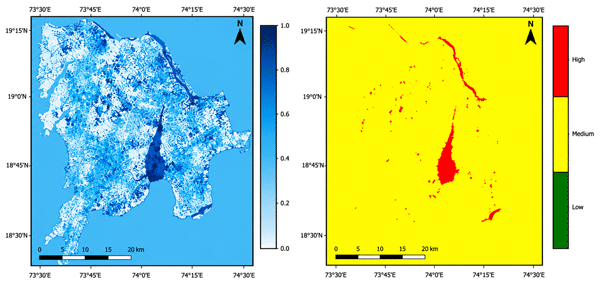
The study-area figure is cartographically inadequate, and the stated bounding box excludes part of the Mumbai Metropolitan Region. The flood-map figure uses pixel indices instead of coordinates, apparently classifies the sea, and the risk-zone panel is unexplained and nearly uniform. All maps need coordinates, scale, and a proper basemap.
The comparison table sets the proposed method against metrics from non-commensurable studies (different regions, events, validation data).
Duplicated in-text citations; bracket mismatches; the significance level should be denoted with the Greek alpha; the manuscript requires thorough professional English editing.
Citation: https://doi.org/10.5194/egusphere-2026-1275-RC2 -
AC3: 'Reply on RC2', Gayatri M Phade, 02 Aug 2026
We sincerely thank Referee 2 for the thorough and constructive evaluation of our manuscript entitled "Review article: Hydrologically Enhanced Machine Learning Framework for Urban Flood Inundation Mapping Using Multi-Sensor Remote Sensing Data: A Case Study of Mumbai, India." We appreciate the time and effort devoted to reviewing our work and for providing valuable technical suggestions. The comments have helped us identify several aspects requiring clarification and improvement. We address each comment below and will incorporate the corresponding revisions in the revised manuscript.
Comment 1: Circularity between flood labels and predictors
Reviewer comment:
The reviewer notes that flood labels are generated using SAR backscatter, NDWI, and REM thresholds, while the same variables are subsequently used as predictors, leading to potential target leakage and circularity.Author Response
We appreciate this important observation. The intention of the consensus-based labeling strategy was to generate a practical flood inventory in a data-limited environment where spatially continuous ground observations were unavailable. We acknowledge that the use of variables contributing to both label generation and model prediction may introduce dependency between the labels and predictor set.
In the revised manuscript, we will explicitly acknowledge this limitation and clarify that the reported performance represents agreement with the adopted consensus-derived flood inventory rather than completely independent flood observations. We will also moderate the interpretation of the feature ablation results and clearly state that the observed improvement associated with hydrologic-topographic predictors should be interpreted within the adopted labeling framework. This limitation and its implications for model evaluation will be discussed in detail in the Discussion and Future Work sections.
Comment 2: Independent validation
Reviewer comment:
The reviewer recommends validating the model using independent flood observations such as official flood records, observed flood locations, or high-resolution imagery.Author Response
We fully agree that independent validation is desirable and would provide a stronger assessment of predictive capability. However, spatially continuous reference flood datasets corresponding to the selected 2019 event were not available for the entire Mumbai Metropolitan Region. Therefore, a consensus-based flood inventory derived from multi-sensor observations was adopted as a practical alternative for supervised learning.
The revised manuscript will explicitly state this limitation and clarify that the reported accuracy measures agreement with the consensus-derived labels rather than confirmed ground truth. We will also indicate that future work will focus on incorporating municipal flood records, field observations, high-resolution satellite imagery, and historical flood inventories for external validation.
Comment 3: Novelty of REM and relation to HAND/GFI
Reviewer comment:
The reviewer recommends relating the proposed Relative Elevation Model (REM) to established geomorphic descriptors such as HAND and GFI.Author Response
We thank the reviewer for this valuable suggestion. We agree that the relationship between REM and existing terrain descriptors should be clarified. In the revised manuscript, we will explain that the proposed Relative Elevation Model is conceptually related to the Height Above Nearest Drainage (HAND) approach, as both represent terrain elevation relative to drainage. However, REM was implemented within the Google Earth Engine environment using SRTM DEM and HydroRIVERS to provide a computationally efficient terrain-conditioned predictor suitable for regional-scale urban flood mapping.
The novelty claim will be revised accordingly. Rather than presenting REM as an entirely new geomorphic descriptor, we will position it as a simplified hydrologically informed predictor integrated into a scalable multi-sensor machine-learning framework. Additional discussion and references to HAND, GFI, and related geomorphic indices will also be included.
Comment 4: Definition of RNI
Reviewer comment:
The reviewer points out that the description of the River Network Index is inconsistent with the implemented equation and recommends revising its definition.Author Response
We appreciate the reviewer identifying this inconsistency. Following this suggestion, the predictor will be renamed Rainfall-Normalized Index (RNI) to accurately reflect its mathematical formulation and physical interpretation. The revised manuscript will remove references to Euclidean distance transforms and river-network connectivity, which were inconsistent with the implemented algorithm.
The revised description will define RNI as a rainfall-dependent surface wetness indicator derived from cumulative CHIRPS precipitation and optical wetness information, consistent with the Google Earth Engine implementation.
Comment 5: Community discussion regarding SAR limitations and spatial resolution
Reviewer comment:
The reviewer refers to concerns raised during the community discussion regarding SAR double-bounce effects and the use of a 30 m spatial resolution.Author Response
We thank the reviewer for highlighting these important issues. The revised manuscript will include a more comprehensive discussion of the limitations of SAR observations in dense urban environments, particularly the influence of double-bounce scattering. We will clarify that integrating Sentinel-1 SAR with Sentinel-2 optical imagery, terrain variables, and rainfall information was intended to reduce uncertainty associated with any single data source, although such limitations cannot be completely eliminated.
We will also explicitly state that all predictor layers were harmonized to a common spatial resolution of 30 m to ensure consistency during feature generation and machine-learning analysis.
Minor Comments
We appreciate the reviewer's additional editorial suggestions. In the revised manuscript, we will:
- correct the manuscript title and formatting where appropriate;
- improve the cartographic quality of all figures by adding coordinate grids, north arrows, scale bars, clearer legends, and map elements;
- clarify the methodology used to derive flood-risk classes and probability thresholds;
- revise the manuscript for English language, readability, and citation consistency; and
- carefully review all tables and figures to ensure consistency in reported performance metrics.
Closing Remarks
Once again, we sincerely thank the reviewer for the thoughtful and constructive comments. We believe that addressing these suggestions will substantially improve the clarity, transparency, and scientific quality of the manuscript. The revised version will incorporate all feasible recommendations and clearly acknowledge the remaining limitations of the current study.
Citation: https://doi.org/10.5194/egusphere-2026-1275-AC3
-
AC3: 'Reply on RC2', Gayatri M Phade, 02 Aug 2026
-
RC3: 'Comment on egusphere-2026-1275', Anonymous Referee #3, 06 Jul 2026
The comment was uploaded in the form of a supplement: https://egusphere.copernicus.org/preprints/2026/egusphere-2026-1275/egusphere-2026-1275-RC3-supplement.pdf
-
AC4: 'Reply on RC3', Gayatri M Phade, 02 Aug 2026
We sincerely thank Referee 3 for the thorough evaluation of our manuscript entitled "Review article: Hydrologically Enhanced Machine Learning Framework for Urban Flood Inundation Mapping Using Multi-Sensor Remote Sensing Data: A Case Study of Mumbai, India." We appreciate the constructive comments and valuable suggestions, which have helped us identify several areas requiring clarification and improvement. Our detailed responses are provided below.
General Comment
Reviewer comment:
The reviewer considers the study interesting but questions the claimed novelty, the lack of independent validation and sensitivity analysis, and the omission of coastal/compound flooding processes.Author Response
We sincerely appreciate the reviewer's overall assessment and constructive recommendations. We agree that these aspects require further clarification. In the revised manuscript, we will moderate our novelty claims, reposition the hydrologically informed predictors within the context of existing literature, expand the discussion of methodological limitations, and explicitly acknowledge the absence of independent validation. We will also include a discussion on compound flooding and coastal influences in Mumbai, together with their implications for future developments of the proposed framework.
Comment 1: Hydrodynamic model discussion
Reviewer comment:
The discussion of hydrodynamic models should acknowledge recent advances such as LISFLOOD-FP and SFINCS.Author Response
We thank the reviewer for this valuable suggestion. We agree that recent developments have significantly improved the computational efficiency of hydrodynamic flood models. Accordingly, the Introduction will be revised to acknowledge advances in models such as LISFLOOD-FP and SFINCS and clarify that our proposed machine-learning framework is intended to complement, rather than replace, physics-based hydrodynamic models, particularly in data-limited environments where rapid regional flood mapping is required.
Comment 2: Novelty statement
Reviewer comment:
Claims regarding the limited use of hydrologic-topographic conditioning in machine learning flood mapping should be revised.Author Response
We appreciate this observation. The Introduction will be revised to include recent studies demonstrating the integration of hydrologic-topographic variables within machine learning flood mapping frameworks. Rather than presenting the proposed methodology as introducing entirely new concepts, the revised manuscript will emphasize its contribution as the systematic integration and evaluation of hydrologically informed predictors within a scalable multi-sensor machine-learning framework for urban flood inundation mapping.
Comment 3: REM versus HAND
Reviewer comment:
The reviewer requests clarification regarding the difference between REM and the established HAND approach.Author Response
We thank the reviewer for this important comment. We agree that the relationship between REM and HAND should be clarified. The revised manuscript will explicitly acknowledge that REM is conceptually related to the Height Above Nearest Drainage (HAND) methodology. However, REM was implemented using SRTM DEM and HydroRIVERS within Google Earth Engine to provide a computationally efficient terrain-conditioned predictor suitable for regional-scale processing. We will therefore moderate the novelty claim and clearly distinguish the implementation from established geomorphic descriptors.
Comment 4: Definition of RNI
Reviewer comment:
The reviewer notes that the mathematical formulation of RNI does not correspond to its textual description.Author Response
We appreciate the reviewer identifying this inconsistency. Following this recommendation, the predictor will be renamed Rainfall-Normalized Index (RNI) to accurately reflect its implemented formulation. All references describing RNI as a measure of hydraulic proximity or Euclidean distance to drainage channels will be removed. The revised description will explain that the index represents rainfall-dependent surface wetness derived from cumulative precipitation and optical information, consistent with its implementation in Google Earth Engine.
Comment 5: Validation of flood labels and threshold sensitivity
Reviewer comment:
The reviewer recommends independent validation and sensitivity analysis of the flood identification thresholds.Author Response
We fully agree that independent validation would strengthen the evaluation of the proposed methodology. However, comprehensive spatially continuous flood observations corresponding to the selected 2019 event were unavailable for the study area. Consequently, a consensus-based flood inventory derived from multiple remote sensing observations was adopted for supervised learning.
To improve transparency, the revised manuscript will explicitly state that the reported performance reflects agreement with the consensus-derived flood inventory rather than independently observed flood extents. Additionally, a detailed justification of the selected SAR backscatter, NDWI, and REM thresholds, supported by published literature and hydrological reasoning, together with a threshold sensitivity analysis, will be incorporated into the methodology.
Comment 6: Feature importance of RNI
Reviewer comment:
Figure 4 shows REM as the dominant predictor, whereas RNI ranks lower than several SAR variables.Author Response
We appreciate this observation. We agree that our previous interpretation overstated the contribution of RNI. The revised Discussion will clarify that REM emerged as the most influential hydrologic-topographic predictor, while RNI provided complementary rainfall-related information that contributed to the overall predictive performance but was not among the highest-ranked individual variables. The discussion will be revised accordingly to maintain consistency with the reported feature importance results.
Comment 7: Ablation experiment
Reviewer comment:
The classifier used for the ablation experiment should be explicitly identified.Author Response
Thank you for this suggestion. The revised manuscript will clearly state that all feature ablation experiments were conducted using the optimized XGBoost classifier. This clarification will be included in both the methodology and the corresponding table caption to improve reproducibility.
Comment 8: Flood-risk classification
Reviewer comment:
The methodology used to classify flood-risk zones should be explained.Author Response
We appreciate this helpful recommendation. The revised manuscript will explicitly describe the probability thresholds used to classify Low, Moderate, High, and Very High flood-risk categories. The corresponding explanation will be included in both the Methods section and the caption of Figure 5.
Comment 9: Coastal and compound flooding
Reviewer comment:
The manuscript should discuss the influence of coastal and compound flooding.Author Response
We thank the reviewer for raising this important point. We acknowledge that flooding within the Mumbai Metropolitan Region may result from the interaction of pluvial, fluvial, tidal, and coastal processes. Since the present framework primarily considers rainfall-driven and terrain-controlled inundation, these compound processes were not explicitly represented. The revised manuscript will include a dedicated discussion acknowledging this limitation and identifying compound flood modelling as an important direction for future research.
Comment 10: Operational readiness
Reviewer comment:
Operational claims should be moderated until independent validation has been demonstrated.Author Response
We agree with the reviewer. The manuscript will be revised to moderate statements regarding operational deployment. Rather than claiming operational readiness, the revised text will state that the proposed framework demonstrates potential for operational urban flood monitoring following further validation using independent observational datasets across multiple flood events.
Closing Remarks
We sincerely thank the reviewer once again for the detailed and constructive comments. We believe these suggestions have significantly strengthened the manuscript. The revised version will incorporate all feasible recommendations, clarify the scope and limitations of the proposed framework, and improve the scientific rigor, transparency, and presentation of the study.
Citation: https://doi.org/10.5194/egusphere-2026-1275-AC4
-
AC4: 'Reply on RC3', Gayatri M Phade, 02 Aug 2026
-
RC4: 'Comment on egusphere-2026-1275', Anonymous Referee #4, 08 Jul 2026
While the authors are tackling an important issue, I have several concerns and questions about their methods, choice of datasets (e.g. ignored HAND, HAR, EAR) and the endless existing studies that use ML and DL for flood susceptibility mapping which use terrain descriptors and in many cases incorporate RS data which are not acknowledged in this work.
The Major issues I have with this manuscript are listed below:
1. literature review - there is a huge number of studies that largely do this (include hydrologic-topographic predictors) and test different ML models on a site. *e.g. search 'flood susceptibility'
2. REM - from a 30m DSM - which does not undergo any hydroconditioning. From what I understand you get some rivers from some place (undeclared) and compute vertical height. There are several models which do this, but also incorporate flow accumulation as well- making them much better substitutes, e.g. Height Above Nearest Drainage (HAND), height above river (HAR), elevation above river (EAR), The DEM is, I believe a DSM not a DTM.
3. RNI - this doesn't seem to even include river network or certain stream orders... the equation presented for RNI is cumulative precipitation divided by the different of the elevation at the pixel from some 'minimum regional' value. What is a region? How do the streams figure in this equation ? would a simple Euclidean distance raster from rivers greater or less than a stream order not suffice, if not, explain why.
these two 'new' datasets are not demonstrating they are better or more efficient than what is already available and how are they determined to be hydrologically significant predictors?
4. Classification of flood non-flood pixels. interesting approach to generate a consensus based label, but, are you confident this is working and the correct labels are being applied? Also, how did you decide that REM < 5 could/would demonstrate flooding? was there a sensitivity test or rationale behind this choice, please explain? same for NDWI. how did you come up with > 0.5 as the best threshold?
5. why is this described solely as an Urban model? could it not be used elsewhere?
6. table 1 misses the whole breadth of literature of ML models.
7. figure 1 - not impactful, what am I learning from this? maybe add terrain, land cover, something of greater interest to show the region
8. Modelling - many issues with this, starting with how labels are defined, but also you use REM to create labels and also in the model. ? this is a form of leakage and likely just means the model's performance does not represent its ability to predict real flood occurrence—only its ability to recover the rule used to create the label. How do you justify this decision?
9. results - auc, f1, etc. in some places you call it 'significantly superior and in the previous sentence/paragraph marginally better. Which is it?
10. it would be great to include a Known location with real flood extent to test your concept
11. figure 5 - I dont' find it convincing to support your confidence in this approach, also where did the low, med high thresholds for the right map come from? Suggest add points or areas of previous flooded monsoons could help strengthen narrative.
From the above list, I find the claims of this approach being an improved method and suitable method for flood hazard evaluation are not supported by the experiment and results.
Citation: https://doi.org/10.5194/egusphere-2026-1275-RC4 -
AC5: 'Reply on RC4', Gayatri M Phade, 02 Aug 2026
We sincerely thank Anonymous Referee #4 for the detailed review and constructive comments on our manuscript entitled "Review article: Hydrologically Enhanced Machine Learning Framework for Urban Flood Inundation Mapping Using Multi-Sensor Remote Sensing Data: A Case Study of Mumbai, India." We appreciate the reviewer's careful assessment and valuable suggestions, which have helped us identify several areas requiring clarification and improvement. We respond to each comment below.
Comment 1: Literature review
Reviewer comment:
The literature review overlooks numerous studies on flood susceptibility mapping that incorporate hydrologic-topographic predictors with machine learning and deep learning approaches.Author Response
We thank the reviewer for this important observation. We agree that the literature review should better reflect the breadth of recent developments in machine learning-based flood susceptibility and inundation mapping. In the revised manuscript, the Introduction will be substantially expanded to include additional studies employing hydrologic-topographic predictors, machine learning, and deep learning approaches. The discussion will include recent work involving HAND, HAR, EAR, GFI, convolutional neural networks, U-Net architectures, and flood susceptibility mapping. The novelty statement will also be moderated to emphasize the systematic integration and evaluation of hydrologically informed predictors within a scalable multi-sensor framework rather than the introduction of entirely new terrain descriptors.
Comment 2: Relative Elevation Model (REM)
Reviewer comment:
The proposed REM appears similar to existing approaches such as HAND, HAR, and EAR, while using a 30 m DEM without hydro-conditioning.Author Response
We appreciate this valuable comment. We acknowledge that REM shares conceptual similarities with established terrain descriptors such as HAND, HAR, and EAR. In the revised manuscript, we will explicitly discuss these relationships and clarify that REM should be considered a simplified terrain-conditioned predictor implemented within Google Earth Engine using SRTM DEM and HydroRIVERS for efficient regional-scale processing. We will no longer present REM as a completely novel geomorphic descriptor but instead position it within the existing family of relative elevation approaches while explaining its practical implementation and application in our framework.
Comment 3: Rainfall-Normalized Index (RNI)
Reviewer comment:
The proposed RNI does not appear to represent river-network influence as described, and its formulation requires clarification.Author Response
We sincerely thank the reviewer for identifying this inconsistency. We agree that the previous terminology did not accurately represent the implemented formulation. Accordingly, the predictor will be renamed Rainfall-Normalized Index (RNI) throughout the manuscript. References describing Euclidean distance to river networks or hydraulic connectivity will be removed. The revised description will clearly explain that the index represents rainfall-dependent surface wetness derived from cumulative CHIRPS precipitation and optical wetness information, consistent with its Google Earth Engine implementation. This revision eliminates the inconsistency between the mathematical formulation and its physical interpretation.
Comment 4: Consensus-based flood labels
Reviewer comment:
The reviewer requests stronger justification for the selected thresholds and questions whether the generated flood labels accurately represent flooded areas.Author Response
We appreciate this constructive suggestion. The revised manuscript will include a dedicated subsection explaining the physical and empirical basis for the selected SAR backscatter, NDWI, and REM thresholds. The threshold selection will be supported using published literature together with hydrological reasoning. In addition, a threshold sensitivity analysis will be included to demonstrate that the adopted thresholds provide stable flood delineation. We will also explicitly acknowledge that the consensus-derived flood inventory represents a practical alternative under limited availability of independent flood observations and discuss this as a limitation of the current study.
Comment 5: Urban applicability
Reviewer comment:
The reviewer asks why the framework is described exclusively as an urban model.Author Response
Thank you for this observation. The present study focuses on the Mumbai Metropolitan Region because of its complex urban hydrology and recurrent monsoon flooding. However, the underlying methodology is not inherently restricted to urban environments. In the revised manuscript, we will clarify that the framework has the potential to be transferred to other flood-prone regions where comparable remote sensing and topographic datasets are available, while acknowledging that additional validation would be required before application under different hydrological settings.
Comment 6: Table 1
Reviewer comment:
Table 1 does not adequately represent the breadth of existing machine learning literature.Author Response
We agree with the reviewer. Table 1 will be expanded to include additional representative studies covering machine learning, deep learning, flood susceptibility mapping, hydrologic-topographic predictors, and recent developments in remote sensing-based flood mapping. This will provide a more comprehensive comparison with the existing literature.
Comment 7: Figure 1
Reviewer comment:
Figure 1 should provide more information about the study area.Author Response
We appreciate this suggestion. Figure 1 will be redesigned to improve its cartographic quality and scientific value. The revised figure will include additional contextual information such as terrain characteristics, drainage networks, major rivers, land use, and improved location maps together with coordinate grids, scale bars, and north arrows.
Comment 8: Potential target leakage
Reviewer comment:
Using REM for both label generation and model prediction may introduce information leakage.Author Response
We thank the reviewer for raising this important methodological concern. We acknowledge that the use of hydrologic information in both the consensus-based labeling procedure and predictor set introduces potential dependency between labels and predictors. In the revised manuscript, we will explicitly discuss this limitation and clarify that the reported performance should be interpreted as agreement with the adopted consensus-derived flood inventory rather than completely independent flood observations. The Discussion and Future Work sections will also emphasize the importance of independent validation datasets in future studies.
Comment 9: Interpretation of results
Reviewer comment:
The manuscript uses both "marginally better" and "significantly superior" when describing model performance.Author Response
We appreciate this observation. The terminology throughout the manuscript will be revised for consistency. Statistical significance will only be discussed where supported by the DeLong test, while numerical performance differences will be described separately. This distinction will ensure consistent and statistically appropriate interpretation of the reported results.
Comment 10: Independent validation
Reviewer comment:
The reviewer recommends comparison with known historical flood extents.Author Response
We fully agree that independent validation represents an important component of operational flood mapping. Unfortunately, comprehensive spatially continuous flood observations corresponding to the selected study period were not available. We will therefore explicitly acknowledge this limitation and clarify that future work will incorporate municipal flood inventories, field observations, and high-resolution satellite imagery to evaluate the transferability and predictive capability of the proposed framework.
Comment 11: Figure 5
Reviewer comment:
Flood-risk thresholds and validation of the flood map require clarification.Author Response
We thank the reviewer for this helpful recommendation. Figure 5 will be substantially improved by including clearer legends, coordinate grids, scale bars, and map elements. The methodology used to classify flood-risk categories will be explicitly described in both the Methods section and the figure caption, including the probability thresholds used to derive Low, Moderate, High, and Very High flood-risk zones.
General Recommendation
Reviewer comment:
The reviewer considers that the proposed improvements are not sufficiently supported by the current experimental design.Author Response
We sincerely appreciate the reviewer's overall assessment. The revised manuscript will substantially moderate claims regarding novelty and operational applicability while strengthening the discussion of methodological assumptions and limitations. The contribution of the study will be repositioned as the systematic integration and quantitative evaluation of hydrologically informed predictors within a scalable multi-sensor machine-learning framework rather than the introduction of entirely new terrain descriptors. We believe these revisions will significantly improve the scientific rigor, transparency, and clarity of the manuscript.
Closing Remarks
We sincerely thank the reviewer once again for the comprehensive and constructive comments. The suggestions have been extremely valuable in strengthening the manuscript. We are confident that the planned revisions will substantially improve the scientific quality, transparency, and presentation of the work.
Citation: https://doi.org/10.5194/egusphere-2026-1275-AC5
-
AC5: 'Reply on RC4', Gayatri M Phade, 02 Aug 2026
-
RC5: 'Comment on egusphere-2026-1275', Anonymous Referee #5, 10 Jul 2026
The topic fits the scope of NHESS, but the study has a fatal methodological flaw, its results do not support its claims, and its presentation is below publishable standard. These problems cannot be fixed by revising the present analysis, so I recommend rejection. My reasons follow the three principal criteria.
The paper is submitted as a "Review article," but its content is a case-study research article, so the manuscript type is misassigned. Beyond this, the claimed novelty is overstated. The Relative Elevation Model is essentially the well-established HAND (Height Above Nearest Drainage) concept, yet it is presented as a new predictor without citing the relevant prior literature. The performance evidence also works against the authors' argument, since their own Table 5 shows the proposed method (71.7% accuracy, AUC 0.803) performing below the CNN/U-Net approaches they cite (75–85%, AUC 0.80–0.88), which contradicts the claim that the framework is competitive.
The most serious problem is a target-leakage issue that undermines the paper's main result. The flood labels are defined in part by REM < 5 m (Sect. 4.3), but REM is then fed back in as a predictor, and the ablation in Table 4 attributes a 5–6% AUC gain to REM/RNI and treats this as the key evidence of novelty. Since the model is essentially predicting labels built from one of its own inputs, that gain reflects circularity rather than genuine predictive skill. The RNI predictor is also internally inconsistent, as Sect. 4.2 describes it as a Euclidean distance to the drainage network while the accompanying formula, RNI = P(x,y) / (DEM − DEM_min), is precipitation divided by relative elevation, which has nothing to do with distance and is dimensionally incoherent. Compounding these issues, there is no independent validation. Both training and testing rely on the same consensus pseudo-labels, so the reported accuracy really measures agreement with synthetic labels rather than observed flooding. The statistical claims are similarly thin, with the AUC difference between models (0.796 vs 0.803) repeatedly described as significant even though no p-values or confidence intervals are reported. Finally, reproducibility is only partial. The data are commendably shared on Zenodo, but the Google Earth Engine scripts, model code, and hyperparameter ranges are not.
The English requires thorough editing throughout, as there are numerous awkward phrasings. The text is also repetitive. the Introduction and Literature Review restate the same point — that ML methods ignore hydrologic–topographic controls — four or more times, and these two sections should be merged and condensed. The references are inconsistently formatted, and the equations are poorly rendered, with broken subscript alignment.
Citation: https://doi.org/10.5194/egusphere-2026-1275-RC5 -
AC6: 'Reply on RC5', Gayatri M Phade, 02 Aug 2026
We sincerely thank Anonymous Referee #5 for the detailed evaluation of our manuscript entitled "Review article: Hydrologically Enhanced Machine Learning Framework for Urban Flood Inundation Mapping Using Multi-Sensor Remote Sensing Data: A Case Study of Mumbai, India." We appreciate the considerable time and effort devoted to reviewing our work. Although the reviewer recommends rejection, we found the comments highly valuable and have carefully considered each point. We have carefully revised the manuscript in response to the reviewer's comments and will incorporate these revisions in the revised version should the editor invite a formal revision. Our detailed responses are provided below.
Comment 1: Manuscript type and novelty
Reviewer comment:
The manuscript is incorrectly submitted as a "Review article." The Relative Elevation Model (REM) is essentially the HAND concept and should not be presented as a novel predictor. Furthermore, the comparison with CNN/U-Net studies does not support the claimed competitiveness of the proposed framework.Author Response
We sincerely thank the reviewer for these important observations.
We agree that the manuscript represents an original research study rather than a review article. The incorrect manuscript type resulted from the editorial submission process and will be corrected in consultation with the handling editor.
We also agree that the previous novelty statement was too strong. In the revised manuscript, REM will no longer be presented as an entirely new geomorphic descriptor. Instead, we will explicitly acknowledge its conceptual relationship with established approaches such as the Height Above Nearest Drainage (HAND) framework and position it as a simplified terrain-conditioned predictor implemented within the Google Earth Engine environment for regional-scale processing.
Furthermore, the discussion comparing our framework with deep learning approaches will be revised. Rather than claiming superior performance, we will emphasize that the proposed methodology offers a computationally efficient, physically interpretable, and scalable alternative for data-limited environments, while recognizing that CNN- and U-Net-based approaches may achieve higher predictive performance where extensive training data and computational resources are available.
Comment 2: Potential target leakage
Reviewer comment:
The reviewer notes that REM is used both for generating flood labels and as a predictor, resulting in circularity and potential target leakage.Author Response
We appreciate the reviewer highlighting this important methodological issue.
The consensus-based flood inventory was developed to provide a practical training dataset in the absence of comprehensive ground observations. We acknowledge that incorporating hydrologic information within both the labeling strategy and predictor set introduces potential dependency between labels and predictors.
To improve transparency, the revised manuscript will explicitly discuss this limitation and clarify that the reported performance reflects agreement with the adopted consensus-derived flood inventory rather than completely independent flood observations. The feature ablation analysis will also be interpreted more cautiously, and the Discussion and Future Work sections will clearly acknowledge the need for independent validation datasets in future investigations.
Comment 3: Definition of RNI
Reviewer comment:
The mathematical formulation of RNI is inconsistent with its description as a river-network-based index.Author Response
We sincerely thank the reviewer for identifying this inconsistency.
Following this recommendation, the predictor will be renamed Rainfall-Normalized Index (RNI) throughout the manuscript. The previous description relating the index to Euclidean distance and river-network connectivity will be removed. The revised manuscript will define RNI according to its implemented formulation as a rainfall-dependent surface wetness indicator derived from cumulative CHIRPS precipitation and optical wetness information. This revision ensures consistency between the mathematical equation, implementation, and physical interpretation.
Comment 4: Independent validation
Reviewer comment:
The reviewer notes that both training and evaluation rely on consensus-derived labels rather than independent flood observations.Author Response
We agree that independent validation represents the preferred approach for evaluating predictive flood mapping models. However, spatially continuous reference flood datasets corresponding to the selected 2019 flood event were not available for the entire Mumbai Metropolitan Region. Consequently, a consensus-based multi-sensor flood inventory was adopted as a practical alternative for supervised learning.
In the revised manuscript, we will explicitly clarify that the reported performance metrics represent agreement with the consensus-derived flood inventory rather than independently observed flood extents. This limitation will be discussed in greater detail, and future incorporation of municipal flood records, field observations, and high-resolution satellite imagery will be identified as an important direction for future work.
Comment 5: Statistical significance
Reviewer comment:
The reviewer requests statistical evidence supporting the reported improvements.Author Response
We appreciate this valuable suggestion.
The revised manuscript will include the results of the DeLong statistical test used to compare model discrimination performance. Corresponding p-values will be reported and discussed together with the performance metrics. The manuscript will also distinguish between numerical improvements and statistically significant differences to avoid overstating the comparative performance of the evaluated classifiers.
Comment 6: Reproducibility
Reviewer comment:
The reviewer requests improved reproducibility, including code and model configuration.Author Response
We agree that reproducibility is essential. The revised manuscript will include additional details regarding data preprocessing, predictor generation, hyperparameter selection, feature engineering, and model configuration. Publicly available datasets used in this study are already referenced, and the corresponding Google Earth Engine workflow and machine-learning implementation will be described in greater detail to facilitate reproducibility.
Comment 7: English language and presentation
Reviewer comment:
The manuscript requires substantial language editing and contains repetition and formatting issues.Author Response
We sincerely appreciate this recommendation.
The manuscript will undergo comprehensive language editing to improve readability, grammar, and sentence structure. The Introduction will be condensed to eliminate repetitive statements, citation formatting will be standardized throughout the manuscript, equations will be reformatted for clarity, and figures and tables will be improved to meet publication-quality standards.
Closing Remarks
We sincerely thank the reviewer once again for the detailed and constructive evaluation of our work. Although the reviewer has identified several significant concerns, we believe these comments have greatly assisted us in strengthening the manuscript. The revised version will incorporate all feasible recommendations, moderate the claims regarding novelty and operational applicability, improve methodological transparency, clarify the study limitations, and enhance the overall scientific quality and presentation of the manuscript.
Citation: https://doi.org/10.5194/egusphere-2026-1275-AC6
-
AC6: 'Reply on RC5', Gayatri M Phade, 02 Aug 2026
Peer review completion


Interactive discussion
Status: closed
-
CC1: 'Comment on egusphere-2026-1275', Anupal Baruah, 26 Apr 2026
1) I am somewhat skeptical about the use of SAR data for urban flood mapping, given the well-known double-bounce scattering effect in built-up areas, which can lead to misclassification of flooded regions. This limitation is already acknowledged in Table 1. In light of this, it would be helpful if the authors could further justify their decision to proceed with SAR data, and clarify how they mitigate or account for these uncertainties in their analysis.
2) Additionally, the use of 30 m spatial resolution may be too coarse for accurately capturing urban flood dynamics, where fine-scale features such as roads, drainage networks, and building footprints play a critical role
Citation: https://doi.org/10.5194/egusphere-2026-1275-CC1 -
AC1: 'Reply on CC1', Gayatri M Phade, 26 Apr 2026
We sincerely thank the commenter for the insightful and constructive feedback on our manuscript. The points raised regarding the use of SAR data in urban environments and the implications of spatial resolution are highly relevant, and we appreciate the opportunity to clarify these aspects.
-
Regarding the use of SAR data in urban flood mapping, we agree that double-bounce scattering in built-up areas can introduce uncertainties and may lead to misclassification of flooded regions. Despite this limitation, SAR data remain a widely adopted and valuable source for flood mapping due to their all-weather, day-and-night imaging capability, which is particularly critical during flood events characterized by cloud cover.
In our study, we mitigate these limitations through a multi-source data integration framework. Specifically, SAR-derived features are not used in isolation but are combined with hydrologic–topographic indicators such as relative elevation and flow accumulation, as well as additional geospatial predictors. This integration allows the machine learning model to reduce reliance on any single data source and improves robustness against SAR-specific artefacts. Furthermore, the use of statistical descriptors and temporal variability features helps to distinguish true flood signals from urban backscatter effects. We will further clarify this mitigation strategy in the revised manuscript.
-
With respect to the use of 30 m spatial resolution, we acknowledge that this resolution may not fully capture fine-scale urban features such as roads, drainage networks, and individual buildings. However, the choice of 30 m resolution was guided by the need to maintain consistency across multiple datasets (e.g., DEM, precipitation, and derived hydrologic variables) and to ensure computational feasibility for regional-scale analysis.
Our objective is to provide a scalable and generalizable framework for urban flood susceptibility mapping rather than detailed street-level inundation modelling. The machine learning framework leverages terrain and hydrologic context, which remain meaningful at this spatial scale. Nevertheless, we agree that higher-resolution datasets could further enhance the accuracy of flood delineation in dense urban environments. This limitation and its implications will be more explicitly discussed in the revised manuscript, along with suggestions for future work using higher-resolution data.
We thank the commenter again for these valuable suggestions, which will help improve the clarity and robustness of our study.
Citation: https://doi.org/10.5194/egusphere-2026-1275-AC1 -
-
AC1: 'Reply on CC1', Gayatri M Phade, 26 Apr 2026
-
RC1: 'Comment on egusphere-2026-1275', Anonymous Referee #1, 31 May 2026
The manuscript addresses an important and timely topic in urban flood inundation mapping by integrating multi-sensor remote sensing data with machine learning and hydrologic-topographic predictors. The use of Sentinel-1 SAR, Sentinel-2 optical imagery, SRTM DEM, CHIRPS rainfall, and HydroRIVERS data provides a relevant basis for developing a scalable flood mapping framework. The inclusion of the Relative Elevation Model (REM) and River Network Index (RNI) is a promising attempt to improve the physical interpretability of machine learning-based flood detection. The reported performance of the tuned XGBoost model, with an accuracy of 71.7% and AUC of 0.803, suggests that the proposed framework has potential for operational urban flood monitoring. However, the manuscript requires substantial revision before it can be considered scientifically robust. First, the title describes the paper as a “Review article,” but the manuscript is clearly an original research article involving data processing, model development, model evaluation, and case study application. This should be corrected to avoid confusion.
The novelty of the study also needs to be clarified. The manuscript claims that REM and RNI are new hydrologic-topographic predictors, but it does not sufficiently explain how these indices differ from existing flood conditioning variables such as elevation, slope, distance to river, HAND, drainage proximity, topographic wetness index, or flow accumulation. The authors should clearly state whether REM and RNI are newly developed indices, modified versions of existing indices, or case-specific hydrologic features. A major concern is the formulation of the RNI. The text describes RNI as a measure of hydraulic proximity and connectivity to river networks, but the equation uses cumulative precipitation divided by the elevation difference from the minimum DEM. This formulation does not directly represent distance to river, drainage connectivity, or river network influence. The authors should revise the RNI equation so that it is mathematically consistent with its stated hydrological meaning.
The flood label generation process also requires stronger justification. The manuscript uses a consensus rule based on SAR backscatter ratio, backscatter difference, NDWI, and REM thresholds, but the selected threshold values are not adequately justified. The authors should explain why SAR ratio > 1.25, backscatter difference ≥ 3 dB, NDWI > 0.05, and REM < 5 m were selected. A threshold sensitivity analysis would strengthen the reliability of the generated flood labels. The validation strategy is another important limitation. Since the training and testing labels are generated from remote sensing-based consensus rules, the model may be learning the labeling assumptions rather than being validated against independent flood observations. The authors are encouraged to include independent validation data, such as official flood records, observed flood locations, high-resolution imagery, or historical flood-prone areas in Mumbai. If such data are unavailable, the manuscript should clearly state that the reported accuracy reflects agreement with consensus-generated labels rather than confirmed ground truth.
The statistical significance claims should also be improved. The manuscript states that the XGBoost model significantly outperforms other models based on the DeLong test, but the p-values, confidence intervals, and test statistics are not reported. Since the AUC difference between Random Forest and XGBoost is small, these values are necessary to support the claim of statistical significance. There is also an inconsistency in the reported ensemble performance. Table 3 reports the RF-XGB ensemble AUC as 0.794, while the ROC figure appears to show a different ensemble AUC value. The authors should carefully check and correct all performance values in the tables, figures, and discussion.
Finally, the manuscript requires substantial language editing. Several sentences are awkward or unclear, and the citation style is inconsistent between author-year and numbered formats. The figures, especially the workflow and spatial flood maps, should be improved for readability and publication quality. Figure 5 should include clearer legends, units, class definitions, and map elements. Overall, the study has potential, but the current version needs major revision. The authors should strengthen the novelty statement, correct the RNI formulation, justify the flood-label thresholds, improve validation, report full statistical testing results, resolve inconsistencies in model performance, and substantially revise the language and presentation.
Citation: https://doi.org/10.5194/egusphere-2026-1275-RC1 -
AC2: 'Reply on RC1', Gayatri M Phade, 01 Jun 2026
We thank Referee #1 for the detailed and constructive review of our manuscript. We appreciate the positive assessment of the overall framework and the valuable suggestions for improvement.
We acknowledge the concerns regarding manuscript classification, the novelty and formulation of the hydrologic–topographic predictors, threshold selection, validation strategy, statistical significance testing, and presentation quality. We are currently revising the manuscript and will address each comment in detail in a point-by-point response and revised manuscript.
We particularly appreciate the referee's suggestions regarding clarification of the Relative Elevation Model (REM) and River Network Index (RNI), justification of flood-label thresholds, reporting of DeLong test statistics, and improvement of figures and language. These comments will substantially strengthen the manuscript.
We thank the referee again for the constructive feedback and will carefully incorporate all recommendations in the revised version.
Citation: https://doi.org/10.5194/egusphere-2026-1275-AC2
-
AC2: 'Reply on RC1', Gayatri M Phade, 01 Jun 2026
-
RC2: 'Comment on egusphere-2026-1275', Anonymous Referee #2, 06 Jul 2026
The manuscript proposes an ML framework for urban flood inundation mapping in the Mumbai Metropolitan Region, combining Sentinel-1, Sentinel-2, SRTM terrain attributes, and CHIRPS rainfall in Google Earth Engine. Two predictors presented as new - a Relative Elevation Model (REM) and a River Network Index (RNI) — are added to the feature stack, and flood labels are generated by consensus of SAR backscatter change, an NDWI threshold, and a REM threshold. A tuned XGBoost model is reported as the best performer, and an ablation experiment attributes a modest AUC gain to REM/RNI.
The topic is relevant, and the aim of a scalable, physically informed workflow for data-limited megacities is valuable. However, a structural circularity between label generation and model evaluation invalidates the reported skill, no independent validation is provided, the terrain predictors overlook the established literature on geomorphic flood descriptors, and the reference list contains duplicated and incorrect entries. These problems are foundational rather than presentational.
Major comments
Circularity between labels and predictors invalidates the evaluation. Flood labels are defined by the joint satisfaction of criteria based on SAR backscatter change, NDWI, and a REM threshold; the same variables are then used as predictors, and skill is computed against these self-derived labels. The model is thus rewarded for reproducing a function of its own inputs, not for detecting floods — the feature-importance figure confirms this, with REM by far the dominant feature and the SAR VV features ranking next. The ablation result — an AUC gain attributed to REM/RNI and presented as the paper's central finding — is a self-fulfilling artifact: removing REM necessarily degrades the prediction of labels partly defined by a REM threshold. Correcting this requires reference data independent of the predictor set and/or the exclusion of labeling variables from the feature stack.
No independent validation. The Mumbai monsoon floods of the study year are extensively documented (municipal flood-spot inventories, geolocated media reports, published flood maps, high-resolution imagery), yet none of these sources is used. The claimed "spatial congruency with known flood-prone regions" is purely qualitative. For a framework promoted as operational decision support, independent quantitative validation is indispensable, not future work.
Ground the terrain predictors in established geomorphic descriptors (HAND, GFI) and drop the novelty claim. The REM as defined is exactly the Height Above Nearest Drainage (HAND; Rennò et al.; Nobre et al.), used for well over a decade to delineate flood-prone areas. Geomorphic descriptors such as HAND and the Geomorphic Flood Index (GFI) have been specifically validated for flood-prone area delineation in data-scarce environments — precisely the manuscript's target setting — and would give the "hydrologic enhancement" a sound physical and bibliographic basis. I recommend that the authors reposition REM as an application of HAND and adopt, or benchmark against, the GFI or similar validated descriptors rather than ad hoc indices.
The RNI definition is internally contradictory. The text describes RNI as a Euclidean distance to the drainage network, but the formula given divides cumulative rainfall by the elevation above the regional minimum — it contains no distance term, is dimensionally arbitrary, and becomes singular near the coast. Please state what was actually computed, justify it physically, and rename it accordingly. Moreover, HydroRIVERS (coarse source hydrography) cannot represent Mumbai's urban drainage network; the adequacy of this river mask for REM/RNI computation must be demonstrated.
Note on the ongoing discussion
I share the concerns raised in the community comment (SAR double-bounce ambiguity in built-up areas; coarse working resolution for urban flood dynamics). The authors' reply does not resolve them: the argument that multi-source integration mitigates SAR artefacts fails here because the SAR features are themselves part of the label definition — errors propagate into the labels instead of being compensated; the reply lists "flow accumulation" among the predictors, but no such variable appears in the manuscript — this discrepancy should be reconciled; and the reply confirms a coarser working resolution than the Sentinel resolution emphasized in the manuscript — the actual common resolution must be stated explicitly.
Minor comments
The title is enclosed in quotation marks and mislabeled "Review article"; the byline uses "Research Scholar/Research Guide" instead of standard affiliations.
The study-area figure is cartographically inadequate, and the stated bounding box excludes part of the Mumbai Metropolitan Region. The flood-map figure uses pixel indices instead of coordinates, apparently classifies the sea, and the risk-zone panel is unexplained and nearly uniform. All maps need coordinates, scale, and a proper basemap.
The comparison table sets the proposed method against metrics from non-commensurable studies (different regions, events, validation data).
Duplicated in-text citations; bracket mismatches; the significance level should be denoted with the Greek alpha; the manuscript requires thorough professional English editing.
Citation: https://doi.org/10.5194/egusphere-2026-1275-RC2 -
AC3: 'Reply on RC2', Gayatri M Phade, 02 Aug 2026
We sincerely thank Referee 2 for the thorough and constructive evaluation of our manuscript entitled "Review article: Hydrologically Enhanced Machine Learning Framework for Urban Flood Inundation Mapping Using Multi-Sensor Remote Sensing Data: A Case Study of Mumbai, India." We appreciate the time and effort devoted to reviewing our work and for providing valuable technical suggestions. The comments have helped us identify several aspects requiring clarification and improvement. We address each comment below and will incorporate the corresponding revisions in the revised manuscript.
Comment 1: Circularity between flood labels and predictors
Reviewer comment:
The reviewer notes that flood labels are generated using SAR backscatter, NDWI, and REM thresholds, while the same variables are subsequently used as predictors, leading to potential target leakage and circularity.Author Response
We appreciate this important observation. The intention of the consensus-based labeling strategy was to generate a practical flood inventory in a data-limited environment where spatially continuous ground observations were unavailable. We acknowledge that the use of variables contributing to both label generation and model prediction may introduce dependency between the labels and predictor set.
In the revised manuscript, we will explicitly acknowledge this limitation and clarify that the reported performance represents agreement with the adopted consensus-derived flood inventory rather than completely independent flood observations. We will also moderate the interpretation of the feature ablation results and clearly state that the observed improvement associated with hydrologic-topographic predictors should be interpreted within the adopted labeling framework. This limitation and its implications for model evaluation will be discussed in detail in the Discussion and Future Work sections.
Comment 2: Independent validation
Reviewer comment:
The reviewer recommends validating the model using independent flood observations such as official flood records, observed flood locations, or high-resolution imagery.Author Response
We fully agree that independent validation is desirable and would provide a stronger assessment of predictive capability. However, spatially continuous reference flood datasets corresponding to the selected 2019 event were not available for the entire Mumbai Metropolitan Region. Therefore, a consensus-based flood inventory derived from multi-sensor observations was adopted as a practical alternative for supervised learning.
The revised manuscript will explicitly state this limitation and clarify that the reported accuracy measures agreement with the consensus-derived labels rather than confirmed ground truth. We will also indicate that future work will focus on incorporating municipal flood records, field observations, high-resolution satellite imagery, and historical flood inventories for external validation.
Comment 3: Novelty of REM and relation to HAND/GFI
Reviewer comment:
The reviewer recommends relating the proposed Relative Elevation Model (REM) to established geomorphic descriptors such as HAND and GFI.Author Response
We thank the reviewer for this valuable suggestion. We agree that the relationship between REM and existing terrain descriptors should be clarified. In the revised manuscript, we will explain that the proposed Relative Elevation Model is conceptually related to the Height Above Nearest Drainage (HAND) approach, as both represent terrain elevation relative to drainage. However, REM was implemented within the Google Earth Engine environment using SRTM DEM and HydroRIVERS to provide a computationally efficient terrain-conditioned predictor suitable for regional-scale urban flood mapping.
The novelty claim will be revised accordingly. Rather than presenting REM as an entirely new geomorphic descriptor, we will position it as a simplified hydrologically informed predictor integrated into a scalable multi-sensor machine-learning framework. Additional discussion and references to HAND, GFI, and related geomorphic indices will also be included.
Comment 4: Definition of RNI
Reviewer comment:
The reviewer points out that the description of the River Network Index is inconsistent with the implemented equation and recommends revising its definition.Author Response
We appreciate the reviewer identifying this inconsistency. Following this suggestion, the predictor will be renamed Rainfall-Normalized Index (RNI) to accurately reflect its mathematical formulation and physical interpretation. The revised manuscript will remove references to Euclidean distance transforms and river-network connectivity, which were inconsistent with the implemented algorithm.
The revised description will define RNI as a rainfall-dependent surface wetness indicator derived from cumulative CHIRPS precipitation and optical wetness information, consistent with the Google Earth Engine implementation.
Comment 5: Community discussion regarding SAR limitations and spatial resolution
Reviewer comment:
The reviewer refers to concerns raised during the community discussion regarding SAR double-bounce effects and the use of a 30 m spatial resolution.Author Response
We thank the reviewer for highlighting these important issues. The revised manuscript will include a more comprehensive discussion of the limitations of SAR observations in dense urban environments, particularly the influence of double-bounce scattering. We will clarify that integrating Sentinel-1 SAR with Sentinel-2 optical imagery, terrain variables, and rainfall information was intended to reduce uncertainty associated with any single data source, although such limitations cannot be completely eliminated.
We will also explicitly state that all predictor layers were harmonized to a common spatial resolution of 30 m to ensure consistency during feature generation and machine-learning analysis.
Minor Comments
We appreciate the reviewer's additional editorial suggestions. In the revised manuscript, we will:
- correct the manuscript title and formatting where appropriate;
- improve the cartographic quality of all figures by adding coordinate grids, north arrows, scale bars, clearer legends, and map elements;
- clarify the methodology used to derive flood-risk classes and probability thresholds;
- revise the manuscript for English language, readability, and citation consistency; and
- carefully review all tables and figures to ensure consistency in reported performance metrics.
Closing Remarks
Once again, we sincerely thank the reviewer for the thoughtful and constructive comments. We believe that addressing these suggestions will substantially improve the clarity, transparency, and scientific quality of the manuscript. The revised version will incorporate all feasible recommendations and clearly acknowledge the remaining limitations of the current study.
Citation: https://doi.org/10.5194/egusphere-2026-1275-AC3
-
AC3: 'Reply on RC2', Gayatri M Phade, 02 Aug 2026
-
RC3: 'Comment on egusphere-2026-1275', Anonymous Referee #3, 06 Jul 2026
The comment was uploaded in the form of a supplement: https://egusphere.copernicus.org/preprints/2026/egusphere-2026-1275/egusphere-2026-1275-RC3-supplement.pdf
-
AC4: 'Reply on RC3', Gayatri M Phade, 02 Aug 2026
We sincerely thank Referee 3 for the thorough evaluation of our manuscript entitled "Review article: Hydrologically Enhanced Machine Learning Framework for Urban Flood Inundation Mapping Using Multi-Sensor Remote Sensing Data: A Case Study of Mumbai, India." We appreciate the constructive comments and valuable suggestions, which have helped us identify several areas requiring clarification and improvement. Our detailed responses are provided below.
General Comment
Reviewer comment:
The reviewer considers the study interesting but questions the claimed novelty, the lack of independent validation and sensitivity analysis, and the omission of coastal/compound flooding processes.Author Response
We sincerely appreciate the reviewer's overall assessment and constructive recommendations. We agree that these aspects require further clarification. In the revised manuscript, we will moderate our novelty claims, reposition the hydrologically informed predictors within the context of existing literature, expand the discussion of methodological limitations, and explicitly acknowledge the absence of independent validation. We will also include a discussion on compound flooding and coastal influences in Mumbai, together with their implications for future developments of the proposed framework.
Comment 1: Hydrodynamic model discussion
Reviewer comment:
The discussion of hydrodynamic models should acknowledge recent advances such as LISFLOOD-FP and SFINCS.Author Response
We thank the reviewer for this valuable suggestion. We agree that recent developments have significantly improved the computational efficiency of hydrodynamic flood models. Accordingly, the Introduction will be revised to acknowledge advances in models such as LISFLOOD-FP and SFINCS and clarify that our proposed machine-learning framework is intended to complement, rather than replace, physics-based hydrodynamic models, particularly in data-limited environments where rapid regional flood mapping is required.
Comment 2: Novelty statement
Reviewer comment:
Claims regarding the limited use of hydrologic-topographic conditioning in machine learning flood mapping should be revised.Author Response
We appreciate this observation. The Introduction will be revised to include recent studies demonstrating the integration of hydrologic-topographic variables within machine learning flood mapping frameworks. Rather than presenting the proposed methodology as introducing entirely new concepts, the revised manuscript will emphasize its contribution as the systematic integration and evaluation of hydrologically informed predictors within a scalable multi-sensor machine-learning framework for urban flood inundation mapping.
Comment 3: REM versus HAND
Reviewer comment:
The reviewer requests clarification regarding the difference between REM and the established HAND approach.Author Response
We thank the reviewer for this important comment. We agree that the relationship between REM and HAND should be clarified. The revised manuscript will explicitly acknowledge that REM is conceptually related to the Height Above Nearest Drainage (HAND) methodology. However, REM was implemented using SRTM DEM and HydroRIVERS within Google Earth Engine to provide a computationally efficient terrain-conditioned predictor suitable for regional-scale processing. We will therefore moderate the novelty claim and clearly distinguish the implementation from established geomorphic descriptors.
Comment 4: Definition of RNI
Reviewer comment:
The reviewer notes that the mathematical formulation of RNI does not correspond to its textual description.Author Response
We appreciate the reviewer identifying this inconsistency. Following this recommendation, the predictor will be renamed Rainfall-Normalized Index (RNI) to accurately reflect its implemented formulation. All references describing RNI as a measure of hydraulic proximity or Euclidean distance to drainage channels will be removed. The revised description will explain that the index represents rainfall-dependent surface wetness derived from cumulative precipitation and optical information, consistent with its implementation in Google Earth Engine.
Comment 5: Validation of flood labels and threshold sensitivity
Reviewer comment:
The reviewer recommends independent validation and sensitivity analysis of the flood identification thresholds.Author Response
We fully agree that independent validation would strengthen the evaluation of the proposed methodology. However, comprehensive spatially continuous flood observations corresponding to the selected 2019 event were unavailable for the study area. Consequently, a consensus-based flood inventory derived from multiple remote sensing observations was adopted for supervised learning.
To improve transparency, the revised manuscript will explicitly state that the reported performance reflects agreement with the consensus-derived flood inventory rather than independently observed flood extents. Additionally, a detailed justification of the selected SAR backscatter, NDWI, and REM thresholds, supported by published literature and hydrological reasoning, together with a threshold sensitivity analysis, will be incorporated into the methodology.
Comment 6: Feature importance of RNI
Reviewer comment:
Figure 4 shows REM as the dominant predictor, whereas RNI ranks lower than several SAR variables.Author Response
We appreciate this observation. We agree that our previous interpretation overstated the contribution of RNI. The revised Discussion will clarify that REM emerged as the most influential hydrologic-topographic predictor, while RNI provided complementary rainfall-related information that contributed to the overall predictive performance but was not among the highest-ranked individual variables. The discussion will be revised accordingly to maintain consistency with the reported feature importance results.
Comment 7: Ablation experiment
Reviewer comment:
The classifier used for the ablation experiment should be explicitly identified.Author Response
Thank you for this suggestion. The revised manuscript will clearly state that all feature ablation experiments were conducted using the optimized XGBoost classifier. This clarification will be included in both the methodology and the corresponding table caption to improve reproducibility.
Comment 8: Flood-risk classification
Reviewer comment:
The methodology used to classify flood-risk zones should be explained.Author Response
We appreciate this helpful recommendation. The revised manuscript will explicitly describe the probability thresholds used to classify Low, Moderate, High, and Very High flood-risk categories. The corresponding explanation will be included in both the Methods section and the caption of Figure 5.
Comment 9: Coastal and compound flooding
Reviewer comment:
The manuscript should discuss the influence of coastal and compound flooding.Author Response
We thank the reviewer for raising this important point. We acknowledge that flooding within the Mumbai Metropolitan Region may result from the interaction of pluvial, fluvial, tidal, and coastal processes. Since the present framework primarily considers rainfall-driven and terrain-controlled inundation, these compound processes were not explicitly represented. The revised manuscript will include a dedicated discussion acknowledging this limitation and identifying compound flood modelling as an important direction for future research.
Comment 10: Operational readiness
Reviewer comment:
Operational claims should be moderated until independent validation has been demonstrated.Author Response
We agree with the reviewer. The manuscript will be revised to moderate statements regarding operational deployment. Rather than claiming operational readiness, the revised text will state that the proposed framework demonstrates potential for operational urban flood monitoring following further validation using independent observational datasets across multiple flood events.
Closing Remarks
We sincerely thank the reviewer once again for the detailed and constructive comments. We believe these suggestions have significantly strengthened the manuscript. The revised version will incorporate all feasible recommendations, clarify the scope and limitations of the proposed framework, and improve the scientific rigor, transparency, and presentation of the study.
Citation: https://doi.org/10.5194/egusphere-2026-1275-AC4
-
AC4: 'Reply on RC3', Gayatri M Phade, 02 Aug 2026
-
RC4: 'Comment on egusphere-2026-1275', Anonymous Referee #4, 08 Jul 2026
While the authors are tackling an important issue, I have several concerns and questions about their methods, choice of datasets (e.g. ignored HAND, HAR, EAR) and the endless existing studies that use ML and DL for flood susceptibility mapping which use terrain descriptors and in many cases incorporate RS data which are not acknowledged in this work.
The Major issues I have with this manuscript are listed below:
1. literature review - there is a huge number of studies that largely do this (include hydrologic-topographic predictors) and test different ML models on a site. *e.g. search 'flood susceptibility'
2. REM - from a 30m DSM - which does not undergo any hydroconditioning. From what I understand you get some rivers from some place (undeclared) and compute vertical height. There are several models which do this, but also incorporate flow accumulation as well- making them much better substitutes, e.g. Height Above Nearest Drainage (HAND), height above river (HAR), elevation above river (EAR), The DEM is, I believe a DSM not a DTM.
3. RNI - this doesn't seem to even include river network or certain stream orders... the equation presented for RNI is cumulative precipitation divided by the different of the elevation at the pixel from some 'minimum regional' value. What is a region? How do the streams figure in this equation ? would a simple Euclidean distance raster from rivers greater or less than a stream order not suffice, if not, explain why.
these two 'new' datasets are not demonstrating they are better or more efficient than what is already available and how are they determined to be hydrologically significant predictors?
4. Classification of flood non-flood pixels. interesting approach to generate a consensus based label, but, are you confident this is working and the correct labels are being applied? Also, how did you decide that REM < 5 could/would demonstrate flooding? was there a sensitivity test or rationale behind this choice, please explain? same for NDWI. how did you come up with > 0.5 as the best threshold?
5. why is this described solely as an Urban model? could it not be used elsewhere?
6. table 1 misses the whole breadth of literature of ML models.
7. figure 1 - not impactful, what am I learning from this? maybe add terrain, land cover, something of greater interest to show the region
8. Modelling - many issues with this, starting with how labels are defined, but also you use REM to create labels and also in the model. ? this is a form of leakage and likely just means the model's performance does not represent its ability to predict real flood occurrence—only its ability to recover the rule used to create the label. How do you justify this decision?
9. results - auc, f1, etc. in some places you call it 'significantly superior and in the previous sentence/paragraph marginally better. Which is it?
10. it would be great to include a Known location with real flood extent to test your concept
11. figure 5 - I dont' find it convincing to support your confidence in this approach, also where did the low, med high thresholds for the right map come from? Suggest add points or areas of previous flooded monsoons could help strengthen narrative.
From the above list, I find the claims of this approach being an improved method and suitable method for flood hazard evaluation are not supported by the experiment and results.
Citation: https://doi.org/10.5194/egusphere-2026-1275-RC4 -
AC5: 'Reply on RC4', Gayatri M Phade, 02 Aug 2026
We sincerely thank Anonymous Referee #4 for the detailed review and constructive comments on our manuscript entitled "Review article: Hydrologically Enhanced Machine Learning Framework for Urban Flood Inundation Mapping Using Multi-Sensor Remote Sensing Data: A Case Study of Mumbai, India." We appreciate the reviewer's careful assessment and valuable suggestions, which have helped us identify several areas requiring clarification and improvement. We respond to each comment below.
Comment 1: Literature review
Reviewer comment:
The literature review overlooks numerous studies on flood susceptibility mapping that incorporate hydrologic-topographic predictors with machine learning and deep learning approaches.Author Response
We thank the reviewer for this important observation. We agree that the literature review should better reflect the breadth of recent developments in machine learning-based flood susceptibility and inundation mapping. In the revised manuscript, the Introduction will be substantially expanded to include additional studies employing hydrologic-topographic predictors, machine learning, and deep learning approaches. The discussion will include recent work involving HAND, HAR, EAR, GFI, convolutional neural networks, U-Net architectures, and flood susceptibility mapping. The novelty statement will also be moderated to emphasize the systematic integration and evaluation of hydrologically informed predictors within a scalable multi-sensor framework rather than the introduction of entirely new terrain descriptors.
Comment 2: Relative Elevation Model (REM)
Reviewer comment:
The proposed REM appears similar to existing approaches such as HAND, HAR, and EAR, while using a 30 m DEM without hydro-conditioning.Author Response
We appreciate this valuable comment. We acknowledge that REM shares conceptual similarities with established terrain descriptors such as HAND, HAR, and EAR. In the revised manuscript, we will explicitly discuss these relationships and clarify that REM should be considered a simplified terrain-conditioned predictor implemented within Google Earth Engine using SRTM DEM and HydroRIVERS for efficient regional-scale processing. We will no longer present REM as a completely novel geomorphic descriptor but instead position it within the existing family of relative elevation approaches while explaining its practical implementation and application in our framework.
Comment 3: Rainfall-Normalized Index (RNI)
Reviewer comment:
The proposed RNI does not appear to represent river-network influence as described, and its formulation requires clarification.Author Response
We sincerely thank the reviewer for identifying this inconsistency. We agree that the previous terminology did not accurately represent the implemented formulation. Accordingly, the predictor will be renamed Rainfall-Normalized Index (RNI) throughout the manuscript. References describing Euclidean distance to river networks or hydraulic connectivity will be removed. The revised description will clearly explain that the index represents rainfall-dependent surface wetness derived from cumulative CHIRPS precipitation and optical wetness information, consistent with its Google Earth Engine implementation. This revision eliminates the inconsistency between the mathematical formulation and its physical interpretation.
Comment 4: Consensus-based flood labels
Reviewer comment:
The reviewer requests stronger justification for the selected thresholds and questions whether the generated flood labels accurately represent flooded areas.Author Response
We appreciate this constructive suggestion. The revised manuscript will include a dedicated subsection explaining the physical and empirical basis for the selected SAR backscatter, NDWI, and REM thresholds. The threshold selection will be supported using published literature together with hydrological reasoning. In addition, a threshold sensitivity analysis will be included to demonstrate that the adopted thresholds provide stable flood delineation. We will also explicitly acknowledge that the consensus-derived flood inventory represents a practical alternative under limited availability of independent flood observations and discuss this as a limitation of the current study.
Comment 5: Urban applicability
Reviewer comment:
The reviewer asks why the framework is described exclusively as an urban model.Author Response
Thank you for this observation. The present study focuses on the Mumbai Metropolitan Region because of its complex urban hydrology and recurrent monsoon flooding. However, the underlying methodology is not inherently restricted to urban environments. In the revised manuscript, we will clarify that the framework has the potential to be transferred to other flood-prone regions where comparable remote sensing and topographic datasets are available, while acknowledging that additional validation would be required before application under different hydrological settings.
Comment 6: Table 1
Reviewer comment:
Table 1 does not adequately represent the breadth of existing machine learning literature.Author Response
We agree with the reviewer. Table 1 will be expanded to include additional representative studies covering machine learning, deep learning, flood susceptibility mapping, hydrologic-topographic predictors, and recent developments in remote sensing-based flood mapping. This will provide a more comprehensive comparison with the existing literature.
Comment 7: Figure 1
Reviewer comment:
Figure 1 should provide more information about the study area.Author Response
We appreciate this suggestion. Figure 1 will be redesigned to improve its cartographic quality and scientific value. The revised figure will include additional contextual information such as terrain characteristics, drainage networks, major rivers, land use, and improved location maps together with coordinate grids, scale bars, and north arrows.
Comment 8: Potential target leakage
Reviewer comment:
Using REM for both label generation and model prediction may introduce information leakage.Author Response
We thank the reviewer for raising this important methodological concern. We acknowledge that the use of hydrologic information in both the consensus-based labeling procedure and predictor set introduces potential dependency between labels and predictors. In the revised manuscript, we will explicitly discuss this limitation and clarify that the reported performance should be interpreted as agreement with the adopted consensus-derived flood inventory rather than completely independent flood observations. The Discussion and Future Work sections will also emphasize the importance of independent validation datasets in future studies.
Comment 9: Interpretation of results
Reviewer comment:
The manuscript uses both "marginally better" and "significantly superior" when describing model performance.Author Response
We appreciate this observation. The terminology throughout the manuscript will be revised for consistency. Statistical significance will only be discussed where supported by the DeLong test, while numerical performance differences will be described separately. This distinction will ensure consistent and statistically appropriate interpretation of the reported results.
Comment 10: Independent validation
Reviewer comment:
The reviewer recommends comparison with known historical flood extents.Author Response
We fully agree that independent validation represents an important component of operational flood mapping. Unfortunately, comprehensive spatially continuous flood observations corresponding to the selected study period were not available. We will therefore explicitly acknowledge this limitation and clarify that future work will incorporate municipal flood inventories, field observations, and high-resolution satellite imagery to evaluate the transferability and predictive capability of the proposed framework.
Comment 11: Figure 5
Reviewer comment:
Flood-risk thresholds and validation of the flood map require clarification.Author Response
We thank the reviewer for this helpful recommendation. Figure 5 will be substantially improved by including clearer legends, coordinate grids, scale bars, and map elements. The methodology used to classify flood-risk categories will be explicitly described in both the Methods section and the figure caption, including the probability thresholds used to derive Low, Moderate, High, and Very High flood-risk zones.
General Recommendation
Reviewer comment:
The reviewer considers that the proposed improvements are not sufficiently supported by the current experimental design.Author Response
We sincerely appreciate the reviewer's overall assessment. The revised manuscript will substantially moderate claims regarding novelty and operational applicability while strengthening the discussion of methodological assumptions and limitations. The contribution of the study will be repositioned as the systematic integration and quantitative evaluation of hydrologically informed predictors within a scalable multi-sensor machine-learning framework rather than the introduction of entirely new terrain descriptors. We believe these revisions will significantly improve the scientific rigor, transparency, and clarity of the manuscript.
Closing Remarks
We sincerely thank the reviewer once again for the comprehensive and constructive comments. The suggestions have been extremely valuable in strengthening the manuscript. We are confident that the planned revisions will substantially improve the scientific quality, transparency, and presentation of the work.
Citation: https://doi.org/10.5194/egusphere-2026-1275-AC5
-
AC5: 'Reply on RC4', Gayatri M Phade, 02 Aug 2026
-
RC5: 'Comment on egusphere-2026-1275', Anonymous Referee #5, 10 Jul 2026
The topic fits the scope of NHESS, but the study has a fatal methodological flaw, its results do not support its claims, and its presentation is below publishable standard. These problems cannot be fixed by revising the present analysis, so I recommend rejection. My reasons follow the three principal criteria.
The paper is submitted as a "Review article," but its content is a case-study research article, so the manuscript type is misassigned. Beyond this, the claimed novelty is overstated. The Relative Elevation Model is essentially the well-established HAND (Height Above Nearest Drainage) concept, yet it is presented as a new predictor without citing the relevant prior literature. The performance evidence also works against the authors' argument, since their own Table 5 shows the proposed method (71.7% accuracy, AUC 0.803) performing below the CNN/U-Net approaches they cite (75–85%, AUC 0.80–0.88), which contradicts the claim that the framework is competitive.
The most serious problem is a target-leakage issue that undermines the paper's main result. The flood labels are defined in part by REM < 5 m (Sect. 4.3), but REM is then fed back in as a predictor, and the ablation in Table 4 attributes a 5–6% AUC gain to REM/RNI and treats this as the key evidence of novelty. Since the model is essentially predicting labels built from one of its own inputs, that gain reflects circularity rather than genuine predictive skill. The RNI predictor is also internally inconsistent, as Sect. 4.2 describes it as a Euclidean distance to the drainage network while the accompanying formula, RNI = P(x,y) / (DEM − DEM_min), is precipitation divided by relative elevation, which has nothing to do with distance and is dimensionally incoherent. Compounding these issues, there is no independent validation. Both training and testing rely on the same consensus pseudo-labels, so the reported accuracy really measures agreement with synthetic labels rather than observed flooding. The statistical claims are similarly thin, with the AUC difference between models (0.796 vs 0.803) repeatedly described as significant even though no p-values or confidence intervals are reported. Finally, reproducibility is only partial. The data are commendably shared on Zenodo, but the Google Earth Engine scripts, model code, and hyperparameter ranges are not.
The English requires thorough editing throughout, as there are numerous awkward phrasings. The text is also repetitive. the Introduction and Literature Review restate the same point — that ML methods ignore hydrologic–topographic controls — four or more times, and these two sections should be merged and condensed. The references are inconsistently formatted, and the equations are poorly rendered, with broken subscript alignment.
Citation: https://doi.org/10.5194/egusphere-2026-1275-RC5 -
AC6: 'Reply on RC5', Gayatri M Phade, 02 Aug 2026
We sincerely thank Anonymous Referee #5 for the detailed evaluation of our manuscript entitled "Review article: Hydrologically Enhanced Machine Learning Framework for Urban Flood Inundation Mapping Using Multi-Sensor Remote Sensing Data: A Case Study of Mumbai, India." We appreciate the considerable time and effort devoted to reviewing our work. Although the reviewer recommends rejection, we found the comments highly valuable and have carefully considered each point. We have carefully revised the manuscript in response to the reviewer's comments and will incorporate these revisions in the revised version should the editor invite a formal revision. Our detailed responses are provided below.
Comment 1: Manuscript type and novelty
Reviewer comment:
The manuscript is incorrectly submitted as a "Review article." The Relative Elevation Model (REM) is essentially the HAND concept and should not be presented as a novel predictor. Furthermore, the comparison with CNN/U-Net studies does not support the claimed competitiveness of the proposed framework.Author Response
We sincerely thank the reviewer for these important observations.
We agree that the manuscript represents an original research study rather than a review article. The incorrect manuscript type resulted from the editorial submission process and will be corrected in consultation with the handling editor.
We also agree that the previous novelty statement was too strong. In the revised manuscript, REM will no longer be presented as an entirely new geomorphic descriptor. Instead, we will explicitly acknowledge its conceptual relationship with established approaches such as the Height Above Nearest Drainage (HAND) framework and position it as a simplified terrain-conditioned predictor implemented within the Google Earth Engine environment for regional-scale processing.
Furthermore, the discussion comparing our framework with deep learning approaches will be revised. Rather than claiming superior performance, we will emphasize that the proposed methodology offers a computationally efficient, physically interpretable, and scalable alternative for data-limited environments, while recognizing that CNN- and U-Net-based approaches may achieve higher predictive performance where extensive training data and computational resources are available.
Comment 2: Potential target leakage
Reviewer comment:
The reviewer notes that REM is used both for generating flood labels and as a predictor, resulting in circularity and potential target leakage.Author Response
We appreciate the reviewer highlighting this important methodological issue.
The consensus-based flood inventory was developed to provide a practical training dataset in the absence of comprehensive ground observations. We acknowledge that incorporating hydrologic information within both the labeling strategy and predictor set introduces potential dependency between labels and predictors.
To improve transparency, the revised manuscript will explicitly discuss this limitation and clarify that the reported performance reflects agreement with the adopted consensus-derived flood inventory rather than completely independent flood observations. The feature ablation analysis will also be interpreted more cautiously, and the Discussion and Future Work sections will clearly acknowledge the need for independent validation datasets in future investigations.
Comment 3: Definition of RNI
Reviewer comment:
The mathematical formulation of RNI is inconsistent with its description as a river-network-based index.Author Response
We sincerely thank the reviewer for identifying this inconsistency.
Following this recommendation, the predictor will be renamed Rainfall-Normalized Index (RNI) throughout the manuscript. The previous description relating the index to Euclidean distance and river-network connectivity will be removed. The revised manuscript will define RNI according to its implemented formulation as a rainfall-dependent surface wetness indicator derived from cumulative CHIRPS precipitation and optical wetness information. This revision ensures consistency between the mathematical equation, implementation, and physical interpretation.
Comment 4: Independent validation
Reviewer comment:
The reviewer notes that both training and evaluation rely on consensus-derived labels rather than independent flood observations.Author Response
We agree that independent validation represents the preferred approach for evaluating predictive flood mapping models. However, spatially continuous reference flood datasets corresponding to the selected 2019 flood event were not available for the entire Mumbai Metropolitan Region. Consequently, a consensus-based multi-sensor flood inventory was adopted as a practical alternative for supervised learning.
In the revised manuscript, we will explicitly clarify that the reported performance metrics represent agreement with the consensus-derived flood inventory rather than independently observed flood extents. This limitation will be discussed in greater detail, and future incorporation of municipal flood records, field observations, and high-resolution satellite imagery will be identified as an important direction for future work.
Comment 5: Statistical significance
Reviewer comment:
The reviewer requests statistical evidence supporting the reported improvements.Author Response
We appreciate this valuable suggestion.
The revised manuscript will include the results of the DeLong statistical test used to compare model discrimination performance. Corresponding p-values will be reported and discussed together with the performance metrics. The manuscript will also distinguish between numerical improvements and statistically significant differences to avoid overstating the comparative performance of the evaluated classifiers.
Comment 6: Reproducibility
Reviewer comment:
The reviewer requests improved reproducibility, including code and model configuration.Author Response
We agree that reproducibility is essential. The revised manuscript will include additional details regarding data preprocessing, predictor generation, hyperparameter selection, feature engineering, and model configuration. Publicly available datasets used in this study are already referenced, and the corresponding Google Earth Engine workflow and machine-learning implementation will be described in greater detail to facilitate reproducibility.
Comment 7: English language and presentation
Reviewer comment:
The manuscript requires substantial language editing and contains repetition and formatting issues.Author Response
We sincerely appreciate this recommendation.
The manuscript will undergo comprehensive language editing to improve readability, grammar, and sentence structure. The Introduction will be condensed to eliminate repetitive statements, citation formatting will be standardized throughout the manuscript, equations will be reformatted for clarity, and figures and tables will be improved to meet publication-quality standards.
Closing Remarks
We sincerely thank the reviewer once again for the detailed and constructive evaluation of our work. Although the reviewer has identified several significant concerns, we believe these comments have greatly assisted us in strengthening the manuscript. The revised version will incorporate all feasible recommendations, moderate the claims regarding novelty and operational applicability, improve methodological transparency, clarify the study limitations, and enhance the overall scientific quality and presentation of the manuscript.
Citation: https://doi.org/10.5194/egusphere-2026-1275-AC6
-
AC6: 'Reply on RC5', Gayatri M Phade, 02 Aug 2026
Peer review completion
Journal article(s) based on this preprint
Data sets
Data for Hydrologic–Topographic Enhanced Machine Learning for Urban Flood Inundation Mapping Ankush S. Pawar and Gayatri M. Phade https://doi.org/10.5281/zenodo.18486214
Data for Hydrologic–Topographic Enhanced Machine Learning for Urban Flood Inundation Mapping Ankush S. Pawar and Gayatri M. Phade https://doi.org/10.5281/zenodo.18486214
Viewed
| HTML | XML | Total | BibTeX | EndNote | |
|---|---|---|---|---|---|
| 503 | 153 | 57 | 713 | 46 | 42 |
- HTML: 503
- PDF: 153
- XML: 57
- Total: 713
- BibTeX: 46
- EndNote: 42
Viewed (geographical distribution)
| Country | # | Views | % |
|---|
| Total: | 0 |
| HTML: | 0 |
| PDF: | 0 |
| XML: | 0 |
- 1
Ankush S. Pawar

The requested preprint has a corresponding peer-reviewed final revised paper. You are encouraged to refer to the final revised version.
- Preprint
(992 KB) - Metadata XML
1) I am somewhat skeptical about the use of SAR data for urban flood mapping, given the well-known double-bounce scattering effect in built-up areas, which can lead to misclassification of flooded regions. This limitation is already acknowledged in Table 1. In light of this, it would be helpful if the authors could further justify their decision to proceed with SAR data, and clarify how they mitigate or account for these uncertainties in their analysis.
2) Additionally, the use of 30 m spatial resolution may be too coarse for accurately capturing urban flood dynamics, where fine-scale features such as roads, drainage networks, and building footprints play a critical role