
the Creative Commons Attribution 4.0 License.
the Creative Commons Attribution 4.0 License.
 | 12 Mar 2026
Secondary ice production within shallow, mixed-phase clouds in cold air outbreaks over the Labrador Sea
Abstract. Shallow, mixed-phase clouds within marine cold air outbreaks (CAOs) frequently form over the North Atlantic. their shortwave radiative effect is modulated as stratocumulus decks break up into cumulus clouds to the south. Microphysical processes controlling their phase remain poorly represented by climate models; of these, secondary ice production (SIP), describing mechanisms producing new ice crystals from existing primary ice, is a major contributor to uncertainties in the mixed-phase cloud response to future warming. We examine in-situ measurements of cloud microphysical properties made using the UK FAAM BAe-146 research aircraft within CAOs over the Labrador Sea as part of the October–November 2022 M-Phase field campaign. Measured ice particle concentrations frequently exceeded ice-nucleating particle (INP) concentrations at all in-cloud temperatures, highlighting the importance of SIP in these clouds. Peak ice concentrations were observed within the Hallett-Mossop (H-M) process temperature range (-3 to -8 °C), four orders of magnitude above expected INP concentrations. SIP regions contained large, rimed columns and graupel mixed with smaller columnar crystals (<200 µm), indicative of the H-M process. Splinter production rate calculations indicated the H-M process could account for most ice production in the largest ice enhancement regions. A secondary zone of SIP activity, between -15 and -18 °C, comprised fragile, branched crystals, aggregates and ice fragments, consistent with laboratory studies of ice-ice collisional breakup. SIP amplified across the stratiform-to-convective regime transition, favouring weak-to-moderate updrafts (0 to +2 m s-1) containing high concentrations of large liquid droplets, suggesting regime-aware SIP schemes would benefit future CAO modelling.
-
Notice on discussion status
The requested preprint has a corresponding peer-reviewed final revised paper. You are encouraged to refer to the final revised version.
-
Preprint
(4669 KB)
-
The requested preprint has a corresponding peer-reviewed final revised paper. You are encouraged to refer to the final revised version.
- Preprint
(4669 KB) - Metadata XML
- BibTeX
- EndNote
- Final revised paper


Journal article(s) based on this preprint
Interactive discussion
Status: closed
- RC1: 'Comment on egusphere-2026-1272', Anonymous Referee #1, 18 May 2026
-
RC2: 'Comment on egusphere-2026-1272', Anonymous Referee #2, 20 May 2026
Review of “Secondary ice production within shallow, mixed-phase clouds in cold air outbreaks over the Labrador Sea” by Biggart et al., for publication in EGUSphere
Summary
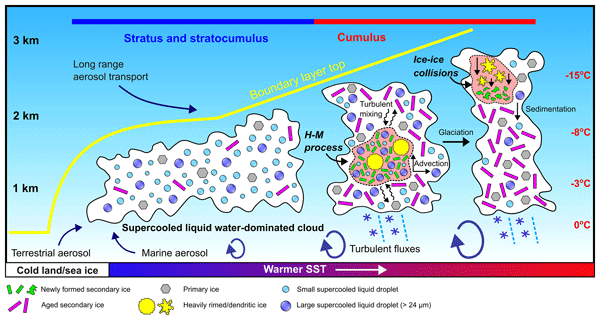
This study examines secondary ice production (SIP) events during the M-Phase field campaign, which took place during Oct-Nov 2022. Peak concentrations in ice number concentrations were observed in the Hallett-Mossop temperature range (-3 to -8 degrees C), which seemed to be predominately in convective CAO regimes. The collocation of INP measurements with in-situ aircraft cloud probes during M-Phase observed CAO events nicely extends previous airborne analysis performed for both the Arctic and Southern Oceans. I think this manuscript does a very good job of examining a complicated cloud microphysics process in dynamical “grey area” clouds generated by CAOs that are notoriously difficult to assess in models. Evaluations of SIP are limited in general, and especially in CAO clouds. The topic, therefore, is a very important one and results of this study will represent valuable contributions to the scientific community and will be of high interest to the EGUsphere readership. The figures and tables are highly detailed, and I especially like Figure 18 as a nice summary figure. With this said, I think the authors need to address a few critical caveats before this manuscript is ready for publication. Namely, I believe the manual inspection components need to be replaced with something automated (i.e., implementing a habit classification scheme) so these results can be reproduced independently. The authors also need to include analysis and further discussion of the implications of cutting off 2D-S data at 100 µm as many cloud particle-sized ice particles are going to form in the < 100 µm range. Finally, I also think there’s some coincidence here that peak ice concentrations in relatively warm regions (-3C to -8C) were in convective clouds, which is where H-M was understandably dominant. I think the authors also need to expand their analysis to more directly compare stratiform and convective clouds in an “apples to apples” comparison to further support their conclusion about H-M being the dominant process. I have a few main comments to address, as well as several technical comments.
Main Comments
- The Clarke et al. (2025) is mentioned repeatedly as the main overview paper, but it appears to not (yet) be published either. I would expect this work will be published before this present manuscript is ready, however, in the event it’s not – it will be critical that the reader can independently review the most essential details from the Clarke et al. study in the event publication of that manuscript is delayed. For this reason, I think the “complete list and full description” of instruments mentioned in L180-182 should be adapted and reproduced as appendix material in this manuscript.
- Given the focus on secondary ice production, ice particles < 100 µm would be logical to examine during periods of known SIP. The 100 µm cutoff for 2D-S ice particles is understandable instrumentally (as this is well known in 2D-S studies), however, this cutoff reduces the size range that SIP studies use as a key tracer of generated secondary ice. In my view, given this understandable-but-critical limitation, this limits the authors’ ability to diagnose the onset of SIP and to reconcile inferred splinter rates against observed small-ice populations. Furthermore, the paper’s SIP/non-SIP period classification seems to rely heavily on manual image inspection (habit classification is explicitly acknowledged as an avenue for future work in the conclusions). The authors, therefore, need to address this caveat. I believe this can be accomplished by adding a sensitivity test for the lower-size cutoff (i.e., provide some estimate for how many ice particles are likely excluded or describe how excluding this size range might affect conclusions drawn across both convective/stratiform regimes), or by implementing a habit classification scheme that can clearly classify primary vs. secondary ice. I think the authors need to replace the manual inspection components as doing so is very hard to reproduce, and implementing a habit classification will allow for clear reproducibility in identifying SIP-generated (and non-SIP generated periods). This manuscript needs to implement something automated here so the relative frequency histograms can be independently computed and verified.
- I like the idea of separating convective and stratiform regimes, however, it seems only flight C324 is the only unambiguous stratiform CAO regime < -10C according to Table 1 though there were twice as many overall stratiform cloud segments. The central claim that the H-M process was the most likely explanation should be softened unless the authors can provide stronger quantitative evidence between the convective events and the stratiform CAO events – Table 3 strongly suggested (based on mean and 95th percentile Nice) that the H-M process is confined mainly to convective clouds (this is concluded as well in the manuscript. I think the manuscript needs at least one matched or “apples to apples” comparison where representative stratiform and convective subsets are restricted to common temperature bins, common cloud-relative heights. This could also be done by sub-setting flights that sampled both regimes within the same CAO event. I think this is necessary to assure the readers that the conclusions drawn are for a real regime effect rather than a temperature-sampling effect.
Specific Comments:
L43: “McCoy et al.; 2017” should be “McCoy et al., 2017.” Check elsewhere in the text for consistency.
L53-L57: This sentence beginning with “The composition of these mixed-phase clouds…” could be broken into two sentences
L78: “Hallet and Mossop, 1974” should be “Hallett and Mossop, 1974” (Hallet has a missing t).
L111: Consider “breakup” or “break-up” instead of “break up”
L144: “Korolev et al, 2020” should be “Korolev et al., 2020” (missing period after al)
L247-248: Do you mean to say “sample volume is airspeed dependent”?
L280: “Constant-altitude filter legs lasted for typically 20-30 minutes” would read better as “Constant-altitude filter legs typically lasted 20-30 minutes”
L312: Consider rewriting it as “Cloud regions with µ3 < 0.1, 0.1 < µ3 < 0.9, and µ3 > 0.9 were classified as liquid, mixed phase, and glaciated (ice), respectively.”
L440: Should be a semicolon after Takahashi et al., 1995;
L443: “1 to 0.1 Hz resolution” should be “1 Hz to 0.1 Hz resolution”
L513: Do you mean to reference Fig. 4e (not 4d) since you’re referring to fully glaciated cloud regimes (hence making 4e more appropriate as it’s the ice mass fraction panel)?
L518: I think you meant “specific temperatures zones” and not “specific temperatures zones”
L543: I think you mean “innovative” and not “innovate”
L601: Please check the “154.3.1” value.
L715: Should Production be capitalized here?
L726: “an Nice increase” should be “an increase in Nice.”
L784: I’d say either 45 min or 45 minutes.
L809: “1-2 two orders of magnitude”… I think the two is put in here by accident.
Figure 13: Is this a single-flight figure (i.e., just 28th Oct 2022)? Please clarify your caption.
L951: “high resolution” should be “high-resolution”
L924-925: “weak-to-moderate updraft regions (0 to +2 ms-1) were particularly suitable…”
Citation: https://doi.org/10.5194/egusphere-2026-1272-RC2 -
AC1: 'Comment on egusphere-2026-1272', Michael Biggart, 26 Jul 2026
The comment was uploaded in the form of a supplement: https://egusphere.copernicus.org/preprints/2026/egusphere-2026-1272/egusphere-2026-1272-AC1-supplement.pdf
Peer review completion


Interactive discussion
Status: closed
- RC1: 'Comment on egusphere-2026-1272', Anonymous Referee #1, 18 May 2026
-
RC2: 'Comment on egusphere-2026-1272', Anonymous Referee #2, 20 May 2026
Review of “Secondary ice production within shallow, mixed-phase clouds in cold air outbreaks over the Labrador Sea” by Biggart et al., for publication in EGUSphere
Summary
This study examines secondary ice production (SIP) events during the M-Phase field campaign, which took place during Oct-Nov 2022. Peak concentrations in ice number concentrations were observed in the Hallett-Mossop temperature range (-3 to -8 degrees C), which seemed to be predominately in convective CAO regimes. The collocation of INP measurements with in-situ aircraft cloud probes during M-Phase observed CAO events nicely extends previous airborne analysis performed for both the Arctic and Southern Oceans. I think this manuscript does a very good job of examining a complicated cloud microphysics process in dynamical “grey area” clouds generated by CAOs that are notoriously difficult to assess in models. Evaluations of SIP are limited in general, and especially in CAO clouds. The topic, therefore, is a very important one and results of this study will represent valuable contributions to the scientific community and will be of high interest to the EGUsphere readership. The figures and tables are highly detailed, and I especially like Figure 18 as a nice summary figure. With this said, I think the authors need to address a few critical caveats before this manuscript is ready for publication. Namely, I believe the manual inspection components need to be replaced with something automated (i.e., implementing a habit classification scheme) so these results can be reproduced independently. The authors also need to include analysis and further discussion of the implications of cutting off 2D-S data at 100 µm as many cloud particle-sized ice particles are going to form in the < 100 µm range. Finally, I also think there’s some coincidence here that peak ice concentrations in relatively warm regions (-3C to -8C) were in convective clouds, which is where H-M was understandably dominant. I think the authors also need to expand their analysis to more directly compare stratiform and convective clouds in an “apples to apples” comparison to further support their conclusion about H-M being the dominant process. I have a few main comments to address, as well as several technical comments.
Main Comments
- The Clarke et al. (2025) is mentioned repeatedly as the main overview paper, but it appears to not (yet) be published either. I would expect this work will be published before this present manuscript is ready, however, in the event it’s not – it will be critical that the reader can independently review the most essential details from the Clarke et al. study in the event publication of that manuscript is delayed. For this reason, I think the “complete list and full description” of instruments mentioned in L180-182 should be adapted and reproduced as appendix material in this manuscript.
- Given the focus on secondary ice production, ice particles < 100 µm would be logical to examine during periods of known SIP. The 100 µm cutoff for 2D-S ice particles is understandable instrumentally (as this is well known in 2D-S studies), however, this cutoff reduces the size range that SIP studies use as a key tracer of generated secondary ice. In my view, given this understandable-but-critical limitation, this limits the authors’ ability to diagnose the onset of SIP and to reconcile inferred splinter rates against observed small-ice populations. Furthermore, the paper’s SIP/non-SIP period classification seems to rely heavily on manual image inspection (habit classification is explicitly acknowledged as an avenue for future work in the conclusions). The authors, therefore, need to address this caveat. I believe this can be accomplished by adding a sensitivity test for the lower-size cutoff (i.e., provide some estimate for how many ice particles are likely excluded or describe how excluding this size range might affect conclusions drawn across both convective/stratiform regimes), or by implementing a habit classification scheme that can clearly classify primary vs. secondary ice. I think the authors need to replace the manual inspection components as doing so is very hard to reproduce, and implementing a habit classification will allow for clear reproducibility in identifying SIP-generated (and non-SIP generated periods). This manuscript needs to implement something automated here so the relative frequency histograms can be independently computed and verified.
- I like the idea of separating convective and stratiform regimes, however, it seems only flight C324 is the only unambiguous stratiform CAO regime < -10C according to Table 1 though there were twice as many overall stratiform cloud segments. The central claim that the H-M process was the most likely explanation should be softened unless the authors can provide stronger quantitative evidence between the convective events and the stratiform CAO events – Table 3 strongly suggested (based on mean and 95th percentile Nice) that the H-M process is confined mainly to convective clouds (this is concluded as well in the manuscript. I think the manuscript needs at least one matched or “apples to apples” comparison where representative stratiform and convective subsets are restricted to common temperature bins, common cloud-relative heights. This could also be done by sub-setting flights that sampled both regimes within the same CAO event. I think this is necessary to assure the readers that the conclusions drawn are for a real regime effect rather than a temperature-sampling effect.
Specific Comments:
L43: “McCoy et al.; 2017” should be “McCoy et al., 2017.” Check elsewhere in the text for consistency.
L53-L57: This sentence beginning with “The composition of these mixed-phase clouds…” could be broken into two sentences
L78: “Hallet and Mossop, 1974” should be “Hallett and Mossop, 1974” (Hallet has a missing t).
L111: Consider “breakup” or “break-up” instead of “break up”
L144: “Korolev et al, 2020” should be “Korolev et al., 2020” (missing period after al)
L247-248: Do you mean to say “sample volume is airspeed dependent”?
L280: “Constant-altitude filter legs lasted for typically 20-30 minutes” would read better as “Constant-altitude filter legs typically lasted 20-30 minutes”
L312: Consider rewriting it as “Cloud regions with µ3 < 0.1, 0.1 < µ3 < 0.9, and µ3 > 0.9 were classified as liquid, mixed phase, and glaciated (ice), respectively.”
L440: Should be a semicolon after Takahashi et al., 1995;
L443: “1 to 0.1 Hz resolution” should be “1 Hz to 0.1 Hz resolution”
L513: Do you mean to reference Fig. 4e (not 4d) since you’re referring to fully glaciated cloud regimes (hence making 4e more appropriate as it’s the ice mass fraction panel)?
L518: I think you meant “specific temperatures zones” and not “specific temperatures zones”
L543: I think you mean “innovative” and not “innovate”
L601: Please check the “154.3.1” value.
L715: Should Production be capitalized here?
L726: “an Nice increase” should be “an increase in Nice.”
L784: I’d say either 45 min or 45 minutes.
L809: “1-2 two orders of magnitude”… I think the two is put in here by accident.
Figure 13: Is this a single-flight figure (i.e., just 28th Oct 2022)? Please clarify your caption.
L951: “high resolution” should be “high-resolution”
L924-925: “weak-to-moderate updraft regions (0 to +2 ms-1) were particularly suitable…”
Citation: https://doi.org/10.5194/egusphere-2026-1272-RC2 -
AC1: 'Comment on egusphere-2026-1272', Michael Biggart, 26 Jul 2026
The comment was uploaded in the form of a supplement: https://egusphere.copernicus.org/preprints/2026/egusphere-2026-1272/egusphere-2026-1272-AC1-supplement.pdf
Peer review completion
Journal article(s) based on this preprint
Viewed
| HTML | XML | Total | BibTeX | EndNote | |
|---|---|---|---|---|---|
| 1,096 | 632 | 114 | 1,842 | 121 | 146 |
- HTML: 1,096
- PDF: 632
- XML: 114
- Total: 1,842
- BibTeX: 121
- EndNote: 146
Viewed (geographical distribution)
| Country | # | Views | % |
|---|
| Total: | 0 |
| HTML: | 0 |
| PDF: | 0 |
| XML: | 0 |
- 1
Michael Biggart

Thomas W. Choularton
Martin W. Gallagher
Keith N. Bower
Gary Lloyd
Paul J. Connolly
Benjamin J. Murray
Mark D. Tarn
Erin N. Raif
Steven J. Abel
The requested preprint has a corresponding peer-reviewed final revised paper. You are encouraged to refer to the final revised version.
- Preprint
(4669 KB) - Metadata XML
My comments are uploaded as a PDF file