
the Creative Commons Attribution 4.0 License.
the Creative Commons Attribution 4.0 License.
 | 10 Jun 2026
Configuration of climatological limits for surface radiation measurement quality control: A global assessment using a novel radiation climate classification
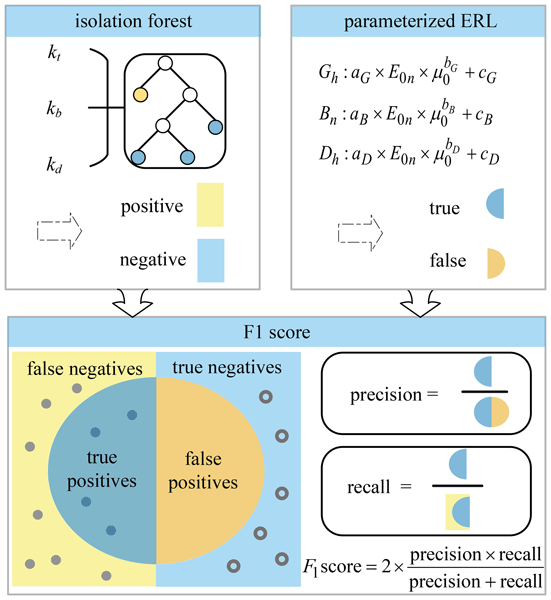
Abstract. Quality control (QC) of ground-based solar radiation measurements is fundamental to ensuring the integrity of surface energy balance and climatological studies. The extremely rare limit (ERL) test, a widely implemented QC standard, is frequently noted for being overly conservative, often failing to isolate subtle instrumental or environmental anomalies. To improve QC tightness and sensitivity, this study presents a data-driven framework for configuring regime-specific climatological limits. Diverging from traditional climate classifications that do not directly account for radiative variability, we define seven distinct radiation regimes through unsupervised learning, utilizing principal component analysis and hierarchical clustering. For each identified regime, optimal test coefficients are established via a machine-learning-based optimization strategy. Specifically, we maximize the F1 score by benchmarking the climatological limit test against an isolation forest outlier detection model. Validation using global measurements from the Baseline Surface Radiation Network demonstrates that the proposed regional limits provide a significantly tighter fit to observed data distributions compared to the original global ERL thresholds. This methodology offers a scalable and automated approach to regionalizing QC procedures, substantially enhancing the precision of global radiation monitoring networks.
-
Notice on discussion status
The requested preprint has a corresponding peer-reviewed final revised paper. You are encouraged to refer to the final revised version.
-
Preprint
(3112 KB)
-
The requested preprint has a corresponding peer-reviewed final revised paper. You are encouraged to refer to the final revised version.
- Preprint
(3112 KB) - Metadata XML
- BibTeX
- EndNote
- Final revised paper


Journal article(s) based on this preprint
Interactive discussion
Status: closed
-
RC1: 'Comment on egusphere-2026-1256', Anonymous Referee #1, 24 Jun 2026
The comment was uploaded in the form of a supplement: https://egusphere.copernicus.org/preprints/2026/egusphere-2026-1256/egusphere-2026-1256-RC1-supplement.pdfCitation: https://doi.org/
10.5194/egusphere-2026-1256-RC1 - AC1: 'Reply on RC1', Dazhi Yang, 27 Jun 2026
-
RC2: 'Comment on egusphere-2026-1256', Anonymous Referee #2, 03 Jul 2026
This manuscript addresses a well-recognized issue in ground-based solar radiation QC: The globally uniform thresholds of traditional ERL tests are overly conservative and frequently insensitive to localized environmental variations. Through a newly proposed method, this work effectively tightens conservative limits. This paper is well-written, logically sound, and worthy of publication in AMT after minor revisions. Below are my detailed comments.
- Eqs (1)-(3) and Eqs. (5)-(7) both contain the cosine of zenith angle. Would it be clearer if the notations are standardized? The same applies to the notation in Line 352.
- In Section 2.2.1 and Fig. 2 of the manuscript, there is an inconsistency regarding the feature variable abbreviations. While the figure caption denotes the feature variable as Bn, the corresponding label inside the actual illustration of Fig. 2 is marked as Bh.
- It is unclear to me why the number of harmonics is set to 25. If it is simply the yearly cycles that need to be identified, a few harmonics should work, given the regularity of the seasonal component.
- In Section 3.2, the authors utilize the L-BFGS-B algorithm to optimize the coefficients of the structural limit curves. However, the choice of the initial guess for this iterative solver is not specified.
- The objective function for parameter optimization is designed to maximize the F1-score. While this is mathematically reasonable, the manuscript would benefit from a brief discussion on its meteorological and practical implications. Specifically, the authors should explicitly justify why a balanced F1-score is preferred in this radiation QC framework.
- From Table 3, it shows that the values of parameter cG are often very small, i.e., near zero. This is inconsistent with the original test, where the parameter c should reflect the measurement uncertainty, as also mentioned by the authors in the introduction. At the same time, the values of cBare capped at 10. This suggests an issue with the optimization setup.
- The authors should explain how the proposed radiation classification can be applied to other locations.
- The authors are expected to append some qualitative scientific remarks in the discussion or future outlook section to enhance the comprehensiveness of this methodological framework. For instance, can this approach be used to handle other QC tests, such as the closure test?
- Comparing Fig. 7 (Class 6, Bn) with Fig. A6 (top two panels), the scatter plots look different. Why? It seems to me that the latter contain more points.
Citation: https://doi.org/10.5194/egusphere-2026-1256-RC2 - AC2: 'Reply on RC2', Dazhi Yang, 04 Jul 2026
Peer review completion


Interactive discussion
Status: closed
-
RC1: 'Comment on egusphere-2026-1256', Anonymous Referee #1, 24 Jun 2026
The comment was uploaded in the form of a supplement: https://egusphere.copernicus.org/preprints/2026/egusphere-2026-1256/egusphere-2026-1256-RC1-supplement.pdf
- AC1: 'Reply on RC1', Dazhi Yang, 27 Jun 2026
-
RC2: 'Comment on egusphere-2026-1256', Anonymous Referee #2, 03 Jul 2026
This manuscript addresses a well-recognized issue in ground-based solar radiation QC: The globally uniform thresholds of traditional ERL tests are overly conservative and frequently insensitive to localized environmental variations. Through a newly proposed method, this work effectively tightens conservative limits. This paper is well-written, logically sound, and worthy of publication in AMT after minor revisions. Below are my detailed comments.
- Eqs (1)-(3) and Eqs. (5)-(7) both contain the cosine of zenith angle. Would it be clearer if the notations are standardized? The same applies to the notation in Line 352.
- In Section 2.2.1 and Fig. 2 of the manuscript, there is an inconsistency regarding the feature variable abbreviations. While the figure caption denotes the feature variable as Bn, the corresponding label inside the actual illustration of Fig. 2 is marked as Bh.
- It is unclear to me why the number of harmonics is set to 25. If it is simply the yearly cycles that need to be identified, a few harmonics should work, given the regularity of the seasonal component.
- In Section 3.2, the authors utilize the L-BFGS-B algorithm to optimize the coefficients of the structural limit curves. However, the choice of the initial guess for this iterative solver is not specified.
- The objective function for parameter optimization is designed to maximize the F1-score. While this is mathematically reasonable, the manuscript would benefit from a brief discussion on its meteorological and practical implications. Specifically, the authors should explicitly justify why a balanced F1-score is preferred in this radiation QC framework.
- From Table 3, it shows that the values of parameter cG are often very small, i.e., near zero. This is inconsistent with the original test, where the parameter c should reflect the measurement uncertainty, as also mentioned by the authors in the introduction. At the same time, the values of cBare capped at 10. This suggests an issue with the optimization setup.
- The authors should explain how the proposed radiation classification can be applied to other locations.
- The authors are expected to append some qualitative scientific remarks in the discussion or future outlook section to enhance the comprehensiveness of this methodological framework. For instance, can this approach be used to handle other QC tests, such as the closure test?
- Comparing Fig. 7 (Class 6, Bn) with Fig. A6 (top two panels), the scatter plots look different. Why? It seems to me that the latter contain more points.
Citation: https://doi.org/10.5194/egusphere-2026-1256-RC2 - AC2: 'Reply on RC2', Dazhi Yang, 04 Jul 2026
Peer review completion
Journal article(s) based on this preprint
Data sets
Supplementary data BSRN https://gitee.com/dazhiyang/rad-clim-class-qc
Model code and software
Supplementary code Zhiwen Wang and Dazhi Yang https://gitee.com/dazhiyang/rad-clim-class-qc
Viewed
| HTML | XML | Total | BibTeX | EndNote | |
|---|---|---|---|---|---|
| 193 | 89 | 31 | 313 | 21 | 20 |
- HTML: 193
- PDF: 89
- XML: 31
- Total: 313
- BibTeX: 21
- EndNote: 20
Viewed (geographical distribution)
| Country | # | Views | % |
|---|
| Total: | 0 |
| HTML: | 0 |
| PDF: | 0 |
| XML: | 0 |
- 1
Zhiwen Wang
Yun Chen

Yanbo Shen
Xiang'ao Xia
The requested preprint has a corresponding peer-reviewed final revised paper. You are encouraged to refer to the final revised version.
- Preprint
(3112 KB) - Metadata XML